Creatine and Lactic Acid: Does It Buffer the Burn or Is That a Myth?
By The Creatine Canada Research Team — Evidence-based supplement analysts
Creatine does not directly “neutralize” lactic acid, but it can reduce how quickly hard efforts feel fatiguing by helping your muscles regenerate ATP faster and rely slightly less on rapid glycolysis early in intense work. In plain English: creatine may lessen the burn indirectly for repeated high-intensity efforts, but it is not a true lactic acid buffer in the way many gym myths claim.
Evidence-based · Cites 4 sources · Editorial standards
Key Takeaways
- Creatine does not chemically buffer lactic acid in your muscles.
- Creatine helps most with short, repeated, high-intensity efforts by improving phosphocreatine availability.
- The burning sensation during exercise is not simply “lactic acid build-up”; hydrogen ions and overall metabolic stress matter more.
- A standard evidence-based dose is 3-5 g of creatine monohydrate daily, with optional loading at about 20 g/day split into 4 doses for 5-7 days.
- If you want less performance drop-off across sprints, intervals, or sets, creatine is more useful than if your only goal is reducing burn during steady cardio.
- Monohydrate is still the best-studied, most cost-effective form; “buffered” creatines have not consistently outperformed it.
- If creatine upsets your stomach, reduce the dose per serving, take it with food, and use plain monohydrate from a reputable Canadian seller.
Does creatine reduce lactic acid? The direct answer most people actually need
No, creatine does not directly reduce or buffer lactic acid in the way supplement marketing and locker-room talk often suggest. What creatine does is increase your muscle phosphocreatine stores, which helps you remake ATP, your cells’ immediate energy currency, faster during short, intense efforts. That matters because when ATP demand spikes, your body leans harder on anaerobic glycolysis, the pathway that produces lactate alongside hydrogen ions. By supporting the phosphocreatine system, creatine can sometimes reduce how fast you reach that highly fatiguing state during repeated hard work.
The key distinction is that creatine changes energy supply more than it changes acid chemistry. It is not a classic buffer like sodium bicarbonate, which directly increases extracellular buffering capacity. Creatine’s main job is intracellular energy support: it donates phosphate through phosphocreatine to help regenerate ATP rapidly. That can improve sprint ability, repeated-effort output, and training volume, which is why the 2017 ISSN position stand concluded creatine monohydrate is one of the most effective ergogenic aids for high-intensity exercise performance and lean mass support.
Also important: “lactic acid” is usually the wrong villain. In exercise physiology, lactate itself is not simply a waste product causing pain. At physiological pH, most so-called lactic acid exists as lactate plus hydrogen ions. The familiar muscle burn during hard intervals or long high-rep sets is more closely tied to the accumulation of hydrogen ions, inorganic phosphate, metabolite build-up, and the overall stress of working at a very high intensity. Lactate can even serve as a useful fuel and shuttle between tissues.
So if your question is, does creatine reduce lactic acid?, the best accurate answer is this: not directly, and not reliably as a “buffer”, but it may help you perform more work before fatigue ramps up by improving rapid ATP resynthesis. That is why people often feel like it helps the burn, especially in repeated sprints, HIIT, and hard resistance training.
If you are new to supplementation, start with our creatine dosage calculator and then read the practical protocols in how to take creatine and how much creatine per day.
What causes the burn during exercise if it is not just lactic acid?
The burn during exercise is not caused by lactic acid alone; it is mainly the result of intense metabolic stress, especially hydrogen ion accumulation when energy demand exceeds what slower systems can supply. This is the part most articles oversimplify. When you do a brutal 400-metre repeat, a 30-second bike sprint, or a set of 20 squats, your muscles need ATP immediately. Aerobic metabolism cannot ramp up fast enough, so glycolysis accelerates.
As glycolysis speeds up, your muscle environment becomes more fatiguing. The old story was that “lactic acid” was the direct cause of the burning feeling and fatigue. Modern physiology is more nuanced. Lactate is produced during fast glycolysis, but it is not the sole bad actor. The decrease in pH and the rise in hydrogen ions are more relevant to the burning sensation and impaired force production than lactate alone. In practical terms, that means two things can both be true: lactate levels go up during hard work, and creatine may help performance, but creatine is not literally soaking up lactic acid like a sponge.
Lactate is also useful, not just harmful. Lactate can be transported to other muscle fibres, the heart, and other tissues to be used as fuel. That is why many physiologists now talk more about “lactate metabolism” than “lactic acid poisoning”. If you have ever recovered between intervals and felt ready to go again, part of that recovery involves clearing and reusing those metabolites, not merely surviving them.
Here is the simplest way to think about the burn:
- Short explosive work: relies heavily on ATP and phosphocreatine.
- Sustained hard work: increasingly relies on glycolysis.
- As intensity stays high: metabolite accumulation rises and the burn increases.
- As fatigue rises: force output and speed drop.
This matters because creatine helps most before and during the transition into severe fatigue, not after you are already deep in it. With fuller phosphocreatine stores, you may hold power a little better in the first seconds of each effort and recover somewhat better between efforts. That is different from directly changing the chemistry of acidosis.
If you want the more complete energy-systems background, see what is creatine and our companion guides on creatine and ATP and the creatine phosphate system.
How creatine affects lactate and fatigue: the real mechanism, step by step
Creatine may influence lactate production and the feeling of fatigue indirectly by increasing phosphocreatine availability, speeding ATP resynthesis, and slightly reducing early dependence on anaerobic glycolysis during repeated maximal efforts. That is the scientifically defensible version of the “creatine lactic acid buffer” idea.
Here is the mechanism in plain English:
- You supplement creatine monohydrate. Over days to weeks, muscle creatine stores rise toward saturation.
- More creatine in muscle means more phosphocreatine. Phosphocreatine is stored high-energy phosphate that helps rapidly regenerate ATP from ADP.
- During a sprint, set, or explosive movement, ATP demand surges. The phosphocreatine system responds first because it is fast.
- If phosphocreatine availability is better, you can maintain high power output a little longer. This can delay the point where glycolysis has to carry quite so much of the burden.
- With repeated efforts, better phosphocreatine recovery between bouts can help preserve performance. That is where many users notice less drop-off from sprint 1 to sprint 6, or set 1 to set 4.
What this means for lactate is subtle, not magical. Some studies report altered lactate responses with creatine under certain exercise conditions, while others do not show a large or consistent change. Differences in training status, exercise protocol, dose, duration, and measurement timing matter. The evidence is stronger for creatine improving repeated high-intensity performance than for creatine directly lowering lactate concentrations in a predictable way across all contexts.
So when people ask about creatine and lactate, the best answer is: creatine can change the conditions under which lactate accumulates, but it is not a dedicated lactate-buffering supplement. If your only target is buffering exercise acidosis, sodium bicarbonate and beta-alanine are discussed more often for that purpose, though each has its own limitations. Creatine has a different primary role.
The broader evidence base remains clear. According to the 2021 JISSN review on common questions and misconceptions about creatine, creatine monohydrate is the reference form because it is the most extensively studied for efficacy and safety. Examine’s evidence summary reaches the same practical conclusion: creatine is most reliable for strength, power, and high-intensity exercise capacity, not as a magic fix for the burn itself.
For most lifters and field-sport athletes, that is enough reason to use it. The right expectation is better repeated performance and training quality, not the complete disappearance of muscular burn.
Who will actually notice a difference in the burn, and who probably will not
People doing repeated high-intensity work are the most likely to notice that creatine helps with the burn indirectly, while people doing long, steady endurance work often notice much less. That is because creatine’s strongest effects show up where the phosphocreatine system matters most.
The best fits include:
- Strength trainees: hard sets of compound lifts, especially when training volume is high.
- HIIT athletes: repeated intervals on the bike, rower, track, or assault bike.
- Team-sport athletes: hockey, soccer, basketball, football, lacrosse and similar stop-start sports.
- Sprinters and jumpers: events dominated by explosive output.
- CrossFit-style training: repeated bursts, short recoveries, high power demands.
Beginners can benefit just as much, and often more, than experienced gym-goers. If you are new to lifting, creatine can support higher-quality sessions and faster progress in strength and work capacity. It does not replace good programming, but it can make it easier to complete planned reps before fatigue crushes output.
Women also benefit from creatine, and there is no evidence-based reason women should avoid it because of “bulking” myths. Women often use lower absolute doses simply because their body size may be smaller, but the standard 3-5 g/day maintenance range still works well for most. If this is your use case, our guide to creatine for women goes deeper.
Older adults can benefit too, especially if the goal is preserving muscle function and training capacity. They may not describe the effect as “less lactic acid”, but better strength training output and recovery between efforts can still be meaningful.
People who may notice less:
- Steady-state endurance athletes doing mostly easy-to-moderate long sessions.
- Very short-term users who stop before saturation is reached.
- People expecting an immediate pre-workout sensation from a single scoop.
Vegetarians and vegans may respond particularly well because baseline muscle creatine stores can be lower. More room to increase stores can mean a more noticeable performance effect once saturation improves.
If your sport includes repeated surges rather than one continuous easy effort, creatine is far more likely to help. If your entire question is really about one long burny spin class or a 10 km tempo run, manage expectations: creatine may still support training, but not because it is directly buffering lactic acid.
How to take creatine if your goal is less fatigue in hard sets, sprints, or intervals
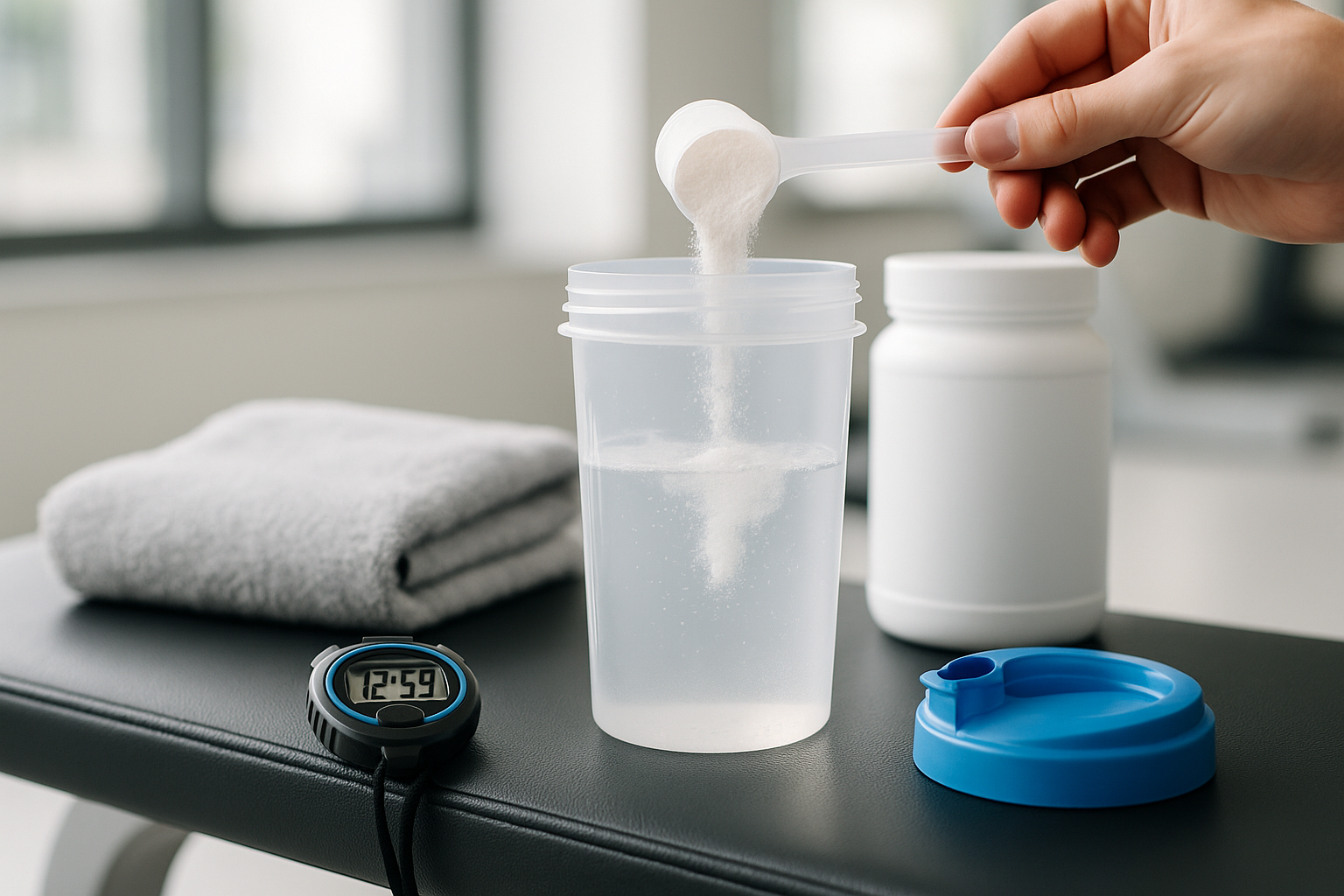
If your goal is better tolerance of repeated hard efforts, the most effective approach is simple: take creatine monohydrate every day until muscle stores are saturated, then keep them there. Timing matters far less than consistency.
- Choose creatine monohydrate. It is the most studied, most reliable, and usually the best value. Start with plain powder unless you have a strong reason to prefer capsules.
- Pick your dosing strategy. Use either a loading phase of about 20 g/day split into 4 doses for 5-7 days, or skip loading and take 3-5 g/day. Loading works faster; daily dosing without loading works too but takes longer.
- Take it with water or a meal. Food can help if you get stomach upset. You do not need a fancy transporter or sugar-heavy drink.
- Keep taking it on rest days. Creatine works by saturating muscle, not by creating an acute stimulant effect.
- Train hard enough to notice the difference. Creatine shines when sessions include repeated high-output work.
What to expect week by week:
- Days 1-7 with loading: some people notice fuller muscles, slight scale increase from intracellular water, and better repeat effort capacity by the end of the week.
- Weeks 2-4 without loading, or after loading: more people notice improved training quality, one or two extra reps on tough sets, or less performance drop-off across intervals.
- Weeks 4-12: the real payoff is often cumulative because better training output can lead to more strength and lean mass over time.
How to tell it is working:
- You recover a bit better between sprints or sets.
- Your power drops less across repeated efforts.
- You can maintain target pace or load deeper into the session.
- You gradually progress more easily in training logs.
What not to expect: a sudden tingling sensation, instant endurance transformation, or the total removal of muscular burn.
For a practical setup, use our creatine dosage calculator, then cross-check with creatine loading phase and how long creatine takes to work. If mixing is your issue, how to mix creatine covers liquids, clumping, and grit.
Exact dosing for creatine and lactate-related performance goals
The evidence-based creatine dose for most adults is 3-5 g/day of creatine monohydrate, while a faster saturation protocol is about 20 g/day split into 4 doses for 5-7 days. That guidance aligns with mainstream sports-nutrition practice and the ISSN position stand.
If your specific goal is better repeated high-intensity performance, the choice is not a special “lactic acid” dose; it is simply whether you want to saturate fast or slow. The dose that helps with sprint repeatability, set quality, and resistance training output is the same standard dose used for general creatine benefits.
| Goal | Best protocol | What to expect | Best for |
|---|---|---|---|
| Fast saturation | ~20 g/day for 5-7 days, split into 4 x 5 g doses; then 3-5 g/day | Quicker rise in muscle creatine stores | Athletes wanting faster results |
| Simple daily use | 3-5 g/day every day | Similar endpoint, slower timeline | Beginners and anyone wanting easy adherence |
| Smaller stomach-friendly approach | 3 g/day or split 5 g into 2 smaller servings | May reduce GI discomfort | People sensitive to larger doses |
Body weight can guide dose selection at the practical level, even though most people still fit within 3-5 g/day maintenance. Examples:
- Under 60 kg: 3 g/day is usually reasonable.
- 60-90 kg: 3-5 g/day fits most people well.
- Over 90 kg or very muscular: 5 g/day is commonly used.
Do not chase bigger doses thinking they will buffer more lactate. More is not better once muscle stores are adequately saturated, and higher intakes are more likely to cause digestive issues. Creatine is a saturation supplement, not a “megadose for more burn relief” supplement.
If you train multiple times per day, daily consistency still matters more than the exact minute you take it. If you miss a day, do not double up aggressively the next day; just resume your normal schedule.
Need a personalised starting point? Check the creatine dosage calculator or read creatine maintenance dose and how to measure creatine for scoop-to-grams accuracy.
Best timing, food, and stacks if the burn is your concern
Creatine timing is a minor detail compared with daily consistency, but taking it at a time you never miss is the best strategy for improving repeated high-intensity performance. There is no compelling evidence that creatine taken immediately before a workout acts like an acute anti-burn supplement.
The simplest rule is this: take 3-5 g daily, whenever adherence is easiest. Post-workout with a shake, with breakfast, or with dinner can all work. Some people prefer taking it with food because it reduces the chance of stomach upset.
Should you take creatine before intervals or hard lifting if the goal is less burn? You can, but mainly for convenience. The benefit comes from saturation over time, not from the exact moment it hits your stomach. Our guide on when to take creatine goes deeper, but the short version is that timing is secondary.
Can you stack creatine with other supplements that target fatigue or acidosis more directly? Yes, but each one does a different job:
- Creatine: supports rapid ATP regeneration and repeated power output.
- Beta-alanine: may support intramuscular buffering over time by increasing carnosine.
- Sodium bicarbonate: can act as a true extracellular buffer, though GI tolerance is a common issue.
- Caffeine: may improve performance through alertness and effort tolerance, but it is not a creatine substitute.
If your concern is the burn during HIIT or repeated sprints, creatine plus solid programming often matters more than a complicated stack. Better pacing, longer rest intervals when appropriate, and progressive conditioning can reduce the burn far more than exotic supplement combinations.
Mixing tips:
- Use water, juice, or a protein shake.
- Warm liquid may help it dissolve more completely, though it is not required.
- Avoid dry scooping; it adds risk and no benefit.
Hydration matters, but not because creatine dehydrates you. Maintain normal fluid intake and drink more when training hard, sweating heavily, or training in the heat. You do not need to force absurd amounts of water. For more, see how much water should you drink with creatine and creatine and caffeine.
Safety, side effects, and the ‘creatine acidosis’ myth
Creatine does not cause exercise acidosis, and standard doses of creatine monohydrate are considered safe for healthy people when used as directed. The confusion usually comes from mixing up creatine with creatinine, or assuming anything involved in intense exercise must worsen acidity.
Creatine acidosis is not a standard evidence-based concern in healthy users taking normal doses. Creatine supports the phosphocreatine energy system; it does not make your muscles “more acidic” in a meaningful supplementation-specific way. During hard exercise, acidosis relates to the metabolic demands of the work itself, not because the supplement is acidifying you.
The best-supported side effects are relatively mild and manageable. According to the ISSN position stand and the Mayo Clinic overview, creatine is generally safe when taken appropriately, with the most common issues being water retention, temporary scale weight increase, or digestive discomfort in some people.
Common side effects and fixes:
- Stomach upset or loose stool: split the dose, reduce per-serving size, take with food.
- Water-weight increase: usually reflects intracellular water in muscle, not fat gain.
- Grittiness or poor mixing: stir longer or use micronized powder.
Kidney concerns are often misunderstood. Creatine can raise creatinine, a breakdown product measured on blood tests, without meaning creatine has harmed healthy kidneys. That is why context matters when interpreting labs. Still, anyone with known kidney disease, a history of relevant medical issues, or medication concerns should speak with a qualified clinician first.
Use extra caution or medical guidance if you:
- Have diagnosed kidney disease.
- Are pregnant or breastfeeding.
- Take medications with potential renal relevance.
- Have a complex medical condition that changes fluid or electrolyte handling.
For a fuller breakdown, see is creatine safe, creatine and kidneys, and creatine digestive side effects. For healthy gym-goers, though, the big picture is straightforward: standard-dose monohydrate is well studied and “creatine acidosis” is mostly a terminology myth, not a real-world reason to avoid it.
Common mistakes and myths: ‘buffered creatine’, lactate confusion, and other bad advice
The biggest mistake people make with creatine and lactic acid is expecting creatine to act like a direct chemical buffer, then deciding it ‘doesn’t work’ when the burn still shows up. The burn still shows up because hard exercise is supposed to be metabolically demanding.
Myth 1: Creatine removes lactic acid from your muscles.
False. Creatine does not function as a direct lactate-clearing agent. It may improve performance conditions in ways that alter fatigue and metabolite accumulation, but that is not the same thing.
Myth 2: If you still feel the burn, creatine is not working.
False. Creatine often works by reducing performance drop-off, improving rep quality, or letting you sustain power better across efforts. You can still feel a hard set and still benefit.
Myth 3: Buffered creatine is necessary if you care about acidity.
Usually false. “Buffered” creatine products are marketed around pH and acid stability, but they have not consistently outperformed standard monohydrate in meaningful real-world outcomes. Monohydrate remains the reference form because it works, is affordable, and has the deepest evidence base.
Myth 4: You need sugar to absorb creatine.
Overstated. Creatine can be taken with many liquids or foods. Insulin can influence uptake, but massive sugar doses are not required for creatine to work in normal practice.
Myth 5: Creatine works like a pre-workout stimulant.
False. It is not caffeine. You will not necessarily feel it the same day.
Other common mistakes:
- Skipping rest-day doses and never reaching stable saturation.
- Using too much at once and blaming creatine for avoidable GI upset.
- Buying trendy forms before trying plain monohydrate.
- Judging results by scale weight alone instead of training output.
If your real goal is less suffering during intervals, look at the whole picture. Warm-up quality, interval structure, pacing, carbohydrate availability for hard sessions, fitness level, and recovery all matter. Creatine is useful, but it is one piece of the system.
For more myth-busting, visit creatine myths debunked, creatine myths vs. facts, and creatine not working?
What to buy in Canada: the best form, labels to check, and what actually matters
If you are buying creatine in Canada for performance and fatigue support, choose plain creatine monohydrate from a reputable brand and prioritise dose accuracy, ingredient simplicity, and quality controls over fancy acid-related claims. This is one of the rare supplement categories where the boring choice is usually the best choice.
The best form for most people is creatine monohydrate. It is the most studied, most cost-effective, and still the benchmark against which other forms are judged. Micronized monohydrate can be a nice convenience upgrade if you want better mixability, but it is not a different active ingredient.
When shopping in Canada, check for:
- Creatine monohydrate as the only medicinal ingredient if you want pure creatine.
- An NPN, meaning a Natural Product Number, which indicates the product is licensed for sale as a natural health product in Canada.
- Third-party testing or sport certification if you are drug-tested or especially quality-conscious.
- No unnecessary proprietary blends if your goal is simple dosing.
| Option | Pros | Cons | Best use case |
|---|---|---|---|
| Plain monohydrate powder | Best evidence, low cost, flexible dosing | Can be slightly gritty | Most people |
| Micronized monohydrate | Mixes more easily, same evidence base | Sometimes costs more | People who dislike grit |
| Capsules | Convenient, portable | Usually more expensive per gram | Travel or no-mix preference |
| Buffered or specialty forms | Marketing appeal | Higher price, no consistent performance advantage | Rarely necessary |
Avoid overpaying for “lactic acid defence” branding. If the label leans heavily on buffering language but provides no meaningful advantage over monohydrate, you are likely paying for positioning, not performance.
To compare products, start with our best creatine rankings, browse creatine brand reviews, or search the creatine product catalog. If you want a deeper buyer’s framework, see best type of creatine and how to choose creatine.
Bottom line: does creatine buffer the burn or is that a myth?
Creatine buffering the burn is partly myth and partly misunderstood physiology. The myth is that creatine directly neutralizes lactic acid. The truth is that creatine can make repeated high-intensity exercise feel more manageable indirectly by improving rapid ATP regeneration, supporting phosphocreatine availability, and helping you maintain output across hard efforts.
If you want the shortest accurate answer, use this one: creatine does not directly buffer lactic acid, but it may reduce fatigue and performance drop-off during repeated intense exercise, which can make the burn seem less limiting.
That means creatine is worth considering if you:
- Lift weights hard and want more quality reps.
- Do sprint intervals or stop-start sports.
- Notice you fade badly from one effort to the next.
- Want one of the best-supported sports supplements available.
It matters less if your only question is whether one scoop will stop your legs from burning during a single hard cardio session. It will not. Creatine is a long-game supplement for muscle energy, not an instant anti-burn hack.
The practical playbook is simple:
- Buy plain creatine monohydrate.
- Take 3-5 g daily, or load at about 20 g/day split into 4 doses for 5-7 days if you want faster saturation.
- Keep taking it on rest days.
- Judge it by training performance over weeks, not by one workout’s sensation.
For most healthy adults, that is the evidence-based way to use creatine for better high-intensity performance, whether your concern is lactate, fatigue, or the burn during exercise. If you want a broader beginner roadmap, continue with creatine for beginners, how to take creatine, and the complete creatine guide.
Creatine and Lactic Acid: The numbers that actually matter
- 3-5 g/day Standard maintenance dose — The evidence-based daily creatine monohydrate range for most adults.
- ~20 g/day Typical loading dose — Usually split into 4 doses for 5-7 days to reach saturation faster.
- 5-7 days Fast-loading timeline — Common timeframe for raising muscle creatine stores more quickly.
- 4 doses/day How loading is commonly split — Smaller servings often improve GI tolerance versus taking it all at once.
Frequently Asked Questions
Does creatine reduce lactic acid during exercise?
No, creatine does not directly reduce lactic acid during exercise. It helps your muscles regenerate ATP faster through the phosphocreatine system, which can reduce fatigue and make repeated hard efforts feel more manageable, but that is different from directly buffering or removing lactate.
Is creatine a lactic acid buffer?
No, creatine is not a true lactic acid buffer in the classic sports-nutrition sense. Its main role is supporting rapid energy production in muscle, whereas true buffering supplements are discussed in relation to acid-base balance more directly.
Why do people say creatine helps with the burn?
People say creatine helps with the burn because it often improves repeated sprint performance, set quality, and short-rest recovery. When you can hold output better and fatigue ramps up more slowly, the burn may feel less limiting even though creatine is not directly neutralizing lactic acid.
Does creatine lower lactate levels?
Sometimes creatine changes lactate responses in specific exercise protocols, but it does not reliably lower lactate in every situation. The stronger and more consistent evidence is for better high-intensity performance, not for a universal lactate-lowering effect.
Can creatine help with muscle burn during HIIT?
Yes, creatine can help indirectly with muscle burn during HIIT by improving repeated high-intensity effort capacity. It is most useful when the workout includes short bursts with incomplete recovery, where the phosphocreatine system plays a large role.
Does creatine cause acidosis?
No, creatine does not cause exercise acidosis in healthy people using normal doses. The acidosis associated with hard exercise comes from the metabolic demands of intense work, not because creatine supplementation makes your muscles abnormally acidic.
What is the best creatine dose if I want less fatigue in hard workouts?
The best creatine dose for most people is still the standard evidence-based dose: 3-5 g of creatine monohydrate daily. If you want faster saturation, use about 20 g/day split into 4 doses for 5-7 days, then continue with 3-5 g/day.
Will creatine stop my legs from burning during cardio?
No, creatine will not stop your legs from burning during cardio. It may help if your cardio involves repeated surges or intervals, but during continuous hard endurance work the burn is still driven by the intensity and metabolic stress of the session.
Is buffered creatine better for lactic acid than monohydrate?
No, buffered creatine has not consistently been shown to outperform creatine monohydrate for performance or fatigue-related outcomes. Monohydrate remains the best-studied and most cost-effective form for most users.
How long does creatine take to help with repeated-effort fatigue?
Creatine can start helping within about 5-7 days if you use a standard loading phase, or within a few weeks if you take 3-5 g/day without loading. The most noticeable benefits often build over time as better training sessions accumulate.