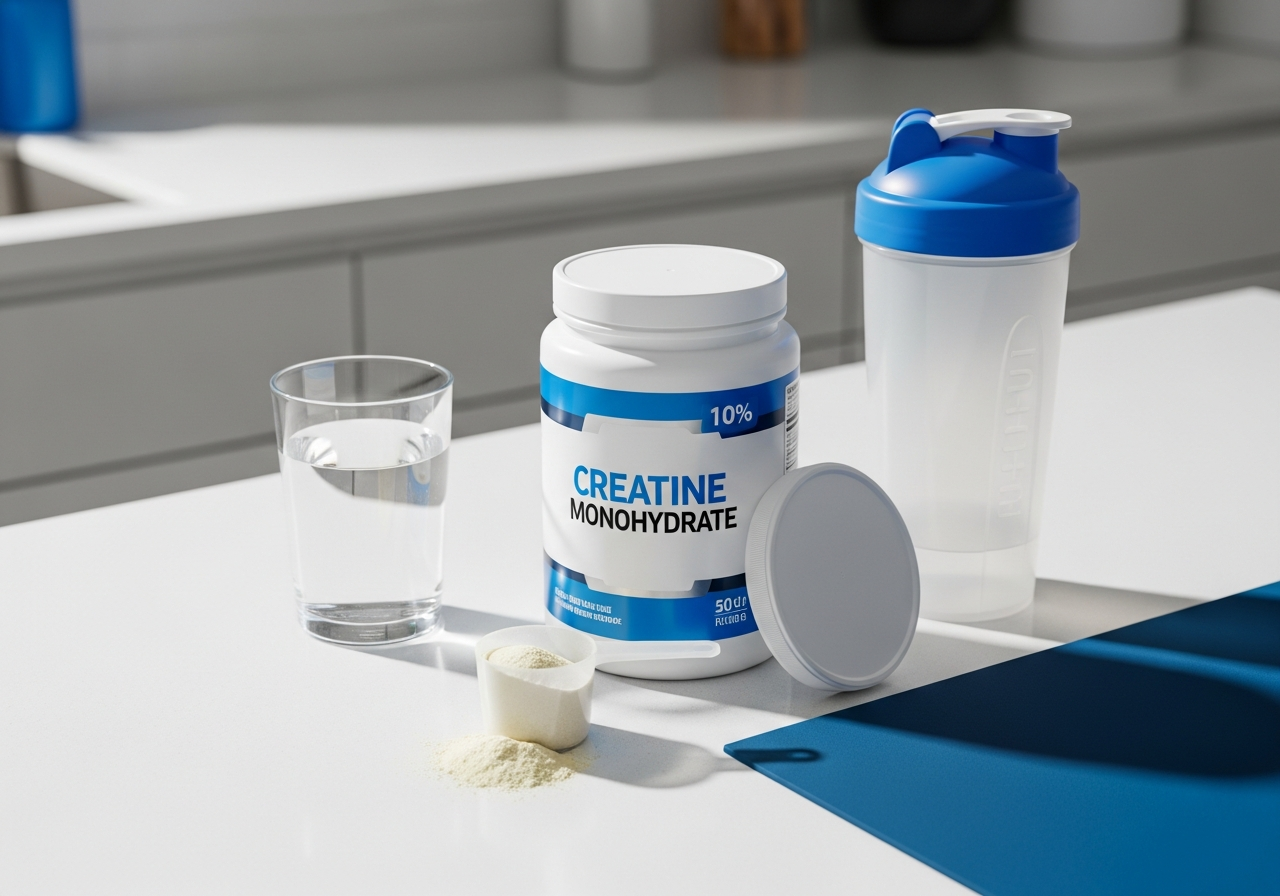
Missed a Day of Creatine? Here's What Actually Happens (Nothing Serious)
By The Creatine Canada Research Team — Evidence-based supplement analysts
Missing a day of creatine usually does not matter. If you forgot to take creatine once, your muscle creatine stores do not suddenly disappear, so you do not need to double your next dose; just take your normal daily amount and get back to your routine.
Evidence-based · Cites 4 sources · Editorial standards
Key Takeaways
- One missed day of creatine is rarely a problem because muscle creatine levels decline gradually, not overnight.
- If you forgot to take creatine, do not 'make up' for it with a double dose the next day.
- The usual maintenance dose is 3-5 g per day, and consistency over weeks matters more than exact timing.
- Missing a day matters more during a loading phase than during long-term maintenance, but even then it is not a disaster.
- If you miss several days, simply restart your normal daily intake; a new loading phase is optional, not required.
- Creatine monohydrate remains the best-studied, most cost-effective form for almost everyone.
- Set up a simple habit, such as taking creatine with breakfast or a post-workout shake, to prevent missed doses.
If you miss one day of creatine, almost nothing changes
If you are missing a day of creatine, the short answer is that almost nothing meaningful happens after a single missed dose. Creatine works by gradually increasing and maintaining the amount of creatine stored in your muscles, not by creating a one-day stimulant-like effect, so can you skip a day of creatine? In most cases, yes, without noticeable consequences.
The reason is simple: once your muscles are reasonably saturated, they do not empty out in 24 hours. Creatine is stored inside muscle partly as phosphocreatine, which is the rapidly available form used to regenerate ATP, the cell's immediate energy currency, during short, hard efforts like sprinting, jumping, or heavy lifting. Because these stores decline gradually, one missed scoop does not suddenly reduce your strength, size, or workout quality.
This is why the practical advice is straightforward: if you forgot to take creatine, take your normal dose the next day and carry on. Do not double up unless a clinician has instructed you otherwise, because larger catch-up doses are more likely to cause stomach upset than to provide extra benefit. The 2017 ISSN position stand concluded that creatine monohydrate is effective and well supported for increasing high-intensity exercise capacity and lean mass when used consistently over time, not because every single daily serving is magically critical on its own. See Kreider et al. (2017), ISSN Position Stand.
For most people, the bigger issue is not one missed day but repeated inconsistency over weeks. If your intake swings between daily use and long gaps, your muscle stores can drift downward enough to blunt the performance and training benefits you are trying to build. That is why habit matters more than clock timing. If you want help setting the right routine, our guides on how to take creatine and when to take creatine will make the process easier.
The bottom line for featured-snippet purposes is this: does missing creatine matter? Usually not if it is one day; yes, more if it becomes a pattern.
Why missing creatine does not matter much: saturation is the real goal
Missing one day of creatine usually does not matter because creatine supplementation is about saturation, which means filling muscle stores over time and then keeping them topped up. Once those stores are elevated, a single skipped day causes only a very small drop, if any, in the total amount available to your muscles.
Here is the mechanism in plain English. Your body makes some creatine naturally from amino acids, and you also get some from foods like meat and fish. Supplementing with creatine monohydrate increases the pool available in muscle. There, part of it becomes phosphocreatine, which helps recycle ATP during repeated bursts of high-intensity work. That is why creatine is most useful for lifting, sprinting, repeated intervals, team sports, and any training that depends on short recovery between hard efforts.
The key point is that this is a storage system, not an instant-on system. Creatine behaves more like topping up a battery than like taking a pre-workout. If the battery is mostly full, skipping one top-up does not suddenly drain it. According to Antonio et al. (2021) in JISSN, many common creatine questions come down to understanding that its benefits depend on regular intake over time rather than precise acute timing.
That is also why timing is a secondary issue for most users. Morning, post-workout, lunch, or evening can all work if you reliably hit your total daily dose. If you are still learning the basics, start with 3-5 g daily and pair it with something you already do every day, such as breakfast, brushing your teeth, or a protein shake. If you want a deeper primer on how creatine works, read what creatine is and what it does.
There is one nuance: people early in a loading phase may notice that missing doses slows how quickly they reach full saturation. That is a speed issue, not a failure issue. You are not resetting your progress with one skipped day; you are just slightly slowing the climb.
Forgot to take creatine? Do this instead of doubling up
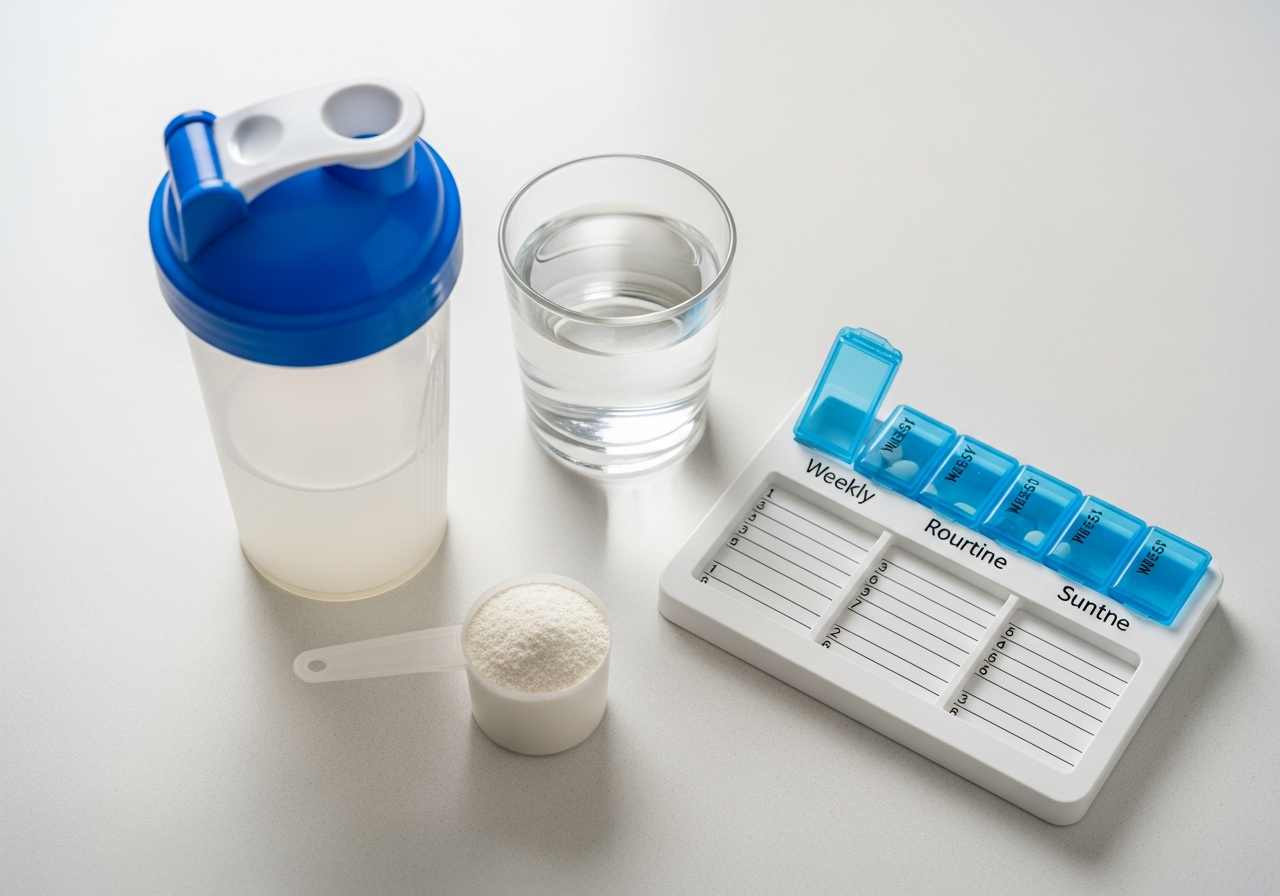
If you forgot to take creatine, the best move is to resume your normal dose as soon as you remember that day, or simply take your usual dose the next day if the day is basically over. In most cases, there is no advantage to doubling your next serving.
- If you remember later the same day, take your usual amount, such as 3-5 g, with water or a meal.
- If you do not remember until the next day, just take your usual daily dose once.
- Do not take two full maintenance doses together as a catch-up strategy unless you already tolerate that amount well and have a specific reason.
- Return to your routine immediately rather than overthinking one missed scoop.
This advice works because the creatine you missed was part of a long-term maintenance pattern, not a one-time ergogenic hit. Catch-up megadoses do not create extra saturation once your tissues are already near their storage ceiling, but they can increase the chance of bloating or digestive discomfort. If stomach issues are a recurring problem, our guide on creatine digestive side effects covers practical fixes.
Here are simple examples:
- You usually take 5 g at breakfast and forgot: take 5 g with lunch or dinner.
- You remember at bedtime and creatine sometimes upsets your stomach: skip it and take 5 g the next morning.
- You missed a rest day: take your normal dose the following day; no special action is needed.
If missed doses happen often, the problem is usually habit friction, not physiology. Keep your tub beside your coffee maker, pack single servings in a small container for work, or add it to a daily shake. If you need help measuring accurately, use our creatine dosage calculator and our guide on how to measure creatine once that page is in your reading queue.
For most users, the ideal mental model is this: one miss is noise, repeated misses are the signal. Focus on adherence, not perfection.
Missing a day during loading vs. maintenance: the impact is different
Missing a day of creatine matters more during a loading phase than during maintenance, but even during loading it is usually just a small delay, not a major setback. The practical difference is that loading is designed to raise muscle creatine quickly, while maintenance is designed to keep already elevated stores from drifting down.
A standard loading protocol is about 20 g per day for 5-7 days, usually split into four 5 g servings. A standard maintenance phase is 3-5 g per day thereafter. The ISSN position stand notes that both strategies work: loading gets you there faster, while taking 3 g daily without loading also increases stores, just more gradually over several weeks.
If you miss a day during loading, you do not need to panic. In most cases, you can either continue your original schedule and accept that full saturation may take a bit longer, or add one extra loading day at the end. What you should not do is take an aggressive catch-up amount far beyond what you tolerate well, because gastrointestinal side effects are more likely when large amounts are swallowed at once.
If you miss a day during maintenance, the impact is usually trivial. Your muscles do not suddenly become unsaturated overnight. That is why long-term users often notice no difference at all in workout performance after one skipped rest-day dose.
| Situation | Typical dose | What happens if you miss one day? | Best next step |
|---|---|---|---|
| Loading phase | 20 g/day split into 4 doses for 5-7 days | You may reach full saturation a bit more slowly | Resume loading or add 1 extra day if desired |
| Maintenance phase | 3-5 g/day | Usually little to no noticeable effect | Take your normal next dose |
| No loading, daily build-up | 3-5 g/day from the start | Progress slows slightly if misses become frequent | Return to daily intake consistently |
If you are debating whether to load at all, our guide on the creatine loading phase explains the trade-offs in detail. For many beginners, skipping loading entirely and simply taking a daily maintenance dose is the easiest way to stay consistent.
How many days can you miss before it actually affects results?
You can usually miss one day of creatine without consequence, and even a few missed days are unlikely to erase your progress, but longer gaps can gradually reduce the stored creatine that helps performance. The exact timeline varies by muscle mass, diet, baseline creatine levels, and whether you loaded, but the principle is consistent: stores fall over time, not all at once.
Think of this in tiers:
- 1 day missed: usually negligible.
- 2-3 days missed: still usually minor, especially if you were already taking creatine regularly.
- About a week missed: likely still not catastrophic, but your stores may begin trending downward enough that very sensitive athletes could notice less "fullness" or slightly less repeat-power output.
- Multiple weeks missed: now you are closer to losing the elevated storage state that made creatine useful in the first place.
This helps answer a common search query: what happens if you miss creatine for a few days? Usually, nothing dramatic happens immediately. You do not lose muscle overnight, and your body does not crash. But the longer the gap, the more likely your muscle creatine concentration moves back toward baseline.
Signs you may be drifting away from a fully saturated state can include slightly fewer reps on repeated hard sets, reduced sprint repeatability, or a less noticeable "full" look from intramuscular water retention. Those changes are subtle and often masked by sleep, food intake, hydration, and training stress, which is why many people cannot feel the difference from a short break.
If you missed a week or two, the easiest fix is to restart with 3-5 g daily. If you want faster re-saturation, you can use a loading phase again, but it is optional. For a realistic timeline of effects, read how long creatine takes to work and how long creatine stays in your system.
The practical rule: if the gap was short, resume. If the gap was long and you care about getting the effect back quickly, consider loading.
The right dose after a missed day, by body weight and training goal
After missing a day of creatine, the right dose is usually the same dose you should have been taking all along: 3-5 g per day for maintenance, with loading optional if you want faster saturation. Body weight can help fine-tune the decision, but most general fitness users do well within that standard range.
A practical evidence-based framework is:
- Smaller adults under about 60 kg: 3 g daily is often enough for maintenance.
- Most adults around 60-90 kg: 3-5 g daily is the standard sweet spot.
- Larger athletes over about 90 kg or those with high lean mass: 5 g daily is a common practical choice.
- Loading option: roughly 20 g daily split into 4 doses for 5-7 days, then 3-5 g daily.
Another commonly cited loading method is 0.3 g/kg/day for 5-7 days, followed by maintenance around 0.03 g/kg/day. That weight-based approach is useful for larger athletes and coaches who want a more tailored plan, but it is not necessary for the average gym-goer.
By goal, here is how to think about it:
- Strength and muscle gain: 3-5 g daily, prioritizing consistency.
- Power and sprint sports: loading can make sense if you want quicker benefits before a training block.
- General fitness beginners: skip the complexity and take 3-5 g daily.
- Vegetarians or vegans: regular intake may be especially helpful because dietary creatine intake is lower on average.
If you are unsure which dose suits you, use our creatine dosage calculator and compare options in our creatine product catalog. If you are choosing your first product, our best creatine rankings and creatine brand reviews can help you avoid underdosed blends and overpriced marketing.
The key point for this article is simple: missing a day does not change your fundamental dosing plan. It just means you continue with the correct plan tomorrow.
Timing matters less than routine, especially on rest days
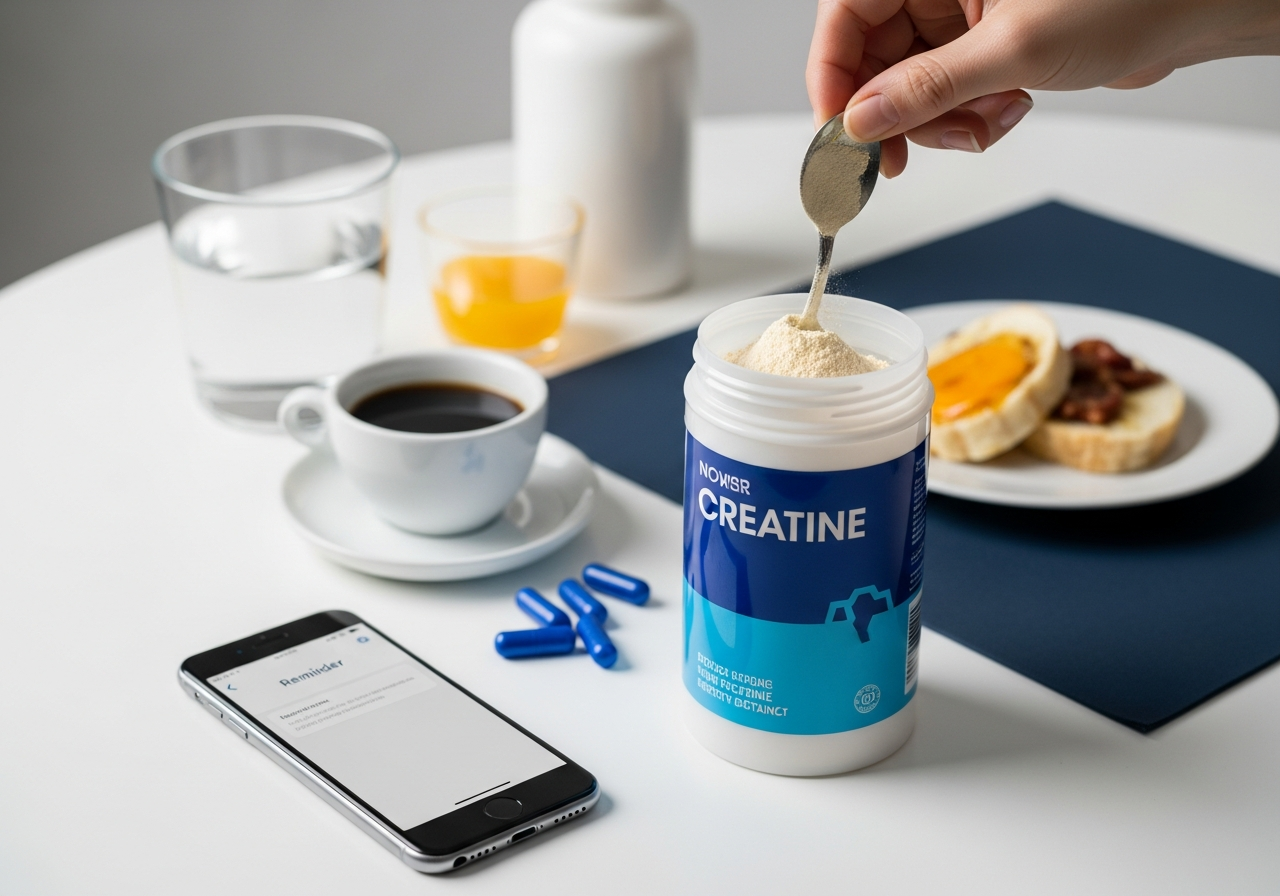
If you are worried about missing a day of creatine, the best prevention is a boring, repeatable routine, because timing matters far less than daily adherence. Creatine does not need to be taken at a precise minute before or after training to work well for most people.
This directly answers another common variation: does missing creatine matter on rest days? Usually no, not if it happens once, but taking creatine on rest days is still recommended because daily intake helps maintain saturation. Rest days are where many people accidentally become inconsistent, simply because their workout habit is not there to trigger the dose.
Here are the easiest routines that work in real life:
- Breakfast anchor: keep creatine beside your coffee or cereal and take it with your first meal.
- Post-workout anchor: add it to your shake on training days, and take it with lunch on rest days.
- Toothbrush anchor: keep a pre-portioned container near a habit you never skip.
- Travel anchor: pack small servings in advance so weekends away do not turn into missed weeks.
You can mix creatine with water, juice, or protein powder; it does not need a special transport system to work. It is also fine with or without food for most people, though some find taking it with a meal is gentler on the stomach. Our guides on taking creatine with or without food, how to mix creatine, and creatine on rest days go deeper on the logistics.
If you keep forgetting, do not solve it with willpower alone. Solve it with environment. Put the tub in sight, use a recurring phone reminder, and buy a format you will actually use consistently. For some people that is powder; for others it may be capsules, though powder is usually more cost-effective.
The best timing strategy is the one you can repeat every day for months.
Beginners, women, older adults, and athletes: does a missed day change anything?
The advice on missing a day of creatine is broadly the same for beginners, women, older adults, and athletes: one missed day is usually insignificant, and the correct response is to resume your normal dose. The main differences between groups are in goals, expected benefits, and how tightly they may care about consistency.
Beginners often overestimate the importance of a single dose because creatine is new to them. In reality, beginners should focus on establishing a simple 3-5 g daily habit and letting the compound work over time. If that is you, our creatine for beginners guide is the best next read.
Women do not need a different missed-dose rule. Creatine works through the same saturation mechanism regardless of sex, and one forgotten serving does not undo anything. Women often benefit from clear reassurance that creatine is not a steroid and that normal use does not automatically mean unwanted bulk. For more, see creatine for women.
Older adults may use creatine to support resistance training, functional strength, and lean mass. For this group, consistency still matters, but one missed day is not dangerous or uniquely harmful. Because older adults may take other medications or have more medical conditions, it is especially sensible to discuss supplementation with a healthcare professional if kidney disease or other contraindications are present.
Competitive athletes may care most about precision during key training blocks because they are chasing small edges in repeated sprint ability, strength, or recovery between hard efforts. Even here, however, one missed day rarely changes outcomes in a measurable way. The International Olympic Committee consensus on supplements includes creatine among supplements with good evidence for specific performance uses when applied appropriately. See the IOC consensus on dietary supplements.
Vegetarians and vegans may respond especially well because baseline muscle creatine can be lower when dietary intake is low. But the missed-day rule is still the same: resume and continue.
The universal principle is not perfection. It is consistency over months.
Safety, side effects, and what to buy in Canada if you want fewer problems
If you miss a day of creatine, the main safety rule is simple: do not compensate with a reckless double dose if large servings usually upset your stomach. Creatine monohydrate is generally well studied and considered safe for healthy individuals when used at standard doses, but side effects such as bloating or gastrointestinal discomfort are more likely when people take too much at once.
The 2017 ISSN position stand and the 2021 JISSN misconceptions review both support creatine's strong safety profile in healthy people when used appropriately. The Mayo Clinic also notes that creatine appears to be safe for many people when taken within recommended amounts. See Mayo Clinic's creatine overview.
Common practical side effects and fixes:
- Stomach upset: split the dose, take it with food, or choose a micronized monohydrate powder.
- Water weight increase: this is typically intramuscular water, not fat gain.
- Clumping in the tub: usually a moisture issue, not necessarily spoilage.
- Confusion about kidneys: creatine can raise creatinine on a blood test without meaning kidney damage in a healthy person, though anyone with known kidney disease should speak to a clinician first.
In Canada, the smartest buying strategy is still boring: choose a straightforward creatine monohydrate from a reputable brand, preferably with transparent testing and a valid NPN, which is a Natural Product Number issued for licensed natural health products. An NPN is not a guarantee of perfection, but it is a useful sign that the product is being sold within Canada's regulatory framework. Third-party testing and brand reputation matter too, especially if you buy online.
| What to look for in Canada | Why it matters |
|---|---|
| Creatine monohydrate | Most studied, most cost-effective, strongest evidence base |
| NPN on label when applicable | Signals Health Canada natural health product licensing framework |
| Third-party testing | Helps verify purity and label accuracy |
| Simple ingredient list | Reduces filler-heavy or underdosed formulas |
If you are shopping now, compare options in our best creatine rankings, creatine brand reviews, and product catalog.
Common mistakes and myths about missing creatine, debunked
The biggest myth about missing a day of creatine is that one skipped dose erases all your progress. It does not. Creatine is not a fragile daily trigger that only works if taken perfectly; it is a storage-based supplement whose effects depend on average consistency over time.
Here are the most common mistakes people make:
- Myth: 'I missed today, so my workout tomorrow is ruined.'
Reality: if your stores were already elevated, one missed day is unlikely to have any noticeable effect. - Myth: 'I should double my dose tomorrow.'
Reality: doubling up is usually unnecessary and may only increase digestive side effects. - Myth: 'Creatine only works if taken right before training.'
Reality: daily intake matters more than exact timing for most users. - Myth: 'Rest days do not count.'
Reality: rest days still matter because maintenance is about keeping muscle stores topped up. - Myth: 'If I stop for a few days, I need to start from zero.'
Reality: short gaps do not instantly return you to baseline; simply resuming daily use is often enough. - Myth: 'Newer forms prevent all missed-dose issues.'
Reality: no fancy form changes the basic physiology of saturation better than monohydrate has already proven.
Another mistake is confusing creatine with stimulant products. If you miss caffeine, you often feel it that day. If you miss creatine, you usually do not, because the benefits come from a gradually maintained reserve in muscle. That difference explains why people who ask can you skip a day of creatine are often relieved by the answer.
Marketing can worsen the confusion by implying that every scoop must be timed perfectly or that advanced forms are needed for effectiveness. The research does not support that for most people. If you want a broader evidence-based reality check, visit our creatine myths debunked hub and our related guide on whether you need to cycle creatine.
The most productive mindset is this: aim for consistency, forgive one-off misses, and do not let supplement perfectionism become the reason you quit a useful habit.
Bottom line: if you miss creatine, just resume your normal daily dose
If you are missing a day of creatine, the bottom line is simple: one missed day usually does not matter, and the correct response is to resume your usual daily intake without doubling up. That direct answer covers the main search intents behind forgot to take creatine, what happens if you miss creatine, and does missing creatine matter.
Why this works is now clear: creatine builds and maintains muscle stores over time, and those stores do not vanish in a day. During maintenance, a skipped dose is usually trivial. During loading, a skipped dose may slow saturation slightly, but it does not ruin the process. If you miss several days, just restart your normal 3-5 g daily intake; loading again is optional if you want faster results.
For most people, the real success factors are not fancy timing hacks or catch-up strategies. They are:
- using plain creatine monohydrate,
- taking the right daily amount,
- buying from a reputable brand, and
- building a routine you can repeat automatically.
If you are still dialing in the fundamentals, these next guides will help: how much creatine per day, how to take creatine, is creatine safe, and the best type of creatine.
Concise final answer: If you miss one day of creatine, do not worry and do not double your next dose; simply take your normal amount and continue, because creatine's benefits come from maintained muscle saturation over weeks, not from a single daily serving.
That is the evidence-based, practical answer most people need.
Missing a Day of Creatine: The Numbers That Matter
- 1 day Usually negligible impact — A single missed dose rarely changes muscle creatine stores enough to affect performance.
- 3-5 g/day Standard maintenance dose — The mainstream evidence-based daily range for most adults once using creatine consistently.
- 20 g/day Typical loading amount — Usually split into 4 doses for 5-7 days to raise stores faster.
- 5-7 days Common loading timeline — After loading, most people shift to a 3-5 g daily maintenance dose.
Frequently Asked Questions
What happens if you miss a day of creatine?
If you miss a day of creatine, usually very little happens. Your muscle creatine stores decline gradually rather than disappearing overnight, so one missed dose rarely affects strength, muscle gain, or workout quality in any noticeable way. The best move is to take your normal dose the next day and keep going.
Can you skip a day of creatine?
Yes, you can skip a day of creatine without causing a major problem. Creatine works by maintaining elevated muscle stores over time, so one skipped day is usually insignificant if you have been taking it consistently. Skipping often is different, because repeated gaps can slowly reduce the saturation that supports performance benefits.
Forgot to take creatine today — should I take two scoops tomorrow?
No, you usually should not take two scoops tomorrow just because you forgot today. Doubling up rarely offers extra benefit and is more likely to cause stomach upset or bloating, especially if you do not tolerate large servings well. In most cases, simply resume your standard 3-5 g daily dose.
Does missing creatine matter during a loading phase?
Yes, missing creatine matters a bit more during a loading phase, but it still is not a disaster. The main effect is that you may reach full muscle saturation slightly more slowly than planned. You can usually continue the loading phase as normal or add an extra day at the end if you want.
If I miss creatine for a few days, do I lose all my progress?
No, missing creatine for a few days does not make you lose all your progress. Your body does not flush out all stored creatine immediately, so short gaps are usually minor. If the break becomes long enough, over many days or weeks, muscle stores can gradually return toward baseline and the supplement's benefits may fade.
Should you take creatine on rest days?
Yes, you should usually take creatine on rest days. Daily intake helps keep muscle stores topped up, and rest-day consistency is one of the easiest ways to avoid accidental gaps that turn into a less effective routine. The exact time of day matters less than simply taking it every day.
How long does it take for creatine levels to drop if you stop taking it?
Creatine levels drop gradually if you stop taking it, not overnight. The exact rate varies by the person, their muscle mass, and how saturated they were, but a single missed day is not enough to meaningfully reverse the storage effect. The bigger concern is a longer break that allows stores to trend back toward baseline.
Can missing creatine make you feel weaker right away?
No, missing creatine usually does not make you feel weaker right away. Because creatine works through stored muscle phosphocreatine rather than a same-day stimulant effect, one missed serving is unlikely to change how you feel in the gym. Day-to-day strength fluctuations are more often driven by sleep, food, stress, and training fatigue.
What should I do if I keep forgetting to take creatine?
If you keep forgetting to take creatine, build it into a habit you already do every day. Good options include taking it with breakfast, mixing it into a daily protein shake, or keeping it beside your coffee setup. The best system is the one that removes decision-making and makes consistency almost automatic.
Is missing a day of creatine worse for athletes than beginners?
Missing a day of creatine is not dramatically worse for athletes than beginners, but athletes may care more because they often chase smaller performance margins. Even so, one missed day rarely changes outcomes in a meaningful way. The difference is that high-level athletes usually benefit more from minimizing repeated inconsistency over a whole training block.