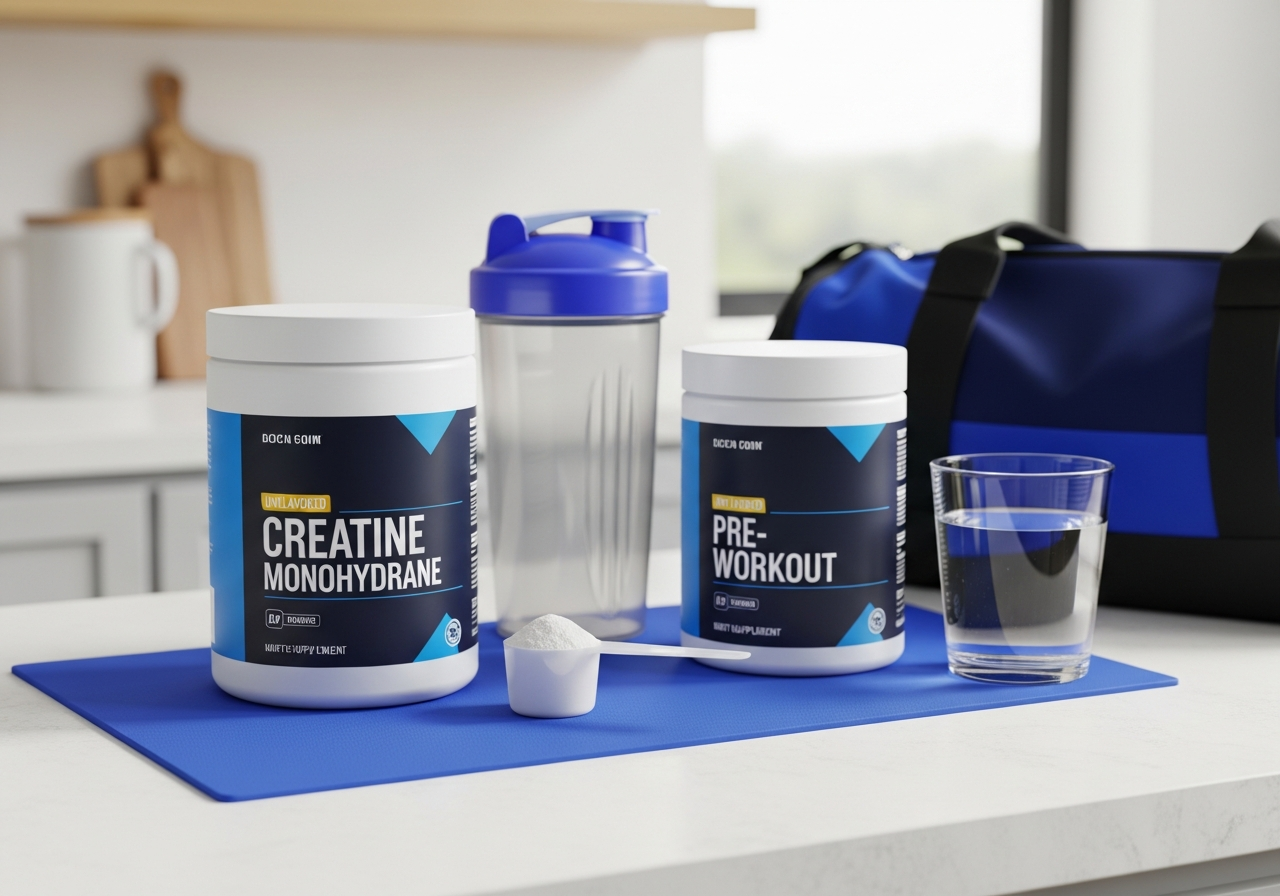
Creatine vs Pre-Workout: What's the Difference?
By The Creatine Canada Research Team — Evidence-based supplement analysts
Creatine and pre-workout are not the same thing: creatine is a daily performance supplement that works by saturating your muscles over time, while pre-workout is a category of products taken before training for an acute boost in energy, focus, pumps, or endurance. If you want the short answer, most lifters can use creatine every day and only use pre-workout when they actually want a noticeable pre-gym lift.
Evidence-based · Cites 4 sources · Editorial standards
Key Takeaways
- Creatine is not a pre-workout; it works through daily muscle saturation, not an immediate stimulant effect.
- Pre-workout is a blend, usually built around caffeine and other acute ingredients, and its effects are felt within about 30-60 minutes.
- You can take creatine and pre-workout together safely for most healthy adults because they do different jobs.
- Creatine monohydrate at 3-5 g/day is the evidence-based default for strength, power, and lean mass support.
- A loading phase of about 20 g/day split into 4 doses for 5-7 days speeds up creatine saturation but is optional.
- If you train late, stimulant pre-workouts can hurt sleep; creatine does not need to be taken pre-workout to work.
- For value and evidence, buy plain creatine monohydrate first, then decide whether you actually need a pre-workout formula.
Creatine vs pre-workout: the direct answer most people need first
Creatine vs pre-workout comes down to chronic effect versus acute effect: creatine helps your muscles perform better once stores are saturated, while pre-workout is taken before training to create a same-day feeling of more energy, alertness, endurance, or pump.
If you are asking is creatine a pre workout, the correct answer is no. Creatine is a single ingredient naturally found in the body and in foods like meat and fish, and supplementation raises muscle creatine and phosphocreatine stores over days to weeks. Pre-workout is not one ingredient at all; it is a product category that often combines caffeine, beta-alanine, citrulline, tyrosine, electrolytes, sweeteners, and sometimes creatine in one formula.
If you are deciding pre workout or creatine, choose based on your goal:
- Choose creatine first if you want the strongest evidence for strength, power, training volume, and lean-mass support.
- Choose pre-workout first if your main problem is feeling flat, sleepy, unfocused, or underpowered before a session.
- Use both if you want the long-term benefit of creatine plus the short-term kick of a pre-workout.
The 2017 ISSN position stand concluded that creatine monohydrate is the most effective nutritional supplement currently available for increasing high-intensity exercise capacity and lean body mass during training. That is why plain creatine monohydrate remains the default recommendation before more complicated stacks. For a full primer, see what creatine is and what it does.
One of the biggest points of confusion is creatine in pre workout. Some pre-workouts include creatine, but that does not make creatine a pre-workout ingredient in the same sense as caffeine. Creatine does not need to be felt in the moment to work. A pre-workout can be excellent without creatine, and a creatine product can be excellent without any stimulant ingredients.
The simplest rule is this: creatine is a daily baseline supplement, and pre-workout is an optional tool you take when you want a noticeable training boost that day. If your budget only allows one, creatine usually offers the better evidence-to-cost ratio for people who train consistently.
How creatine and pre-workout actually work in the body
Creatine works by increasing phosphocreatine in muscle, while pre-workout ingredients work through several separate pathways depending on the formula.
Creatine's main job is to help regenerate adenosine triphosphate, or ATP, the cell's immediate energy currency. During short, hard efforts like heavy sets, sprints, jumps, or repeated intervals, stored phosphocreatine donates a phosphate to help rebuild ATP quickly. More stored creatine generally means better support for repeated high-intensity efforts, slightly more training volume, and over time, better strength and muscle gains. This is why creatine is especially relevant for lifting, sprinting, team sports, and repeated-burst work. If you want the deeper physiology, our guide on how creatine gives you energy breaks this down further.
Pre-workout works differently because it is a formula, not a single mechanism. In many products:
- Caffeine reduces perceived effort and increases alertness by blocking adenosine receptors.
- Beta-alanine supports muscle carnosine over time, which can help buffer acidity during hard efforts, although it often causes tingling and is not an instant booster despite being common in pre-workout.
- Citrulline is used to increase nitric oxide production, which may support blood flow and the sensation of a pump.
- Tyrosine is included for focus or stress resilience, though evidence is less robust than for caffeine.
- Electrolytes can support hydration, especially in sweaty sessions or hot environments.
This distinction matters because many people expect creatine to feel like caffeine. It usually does not. Creatine is judged by training performance and body-composition outcomes over time, not by whether you feel wired after one scoop. By contrast, a stimulant pre-workout often produces an obvious subjective effect within the same session.
It also explains why creatine and pre workout together can make sense. The creatine portion supports the energy system you rely on for repeated high-output efforts once your muscles are saturated, while the pre-workout portion can make you more ready to attack the session right now.
According to Kreider et al. (2017), ISSN Position Stand, creatine monohydrate is the most studied form and the standard against which other forms are compared. In practice, that means plain monohydrate is still the smartest starting point unless you have a specific reason to choose a different delivery format.
What results to expect, and how fast each one works
Pre-workout usually works the same day, while creatine usually works after your muscle stores rise enough over several days or weeks.
If you take a caffeinated pre-workout, you will often notice the effect within about 30 to 60 minutes. That effect may include more alertness, better motivation to train, reduced perception of effort, and sometimes a stronger pump if the formula contains citrulline or similar ingredients. The flip side is that the effect is temporary and depends heavily on the formula, the caffeine dose, and your tolerance.
Creatine has a different timeline. With a loading phase of roughly 20 g/day split into 4 doses for 5 to 7 days, many people reach near-saturation quickly and may notice better gym performance within the first week or two. Without loading, a maintenance dose of 3 to 5 g/day generally gets you there more gradually, often over about 3 to 4 weeks. For a deeper timeline, see how long creatine takes to work.
What does “working” look like in real life?
- You get an extra rep on some working sets.
- Your sprint or repeated-effort quality holds up better later in the workout.
- Your body weight may increase modestly early on because creatine pulls more water into muscle cells, not because it adds fat.
- Over a training block, your strength and lean-mass progress may improve compared with not taking it.
The early weight change is one reason some people misjudge creatine. A small increase in scale weight during the first week or two is usually water stored inside muscle, not body-fat gain. If that topic worries you, read does creatine make you gain weight.
Pre-workout can also stop “working” subjectively if you rely on high caffeine every session and build tolerance. Creatine does not work that way. Once muscle stores are saturated, the goal is simply to maintain them through regular intake.
The practical takeaway is simple: use pre-workout if you want to feel something today, and use creatine if you want to perform better and potentially build more over time. They are not direct substitutes because they are judged on different timelines and different outcomes.
Can you take creatine and pre-workout together? Yes, and here is the smartest way
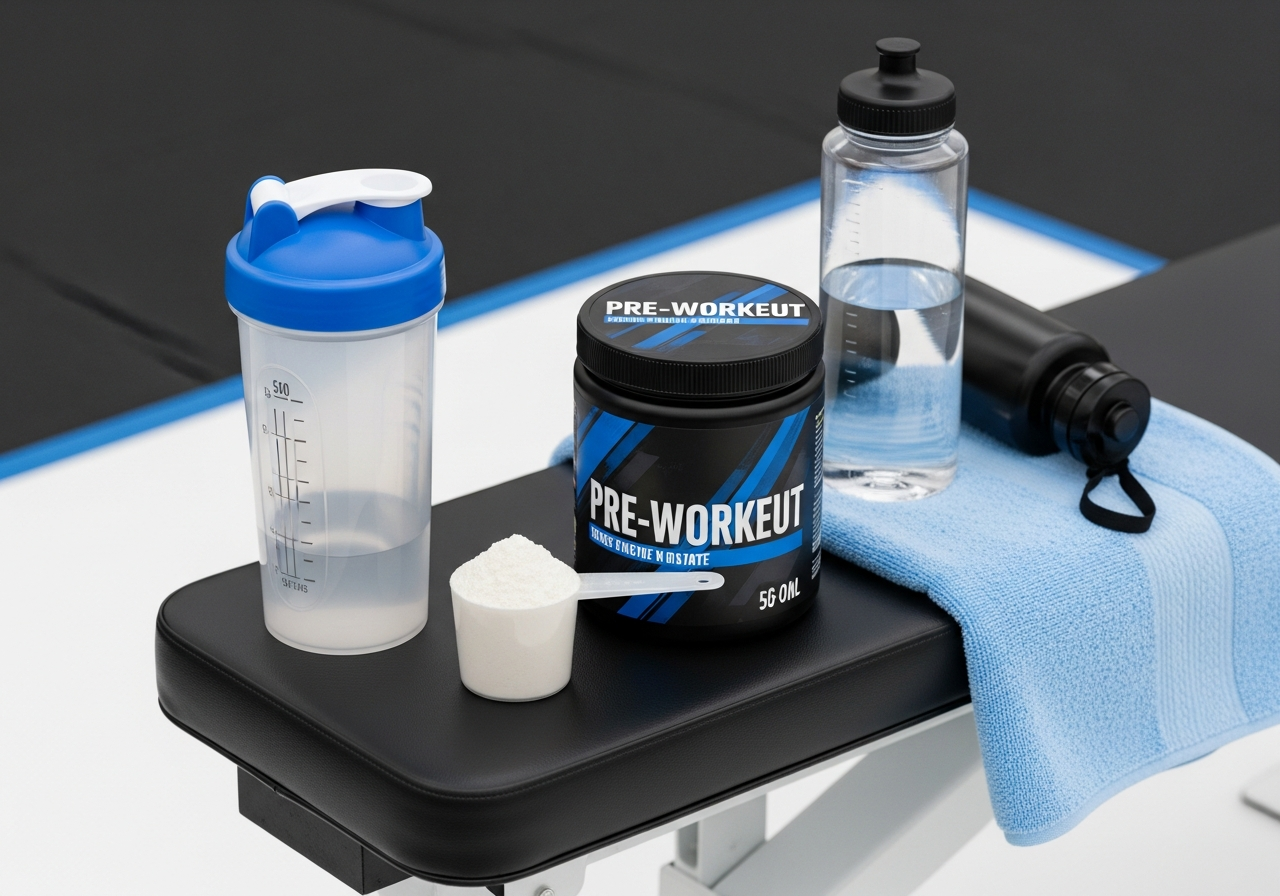
Yes, most healthy adults can take creatine and pre-workout together, because creatine does not conflict with the main acute ingredients in pre-workout.
This is the answer to the common question creatine and pre workout together. In fact, many products are already stacked this way by design. The key is understanding that you are combining a daily foundational supplement with an optional session-specific one.
Here is the simplest way to do it:
- Take creatine every day at 3 to 5 g of creatine monohydrate, whether you train or not.
- Take pre-workout only when useful, usually 30 to 60 minutes before training, following the label and watching total caffeine intake.
- Do not depend on the creatine inside a pre-workout unless the label gives a real daily dose. Many formulas underdose creatine or make it awkward to hit 3 to 5 g every day.
- On rest days, still take creatine even though you are not taking pre-workout.
If your pre-workout contains creatine, check the amount carefully. If it provides 3 to 5 g per serving and you use it daily, that may cover your creatine intake. If it provides less, or you do not use pre-workout every day, add plain creatine separately. Our creatine dosage calculator can help you set the right daily amount.
People also ask whether creatine and caffeine cancel each other out. The modern evidence does not support a blanket claim that caffeine makes creatine useless. There may be practical issues for some people, such as stomach upset when combining large doses of both, but not a reason to avoid the stack altogether. For more on that specific myth, see creatine and caffeine.
What should you watch for?
- Too much caffeine causing jitters, anxiety, elevated heart rate, or poor sleep.
- Large one-shot creatine doses causing stomach upset; split doses if needed.
- Underhydration during hard training, especially with stimulant-heavy products.
The best combined strategy is boring but effective: plain creatine daily, pre-workout only when it solves a real problem. That approach gives you consistent creatine saturation without tying your supplement plan to caffeine dependence.
Exact dosing: creatine vs pre-workout by body weight, goal, and schedule
For creatine, 3 to 5 g/day is the evidence-based maintenance dose for most adults, while pre-workout dosing depends on the label because it is a multi-ingredient product.
Creatine dosing is refreshingly simple compared with pre-workout. The most established approach is either:
- Loading: about 20 g/day, split into 4 doses of 5 g, for 5 to 7 days; then 3 to 5 g/day.
- No loading: 3 to 5 g/day from day one.
Smaller and lighter athletes often do well at 3 g/day, while larger athletes and people with more lean mass often choose 5 g/day. Some practitioners also use a body-weight-based loading approach of about 0.3 g/kg/day for 5 to 7 days, followed by around 0.03 g/kg/day.
| Body weight | Typical creatine maintenance | Optional loading example | Best fit |
|---|---|---|---|
| Under 60 kg | 3 g/day | ~18 g/day for 5-7 days | Beginners, smaller adults |
| 60-90 kg | 3-5 g/day | ~20 g/day for 5-7 days | Most lifters and team-sport athletes |
| Over 90 kg | 5 g/day | ~25-30 g/day for 5-7 days | Larger athletes, high lean mass |
Goal matters too:
- Strength and hypertrophy: creatine is highly relevant; take it daily.
- Sprinting, HIIT, and team sports: creatine is often useful because these rely on repeated high-intensity efforts.
- General fitness: 3 to 5 g/day is still reasonable if you want a simple, well-supported supplement.
- Mostly steady-state endurance: creatine can still help in certain contexts, but the benefit is more situational.
Pre-workout is less straightforward because formulas vary wildly. A “one scoop” serving tells you nothing unless you inspect the ingredient panel. If the product is mainly caffeine-driven, treat caffeine tolerance and training time as the biggest variables. If you train in the evening, a full-dose stimulant pre-workout may hurt sleep more than it helps performance.
If you want precise creatine guidance, use our daily creatine dosing guide and how to measure 5 g accurately. For product selection, compare options in our best creatine rankings and creatine brand reviews.
Best timing: before workout, after workout, or any time?
Creatine timing matters far less than daily consistency, while pre-workout timing matters a lot because its goal is to affect the upcoming session.
If you are asking whether creatine should be taken before a workout because it is “like a pre-workout,” the answer is no. Creatine is not acutely performance-enhancing in the way caffeine is. Once your muscles are saturated, taking your creatine at breakfast, after training, or with dinner can all work if you do it consistently. For a full breakdown, see when to take creatine.
Pre-workout timing is different. Most people take it about 30 to 60 minutes before training to allow ingredients like caffeine to take effect. The exact sweet spot depends on the product, the meal before it, and how quickly you personally feel stimulants.
Here is the practical timing hierarchy:
- For creatine, prioritise daily adherence over timing perfection.
- For pre-workout, time it based on when you want the acute effect during training.
- If you train late, reduce or avoid stimulant-heavy pre-workout.
- If your stomach is sensitive, take creatine with food or split the dose.
One common mistake is taking a pre-workout with creatine in it only on training days and assuming that covers creatine supplementation. It usually does not. Creatine works best when taken daily, including rest days, because the goal is to maintain saturation, not spike it once in a while. If you only use pre-workout three days per week, you are unlikely to maintain optimal creatine stores unless you supplement separately on the other days.
Another common question is whether mixing creatine into your pre-workout drink changes anything. Usually, no. It is mostly a convenience choice. If you want tips for dissolving it properly, read how to mix creatine.
The bottom line on timing is simple: take creatine whenever you are most likely to remember it, and take pre-workout early enough to help the session without wrecking your sleep later.
Who should choose creatine, who should choose pre-workout, and who may want both
Creatine suits more people more often, while pre-workout is more individual because tolerance, sleep, anxiety, and training time matter.
If you are a beginner, creatine is usually the better first supplement. It is simple, well studied, relatively inexpensive, and tied to outcomes that matter: improved high-intensity performance, more total training quality, and better support for lean mass over time. Beginners do not need a high-stim lifestyle to make progress. For a starter roadmap, see creatine for beginners.
Women can use creatine just as men can. Creatine is not a hormone and does not “bulk women up” in a magical or uncontrolled way. It may support training performance, lean mass retention, and possibly other areas of interest, especially across life stages where muscle preservation matters. Our guide on creatine for women goes deeper.
Older adults may be especially good candidates for creatine if the goal is preserving strength, function, and lean mass alongside resistance training. Pre-workout can still be useful, but stimulant tolerance, blood-pressure considerations, medication interactions, and sleep quality deserve more attention. See creatine for older adults for specifics.
Athletes in power, sprint, collision, and repeated-burst sports often have the clearest use case for creatine. The International Olympic Committee's 2018 consensus on dietary supplements recognised creatine as one of the few supplements with good evidence for certain performance contexts. For these athletes, pre-workout can be added strategically, but only after testing it in training, never first on competition day.
Who may want pre-workout more than creatine?
- People who train very early and struggle with alertness.
- Those who need a stronger sense of readiness before hard sessions.
- Athletes using a lower-frequency approach, where session quality today matters more than chasing long-term saturation effects alone.
Who should be more cautious with pre-workout?
- People sensitive to caffeine.
- Those with anxiety that worsens with stimulants.
- Late-night trainees.
- Anyone with medical reasons to review stimulant use with a clinician.
If you only buy one supplement, creatine is usually the smarter all-rounder; if you already take creatine consistently, pre-workout becomes a situational add-on rather than a replacement.
Safety, side effects, and what to look for when buying in Canada
Creatine monohydrate is well supported for safety in healthy people when used at standard doses, while pre-workout safety depends far more on the formula and stimulant load.
According to Antonio et al. (2021), many persistent fears about creatine, including broad claims that it damages healthy kidneys, causes dehydration, or inevitably causes cramping, are misconceptions not supported by the totality of evidence in healthy users. That said, context matters. If you have pre-existing kidney disease, other relevant medical issues, or are taking medications that raise concerns, speak with a qualified clinician before use. For a fuller review, see is creatine safe and the creatinine and kidney confusion explained.
Typical creatine side effects, when they happen, are usually practical rather than dangerous:
- Mild stomach upset if you take too much at once.
- Temporary water-weight increase inside muscle.
- Occasional bloating complaints, often more noticeable during aggressive loading.
Pre-workout side effects are more variable because ingredient lists vary. Common issues include:
- Jitters, rapid heartbeat, nausea, or anxiety from caffeine or other stimulants.
- Tingling from beta-alanine.
- Sleep disruption, especially if taken later in the day.
- Digestive upset from concentrated formulas or sugar alcohols.
In Canada, check for a Natural Product Number (NPN), which is Health Canada's product licence number for authorised natural health products. An NPN does not mean the product is perfect, but it does mean the product has entered the Canadian regulatory framework with approved information. Also look for:
- Clear grams-per-serving disclosure for creatine monohydrate.
- Third-party testing or brand transparency.
- No reliance on proprietary blends if you want to know exactly what you are getting.
For buying help, compare products in our creatine product catalog and related Canadian buying guides. If you want the strongest value proposition, plain monohydrate from a reputable brand is still the easiest recommendation.
Creatine safety is mostly about correct dosing and realistic expectations; pre-workout safety is mostly about ingredient scrutiny, stimulant tolerance, and responsible timing.
The biggest mistakes and myths: what people get wrong about creatine vs pre-workout
The biggest mistake is treating creatine like a stimulant product and treating pre-workout like a foundational daily supplement.
Here are the most common myths and errors, with the straight answer.
- Myth: Creatine is a pre-workout.
Reality: Creatine can be included in a pre-workout, but it is not itself a pre-workout because it does not rely on immediate acute effects. - Myth: If I do not feel creatine, it is not working.
Reality: Creatine often works quietly by improving training output and cellular energy buffering over time. - Myth: Pre-workout gives the same benefits as creatine.
Reality: A caffeine boost can help session quality, but it does not replace the muscle-saturation mechanism of creatine. - Myth: You only need creatine on workout days.
Reality: Daily use matters because saturation is the goal. - Myth: More scoops equals better results.
Reality: Excess pre-workout often just means more side effects, and excess creatine at one time often just means digestive issues. - Myth: Creatine causes fat gain.
Reality: Early scale changes are typically water stored in muscle, not body fat. - Myth: You need fancy forms of creatine.
Reality: Monohydrate remains the most studied and most cost-effective form for most people.
Another error is relying on “kitchen sink” pre-workouts that include small amounts of many trendy ingredients, including creatine, then assuming the label automatically adds up to an evidence-based formula. It often does not. The label matters more than the marketing name.
There is also a behavioural mistake: using pre-workout to compensate for poor sleep, inconsistent training, weak programming, or under-eating. Supplements can help at the margins, but they cannot rescue the basics. Creatine pays off best when you train hard enough to create a reason for better phosphocreatine availability to matter.
If you enjoy debunking this topic properly, see creatine myths debunked and our myths vs facts guide.
The practical rule is easy: judge creatine by consistency and results over weeks, and judge pre-workout by whether it improves the quality of a session without creating more downside than upside.
How to choose: a simple decision framework for real-world buyers
If you are torn between pre workout or creatine, start by asking whether you need better long-term adaptation or a better immediate training experience.
Use this decision framework.
- If you take no supplements yet, start with creatine monohydrate. It has one of the strongest evidence bases in sports nutrition, it is usually affordable, and it works without depending on daily stimulant use.
- If you already take creatine but still drag yourself into sessions, consider pre-workout. In that case the issue may be arousal, alertness, or motivation rather than baseline muscle creatine stores.
- If you train late, prioritise non-stimulant or lower-stimulant options. Sacrificing sleep to force one good workout is often a poor trade.
- If your pre-workout contains creatine, verify the dose. Do not assume a token amount counts as a proper daily creatine strategy.
- If budget matters, buy plain creatine first. Then decide whether a pre-workout solves a specific problem worth paying for.
Here is a simple side-by-side comparison:
| Question | Creatine | Pre-workout |
|---|---|---|
| Main purpose | Raise muscle creatine/phosphocreatine stores | Boost energy, focus, pump, or session readiness |
| When it works | After days to weeks of consistent use | Usually within 30-60 minutes |
| Best evidence for | Strength, power, repeated high-intensity performance, lean mass support | Acute alertness and reduced perceived effort, especially if caffeinated |
| Take every day? | Yes | No, optional and situational |
| Best first purchase? | Usually yes | Only if you truly need the acute boost |
Canadian buyers should also think about product simplicity. Plain creatine monohydrate is easy to compare across brands. Pre-workout is harder because formulas, sweeteners, stimulant blends, and serving sizes vary widely. For comparison help, review our best creatine monohydrate in Canada guide and buying creatine online in Canada.
The smartest buying sequence for most people is: creatine first, evaluate results, then add pre-workout only if you still want a stronger pre-training feel.
A step-by-step plan you can start today, whether you choose creatine, pre-workout, or both
The best plan is the one you will actually follow, so keep it simple enough to repeat for months, not just for one motivated week.
Option 1: You choose creatine only
- Buy plain creatine monohydrate from a reputable brand.
- Take 3 to 5 g every day.
- Decide whether to load: use 20 g/day split into 4 doses for 5 to 7 days if you want quicker saturation, or skip loading if you prefer simplicity.
- Take it at the time you are most likely to remember.
- Track body weight, gym performance, and rep quality for 4 to 6 weeks.
Option 2: You choose pre-workout only
- Choose a formula with transparent ingredients rather than a vague proprietary blend.
- Start with a partial serving if you are caffeine-sensitive.
- Take it 30 to 60 minutes before training.
- Do not use it so late that it ruins sleep.
- Assess whether the session actually improved or whether you just felt more stimulated.
Option 3: You use both
- Take creatine daily no matter what.
- Use pre-workout only for sessions where the acute benefit is worth it.
- If the pre-workout includes creatine, count the grams accurately and top up separately if needed.
- Monitor hydration, digestion, and sleep.
Week-by-week, a realistic expectation looks like this:
- Week 1: Pre-workout effect is immediate if caffeinated; creatine may show little without loading, though body weight can shift slightly if loading.
- Weeks 2-4: Creatine users often start noticing better repeat effort quality, extra reps, or stronger sessions.
- Weeks 4-8: The benefits of improved training quality can start compounding into better strength and lean-mass progress.
If creatine seems not to work, first check consistency, dose accuracy, and whether your training is hard enough to reveal the benefit. Our guides on creatine non-responders and how to take creatine properly can help troubleshoot.
Start simple, stay consistent, and measure real outcomes: the barbell, your reps, your sprint quality, and your recovery tell the story better than the buzz from one scoop ever will.
Bottom line: which is better, creatine or pre-workout?
Creatine is better for most people as a first supplement, while pre-workout is better as an optional tool for specific sessions.
If the question is creatine vs pre workout, the fairest answer is that they are not true rivals. Creatine is a foundational supplement with strong evidence for strength, power, repeated high-intensity performance, and lean-mass support when taken consistently. Pre-workout is a broad product category designed to change how you feel and perform in the next workout, usually through stimulants and other acute ingredients.
If you have to choose one, choose creatine monohydrate first unless you have a very specific reason not to. It is the more evidence-based, more cost-effective, and more universally useful option for regular lifters and athletes. If you already have creatine covered and still want more energy, focus, or drive before training, then a well-formulated pre-workout can be a useful second layer.
The best summary is this:
- Creatine: daily, cumulative, foundational.
- Pre-workout: optional, acute, situational.
- Together: often sensible, as long as you manage caffeine and still hit daily creatine intake.
That is why the practical recommendation for most Canadians is straightforward: buy a reputable creatine monohydrate product, take 3 to 5 g every day, and add pre-workout only if you genuinely benefit from the acute effect. If you want help choosing a product, start with our best creatine rankings or browse the product catalog.
Creatine is not a pre-workout, but it is often the better first supplement because it improves the capacity to do high-quality work over time rather than just changing how a workout feels today.
That single distinction will keep you from wasting money, underdosing creatine in a flashy blend, or expecting the wrong result from the right supplement.
Creatine vs Pre-Workout at a Glance
- 3-5 g/day Standard creatine maintenance dose — Evidence-based daily dose for most healthy adults using creatine monohydrate.
- 20 g/day Typical loading dose — Usually split into 4 doses for 5-7 days to saturate muscle faster.
- 30-60 min Typical pre-workout timing window — Common window for acute ingredients such as caffeine to be felt.
- 5-7 days Fast saturation timeline with loading — Without loading, full benefits often build more gradually over roughly 3-4 weeks.
Frequently Asked Questions
Is creatine a pre-workout?
No, creatine is not a pre-workout. Creatine is a daily supplement that works by saturating your muscles over time, whereas pre-workout is a product taken before training for a same-day boost in energy, focus, endurance, or pump.
Can you take creatine and pre-workout together?
Yes, most healthy adults can take creatine and pre-workout together. Creatine supports long-term muscle energy availability when taken daily, and pre-workout provides an acute session-specific effect, so they usually complement rather than replace each other.
Is creatine in pre-workout enough to work?
Sometimes, but often not consistently enough. Creatine in pre-workout only counts if the product provides a real daily dose, usually 3 to 5 g, and you take it every day, including on rest days.
Should I take pre-workout or creatine first?
For most people, creatine should come first. Creatine monohydrate is usually the better first purchase because it has stronger evidence for long-term performance and muscle benefits, while pre-workout is more optional and more dependent on stimulant tolerance.
Does creatine give you energy like pre-workout?
No, creatine does not usually feel like pre-workout. Creatine helps your muscles regenerate ATP faster during repeated hard efforts, but it rarely creates the obvious alert, wired feeling associated with stimulant-based pre-workouts.
When should I take creatine if I also use pre-workout?
Take creatine whenever you can do it consistently every day. If you also use pre-workout, time the pre-workout about 30 to 60 minutes before training, but do not worry about taking creatine specifically before the workout unless that is simply your easiest routine.
Do I need creatine on rest days if my pre-workout already has it?
Yes, you still need creatine on rest days if you want to maintain saturation. If your pre-workout is only used on training days, you should usually add plain creatine on rest days unless your total weekly intake is otherwise being covered intentionally.
Can pre-workout replace creatine?
No, pre-workout cannot truly replace creatine. A pre-workout may improve session energy or focus, but it does not automatically provide enough creatine or reproduce creatine's muscle-saturation mechanism unless the formula and dosing are specifically designed for that purpose.
Which is better for muscle gain: creatine or pre-workout?
Creatine is generally better supported for muscle gain over time. Pre-workout may help you train harder in a given session, but creatine has much stronger direct evidence for supporting training quality and lean-mass gains across weeks and months.
Can women take creatine and pre-workout together?
Yes, women can generally take creatine and pre-workout together if they tolerate the ingredients well. The same rules apply as for men: creatine is the daily foundational supplement, while pre-workout should be chosen carefully based on caffeine tolerance, training time, and goals.