The Creatine Phosphate Energy System: How Your Muscles Power Explosive Effort
By The Creatine Canada Research Team — Evidence-based supplement analysts
The creatine phosphate energy system is your body’s fastest way to make energy for all-out effort, using stored phosphocreatine in muscle to rapidly regenerate ATP for about 5 to 10 seconds of explosive work. In practice, this phosphagen or ATP-PCr system powers sprints, jumps, heavy lifts, throws, and repeated high-intensity bursts before slower energy systems take over.
Evidence-based · Cites 4 sources · Editorial standards
Key Takeaways
- The creatine phosphate system is the muscle’s immediate energy pathway for maximal effort lasting roughly 5-10 seconds.
- Phosphocreatine donates a phosphate to ADP so your body can rapidly remake ATP, the direct fuel for muscle contraction.
- Creatine monohydrate raises muscle creatine and phosphocreatine stores, which can improve power, strength, and repeated sprint ability.
- The best-supported protocol is either 3-5 g/day daily or a loading phase of 20 g/day split into 4 doses for 5-7 days, then 3-5 g/day.
- This system matters most for sprinting, lifting, team sports, HIIT, and any activity with repeated explosive efforts and short rests.
- Creatine timing matters far less than consistency; saturating muscle stores is what drives results.
- For most healthy adults, creatine monohydrate is safe, well-studied, and the most cost-effective form.
What the creatine phosphate energy system actually is, in plain English
The creatine phosphate energy system, also called the phosphocreatine system, PCR system, ATP-PCr system, alactic system, or phosphagen system, is your body’s fastest energy pathway for short, maximal effort. It works by using phosphocreatine stored inside muscle to rapidly rebuild ATP, the immediate energy currency your muscles use to contract.
If you want the simple version, the ATP-PCr system is what fuels the first few seconds of an all-out sprint, a heavy set of 1 to 3 reps, a vertical jump, a hockey acceleration, or an explosive change of direction. It dominates when the job is very intense and very short. Once those stored high-energy phosphates start running low, your body relies more on anaerobic glycolysis and then oxidative metabolism.
This is why the phosphagen system matters so much in sport and training. It does not mainly determine how you perform in a 10 km run or a long bike ride. It mainly determines how powerfully you can perform in short bursts, and how well you can repeat those bursts with incomplete rest.
- ATP stands for adenosine triphosphate, the molecule that directly powers muscular work.
- Phosphocreatine is creatine with a phosphate attached, stored in muscle as a rapid phosphate reserve.
- Alactic means this system does not directly produce lactate as its main byproduct.
Roughly speaking, the creatine phosphate system contributes most during efforts lasting about 5 to 10 seconds, though it begins working the instant you move and overlaps with other systems. Energy systems never operate in isolation; they simply contribute in different proportions depending on intensity and duration.
If you are new to creatine itself, start with what creatine is. If you already know the basics and want the practical side, our creatine dosage calculator helps you match dose to body size and goal.
The key idea is this: creatine does not act like a stimulant. It helps by increasing the muscle’s stored raw material for rapid ATP regeneration, which is why it supports power rather than giving a caffeine-like buzz.
How the ATP-PCr system regenerates energy in seconds
The ATP-PCr system works by transferring a phosphate from phosphocreatine to ADP to rapidly remake ATP, allowing muscle contraction to continue during brief, explosive effort. That phosphate transfer is catalyzed by the enzyme creatine kinase, which acts as one of the body’s quickest energy-buffering reactions.
Here is the sequence:
- Your muscle contracts and uses ATP.
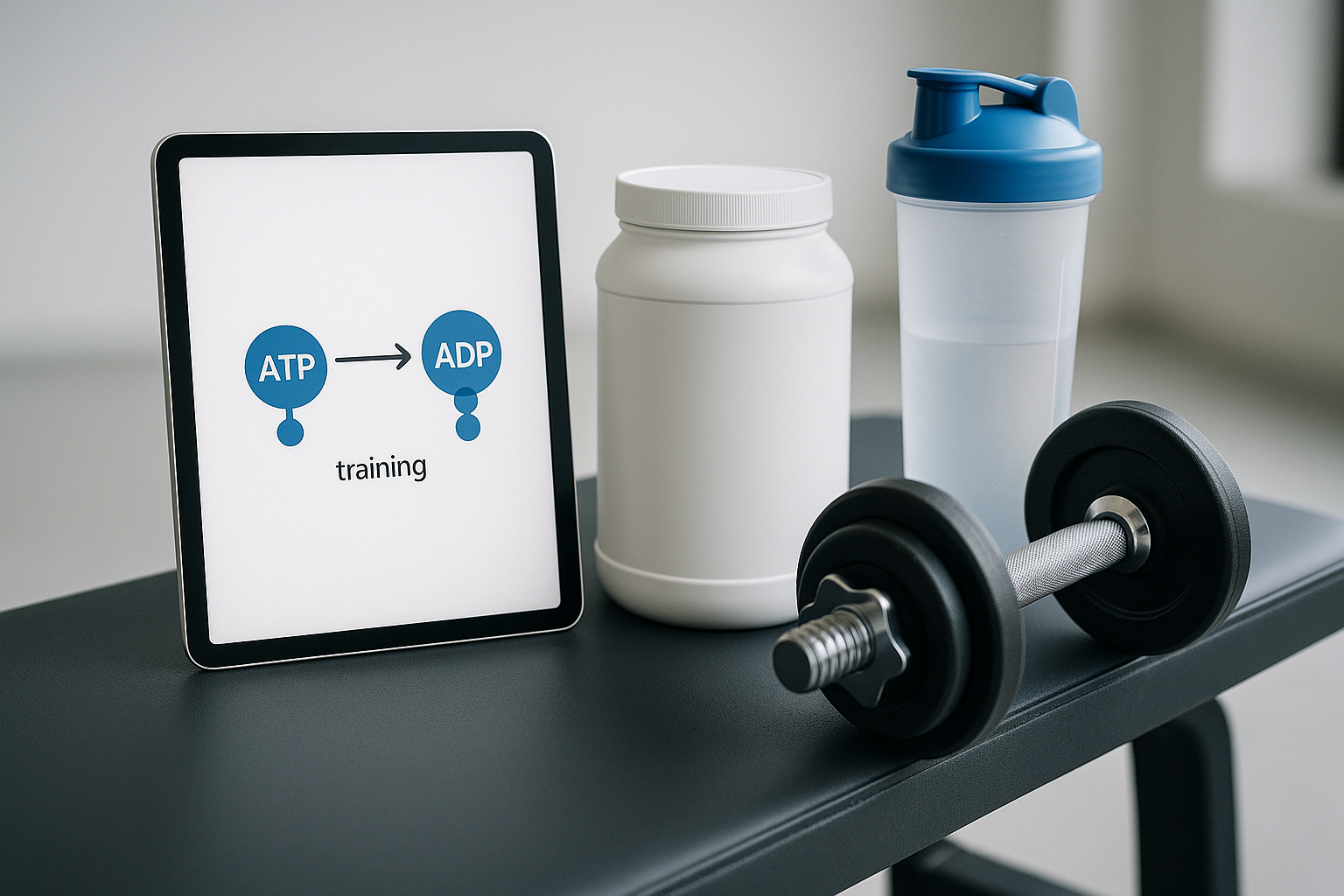
- ATP loses a phosphate and becomes ADP.
- Phosphocreatine donates its phosphate to ADP.
- ATP is regenerated almost immediately.
- Your muscle gets a few more seconds of high-power output.
This matters because stored ATP inside muscle is very limited. You carry only a small amount at any given moment, enough for only a brief burst of maximal work. The phosphocreatine system exists as a rapid backup generator. It does not make large total amounts of energy, but it makes energy fast, and speed is what matters during maximal effort.
Mechanistically, phosphocreatine acts as an energy buffer. It helps stabilise ATP availability in places where energy demand spikes suddenly, especially in fast-twitch muscle fibres. Fast-twitch fibres are the fibres most responsible for sprinting, jumping, throwing, tackling, and lifting heavy loads quickly.
Another important piece is recovery between efforts. Phosphocreatine stores can be partially restored during rest, especially in the first few minutes after a hard bout. That is why your rest periods matter in power training. If you cut rest too short, your next sprint or set may rely less on the phosphagen system and more on glycolysis, reducing peak output.
The mechanism is well-established and not controversial. What supplementation does is increase total muscle creatine content, which can increase phosphocreatine availability and improve the capacity of this fast energy system. The 2017 ISSN position stand concluded that creatine monohydrate is the most effective ergogenic nutritional supplement currently available for increasing high-intensity exercise capacity and lean mass during training.
If you want the deeper supplementation angle, see creatine and ATP and creatine muscle saturation.
When the phosphagen system does most of the work
The phosphagen system dominates during near-maximal effort that lasts only a few seconds, especially when force, speed, or acceleration matters more than endurance. In practical terms, that means activities like a 30-metre sprint, a maximal jump, a single Olympic lift, a football tackle, or the first few seconds of a hockey shift.
Think of the creatine phosphate system as the engine for:
- Short sprints and accelerations
- Heavy resistance training sets
- Jumps, throws, and explosive sport skills
- Repeated high-intensity intervals with short rest
- Team sports with frequent bursts, such as hockey, soccer, basketball, and lacrosse
It matters less for long, steady-state efforts because those rely much more on aerobic energy production. Still, even endurance sports involve moments where the ATP-PCr system matters: breakaways, climbs, surges, finishing kicks, and starts.
A useful coaching rule is this:
- 0-10 seconds, all-out: ATP-PCr is the primary system.
- 10-60 seconds, very hard: glycolytic contribution rises rapidly.
- Beyond that: aerobic contribution becomes increasingly important.
These are not hard borders, but they are useful for training decisions. If your sport depends on repeated alactic bursts, you want both strong phosphocreatine stores and programming that lets you express them. That means hard efforts, appropriate rest, and enough overall recovery to replenish PCr between sessions.
Creatine supplementation tends to shine most in athletes and lifters who repeatedly ask for high power output. That includes powerlifters, bodybuilders, sprinters, CrossFit athletes, field and court sport athletes, and recreational gym-goers trying to get stronger or train harder. The International Olympic Committee’s 2018 consensus on dietary supplements recognises creatine as one of the few supplements with strong evidence for performance benefits in specific sporting contexts.
For sport-specific applications, our guides on creatine for sprinting, creatine for HIIT, and creatine for hockey go deeper.
How creatine supplementation boosts the creatine phosphate system
Creatine supplementation helps the creatine phosphate energy system by increasing total muscle creatine and phosphocreatine stores, which can improve rapid ATP regeneration during short, intense effort. In simple terms, you are topping up the fuel reserve that powers explosive work.
Most of the evidence supports creatine monohydrate as the best form because it is the most studied, the most reliable, and usually the most affordable. Despite aggressive marketing around alternatives, newer forms have not consistently outperformed monohydrate in the evidence base. That is why monohydrate remains the default recommendation in 2026.
What performance changes should you realistically expect? Not magic, and not identical results for everyone. But many users notice:
- Better output on repeated hard sets or sprints
- Slightly more reps at a given load
- Improved training quality over weeks
- Gradual increases in strength and lean mass when combined with resistance training
The mechanism is both direct and indirect. Directly, more intramuscular creatine means more phosphocreatine available to buffer ATP during high-power effort. Indirectly, being able to train a little harder, recover between efforts a little better, or maintain output across sets can compound into better long-term adaptations.
The 2021 JISSN review on common questions and misconceptions about creatine reinforces that creatine is one of the most effective, well-researched supplements available for exercise performance, and that many fears around it are overstated or unsupported.
Week by week, a common pattern looks like this:
- Week 1 with loading: body mass may rise modestly from increased intracellular water; some people feel improved training capacity quickly.
- Weeks 2-4: repeated sprint ability, rep performance, and workout quality may improve more noticeably.
- Weeks 4-12: strength and lean mass differences often become easier to detect if training and nutrition are solid.
If your goal is practical implementation rather than theory, see how to take creatine and how long creatine takes to work.
Exact creatine dosing for muscle saturation, by goal and body size
The most evidence-based creatine protocol is either 3 to 5 g per day consistently or a loading phase of 20 g per day split into 4 doses for 5 to 7 days, followed by 3 to 5 g per day. The goal is muscle saturation, because saturated muscle stores support the phosphocreatine system better than sporadic use.
For many adults, 5 g daily is a practical one-size-fits-most maintenance dose. Smaller people may do well on 3 g daily, while larger athletes or those with more lean mass often choose 5 g daily. Some practitioners also use roughly 0.1 g/kg/day as a practical body-weight-based maintenance approach.
| Goal | Protocol | Who it suits | What to expect |
|---|---|---|---|
| Fast saturation | 20 g/day for 5-7 days, split into 4 x 5 g doses; then 3-5 g/day | Athletes who want quicker results | Stores rise faster; higher chance of mild stomach upset if doses are too large at once |
| Slow saturation | 3-5 g/day every day | Beginners, general fitness, sensitive stomachs | Similar end point, but saturation takes longer |
| Body-weight guided | About 0.1 g/kg/day maintenance | Larger or smaller users wanting precision | Helps scale dose to leaner or heavier bodies |
Examples:
- 60 kg person: 3 g/day is usually reasonable; 5 g/day is also commonly used and acceptable.
- 75 kg person: 5 g/day is a standard maintenance dose.
- 90 kg+ strength athlete: 5 g/day is still common; some prefer a body-weight-guided intake closer to 0.1 g/kg/day.
Take it daily, including rest days. Missing one day is not catastrophic, but consistency is what keeps intramuscular creatine elevated. If you want a personalised estimate, use our creatine dosage calculator or read how much creatine per day.
Two practical tips reduce side effects:
- Split loading doses rather than taking 20 g all at once.
- Mix each dose fully in water or a shake and take with a meal if your stomach is sensitive.
Creatine is not a pre-workout in the usual sense. The benefit comes from saturated stores, not from a one-time acute hit minutes before training.
When to take creatine, what to mix it with, and how to make it work
The best time to take creatine is the time you will remember to take it every day, because muscle saturation matters far more than exact timing. For most people, that means 3 to 5 g once daily with water, a meal, or a post-workout shake.
If you prefer a step-by-step plan, use this:
- Buy plain creatine monohydrate from a reputable source.
- Measure 3 to 5 g accurately.
- Mix it into water, juice, or a protein shake.
- Take it daily, including rest days.
- If loading, split 20 g/day into 4 doses for 5 to 7 days.
- Continue for weeks, not days, before judging results.
You do not need sugar, a special transport blend, or a complicated stack to make creatine effective. Taking it with food is fine. Taking it after training is fine. Taking it in the morning is fine. Warm water can help it dissolve better, but temperature is mostly a convenience issue, not a performance issue.
What about caffeine? Current evidence does not support the simple claim that caffeine “cancels out” creatine. Many people use both. If you personally notice stomach upset when combining them, separate them by a few hours and move on.
How can you tell if it is working? Creatine does not create a dramatic sensation, so use performance markers instead:
- One more rep on your working sets
- Less drop-off across repeated sprints
- Better power late in a session
- A modest increase in scale weight early on from intracellular water
If you want timing-specific guidance, see when to take creatine. For mixing and solubility, visit how to mix creatine. If you train fasted or with coffee, our guides on with or without food and creatine with coffee cover the common edge cases.
The best protocol is boring on purpose: daily, measured, consistent, and paired with training that actually uses the ATP-PCr system.
Who benefits most from the phosphocreatine system and creatine supplementation
Creatine helps most when your training or sport depends on repeated explosive effort, but the supplement is not just for young male bodybuilders. Beginners, women, older adults, vegetarians, and many team-sport athletes can all benefit, though the exact payoff depends on the demands of their activity.
Beginners: Creatine can be worthwhile from day one if you are resistance training. It does not replace good programming, but it can support faster progress by improving training quality over time. If you are just starting, our creatine for beginners guide gives a simple plan.
Women: Women can benefit just as men can, especially for strength, power, training volume, and preserving lean mass. The common fear that creatine will make women “bulky” is a myth. Any early body mass increase is usually from intracellular water, not fat gain. See creatine for women for the full breakdown.
Older adults: Older adults may benefit from creatine because age-related losses in muscle mass, power, and function make high-quality training support more valuable. Combined with resistance exercise, creatine can help support training adaptations that matter for healthy ageing.
Vegetarians and vegans: People who eat little or no meat often start with lower baseline creatine stores, so they may respond especially well to supplementation. If this is you, read is creatine vegan and creatine for vegetarians.
Athletes in power and repeated-sprint sports: This is the clearest fit. Sprinters, lifters, hockey players, football players, swimmers in sprint events, racquet-sport athletes, and CrossFit athletes often have the most obvious use case because their performance repeatedly stresses the phosphagen system.
Endurance athletes: Benefits are more situational. If your event includes surges, sprints, hills, or gym-based strength work, creatine may still help. The trade-off is that some endurance athletes do not want any increase in body mass.
Put simply, if your sport asks, “Can you produce high power right now, and can you do it again soon?” the creatine phosphate system is central, and creatine supplementation deserves a serious look.
Safety, side effects, and how to buy creatine well in Canada
For most healthy adults, creatine monohydrate is considered safe when used at standard doses, and the main side effects are usually mild and manageable, such as stomach upset from large doses or a small early increase in body mass from water retained inside muscle. The evidence base on safety is unusually strong for a sports supplement.
The Mayo Clinic overview and the ISSN position stand both align with the broad view that creatine is safe for most healthy users when taken appropriately. Common realities include:
- Water weight: often appears early, but this is typically intracellular water, not fat gain.
- Digestive upset: more likely with large single doses, poor mixing, or taking loading doses too aggressively.
- Creatinine on lab work: may rise because creatinine is a breakdown product of creatine, which can confuse people without indicating kidney damage on its own.
Who should be more cautious? Anyone with known kidney disease, major medical conditions, or medication concerns should speak to a clinician before supplementing. That is not because creatine is broadly dangerous, but because individual medical context matters.
In Canada, check for a valid NPN, which stands for Natural Product Number. An NPN indicates the product is licensed for sale by Health Canada as a natural health product. For athletes, third-party testing such as NSF Certified for Sport or Informed Sport can add confidence around contamination risk.
When buying, prioritise:
- Creatine monohydrate as the listed ingredient
- Clear gram-based serving size
- NPN on Canadian products where applicable
- Third-party testing if you are drug-tested or extra cautious
- Value per gram, not fancy marketing
To compare options, browse our best creatine rankings, creatine brand reviews, and creatine product catalog. For deeper safety questions, see is creatine safe and creatine and kidneys.
The biggest mistakes and myths about the ATP-PCr system and creatine
The biggest creatine mistakes are inconsistency, overdosing without a reason, expecting a stimulant-like feeling, and buying flashy forms that do not beat monohydrate. Most myths around the creatine phosphate system come from confusing rapid energy support with “fake energy,” misunderstanding water retention, or mixing up creatine with creatinine.
Let’s clear up the common ones directly:
- Myth: Creatine is a steroid.
False. Creatine is a naturally occurring compound involved in cellular energy metabolism, not an anabolic steroid. - Myth: Creatine only helps bodybuilders.
False. It can help anyone whose performance depends on short, repeated, intense effort. - Myth: You must cycle creatine.
False for most users. Daily use is standard, and cycling is not required to maintain effectiveness. - Myth: Creatine causes dehydration or cramps.
The evidence does not support a blanket claim that creatine causes either in healthy users at normal doses. - Myth: If you do not feel it, it is not working.
False. Creatine is usually assessed by training performance and body composition over time, not by a noticeable buzz. - Myth: HCL, buffered creatine, or gummies inherently work better.
Not supported. Monohydrate remains the benchmark for evidence, cost, and reliability.
The most common practical errors are simpler than the myths:
- Skipping days frequently
- Taking huge single doses and blaming creatine for stomach issues
- Stopping after one week without understanding saturation
- Judging results by mirror changes alone rather than performance logs
- Buying underdosed or overpriced formats
If you think creatine is not working, the first things to check are your dose, your consistency, your training quality, and whether your sport truly stresses the phosphagen system enough to show a clear difference.
For a deeper myth breakdown, visit creatine myths debunked and why creatine might not seem to work.
Creatine monohydrate vs other forms: which one actually makes sense
Creatine monohydrate is still the best choice for almost everyone because it has the strongest evidence, the lowest cost, and no consistent proof that newer forms outperform it. If your goal is to support the phosphocreatine system, the ingredient that matters most is enough actual creatine reaching and saturating muscle.
| Form | Evidence level | Typical advantage claimed | Practical verdict |
|---|---|---|---|
| Creatine monohydrate | Strongest | Most studied, affordable, effective | Best default choice |
| Micronized monohydrate | Strong, because it is still monohydrate | Mixes a bit easier | Fine if price is close |
| Creatine HCl | Limited comparative advantage | Better solubility, less bloating | May be convenient, but not proven superior |
| Buffered creatine | Weak support for superiority | Less breakdown, better absorption | Usually not worth the premium |
| Gummies/capsules/liquids | Delivery format varies | Convenience | Can work, but often cost more per effective gram |
What about “better absorption” claims? In the real world, the meaningful issue is not whether a product sounds advanced. The meaningful issue is whether you take enough of it, every day, long enough to saturate muscle. Monohydrate does that extremely well.
There are cases where a different format may be useful. Capsules can help with travel. Micronized powder may mix more smoothly. Gummies may appeal to people who hate powders, though cost and dose accuracy can be drawbacks. But none of those convenience features changes the core physiology of the ATP-PCr system.
When comparing products in Canada, read the label carefully. Check the total grams per container, the cost per gram, the presence of an NPN where applicable, and any third-party testing claims. A bigger tub of plain monohydrate often beats a heavily marketed specialty format on both value and evidence.
For buyer-focused guidance, see best type of creatine, best creatine monohydrate in Canada, and how to choose creatine.
Bottom line: how to use this knowledge in your training this week
The creatine phosphate energy system is your body’s rapid-response engine for explosive effort, and creatine monohydrate is the simplest evidence-based way to support it. If your training includes sprinting, jumping, lifting, tackling, throwing, or repeated hard intervals, this system matters directly to your performance.
The practical playbook is straightforward:
- Use creatine monohydrate.
- Take 3 to 5 g daily, or load with 20 g/day split into 4 doses for 5 to 7 days if you want faster saturation.
- Keep taking it on rest days.
- Judge it by improved performance and training quality over weeks, not by a one-day feeling.
- Buy for purity, label clarity, and value per gram, not hype.
If you are programming around the ATP-PCr system, support that biology with training too. Use short, high-quality efforts, full or near-full rest for power work, and enough total recovery to restore phosphocreatine between sessions. Supplementation helps, but it works best when your training actually demands fast ATP regeneration.
The evidence here is mature, not trendy. The science on creatine and ATP regeneration is one of the more settled areas in sports nutrition, even though details around niche populations and emerging non-performance uses continue to develop. For the general fitness audience, the verdict is simple: if you want better support for short-duration power output, creatine monohydrate is one of the highest-confidence supplements you can use.
Next steps: use our creatine dosage calculator, compare products in the best creatine rankings, or read the complete creatine guide if you want the full picture.
Creatine phosphate system: the numbers that matter
- 5-10 sec Primary window of maximal ATP-PCr dominance — Best thought of as the main fuel source for brief, explosive effort
- 20 g/day Standard loading dose — Usually split into 4 doses for 5-7 days
- 3-5 g/day Standard maintenance dose — Used daily to maintain elevated muscle creatine stores
- 5-7 days Typical loading phase length — Used when faster muscle saturation is the goal
Frequently Asked Questions
What is the creatine phosphate energy system?
The creatine phosphate energy system is the body’s fastest way to regenerate ATP for very short, explosive effort. It uses phosphocreatine stored in muscle to donate a phosphate to ADP, quickly remaking ATP during activities like sprinting, jumping, and heavy lifting.
Is the phosphocreatine system the same as the ATP-PCr system?
Yes, the phosphocreatine system and the ATP-PCr system are the same energy system. They are also commonly called the creatine phosphate system, phosphagen system, or alactic system, all referring to the rapid ATP-regeneration pathway used in brief maximal effort.
How long does the ATP-PCr system last?
The ATP-PCr system contributes most during roughly the first 5 to 10 seconds of maximal effort. It starts working immediately when movement begins, but its dominant role fades as phosphocreatine stores drop and glycolytic and aerobic pathways contribute more.
How does creatine help ATP regeneration?
Creatine helps ATP regeneration by increasing muscle phosphocreatine stores, which serve as a rapid phosphate reservoir. During intense exercise, phosphocreatine donates its phosphate to ADP through the creatine kinase reaction, allowing ATP to be rebuilt quickly enough to support explosive contractions.
What sports use the creatine phosphate system the most?
Sports that rely on short, repeated bursts of speed or power use the creatine phosphate system the most. Examples include sprinting, weightlifting, hockey, football, basketball, volleyball, swimming sprints, throwing events, and many HIIT or CrossFit-style efforts.
Does creatine supplementation improve the phosphagen system?
Yes, creatine supplementation can improve the phosphagen system by increasing total muscle creatine and phosphocreatine availability. That can support better repeated sprint performance, more high-quality reps, and improved power output over time, especially when paired with appropriate training.
What is the best creatine dose for supporting the ATP-PCr system?
The best-supported creatine dose is either 3 to 5 g daily or a loading phase of 20 g daily split into 4 doses for 5 to 7 days followed by 3 to 5 g daily. The main goal is saturating muscle stores, because that is what supports the ATP-PCr system.
Do I need to take creatine before a workout for energy?
No, you do not need to take creatine right before a workout for it to work. Creatine is not an acute stimulant; its benefits come from building up muscle creatine stores over days and weeks, so daily consistency matters far more than pre-workout timing.
Is the alactic system related to lactic acid?
The alactic system is called alactic because it does not primarily produce lactate during its main reaction. That term refers to the ATP-PCr system, which relies on phosphocreatine to rapidly regenerate ATP rather than generating energy mainly through anaerobic glycolysis.
Is creatine monohydrate the best form for the creatine phosphate system?
Yes, creatine monohydrate is still the best form for most people because it has the strongest evidence, the most reliable results, and the best value. Other forms may offer convenience or easier mixing, but they have not consistently outperformed monohydrate in research.