
Creatine for Track and Field: Sprinters, Jumpers, and Throwers
By The Creatine Canada Research Team — Evidence-based supplement analysts
Creatine for track and field is a strong fit for sprinters, jumpers, and throwers because it helps the body regenerate high-power energy faster during short, explosive efforts. It is most useful for events driven by repeated sprinting, acceleration, maximal power, and heavy training sessions, and less valuable for pure endurance-focused track athletes worried about extra body mass.
Evidence-based · Cites 4 sources · Editorial standards
Key Takeaways
- Creatine monohydrate is the best-studied and most practical form for track and field athletes.
- A standard protocol is 3-5 g daily, or a 5-7 day loading phase of about 20 g/day split into 4 doses.
- Sprinters, jumpers, and throwers are the track athletes most likely to benefit.
- The main trade-off is modest water-weight gain, which matters more for some jumpers and middle-distance runners.
- Timing matters far less than daily consistency and reaching muscle saturation.
- Most healthy athletes can use creatine safely, but third-party tested products are smartest for tested competition.
- If creatine feels like it is not working, the usual problems are underdosing, inconsistency, or expecting stimulant-like effects.
Yes—creatine can help many track and field athletes, especially sprinters, jumpers, and throwers
Creatine for track and field is most effective for athletes whose events depend on short bursts of maximal effort, repeated accelerations, and high-force training. That means creatine for sprinters, creatine for jumpers, and creatine for throwers is usually a much better fit than creatine for long-distance specialists.
The reason is simple: the events and training sessions that dominate sprinting, jumping, and throwing rely heavily on the phosphocreatine system, the fast energy system that rapidly helps regenerate ATP, the immediate energy currency your muscles use to contract. The 2017 ISSN position stand concluded that creatine monohydrate is the most effective ergogenic nutritional supplement currently available for increasing high-intensity exercise capacity and lean mass during training. In practice, that makes creatine most relevant for the 100 m sprint, 200 m sprint, 400 m training, hurdles, jumps, and throwing events rather than steady-state aerobic work.
For track athletes, the likely benefits include:
- More power in short training reps and repeated sprint work
- Better quality in weight-room sessions that support sprinting and throwing
- Greater ability to maintain output across sets, jumps, throws, or speed-endurance reps
- Over time, better strength and lean-mass gains from training
The trade-off is that creatine can increase body mass, usually from extra water stored inside muscle. For throwers, that is often neutral or helpful. For many sprinters, it is usually acceptable if performance improves. For some jumpers or middle-distance athletes, even a small increase in body mass can be a more meaningful downside.
If you are new to the topic, start with our creatine dosage calculator and the broader explainer on best creatine rankings. If you want the short version, the answer is this: track and field creatine use makes the most sense when your event is explosive, your training is power-based, and you can tolerate a small chance of scale-weight gain.
For independently verifiable background, see the ISSN position stand and the International Olympic Committee consensus on dietary supplements.
How creatine actually helps sprinting, jumping, and throwing performance
Creatine helps track and field performance by increasing muscle phosphocreatine stores, which lets your muscles regenerate ATP faster during explosive efforts. That mechanism matters most when an effort lasts only a few seconds, or when short efforts are repeated with incomplete recovery.
In a 100 m sprint, the start, first steps, and acceleration phase demand extremely rapid force production. In jumps and throws, the entire event is one explosive expression of force and coordination. In speed training, plyometrics, and weight-room work, athletes repeat high-intensity efforts over and over. Creatine supports all of those by improving the buffering capacity of the phosphocreatine energy system. More available phosphocreatine means your muscles can restore ATP more quickly between contractions and between reps.
That is why creatine is often more noticeable in training than in a single all-or-nothing race. A sprinter may not feel a dramatic day-one boost in a 100 m heat, but may notice better output across block starts, fly sprints, resisted sprints, heavy squats, cleans, repeated jumps, or medicine-ball throws. Over weeks, that training-quality effect can compound.
Creatine may also help indirectly by supporting:
- Greater training volume: more quality reps before power drops off
- Better strength gains: especially when combined with resistance training
- Cell hydration: more water stored inside muscle cells, which may support training adaptation
- Recovery between repeated efforts: especially in sessions with short rest periods
For track athletes, this helps explain the event split. Creatine for short distance running has a stronger logic than creatine for 5,000 m racing because the energy demands are different. It is not a stimulant, so it does not create a buzz or rush. Instead, it gradually saturates muscle and makes your high-power energy system more robust.
If you want the deeper physiology, see related guides on how much creatine per day and how long creatine takes to work. For a broad evidence summary, Examine's creatine evidence summary is also useful.
Which events benefit most: sprinters, jumpers, and throwers are not all the same
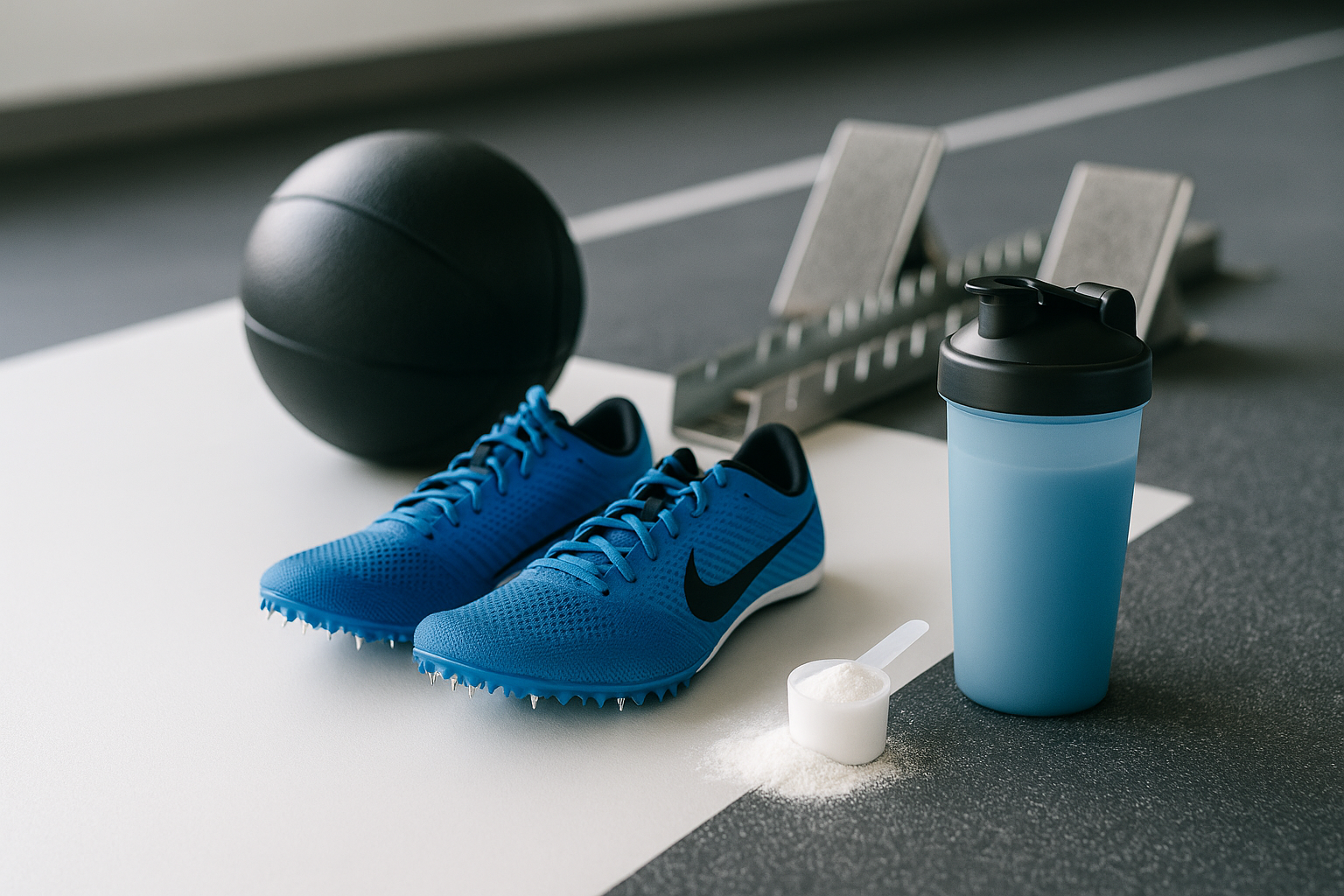
Creatine is usually best for throwers, highly relevant for sprinters, and more situational for jumpers and middle-distance track athletes. The closer your event is to repeated explosive power, the stronger the case.
For creatine for sprinters, the best fit is usually the 60 m, 100 m, 200 m, hurdles, and sprint-focused training for the 400 m. Creatine 100 m sprint use is popular because the event depends on acceleration, neural output, force production, and high-quality training. Sprinters often benefit most in the gym and in repeated speed sessions, where maintaining power output matters.
For creatine for jumpers, the answer is more nuanced. Long jump, triple jump, high jump, and pole vault all require explosive takeoff power, so creatine has a clear theoretical benefit. However, jump performance is also sensitive to body mass, approach rhythm, and technical precision. Some jumpers thrive with creatine; others feel less springy if they gain even a small amount of scale weight too quickly.
For creatine for throwers and creatine for throwing events, the case is strongest. Shot put, discus, hammer, and javelin all reward maximal force production, repeated technical throws in practice, and heavy strength work. Extra intracellular water and modest lean-mass gain are less likely to be drawbacks, and may be positives.
Here is the practical breakdown:
- Best candidates: shot put, discus, hammer, 100 m, 200 m, hurdles, relay sprinters
- Often good candidates: 400 m athletes, long jump, triple jump, high jump, pole vault
- Situational candidates: 800 m and 1,500 m athletes doing heavy sprint/strength work
- Usually lower priority: distance runners focused on minimizing mass and maximizing economy
This does not mean creatine is useless outside pure sprint-power events. It means the benefit-to-trade-off ratio changes. If you are a jumper close to a major meet, you may avoid an aggressive loading phase. If you are a thrower in hard winter training, creatine is often an easy yes.
If event demands are your main concern, our related guides on creatine for sprinting and creatine for competitive athletes go deeper into sport-specific use.
Exactly how to take creatine for track training, gym sessions, and meet season
The best way to take creatine for track and field is to use creatine monohydrate every day until your muscles are saturated, then keep taking a maintenance dose consistently. For most athletes, the simplest protocol works just fine.
- Choose creatine monohydrate. It is the most studied, most cost-effective form, and the form backed most strongly by the ISSN. Fancy forms are usually more marketing than meaningful advantage. If you are shopping, compare options in our creatine product catalog and creatine brand reviews.
- Decide whether to load. A loading phase is optional, not required. Use about 20 g/day split into 4 doses for 5-7 days if you want faster saturation. Or take 3-5 g/day and let saturation build more gradually over several weeks.
- Take it daily. Training days and rest days both count. Creatine works by saturation, not by a one-time pre-workout hit.
- Mix it in water or another drink. There is no need to dry scoop. A shaker bottle or glass works fine.
- Pair it with a habit. Take it after breakfast, after training, or with your post-workout shake so you stop forgetting it.
- Track response for 3-6 weeks. Watch gym numbers, repeated sprint quality, and session-to-session power rather than just scale weight.
For meet season, most athletes can keep using creatine as usual. There is no universal need to stop before competition. The main exception is an athlete who knows rapid loading causes uncomfortable water-weight gain or stomach upset. In that case, maintain your regular dose instead of changing anything close to a meet.
A practical example:
- 100 m sprinter starting in off-season: load for 5-7 days, then 3-5 g/day
- Long jumper near competition: skip loading, use 3 g/day to reduce abrupt scale changes
- Shot putter in strength block: loading is often reasonable if tolerated well
If you want a more detailed setup, see how to take creatine, creatine loading phase, and creatine on rest days.
Best creatine dose for sprinters, jumpers, and throwers by body weight and goal
For most track and field athletes, 3-5 g of creatine monohydrate per day is the standard maintenance dose, while a loading phase is about 20 g/day split into 4 doses for 5-7 days. Larger athletes and those prioritizing fastest saturation often sit at the upper end of the range.
The body-weight logic is practical rather than obsessive. A lighter high jumper does not need the same absolute intake strategy as a heavyweight thrower, but both can still use mainstream evidence-based dosing.
| Athlete type | Typical body-weight context | Simple daily dose | Optional loading phase | Best use case |
|---|---|---|---|---|
| Light jumper or lighter sprinter | Smaller frame | 3 g/day | 20 g/day split for 5-7 days if rapid saturation is needed, though many skip loading | Minimize abrupt weight gain while building saturation |
| Average sprinter or hurdler | Moderate frame | 3-5 g/day | 20 g/day split for 5-7 days | General speed, power, and gym support |
| 400 m power athlete or larger jumper | Moderate to large frame | 5 g/day | 20 g/day split for 5-7 days | Repeated power efforts and strength work |
| Thrower | Larger frame | 5 g/day | 20 g/day split for 5-7 days | Power, training volume, and strength emphasis |
If you want a more individualized starting point, use the creatine dosage calculator. Most athletes do not need precision beyond choosing a sensible place within the standard range and being consistent.
Goal-based advice matters too:
- Fastest results: load, then maintain
- Least risk of stomach upset: skip loading and take 3-5 g/day
- Concern about jump-event body mass: start at 3 g/day and monitor how you feel
- Big off-season strength phase: 5 g/day after loading is common and practical
Do not confuse more with better. Taking far above standard doses does not mean better performance and is more likely to cause digestive issues. Consistency beats excess. For a deeper dose breakdown, see creatine maintenance dose and how much creatine per day.
When to take it, how long it takes to work, and what results track athletes usually notice
Creatine timing is far less important than taking it every day, and most track athletes notice results after muscle saturation builds over days to weeks rather than after a single serving. If you load, effects may show up within about a week. If you do not load, expect a slower ramp over several weeks.
The first thing to understand is that creatine is not caffeine. You do not take it 20 minutes before a sprint session and suddenly feel more explosive. Instead, creatine gradually increases muscle creatine stores until your high-energy system has a larger reserve to draw from.
What to expect in practice:
- Days 1-7 with loading: some athletes notice a small increase in body weight and fuller muscles; training output may start improving by the end of the week
- Weeks 2-4 without loading: better repeatability in sprint reps, lifts, jumps, or throws becomes more noticeable
- Weeks 4-8: strength and power training may compound into clearer performance improvements
- Months 2-3: the biggest effect is often the training adaptation you built while saturated, not a dramatic acute feeling
Best timing options are whichever one you will actually stick to:
- After training with protein or a recovery shake
- With breakfast on non-training days
- At the same time daily to reduce missed doses
There is no strong evidence that morning versus evening timing meaningfully changes outcomes when daily intake is matched. A track athlete who takes 5 g after lifting each day will almost certainly do better than one with the "perfect" timing plan who forgets half their doses.
Good signs creatine is helping include improved quality in late-session reps, slightly better gym numbers, better tolerance for repeated explosive efforts, and more stable power from set to set. If you want a complete expectations guide, see when to take creatine and how long creatine takes to work.
Who should consider it most: beginners, women, masters athletes, and plant-based competitors
Creatine is not only for elite male sprinters; it can be useful for beginners, women, masters athletes, and vegetarian or vegan track athletes as well. The key question is whether your event and training depend on explosive output and repeated high-intensity work.
Beginners can absolutely use creatine. In fact, a beginner starting sprint work and strength training may benefit because creatine can help support higher-quality training from the start. The biggest beginner mistake is expecting it to replace proper sprint mechanics, lifting, sleep, and adequate calories. It will not.
Women track athletes can use the same evidence-based creatine monohydrate protocols as men. The common fear that creatine automatically makes women bulky is inaccurate. Any early weight increase is usually water drawn into muscle, not fat gain. For women in jumps or aesthetic-sensitive environments, starting at 3 g/day instead of loading is often a comfortable entry point. See creatine for women for a deeper breakdown.
Masters and older athletes may find creatine especially attractive because it can support strength and power training while helping counter age-related declines in muscle function. For older sprinters and masters throwers, that can make creatine unusually high-value. Related reading: creatine for older adults and creatine for masters athletes.
Vegetarian and vegan athletes may respond particularly well because dietary creatine intake is often lower when little or no meat is consumed. That does not change the protocol, but it may change how noticeable the response is.
Who should be more cautious? Middle-distance runners who are extremely sensitive to body-mass changes, athletes with relevant medical conditions who have not discussed supplementation with a clinician, and anyone subject to anti-doping rules who buys low-quality products without contamination safeguards.
The IOC consensus on supplements emphasized that supplement decisions should match the athlete's event, goals, and risk profile. In track and field, that event-specific lens matters more than broad gym culture advice.
Safety, side effects, hydration, and what tested Canadian athletes should check

Creatine monohydrate is well supported as safe for healthy individuals when used at standard doses, but track athletes should still pay attention to digestion, hydration habits, and product quality. The 2017 ISSN position stand and the 2021 JISSN review both reinforce that many common creatine safety fears are overstated or false.
The most common side effects are practical rather than dangerous:
- Water-weight gain: usually from more water stored inside muscle
- Stomach upset: more likely with large single doses or poor mixing
- Temporary scale fluctuations: especially during loading
Creatine does not reliably cause dehydration, cramps, or kidney damage in healthy users at standard doses, despite those myths circulating for years. If you have a kidney condition or a medical reason to limit supplement use, discuss it with a qualified clinician first. For broader safety reading, see is creatine safe, is creatine bad for your kidneys, and creatine and dehydration.
For track athletes training in heat, creatine does not replace hydration planning. You still need normal good practice: regular fluids, sodium where appropriate, and sensible recovery after hard sessions. If you load, splitting doses across the day helps reduce digestive issues.
For Canadian athletes, quality control matters. Look for a Natural Product Number, or NPN, on products sold as licensed natural health products in Canada, and prioritize reputable manufacturing plus third-party testing where possible. Tested athletes should strongly prefer products screened through recognized sport programs because contamination risk, not creatine itself, is the anti-doping concern.
Smart shopping criteria include:
- Creatine monohydrate listed clearly as the ingredient
- NPN or compliant Canadian labelling where applicable
- Batch testing or third-party sport certification for high-level competitors
- No unnecessary proprietary blends
For myth clean-up, see creatine myths debunked. For a consumer-friendly medical overview, the Mayo Clinic creatine page is also a reasonable starting point.
The biggest creatine mistakes track athletes make—and the myths that still confuse them
If creatine seems not to work for a track athlete, the most common reasons are inconsistency, unrealistic expectations, poor event fit, or a body-mass trade-off that outweighs the benefit. Creatine failure is often user error, not supplement failure.
Here are the mistakes that show up most often:
- Taking it only before workouts. Creatine is not a stimulant. Skipping rest days slows or prevents full saturation.
- Underdosing. Tiny sprinkle-sized servings are not enough. Most athletes need 3-5 g/day.
- Expecting an instant feeling. Creatine works gradually. You may notice it more in your third jump set or last sprint rep than in your first warm-up stride.
- Choosing the wrong event for it. A thrower and a 5,000 m runner have very different cost-benefit profiles.
- Loading right before an important meet without testing tolerance. Rapid water-weight gain or stomach upset can be disruptive if you are sensitive.
- Buying flashy forms instead of plain monohydrate. More expensive does not mean more effective.
Now the myths:
- "Creatine is a steroid." False. Creatine is a naturally occurring compound involved in energy metabolism. It is not an anabolic steroid. See is creatine a steroid.
- "Creatine only helps bodybuilders." False. It is especially relevant to sports built on repeated explosive effort.
- "Creatine makes you fat." False. Early weight changes are usually water in muscle, not fat tissue. See does creatine make you gain weight.
- "You need to cycle it." False for most healthy users. Daily continuous use is standard. See do you need to cycle creatine.
The 2021 JISSN paper on common questions and misconceptions about creatine addressed many of these myths directly. For track athletes, the smartest approach is brutally practical: use monohydrate, dose correctly, monitor body-mass response, and judge it by training quality over several weeks.
What kind of creatine should a track athlete buy in Canada?
The best creatine for track and field athletes is usually plain creatine monohydrate powder from a reputable brand with transparent labelling and, ideally, third-party testing if you compete in tested sport. In nearly every case, the simplest option is the best one.
Creatine monohydrate keeps winning because it has the deepest evidence base, works at standard doses, and is usually the best value per gram. Other forms such as HCL, buffered creatine, ethyl ester, gummies, or liquid products are often more expensive without proving better performance outcomes in the mainstream evidence base.
| Form | Best for | Main upside | Main downside | Verdict for track athletes |
|---|---|---|---|---|
| Creatine monohydrate powder | Almost everyone | Best evidence, best value, easy to dose | Can feel gritty if not mixed well | Best default choice |
| Micronized monohydrate | Athletes who dislike texture | Often mixes a bit easier | Sometimes costs more | Fine, but still just monohydrate |
| Capsules | Travel convenience | No mixing | Often expensive and requires many capsules | Useful for travel, not best value |
| Gummies | Those who hate powders | Convenient and palatable | Often underdosed or costly per effective dose | Usually not first choice |
| HCL or other specialty forms | Marketing-sensitive buyers | Claims of better solubility | Higher price, weaker comparative evidence | Monohydrate still wins |
In Canada, check for clear ingredient transparency, an NPN where relevant, and quality assurance practices. If you are shopping broadly, review the best creatine rankings, compare options in the creatine product catalog, and explore creatine brand reviews. For a sport-specific quality lens, third-party testing matters more than trendy flavour systems or influencer branding.
If you only remember one buying rule, make it this: buy boring, pure, properly labelled monohydrate from a trustworthy seller, then spend your energy on training and sleep instead of supplement novelty.
Bottom line: when creatine is worth it for track and field—and when it is not
Creatine for track and field is worth it for most sprinters, many jumpers, and nearly all throwers, provided the athlete uses standard dosing and accepts the possibility of modest water-weight gain. It is one of the few supplements with a strong enough evidence base to justify serious attention.
If your event lives on acceleration, maximal power, repeated high-intensity reps, and heavy strength training, creatine is a logical performance tool. That is why creatine and track athletes are such a common pairing in sprint and power programmes. The biggest upside is often not a magical race-day sensation but better power training over time, which can lead to real performance improvements.
If you are a thrower, the answer is usually straightforward: creatine is often a very good fit. If you are a sprinter, the answer is still usually yes, especially in training-heavy phases. If you are a jumper, the answer is individualized: weigh explosive benefits against how sensitive you are to even small body-mass increases. If you are a middle- or long-distance athlete, creatine is more situational and lower priority.
The most practical plan for most athletes is:
- Choose creatine monohydrate
- Take 3-5 g daily, or load with about 20 g/day split into 4 doses for 5-7 days if you want faster saturation
- Keep taking it on rest days
- Track body weight, training quality, and event feel for 3-6 weeks
- Adjust only if the body-mass trade-off is clearly hurting performance
If you want next steps, start with our creatine dosage calculator, then read creatine for beginners and best type of creatine. For most explosive track and field athletes, creatine is not hype. It is simply one of the rare supplements that actually earns its place.
Creatine for Track and Field at a Glance
- 3-5 g/day Standard maintenance dose — Fits most sprinters, jumpers, and throwers after saturation.
- ~20 g/day Typical loading amount — Usually split into 4 daily doses for 5-7 days.
- 5-7 days Fastest common saturation timeline — Applies when using a standard loading phase.
- 1 supplement Gold-standard form — Creatine monohydrate remains the most studied and cost-effective option.
Frequently Asked Questions
Is creatine good for track and field athletes?
Yes, creatine is good for many track and field athletes, especially those in sprint, jump, and throwing events. It is most useful when performance depends on short explosive efforts, repeated sprints, and power-based training. It is less compelling for athletes whose main priority is endurance economy and keeping body mass as low as possible.
Does creatine help the 100 m sprint?
Creatine can help 100 m sprinters, mainly by supporting acceleration, power training, and repeated high-quality sprint work. It does not act like a stimulant, so the benefit is usually indirect through better training quality and energy regeneration in short maximal efforts. Many sprinters notice it more in blocks, gym work, and repeated speed sessions than in a single all-out race feeling.
Should sprinters take creatine every day?
Yes, sprinters should usually take creatine every day if they want full benefit. Creatine works by saturating muscle stores over time, so rest days matter too. Taking it only before workouts is one of the most common mistakes and can blunt results.
Is creatine good for throwers?
Yes, creatine is one of the best supplement fits for throwers. Shot put, discus, hammer, and javelin all rely on explosive power, repeated technical reps, and heavy strength training, which aligns well with creatine's mechanism. The small increase in water-weight is also usually less problematic for throwers than for some jumpers.
Can jumpers use creatine without hurting performance?
Yes, jumpers can use creatine, but they should monitor body-mass response carefully. Creatine may support takeoff power and power training, yet some jumpers are sensitive to even modest weight gain or changes in rhythm. Starting with 3 g/day and skipping loading is often a sensible approach for athletes in long jump, triple jump, high jump, or pole vault.
What is the best creatine dose for track athletes?
The best creatine dose for most track athletes is 3-5 g of creatine monohydrate per day. If faster saturation is desired, a common loading phase is about 20 g/day split into 4 doses for 5-7 days, followed by 3-5 g/day. Throwers and larger athletes often use 5 g/day, while lighter jumpers may prefer 3 g/day.
When should track athletes take creatine?
Track athletes can take creatine at any time of day, as long as they take it consistently. After training or with a regular meal is often the easiest option because it builds habit compliance. Daily saturation matters far more than exact timing.
Will creatine make a sprinter slower by adding weight?
Creatine can add a small amount of body weight, usually from water stored inside muscle, but that does not automatically make a sprinter slower. For many sprinters, the power and training benefits outweigh the scale change. The real answer is individual, so athletes should monitor sprint times, body weight, and how they feel over several weeks.
Is creatine legal in track and field competition?
Yes, creatine is legal in track and field competition and is not a banned substance. The real issue for tested athletes is product contamination, not creatine itself. That is why reputable brands and third-party tested products are the safest choice for competitors subject to anti-doping rules.
What type of creatine is best for sprinters, jumpers, and throwers?
Creatine monohydrate is the best type for sprinters, jumpers, and throwers. It has the strongest evidence base, works well at standard doses, and is usually the most cost-effective form. Most other forms cost more without proving superior performance results.