Creatine for Nurses and Healthcare Workers: Energy, Focus, and Shift Recovery
By The Creatine Canada Research Team — Evidence-based supplement analysts
Yes—creatine for nurses and healthcare workers can be a smart, evidence-based supplement for improving high-intensity physical performance, supporting training recovery, and potentially helping mental performance under sleep loss, provided you use plain creatine monohydrate at the right dose. For long shifts, night shift schedules, and demanding professional routines, the main benefit comes from saturating your muscles and brain over time, not from taking a quick stimulant-like hit before work.
Evidence-based · Cites 4 sources · Editorial standards
Key Takeaways
- Creatine monohydrate is the best-studied, most cost-effective form for nurses and healthcare workers.
- A simple maintenance dose of 3-5 g daily works for most adults, even on non-training days.
- Loading with 20 g/day split into 4 doses for 5-7 days saturates stores faster but is optional.
- Creatine does not act like caffeine; it works by increasing phosphocreatine stores over days to weeks.
- Healthcare workers on long or night shifts may value creatine most for gym performance, physical resilience, and possible cognitive support during sleep deprivation.
- Mild water-weight gain and occasional stomach upset are the most common side effects and are usually manageable.
- In Canada, choose a product with a Natural Product Number when applicable and, ideally, third-party testing.
Does creatine help nurses and healthcare workers? Yes—but mainly by improving energy systems, not by acting like a stimulant
Yes, creatine can help nurses and healthcare workers, especially if you work long shifts, rotate days and nights, lift patients, spend hours on your feet, or train around an exhausting schedule. The key point is that creatine is not a fast-acting pick-me-up like caffeine; it supports your body's short-burst energy system by increasing stored phosphocreatine, which is the compound that helps regenerate ATP, your cells' immediate energy currency.
That distinction matters. When people search for creatine for nurses or creatine for night shift, they often mean, "Will this help me feel more capable during a brutal schedule?" The evidence-based answer is yes, but indirectly. Creatine consistently helps with repeated high-intensity efforts, strength, lean mass, and training quality. For healthcare workers, that can translate into better gym performance, more resilience when moving equipment or patients, less drop-off during physically demanding days, and improved recovery between shifts and workouts.
There is also legitimate interest in cognition. Emerging and increasingly discussed evidence suggests creatine may help some aspects of brain energy metabolism, particularly in situations of sleep deprivation or high cognitive demand. That does not mean creatine is a proven treatment for fatigue, brain fog, or burnout in healthcare workers. It means there is a plausible mechanism and some supportive human data for mental performance under stress, but the strongest evidence base still sits with exercise performance and body-composition outcomes. If you want a deeper primer, see what creatine is and what it does and our guide on creatine and the brain.
The 2017 ISSN position stand concluded that creatine monohydrate is the most effective nutritional supplement currently available for increasing high-intensity exercise capacity and lean body mass during training. That conclusion is why creatine makes sense for medical workers and other professionals with physically demanding schedules: if your job already drains you, any supplement that reliably improves your training return on investment becomes more valuable, not less.
Bottom line: creatine for healthcare workers is worth considering if your goals include better training performance, more robust recovery, preserving muscle during stressful schedules, or potentially supporting mental performance when sleep is imperfect. It is not a substitute for sleep, food, hydration, or medical care, and it is not a stimulant.
How creatine works for long shifts, lifting, and mental fatigue
Creatine works by increasing phosphocreatine stores in muscle and other tissues, which helps your body remake ATP faster during repeated effort. In plain language, it supports the energy system you use when you stand up a patient, push a heavy bed, climb stairs quickly, rush during an emergency, or try to train hard after a 12-hour shift.
Your body makes some creatine naturally, and you also get small amounts from foods such as meat and fish. Supplementing increases your total creatine pool beyond what diet alone usually provides. Once stores rise, you typically perform better in short, repeated bouts of work and recover those bursts faster between efforts. That is why creatine is more relevant to creatine long shifts than many people realise: a hospital shift is rarely one continuous sprint, but it often includes dozens of small, physically and mentally intense demands stacked together.
Mechanistically, creatine's best-established role is in the phosphagen system. Phosphocreatine donates a phosphate group to ADP to rapidly regenerate ATP. More stored phosphocreatine means you can maintain force or power a little better, especially when tasks repeat with incomplete recovery. Over weeks and months, that often allows better training quality, which then drives greater strength and lean mass gains.
There is also a brain angle. The brain uses large amounts of ATP, and creatine is involved in cellular energy buffering there as well. This is one reason creatine is increasingly discussed as a support for people under sleep stress, including shift workers. However, the evidence is still more mixed and context-dependent than the exercise data. A fair summary is that creatine may support some aspects of memory, processing, or mental fatigue resistance in certain scenarios, but it should not be oversold as a cure for cognitive fatigue.
The 2021 JISSN review on common creatine questions and misconceptions emphasised that creatine is one of the most widely studied sports supplements and that many safety fears are unsupported by the evidence. For a concise external overview, see Antonio et al. (2021) in JISSN and the Examine.com creatine evidence summary.
For nurses, the most realistic expectation is this: creatine will not make a night shift feel easy, but it can improve the underlying energy availability that supports physical output, training adaptation, and possibly some mental resilience when life is demanding.
Who creatine is best for: bedside nurses, night shift staff, women, older clinicians, and beginners
Creatine is a strong fit for many healthcare workers because the people who benefit most are not just bodybuilders—they are also busy adults trying to preserve performance and muscle under real-world stress. If you are a nurse, physician, paramedic, respiratory therapist, porter, PSW, or any other healthcare worker with a demanding schedule, creatine is especially worth considering if your days include physical work, irregular meals, inconsistent sleep, or limited training time.
Beginners often benefit a lot because creatine improves the quality of the work they can do in the gym while they are learning to train consistently. If you can only lift two or three times per week around shifts, making each session more productive matters. Our creatine for beginners guide goes deeper.
Women should not avoid creatine. Creatine does not "bulk women up" in some unusual way; it supports the same core physiology in women as in men. Women in healthcare often juggle training with fatigue, caregiving, and shift work, which can make a low-maintenance supplement especially appealing. If that is you, see creatine for women.
Older adults and senior clinicians may benefit because maintaining muscle, strength, and function becomes harder with age. Creatine paired with resistance training has supportive evidence for lean mass and strength outcomes in older populations, making it relevant to healthcare workers in their 40s, 50s, and beyond.
Vegetarians and vegans may respond particularly well because baseline creatine intake from diet is lower. If you rarely eat meat or fish, supplementation can fill a larger gap in total creatine stores.
Athletic healthcare workers—the nurse who powerlifts, the doctor training for a half marathon, the medic doing CrossFit—can use creatine exactly as any other athlete would. The only caveat is sport specificity. If body-mass-sensitive endurance events matter to you, any early water-weight increase has to be weighed against the performance upside.
Who should pause and ask a clinician first? Anyone who is pregnant, breastfeeding, has known kidney disease, or takes medications where supplementation discussions are appropriate should get individual guidance first. Creatine is well studied, but personal medical context still matters. If you are unsure, start with who should not take creatine and is creatine safe.
In short, creatine for demanding professional schedules is most useful for people who want more physical capability, better training carryover, and a simple daily habit with a strong evidence base.
Exactly how much creatine to take for nurses and healthcare workers
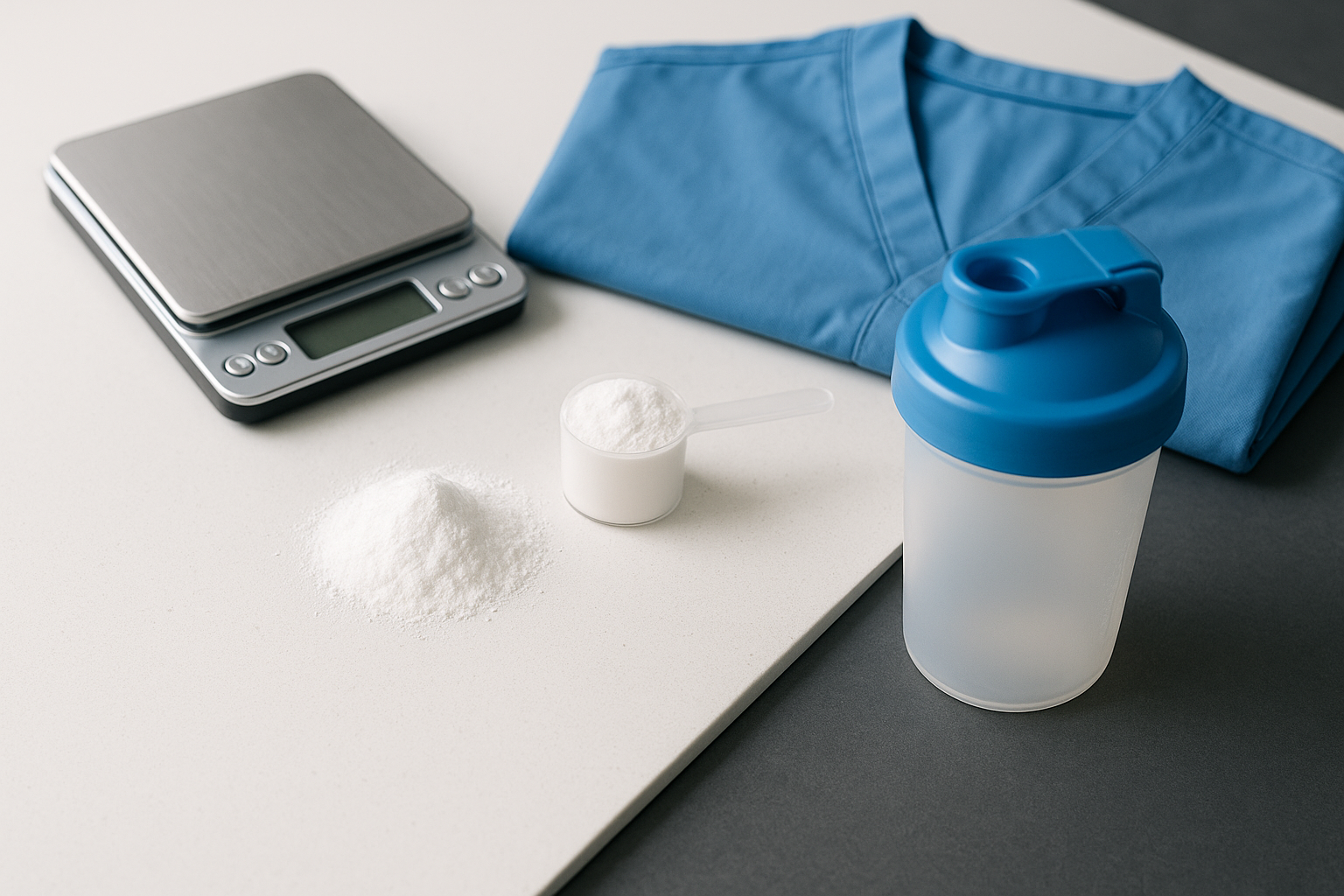
For most nurses and healthcare workers, the right creatine dose is 3-5 g of creatine monohydrate every day. That maintenance dose is enough for most adults to raise and maintain muscle creatine stores over time, whether you train before shifts, after shifts, or only a few times per week.
If you want faster saturation, use a loading phase of 20 g per day for 5-7 days, split into four 5 g doses, then switch to 3-5 g daily. Loading is optional. It speeds up results, but it does not produce better long-term results than simply taking a maintenance dose consistently.
Here is the simplest practical framework:
- General wellness + training support: 3 g/day if you are smaller-bodied and consistent.
- Most adults: 5 g/day is the easiest, most common default.
- Faster saturation: 20 g/day in 4 divided doses for 5-7 days, then 3-5 g/day.
- Larger-bodied or very muscular individuals: many still do well on 5 g/day, though some prefer the upper end of maintenance guidance.
Body weight can refine the plan, but it usually does not need to complicate it. In real life, a 55 kg nurse, a 75 kg respiratory therapist, and a 95 kg ICU porter can all start with 5 g/day and do perfectly well. If you want a tailored approach, use our creatine dosage calculator or read how much creatine per day.
| Goal | Best dose | What to expect |
|---|---|---|
| Simple daily support | 3-5 g once daily | Gradual saturation over roughly 3-4 weeks |
| Faster results | 20 g/day split into 4 doses for 5-7 days, then 3-5 g/day | Faster saturation, often within about 1 week |
| Sensitive stomach | 3 g/day or 5 g/day split into 2 doses | Similar long-term effect with fewer GI issues |
| Night-shift routine | 3-5 g at any reliable daily time | Consistency matters more than timing |
Do not overthink scoops versus teaspoons. The priority is getting a true gram-based dose from a reputable product. If your scoop size is unclear, check the label carefully or use a small kitchen scale. More is not necessarily better; taking very high doses long-term without a reason just increases the chance of stomach upset without improving results.
The most effective dosing plan is the one you can repeat every day, including weekends, off days, and chaotic shift blocks.
Best timing for creatine on day shift, night shift, and non-training days
The best time for creatine is the time you will actually remember to take it every day. For nurses and healthcare workers, timing matters far less than consistency because creatine works by gradually saturating tissues, not by creating an immediate boost right after you swallow it.
If you work day shifts, taking creatine with breakfast, after your workout, or with your first large meal is perfectly reasonable. If you work night shifts, tie it to your wake-up routine rather than the clock. For example, if you wake at 4:30 p.m. before a 7 p.m. shift, take your 3-5 g then. If you train after work, taking it post-workout is also fine. What matters is that it becomes automatic.
If you work rotating shifts, create a trigger habit instead of a time-based habit. Good examples include:
- Take it when you brush your teeth after waking.
- Mix it into your first shaker of the day.
- Keep it beside your coffee setup.
- Take it with your main meal before leaving for work.
Can you take creatine before a long shift for "energy"? Yes, but not because pre-shift timing itself is special. A pre-shift dose is fine if that is the easiest time for you, but the benefit comes from weeks of accumulated use. This is one reason creatine fits demanding professional schedules: it is one of the least timing-sensitive supplements in sports nutrition.
Can you take it with coffee? Usually yes. The old idea that caffeine cancels out creatine is not well supported as a blanket rule, especially in normal mixed diets and practical supplementation routines. If coffee helps you remember your dose, that is a feature, not a bug. See can you mix creatine with coffee and when to take creatine for details.
On non-training days, still take it. Skipping rest days slows or compromises your ability to keep muscle stores elevated. If you miss one day, it is not a disaster; just resume the next day rather than doubling up unnecessarily. Our guide on creatine on rest days explains the logic.
For most healthcare workers, the ideal answer is boring but effective: take 3-5 g once daily with any meal or drink that fits your schedule, seven days per week.
A practical step-by-step creatine plan for a busy nurse or healthcare worker
The easiest way to start creatine is to buy a plain creatine monohydrate powder, take 3-5 g daily, and pair it with a routine you already never miss. If you want a zero-fuss protocol that works around chaotic schedules, use the plan below.
- Choose the right product. Buy plain creatine monohydrate, ideally unflavoured, with clear grams-per-serving labelling. Avoid underdosed blends that hide the actual creatine amount. If you need help, compare options in our best creatine rankings and creatine brand reviews.
- Pick your dose. Start with 5 g daily, or 3 g daily if you are small-bodied or cautious about digestion.
- Decide whether to load. If you want faster saturation, take 5 g four times daily for 5-7 days. If not, skip loading and just take your maintenance dose daily.
- Choose a trigger habit. Link creatine to your wake-up drink, first meal, or post-workout shake. Shift workers do better with habit triggers than with fixed clock times.
- Mix it simply. Stir it into water, a protein shake, juice, or coffee. If grittiness bothers you, use warm water first or choose a micronized powder. More mixing tips are in how to mix creatine.
- Keep taking it on off days. Creatine is a saturation supplement, so consistency on weekends and recovery days matters.
- Track outcomes for 4-8 weeks. Watch for small but meaningful changes: one more rep, slightly better work capacity, less drop-off across sets, modest body-weight increase from water in muscle, or better tolerance for your training around shifts.
Here is a realistic week-by-week expectation for a healthcare worker using creatine:
- Week 1 with loading: faster saturation, possible slight body-weight increase, maybe mild stomach upset if doses are too large.
- Weeks 2-4 without loading, or after loading: gym performance benefits often become easier to notice.
- Weeks 4-8: better training quality may start translating into visible strength or body-composition changes.
- Beyond 8 weeks: the real value is compounded consistency, especially if your schedule would otherwise limit progress.
If your goal is better creatine nursing energy, define that practically. Creatine is "working" if your workouts improve, your strength stops stalling, your muscles feel fuller, or physically demanding shifts feel less punishing relative to your baseline. It is not supposed to feel like an instant surge.
Keep the process boring. Creatine rewards routine, not biohacking.
What results nurses can realistically expect from creatine, and how to tell if it is working
Most healthcare workers should expect creatine to improve training performance first, with visible physique or strength changes showing up later. The first signs are usually subtle: a bit more output in the gym, slightly faster recovery between hard sets, or less performance drop when life and work fatigue are high.
Creatine does not guarantee that your shift itself will feel easier on day three of a brutal rotation. The more realistic chain is: better muscle energy availability leads to better training quality, better training quality leads to improved strength and lean mass over time, and improved fitness can make work demands more tolerable.
Common early signs that creatine is working include:
- You squeeze out 1-2 more reps on difficult sets.
- Your repeated efforts hold up better across a full workout.
- You recover a bit faster between sets or intervals.
- Your body weight rises slightly, often from intracellular water stored in muscle.
- Your muscles look or feel a little fuller.
For nurses using creatine around busy schedules, one of the best metrics is training quality despite fatigue. Ask: can you still hit useful sessions after work? Is your performance less inconsistent across a stretch of long shifts? If yes, that is meaningful.
What about brain benefits? Some people report better mental endurance or less "fried" feeling during sleep-restricted periods, but this is less predictable than the exercise effect. It is best treated as a possible bonus rather than the primary reason to buy creatine.
What if you notice nothing? First, give it enough time. Without loading, many people need about 3-4 weeks to saturate. Second, check dose accuracy. Third, make sure you are using creatine monohydrate consistently. Fourth, remember that creatine works best when there is some meaningful physical training demand. It can still be useful without structured exercise, but the effects are often easier to notice when you are resistance training. See how long creatine takes to work and creatine not working.
Also understand the non-responder issue carefully. True non-response exists, but it is often overstated. People with naturally high baseline stores, higher habitual meat intake, or lower training stimulus may simply notice less dramatic change. That does not mean the supplement is useless; it means the margin for improvement is smaller.
Think of creatine as a high-probability, low-drama supplement. The results are usually real, but they are cumulative rather than flashy.
Is creatine safe for healthcare workers? What the evidence says about kidneys, dehydration, weight gain, and side effects
For healthy adults, creatine monohydrate is generally considered safe when used at recommended doses, and this is one of the most consistent findings in the literature. The 2017 ISSN position stand and later reviews conclude that creatine is both effective and well supported for safety in healthy populations.
The most common side effects are mild and manageable. These include:
- Water-weight gain: often an early increase from more water stored inside muscle cells, not body fat.
- Stomach upset: more likely with large single doses, poor mixing, or loading done too aggressively.
- Temporary bloated feeling: not universal, and often improved by splitting doses or choosing micronized powder.
One major myth is that creatine damages the kidneys in healthy people. Current evidence does not support that claim for healthy adults using recommended doses. What does happen is that creatine supplementation can raise creatinine, a breakdown product seen on bloodwork. Creatinine is commonly used as a kidney marker, so this can confuse interpretation if the clinician does not know you are supplementing. That is a lab interpretation issue, not proof of kidney harm. If you routinely get bloodwork, it is wise to tell your healthcare provider you use creatine. Our creatine vs. creatinine and kidney guide cover this in detail.
Another myth is that creatine dehydrates you or causes cramps. That claim is not well supported by the broader evidence. In fact, creatine increases intracellular water in muscle, which is different from "drying you out." That said, healthcare workers often already underdrink during shifts, so basic hydration habits still matter. See how much water to drink with creatine.
Who should be more cautious? People with known kidney disease, those who are pregnant or breastfeeding, and anyone managing complex medical conditions or medications should discuss supplementation with a clinician first. A supplement being safe for healthy adults does not erase the need for individual judgement.
If you want a conservative evidence-based summary from mainstream sources, see Kreider et al. (2017), ISSN Position Stand and Mayo Clinic's creatine overview.
In practical terms: if you are a healthy nurse or healthcare worker using 3-5 g/day of creatine monohydrate, the risk profile is low and well understood.
Night-shift myths and common questions: does creatine boost focus, replace sleep, or work like pre-workout?
Creatine does not replace sleep, and it does not work like a stimulant pre-workout. That is the most important myth to clear up for healthcare workers searching for an edge during nights, doubles, or high-stress stretches.
Myth 1: Creatine gives instant energy. Not really. Creatine supports cellular energy availability by increasing phosphocreatine stores, but you do not usually feel it "kick in" on the first dose. The effect is cumulative, not acute.
Myth 2: Creatine can make up for bad sleep. No supplement can fully compensate for chronic sleep deprivation. Some research and mechanistic reasoning suggest creatine may support cognitive performance under sleep loss in certain contexts, but that is very different from cancelling out the effects of poor sleep.
Myth 3: Creatine is only for bodybuilders. False. The strongest evidence is in strength, power, and lean mass, but the practical users include shift workers, older adults, recreational exercisers, and people trying to preserve muscle under stress.
Myth 4: If you do not work out, creatine is pointless. Not necessarily. Training makes the benefits easier to notice, but creatine's role in energy metabolism is broader than bodybuilding. Still, if your main goal is feeling awake at 3 a.m., caffeine, sleep hygiene, light exposure, and shift-management strategies matter far more.
Myth 5: Creatine causes fat gain. Creatine does not directly cause fat gain. Early scale changes are usually water inside muscle cells, not body fat. For more on that, read does creatine make you gain weight.
The fairest way to position creatine for creatine healthcare workers is this: it is a foundational performance supplement, not a fatigue miracle. If your life is physically demanding and your training time is precious, a supplement that reliably improves training adaptations may help more than flashy products that only make you feel stimulated for an hour.
That is also why creatine stacks well with common sense. You can use creatine alongside adequate protein, regular resistance training, hydration, and, when appropriate, moderate caffeine. But if your expectation is "I want something that makes me instantly alert on night shift," creatine is the wrong product for that job.
Used correctly, creatine is valuable precisely because it is not a gimmick. It supports the capacity you build over time.
How to choose the best creatine in Canada: monohydrate, labels, testing, and value
The best creatine for nurses and healthcare workers in Canada is almost always plain creatine monohydrate from a reputable brand with transparent labelling. You do not need a complex blend, a recovery matrix, or a branded hospital-shift formula to get the proven benefits.
Here is what to look for first:
- Form: creatine monohydrate.
- Dose transparency: grams per serving clearly stated.
- Minimal ingredients: ideally just creatine monohydrate, especially if you want to avoid unnecessary sweeteners or fillers.
- Third-party testing: valuable for athletes, tested professions, or anyone wanting more quality assurance.
- Canadian compliance: where applicable, check for Health Canada-friendly labelling and a Natural Product Number, often abbreviated NPN, which is the product licence number for many natural health products sold in Canada.
Micronized creatine can improve mixability, but it is still monohydrate. Fancy alternate forms such as HCl, buffered creatine, or gummies are not automatically better and often cost more per effective gram. For most buyers, monohydrate remains the default winner. See best type of creatine, best creatine monohydrate in Canada, and third-party tested creatine in Canada.
| Option | Best for | Pros | Cons |
|---|---|---|---|
| Creatine monohydrate powder | Most nurses and healthcare workers | Best studied, cheapest per gram, easy to dose | Can feel gritty if poorly mixed |
| Micronized monohydrate | People who dislike texture | Mixes better, same core ingredient | Sometimes slightly pricier |
| Capsules | Travel or convenience | No mixing, portable for shifts | Often more expensive and requires many capsules |
| Gummies or flavoured blends | Taste-first buyers | Convenient and pleasant | Usually worse value and sometimes underdosed |
If you are buying in Canada, be extra sceptical of imported marketplace listings with vague labels or suspiciously low prices. Quality matters more than marketing. Start with trusted retailers, then compare real cost per serving and cost per gram rather than just tub size. Our creatine product catalog and best creatine rankings can help narrow the field.
The simplest buying advice is still the best: choose a plain monohydrate product you trust, with a clear 3-5 g serving, and keep reordering the same thing once it proves easy to use.
The biggest creatine mistakes busy healthcare workers make—and how to fix them
The most common reason creatine disappoints healthcare workers is not that creatine failed; it is that the routine failed. Busy schedules create predictable mistakes, but they are easy to fix once you know what to watch for.
- Mistake 1: Taking it only on workout days. Fix: take creatine daily, including rest days and stretches of overtime, because saturation matters more than workout timing.
- Mistake 2: Expecting a stimulant effect. Fix: judge creatine by weekly performance trends, not by whether you feel a buzz.
- Mistake 3: Buying a fancy blend instead of plain monohydrate. Fix: default to monohydrate unless you have a specific reason otherwise.
- Mistake 4: Using too much at once. Fix: if 5 g causes stomach upset, split it into 2 smaller doses or use 3 g/day.
- Mistake 5: Quitting after one week. Fix: give it 3-4 weeks without loading, or load properly if you want faster saturation.
- Mistake 6: Blaming normal water-weight changes on fat gain. Fix: understand that small early scale increases are usually intracellular water, not fat.
- Mistake 7: Ignoring the basics. Fix: creatine works best alongside resistance training, adequate protein, hydration, and reasonable sleep wherever possible.
Healthcare workers also make one unique mistake: they build supplement plans around ideal weeks that never happen. If your schedule is chaotic, do not create a protocol that needs perfect meal timing, multiple powders, and exact clock-based dosing. Creatine is powerful partly because it does not require that level of precision. A tub in your kitchen and one reliable daily scoop beats an elaborate protocol you abandon in three days.
If digestion is the issue, check the product first, then the dose size, then how you mix it. Poorly dissolved powder and large single loading doses are common culprits. Our guides on digestive side effects and common creatine mistakes can help troubleshoot.
If your goal is better creatine for demanding professional schedules, the winning strategy is consistency plus simplicity. The more stressful your life is, the more your supplement routine should look like autopilot.
Remember: the best creatine protocol is not the most advanced one. It is the one that survives night shifts, overtime, childcare, and exhaustion.
Bottom line: should nurses and healthcare workers take creatine?
Yes—many nurses and healthcare workers should seriously consider creatine monohydrate because it is one of the most evidence-based, practical, and low-maintenance supplements available for physically and mentally demanding lives. If your goals include better training output, stronger recovery support, preserving muscle during stressful schedules, or possible cognitive support during sleep disruption, creatine is a rational choice.
The right formula is simple: take plain creatine monohydrate, use 3-5 g daily, keep taking it on off days, and judge it over weeks rather than hours. If you want faster saturation, use a 5-7 day loading phase at 20 g/day split into four doses. If you have a sensitive stomach, skip loading and stay consistent with a smaller daily dose.
What creatine is best at is helping your underlying capacity. It helps you train harder, maintain performance better across repeated efforts, and potentially build more useful resilience into a body that already works hard for a living. For healthcare workers, that matters. Your schedule can make health and fitness harder to maintain than your motivation does.
What creatine is not is a substitute for sleep, hydration, food, or medical care. It will not erase night-shift fatigue, and it is not a magic focus pill. But among legal, affordable, well-studied supplements, few have a stronger signal-to-noise ratio.
If you want one sentence to remember, it is this: creatine for nurses and healthcare workers is worth it when you want a proven daily supplement that supports physical performance, training recovery, and possibly mental resilience under demanding schedules—without needing perfect timing or a complicated stack.
From here, the most useful next steps are to choose a trustworthy product, confirm your dose in our creatine dosage calculator, and build a routine you can keep through both calm weeks and chaotic ones.
Creatine for Nurses and Healthcare Workers: the numbers that matter
- 3-5 g/day Standard daily maintenance dose — Works for most healthy adults when taken consistently
- 20 g/day Typical loading dose — Usually split into 4 doses for 5-7 days
- 5-7 days Fast saturation timeline — Using a standard loading phase
- 3-4 weeks Gradual saturation without loading — Typical timeline on a daily maintenance dose alone
Frequently Asked Questions
Is creatine good for nurses?
Yes, creatine can be a good supplement for nurses because it reliably supports high-intensity physical performance, training quality, and muscle recovery. For nurses who work long hours, lift patients, train around fatigue, or want to preserve strength during demanding schedules, creatine monohydrate is one of the most practical evidence-based options.
Can creatine help with night shift fatigue?
Creatine may help indirectly with night shift fatigue, but it is not a stimulant and should not be treated like one. Its best-supported role is improving muscle energy availability and training performance, while possible cognitive benefits during sleep deprivation are promising but less established than the physical performance evidence.
What is the best creatine for healthcare workers?
The best creatine for healthcare workers is plain creatine monohydrate from a reputable brand with transparent dosing. It is the most studied, most cost-effective form, and it usually outperforms fancier alternatives on value, evidence, and simplicity.
How much creatine should a nurse take?
Most nurses can take 3-5 g of creatine monohydrate per day. A loading phase of 20 g/day split into four doses for 5-7 days is optional if faster saturation is important, but long-term results are similar as long as daily maintenance is consistent.
Should I take creatine before or after a 12-hour shift?
You can take creatine before or after a 12-hour shift, but the exact timing matters much less than taking it every day. Because creatine works through saturation over days to weeks, the best time is simply the time you will remember consistently.
Can healthcare workers take creatine without working out?
Yes, healthcare workers can take creatine without working out, although the benefits are usually more obvious when resistance training is part of the routine. Even without formal training, creatine still supports cellular energy systems, but expecting dramatic noticeable effects without exercise is less realistic.
Does creatine help focus during long shifts?
Creatine may help some aspects of mental performance during long shifts, especially under sleep stress, but the evidence is still less robust than it is for strength and exercise performance. It is reasonable to see cognitive support as a possible bonus rather than the main guaranteed outcome.
Is creatine safe for women in healthcare?
Yes, creatine is generally safe for healthy women in healthcare when used at recommended doses, and women should not avoid it because of bulking myths. The same evidence-based dosing principles apply, though anyone pregnant, breastfeeding, or managing a medical condition should speak with a clinician first.
Will creatine make me gain weight during a busy hospital schedule?
Creatine can cause a small increase in body weight, but this is usually from water stored inside muscle cells rather than fat gain. For many healthcare workers, that is a normal sign of saturation rather than a problem, though body-mass-sensitive endurance athletes may care more about the trade-off.
Can I take creatine with coffee before work?
Yes, most people can take creatine with coffee before work without issue. If mixing creatine with coffee helps you remember your daily dose, that is often a smart routine, as long as the product dissolves well and your stomach tolerates it.