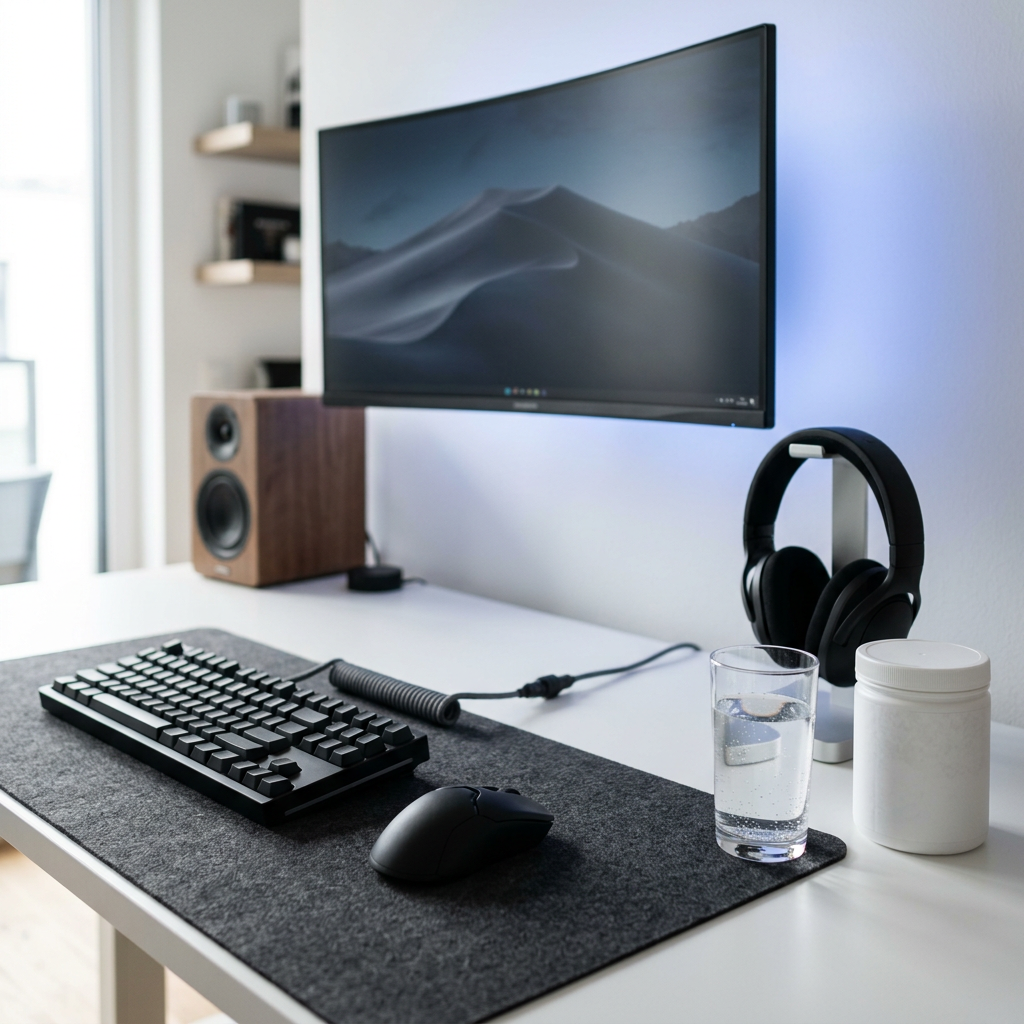
Creatine for Esports and Gaming: Cognitive Performance and Reaction Time
By The Creatine Canada Research Team — Evidence-based supplement analysts
Creatine for esports and gaming can help cognitive performance in specific situations, but it is not a magic reaction-time booster for every gamer. The strongest evidence suggests creatine may support brain energy, mental performance under stress or sleep loss, and possibly some aspects of reaction speed or decision quality, while remaining most proven for physical training and recovery that also matter to esports athletes.
Evidence-based · Cites 4 sources · Editorial standards
Key Takeaways
- Creatine monohydrate is the best-supported form for gamers and esports athletes.
- A simple 3 to 5 g daily dose is enough for most people; loading is optional.
- Creatine is more likely to help when sleep is poor, mental workload is high, or dietary creatine intake is low.
- Do not expect a stimulant-like feeling; benefits are subtle and build over days to weeks.
- Reaction time may improve modestly, but stronger evidence exists for brain energy support than for direct gaming K/D gains.
- Vegetarians, vegans, older adults, and heavy training gamers may respond especially well.
- In Canada, choose a product with an NPN and preferably third-party testing.
Does creatine actually help gaming performance? Yes, but mostly through brain energy support rather than a caffeine-like buzz
Creatine for esports and gaming may help cognitive performance, especially during mentally demanding sessions, sleep restriction, or low dietary creatine intake, but it is not a guaranteed instant reaction-time enhancer for every player.
That distinction matters. When people search for creatine for gaming or creatine for reaction time, they often imagine a fast, obvious effect like caffeine. Creatine does not work that way. Creatine increases the body's stored phosphocreatine, a rapidly available energy reserve that helps regenerate ATP, the cell's immediate energy currency. In muscle, that system clearly supports short, explosive effort. In the brain, the same energy-buffering logic may help maintain performance when mental demand is high.
The most defensible summary is this: creatine and gaming performance are plausibly linked because the brain uses large amounts of energy, and creatine can help support cellular energy availability. That does not mean every healthy, well-rested gamer will suddenly click faster or aim better after one scoop. It means some gamers may notice steadier focus, less mental fatigue, and modest improvements on certain cognitive tasks over time.
This is why creatine makes the most sense for three groups:
- Esports athletes who also train physically, because creatine's sports-performance benefits are already well established.
- Gamers under high cognitive stress, such as long scrim blocks, tournaments, travel, and poor sleep.
- Vegetarians and vegans, who tend to have lower baseline creatine intake from food and may respond more strongly.
The 2017 ISSN position stand concluded that creatine monohydrate is the most effective ergogenic nutritional supplement currently available for increasing high-intensity exercise capacity and lean mass, which matters to esports players who need physical resilience, posture tolerance, and training support as well as screen performance. For a broader primer, see our what is creatine guide.
If your only goal is to feel instantly wired for ranked matches, creatine is the wrong tool. If your goal is to support brain energy, reduce the performance drop from fatigue, and improve your physical training capacity as an esports athlete, creatine is one of the most evidence-based supplements worth considering.
How creatine may help gamers: the brain-energy mechanism behind focus, fatigue resistance, and reaction quality
Creatine may help gaming and esports by supporting the brain's phosphocreatine system, which helps regenerate ATP during periods of high mental demand.
Here is the core mechanism in plain English. Your brain runs on constant energy turnover. ATP is the usable energy molecule that powers neuronal signalling, ion pumping, and other processes required for attention, working memory, and rapid decision-making. Phosphocreatine acts like a fast backup battery: it donates a phosphate group to help restore ATP when demand spikes.
That matters in gaming because fast-paced games are not just visual tasks. They combine:
- continuous attention
- split-second motor decisions
- working memory
- pattern recognition
- stress regulation
- sometimes long periods of sleep debt or travel fatigue
In these settings, creatine mental performance gaming interest makes sense. A gamer's performance can dip not only because of weak mechanics, but because cognitive energy systems are strained. Creatine will not teach strategy or improve game sense, but it may help preserve the brain's energy buffer when the session gets long.
This is also why the evidence is mixed rather than uniformly dramatic. If a young, well-fed, well-rested player already has adequate creatine stores and is tested on a simple task, the extra benefit may be small or hard to detect. If the player is sleep deprived, vegetarian, older, or under intense mental load, the effect may be more noticeable.
Creatine is also being studied more broadly for cognition and brain health, but that literature is still more nuanced than the sports literature. Strong claims that creatine turns you into a nootropic superhuman are not supported. Better claims are these:
- Creatine supports cellular energy buffering.
- The brain uses creatine as part of its energy system.
- Cognitive benefits appear most likely under stress, fatigue, or lower baseline creatine status.
Antonio et al. (2021) reviewed common questions and misconceptions and reinforced that creatine is one of the most studied supplements in sport and health, with a strong overall safety record in healthy people. For deeper reading on the brain side, our creatine and the brain guide expands on memory, focus, and mental energy.
In short, creatine for cognitive esports is biologically plausible because it supports energy availability where mental performance depends on rapid, repeated ATP turnover.
What the research says on creatine, reaction time, and esports-style mental performance
The evidence for creatine and gaming performance is promising but not conclusive, with the best support for brain-energy support under fatigue and more mixed findings for direct reaction-time improvements.
That is the honest, evidence-based answer. Creatine has decades of strong research behind muscle and high-intensity exercise performance. For cognition, the picture is less settled. Some studies and evidence summaries suggest benefits for short-term memory, reasoning, mental fatigue, or performance under sleep deprivation. Direct improvements in simple reaction time are less consistently shown.
Why the inconsistency? There are several reasons:
- Different populations: omnivores, vegetarians, older adults, and sleep-deprived participants do not respond the same way.
- Different tasks: simple button-press reaction tests are not the same as real esports decision-making.
- Different protocols: some studies use loading, others use lower daily doses; durations vary.
- Baseline status matters: people with lower creatine stores may gain more.
Examine's evidence summary is useful here because it synthesizes the broader body of research rather than over-selling one flashy study. The practical takeaway is that creatine seems more likely to help with mental fatigue resistance and energy-demanding cognition than to transform baseline speed in every healthy person. That still matters in esports. In a long tournament day, preserving decision quality late in the schedule can be more valuable than shaving a tiny amount off a fresh, single-trial reflex test.
The most responsible claim for SEO terms like creatine and video games or creatine for esports is this: creatine may support the mental side of esports, but the strongest evidence remains indirect and mechanistic rather than game-specific. Right now, there is not enough high-quality esports-specific clinical research to claim guaranteed improvements in rank, accuracy, APM, or win rate.
Still, if you are an esports athlete who lifts, conditions, travels, and competes under stress, creatine has a strong argument because it may help both sides of the performance equation: physical training and cognitive resilience.
Useful source reading: Examine.com — Creatine evidence summary and Antonio et al. (2021), Common questions and misconceptions about creatine supplementation.
Exactly how to take creatine for esports and gaming, step by step
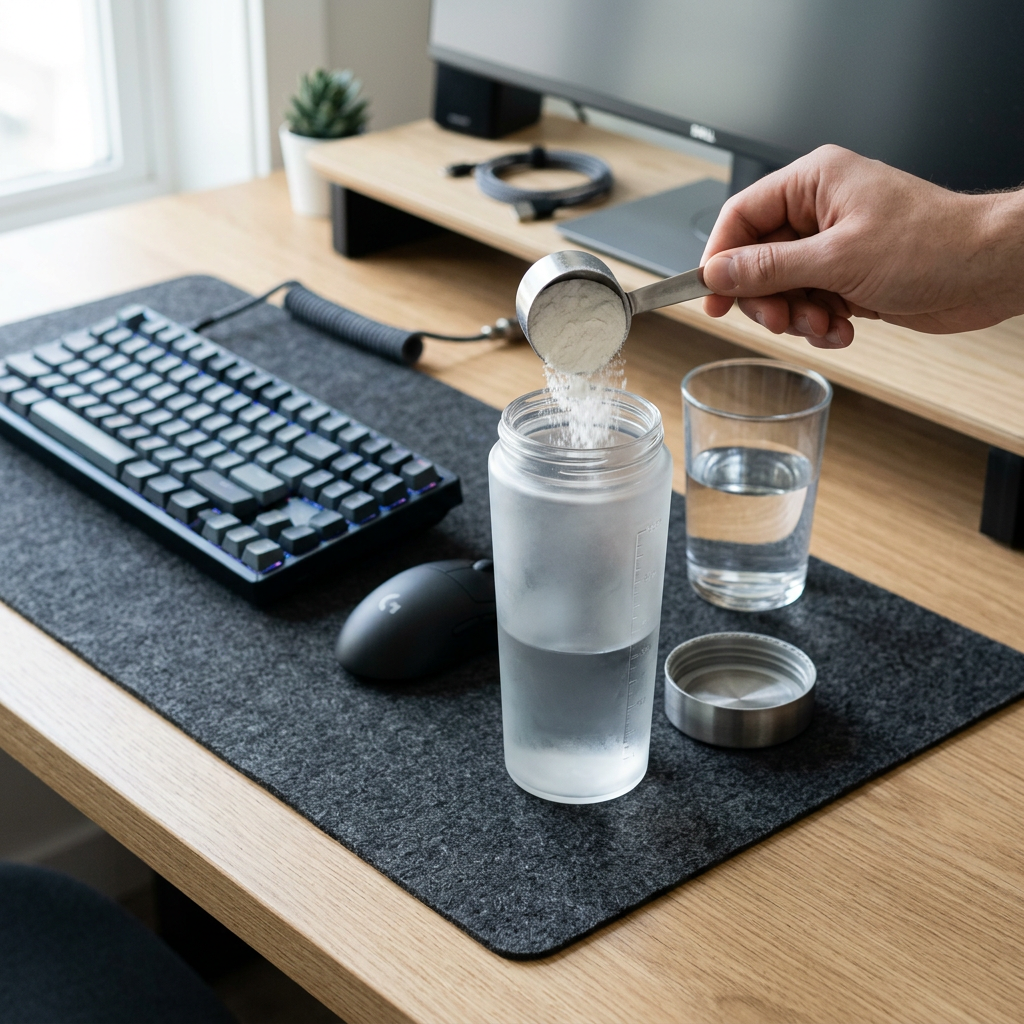
The simplest effective creatine protocol for gamers is 3 to 5 g of creatine monohydrate every day, at any time you will reliably remember.
If you want the practical answer today, follow this:
- Buy plain creatine monohydrate. It is the most studied, the most cost-effective, and the benchmark form against which others are judged. If you need help choosing, see our best creatine rankings and creatine brand reviews.
- Take 3 to 5 g daily. Most adults do well in that range for maintenance and saturation over time.
- Mix it with water, a shake, or coffee if tolerated. The exact liquid matters less than consistency. If texture bothers you, use warm water or read our how to mix creatine guide.
- Take it every day, including non-training and non-gaming days. Creatine works by saturating stores, not by acting acutely like a pre-match stimulant.
- Optional: use a loading phase if you want faster saturation. That usually means 20 g per day split into 4 doses for 5 to 7 days, then drop to 3 to 5 g daily.
- Give it enough time. Without loading, expect roughly 3 to 4 weeks to fully build muscle creatine stores; brain-related effects may also take time and vary by person.
For many gamers, the best habit is to pair creatine with something you already do every morning or after training. Consistency beats perfect timing. If you often forget doses, put the tub near your keyboard setup, coffee station, or protein powder.
What should you expect week by week?
- Days 1 to 7: little or no noticeable cognitive effect unless you loaded.
- Weeks 2 to 4: some users report steadier training output, slightly better mental stamina, or less fade late in long sessions.
- Weeks 4+: benefits are most likely to show as consistency rather than a dramatic sensation.
How do you tell it is working? Not by a sudden buzz. Look for small practical wins: less drop-off in concentration during long blocks, more stable gym performance, slightly better resilience after short sleep, or easier maintenance of performance across repeated matches.
If you want a tailored estimate, use our creatine dosage calculator and our guide on how long creatine takes to work.
Best creatine dose for gamers by body weight, goal, and urgency
Most gamers and esports athletes should use 3 to 5 g of creatine monohydrate daily, while larger athletes or those following formal loading protocols may use more.
You do not need an ultra-precise micro-dose, but body size and goals can guide your choice. The key principle is that creatine works by increasing total body stores over time. The bigger the body, the more total storage capacity there tends to be, especially if you have more lean mass.
| Body weight / goal | Practical daily dose | Best use case |
|---|---|---|
| Under 60 kg | 3 g/day | Smaller adults, beginners, lower-cost maintenance |
| 60 to 90 kg | 3 to 5 g/day | Most gamers and recreational esports athletes |
| Over 90 kg | 5 g/day | Larger athletes, high lean mass, heavier training loads |
| Fast saturation protocol | 20 g/day split into 4 doses for 5 to 7 days, then 3 to 5 g/day | Those wanting stores topped up quickly before an event block or training phase |
How should goal affect dose?
- Pure gaming / cognitive support: 3 to 5 g/day is still the standard.
- Gaming plus gym training: 5 g/day is a sensible default for many adults.
- Vegetarian or vegan gamers: 5 g/day is often reasonable because baseline dietary creatine intake is lower.
- Older adults: 3 to 5 g/day is commonly used, especially when paired with resistance training.
Should you use a body-weight formula? Some sports nutrition guidance uses relative loading protocols, but for real-world use, a flat 3 to 5 g daily maintenance dose is enough for most people. If you want the exact breakdown, our how much creatine per day guide goes deeper.
One practical note for gamers: if you are small-framed, prone to stomach upset, or worried about water-retention changes before a streamed event, start with 3 g/day for two weeks. If all is well, move to 5 g/day only if you want the extra margin of saturation and you tolerate it comfortably.
The dosing message should stay simple: for creatine gamer use, more is not automatically better, and the gold-standard maintenance range remains 3 to 5 g per day.
Should you take creatine before gaming? Timing matters less than daily consistency
You do not need to take creatine right before gaming for it to work, because creatine works through saturation over time rather than an immediate stimulant effect.
This is one of the most misunderstood parts of creatine and gaming performance. If you are searching creatine for reaction time, it is natural to ask whether taking it 30 minutes before queueing up matters. For most people, it does not. Once your tissues are saturated, the exact clock time of the dose has little practical importance.
That means these timing options are all fine:
- with breakfast
- after your workout
- with a protein shake
- before a gaming block simply because it helps you remember
- at night if your stomach tolerates it
The best time is the one you will repeat daily. If you also lift or do physical training, you can take it with your post-workout shake for convenience, but that is mostly habit-building rather than a proven gaming-specific advantage. Read more in our when to take creatine guide.
What about stacking?
- Creatine plus caffeine: generally fine for most people; caffeine gives the acute alertness, creatine supports long-term energy stores. See creatine and caffeine.
- Creatine plus protein: completely normal and convenient, especially if you train. See creatine and protein powder.
- Creatine plus carbs: not necessary, though some people prefer it with a meal.
If you are preparing for a LAN event or tournament weekend, the smartest move is not a pre-match mega-dose. It is making sure your stores are already topped up in the weeks before. Acute last-minute dosing cannot replace chronic consistency.
For gamers sensitive to routine disruption, here is a useful system: take creatine during your first daily anchor habit, then use caffeine separately only when needed for alertness. That separates two very different tools and makes it easier to judge what is actually helping your performance.
The bottom line on timing is simple: treat creatine like a daily nutrition habit, not like a stim pre-game.
Who should consider creatine for esports: beginners, women, older adults, vegetarians, and hybrid athlete-gamers
Creatine can be appropriate for many gamers, but it makes the most sense for people who want support for both cognitive demands and physical training, or who may have lower baseline creatine stores.
That includes more groups than many people think.
- Beginners: Yes, beginners can take creatine. You do not need to “earn the right” to use it. If you are new to lifting and also game heavily, creatine is often one of the few supplements worth buying early because the evidence base is strong.
- Women: Women can absolutely use creatine. It does not make women bulky overnight, and the basic dosing is similar. For more, see creatine for women.
- Older adults: Older gamers or masters competitors may benefit from both the physical and cognitive sides of creatine, especially when resistance training is included.
- Vegetarians and vegans: This may be the highest-priority non-athlete group because dietary creatine intake from meat and fish is lower or absent. See creatine for vegetarians.
- Esports athletes who also train: This is the clearest fit. Better resistance training output, sprint work, or recovery can support posture, durability, and general athleticism around competition.
Who might be especially interested in creatine and esports athletes? Players whose schedule includes:
- long scrim blocks
- travel and sleep disruption
- strength and conditioning sessions
- periods of calorie restriction
- high stress and repeated performance demands
It is also reasonable for casual gamers who simply want broad support for training and brain energy, but expectations should stay realistic. If you do not train, sleep poorly, eat randomly, and hope creatine alone will solve your performance, it will disappoint you. Lifestyle still dominates.
The International Olympic Committee's supplement consensus makes the wider point that supplements should support, not replace, the basics of performance nutrition and recovery. That applies perfectly to gaming. Sleep, hydration, meal regularity, vision breaks, posture, and physical conditioning all matter.
So who benefits most from creatine for esports? Usually the person who treats esports like a real performance domain, not just a screen hobby. Those players get value from both the brain side and the body side.
Safety, side effects, and what Canadians should check before buying a creatine supplement
Creatine monohydrate is widely considered safe for healthy individuals at standard doses, with the most common issues being mild stomach upset or temporary water-weight gain rather than serious harm.
The 2017 ISSN position stand and the 2021 JISSN misconceptions paper both support the strong overall safety profile of creatine in healthy people when used appropriately. Mayo Clinic also notes creatine appears safe when used orally at recommended doses for up to several years in healthy adults.
Common, manageable side effects include:
- Water retention: often a small increase in intracellular water, especially early on or with loading.
- Stomach upset: more likely if you take too much at once or dry scoop it.
- Loose stools: usually a dosing or mixing problem, not proof creatine is “bad for you.”
How to reduce side effects:
- Use 3 to 5 g/day instead of loading if your stomach is sensitive.
- Split larger doses into smaller servings.
- Take it with food if needed.
- Drink adequate fluids and maintain normal hydration habits.
Who should be cautious? Anyone with known kidney disease, significant medical conditions, pregnancy or breastfeeding concerns, or medication questions should speak with a qualified healthcare professional first. Healthy people often confuse creatine with creatinine, a waste marker measured on blood tests. Creatine supplementation can affect creatinine readings without meaning kidney damage, which is why context matters. We cover that more in is creatine bad for your kidneys and is creatine safe.
For Canadians, product quality matters. Check for:
- NPN: a Natural Product Number, which indicates the product is licensed by Health Canada.
- Third-party testing: especially useful for competitive players who also compete in drug-tested sport.
- Clear ingredient list: ideally plain creatine monohydrate with minimal extras.
- Reputable seller: use known retailers and inspect lot details and packaging quality.
If you want comparison shopping help, browse our creatine product catalog. For authoritative external reading, see Kreider et al. (2017), ISSN Position Stand and Mayo Clinic — Creatine.
Common creatine mistakes gamers make, and the myths that still will not die
The biggest creatine mistakes in gaming are expecting instant effects, buying over-marketed forms, skipping doses, and blaming normal water retention on fat gain.
Let us clear up the most common errors and myths.
Myth 1: Creatine is basically a stimulant for gamers.
False. Creatine does not act like caffeine. If you feel nothing immediately, that is normal.
Myth 2: More creatine means faster reaction time.
False. Once standard stores are saturated, taking more is unlikely to provide extra gaming benefits and may just upset your stomach.
Myth 3: Fancy forms like HCL or gaming-specific blends work better than monohydrate.
Usually not supported. Monohydrate remains the reference form because it is the most studied and most cost-effective.
Myth 4: Creatine causes fat gain.
False. Early scale gain is usually water retained inside muscle cells, not body fat. See does creatine make you gain weight.
Myth 5: You need to cycle creatine.
No. Daily continuous use is standard for most healthy users. See do you need to cycle creatine.
Myth 6: Creatine dehydrates you.
This is not supported in the simplistic way it is often repeated. Normal hydration habits are enough for most users.
The practical mistakes are even more important:
- Taking it only on game day: ineffective strategy because saturation matters.
- Dry scooping: pointless and more likely to cause coughing or stomach discomfort.
- Changing multiple variables at once: if you add creatine, pre-workout, sleep debt, and a new diet together, you will not know what is helping.
- Ignoring basics: no supplement can rescue chronic poor sleep, no movement, and an energy-drink-only diet.
A good rule for esports athletes is to think of creatine as infrastructure, not fireworks. It supports the system in the background. That is why the people who benefit most are usually the ones patient enough to run a proper protocol for several weeks.
For a wider myth breakdown, visit creatine myths debunked and our deeper creatine myths vs. facts guide.
Best type of creatine for gaming: monohydrate vs flashy alternatives
Creatine monohydrate is the best type of creatine for esports and gaming because it has the strongest evidence, the best value, and no proven gaming-specific disadvantage versus newer forms.
If you are shopping for a creatine gamer product, brands will try to make this seem complicated. It is not. The question is not which label sounds coolest for focus or esports branding. The question is which form has the best evidence and the fewest reasons to overpay.
| Form | Evidence quality | Best for | Bottom line |
|---|---|---|---|
| Creatine monohydrate | Strongest by far | Almost everyone | Best default choice |
| Micronized monohydrate | Same core evidence as monohydrate | People who want easier mixing | Fine if price is reasonable |
| Creatine HCl | Much smaller evidence base | People who strongly prefer capsule-style or lower-volume servings | No clear proof it works better |
| Buffered / ester / nitrate forms | Limited or less convincing support | Mostly marketing-driven purchases | Usually not worth the premium |
| Gaming blends with stimulants | Creatine benefit mixed with other ingredients | People who specifically want a combo product | Harder to evaluate; often worse value |
For gaming, plain monohydrate has another advantage: clarity. If you also use caffeine, L-theanine, or other performance aids, you want to know what creatine itself is doing. A simple ingredient panel makes that easier.
Canadian buyers should prioritise:
- creatine monohydrate as the first and ideally only active ingredient
- NPN on the package
- third-party testing where possible
- cost per gram rather than just tub price
If texture bothers you, micronized creatine may mix a bit better, but it is still monohydrate at heart. That is a convenience choice, not a superior-performance choice.
For deeper comparisons, see best type of creatine, creatine monohydrate vs. HCL, and best creatine monohydrate in Canada.
The buying conclusion is refreshingly boring: the best creatine for gaming is usually the plain, tested, affordable monohydrate tub you will actually use every day.
What results to expect, how to tell if creatine is helping, and what to do if it seems not to work
If creatine helps your gaming, the changes are usually subtle and cumulative: steadier focus, less late-session fade, and better physical training support rather than an obvious instant reaction-time jolt.
That subtlety is exactly why some gamers wrongly assume it is doing nothing. Ask better questions than “Do I feel hyped?”
Signs creatine may be helping include:
- less mental drop-off in the last hour of a long session
- better consistency across multiple scrims or matches
- slightly improved tolerance to short sleep or travel stress
- better gym strength, sprint, or repeated-effort output if you train
- small early body-weight increase from water retention, especially with loading
If it seems not to work, troubleshoot in order:
- Have you taken it daily for at least 3 to 4 weeks? If not, you may simply not be saturated yet.
- Are you using monohydrate at 3 to 5 g/day? Under-dosed gummies, blends, or proprietary formulas often miss the mark.
- Are your expectations realistic? Creatine is not a stimulant or skill injector.
- Are sleep, hydration, and meals poor? These can drown out subtle supplement benefits.
- Do you already eat a lot of meat and sleep well? Your baseline may already be relatively good, so the margin to improve is smaller.
The concept of a “non-responder” is real but often overstated. Some people gain less from creatine than others, particularly if their baseline stores are already high. But many apparent non-responders are actually inconsistent users, under-dosed users, or people judging the supplement by the wrong sensation.
If your stomach is the issue, reduce the dose temporarily, split it, or switch to micronized monohydrate. If body-weight fluctuation bothers you before competition, avoid loading and use the steady 3 to 5 g/day approach.
For more problem-solving, our creatine not working and creatine non-responders guides go deeper.
The smart evaluation window for creatine and gaming performance is not one match. It is a controlled 4- to 8-week trial with stable sleep, stable caffeine, and daily dosing.
Bottom line: is creatine worth it for esports athletes and serious gamers?
Yes, creatine is worth considering for esports and gaming if you want a safe, evidence-based supplement that may support brain energy under demanding conditions and clearly supports physical training, but you should not expect miracle reflex gains.
That is the balanced verdict. If your question is “Will creatine make me a better gamer overnight?” the answer is no. If your question is “Can creatine support the mental and physical demands of esports over time?” the answer is much more positive.
Creatine earns a place in an esports setup for four reasons:
- It has one of the strongest safety and evidence profiles in sports nutrition.
- It may help preserve cognitive performance when fatigue, stress, or low baseline stores are relevant.
- It clearly supports gym and high-intensity training, which many serious esports athletes now use to improve resilience and recovery.
- It is inexpensive compared with many over-hyped gaming supplements.
Here is the simplest actionable plan:
- Choose a reputable creatine monohydrate product.
- Take 3 to 5 g every day.
- Do that for at least 4 weeks before judging results.
- Keep caffeine, sleep, and training habits stable enough to notice the difference.
- Focus on long-session consistency, not an instant buzz.
For many people, that alone is enough. For others, creatine is one part of a broader performance stack that starts with sleep, protein, hydration, meal timing, movement, and smart caffeine use. As the International Olympic Committee consensus emphasises, supplements work best when the foundations are already in place.
If you want a final one-sentence answer that can stand on its own, use this: Creatine for esports and gaming is most likely to help as a daily brain-and-body support supplement that improves energy buffering over time, especially under high mental demand, rather than as a fast-acting reaction-time stimulant.
Creatine for Esports and Gaming: the practical numbers
- 3–5 g/day Standard daily dose — Effective maintenance range for most adults using creatine monohydrate.
- 20 g/day Typical loading dose — Usually split into 4 doses for 5–7 days if faster saturation is desired.
- 5–7 days Loading timeline — Common period used to raise creatine stores more quickly.
- 3–4 weeks No-loading timeline — Typical time to approach saturation with a steady daily maintenance dose.
Frequently Asked Questions
Does creatine improve reaction time for gaming?
Creatine may improve reaction-related performance in some situations, but it is not a guaranteed reaction-time booster for every gamer. The evidence is more consistent for supporting brain energy and reducing mental fatigue under demanding conditions than for dramatically improving simple reflex speed in healthy, well-rested players.
Is creatine good for esports athletes?
Yes, creatine can be a good fit for esports athletes because it may support both cognitive resilience and physical training performance. That dual benefit matters in modern esports, where players often combine scrims, travel, gym work, and long tournament days rather than just sitting at a desk.
What is the best creatine for gaming?
The best creatine for gaming is plain creatine monohydrate from a reputable brand. Monohydrate has the strongest evidence, the best cost-effectiveness, and no clear gaming-specific disadvantage compared with more expensive forms marketed for focus or esports.
Should I take creatine before gaming?
You can take creatine before gaming, but you do not need to for it to work. Creatine helps by increasing stored creatine over time, so daily consistency matters far more than taking it right before a match or session.
How much creatine should a gamer take?
Most gamers should take 3 to 5 g of creatine monohydrate per day. Smaller adults may do well with 3 g, while larger or more physically active gamers often choose 5 g for a straightforward maintenance protocol.
Can creatine help focus during long gaming sessions?
Creatine may help maintain focus during long gaming sessions by supporting brain energy availability, especially when mental fatigue is high. The effect is usually subtle, so think more in terms of less fade late in a session rather than a dramatic boost in alertness.
How long does creatine take to work for cognitive performance?
Creatine usually takes days to weeks to build up, not minutes, so do not expect same-day cognitive effects. With a loading phase, stores rise faster over about 5 to 7 days; without loading, many people use 3 to 5 g daily for around 3 to 4 weeks before judging results.
Can you take creatine with coffee or energy drinks before gaming?
Yes, most people can take creatine with coffee or an energy drink, although the two supplements do different jobs. Caffeine provides acute stimulation, while creatine supports long-term tissue saturation, so combining them is more about convenience than synergy.
Is creatine safe for gamers who do not work out?
Creatine can still be appropriate for gamers who do not work out, because its role is not limited to muscle performance. That said, the clearest proven benefits remain in exercise performance, so non-training gamers should keep expectations realistic and view creatine as optional rather than essential.
Do gamers need to cycle creatine?
No, gamers do not need to cycle creatine in the usual sense. Standard practice is to take it daily and continuously, as long as it is tolerated and there is no medical reason to stop.