Creatine for Badminton: Speed, Power, and Shuttle Endurance
By The Creatine Canada Research Team — Evidence-based supplement analysts
Yes—creatine can help badminton players by improving repeated explosive efforts, jump power, fast directional changes, and recovery between hard rallies, as long as you use the right dose and account for the small water-weight trade-off. For most badminton athletes, 3 to 5 g of creatine monohydrate daily is the simplest, best-supported protocol.
Evidence-based · Cites 4 sources · Editorial standards
Key Takeaways
- Creatine helps badminton most in repeated high-intensity efforts, not by magically boosting steady-state cardio.
- Creatine monohydrate is the best-studied, most cost-effective form for badminton and other racquet sports.
- A standard maintenance dose is 3-5 g daily; loading at 20 g/day for 5-7 days works faster but is optional.
- Badminton players often notice better late-session pop, quicker recovery between rallies, and improved gym performance within 1-4 weeks.
- A small increase in body mass from intracellular water is common, which can matter more for very speed-sensitive players.
- Take creatine every day, including rest days; timing matters far less than consistency.
- Choose a plain product with clear dosing, a Health Canada NPN when applicable, and preferably third-party testing for sport.
Does creatine help badminton players? Yes—mainly for repeated power, not pure cardio
Yes, creatine for badminton is genuinely useful for many players because badminton is a repeated-sprint, repeated-jump, repeated-acceleration sport rather than a purely aerobic one. Badminton rallies demand fast lunges, split steps, jumps, smashes, recoveries to base, and quick changes of direction, all of which rely heavily on the body’s rapid energy systems.
Creatine helps most when the match or training session includes short, explosive efforts repeated with incomplete rest. That is exactly the profile of badminton, especially in singles with long rallies and deep movement patterns, or doubles with frequent bursts of maximal speed and jumping. The best evidence across team, sprint, power, and intermittent sports shows that creatine improves high-intensity exercise capacity, strength, lean mass, and training quality. The 2017 ISSN position stand concluded that creatine monohydrate is the most effective nutritional supplement currently available for increasing high-intensity exercise capacity and lean body mass during training.
For badminton players, that usually translates into practical benefits such as:
- more pop on jump smashes and overhead attacks
- better repeated acceleration to the shuttle
- less drop-off in explosiveness late in sessions
- better output in gym sessions that support on-court performance
- potentially improved recovery between hard rallies and training bouts
What creatine does not do is turn it into an endurance supplement in the marathon sense. If your only goal is low-intensity aerobic capacity, creatine is not the first tool to reach for. But if your sport depends on producing ATP quickly during repeated bursts, creatine is highly relevant. Badminton clearly fits that category, much like other shuttle and racquet sports.
If you are new to supplementation, start with the basics: learn your daily dose, read up on how to take creatine, and stick to a plain monohydrate product before experimenting with more expensive formats. In short, does creatine help badminton? For most players who train or compete seriously, yes—provided expectations are realistic and the small body-mass increase does not outweigh the performance gain for your specific style of play.
How creatine works in badminton: faster ATP recycling for rallies, jumps, and court coverage
Creatine works for badminton by increasing muscle phosphocreatine stores, which helps your body regenerate ATP faster during brief, intense efforts. ATP, or adenosine triphosphate, is the immediate energy currency your muscles use to contract, and phosphocreatine is the stored compound that rapidly donates a phosphate to rebuild ATP when effort spikes.
That mechanism matters in badminton because many decisive actions happen in seconds, not minutes. A lunge to the forecourt, a recovery push to the rear court, a jump smash, and a reactive chase after a net tumble all place sudden demands on the phosphagen system. When muscle phosphocreatine stores are higher, your body can resynthesise ATP a little faster during and between these explosive movements.
This does not mean every rally becomes easier in a dramatic way. It means the rate-limiting step in repeated power output is slightly improved. Over the course of training, those small gains can matter a lot because they allow:
- more quality reps before fatigue forces technique breakdown
- heavier or faster work in the gym
- better maintenance of power across sets and intervals
- greater training adaptations over weeks and months
Creatine may also support cell hydration and training quality, which can indirectly help muscle retention and strength development. That is one reason players often feel the benefit first in off-court training: better sprint repeatability, stronger lifts, more medicine-ball speed, and improved jumping power. Those qualities then transfer to badminton when the training plan is sensible.
For racquet sports, this is the key nuance: creatine is not mainly about one giant performance jump on day one. It is about improving the energy availability behind repeated explosive actions and the quality of the training that builds those actions. That makes creatine and badminton players a logical match, especially for athletes doing structured strength and conditioning alongside court sessions.
If you want a broader primer on the underlying physiology, see our guide to what creatine is and what it does and our explainer on creatine and ATP. For a research-backed overview, Examine’s creatine evidence summary is also a useful high-level reference.
Who benefits most: singles, doubles, beginners, women, vegetarians, and masters players
Creatine can help many badminton athletes, but the biggest upside usually goes to players who rely on repeated explosiveness, train hard year-round, or start with lower muscle creatine stores. That includes a surprisingly wide range of athletes, from ambitious club players to national-level competitors.
Singles players often benefit because long rallies and full-court movement create repeated high-intensity demands with incomplete recovery. Doubles players can also benefit because the game includes explosive interceptions, jump attacks, rapid drive exchanges, and quick recovery steps, even if rally patterns differ.
Beginners should not think creatine is only for bodybuilders or elite athletes. If you are learning badminton and also doing gym work, creatine can support strength and power development while your movement skills improve. The supplement will not replace footwork, timing, or tactical awareness, but it can support the physical side of development.
Women can use creatine just as effectively as men. The common fear that women will "bulk up" from creatine is misleading. Creatine does not act like a hormone; it supports energy availability in muscle. Some women notice a small scale increase from water stored inside muscle, but that is not body fat. Our guide on creatine for women covers this in more depth.
Vegetarians and vegans may respond particularly well because dietary creatine intake is typically lower when you do not eat meat or fish. Lower starting stores can leave more room for supplementation to help. That is especially relevant for plant-based badminton players trying to maximise training output.
Older adults and masters athletes can also benefit. Badminton after 35, 45, or 55 often becomes a game of preserving repeat power, leg strength, reaction quality, and lean mass while recovering from dense training weeks. Creatine is well-supported in older populations, especially when paired with resistance training.
Who may need more caution? Very light, highly movement-sensitive players who feel even a 1 to 2 kg scale increase affects speed should test creatine in training, not right before a tournament. It can still be worth using, but the personal cost-benefit is more individual in sports where body mass and court speed are tightly linked.
For athletes in drug-tested environments, choose products carefully and review creatine for competitive athletes before buying.
Exactly how to take creatine for badminton: the simplest step-by-step plan
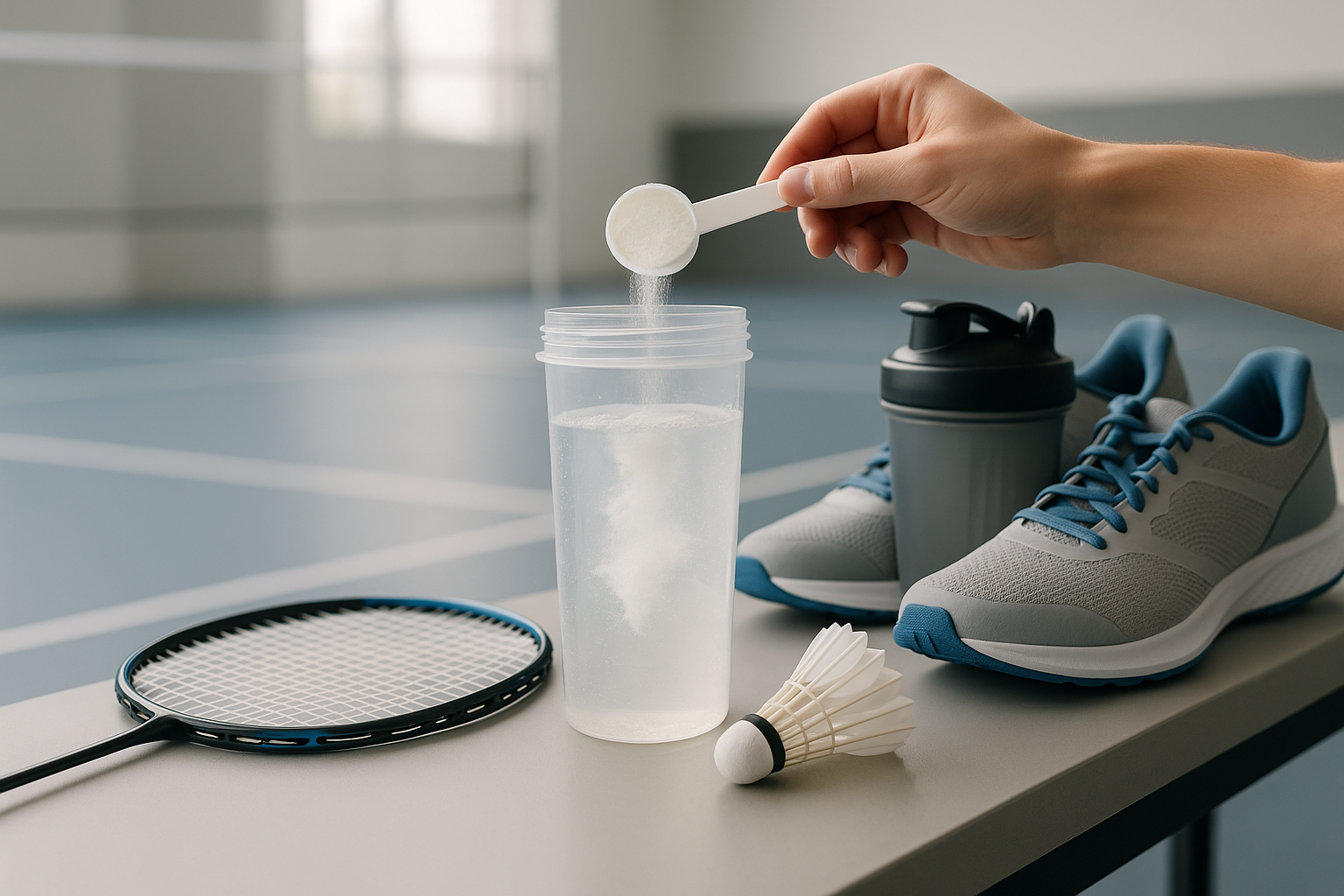
The best way to take creatine for badminton is to use 3 to 5 g of creatine monohydrate every day, with or without food, and keep taking it on rest days. Consistency matters far more than perfect timing.
- Buy the right form. Choose plain creatine monohydrate first. It is the form with the strongest evidence, the best value, and the most reliable dosing. If you need product help, see our best creatine rankings, creatine brand reviews, or product catalog.
- Pick your dose. Most badminton players do well with 3 to 5 g daily. Larger athletes and those doing more strength and sprint work often choose the upper end.
- Decide whether to load. If you want faster saturation, take 20 g/day split into 4 doses of 5 g for 5 to 7 days, then switch to 3 to 5 g/day. If you prefer simplicity or have a sensitive stomach, skip loading and just take 3 to 5 g/day from day one.
- Mix it in a practical liquid. Water is fine. Juice, a shake, or a post-training drink is also fine. Warm liquid can improve dissolving, but it is not required.
- Take it daily. Training days, match days, rest days, travel days—it all counts. Muscle creatine stores rise from regular intake, not from one perfectly timed serving.
- Track real outcomes. Watch for better gym reps, less late-session fade, stronger jumps, or more repeat sprint quality over 2 to 4 weeks.
A simple example protocol:
- Monday to Sunday: 5 g after breakfast or after training
- Match day: still take your normal 3 to 5 g; no special "booster" dose is needed
- If stomach upset occurs: split the dose into 2 to 3 smaller servings and take with food
If you are unsure where to start, use our creatine dosage calculator. For a detailed beginner walkthrough, see creatine for beginners and how to take creatine. The short version is simple: take enough, take it daily, and give it time to saturate your muscles.
Creatine dosage for badminton by body weight and goal
The right creatine dose for badminton is usually 3 to 5 g per day, but body size and your goal can justify small adjustments within that range. The most evidence-based universal recommendation is still simple monohydrate taken daily.
If you want a more tailored approach, a classic loading strategy uses roughly 0.3 g per kg of body weight per day for 5 to 7 days, followed by a maintenance intake around 0.03 g per kg per day. In practice, that usually lands most badminton players in the familiar 3 to 5 g daily range for maintenance.
| Player profile | Goal | Suggested protocol | What to expect |
|---|---|---|---|
| 55-65 kg player | General performance support | 3 g/day monohydrate | Steady saturation over about 3-4 weeks without loading |
| 65-80 kg player | Most club and competitive badminton | 4-5 g/day monohydrate | Better repeat power and gym output over 2-4 weeks |
| 80+ kg player | Power, strength, heavier training load | 5 g/day monohydrate | Most practical standard maintenance dose |
| Any body weight | Fast saturation before a training block | 20 g/day split into 4 x 5 g for 5-7 days, then 3-5 g/day | Quicker effect, but higher chance of GI discomfort or temporary extra water weight |
| Any body weight | Sensitive stomach | 3-5 g/day, split into 2 smaller servings if needed | Slower build-up, usually better tolerance |
Goal matters too. If your main target is on-court repeat explosiveness, standard maintenance is enough. If you are entering a heavy strength phase to build leg power, jump ability, and upper-body hitting force, using 5 g/day is reasonable for most adults. If you need the benefit quickly ahead of a pre-season camp, loading is a practical option.
The most common mistake is underdosing because a flavoured product provides only 2 or 3 g per serving unless you use multiple scoops. Always read the label carefully. If you want a deeper dosing breakdown, visit how much creatine per day and creatine maintenance dose.
For badminton and other shuttle sports, precision matters less than consistency. The best dose is the one you will actually take every day for long enough to stay saturated.
Best timing, loading, and week-by-week results for badminton players
The best time to take creatine for badminton is simply the time you will remember to take it every day, because saturation matters more than clock timing. Pre-match, post-match, morning, and evening can all work if your daily intake is consistent.
There is no strong evidence that badminton players need a special pre-rally or pre-game creatine dose. Creatine is not a stimulant and does not work like caffeine. It helps by gradually raising muscle creatine stores over days to weeks. That means the timeline looks like this:
- With loading: many players notice effects within about 5 to 10 days.
- Without loading: many players notice effects within about 2 to 4 weeks.
- Over 6 to 12 weeks: the bigger benefit often comes from better training quality, not just a single-session boost.
A realistic badminton-specific timeline:
- Week 1: if loading, body weight may rise slightly as water is drawn into muscle; some players feel fuller muscles or improved gym performance.
- Week 2: repeated jump, sprint, and strength work may feel a little more sustainable; less drop-off across hard drills is common.
- Weeks 3-4: on-court benefits become easier to notice, especially in longer sessions and late rallies.
- Weeks 5-8: gains in strength, lean mass, and explosive training quality can compound if your programme is solid.
So should you time it around badminton training? If it helps adherence, yes. A convenient approach is taking your dose after training in a shake or with a meal. But if you always forget post-training nutrition, breakfast is just as good. Our guides on when to take creatine, how long creatine takes to work, and the creatine loading phase go deeper.
One more practical point: do not stop taking creatine on off-days or tournament taper days. Muscle stores gradually stay elevated through daily use. Missing one day is not a crisis, but routine inconsistency is one of the biggest reasons players think creatine is “not working.”
The key trade-off in badminton: more power vs. a small increase in body mass
The main downside of creatine for badminton is that it commonly increases body mass slightly, usually because more water is stored inside muscle cells rather than because you gained fat. For many players, that trade-off is worth it; for some very speed-sensitive athletes, it needs testing.
This matters more in badminton than in some gym-only settings because your sport is a constant contest between force production and movement efficiency. A player who gains a little intracellular water may feel stronger and more explosive, yet also slightly heavier on court. The effect is highly individual. Some athletes barely notice any change; others feel it more clearly during repeated lunges or long singles matches.
Here is the honest framework:
- If you are under-muscled or physically underpowered, creatine is often a clear net positive.
- If you are already strong but fade late in sessions, creatine often helps repeated efforts and training quality.
- If you are extremely light, movement-dependent, or close to a target body weight, trial it in training before important competition.
The body-mass increase is usually most noticeable during the first 1 to 3 weeks, especially if you load. That is one reason many badminton players prefer skipping a loading phase and using 3 to 5 g/day instead: slower saturation often means a gentler change on the scale.
If you are worried about “getting bulky,” separate three different ideas:
- water in muscle: common and often helpful for performance
- fat gain: creatine does not directly cause this
- muscle gain: possible over time, mainly because you train better
For more on the scale issue, read does creatine make you gain weight and does creatine cause bloating. The short answer is that most badminton athletes should think in terms of performance-to-mass ratio. Test creatine in a normal training block, monitor your body weight and court feel, and decide based on actual movement quality rather than internet fear.
Safety, side effects, hydration, and what badminton players should watch
Creatine monohydrate is one of the best-studied sports supplements available, and for healthy people using standard doses, it has a strong safety profile. The 2021 JISSN review on common creatine questions and misconceptions concluded that many long-standing fears about creatine are not supported by the evidence.
The most common side effects are practical, not dangerous:
- mild stomach upset if you take too much at once
- temporary scale increase from water retention inside muscle
- occasional bloating feelings, especially with large loading doses
For badminton players, the hydration question comes up constantly because indoor halls can be hot and sweaty environments. Creatine does not dehydrate you in the way many old myths claim. In fact, because creatine increases intracellular water, the idea that it automatically causes dehydration or cramps is not supported by current evidence. That said, badminton athletes still need good hydration habits because the sport itself can create major fluid losses through sweat.
Smart practical rules:
- drink to thirst and ensure normal day-to-day hydration
- use extra fluids around hot sessions and tournaments
- consider electrolytes for long, sweaty sessions, but do not confuse them with creatine itself
- if loading causes GI discomfort, split doses more evenly or skip loading
Who should speak with a healthcare professional first? Anyone with pre-existing kidney disease, significant medical conditions, pregnancy or breastfeeding questions, or medication concerns should get personalised advice before supplementing. Healthy athletes with normal kidney function generally tolerate standard creatine use well, but individual medical context still matters. The Mayo Clinic overview on creatine is a reasonable patient-friendly reference if you want a conservative mainstream summary.
If blood work is involved, remember that creatine supplementation can affect creatinine, a lab marker related to creatine metabolism, which can confuse interpretation if your clinician does not know you supplement. That does not automatically mean kidney damage. Our safety guides on is creatine safe, creatine and kidneys, and digestive side effects explain the details.
Best creatine for badminton in Canada: what to buy, what to ignore, and how to compare
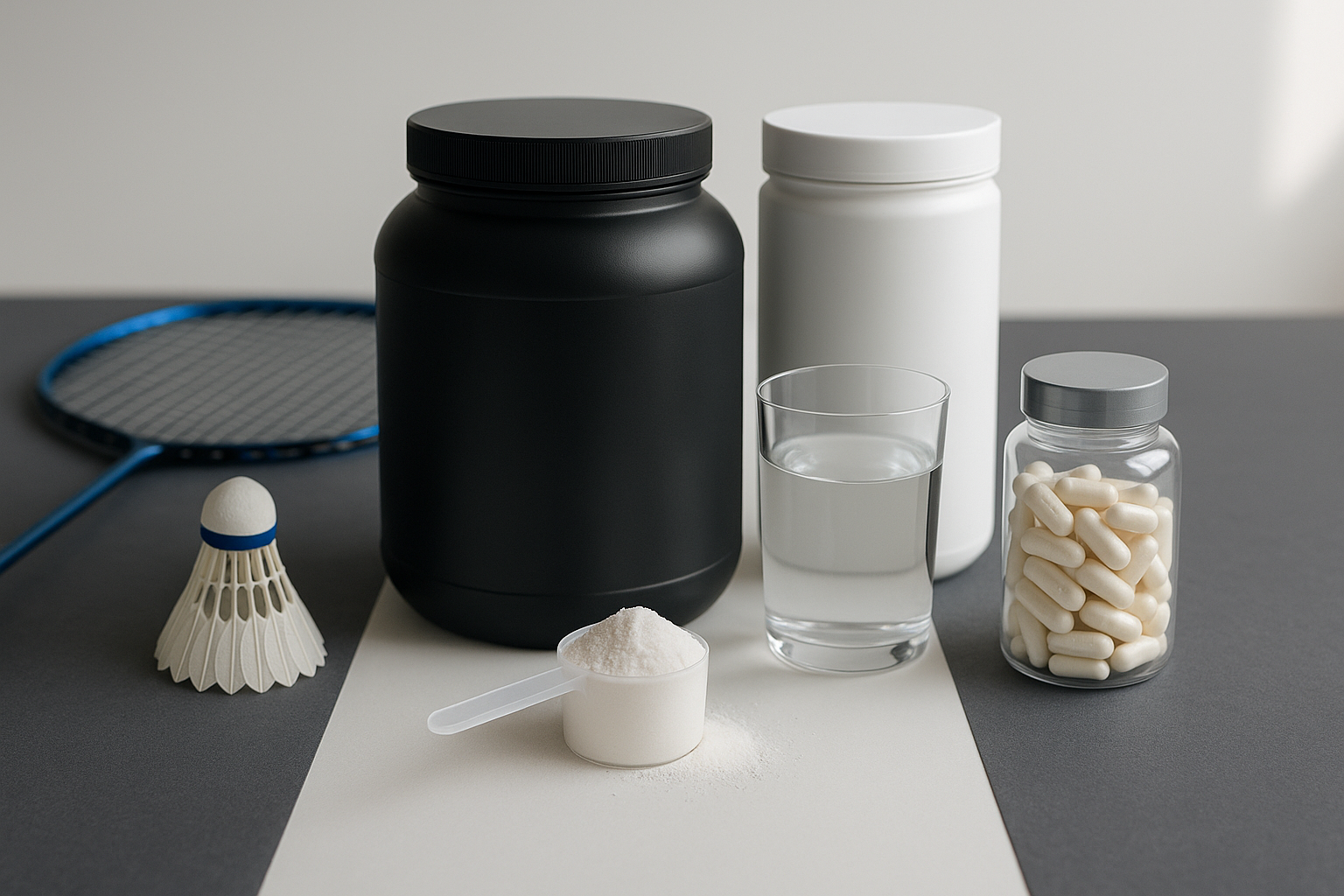
The best creatine for badminton players in Canada is almost always a plain creatine monohydrate powder with transparent dosing and reliable quality controls. Most premium claims beyond that are marketing before they are science.
Badminton players do not need a racquet-sport-specific creatine blend. They need the form with the strongest evidence and the fewest variables. That means monohydrate first, preferably unflavoured if you want maximum value per gram and simple dosing.
| Option | Best for | Pros | Cons |
|---|---|---|---|
| Creatine monohydrate powder | Almost everyone | Most studied, cheapest per gram, easy to dose at 3-5 g | Can feel gritty if not mixed well |
| Micronized monohydrate | Players who dislike texture | Usually mixes better, same active ingredient | Often slightly more expensive |
| Capsules | Travel or convenience | No mixing, easy to pack for tournaments | More expensive and often many capsules per dose |
| Gummies/chews | Taste-first users | Convenient and approachable | Usually poor value and sometimes underdosed |
| HCl or exotic forms | Rarely necessary | Marketed as easier on stomach | Less evidence, usually pricier, no clear performance edge |
For Canadian buyers, look for:
- clear serving size in grams, not vague proprietary blends
- a Natural Product Number, or NPN, when applicable, which is Health Canada’s product licence identifier for natural health products sold in Canada
- third-party testing or sport certification if you are tested or risk-averse
- minimal extra ingredients unless you specifically want flavouring
If you compete, third-party testing matters more than trendy branding. A clean plain powder from a reputable company is usually the smarter choice than a flashy “performance matrix.” For help comparing options, see best creatine rankings, best creatine monohydrate in Canada, third-party tested creatine in Canada, and how to choose creatine.
Bottom line: creatine for racquet sports does not require a special formula. Buy quality monohydrate, verify the dose, and avoid paying a premium for claims that do not outperform the gold standard.
Common badminton creatine mistakes and myths, debunked clearly
Most problems with creatine in badminton come from bad expectations, bad dosing, or old myths—not from the supplement itself. If you avoid a few common mistakes, creatine is usually straightforward.
Myth 1: Creatine is only for bodybuilders. False. Creatine is useful in any sport that depends on repeated high-intensity effort, including badminton, tennis, squash, hockey, and sprint-based field sports.
Myth 2: Creatine ruins agility because it makes you heavy. Not exactly. Creatine can increase body mass slightly, but whether that hurts or helps your badminton depends on the balance between added power and any movement trade-off. Many players improve overall performance.
Myth 3: You must load creatine. False. Loading is optional. It saturates muscles faster, but 3 to 5 g/day without loading works just fine if you are patient.
Myth 4: Creatine dehydrates you and causes cramps. Current evidence does not support that blanket claim. Hydration still matters in badminton, but creatine itself is not a proven cramp trigger.
Myth 5: Creatine is a stimulant you feel immediately. False. Creatine is not caffeine. It works by building up muscle stores over time.
The biggest real-world mistakes:
- Taking it only on workout days. This slows or prevents full saturation.
- Using too little. Some products underdose per scoop; check the grams.
- Switching forms constantly. Monohydrate is enough for almost everyone.
- Judging it after three days. Without loading, you may need 2 to 4 weeks.
- Starting right before a key tournament. Trial it in training first, especially if you are sensitive to body-mass changes.
If you think creatine is not helping, ask four questions: Am I taking enough? Am I taking it every day? Have I given it enough time? Am I expecting endurance effects that creatine is not designed to deliver? Those questions solve most cases.
For a deeper myth-by-myth breakdown, see creatine myths debunked, creatine not working, and common creatine mistakes. Clear thinking beats supplement hype every time.
What to stack with creatine for badminton—and what matters more than supplements
Creatine is often the best first supplement for badminton players, but it works best when the rest of your programme is already sound. No stack can compensate for poor sleep, low protein intake, under-fuelling, or weak strength training.
If you want to build a simple evidence-based badminton supplement setup, the order of importance is usually:
- Creatine monohydrate: for repeated power and training quality
- Protein powder if needed: to help hit daily protein targets conveniently
- Caffeine used strategically: for alertness and perceived effort, if tolerated
- Electrolytes/carbohydrates around long sessions: especially in hot halls or tournaments with multiple matches
Creatine pairs well with protein powder simply because it makes adherence easy. Many players take both in one post-training shake; that is practical, not magical. If that interests you, read can you mix creatine with protein powder. Caffeine can also be used alongside creatine, and the old idea that they cancel each other out is overstated; see creatine and caffeine for the nuance.
For badminton specifically, the bigger performance return often comes from using creatine to support better training in these areas:
- lower-body strength for braking and push-off power
- reactive jumps and pogo work for first-step quickness
- medicine-ball rotational and overhead power for smash mechanics
- repeat sprint and change-of-direction intervals
- high-quality skill sessions where fatigue does not wreck footwork
If you are deciding between creatine and other popular options, creatine usually beats BCAAs, "test boosters," and most flashy pre-workout formulas on evidence and value. It is also far more relevant to badminton performance than muscle-pump ingredients marketed at gym aesthetics.
The International Olympic Committee’s 2018 consensus on supplements placed creatine among the few supplements with evidence for performance benefits in appropriate scenarios. That is one reason it remains a staple in serious sports nutrition.
The practical lesson is simple: use creatine as a foundation, not as a shortcut. The best badminton supplement stack is still built on training, recovery, hydration, and enough food to support speed and power.
Bottom line: when creatine is worth it for badminton, and when it may not be
Creatine is worth it for many badminton players because it can improve repeated explosive performance, support better strength and power training, and reduce late-session drop-off, all with a strong evidence base and low cost. For most athletes, the best protocol is 3 to 5 g of creatine monohydrate every day.
If your badminton depends on sharp acceleration, jump power, fast recovery between rallies, and maintaining output over long sessions, creatine is one of the few supplements that makes physiological sense and has the research support to justify using it. That is why badminton supplements creatine searches are so common: the fit is real, not just marketing.
Creatine may be especially worth it if you:
- do regular strength and conditioning
- play singles or high-volume doubles
- fade late in matches or training sessions
- are vegetarian or vegan
- want a low-risk, evidence-based supplement rather than a stimulant-heavy product
Creatine may be less compelling, or at least more individual, if you:
- are extremely sensitive to small body-mass increases
- have no structured training and expect miracles from supplementation alone
- have a medical condition that needs clinician oversight
- need immediate results but are unwilling to load or wait for saturation
The smartest approach is to test creatine in a normal 4- to 8-week training block, not during a major tournament week. Track body weight, jump feel, repeat sprint quality, and on-court freshness late in sessions. If performance improves and you feel fine, keep it in. If the body-mass trade-off clearly hurts your movement, adjust or stop.
So, creatine badminton: yes, for most players it is a sensible, evidence-based tool. Just use plain monohydrate, dose it properly, keep expectations realistic, and let your actual on-court response decide.
Creatine for Badminton: The Numbers That Matter
- 3-5 g/day Standard daily maintenance dose — Works well for most badminton players once used consistently.
- 20 g/day Typical loading dose — Usually split into 4 doses for 5-7 days to saturate faster.
- 5-7 days Fast saturation timeline with loading — Many athletes notice effects sooner when using a loading phase.
- 2-4 weeks Typical time to notice effects without loading — Consistency matters more than timing for muscle saturation.
Frequently Asked Questions
Does creatine help badminton players specifically, or just gym athletes?
Yes, creatine can help badminton players specifically because badminton relies on repeated explosive efforts such as lunges, jumps, accelerations, and fast recoveries between rallies. The biggest benefits are usually better repeated power, improved training quality, and less performance drop-off late in sessions rather than a huge boost in steady aerobic endurance.
Is creatine good for racquet sports like badminton, tennis, and squash?
Yes, creatine is often a good fit for racquet sports because these sports demand short bursts of power repeated many times with incomplete rest. Badminton, tennis, and squash all use rapid ATP turnover during accelerations and shot production, so creatine’s role in replenishing high-energy phosphate stores is relevant.
Will creatine make me slower on the badminton court?
Creatine can make some badminton players feel slightly heavier at first because it often increases intracellular water in muscle, but it does not automatically make you slower. Whether it helps or hurts depends on whether the added power and repeatability outweigh any small increase in body mass for your style of play.
What is the best creatine for badminton players?
The best creatine for badminton players is usually plain creatine monohydrate powder. It is the most studied form, the most cost-effective form, and the form with the strongest evidence for improving high-intensity performance and training adaptations.
How much creatine should a badminton player take?
Most badminton players should take 3 to 5 g of creatine monohydrate per day. A loading phase of 20 g/day split into 4 doses for 5 to 7 days can speed up saturation, but it is optional and not necessary for creatine to work.
Should I take creatine before or after badminton?
You can take creatine before or after badminton, but the exact timing matters much less than taking it every day. Creatine works by gradually saturating muscle stores over time, so the best timing is whichever routine you can follow consistently.
How long does creatine take to work for badminton?
Creatine usually starts working within about 5 to 10 days if you use a loading phase, or around 2 to 4 weeks if you take a standard daily dose without loading. Many badminton players first notice the effect in gym performance, repeat sprint quality, or reduced late-session fatigue.
Can women badminton players take creatine?
Yes, women badminton players can absolutely take creatine, and the evidence does not suggest it is only for men. Women often use the same 3 to 5 g daily protocol, with the main practical consideration being the same as for everyone else: whether the small water-weight increase feels worthwhile for performance.
Is creatine safe for badminton athletes?
Creatine is considered safe for most healthy badminton athletes when used at standard doses such as 3 to 5 g per day. The best-supported concerns are mild digestive upset and temporary water-weight gain, while broader fears about kidney damage in healthy users are not supported by the mainstream evidence base.
Do I need to cycle creatine during badminton season?
No, most badminton players do not need to cycle creatine during the season. Creatine works best when taken consistently to keep muscle stores saturated, and there is no evidence-based reason healthy users must take routine off-cycles.