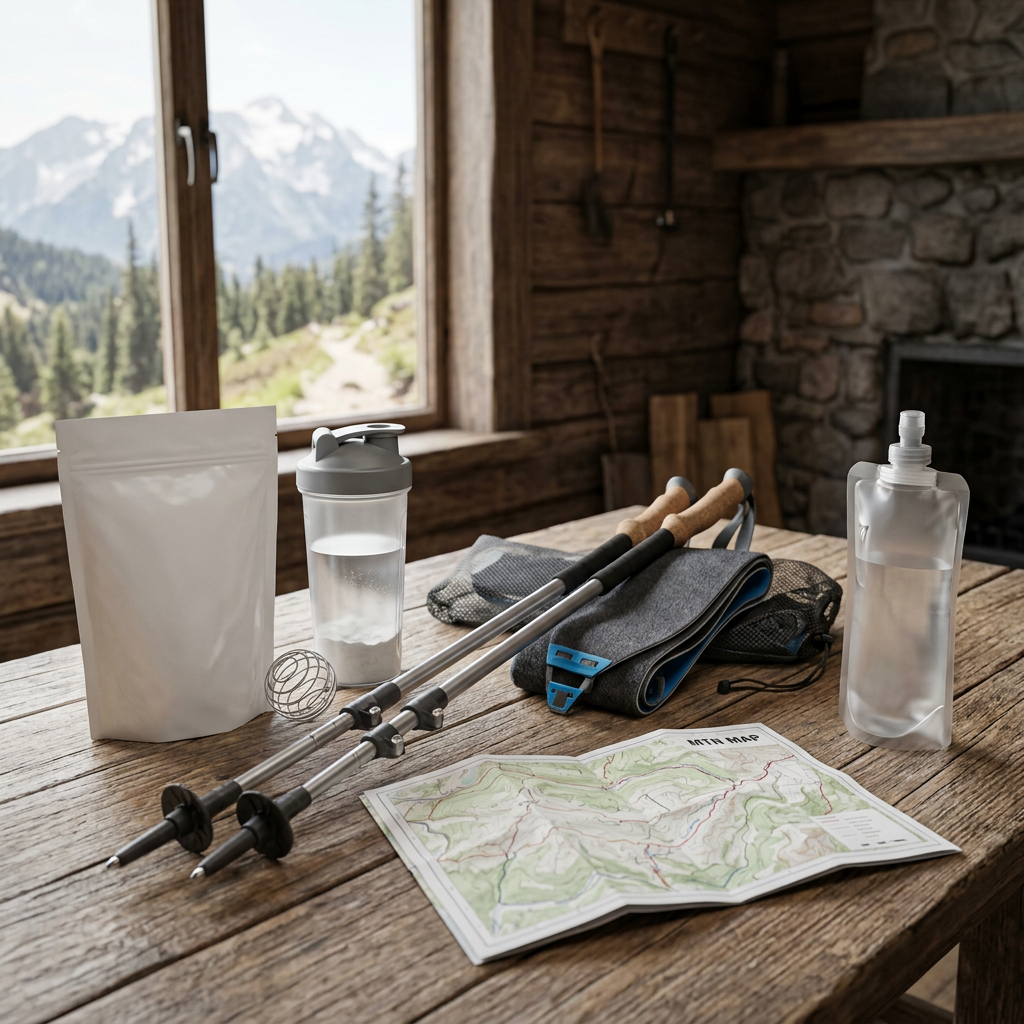
Creatine for Adventure and Outdoor Sports: Hiking, Skiing, and Beyond
By The Creatine Canada Research Team — Evidence-based supplement analysts
Yes—creatine for outdoor and adventure sports can help, especially when your sport includes repeated hard efforts such as steep climbs, kick turns, skinning, sprinting to a crux, carrying a pack, or powerful turns on fatigued legs. The best-supported use is 3–5 g of creatine monohydrate daily to improve high-intensity repeat performance, strength, training quality, and recovery capacity, with the main trade-off being a small increase in body water.
Evidence-based · Cites 4 sources · Editorial standards
Key Takeaways
- Creatine helps outdoor athletes most when performance depends on repeated short, hard efforts layered into longer days.
- Creatine monohydrate is the most-studied, most reliable, and usually best-value form for hiking, skiing, climbing, paddling, and expedition prep.
- Take 3–5 g daily; a loading phase of about 20 g/day split into 4 doses for 5–7 days works faster but is optional.
- Expect faster benefits for gym training, steep climbs, sprints, and pack carries than for pure steady-state aerobic output.
- A small body-mass increase from extra intracellular water is common, so ultralight and weight-sensitive athletes should test it before key trips.
- Creatine does not dehydrate you, and it is not banned; hydration, sodium, and overall fuelling still matter more in the mountains.
- For Canadian buyers, choose a plain monohydrate product with an NPN when applicable and, ideally, third-party testing for purity and sport safety.
Does creatine help in outdoor and adventure sports? Yes—but mainly for the hard efforts inside long days
Yes, creatine for outdoor and adventure sports is useful when your performance is limited by repeated high-force efforts, not just by pure low-intensity endurance. In practical terms, creatine is most likely to help hikers on steep ascents, backcountry skiers making repeated kick turns and punchy climbs, climbers pulling through powerful sequences, paddlers accelerating repeatedly, and expedition athletes who need to preserve strength and work capacity under fatigue.
The reason is simple: creatine increases your muscle stores of phosphocreatine, the rapidly available energy reserve used to regenerate ATP, the cell’s immediate energy currency, during short bouts of intense work. The 2017 ISSN position stand concluded that creatine monohydrate is the most effective nutritional supplement available for increasing high-intensity exercise capacity and lean mass during training when used appropriately. That matters outdoors because many “endurance” adventures are not truly steady-state. A long hike may include dozens of near-threshold surges over ledges, creek crossings, loaded carries, and steep pushes where leg power and repeatability decide how strong you finish.
What creatine does not reliably do is transform pure aerobic engine performance on its own. If your event is mostly easy-pace locomotion with minimal surging, the direct payoff may be modest and the small body-mass increase may matter more. That is why creatine for hiking or creatine and altitude sports should be framed as a tool for strength-endurance support, not a magic bullet for VO2 max.
For most outdoor athletes, the best use case is indirect as much as direct: creatine helps you train harder in the gym and on hill intervals, which can improve the qualities that make mountain days feel easier. If you are new to the supplement, start with plain monohydrate and keep the protocol boring and consistent. Our creatine dosage calculator and guide to how to take creatine make the setup straightforward.
Bottom line: creatine adventure sports benefits are real, but they are strongest for repeated power, muscular endurance under load, and maintaining quality when fatigue accumulates.
Why creatine can matter on trails, skin tracks, and big mountain days
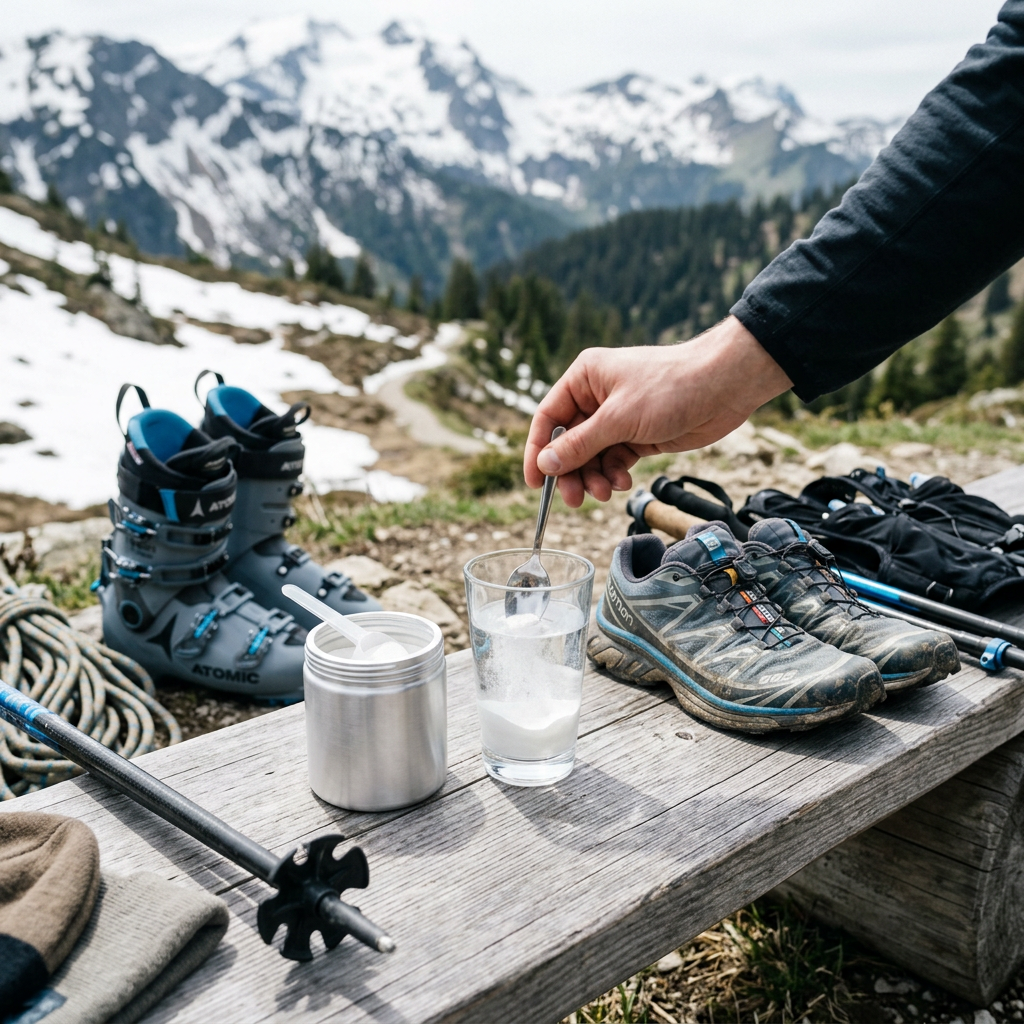
Creatine works by improving rapid energy recycling in muscle, which is exactly what many outdoor athletes need during repeated surges. When you climb a steep switchback, step up onto a high rock, accelerate a bike over a rise, or drive hard out of a turn on skis, your muscles rely heavily on phosphocreatine to quickly rebuild ATP for the first seconds of hard work.
Supplementing with creatine raises muscle phosphocreatine stores over time, which can improve your ability to produce force repeatedly, recover between bursts, and maintain power deeper into a session. This is why creatine is consistently stronger for intervals, sprints, lifting, jumping, and repeated-effort sport than for continuous submaximal exercise. Outdoor sport often mixes both. Alpine sports are a classic example: skinning for hours is mostly aerobic, but technical terrain, transitions, boot packs, kick turns, and steep cruxes repeatedly spike intensity.
Creatine may also help outdoor athletes by supporting training adaptation. Better gym sessions can mean stronger quads for descents, better posterior-chain endurance for pack carries, and more resilient upper body strength for poles, scrambling, or paddling. Over weeks and months, the training effect often matters more than the acute “feel” of the supplement.
There is also interest in creatine and altitude sports because altitude, sleep disruption, caloric deficits, and cold can all raise the cost of maintaining physical and cognitive performance. The evidence here is more limited than the evidence for strength and repeated sprint work, so claims should stay modest. Creatine is not an altitude supplement in the way iron or acclimatization strategy can be, but it may still be useful because it supports cellular energy buffering when conditions are demanding.
According to Antonio et al. (2021) in JISSN, many common fears about creatine are unsupported, while its ergogenic value in high-intensity contexts is well established. If you want the broader basics first, read what creatine is and then come back to apply it to mountain sport.
The key takeaway is mechanism-based: creatine does not replace endurance training, but it can improve the high-cost moments that often determine how well an outdoor athlete moves through demanding terrain.
Which outdoor sports benefit most from creatine, and which should think twice
Creatine benefits outdoor athletes most when their sport demands repeated bursts of force, technical power, or heavy loaded movement. The more your day includes surging above an easy aerobic pace, the better the odds that creatine is worth using.
Outdoor sports and scenarios where creatine often makes sense:
- Backcountry skiing and ski mountaineering: repeated climbs, kick turns, steep transitions, boot packs, and leg power for descents on tired legs.
- Hiking with vertical gain or pack weight: steep hiking, scrambling, uphill hiking under load, and long descents that reward stronger quads and glutes.
- Rock climbing and bouldering: short, powerful moves, repeated attempts, and finger-arm-shoulder power, though weight trade-offs matter.
- Mountain biking and gravel racing: punchy climbs, attacks, accelerations out of corners, and strength support in the gym.
- Paddling sports: repeated starts, accelerations, technical strokes, and upper-body strength endurance.
- Obstacle racing and adventure racing: carries, climbs, crawls, and repeated high-output segments embedded in long events.
- Expedition training blocks: preserving strength and muscle during heavy volume and energy stress.
Cases where the decision is more individual:
- Ultralight hiking or fastpacking: even a small body-mass increase may feel unwelcome if pace economy matters more than punchy power.
- Long, steady efforts with minimal surging: creatine may help training quality more than event-day performance.
- Climbing disciplines where power-to-weight is everything: some climbers love the power gain; others dislike the scale change.
This is why “creatine for outdoor sports” is not one answer for everyone. A backcountry skier doing strength work and interval climbs often gets more from creatine than a minimalist thru-hiker moving at one moderate pace all day. Likewise, creatine alpine sports use is most compelling in technical, repeated-effort terrain rather than pure low-output slogging.
If you are unsure, run a simple self-test: use creatine for 6–8 weeks during normal training, then compare uphill intervals, loaded carries, gym numbers, and how your legs hold up on descents. If you want sport-specific context, our guides on creatine for skiing and snowboarding, creatine for rock climbing, and creatine for endurance athletes help narrow the trade-offs.
Exactly how much creatine to take for hiking, skiing, climbing, and expedition prep
For nearly all outdoor athletes, the right creatine dose is 3–5 g of creatine monohydrate per day, every day. That dose is enough to gradually saturate muscle stores in most adults, while a loading phase of about 20 g/day split into 4 doses for 5–7 days saturates faster.
Body weight can guide whether you sit closer to 3 g or 5 g. Smaller athletes often do well at 3 g/day, while larger athletes and those with more muscle mass usually choose 5 g/day. Some practitioners also use approximately 0.1 g/kg/day as a practical maintenance rule, which lands most people in the same range.
| Goal / Athlete type | Suggested approach | What to expect |
|---|---|---|
| Beginner hiker or recreational outdoor athlete under ~70 kg | 3 g/day monohydrate | Gradual saturation over about 3–4 weeks with minimal fuss |
| Most outdoor athletes ~70–100 kg | 5 g/day monohydrate | Reliable maintenance dose and easiest all-purpose protocol |
| Need faster results before a training block | 20 g/day for 5–7 days split into 4 x 5 g, then 3–5 g/day | Quicker saturation, but higher chance of stomach upset or quick scale increase |
| Weight-sensitive climber or fastpacker | 3 g/day, no loading | Slower uptake and smaller short-term body-mass jump |
| Heavy strength-focused skier, paddler, or expedition athlete | 5 g/day, optionally after loading | Best fit when strength and repeated force matter a lot |
Examples: a 60 kg hiker could start at 3 g/day; an 80 kg backcountry skier would usually choose 5 g/day; a 95 kg paddler or pack-carry heavy athlete would also typically use 5 g/day. The exact gram is less important than daily consistency.
If you want precision, use our creatine dosage calculator or the full guide on how much creatine per day. If you are considering loading, read creatine loading phase first so you know the pros and cons.
The evidence-based default is plain: do not overcomplicate this. For creatine for expedition athletes, more is not better. Enough to saturate is enough.
A simple step-by-step creatine protocol outdoor athletes can start today
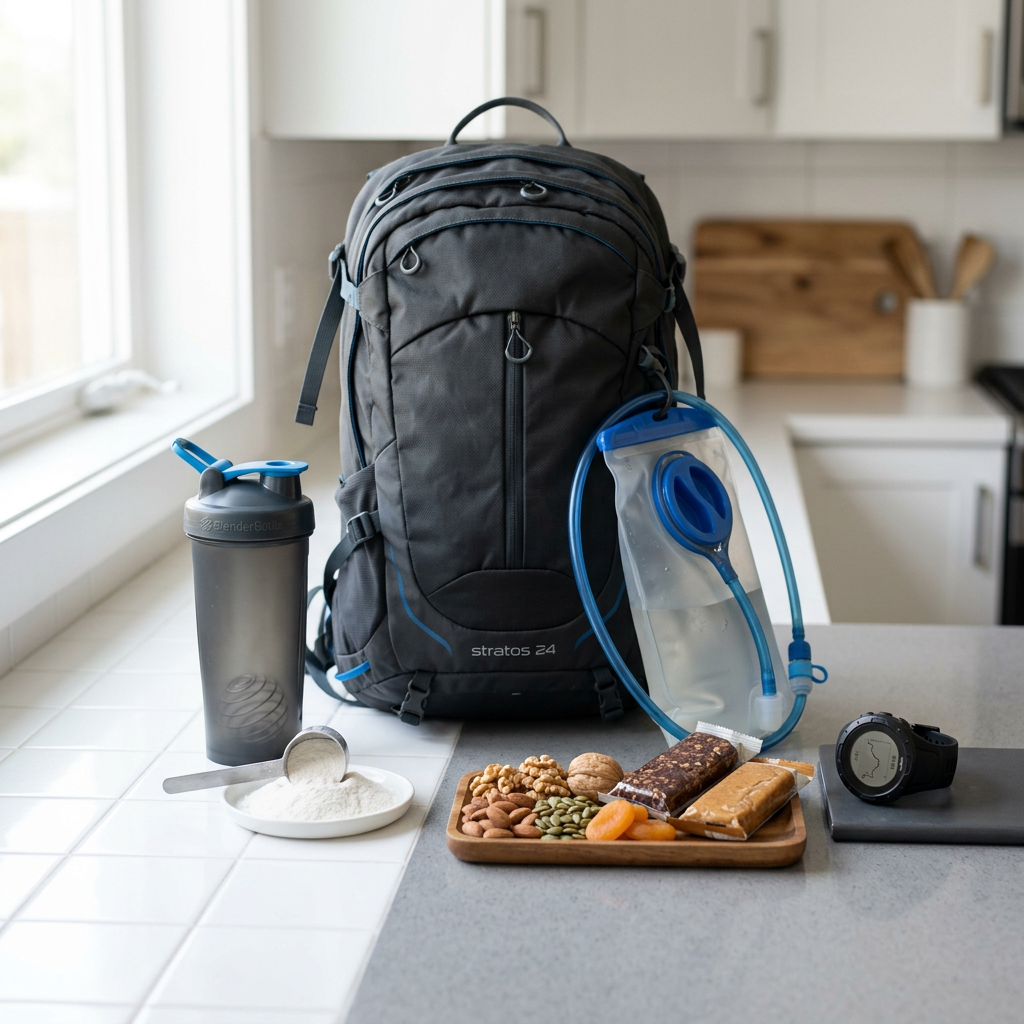
The best creatine protocol for outdoor athletes is simple: choose monohydrate, take it daily, stay consistent, and judge it over weeks, not one workout. You do not need a complicated stack or a special mountain-specific formula.
- Choose the form: Buy plain creatine monohydrate powder. It is the most studied and usually the most cost-effective option. Our best creatine rankings and creatine brand reviews can help you compare options.
- Pick your dose: Use 3 g/day if you are smaller or want to minimize short-term weight change; use 5 g/day if you are average-to-larger or want the standard maintenance dose.
- Decide on loading or not: If you want faster saturation before a training camp, use 20 g/day split into four 5 g doses for 5–7 days. Otherwise skip loading and just take your daily dose.
- Take it with a routine you will remember: Mix it into water, a shake, or a meal once daily. Timing is secondary to consistency. Many people take it after training or with breakfast because those are easy habits.
- Keep hydration normal and sensible: You do not need extreme water intake, but mountain athletes should already be taking hydration seriously. If hot weather, altitude, or long sessions are involved, also think about sodium, fuelling, and drinking access.
- Track a few real metrics: Compare loaded step-ups, hill repeats, gym lifts, power on short climbs, and how your legs feel late in long descents. Creatine is easier to notice in these markers than in a relaxed flat hike.
- Stay on it through rest days: Creatine works by saturating muscle over time, so do not save it only for workout days. If you miss one day, just resume the next day.
Outdoor athletes often make the mistake of starting creatine only during the expedition itself. That is backwards. Creatine is better used during the training block leading into the trip, when it can support strength training, intervals, and muscle saturation before the event starts.
If you want a broader walkthrough, see how to take creatine, when to take creatine, and whether to take creatine on rest days. The best routine is the one you will still be following a month from now.
Timing, altitude, and hydration: what matters most when using creatine outside
For outdoor athletes, daily consistency matters far more than exact timing, and creatine does not replace hydration or altitude strategy. The biggest timing mistake is obsessing over pre- versus post-workout while forgetting to take the supplement regularly.
Once muscles are saturated, whether you take creatine in the morning, after a gym session, or with dinner usually matters little compared with simply taking it every day. If one time sits better in your stomach or fits your routine better, use that time. On long mountain days, it is often easier to take creatine at home rather than carrying a dose to use mid-route.
Creatine and altitude sports is a popular topic, but the evidence is still less robust than it is for strength and repeated sprint performance. There is no strong basis to say creatine directly improves acclimatization. It should be viewed as a support supplement that may help preserve high-energy muscular performance and training quality when travel, cold, poor sleep, and fatigue create extra stress.
Hydration deserves a direct answer: creatine does not dehydrate you. The notion that creatine pulls water away from the rest of the body and causes dehydration has not held up well, and the 2021 JISSN misconceptions paper addresses this directly. What does happen is that creatine can increase intracellular water, meaning water inside muscle cells. That is not the same thing as being dehydrated. Still, mountain athletes should manage total fluid and electrolyte intake carefully because long hikes, high heat, dry cold air, and altitude all increase hydration demands regardless of creatine use.
Practical rule: keep your normal daily creatine dose, and match your fluid plan to terrain, temperature, duration, and sweat loss. If you are prone to headaches, GI upset, or “creatine feels bad in the mountains,” the issue is often under-fuelling, too little sodium, too little fluid, or taking too much at once rather than the supplement itself. Our guides on how much water to drink with creatine and creatine and dehydration go deeper.
For most outdoor athletes, the hierarchy is clear: acclimatization, fuelling, hydration, sleep, and pacing come first; creatine is a useful add-on, not a substitute.
Who should consider creatine for outdoor sports: beginners, women, older adults, and plant-based athletes
Creatine is not just for bodybuilders; many outdoor athletes are good candidates, including beginners, women, older adults, and plant-based athletes. The best predictor is not identity alone, but whether your sport and training include forceful repeated efforts and whether preserving strength matters to your performance.
Beginners: If you are new to hiking, ski touring, climbing, or paddling and you are also strength training, creatine can be worth starting early because it supports the training process itself. That said, a beginner does not need supplements to start. Build your basics first: consistent training, enough protein, enough total calories, and a hydration plan.
Women: Women can use the same evidence-based monohydrate protocols as men, and they do not need a “women’s creatine” formula for creatine to work. Many female outdoor athletes value creatine for strength, recovery, and maintaining training quality during busy life phases. If scale weight is a concern before a climb or a long objective, trial it in advance rather than during a peak event week. See creatine for women for a fuller discussion.
Older adults and masters athletes: Creatine becomes more interesting with age because preserving muscle, strength, and training capacity matters more. A hiker in their 50s or 60s may care less about sprint power and more about keeping leg strength for descents, maintaining pack-carry ability, and staying robust enough to train regularly. Guides on creatine for older adults and creatine for masters athletes are especially relevant here.
Vegetarian or vegan outdoor athletes: Plant-based athletes often start with lower dietary creatine intake, so they may notice a more meaningful response to supplementation. If you train hard for alpine sports or expedition work and eat little or no meat, creatine deserves strong consideration.
Competitive outdoor athletes: Ski mountaineers, OCR athletes, paddlers, and mountain bikers who rely on repeated surges and gym support often get the clearest return.
The main people who should be more cautious are those with relevant medical conditions or those advised by a clinician not to use it. If that might be you, read who should not take creatine and is creatine safe before starting.
Safety, side effects, and the main trade-off for mountain athletes: a bit more body water
Creatine monohydrate is generally considered safe for healthy people when used at recommended doses, but outdoor athletes should understand the trade-off clearly: the main downside is often a small increase in body mass from extra water stored inside muscle. For some athletes that is negligible; for others, especially those obsessed with pack weight or power-to-weight ratio, it is a real consideration.
The 2017 ISSN position stand and the 2021 JISSN review on misconceptions both support creatine’s safety profile in healthy populations. Common side effects are usually practical rather than dangerous: stomach upset from taking too much at once, transient bloating feelings in some users, or quick scale changes during loading.
What is common:
- Mild water-weight increase, especially early on
- Stomach discomfort if you take large single doses
- Some people feeling “puffy” during aggressive loading
What is commonly misunderstood:
- Kidney damage: Creatine can raise creatinine, a lab marker, without meaning kidney harm in a healthy person. That is a testing interpretation issue, not proof of damage.
- Dehydration and cramps: These claims are not well supported by the broader evidence base.
- Fat gain: Creatine does not inherently add body fat; if scale weight rises, it is usually water first.
For outdoor athletes, context matters. If you are about to attempt a very long high-output objective where every kilogram matters, testing creatine in training first is the smart move. A climber heading to a weight-sensitive trip, or a fastpacker trying to move efficiently over many hours, may prefer a lower daily dose and no loading—or may decide the trade-off is not worth it for that phase.
If you experience digestive issues, split the dose, take it with food, or choose micronized monohydrate. For deeper troubleshooting, see creatine digestive side effects, does creatine cause bloating, and does creatine make you gain weight.
The simple safety summary is this: for healthy outdoor athletes, creatine is one of the better-supported and lower-risk sports supplements, but the body-mass trade-off should be judged against your exact sport demands.
Common mistakes and myths outdoor athletes still get wrong about creatine
The biggest creatine mistakes in outdoor sport are taking it only on big days, expecting it to act like a stimulant, and assuming any weight increase means it is bad for performance. Creatine is a saturation supplement, not a pre-workout buzz product.
Mistake 1: Only taking creatine before hikes or ski days.
This undercuts the whole point. Creatine works by raising muscle stores over time, so sporadic use is far less effective than daily use.
Mistake 2: Loading right before a major trip without testing it.
A fast-loading protocol can cause temporary stomach upset or a noticeable water-weight bump. If your event is important, trial creatine well beforehand.
Mistake 3: Thinking creatine should improve every kind of endurance equally.
It is much better for repeated surges, strength, and work capacity than for steady-state cruising. If your trail day is all low-intensity movement, your benefit may be indirect through training.
Mistake 4: Confusing creatine with dehydration risk.
Creatine does not automatically dehydrate you. Outdoor athletes get dehydrated because of sweat loss, poor access to water, altitude, heat, dry air, and pacing errors—not because creatine “steals” their water.
Mistake 5: Buying fancy forms over monohydrate.
HCL, buffered, nitrate, gummies, and other formats are heavily marketed, but monohydrate remains the benchmark for evidence, value, and reliability. If you want the broad myth cleanup, read creatine myths debunked and creatine myths vs. facts.
Mistake 6: Blaming creatine when the real issue is poor fuelling.
A backcountry skier bonking late in the day likely needs more carbohydrates and sodium, not less creatine.
Mistake 7: Ignoring the training effect.
Many athletes quit because they do not “feel” creatine immediately outdoors. The more meaningful benefits often show up in better strength sessions, stronger repeated climbs, and less fade late in hard training blocks.
The evidence-based mindset is to treat creatine like a long-term support tool. It is boring by design, and that is exactly why it works.
What to buy in Canada: monohydrate vs other forms, labels, testing, and value
If you are buying creatine in Canada for outdoor sports, plain creatine monohydrate is usually the smartest purchase. It has the strongest evidence base, is typically the cheapest per effective dose, and avoids the premium pricing attached to less-proven forms.
| Form | Best for | Evidence strength | Practical verdict |
|---|---|---|---|
| Creatine monohydrate | Almost everyone | Strongest | Best default for performance, safety evidence, and value |
| Micronized monohydrate | People who want easier mixing | Strong, since it is still monohydrate | Good option if texture bothers you |
| Creatine HCl | People attracted to smaller servings | Weaker than monohydrate | Usually not worth paying more |
| Buffered / Kre-Alkalyn / nitrate / ethyl ester | Marketing-driven buyers | Limited or unimpressive versus monohydrate | Generally skip unless a specific reason applies |
| Gummies, capsules, chewables | Convenience-first users | Can work if dosed properly | Often pricier and less dose-efficient than powder |
For Canadians, look for straightforward labels and a product that fits regulatory expectations. An NPN, or Natural Product Number, indicates a natural health product has been licensed by Health Canada for sale under applicable rules. Third-party testing can add confidence, especially for competitive athletes concerned about contamination. Informed Sport or NSF-style certification is especially relevant if your event circuit has anti-doping oversight.
Also judge value by cost per effective gram, not by serving hype. A colourful “adventure blend” with electrolytes, herbs, and underdosed creatine often gives you less actual performance support than a plain tub of monohydrate plus separate hydration products tailored to your outing.
Useful starting points include our creatine product catalog, best creatine rankings, and best creatine monohydrate in Canada. If purity matters most to you, check third-party tested creatine in Canada and Canadian supplement regulations.
For most outdoor athletes, the buying answer is refreshingly dull: choose plain monohydrate, verify quality, and spend the saved money on good food and trip fuel.
What results to expect, how to tell if it is working, and the final verdict
Creatine usually works gradually, and outdoor athletes should expect the clearest signs in training quality, repeated hard efforts, and strength under fatigue rather than in dramatic day-one sensations. If you load, you may notice changes within about a week; if you take 3–5 g/day without loading, expect the first meaningful effects after roughly 2–4 weeks as muscle stores rise.
A realistic timeline:
- Week 1 with loading: faster saturation, possible small scale increase, some athletes notice better gym performance quickly.
- Weeks 2–4 without loading: gradual improvement in repeated efforts, hill intervals, pack carries, and lower-body training quality.
- Weeks 4–8: better chance of noticing less fade in hard sessions, stronger descents, more robust climbing or skiing legs, and small strength gains that matter outdoors.
- Beyond 8 weeks: the main benefit often becomes cumulative training adaptation rather than acute sensation.
How to tell it is working:
- You hold power better on short climbs or repeated uphill bursts.
- Your strength work improves, especially on squats, hinges, step-ups, carries, pulls, or intervals.
- You recover better between hard efforts in training.
- Your legs feel less empty late in demanding days.
How to tell it may not be the right fit right now:
- You hate even a small body-mass increase in a highly weight-sensitive phase.
- Your sport is almost entirely steady-state and you see no meaningful training benefit after a fair trial.
- You are inconsistent with dosing and therefore never truly saturate.
The overall verdict is straightforward: creatine for hiking, backcountry skiing, alpine sports, and expedition training is worth considering when repeated force, pack carrying, strength preservation, and fatigue resistance matter. It is less compelling as a pure endurance booster and more compelling as a high-value support supplement that improves the hard parts of outdoor performance.
For the evidence background, see the ISSN position stand, the IOC consensus on dietary supplements, and our practical guides on how long creatine takes to work and what to do if creatine seems not to be working. For most outdoor athletes, the bottom line is simple: if your sport includes hard surges inside long days, creatine monohydrate is usually a smart, evidence-based addition.
Creatine for Outdoor Athletes at a Glance
- 3–5 g/day Standard daily creatine monohydrate dose — Best default for most hikers, skiers, climbers, paddlers, and adventure athletes
- ~20 g/day Typical loading dose — Usually split into 4 doses for 5–7 days to saturate muscle faster
- 5–7 days Fastest common saturation window — Achieved with a standard loading phase
- 2–4 weeks Typical timeline without loading — Daily 3–5 g use gradually raises muscle stores over this period
Frequently Asked Questions
Is creatine good for hiking?
Yes, creatine can be good for hiking when the hike includes steep climbs, pack carrying, scrambling, or repeated hard surges. It is less about making easy walking feel magical and more about supporting leg strength, repeated power, and training quality so steep terrain and long descents feel more manageable.
Does creatine help with backcountry skiing?
Yes, creatine can help with backcountry skiing because the sport combines long aerobic work with repeated high-output demands. Skinning steep sections, kick turns, short boot packs, transitions, and skiing technical descents on tired legs all reward stronger repeated muscular efforts.
Should climbers take creatine?
Some climbers benefit from creatine, especially boulderers and sport climbers who need repeated power, but it depends on power-to-weight trade-offs. If even a small increase in body water hurts your climbing feel, trial a low daily dose without loading well before an important trip.
Does creatine help at altitude?
Creatine is not a proven altitude-acclimatization supplement, but it may still be useful at altitude because it supports rapid energy buffering and training quality. Think of it as a supportive tool rather than a substitute for acclimatization, fuelling, hydration, sleep, or pacing.
Will creatine make me heavier for mountain sports?
Possibly, yes—creatine commonly increases body water stored inside muscle, which can raise scale weight slightly. Whether that matters depends on your sport: a loaded hiker or skier may barely care, while an ultralight fastpacker or weight-sensitive climber may notice it more.
Can expedition athletes use creatine during long trips?
Yes, expedition athletes can use creatine, but the best strategy is usually to start during the training block well before the trip. Daily consistency matters more than taking it only in the field, and some athletes may decide the extra carried supplement weight is not worth bringing once saturated.
Does creatine dehydrate outdoor athletes?
No, creatine does not inherently dehydrate outdoor athletes. Dehydration risk in outdoor sport comes mainly from sweat loss, heat, dry air, altitude, poor access to fluids, and weak electrolyte planning, so hydration strategy still matters whether you take creatine or not.
What type of creatine is best for outdoor athletes?
Creatine monohydrate is the best type for most outdoor athletes because it has the strongest research support and is usually the most cost-effective. Micronized monohydrate is a fine option if you want easier mixing, but you generally do not need fancier forms.
When should I take creatine for outdoor sports?
Take creatine whenever you are most likely to remember it, because daily consistency matters more than exact timing. Many outdoor athletes take it with breakfast or after training so it becomes part of an easy routine and does not need to be carried into the field.
Is creatine worth it for outdoor athletes who also lift weights?
Yes, creatine is especially worth considering if you do outdoor sport and also lift weights. The gym benefits often carry over outdoors by improving strength, work capacity, and fatigue resistance in the muscles you rely on for climbing, descending, carrying, and repeated surges.