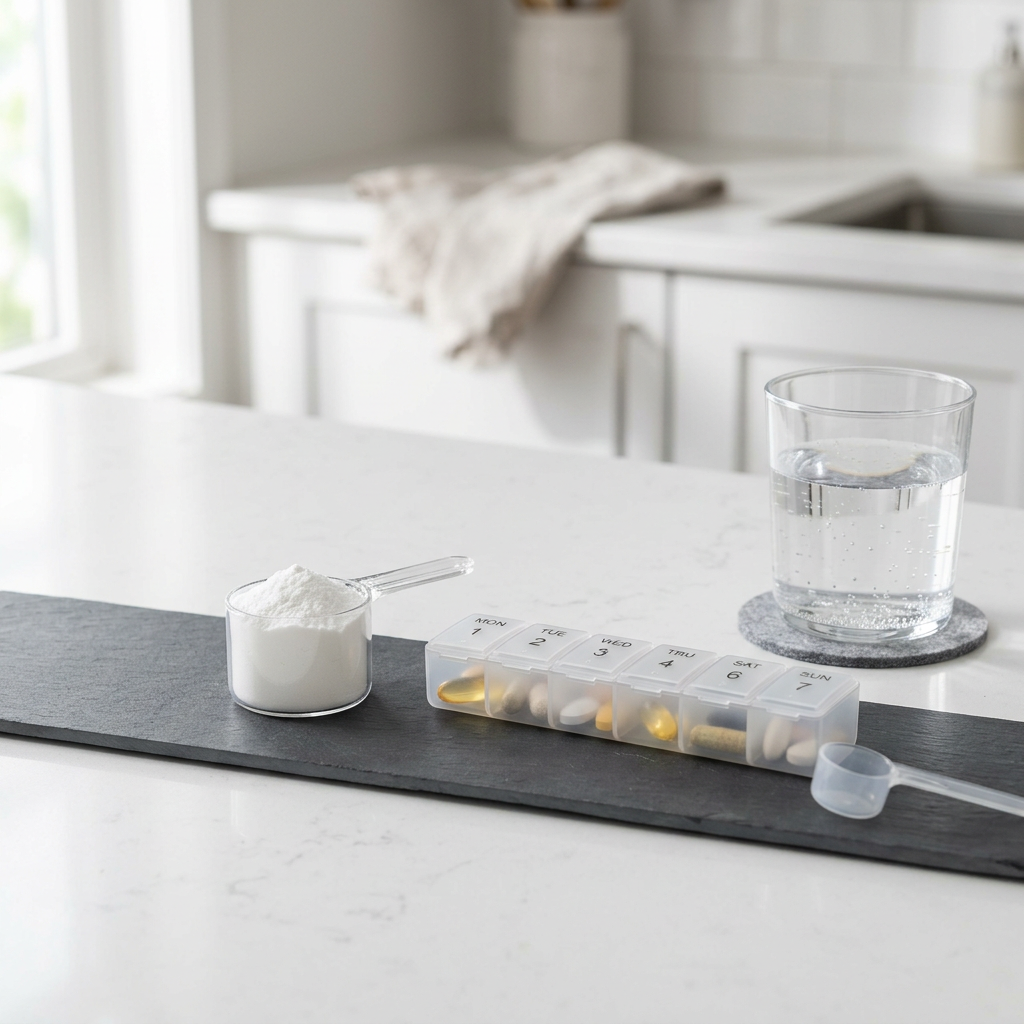
Creatine and Vitamins: Which Supplements Can You Take Together Safely?
By The Creatine Canada Research Team — Evidence-based supplement analysts
Yes, you can take creatine and vitamins together safely in most cases, including a multivitamin, vitamin C, and vitamin D. Creatine does not meaningfully conflict with common vitamin supplements, and for most healthy adults the main priorities are using the right creatine dose consistently, choosing quality products, and checking for personal medical contraindications rather than worrying about harmful interactions.
Evidence-based · Cites 4 sources · Editorial standards
Key Takeaways
- Creatine monohydrate can generally be taken with a multivitamin, vitamin C, and vitamin D without reducing its effectiveness.
- The evidence-based creatine dose for most adults is 3 to 5 g daily; loading is optional at 20 g daily split into 4 doses for 5 to 7 days.
- Timing matters less than consistency, so taking creatine and vitamins together with a meal is a simple, effective routine.
- Vitamin supplements do not ‘cancel out’ creatine absorption; stomach upset is far more likely to come from oversized doses or poor mixing.
- Older adults, women, vegetarians, and hard-training athletes may benefit from using creatine alongside vitamin D or a multivitamin when intake is otherwise low.
- Choose plain creatine monohydrate first, and in Canada look for a Natural Product Number and, if possible, third-party testing for sport or purity.
- If you have kidney disease, are pregnant, are breastfeeding, or take medications that affect kidney function, speak with a clinician before combining supplements.
Yes — you can usually take creatine and vitamins together safely
Yes, creatine and vitamins together is generally a safe and practical combination for healthy adults. If your question is can you take creatine with vitamins?, the evidence-based answer is that creatine monohydrate does not have a known harmful interaction with standard vitamin supplements such as a multivitamin, vitamin C, or vitamin D in healthy users.
Creatine is not a stimulant, hormone, or steroid. It is a naturally occurring compound made from the amino acids glycine, arginine, and methionine, and it helps your body rapidly regenerate ATP, short for adenosine triphosphate, the immediate energy currency your muscles use for short, intense effort. Vitamins, by contrast, are micronutrients that support many processes including energy metabolism, immune function, bone health, and red blood cell formation. Because they do different jobs, they usually do not compete with each other in a meaningful way.
The best-supported form is creatine monohydrate. The 2017 ISSN position stand concluded that creatine monohydrate is the most effective ergogenic nutritional supplement currently available for increasing high-intensity exercise capacity and lean mass gains during training. That same broad literature base does not show that common vitamins block creatine uptake or make it unsafe when taken together. See the full position stand here: Kreider et al. (2017), ISSN Position Stand: Safety and Efficacy of Creatine.
For most people, the practical answer is simple:
- Take 3 to 5 g creatine monohydrate daily.
- You may take it at the same time as your vitamins.
- A meal can make the routine easier and may reduce stomach upset.
- Consistency over weeks matters more than the exact minute you take it.
If you are brand new to supplementation, start with plain monohydrate and a basic routine before building a larger stack. Our creatine dosage calculator and related guide on how to take creatine approach can help you set up a simple daily plan.
There are exceptions. People with known kidney disease, those using nephrotoxic medications, and those who are pregnant or breastfeeding should get individual medical advice before using creatine or any multi-supplement stack. But for the average gym-goer, taking creatine and vitamin supplements together is not only acceptable; it is one of the easiest ways to simplify supplement adherence.
Why creatine and vitamins do not clash: different jobs, different pathways
Creatine and vitamins can be taken together because they work through largely different mechanisms in the body. Creatine mainly supports the phosphocreatine system, while vitamins act as micronutrient cofactors, antioxidants, or hormone-like regulators depending on the vitamin.
Here is the key mechanism. Creatine is stored in muscle partly as phosphocreatine, a high-energy compound that donates a phosphate group to help remake ATP during short bursts of effort such as sprinting, heavy lifting, jumping, and repeated hard intervals. Supplementing increases muscle creatine stores over time, which can improve performance in high-intensity efforts and help you accumulate more quality training. More quality training can translate into greater strength and lean mass gains.
Vitamins are not doing that same job. For example:
- Vitamin D supports calcium handling, bone health, and muscle function.
- Vitamin C acts as an antioxidant and supports collagen formation and immune function.
- B vitamins help enzymes convert food into usable energy.
- Vitamin B12 supports nerve function and red blood cell formation.
- Vitamin A, E, and K have their own distinct roles in vision, antioxidant defence, and blood clotting or bone metabolism.
Because those roles are separate, the common idea that vitamins somehow “cancel out” creatine is not supported by mainstream evidence. The more relevant factors for creatine uptake are total daily dose, consistency, existing muscle creatine levels, and to a lesser degree whether you take it with food or carbohydrate-containing meals. If you want a deeper primer on the basics, read what creatine is and what it does.
There is also an important nuance: not every supplement in a vitamin aisle is actually a vitamin. Some blends combine vitamins with herbs, stimulants, laxatives, or minerals in large doses. Those formulas are not automatically unsafe with creatine, but they deserve separate scrutiny because side effects may come from the blend rather than from creatine itself.
The 2021 JISSN review on common creatine misconceptions reinforces that most safety fears around standard creatine use are overstated in healthy people. You can review it here: Antonio et al. (2021), Common questions and misconceptions about creatine supplementation.
In plain English: creatine fills your muscle energy reserve, while vitamins help the broader machinery of health and metabolism run properly. That is why a creatine supplement stack with vitamins is usually complementary rather than conflicting.
Creatine with a multivitamin, vitamin C, and vitamin D: what to know about the most common pairings
The most common combinations are creatine and multivitamin, creatine with vitamin C, and creatine and vitamin D together, and none of these pairings are known to meaningfully reduce creatine’s effectiveness in healthy adults.
Creatine and a multivitamin: This is the simplest stack for people who want broad micronutrient coverage and a performance supplement. A standard once-daily multivitamin can be taken at the same meal as creatine. The main thing to watch is not an interaction with creatine, but whether the multivitamin megadoses certain nutrients you do not need, especially if you already use fortified foods or separate supplements.
Creatine with vitamin C: The recurring myth is that ascorbic acid destroys creatine or blocks absorption. That concern is not supported in normal real-world use. Creatine may slowly degrade to creatinine when dissolved in liquid over long periods, especially in certain storage conditions, but mixing creatine into a drink and consuming it within a reasonable time is standard practice. Vitamin C in a normal supplement dose is not a reason to avoid the combo.
Creatine and vitamin D together: This is a particularly sensible pairing in Canada, where low vitamin D status is common during darker months because cutaneous production from sunlight falls. Vitamin D does not enhance creatine uptake directly, but it supports muscle and bone function through separate pathways. Many people use both because they address different needs rather than because they act synergistically in a narrow biochemical sense.
What about B12? People following plant-based diets often have lower dietary creatine intake because creatine is concentrated in animal foods, and they may also be more attentive to vitamin B12. That does not mean the two interact directly, but it does make the pairing practically relevant. See our guide on vegan creatine if that applies to you.
If you are building a basic stack, keep it boring:
- Plain creatine monohydrate
- A multivitamin only if your diet or clinician suggests it
- Vitamin D if your intake or status is low
- Nothing fancy unless there is a clear reason
Many “all-in-one” performance blends sound efficient but can hide underdosed creatine, proprietary blends, or unnecessary ingredients. For most users, separate products are easier to dose accurately, easier to troubleshoot, and often better value than complex stacks.
The easiest daily routine: exactly how to take creatine and vitamins together

The best way to take creatine and vitamins together is to pair them with a consistent daily habit, usually a meal. If you want a simple answer you can use today, take 3 to 5 g of creatine monohydrate once daily and swallow your vitamins at the same time unless the label or your clinician says otherwise.
- Choose the right creatine. Use plain creatine monohydrate powder or capsules. If you need help choosing, compare options in our best creatine rankings or browse the creatine product catalog.
- Pick one daily anchor. Breakfast, lunch, your post-workout shake, or dinner all work. The best time is the time you will repeat every day.
- Measure your dose accurately. Take 3 to 5 g daily for maintenance. If your scoop is not exact, check the serving size on the label. You can also use our creatine dosage calculator.
- Take your vitamins with the same meal. This is especially practical for vitamin D and multivitamins, which many people already take with food.
- Mix creatine well. Stir it into water, a shake, or another cold or room-temperature drink and consume it. Good mixing reduces grit and may reduce stomach complaints.
- Stay consistent for weeks, not days. Creatine works by saturating muscle stores over time, so missing the perfect timing window is far less important than taking it regularly.
If you want to load creatine to saturate faster, take 20 g per day split into 4 doses of 5 g for 5 to 7 days, then shift to 3 to 5 g daily. Loading is optional, not required. Without loading, daily creatine still works; it just takes longer to fully saturate stores.
What should you expect?
- Days 1 to 7 with loading: some people notice fuller muscles or a small body-weight increase from intracellular water.
- Weeks 2 to 4 without loading: performance benefits begin to become more noticeable.
- Weeks 4 to 8: many users report improved repeat effort performance and slightly better strength progression.
If you want a deeper timing discussion, see when to take creatine. The short version is that meal timing and workout timing are secondary to total daily intake and adherence.
Creatine dose by body weight and goal, plus how vitamins fit into the plan
The standard creatine dose for most adults is still 3 to 5 g daily, but body size and training goal can justify where you land in that range. Vitamins do not usually change the creatine dose you need; they are a separate decision based on diet, lifestyle, lab work, or clinician advice.
| Body weight / goal | Creatine approach | Vitamin pairing note |
|---|---|---|
| Under 60 kg, general fitness | 3 g daily | Take with a meal; multivitamin only if diet is inconsistent |
| 60 to 90 kg, strength or hypertrophy | 3 to 5 g daily | Vitamin D is commonly paired in Canada when intake is low |
| Over 90 kg, high training volume | 5 g daily | A multivitamin may be practical during calorie deficits or travel |
| Fast saturation desired | 20 g daily in 4 x 5 g doses for 5 to 7 days, then 3 to 5 g daily | Split vitamins as usual; no need to match each creatine dose |
| Older adults doing resistance training | 3 to 5 g daily | Vitamin D is often relevant for bone and muscle support |
These are practical rather than rigid categories. If you are using capsules, compare the label math carefully because some products require several capsules to reach a full evidence-based dose. If you are using powder, one level scoop is often around 5 g, but never assume; read the label.
Goal also matters:
- Strength and power: 3 to 5 g daily is standard.
- Muscle gain: 3 to 5 g daily, paired with resistance training and adequate protein.
- Older adult muscle support: 3 to 5 g daily, ideally alongside progressive strength training.
- Vegetarian or vegan users: 3 to 5 g daily may feel especially worthwhile because baseline muscle creatine stores can be lower.
What about very high doses long term? For most people, there is no clear reason to exceed typical maintenance dosing once stores are saturated. More is not necessarily better, and higher doses are more likely to cause stomach upset without providing extra benefit.
If you want to fine-tune your amount, read how much creatine per day and our maintenance dose guide. The bottom line is that vitamins do not force any special creatine dose adjustment. Choose the creatine dose based on your size, training, and tolerance, then keep the vitamin side evidence-based and minimal.
Does timing matter when you take creatine and vitamins together?
Timing matters less than consistency, but taking creatine and vitamins together with food is often the easiest and best-tolerated option. If you are wondering whether creatine and vitamin supplements together should be taken before workouts, after workouts, or at night, the evidence says the exact timing is a smaller issue than simply taking them daily.
Why? Creatine works by raising total muscle creatine stores over days and weeks. This process is called saturation. Once your muscles are saturated, the exact hour of ingestion matters little compared with not missing doses. That is why a boring, repeatable routine beats an elaborate one.
That said, food can still help in practical ways:
- It may reduce stomach discomfort, especially if you are sensitive to supplements.
- It makes adherence easier because meals happen every day.
- Fat-soluble vitamins such as vitamins D, A, E, and K are commonly taken with food.
What if you prefer taking creatine on an empty stomach? That is also fine if you tolerate it. Some people experience no issues at all, while others notice cramping, nausea, or loose stool when they take a full 5 g dose dry or in too little liquid. If that is you, take it with a meal or split the dose.
What about post-workout? It is a reasonable time because many people already have a shake or meal then, but it is not magic. Pre-workout can work just as well if that is your habit. Rest days still count, because creatine’s benefit depends on keeping muscle stores topped up.
For vitamins, timing can matter more for tolerance than efficacy. Multivitamins are often easier on the stomach with meals. Vitamin D is commonly taken with a meal as well. Water-soluble vitamins such as vitamin C and many B vitamins can also be taken at meal time for simplicity.
If your routine is inconsistent, this is a good default:
- Take creatine daily at breakfast or lunch.
- Take your multivitamin or vitamin D at that same meal.
- On training days, do not stress if it is not exactly around the workout.
For a full breakdown, our guides on creatine with or without food and creatine on rest days go deeper. For most users, simplicity wins.
Who should consider creatine plus vitamins: beginners, women, older adults, athletes, and plant-based eaters
A creatine-plus-vitamins routine makes the most sense when the creatine supports performance or muscle goals and the vitamins fill a genuine dietary or lifestyle gap. This means the stack can be useful for several groups, but the reason differs by person.
Beginners: Creatine is one of the best-supported first supplements because the evidence for performance and training support is stronger than for most flashy products. A multivitamin is not mandatory for beginners, but it can be a practical backup for people with inconsistent diets. If you are just starting out, read creatine for beginners.
Women: Women can take creatine and vitamins together just as safely as men in most cases. Creatine does not “bulk you up” by itself; it supports training quality and lean mass development. Vitamin D and iron-related concerns are common topics for women, but iron should not be added casually without a real need. If female-specific questions matter to you, our creatine for women guide covers the details.
Older adults: Creatine can be especially relevant for preserving strength and lean mass when combined with resistance training. Vitamin D may also be more relevant in older adults because of bone and muscle considerations. This is not because vitamin D boosts creatine directly, but because both can address common age-related issues through separate mechanisms.
Athletes: Athletes in repeated-sprint or power sports often benefit from creatine, and a basic vitamin strategy can help during travel, intense training blocks, or limited food variety. The International Olympic Committee consensus on dietary supplements recognises creatine among supplements with evidence for certain performance applications. Drug-tested athletes should also prioritise products with robust quality control.
Vegetarians and vegans: This group often has lower dietary creatine intake because creatine is found primarily in meat and fish. That can make supplementation particularly useful. B12 status is also a separate practical consideration for vegans, which is why creatine and B12 are often discussed together even though they do not have a special direct interaction.
People in a calorie deficit: Creatine can help support training quality and lean mass retention during a cut, while a multivitamin may be more reasonable if food variety is temporarily reduced. But it is still better to fix the diet than to rely on a giant supplement stack.
In short, creatine with vitamin supplements is most useful when each piece has a clear job. Use creatine for performance, strength, and lean mass support; use vitamins to correct likely gaps, not because combining more bottles feels more advanced.
Safety, side effects, and the few times you should not self-stack supplements casually

Creatine and vitamins together are usually safe for healthy adults, but “usually safe” is not the same as “ignore all context.” The main risks are not from creatine colliding with vitamins; they are from underlying medical conditions, unnecessary mega-dosing, contaminated products, or mixing too many supplements at once.
The strongest safety data are on creatine monohydrate at standard doses. The 2017 ISSN position stand and the 2021 JISSN review both support its safety profile in healthy individuals when used appropriately. You can also review the broader clinical summary at Mayo Clinic — Creatine.
Typical side effects when they happen are usually mild and practical:
- Stomach upset
- Loose stool, especially from too much at once
- Water retention inside muscle, which can raise scale weight
- Gritty texture or bloating from poor mixing or aggressive loading
Vitamin products add their own considerations. For example, very high-dose niacin can cause flushing, excess vitamin C can bother some stomachs, and fat-soluble vitamins can accumulate when overused. A basic multivitamin at label dose is one thing; a stack of overlapping products is another.
Use extra caution or get professional advice if you:
- Have known kidney disease
- Have been told to monitor kidney function closely
- Use medications that can stress the kidneys
- Are pregnant or breastfeeding
- Have a medical condition requiring therapeutic vitamin dosing
A common point of confusion is creatinine on blood work. Creatine supplementation can raise serum creatinine somewhat because creatinine is a breakdown product, but that does not automatically mean kidney damage. Interpretation depends on the full clinical picture. If this concerns you, our related guide on kidney questions is worth reading: is creatine bad for your kidneys?
One smart rule: change one variable at a time. If you start creatine, a multivitamin, vitamin D, magnesium, and a pre-workout on the same day, you will not know what caused any side effect. Add products gradually so you can troubleshoot cleanly.
For healthy adults who keep the plan simple, the safety story is reassuring. The danger is usually not the combination itself; it is overcomplicating supplementation beyond what your body, budget, or evidence actually needs.
Common mistakes and myths: what people get wrong about creatine and vitamins together
The biggest myths about creatine and vitamins are mostly recycled supplement folklore, not conclusions from strong evidence. If you want the fast answer, vitamins do not “kill” creatine, multivitamins do not make creatine useless, and you do not need a complicated stack to make creatine work.
Myth 1: Vitamin C destroys creatine.
This is overstated. Creatine can slowly degrade in solution over time, but taking creatine with a vitamin C supplement or in a drink that contains vitamin C is not a meaningful real-world problem when you mix and drink it in a normal timeframe.
Myth 2: You need sugar or special vitamins for creatine absorption.
Not really. Insulin can influence creatine transport, but the practical effect of “stacking tricks” is much less important than taking enough creatine consistently. Plain daily monohydrate works very well on its own.
Myth 3: More vitamins make creatine work better.
No. Correcting a deficiency can improve overall health and training, but that is not the same as supercharging creatine. If your vitamin D is low, bringing it into a healthier range matters. If it is already adequate, adding more is not a shortcut to bigger lifts.
Myth 4: Creatine causes dangerous bloating when mixed with vitamins.
Usually false. The more common explanation is taking too much creatine at once, loading too aggressively, or mixing it poorly. For help, see creatine digestive side effects and does creatine cause bloating?.
Myth 5: You need a proprietary creatine-vitamin blend.
Almost never. Most users are better served by buying plain monohydrate and adding only the specific vitamins they actually need.
Common real-world mistakes include:
- Taking random overlapping products with duplicate vitamins
- Using underdosed blend formulas
- Stopping creatine after a few days because you expected instant results
- Assuming weight gain from creatine means fat gain
- Using expensive “advanced” forms instead of monohydrate
If you like myth-busting content, our creatine myths debunked page and creatine myths vs facts guide unpack the biggest misconceptions in more detail.
The practical truth is unsexy but reliable: use plain creatine monohydrate, take it daily, use vitamins only where they solve a real problem, and ignore the marketing noise.
How to choose the right products in Canada without overpaying for a fancy stack
The best buying strategy in Canada is usually to purchase plain creatine monohydrate and separate vitamin products only when you actually need them. If you are shopping for a creatine supplement stack with vitamins, start by asking whether the convenience is worth the trade-offs in dose accuracy, price per gram, and label transparency.
For creatine, look first for:
- Creatine monohydrate as the main ingredient
- Clear dose per serving, ideally landing you at 3 to 5 g daily easily
- Minimal extras, especially if you already use other supplements
- Third-party testing if you are a competitive athlete
- A Natural Product Number (NPN) on products sold as natural health products in Canada
An NPN, or Natural Product Number, is the Health Canada identifier that shows a natural health product has been assessed for sale under its regulatory framework. An NPN is not a guarantee that a product is the best one on the shelf, but it is a useful legitimacy check for Canadian buyers. If you want more context, see the related guide on Canadian supplement rules in our broader site ecosystem.
When deciding between standalone products and blends, this framework helps:
| Option | Pros | Cons |
|---|---|---|
| Plain creatine monohydrate | Best evidence, easiest to dose, usually best value | Requires separate vitamin product if needed |
| Creatine + multivitamin bundle | Convenient if both are well-dosed | Often more expensive than buying separately |
| All-in-one performance blend | One scoop convenience | Commonly underdosed, harder to troubleshoot, more filler ingredients |
If you are comparison shopping, use our creatine brand reviews and best creatine rankings to narrow down reputable options. Athletes subject to drug testing should prioritise products with recognised testing programmes rather than simply trusting marketing claims.
One final buying rule: do not pay a premium just because the label says “stack,” “matrix,” or “advanced absorption.” The research-supported part of the purchase is still the same old workhorse: plain creatine monohydrate, taken consistently, with vitamins added only when they are genuinely useful.
Bottom line: the smart way to combine creatine and vitamins
Yes, you can take creatine and vitamins together safely in most cases, and for most people there is no meaningful downside to taking creatine with a multivitamin, vitamin C, or vitamin D. The bigger issues are choosing the right creatine form, using the right dose, and not turning a simple routine into a cluttered supplement stack.
If you want the most practical evidence-based plan, use this:
- Choose creatine monohydrate.
- Take 3 to 5 g daily.
- Take it with a meal if that helps you remember and tolerate it.
- Add a multivitamin or vitamin D only if your diet, lifestyle, or clinician suggests a need.
- Keep products separate unless a combined formula clearly gives full doses at a fair price.
- Use caution and get individual advice if you have kidney disease, are pregnant, are breastfeeding, or take relevant medications.
That answers nearly every version of the question, whether you searched for creatine and multivitamin, can you take creatine with vitamins, creatine with vitamin C, or creatine and vitamin D together. In all of those cases, the default answer is yes for healthy adults, with the usual common-sense caveats around health status and product quality.
If you want to keep learning, the most useful next reads are how much creatine per day, how long creatine takes to work, is creatine safe, and how to take creatine. Those guides will help you move from “can I combine these?” to “how do I get the best real-world results?”
The shortest honest summary is this: creatine and vitamins together is usually safe, usually sensible, and usually less complicated than the supplement industry wants you to believe.
Creatine and Vitamins Together: The Numbers That Actually Matter
- 3–5 g/day standard creatine maintenance dose — The usual evidence-based daily amount for most adults.
- 20 g/day optional loading dose — Typically split into 4 doses for 5–7 days to saturate faster.
- 5–7 days typical loading phase length — After loading, most people switch to 3–5 g/day.
- 4 weeks rough no-loading saturation timeline — Daily creatine without loading generally takes several weeks to fully build muscle stores.
Frequently Asked Questions
Can you take creatine with a multivitamin?
Yes, you can usually take creatine with a multivitamin safely. Creatine monohydrate does not have a known harmful interaction with a standard multivitamin in healthy adults, and taking both with a meal is an easy way to stay consistent. The main caution is to avoid unnecessary megadoses or overlapping vitamin products.
Can you take creatine and vitamin D together?
Yes, creatine and vitamin D can be taken together. They work through different pathways, with creatine supporting rapid energy availability in muscle and vitamin D supporting bone and muscle function, so there is no established reason to separate them in healthy users.
Can you take creatine with vitamin C?
Yes, taking creatine with vitamin C is generally fine. The popular claim that vitamin C destroys creatine in normal supplement use is not supported in a meaningful real-world way, especially if you mix your drink and consume it within a normal timeframe rather than storing it for long periods.
Do vitamins make creatine work better?
Not directly in most cases. Vitamins can support general health, and correcting a deficiency may improve training capacity or recovery overall, but vitamins do not act like a special activator that suddenly makes creatine effective if the creatine dose and consistency are already on point.
Should you take creatine and vitamins at the same time of day?
Yes, taking them at the same time of day is usually a smart routine. Creatine depends more on daily consistency than precise timing, and vitamins are often easiest to remember with meals, so combining them in one daily habit is practical and evidence-aligned.
Is it better to take creatine with food when also taking vitamins?
For many people, yes, taking creatine with food is the easiest option when also taking vitamins. A meal can improve supplement tolerance, helps with adherence, and is especially practical for multivitamins and fat-soluble vitamins such as vitamin D.
Can women take creatine and vitamins together?
Yes, women can generally take creatine and vitamins together safely if they are otherwise healthy. Creatine is not male-specific, and women commonly pair it with vitamin D or a multivitamin for convenience, though individual needs such as iron should be assessed more carefully.
Can older adults take creatine with vitamin supplements?
Yes, older adults can often take creatine with vitamin supplements, and this can be a sensible combination. Creatine may support strength and lean mass when paired with resistance training, while vitamin D and other nutrients may matter more if dietary intake, bone health, or deficiency risk are concerns.
What vitamins should not be taken with creatine?
There is no common vitamin that healthy adults generally need to avoid solely because they are taking creatine. The bigger concern is not a creatine-vitamin conflict, but whether a given vitamin product is unnecessary, excessively dosed, or part of a larger supplement stack that creates avoidable side effects.
Is a combined creatine-and-vitamins supplement better than buying them separately?
Usually no, buying them separately is the better default. Separate products make it easier to hit the full evidence-based creatine dose, avoid underdosed blends, compare cost per gram, and adjust your vitamin intake based on actual need rather than whatever a single formula happens to include.