Creatine and ADHD: What the Emerging Research Actually Shows
By The Creatine Canada Research Team — Evidence-based supplement analysts
Creatine and ADHD is an interesting but still emerging area of research: creatine is not an established ADHD treatment, but it may support brain energy metabolism and, in some people, mental fatigue, focus, or cognition. The practical takeaway is simple: if you want to try creatine for ADHD-related focus, use plain creatine monohydrate at standard evidence-based doses and treat it as a supportive supplement, not a replacement for medical care or prescribed medication.
Evidence-based · Cites 4 sources · Editorial standards
Key Takeaways
- Creatine does not currently have enough direct evidence to be recommended as a proven treatment for ADHD.
- The strongest rationale for creatine and ADHD is brain energy support, not a confirmed dopamine-boosting effect.
- A standard dose of 3 to 5 g/day of creatine monohydrate is the evidence-based starting point for most adults.
- Loading with 20 g/day split into 4 doses for 5 to 7 days can saturate stores faster, but it is optional.
- If creatine helps, the most noticeable changes are more likely to be mental energy or workout performance than dramatic ADHD symptom relief.
- Creatine is generally well-studied for safety in healthy people, but anyone with kidney disease, pregnancy concerns, or complex medication questions should speak with a clinician first.
- In Canada, look for a creatine product with clear ingredient labelling, an NPN when applicable, and preferably third-party testing.
Does creatine help ADHD? The direct answer most people actually need
Creatine may help some aspects of brain function that matter to people with ADHD, but it is not a proven ADHD treatment and should not be presented that way. That direct answer matters because search results often blur three different claims: creatine for ADHD symptoms, creatine for general focus, and creatine for brain energy. Those are related ideas, but the evidence is not equally strong for all three.
What we know with confidence is that creatine is a naturally occurring compound stored in muscle and brain tissue, where it helps regenerate adenosine triphosphate, or ATP, the cell's immediate energy currency. The 2017 ISSN position stand concluded that creatine monohydrate is the most effective form of creatine for increasing body creatine stores and is among the most studied sports supplements available. What we do not know with the same confidence is whether raising creatine availability translates into reliable, clinically meaningful improvement in ADHD symptoms such as inattention, impulsivity, or hyperactivity.
The reason people ask about creatine and ADHD is sensible. ADHD is associated with attention regulation, executive function, motivation, and sometimes mental fatigue, and the brain is an energy-hungry organ. Creatine's biological role in cellular energy makes it plausible that some people could notice benefits in mental stamina or focus, especially under conditions of high demand, poor sleep, heavy training, or lower baseline dietary creatine intake. That is a plausible mechanism; it is not yet proof of an ADHD effect.
For a general fitness audience, the practical position is this: creatine can be worth trying if your goal is broad support for training, recovery, and possibly brain function, but you should set realistic expectations. Think of creatine as a low-cost, evidence-based supplement for muscle performance with possible cognitive upside, not as a nootropic replacement for ADHD medication or therapy. If you want a broader primer first, see what creatine is and what it does and our guide to creatine and the brain.
If your main question is, "does creatine help ADHD?" the fairest evidence-based answer in 2026 is: possibly for some people, indirectly or modestly, but the direct research base is still too limited to call it an established ADHD supplement.
How creatine could affect the ADHD brain: energy first, dopamine second
The best mechanistic case for creatine and ADHD is improved brain energy availability, not a confirmed direct dopamine fix. That distinction matters because many articles oversimplify creatine as a dopamine booster, when the evidence is much stronger for phosphocreatine buffering than for any specific neurotransmitter effect.
Creatine works through the creatine-phosphocreatine system. Phosphocreatine is a stored high-energy phosphate that helps rapidly regenerate ATP when cells need energy fast. In skeletal muscle that supports repeated high-intensity effort; in the brain, the same system helps energy-demanding cells maintain function during heavy cognitive work, stress, or sleep loss. In plain language, creatine helps the body and brain recharge their short-term energy system more efficiently.
Why might that matter for ADHD? Attention, working memory, inhibitory control, and task persistence all depend on brain networks that are metabolically expensive. If brain energy supply is one limiting factor for some people, then increasing available creatine stores could theoretically support those processes. This is one reason creatine is often discussed in the broader context of cognition, mental fatigue, and neuroprotection rather than only athletic performance.
The dopamine question is more nuanced. Dopamine is heavily involved in motivation, reward prediction, and attention regulation, so it is natural to ask whether creatine affects dopamine in ADHD. The honest answer is that creatine may interact with brain systems that overlap with dopamine function, but the direct evidence that creatine reliably increases dopamine signalling in people with ADHD is not strong enough to make that a headline claim. When people report better drive, clearer thinking, or easier task initiation, the mechanism may be indirect: more stable cellular energy, better training recovery, or less mental fatigue rather than a simple neurotransmitter surge.
Another reason creatine and ADHD gets attention is that some groups may start with lower creatine stores or respond more noticeably, including vegetarians and vegans, because dietary creatine comes mainly from meat and fish. If your baseline stores are lower, the effect of supplementation can be more obvious. That does not mean everyone with ADHD will benefit equally.
So if you are searching for "creatine dopamine ADHD" or "creatine brain ADHD," the strongest evidence-based wording is this: creatine supports the brain's rapid energy system, and that energy support is the main scientifically plausible reason it could help some people with focus or mental stamina.
What the research actually shows on creatine ADHD benefits
The current research does not justify saying that creatine treats ADHD, but it does justify saying creatine is biologically plausible for brain support and has stronger evidence for general cognition in some contexts than for ADHD specifically. That difference is the centre of an honest review.
The broad creatine literature is large, but most of it focuses on exercise performance, muscle mass, strength, and recovery. According to the 2017 ISSN position stand and the 2021 review on common creatine questions and misconceptions, creatine monohydrate remains the reference form because it consistently raises tissue creatine stores and has the strongest safety and efficacy record. Those papers are useful here because any ADHD discussion must start with the form and dose that actually works in human studies: plain monohydrate, not exotic "brain" versions of creatine.
When you narrow the question to ADHD, the evidence base becomes much thinner. There is not a large body of robust clinical trials showing that creatine supplementation reliably improves diagnosed ADHD symptoms in children or adults. That means claims like "creatine for focus ADHD is clinically proven" are not supportable. Some emerging discussions come from adjacent evidence: creatine's role in cognitive performance, mental fatigue, sleep deprivation, mood-related research, and the brain's energy systems.
That adjacent evidence matters, but it has limits. A supplement can improve a mechanism that seems relevant to ADHD without producing a clinically meaningful change in actual ADHD symptoms. For example, better brain energy availability does not automatically equal better impulse control, better organisational skills, or reduced hyperactivity. Real-world ADHD outcomes are complex and often require medication, behavioural strategies, sleep management, and environmental changes.
Still, the emerging research is interesting enough that creatine is a reasonable self-experiment for some adults who want broader support. The clearest case is when creatine serves multiple goals at once: you train hard, you want proven physical benefits, and you are also curious whether better mental energy helps your focus. In that scenario, creatine does not need to be a magic ADHD supplement to be worth using.
For a concise overview of the broader evidence, see Examine's creatine evidence summary. For practical context on realistic timelines, our guide on how long creatine takes to work helps set expectations.
The bottom line from the research is straightforward: strong evidence for physical performance, plausible and sometimes promising evidence for brain function, and currently limited direct evidence for ADHD itself.
How to try creatine for focus or ADHD support: a simple 4-step protocol
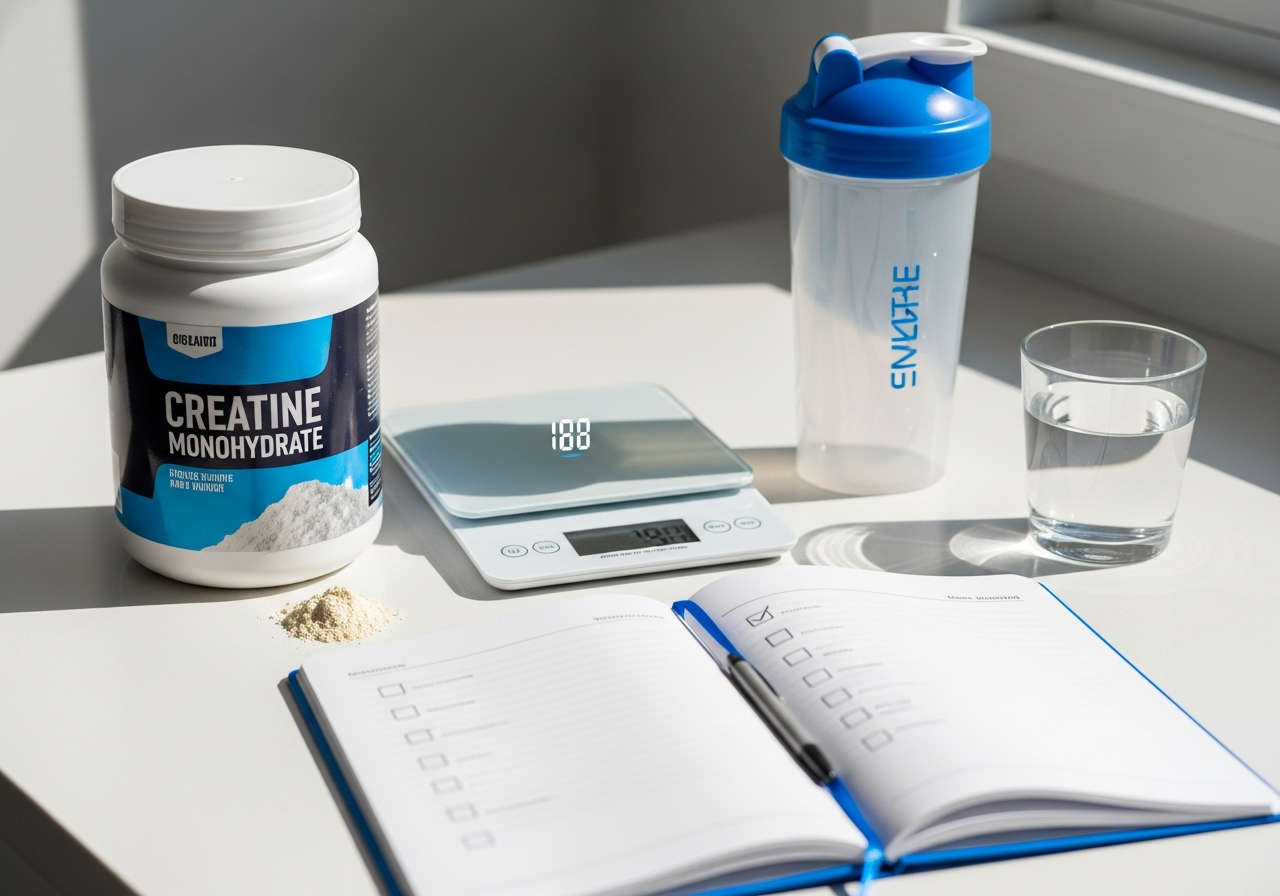
If you want to try creatine for focus or ADHD-related mental stamina, the best approach is to use a standard monohydrate protocol, track outcomes for several weeks, and judge it by real-world function rather than hype. A structured trial works better than taking random scoops and wondering if anything happened.
- Choose the right form. Buy plain creatine monohydrate powder with minimal ingredients. You do not need a proprietary "brain creatine" formula. If you want help comparing options, see our best creatine rankings, creatine brand reviews, or browse the product catalog.
- Pick your dosing strategy. Take 3 to 5 g once daily, every day, or use an optional loading phase of 20 g/day split into 4 doses for 5 to 7 days, then continue with 3 to 5 g/day. Loading saturates stores faster; steady daily dosing gets you there more gradually.
- Keep everything else stable. Do not change caffeine intake, ADHD medication timing, sleep schedule, training volume, and three other supplements all at once. If you stack too many changes, you cannot tell what did what.
- Track specific outcomes for 4 to 8 weeks. Each day, rate 1 to 10 for mental energy, ability to start tasks, sustained focus, afternoon crash, gym performance, and any side effects. Also note body weight because a small increase from intracellular water is common.
A good beginner rule is to judge creatine by outcomes you can actually notice. That might mean fewer mentally drained afternoons, one more high-quality set in the gym, slightly better tolerance to sleep loss, or steadier cognitive stamina during long work blocks. It is less realistic to expect a dramatic overnight improvement in distractibility.
Week by week, many people notice nothing in the first several days if they skip loading. With loading, some notice quicker changes in training performance or body weight. Mental effects, if they happen, are often subtler and can take longer to judge clearly. That is why a written log matters.
For step-by-step help, you can use our creatine dosage calculator, plus detailed guides on how to take creatine and whether to use a loading phase.
The key mindset is simple: run creatine like a measured trial, not like a miracle cure.
Best creatine dose for brain support, training, and body size
For creatine and ADHD-related interest, the standard adult dose is still 3 to 5 g/day of creatine monohydrate, because that is the established dose range used to maintain elevated creatine stores. There is no separate evidence-based "ADHD dose" that has clearly been shown to work better.
The reason standard dosing still makes sense is that creatine works by gradually increasing tissue saturation. Once stores are sufficiently elevated, the exact clock time matters less than daily consistency. Many people overcomplicate this and end up taking too little, skipping days, or buying overpriced forms that promise better brain effects without better evidence.
| Body weight / goal | Practical daily plan | Notes |
|---|---|---|
| Under 60 kg | 3 g/day | Reasonable maintenance dose for smaller adults. |
| 60-90 kg | 3-5 g/day | The most common evidence-based range. |
| Over 90 kg | 5 g/day | Larger athletes often default to the top end of the standard range. |
| Want faster saturation | 20 g/day for 5-7 days, split into 4 doses, then 3-5 g/day | Loading is optional, not required. |
| Focus on convenience | One daily dose at the same time each day | Consistency beats perfect timing. |
If your goal is mostly cognitive support, a simple 3 to 5 g/day plan is still the default. If your goal includes gym performance, body recomposition, or repeated sprint performance, the same dose works because the mechanism is shared across muscle and brain: better creatine availability. If you want a deeper dosing breakdown, see how much creatine per day and maintenance dosing.
People who may notice more from creatine include vegetarians, vegans, newer lifters, high-intensity athletes, and some older adults. Women can use the same evidence-based dose range; creatine is not a "men's supplement." For more, see creatine for women and creatine for older adults.
One practical tip: if 5 g at once causes stomach upset, split it into two smaller servings. There is no bonus for taking it all in one giant scoop. What matters most is that your actual measured daily intake matches the plan.
The shortest correct answer is: for creatine and ADHD, use the same proven monohydrate dose used for general creatine saturation, because no special ADHD-specific dose has been established.
When to take creatine, how long it takes, and how to tell if it is working
For creatine and ADHD-related goals, timing is far less important than taking it daily, and meaningful effects usually depend on reaching saturated stores rather than on taking it at a special "focus" hour. That is why the best time to take creatine is the time you will remember.
Without a loading phase, most people should think in weeks, not days. Daily 3 to 5 g dosing gradually raises creatine stores, while loading at 20 g/day split into 4 doses for 5 to 7 days speeds up that process. This is well aligned with mainstream creatine guidance described in the ISSN position stand and practical summaries like Mayo Clinic's creatine overview.
What should you expect week by week?
- Days 1-7: Little to no obvious cognitive change is common, especially without loading. Some people notice mild water-weight gain or fuller muscles first.
- Weeks 2-4: Training performance is often easier to notice than focus changes. If creatine helps your brain-related goals, the signs are usually subtle: less mental fatigue, better tolerance to long tasks, or slightly steadier attention.
- Weeks 4-8: This is a fair window to judge whether creatine adds anything meaningful to your routine.
How do you tell if it is working? Use objective and subjective markers. Objective markers include body weight, total training volume, repeated sprint output, or one extra rep at a fixed load. Subjective markers include easier task initiation, fewer afternoon crashes, and better sustained concentration during cognitively demanding work. For many adults with ADHD, improved physical energy and reduced mental fatigue may matter almost as much as pure attentional change.
There are also false negatives to watch for. If you miss doses often, take tiny under-dosed servings, switch brands every week, or expect a stimulant-like feeling, you may conclude creatine "didn't work" when the trial was not run properly. Creatine is not supposed to feel like caffeine.
If you want the detailed timing breakdown, see when to take creatine and whether to take it on rest days. The practical rule stays the same: take it every day, give it time, and look for gradual improvements rather than an immediate buzz.
Who creatine may help most: beginners, women, vegetarians, older adults, and athletes with ADHD
Creatine is most likely to be worth trying when you want proven physical benefits and possible brain benefits at the same time. That makes it especially appealing for people with ADHD who also train, struggle with mental fatigue, or have lower dietary creatine intake.
Beginners are often good candidates because creatine is simple, inexpensive per serving, and easier to evaluate than a complicated supplement stack. If you are brand new, start with monohydrate only and avoid mixing it with five other products. Our creatine for beginners guide covers the basics.
Women can use creatine just as effectively as men. There is no evidence-based reason women need a special pink-labelled formula. Some women are initially put off by transient scale changes, but that is usually intracellular water, not fat gain. If focus or training performance are goals, the same 3 to 5 g/day range applies.
Vegetarians and vegans may be particularly relevant in a creatine-and-ADHD conversation because they often consume less dietary creatine. Lower baseline stores can mean a more noticeable response to supplementation in some cases. If you eat no meat or fish, creatine is one of the more rational supplements to consider.
Older adults may care less about ADHD specifically and more about the overlap between cognitive stamina, muscle function, and healthy ageing. Creatine's muscle benefits are well established, and the brain-health angle remains actively discussed. The combined upside can make it attractive if tolerated well.
Athletes with ADHD are a practical real-world group. Even if creatine does not substantially change core ADHD symptoms, it can still improve repeated high-intensity performance, training quality, and recovery. That alone may make it worthwhile. The IOC consensus on dietary supplements recognises creatine as one of the few supplements with solid evidence for certain performance outcomes.
Who may be less impressed? People expecting a medication-like mental effect, people already eating creatine-rich diets and training lightly, and people whose main ADHD challenges are behavioural or environmental rather than fatigue- or stamina-related. In those cases, creatine might still help physically, but the ADHD-specific payoff may be small.
The honest takeaway is this: creatine is usually a better fit as a broad support supplement for active people with ADHD than as a stand-alone cognitive intervention.
Safety, side effects, and the big ADHD question: can you take creatine with medication?
Creatine is generally considered safe for healthy people at standard doses, but if you have ADHD and take medication, the responsible answer is to treat creatine as a low-risk supplement that still deserves basic medical common sense. Safe does not mean thoughtless.
The best-established side effects are usually mild and practical: stomach upset, loose stools, and temporary water-weight gain, especially when people take too much at once. The 2021 JISSN review on creatine misconceptions addresses many common fears and notes that creatine has been extensively studied across different populations. A frequent lab issue is that creatine can increase creatinine, a breakdown product measured on blood tests, without necessarily indicating kidney damage. That point causes a lot of confusion and is why context matters if you do lab work. For a deeper explanation, see creatine and kidney concerns and creatine vs creatinine.
What about ADHD medication? There is no standard warning that creatine monohydrate should never be used with stimulant medications, but research specific to that combination is limited enough that you should avoid pretending it has been exhaustively tested. In practice, many people use creatine alongside caffeine or stimulant medication without issue, but that is not the same as saying the combination has a robust ADHD-specific evidence base. If you take prescription stimulants, have appetite suppression, or are prone to headaches, elevated heart rate, or dehydration from training, it is sensible to monitor hydration, appetite, sleep, and how you feel overall.
You should speak with a clinician before using creatine if you have known kidney disease, are pregnant or breastfeeding, are managing a complex medical condition, or are buying a multi-ingredient product rather than plain monohydrate. The more variables in the formula, the less confident you can be that any effect or side effect comes from creatine itself.
Two practical safety rules solve most problems:
- Take the correct dose consistently instead of taking huge catch-up doses.
- Choose a simple product with transparent ingredient labelling and good manufacturing quality.
In other words, creatine is well-supported for general safety in healthy users, but ADHD-specific medication questions still deserve individual judgement rather than blanket internet reassurance.
Common mistakes and myths about creatine for ADHD, focus, and dopamine
The biggest mistake in the creatine and ADHD conversation is confusing a plausible mechanism with proven clinical benefit. Creatine can support brain energy and still fail to meaningfully improve ADHD symptoms for a given person. That is not a contradiction; it is how evidence works.
Here are the most common myths worth correcting.
- Myth: Creatine is a proven ADHD treatment.
Reality: It is not. The direct evidence for ADHD is limited, so creatine should be framed as an optional supportive supplement, not a primary treatment. - Myth: Creatine works like a stimulant for focus.
Reality: Creatine is not supposed to feel like caffeine or ADHD medication. If it helps, the effect is usually gradual and tied to energy buffering, training output, or mental stamina. - Myth: More creatine means more brain benefits.
Reality: Once you use established dosing, megadoses are unlikely to add benefit and are more likely to cause digestive issues. - Myth: Fancy forms are better for the brain.
Reality: Creatine monohydrate remains the most studied and most cost-effective form. Stronger marketing does not equal stronger evidence. - Myth: Water-weight gain means creatine is making you fat.
Reality: Early scale increases are typically from increased intracellular water, not fat mass. - Myth: Creatine is only for male bodybuilders.
Reality: Creatine is relevant for women, older adults, vegetarians, team-sport athletes, and anyone interested in evidence-based performance support.
Another mistake is poor self-testing. People often begin creatine during a stressful week, while changing sleep, food intake, training, and medication timing, then conclude it either worked miracles or did nothing. Neither conclusion is very reliable. A cleaner trial gives you a much better answer.
Finally, there is the dopamine oversell. Searching "creatine dopamine ADHD" can lead to content that sounds more certain than the science. The accurate version is that creatine may influence systems related to mental energy and function, but it is not established as a direct dopamine therapy.
If you want a broader myth-busting resource, our creatine myths debunked and creatine myths vs facts guides cover the recurring claims in more detail.
The key correction is this: creatine is worth taking seriously, but not worth exaggerating.
How to choose a creatine product in Canada without overpaying for buzzwords
If you want to try creatine for ADHD-related goals, buy the same kind of creatine you would buy for strength and performance: plain creatine monohydrate from a reputable brand with transparent labelling. The smartest buying move is usually the least exciting one.
In Canada, check the label carefully. Many natural health products carry an NPN, or Natural Product Number, which shows Health Canada has authorised the product under the Natural and Non-prescription Health Products framework. An NPN is not a magic quality guarantee, but it is a useful legitimacy marker when applicable. Also look for third-party testing or clear quality-control statements, especially if you are choosing between multiple similar powders.
What should the ingredient panel ideally say? For a basic product, it may be as simple as creatine monohydrate and nothing else. That is often the best sign. Extra stimulants, nootropic blends, proprietary focus matrices, and mega-dose flavour systems can make it harder to evaluate both value and tolerability.
| What to look for | Why it matters | What to avoid |
|---|---|---|
| Creatine monohydrate | Most studied, most cost-effective, strongest evidence base | Claims that exotic forms are automatically superior for the brain |
| Simple ingredient list | Easier to dose and troubleshoot | Proprietary blends that hide exact amounts |
| Clear grams per serving | Lets you hit 3-5 g/day accurately | Tiny under-dosed servings marketed as premium |
| NPN and/or reputable manufacturing details | Helpful Canadian legitimacy signal | Vague labels and unverifiable quality claims |
| Third-party testing when available | Added confidence in purity and label accuracy | Overpaying only for flashy branding |
If you are comparison shopping, start with our best creatine rankings, brand reviews, and best creatine monohydrate in Canada. If you prefer a broader selection view, the product catalog can help.
The shortest buying advice is simple: for creatine and ADHD, do not chase a special "focus" version unless it still gives you a clearly dosed, straightforward amount of creatine monohydrate.
Bottom line: should you use creatine if you have ADHD?
Yes, creatine can be a reasonable supplement to try if you have ADHD, but the reason to try it should be realistic: strong evidence for exercise performance and muscle support, plus a plausible but not yet conclusive case for helping brain energy, mental fatigue, or focus. That is the balanced answer most people need.
If you are hoping creatine will replace medication, therapy, coaching, or sleep and routine management, the evidence does not support that expectation. If you are hoping it might give you a small edge in mental stamina while also improving training quality, that is a much more defensible use case. In other words, creatine is better viewed as a supportive tool than as an ADHD intervention with established clinical efficacy.
The smartest way to proceed is uncomplicated:
- Buy plain creatine monohydrate from a reputable source.
- Take 3 to 5 g/day consistently, with optional loading if you want faster saturation.
- Track mental energy, task stamina, gym performance, and side effects for 4 to 8 weeks.
- Keep your expectations modest and your routine stable.
If it helps, you may notice subtle but worthwhile benefits: slightly steadier focus, fewer washed-out afternoons, better training output, or improved resilience when life is busy. If it does not help your ADHD-related goals, it may still be worth keeping for its much better-established physical performance benefits.
That is the strongest honest conclusion in 2026: creatine and ADHD is a promising but still emerging topic, and creatine monohydrate is reasonable to trial as a safe, evidence-based support supplement rather than a proven ADHD treatment.
For next steps, the most useful related guides are is creatine safe, how much creatine per day, and creatine and cognition.
Creatine and ADHD: The evidence-based numbers that matter
- 3-5 g/day Standard daily creatine monohydrate dose — Evidence-based maintenance range for most adults.
- 20 g/day Optional loading dose — Usually split into 4 doses for 5-7 days to saturate stores faster.
- 4-8 weeks Fair self-test window for ADHD-related goals — Long enough to judge consistency, mental stamina, and side effects.
- 1 form Creatine monohydrate is the reference standard — It remains the most studied and most cost-effective form.
Frequently Asked Questions
Does creatine help ADHD symptoms?
Creatine might help some people with mental energy or focus-related function, but it is not a proven treatment for ADHD symptoms. The direct ADHD research is still limited, so creatine is best viewed as a supportive supplement with plausible brain benefits rather than an established therapy for inattention, impulsivity, or hyperactivity.
Can creatine improve focus if you have ADHD?
Creatine may improve focus indirectly in some people with ADHD by supporting brain energy metabolism, but the effect is usually subtle rather than stimulant-like. If it helps, you are more likely to notice better mental stamina or less cognitive fatigue than a dramatic change in attention overnight.
How does creatine affect the brain in ADHD?
Creatine affects the brain mainly by helping regenerate ATP through the phosphocreatine system, which supports short-term cellular energy demands. In ADHD, that matters because attention and executive function are energy-intensive processes, but this mechanism alone does not prove that creatine will reliably improve clinical ADHD symptoms.
Does creatine increase dopamine in ADHD?
Creatine is not established as a direct dopamine treatment for ADHD. The stronger scientific case is that creatine supports cellular energy systems that may influence how well brain networks function, while any dopamine-related effects remain more theoretical or indirect than clinically confirmed.
What is the best creatine dose for ADHD or focus?
The best evidence-based dose to try is the standard creatine monohydrate dose of 3 to 5 g/day. There is no clearly established ADHD-specific dose, so using the same proven dosing strategy used for general creatine saturation is the most rational approach.
How long does creatine take to work for focus or ADHD-related benefits?
Creatine usually takes days to weeks to build up, and a fair trial for focus or ADHD-related goals is about 4 to 8 weeks. Loading can speed saturation, but even then, any cognitive effects are more likely to be gradual and modest than immediate.
Can you take creatine with ADHD medication?
Many people likely do, but the ADHD-specific research on combining creatine with medication is limited, so the cautious answer is yes in many cases, but check with your clinician if you use prescription stimulants or have other health concerns. Plain creatine monohydrate is the simplest option if you want to minimise confounding ingredients.
Is creatine safe for adults with ADHD?
Creatine is generally considered safe for healthy adults at standard doses, including adults with ADHD, when used as plain creatine monohydrate. The main issues are usually mild digestive upset or temporary water-weight gain, while people with kidney disease or complex medical conditions should get individual medical advice first.
What type of creatine is best for ADHD and brain benefits?
Creatine monohydrate is the best type to choose because it is the most studied, most reliable, and most cost-effective form. There is no strong evidence that more expensive specialty forms are better for ADHD or cognitive support.
Is creatine worth trying if you have ADHD but do not work out?
Yes, creatine can still be worth trying even if you do not work out, because the rationale for ADHD-related interest is brain energy support, not only gym performance. That said, if you are inactive, the total perceived benefit may be smaller because you will miss the well-established physical performance upside.