Can You Mix Creatine With Coffee? Caffeine, Heat, and Absorption
By The Creatine Canada Research Team — Evidence-based supplement analysts
Yes — you can put creatine in coffee, including hot coffee, and for most healthy adults it is a practical way to take your daily dose. The key points are simple: creatine does not contain caffeine, coffee does not meaningfully “destroy” creatine in the way most people use it, and your total daily creatine intake matters far more than whether you mix it into your morning cup.
Evidence-based · Cites 4 sources · Editorial standards
Key Takeaways
- Yes, you can mix creatine with coffee; it is generally fine and effective.
- Creatine does not contain caffeine, and plain creatine monohydrate is a separate ingredient from coffee or pre-workout stimulants.
- Hot coffee is not a major problem if you drink it within a normal timeframe after mixing.
- Take 3-5 g of creatine monohydrate daily; consistency matters more than exact timing.
- If coffee plus creatine upsets your stomach, lower the dose per serving or take creatine with another drink or meal.
- Caffeine does not reliably cancel out creatine’s benefits, but some people feel better separating high caffeine intakes from creatine.
- Choose simple creatine monohydrate with clear labelling, and in Canada look for an NPN and reputable third-party testing where possible.
Yes, you can put creatine in coffee — and for most people it works perfectly well
Yes, you can put creatine in coffee, and for most healthy adults it is an effective, low-friction way to take creatine every day. If your goal is muscle, strength, sprint performance, training capacity, or simply staying consistent with supplementation, mixing creatine monohydrate into coffee is usually fine.
The most important fact is this: creatine works by saturating your muscles over time, not by producing an immediate stimulant effect the way caffeine does. Creatine increases the amount of stored phosphocreatine, which is the rapidly available form of stored energy your muscles use to regenerate ATP, the cell’s direct energy currency, during short, intense efforts. Because that process depends on daily saturation, the exact drink you mix it into matters much less than whether you actually take it consistently.
This also answers a common related question: creatine does not contain caffeine. Plain creatine monohydrate is not a stimulant, does not naturally contain caffeine, and does not provide the alertness or “buzz” associated with coffee. If a creatine product seems stimulating, it is usually because it is really a pre-workout blend or flavoured formula with added caffeine, not because creatine itself has caffeine.
Another common concern is whether hot coffee ruins creatine. In normal real-world use, that concern is usually overstated. Creatine can gradually break down into creatinine in solution over time, and heat can speed that process, but this is more relevant to long storage in liquid than to stirring 3-5 g into a fresh cup and drinking it soon after. If you mix and drink within a normal window, hot coffee is not a deal-breaker.
If you are brand new to supplementation, start simple: use 3-5 g of creatine monohydrate once daily. You can add it to coffee, water, a shake, or another beverage you already consume. If you want help choosing a product first, see our best creatine rankings and creatine product catalog.
The short version is straightforward: can you mix creatine with coffee? Yes. Can you put creatine in your hot coffee? Yes, if you drink it reasonably soon. Can you take creatine with coffee? Absolutely — for most people, that is a convenient habit that improves adherence.
Does creatine have caffeine? No — and that confusion causes a lot of bad advice
No, creatine does not have caffeine, and pure creatine monohydrate contains no stimulant by default. If you are asking “does creatine contain caffeine”, “do creatine have caffeine”, or “does creatine contains caffeine”, the correct answer is no for plain standalone creatine products.
The confusion usually comes from three places:
- Pre-workouts often contain creatine and caffeine together, so people assume creatine itself is caffeinated.
- Energy drinks or RTD gym products may include both ingredients in the same formula.
- Marketing language sometimes makes people think all performance supplements act like stimulants.
Creatine and caffeine do very different jobs. Caffeine primarily affects the central nervous system, which means it helps alertness, perceived energy, and sometimes endurance or training effort. Creatine primarily affects energy recycling inside muscle, especially during repeated high-intensity efforts like heavy sets, sprints, jumps, and short bursts of work.
That distinction matters because your expectations should be different. Coffee can make you feel something within 15-60 minutes. Creatine usually does not create a noticeable acute feeling at all. Instead, creatine’s benefits tend to show up over days to weeks as better repeat power, a small increase in training volume, improved strength progression, or a fuller muscle look from increased intracellular water. If you want the full background, our guides on what creatine is and creatine benefits go deeper.
When checking a label in Canada, look carefully at whether the product is a plain creatine powder or a multi-ingredient performance formula. A straightforward creatine monohydrate product should list creatine monohydrate as the active ingredient and, if sold as a Natural Health Product, should typically show an NPN, which is a Natural Product Number issued under Health Canada’s regulatory framework. An NPN does not guarantee perfection, but it is a useful sign that the product is being sold within the proper supplement framework.
If you want to avoid accidental caffeine entirely, choose an unflavoured or plainly flavoured creatine monohydrate and compare labels through our creatine brand reviews. The bottom line is simple: coffee has caffeine, creatine does not, and mixing them does not magically turn creatine into a stimulant.
What the science actually says about caffeine, heat, and creatine absorption
The science-based answer is that coffee does not stop creatine from being absorbed, and caffeine does not clearly cancel out creatine’s benefits in the way social media often claims. The bigger concerns are practical ones such as stomach comfort, total caffeine intake, and whether you leave creatine sitting in hot liquid for a long time before drinking it.
Creatine absorption itself is not the main problem when you mix it with coffee. Once ingested, creatine is absorbed from the gut and then transported into muscle cells, where it helps raise phosphocreatine stores. The 2017 ISSN position stand concluded that creatine monohydrate is the most effective ergogenic nutritional supplement currently available for increasing high-intensity exercise capacity and lean body mass during training, and it remains the reference form for dosing and efficacy. See Kreider et al. (2017), ISSN Position Stand: Safety and Efficacy of Creatine — JISSN.
The “caffeine cancels creatine” idea comes from older and limited findings that have been debated for years. Current evidence does not support a blanket rule that you must never combine them. The more balanced view, reflected in reviews such as Antonio et al. (2021), Common questions and misconceptions about creatine supplementation — JISSN and the Examine.com — Creatine evidence summary, is that creatine remains effective overall, though very high caffeine intake or certain study conditions may muddy some outcomes.
Heat is a separate issue. Creatine in dry powder form is stable. Once dissolved in liquid, especially warm or acidic liquid, it can slowly degrade to creatinine over time. Coffee is both hot and mildly acidic, so if you mixed creatine into a thermos and left it there for hours, that would be less ideal than drinking it soon after mixing. But freshly mixing creatine into a cup of coffee and drinking it within a normal timeframe is generally not a meaningful problem.
Practical takeaway:
- Mixing creatine into coffee does not ruin absorption.
- Heat matters more over time than instantly.
- Freshly mixed hot coffee is fine for most people.
- Long storage in hot liquid is not ideal.
- Total daily creatine intake matters more than exact co-ingestion with caffeine.
If you want a deeper timing breakdown, see when to take creatine and creatine and caffeine.
How to mix creatine with coffee properly: the simplest step-by-step method
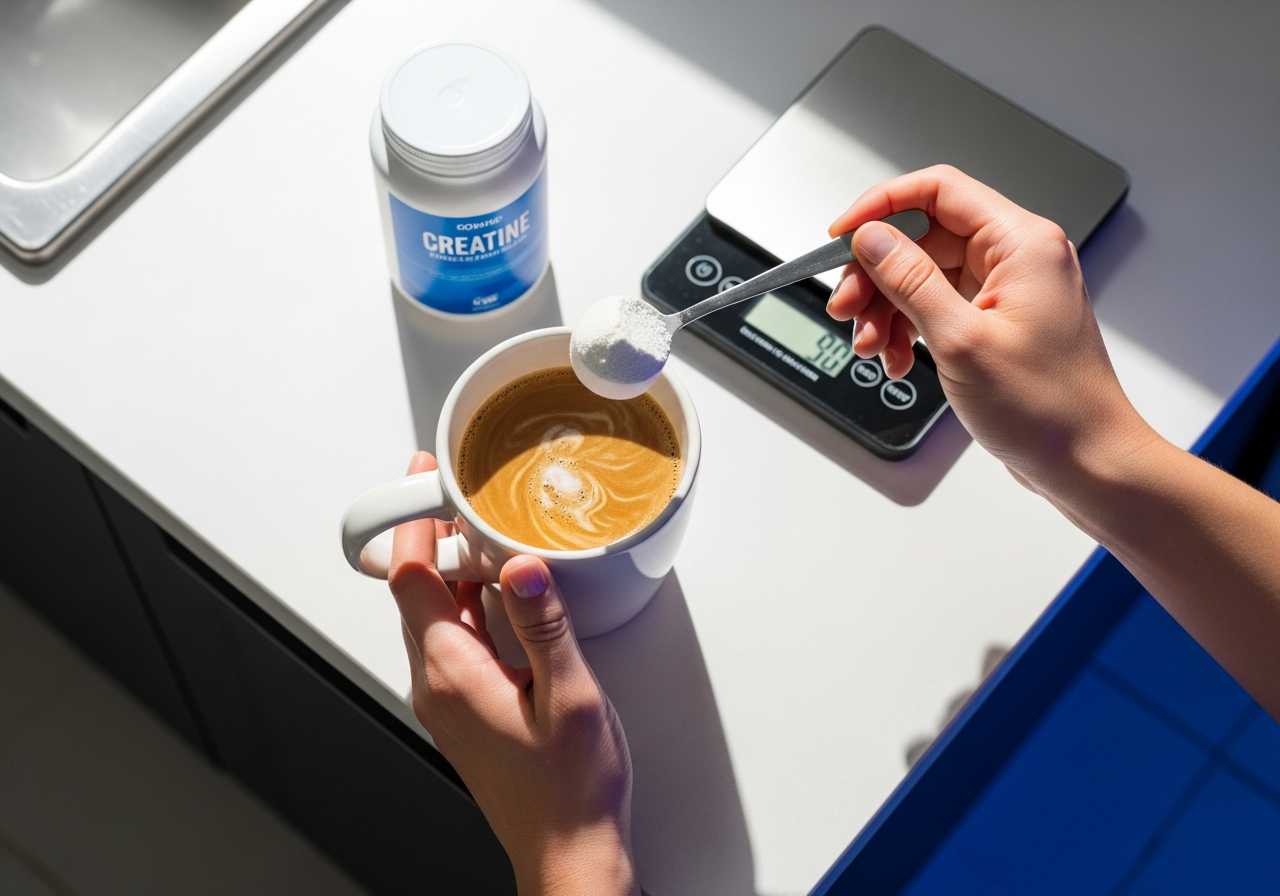
The best way to mix creatine with coffee is to add a measured daily dose to a fresh cup, stir well, and drink it within a normal period rather than letting it sit for hours. That gives you convenience without overcomplicating the chemistry.
- Measure your dose. Use 3-5 g of creatine monohydrate for a standard maintenance dose. If your scoop is not clearly labelled in grams, use a scale or check our creatine dosage calculator and how to measure creatine guidance.
- Brew your coffee as usual. Black coffee, coffee with milk, or coffee with a bit of cream all work.
- Let it cool slightly if you want better comfort. You do not need cold coffee, but adding creatine to a cup that is merely hot rather than scalding can improve handling and sometimes mixing.
- Stir in the creatine. Micronized creatine tends to disperse better than coarse powder, but plain monohydrate is still fine. Stir thoroughly. Some powder may settle if the drink is not agitated again.
- Drink it reasonably soon. Aim to finish it as you normally would, rather than leaving it on a desk all morning.
- Rinse with a bit of water if powder remains. If some creatine settles at the bottom, add a splash of water, swirl, and finish it.
If your coffee is small, strong, and low-volume, you may notice more grittiness. In that case, use one of these fixes:
- Choose micronized creatine monohydrate.
- Stir it first into a small amount of lukewarm water, then add that to coffee.
- Use a larger mug or americano-style drink.
- Take the creatine alongside coffee in water instead.
If coffee plus creatine causes stomach upset, do not force it. Take the same 3-5 g with another beverage or with food. Creatine is not a supplement where discomfort is a badge of honour; comfort improves adherence. Our full guides on how to mix creatine and creatine digestive side effects can help you troubleshoot.
The main rule is simple: the best mixing method is the one you will repeat every day. For many people, morning coffee is exactly that.
How much creatine to add to coffee: exact doses by goal, body size, and loading strategy
For most adults, the right amount of creatine to add to coffee is 3-5 g per day, regardless of whether you train in the morning or not. That is the evidence-based maintenance range most people use after muscles are saturated, and it is consistent with mainstream guidance from sports nutrition research and practice.
You have two standard ways to start:
- No loading: take 3-5 g daily and expect saturation in roughly 3-4 weeks.
- Loading phase: take about 20 g daily, split into 4 servings of 5 g, for 5-7 days, then continue with 3-5 g daily.
Loading is optional. It works faster, but it is more likely to cause stomach upset, and most people do just fine without it. If you do load, many people prefer not to put all loading servings into coffee because that may be unnecessarily harsh on the gut and may push caffeine intake too high if each dose is attached to a separate coffee.
| Body weight / goal | Practical daily creatine dose | Best coffee-mixing approach |
|---|---|---|
| Under 60 kg, general fitness | 3 g/day | One daily serving in coffee or another drink |
| 60-90 kg, muscle and strength | 3-5 g/day | One daily serving in coffee is fine |
| Over 90 kg, strength/power focus | 5 g/day | One daily serving, or split if stomach-sensitive |
| Fast saturation / loading phase | 20 g/day for 5-7 days, split into 4 x 5 g | Usually better split across water, meals, or shakes rather than all in coffee |
| Older adults or beginners wanting simplicity | 3 g/day to start, then 3-5 g/day | Use the easiest daily routine you will maintain |
For a more personalised estimate, use our creatine dosage calculator and read how much creatine per day. If you want to load, our creatine loading phase guide walks you through it.
One useful beginner tip: if you are uncertain whether creatine is “working,” do not judge it by a single workout. Judge it over 2-6 weeks by whether you gain an extra rep here and there, recover between sets slightly better, or see your body weight rise modestly from increased intracellular water. Daily dose and consistency matter far more than whether the powder went into coffee, water, or a shake.
Can you take creatine with coffee before or after a workout? Yes — timing is secondary to consistency
Yes, you can take creatine with coffee before a workout, after a workout, or on a rest day, because total daily intake matters more than precise timing. If your coffee habit makes you more consistent, that timing advantage usually outweighs minor theoretical differences.
Creatine is not like caffeine, where a pre-workout dose often has an obvious short-term effect. Instead, creatine works by building up muscle stores over time. Once your muscles are saturated, the timing window becomes much less important than simply not missing doses. That is why many evidence-based guides treat creatine as a daily saturation supplement rather than an acute “performance shot.”
Here is the practical timing breakdown:
- Morning coffee: excellent if it helps you remember your dose every day.
- Pre-workout coffee: fine, especially if coffee is already part of your routine.
- Post-workout coffee: also fine, though many people prefer a shake, meal, or water after training instead.
- After drinking coffee: yes, you can take creatine later in the day; there is no rule that they must be swallowed together.
- Rest days: still take your creatine, even if you are not training.
If you train late and caffeine affects your sleep, do not force a coffee-based creatine habit in the evening. In that case, take creatine with water, a meal, or a non-caffeinated drink later in the day. Poor sleep will hurt recovery more than any hypothetical advantage from coffee timing.
Some people ask whether taking creatine after coffee is better than taking them together. In most cases, it makes little difference. Separate them if you prefer the taste, if the texture bothers you, or if coffee and creatine together upset your stomach. Keep them together if that makes the habit effortless.
For detailed scheduling, visit when to take creatine, creatine on rest days, and how long creatine takes to work. The best timing plan is the one you can repeat for months, not the one that looks most “hardcore” on paper.
Who should use coffee as a creatine mixer — and who is better off separating them
Coffee is a good creatine mixer for many people, but not for everyone. The best candidates are adults who already drink coffee comfortably, tolerate caffeine well, and want a dead-simple daily habit that reduces missed doses.
Beginners often do especially well with coffee-based creatine because the routine is easy: one mug, one scoop, once a day. The simpler the habit, the more likely it is to stick. If you are new, pair 3-5 g of creatine monohydrate with the same morning routine every day and assess results after several weeks, not several hours.
Women can mix creatine with coffee just as men can. Creatine is not a male-only supplement, and women often use it for strength, training performance, lean mass support, and potentially broader healthy-aging goals. If you want more detail, see creatine for women.
Older adults may also benefit from a simple daily approach, particularly if the goal is preserving muscle and training quality. For many adults over 50, habit design matters more than supplement complexity, and morning coffee may be the easiest anchor. Our creatine for older adults guide goes deeper.
Athletes can absolutely use coffee as a delivery method, but they should think practically. If you already use caffeine strategically before training or competition, just account for total caffeine intake so you do not overshoot your tolerance. The International Olympic Committee consensus on dietary supplements (2018) recognises creatine among the better-supported performance supplements for certain use cases.
Who may want to separate them?
- People with caffeine sensitivity, anxiety, palpitations, or sleep issues.
- People prone to acid reflux or stomach upset from coffee.
- Anyone doing a loading phase, because multiple 5 g servings plus multiple coffees is often unnecessary.
- People who simply dislike the taste or texture.
If any of those apply, take the same daily creatine dose with water, a shake, or a meal. You are not losing benefits by skipping the coffee method. You are simply choosing the delivery method your body tolerates best.
Is taking creatine with coffee bad? Usually no — but side effects are mostly a comfort issue, not a danger issue
For most healthy adults, taking creatine with coffee is not bad, dangerous, or uniquely harmful. The main downside is not that the combination is toxic; it is that some people do not feel great when they combine a powdered supplement with a hot, acidic, caffeinated drink.
The best-supported safety picture for creatine is strong. The 2017 ISSN position stand and later reviews conclude that creatine monohydrate is safe for healthy individuals when used at recommended doses. The Mayo Clinic — Creatine overview also notes that creatine is likely safe for many people when used appropriately.
That said, common real-world side effects can still happen:
- Stomach upset or nausea: more likely if you take too much at once, use a loading phase, or combine it with very strong coffee on an empty stomach.
- Loose stools: usually a dose issue, especially above typical maintenance amounts.
- Heart-racing feeling: usually from the coffee’s caffeine, not from creatine itself.
- Sleep disruption: related to caffeine timing, not to creatine timing.
- Grittiness or settling: a mixing issue rather than a safety issue.
Try these fixes before giving up:
- Reduce to 3 g/day for a week, then reassess.
- Take it with food instead of on an empty stomach.
- Use micronized creatine monohydrate.
- Separate creatine from coffee and take it in water later.
- Do not use coffee as the vehicle for every loading dose.
If you have kidney disease, are under medical care for a renal condition, are pregnant or breastfeeding, or have another medical reason to be cautious with supplements, speak with a qualified healthcare professional before use. Also remember that creatine can raise blood creatinine, which can confuse lab interpretation without necessarily meaning kidney damage; if that topic concerns you, our guides on creatine and kidneys and creatine vs creatinine explain the distinction.
In other words: for healthy adults, coffee plus creatine is usually a tolerance question, not a safety crisis.
The best creatine to mix with coffee is still plain monohydrate — not the trendiest form
The best creatine to mix with coffee is creatine monohydrate, ideally from a reputable brand with clear labelling and good quality control. It remains the most studied, most evidence-based, and usually most cost-effective form, which is exactly why it still dominates serious sports-nutrition recommendations.
The 2017 ISSN position stand specifically supports creatine monohydrate as the reference standard for efficacy and safety. Despite constant marketing for newer forms, monohydrate remains the benchmark that other versions are measured against.
| Creatine form | Good in coffee? | Evidence and practical verdict |
|---|---|---|
| Creatine monohydrate | Yes | Best-studied, effective, usually best value |
| Micronized monohydrate | Yes | Same core ingredient, often mixes a bit better |
| Creatine HCl | Sometimes | May dissolve well, but not better supported than monohydrate overall |
| Buffered / Kre-Alkalyn-type products | Not necessary | Marketing often exceeds evidence |
| Liquid creatine products | Usually not preferred | Convenient, but not the gold standard for stability or value |
In Canada, look for:
- A clear ingredient panel that identifies creatine monohydrate plainly.
- An NPN where applicable for Natural Health Products sold under Health Canada rules.
- Third-party testing or strong brand reputation for purity and label accuracy.
- Minimal extras if you do not want hidden caffeine, sweeteners, or “pre-workout” ingredients.
If your main priority is mixability, micronized creatine can be nice, but it is not inherently more effective. If your main priority is value and evidence, regular monohydrate is already excellent. To compare options sold in Canada, browse our best creatine rankings, creatine brand reviews, and creatine product catalog.
The key buying advice is boring but correct: buy the simplest proven form from a trustworthy seller. For coffee mixing, that means a plain monohydrate powder you can measure accurately and take every day.
Common myths about creatine and coffee, debunked in plain English
Most of the fear around mixing creatine with coffee comes from half-true myths. Here is the evidence-based version of what is true, what is exaggerated, and what actually matters.
Myth 1: Coffee destroys creatine instantly.
False. Creatine can degrade slowly in liquid over time, and heat can contribute, but stirring it into fresh coffee and drinking it within a normal period is not the same as storing it for hours or days.
Myth 2: Caffeine cancels out all creatine benefits.
False as a blanket statement. The evidence does not support a universal claim that creatine and caffeine cannot be used together. Real-world results depend more on consistent creatine intake, training, and tolerance.
Myth 3: If you cannot feel creatine in your coffee, it is not working.
False. Creatine is not supposed to feel like caffeine. It works through tissue saturation and shows benefits over time, not as an instant buzz.
Myth 4: Creatine in coffee is bad for your kidneys.
Not supported in healthy individuals at recommended doses. Confusion often comes from blood creatinine, a lab marker that can rise with creatine use without meaning kidney damage.
Myth 5: Hot coffee makes creatine useless.
Exaggerated. Hot coffee is less ideal for long storage than cool water, but not useless when mixed fresh and consumed normally.
Myth 6: Fancy creatine forms are required if you mix with coffee.
False. Monohydrate is still the evidence-based default. You do not need to pay more just because your delivery method is coffee.
The more important mistakes are behavioural:
- Skipping days because you are overthinking timing.
- Taking random scoop sizes instead of measured grams.
- Doing a loading phase without realising it may upset your stomach.
- Using a caffeinated pre-workout-creatine blend and thinking it is plain creatine.
- Judging success after one workout instead of several weeks.
If you enjoy myth-busting, visit creatine myths debunked and creatine myths vs. facts. The best anti-myth rule is simple: use monohydrate, dose it properly, take it daily, and do not let internet folklore make a simple supplement complicated.
Bottom line: can you have coffee and creatine together? Yes — if it helps you stay consistent, it is a smart choice
Yes, you can have coffee and creatine together, and for most people it is an entirely sensible way to take creatine. If the combination tastes acceptable, feels good on your stomach, and helps you remember your daily dose, it is not just “allowed” — it is often a very good adherence strategy.
Here is the bottom line in practical terms:
- Can you put creatine in coffee? Yes.
- Can you put creatine in hot coffee? Yes, if you drink it within a normal timeframe after mixing.
- Does creatine contain caffeine? No, plain creatine monohydrate does not.
- Is taking creatine with coffee bad? Usually no; the main issue is personal tolerance, not safety.
- Does caffeine affect creatine? Not enough to justify avoiding the combination for most people.
If you want the most reliable starting plan, do this:
- Buy a plain creatine monohydrate powder from a reputable brand.
- Take 3-5 g daily.
- Mix it into your morning coffee or another drink you reliably consume.
- Drink it soon after mixing.
- Continue for at least 3-4 weeks before judging results if you are not loading.
If coffee makes the experience worse, simply switch the liquid, not the supplement. Water, a shake, or a meal all work well too. The effectiveness of creatine depends on regular intake and muscle saturation, not on whether it was delivered in espresso, drip coffee, or a shaker bottle.
For your next step, see how to take creatine, creatine for beginners, how much creatine per day, and best creatine monohydrate options. Keep it simple, keep it measured, and keep it consistent.
Creatine in Coffee: The Numbers That Actually Matter
- 3-5 g/day Standard maintenance dose — The evidence-based daily range most adults use once saturated.
- 20 g/day Typical loading dose — Usually split into 4 doses for 5-7 days if faster saturation is desired.
- 3-4 weeks Time to saturate without loading — A realistic timeline when taking a daily maintenance dose consistently.
- 5-7 days Time to saturate with loading — Loading speeds up saturation but is optional and may increase GI side effects.
Frequently Asked Questions
Can you put creatine in coffee?
Yes, you can put creatine in coffee, and for most people it is a perfectly effective way to take a daily dose. Creatine works by saturating muscle over time, so the beverage matters less than consistent intake, accurate dosing, and drinking it within a normal timeframe after mixing.
Can I put creatine in my hot coffee?
Yes, you can put creatine in hot coffee if you drink it reasonably soon after mixing. Heat and acidity can slowly increase creatine’s breakdown in liquid over time, but this matters much more for long storage than for a fresh cup you drink right away.
Can you mix creatine with coffee every day?
Yes, you can mix creatine with coffee every day, and daily use is exactly how creatine is meant to be taken. A standard maintenance dose is 3-5 g per day, and consistent use over weeks is what raises muscle creatine stores and supports performance benefits.
Does creatine have caffeine?
No, plain creatine does not have caffeine. Creatine monohydrate is a non-stimulant compound, so if a product containing creatine feels stimulating, that usually means caffeine or other stimulants were added separately in a pre-workout or energy formula.
Does creatine contain caffeine naturally?
No, creatine does not contain caffeine naturally. Creatine and caffeine are different compounds with different effects: caffeine mainly affects alertness and perceived energy, while creatine helps regenerate ATP during short, intense muscular effort.
Is it OK to mix creatine in coffee?
Yes, it is OK to mix creatine in coffee for most healthy adults. The main reasons not to do it are practical ones such as stomach upset, taste, texture, or caffeine sensitivity, not because the combination is inherently harmful or ineffective.
Can I take creatine after drinking coffee?
Yes, you can take creatine after drinking coffee, and there is no requirement that they be taken together. Creatine’s benefits depend on total daily intake and long-term saturation, so taking it later with water, a shake, or a meal works just as well.
Does caffeine affect creatine?
Caffeine does not appear to reliably cancel out creatine’s benefits for most people. The more important issues are whether you tolerate the combination well, whether your total caffeine intake is sensible, and whether you take your creatine consistently every day.
Is taking creatine with coffee bad?
No, taking creatine with coffee is usually not bad for healthy adults at recommended doses. The most common issues are gastrointestinal discomfort, jitteriness from caffeine, or sleep disruption if coffee is taken too late, all of which can usually be solved by adjusting timing or drink choice.
Can you have coffee and creatine together before a workout?
Yes, you can have coffee and creatine together before a workout, especially if coffee is already part of your routine. Just remember that caffeine may help acutely, while creatine’s main benefits come from long-term saturation, so the real priority is taking your daily dose consistently.