Does Creatine Cause Muscle Cramps? Debunking the Myth
By The Creatine Canada Research Team — Evidence-based supplement analysts
No—creatine does not appear to cause muscle cramps in healthy people when taken at standard doses. The cramping myth came from anecdote and old sports lore, but modern evidence, including the 2017 ISSN position stand, does not support creatine as a cause of leg cramps, dehydration, or exercise-related muscle cramping.
Evidence-based · Cites 4 sources · Editorial standards
Key Takeaways
- Current evidence does not show that creatine monohydrate causes muscle cramps in healthy users.
- The standard evidence-based dose is 3 to 5 g daily, with an optional loading phase of 20 g daily split into 4 doses for 5 to 7 days.
- Creatine pulls water into muscle cells, but that intracellular water shift is not the same thing as dehydration.
- If you cramp while using creatine, common culprits are hard training, sweat and sodium losses, under-fuelling, or large single doses causing stomach upset.
- Abdominal cramping is more plausible than muscle cramping if you take too much at once or mix creatine poorly.
- Micronized creatine monohydrate, taken consistently and with adequate fluids, is the simplest low-risk approach for most beginners.
- In Canada, choose products with a Natural Product Number and preferably third-party testing for identity and purity.
Does creatine cause cramps? The direct answer is no for most healthy users
No, creatine does not reliably cause muscle cramps, leg cramps, or exercise-related cramping in healthy people taking normal doses. The best-supported modern position is that creatine monohydrate is not a proven cause of cramping, and the long-running belief that it “makes you cramp” is largely a myth that outlived the evidence.
The reason this matters is that many people stop one of the most studied and effective sports supplements because of an old fear that is not well supported. The 2017 ISSN position stand concluded that creatine monohydrate is effective and generally safe, and it specifically addressed common concerns about dehydration and muscle cramping. Likewise, Antonio et al. (2021) reviewed common creatine misconceptions and noted that evidence does not support the claim that creatine causes cramps.
What people often mean when they ask “can creatine cause cramping?” falls into three separate issues:
- Muscle cramps during training, such as calf, hamstring, or quad cramps.
- Abdominal cramps, meaning stomach pain or digestive discomfort after taking a dose.
- A feeling of tightness or “pumped” muscles, which can be mistaken for cramping.
Those are not the same problem, and creatine is much more likely to be blamed unfairly for the first and second than to be the real cause. If you develop leg cramps while lifting, sprinting, or playing sport, the more likely explanations are heat, fatigue, poor conditioning, low sodium from heavy sweating, low carbohydrate availability, or simply training harder because creatine is helping you perform more work.
If you develop abdominal cramps, that is a different story. Large single doses, especially 10 g or more at once, can cause transient stomach upset in some users. That does not mean creatine is causing muscle cramping throughout the body; it means your gut may not like the way you took it. For a deeper look at non-muscle side effects, see creatine and digestive side effects.
The short version is simple: does creatine cause cramps? For muscle cramps, evidence says no; for stomach cramps from poor dosing, sometimes yes. The practical fix is to use creatine monohydrate, take 3 to 5 g daily, split loading doses if you load, and pay attention to hydration and electrolytes rather than blaming the supplement first.
Why the creatine cramping myth spread so widely in gyms and sports
The creatine cramping myth spread because early anecdote travelled faster than controlled evidence. Athletes, coaches, and trainers noticed cramps during hard summer practices and connected them to creatine use, even though cramping is already common in heat, repeated sprint sport, and poorly managed hydration.
This is a classic correlation problem. Creatine is most popular among people doing the exact types of training that already carry a higher risk of cramps: football camps, hockey dryland sessions, repeated sprint work, bodybuilding volume blocks, and intense HIIT. When a well-trained athlete starts creatine and also trains harder, sweats more, and gains a kilogram or two of water inside muscle over the first couple of weeks, the supplement can become the easy scapegoat.
There was also a plausible-sounding but incomplete story behind the myth: creatine increases total body water and draws water into muscle cells, so some people assumed it must “steal” water from the rest of the body and lead to dehydration or cramping. That sounds neat, but it is not how the full physiology plays out. Intracellular water is water held inside cells; that shift is not automatically harmful, and research has not shown that standard creatine use raises cramp risk in healthy people.
The Mayo Clinic’s creatine overview reflects the mainstream position that creatine is generally safe when used appropriately. The International Olympic Committee consensus on dietary supplements also places creatine among the small number of supplements with strong performance evidence, not among products known for causing dangerous hydration problems.
Another reason the myth stuck is that “cramps” is often used loosely. A calf that seizes in the fourth quarter, a stomach ache after dry scooping, and a hard muscle pump are all called cramps by different people. That blurs the conversation and makes the supplement sound guiltier than it is.
Today, the better question is not “can taking creatine cause muscle cramps?” as a blanket claim. The better questions are: What type of cramp are we talking about? What dose was used? Was the person also dehydrated, under-fuelled, or training in the heat? Once you separate those variables, the anti-creatine cramping story becomes much weaker.
If you want a broader myth cleanup, see creatine myths debunked and creatine myths vs. facts.
How creatine affects hydration, muscle cells, and why that does not equal cramping
Creatine works by increasing muscle phosphocreatine stores, and that helps your muscles regenerate ATP, the immediate energy currency used during short, intense efforts. This mechanism improves repeated high-power performance, but it does not provide a convincing biological reason that creatine should directly cause muscle cramps.
Here is the key physiology in plain English:
- Creatine is stored in muscle, mostly as free creatine and phosphocreatine.
- Phosphocreatine donates phosphate to help rapidly remake ATP during hard efforts like sprinting, jumping, and lifting.
- Creatine increases intracellular water, meaning water inside the muscle cell, which may contribute to cell volume and the small early body-mass increase many users notice.
That intracellular water shift is often misunderstood. Water moving into muscle cells does not automatically mean you become dehydrated overall. In fact, some data reviewed in the sports nutrition literature suggest creatine may improve heat tolerance or hydration status in certain contexts rather than worsen it. The mainstream take in 2026 remains that standard creatine dosing is not established as a dehydration or cramp trigger in healthy populations.
So why do cramps happen at all? Exercise-associated muscle cramps are complex and likely involve multiple mechanisms, including neuromuscular fatigue, altered reflex control at the muscle, sodium losses through sweat, and local overload. A cramp is not simply “low water.” That matters because people often think, “I cramped, so creatine must have dehydrated me.” The body is rarely that simple.
There is another practical wrinkle: when creatine works, you often do more work. You might get an extra rep, a slightly higher sprint output, or better repeat performance. That extra output can increase fatigue, sweating, and local muscular stress. In that sense, someone might cramp more during a brutal session while on creatine, but the more plausible chain is higher performance leading to more training stress, not creatine directly poisoning hydration or muscle function.
If you are new to the basics, read what creatine is and what it does. If your worry is specifically dehydration, our guide on creatine and dehydration breaks down the evidence in more detail. The bottom line is that the mechanism of creatine supports performance, and the evidence does not support the idea that this mechanism inherently causes muscle cramping.
If you cramp while taking creatine, these are the more likely causes
If you cramp while taking creatine, the most likely explanation is usually training stress, sweat loss, under-fuelling, or poor dosing habits, not creatine itself. In real-world use, creatine often gets blamed for problems that would have happened anyway.
The most common non-creatine causes of cramping include:
- Heavy sweating with sodium loss, especially in hot gyms, summer sport, or long sessions.
- Neuromuscular fatigue, which is a major driver of exercise-associated muscle cramps late in hard efforts.
- Rapid increases in training volume or intensity, such as pre-season camps or a new leg day.
- Low carbohydrate intake, which can reduce training quality and increase fatigue in hard sessions.
- Poor sleep and recovery, which can lower tolerance to hard effort.
- Large single creatine doses, which can cause stomach discomfort that people describe as cramping.
For example, if someone asks, “can creatine cause leg cramps?” the honest answer is that creatine is not a proven cause of leg cramps, but leg cramps can still happen while using it because athletes cramp for many reasons. If someone asks, “can creatine cause abdominal cramps?” the answer is more nuanced: yes, it can irritate the gut in some people if the dose is too large at once, taken on an empty stomach, or not mixed well.
A useful self-check is to look at the pattern:
- Calf or hamstring cramps during intense sport suggest fatigue, sweat loss, pacing, or conditioning.
- Stomach cramping 15 to 60 minutes after a big scoop suggests the dose or mixing method is the issue.
- General tightness and fullness in muscles may simply be the water-retention effect inside muscle cells and a stronger training pump.
If cramping is new after starting creatine, do not jump straight to “creatine makes me cramp.” First ask whether you also changed your training, climate, pre-workout, hydration, sleep, or food intake. That broader troubleshooting frame is more accurate and more useful.
To support daily habits, our guides on how much water to drink with creatine and how to take creatine can help you clean up the variables that most often cause preventable problems.
How to take creatine to reduce stomach upset, abdominal cramps, and false alarms
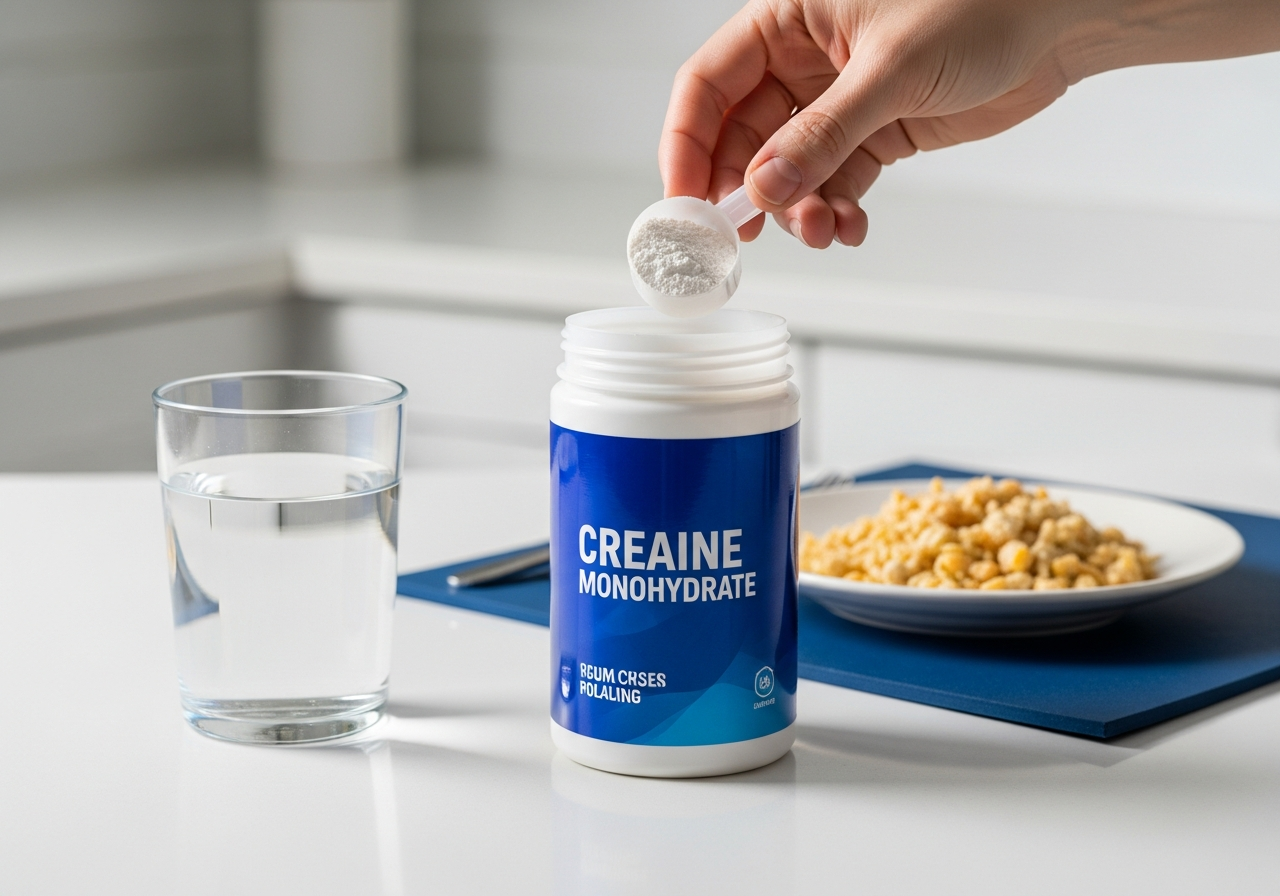
The best way to avoid abdominal cramping from creatine is to use creatine monohydrate, keep the daily dose modest, and avoid taking a large amount at once. Most people tolerate 3 to 5 g per day very well, while bigger single servings are more likely to cause bloating, loose stools, or stomach cramps.
- Choose creatine monohydrate. It is the most studied form, usually the most cost-effective, and the standard used in most safety data. If texture bothers you, micronized monohydrate often mixes better.
- Start with 3 g daily for a few days. If you are cautious or have a sensitive stomach, begin at 3 g rather than jumping to aggressive loading.
- Move to 3 to 5 g daily. This is the standard maintenance range for most adults.
- If you load, split the dose. Use 20 g daily as 4 doses of 5 g for 5 to 7 days rather than one or two huge servings. This reduces the chance of GI distress.
- Mix it fully in enough fluid. Stir or shake in water, juice, or a protein shake rather than dry scooping. Better mixing can reduce gritty residue and improve comfort.
- Take it with food if your stomach is sensitive. This is not required for absorption, but it can improve tolerance.
- Be consistent. Creatine works by saturation over time, not by a one-time hit before a session.
Many users asking “can creatine give you cramps?” are actually dealing with digestive discomfort from a poor protocol. If you slam 10 to 20 g at once, especially before training, you are much more likely to feel abdominal cramping than if you take 3 to 5 g calmly with a meal or shake.
Week by week, here is what a beginner can expect:
- Week 1 without loading: usually no dramatic feeling, though some notice slightly fuller muscles.
- Weeks 2 to 4: muscle stores rise steadily; performance benefits become more noticeable in repeated efforts.
- After loading: stores saturate faster, often within about a week, but GI side effects are more likely if you do not split doses.
If your stomach still protests, consider dividing 5 g into 2.5 g twice daily for a week. You can also compare forms and brands in our best creatine rankings or browse the creatine product catalog for simpler unflavoured options.
Best creatine dose by body weight and goal, with a practical comparison table
The best creatine dose for avoiding unnecessary side effects while getting results is usually 3 to 5 g per day, regardless of whether your goal is strength, muscle, or general performance. Larger athletes and aggressive loading protocols can justify the higher end, but more is not better once muscle stores are saturated.
Here is the practical framework most people can use:
| Body weight / goal | Simple daily dose | Optional loading phase | Best use case |
|---|---|---|---|
| Under 60 kg | 3 g/day | 15 to 20 g/day split into 4 doses for 5 to 7 days | Smaller adults, cautious beginners, sensitive stomachs |
| 60 to 90 kg | 3 to 5 g/day | 20 g/day split into 4 doses for 5 to 7 days | Most gym-goers, team-sport athletes, women and men |
| Over 90 kg | 5 g/day | 20 g/day split into 4 doses for 5 to 7 days | Larger athletes, strength and power focus |
| Fast saturation needed | 5 g/day after loading | 20 g/day split into 4 doses for 5 to 7 days | Competition prep, impatient users, short timeline |
| Minimal GI risk preferred | 3 to 5 g/day | No loading | Beginners, anyone prone to abdominal cramps |
A body-weight formula sometimes used in research is about 0.3 g/kg/day for loading and about 0.03 g/kg/day for maintenance. For a 70 kg person, that works out to roughly 21 g/day during loading and about 2.1 g/day for maintenance, though in practice 3 to 5 g/day remains the standard real-world recommendation because it is simple and effective.
Examples:
- 55 kg woman starting creatine: 3 g/day is usually enough.
- 75 kg recreational lifter: 5 g/day is a simple default.
- 100 kg rugby player: 5 g/day maintenance is reasonable after optional loading.
If your goal is to avoid any chance of abdominal cramping, skip loading and just take your maintenance dose daily. Saturation will take longer, typically a few weeks instead of about a week, but tolerance is usually better. For a deeper breakdown, use the creatine dosage calculator and read how much creatine per day or whether a loading phase is necessary.
The key point for the cramps question is that staying within these evidence-based ranges makes muscle cramping unlikely and digestive side effects much easier to avoid.
Timing, fluids, and electrolytes: what actually matters if you are worried about cramping
If you are worried about cramping, daily consistency matters more than creatine timing, and your hydration and electrolyte habits matter more than the creatine itself. Creatine is not a pre-workout stimulant; it works by gradually saturating muscle over days to weeks.
That means you can take creatine:
- Before training
- After training
- With breakfast
- On rest days at any convenient time
For most people, the “best” time is simply the time you will remember every day. If you want a full timing breakdown, see when to take creatine and creatine on rest days.
Hydration is where many cramp concerns get misdirected. A practical approach is:
- Take creatine with a full glass of water or in a shake.
- Drink according to thirst through the day, then add more attention if you train hard or sweat heavily.
- Replace sodium and fluids after long, hot, or very sweaty sessions.
- Do not assume plain water alone solves all cramps. Low sodium can matter, especially for salty sweaters.
People also ask, “does creatine help with cramping?” The honest answer is that creatine is not an established treatment for muscle cramps, but it also is not a proven cause. Its role is performance support, not cramp therapy. If better training capacity from creatine improves conditioning over time, that could indirectly reduce fatigue-related cramping in some athletes, but that is not the same as saying creatine directly treats cramps.
Another common question is whether creatine and caffeine together increase cramp risk. In normal dietary amounts, there is no strong reason to think combining them makes muscle cramping likely, though some pre-workout products can upset the stomach and muddy the picture. If you use multiple supplements, simplify variables before blaming creatine alone.
The practical rule is simple: take creatine daily, drink sensibly, and treat heat, sodium, and training load as the first places to troubleshoot if you cramp. In most cases, those factors explain far more than the supplement does.
Who the evidence applies to: beginners, women, older adults, and competitive athletes
The evidence that creatine does not typically cause muscle cramps applies broadly to healthy beginners, women, older adults, and athletes, provided dosing is sensible and there is no relevant medical contraindication. The main differences between groups are usually goal, body size, training demands, and tolerance—not a unique cramp risk from creatine itself.
Beginners: New users often feel nervous because they are reading side-effect threads before they have any context. For a beginner, the lowest-friction plan is 3 to 5 g of creatine monohydrate daily, no loading, taken with a meal or shake. That approach is effective and keeps digestive discomfort less likely. Our creatine for beginners guide expands on this.
Women: Women often ask whether creatine causes cramping, bloating, or menstrual issues. The evidence does not show that creatine specifically causes muscle cramps in women. Some women may notice a mild increase in scale weight from intracellular water, but that is not the same as bloating in the negative, puffy sense many people fear. See creatine for women for a full breakdown.
Older adults: Older adults using creatine for strength, muscle, or healthy ageing generally use the same 3 to 5 g/day range. There is no special evidence-based reason to expect more muscle cramping solely because of age, though hydration habits, medications, and kidney monitoring may matter more in this group if there are existing health issues.
Athletes: Competitive athletes in repeated sprint, power, or contact sports are often the exact people most likely to hear the cramping myth. In reality, they are also the most exposed to heat, intense workloads, and sweat losses, which are the real confounders. Creatine remains one of the most evidence-based supplements for sport performance.
Vegetarians and vegans: People with lower baseline dietary creatine intake may respond especially well to supplementation. A better response does not imply a higher cramp risk; it simply means they may notice benefits more clearly.
This is where context matters: if a healthy user asks, “does creatine cause cramps in legs?” the answer is generally no. If a person with a medical condition, recurrent unexplained cramping, or unusual medication use asks the same question, the answer should include personal medical review rather than internet generalities.
Creatine safety, real side effects, and when cramping is a reason to pause and reassess
Creatine monohydrate is generally considered safe for healthy people, but that does not mean every symptom should be ignored. Muscle cramps are not a classic evidence-based creatine side effect, while digestive upset, small early weight gain from intracellular water, and occasional mixing-related intolerance are more realistic issues.
What is commonly normal:
- Body mass increasing by roughly 1 to 2 kg early on, especially with loading, from water stored inside muscle.
- Fuller muscles or a tighter feeling, which can be mistaken for “cramping” but is not the same thing.
- Mild GI discomfort if the dose is too large at once.
What is not normal enough to ignore:
- Severe, persistent abdominal pain
- Repeated vomiting or diarrhoea
- Cramping plus signs of heat illness, dizziness, or confusion
- Unexplained swelling, allergic-type symptoms, or any symptom that seems clearly disproportionate
If you have kidney disease, significant renal impairment, or a clinician has told you to avoid creatine, get individual medical advice before supplementing. Healthy kidneys and diseased kidneys are not the same discussion. Also remember that creatine can raise blood creatinine, which is a breakdown product often used as a kidney marker, without meaning the supplement damaged healthy kidneys. If that topic worries you, read the creatinine confusion explained and our full creatine safety guide.
In Canada, it is smart to buy products with a Natural Product Number (NPN), which is Health Canada’s product licensing identifier for many natural health products sold legally with approved labelling claims. NPNs do not make a product magically superior, but they do indicate a regulated pathway. Third-party testing for purity and banned substances is also valuable, especially for athletes.
So when should you stop creatine temporarily? If you repeatedly get stomach cramps immediately after dosing, reduce the dose, split it, take it with food, and simplify other supplements. If the problem persists even at 3 g/day with a plain monohydrate product, pause and reassess. But if the issue is muscle cramping during hard exercise, look first at heat, fluids, sodium, workload, and recovery before assuming creatine is to blame.
Myths debunked: leg cramps, menstrual cramps, and other common creatine questions
The fastest way to answer most creatine cramp myths is this: creatine is not a proven cause of muscle cramps, and it is not an established treatment for cramps either. Beyond that, each specific question needs a precise answer.
Myth: creatine causes leg cramps.
Reality: evidence does not support creatine as a common cause of calf, hamstring, or quad cramps in healthy users. Leg cramps during sport are more often tied to fatigue, pace, heat, and sweat losses.
Myth: creatine causes dehydration.
Reality: creatine increases intracellular water, but that is not the same as whole-body dehydration. Research reviews do not support a blanket dehydration claim.
Myth: if I cramped after starting creatine, creatine caused it.
Reality: timing alone does not prove cause. New supplements often begin at the same time as harder training blocks, pre-season heat, or diet changes.
Question: does creatine help with muscle cramps?
Answer: not directly, based on current evidence. Creatine is taken for strength, power, lean mass support, and repeated high-intensity performance, not as a recognised anti-cramp supplement.
Question: can creatine help with leg cramps?
Answer: there is no strong evidence to recommend creatine as a treatment for leg cramps. If leg cramps are frequent, look first at training load, hydration strategy, sodium, and medical causes.
Question: does creatine help with period cramps or menstrual cramps?
Answer: there is not strong mainstream evidence in 2026 to recommend creatine as a proven treatment for menstrual cramps. Some creatine research in women looks at performance, body composition, cognition, or healthy ageing, but period-cramp relief is not an established indication.
Question: can creatine cause abdominal cramps?
Answer: yes, sometimes, especially with large single doses or poor mixing. That is a digestive tolerance issue, not proof that creatine causes whole-body muscle cramping.
These distinctions matter because many search queries mash all “cramps” together. The evidence-based answer is more specific: does creatine cause muscle cramps? Usually no. Can creatine cause stomach cramps if taken poorly? Yes, that is plausible and fixable.
How to choose a creatine product in Canada if you want fewer side effects and less guesswork
If you want the lowest-risk, best-supported option, buy a simple creatine monohydrate powder from a reputable brand with transparent labelling. For the cramps question, product choice matters less for muscle cramps than for stomach tolerance, mixing, and confidence in purity.
Here is what to look for in Canada:
- Creatine monohydrate as the only active ingredient if you want the most studied form.
- An NPN on the label where applicable, indicating a Health Canada natural health product licence.
- Third-party testing or clear quality assurance, especially for competitive athletes.
- Micronized powder if you want easier mixing and potentially better mouthfeel.
- No unnecessary stimulant blends if you are troubleshooting cramps, stomach upset, or hydration concerns.
What to be cautious with:
- “Proprietary” pre-workouts that bundle creatine with high caffeine, niacin, sweeteners, and other ingredients that can muddy side effects
- Underdosed gummies or formats that make it hard to reach an effective daily dose
- Exotic creatine forms marketed as cramp-free without strong evidence they beat monohydrate
Monohydrate still wins because it has the best evidence base, the clearest safety record, and usually the best value. Claims that HCL, buffered creatine, or other forms uniquely prevent cramps are not strongly supported. If your real issue is stomach comfort, a smaller dose, split dosing, better mixing, or taking it with food usually solves more than switching to a premium form.
For practical shopping help, compare products in our creatine brand reviews, see the best creatine rankings, or read how to choose the best creatine monohydrate in Canada. If you are specifically trying to avoid hype, plain unflavoured monohydrate from a reputable seller is still the most rational buy.
The key buying takeaway is simple: if you are worried that creatine causes cramps, do not solve the wrong problem with a fancier product. First solve dose, mixing, fluids, and training variables; then choose a clean, regulated, straightforward monohydrate product you can take consistently.
Bottom line: does creatine cause cramps, and what should you do next?
No, creatine does not appear to cause muscle cramps in healthy people when used at evidence-based doses, and the old cramping myth is not supported by modern research. If you are asking whether creatine can cause muscle cramps, leg cramps, or exercise cramping, the best answer is generally no; if you are asking whether it can cause abdominal cramps from taking too much at once, the answer is yes, sometimes.
So what should you do in practice?
- Use creatine monohydrate.
- Take 3 to 5 g daily.
- Skip loading if you want the lowest chance of stomach upset.
- If you load, use 20 g/day split into 4 doses for 5 to 7 days.
- Take it with water or a meal if your stomach is sensitive.
- If you cramp during exercise, troubleshoot heat, sweat, sodium, conditioning, and workload first.
How do you know creatine is working? Usually not from a dramatic feeling on day one. Instead, look for slightly fuller muscles, better repeat effort performance, an extra rep here and there, improved sprint repeatability, or steadier strength progress over a few weeks. For realistic expectations, read how long creatine takes to work.
If you have persistent digestive symptoms even with a simple 3 g daily dose, pause and reassess your product and routine. If you have a medical condition, recurrent unexplained cramping, or kidney disease, get individual guidance. But for the average healthy lifter, athlete, or beginner, creatine is one of the safest and best-supported supplements in sport nutrition.
The final answer is short enough to remember: creatine does not usually cause cramps; bad dosing, hard training, heat, and poor hydration habits are far more likely explanations.
Creatine and Cramps: The Numbers That Actually Matter
- 3–5 g/day Standard maintenance dose — The usual evidence-based daily dose for most adults.
- 20 g/day Optional loading dose — Typically split into 4 doses for 5–7 days to saturate muscle faster.
- 5–7 days Typical loading timeline — Loading can raise muscle creatine stores faster than maintenance-only dosing.
- 1–2 kg Common early weight increase — Usually intracellular water in muscle, especially during the first 1–2 weeks.
Frequently Asked Questions
Does creatine cause muscle cramps?
No, creatine does not appear to cause muscle cramps in healthy people when taken at standard doses. The best modern evidence and expert reviews do not support creatine as a common cause of cramping, dehydration, or heat illness, although cramps can still happen during hard training for other reasons.
Can creatine cause leg cramps?
Usually no, creatine is not a proven cause of leg cramps. If you get calf, hamstring, or quad cramps while using creatine, heat, fatigue, sweat sodium losses, and rapid training increases are more likely explanations than the supplement itself.
Can creatine cause abdominal cramps?
Yes, creatine can cause abdominal cramps in some people if the dose is too large at once. This is most likely with big single servings, poor mixing, or taking it on an empty stomach, and it is usually solved by using 3 to 5 g daily or splitting doses.
Does creatine cause cramping in the heat?
No, creatine is not established as a heat-cramp trigger. People often associate creatine with summer practices because those are high-cramp environments anyway, but the research does not support the idea that standard creatine use causes heat-related cramping in healthy athletes.
Can taking creatine make you cramp during workouts?
Not directly in most cases. If you cramp during workouts while taking creatine, the more likely chain is that you trained harder, sweated more, or were more fatigued, not that creatine itself caused the cramp.
Does creatine help with cramps?
Creatine is not a recognised treatment for muscle cramps. Its main benefits are improved phosphocreatine availability, better repeated high-intensity performance, and support for strength and lean mass gains, so it should not be relied on as a cramp remedy.
Does creatine help with leg cramps?
There is no strong evidence that creatine helps treat leg cramps. If leg cramps are frequent, focus first on hydration strategy, sodium replacement, conditioning, training load, and medical review if the problem is persistent or unexplained.
Does creatine help with period cramps or menstrual cramps?
There is not strong mainstream evidence in 2026 to recommend creatine as a treatment for period cramps. Creatine has promising applications in women’s performance and healthy ageing, but menstrual cramp relief is not an established evidence-based use.
What is the best way to take creatine to avoid cramps?
The best way is to take creatine monohydrate at 3 to 5 g daily, mixed well in fluid, and avoid large single doses. If you choose to load, split 20 g daily into four 5 g servings for 5 to 7 days to reduce the chance of stomach upset.
Should I stop creatine if I get cramps?
Not necessarily, especially if the cramps are in working muscles during hard exercise. First check heat, fluids, sodium, food intake, and training load; however, if you have repeated stomach cramps right after dosing, severe symptoms, or a medical condition, pause and reassess.