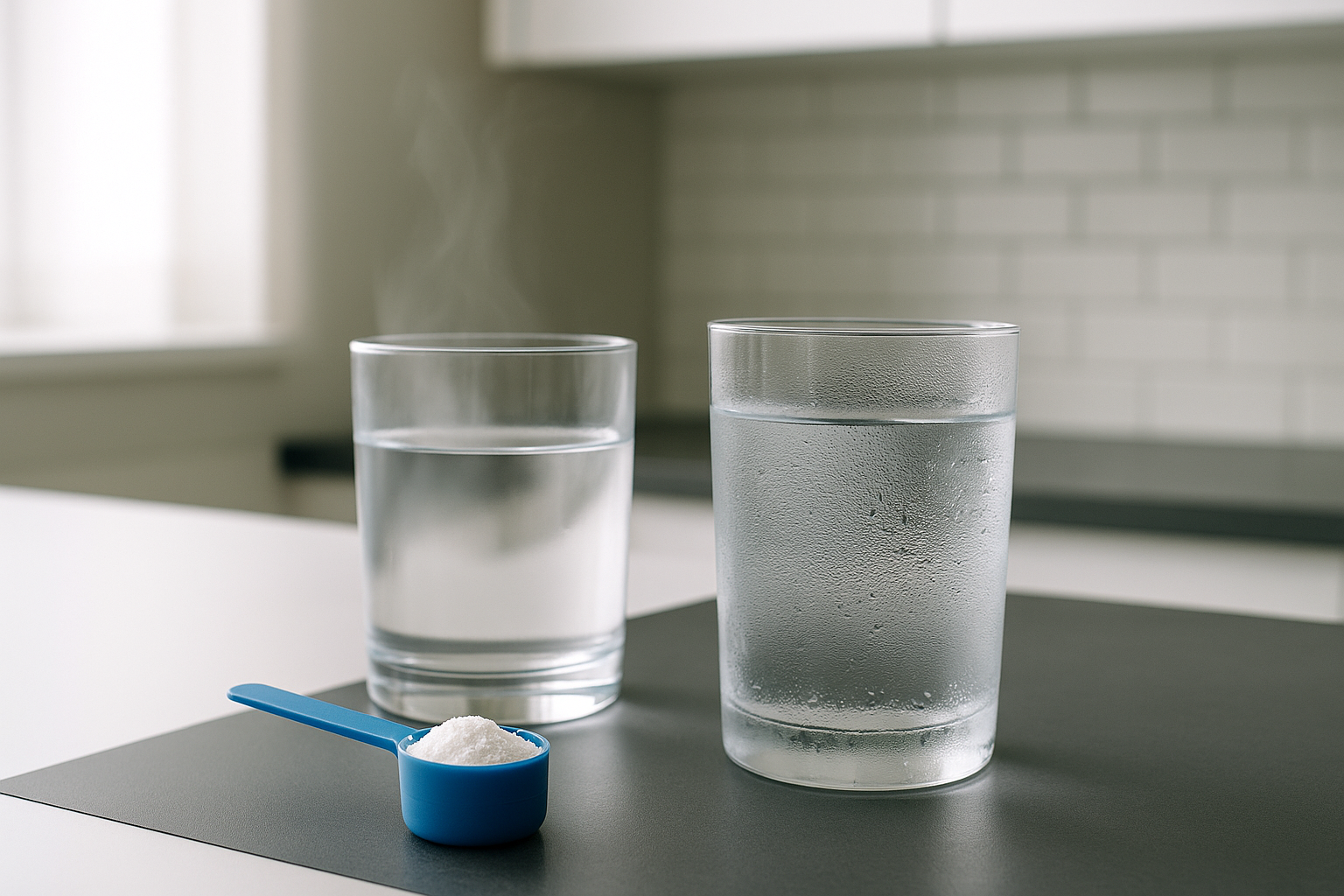
Creatine in Hot vs. Cold Water: Does Temperature Affect Solubility and Effectiveness?
By The Creatine Canada Research Team — Evidence-based supplement analysts
Yes — creatine dissolves better in warm or hot water than in cold water, but normal mixing temperature does not meaningfully change how well creatine works in your body. The practical rule is simple: use room-temperature or warm water if you want less grit, avoid leaving creatine sitting in very hot liquid for long periods, and focus far more on taking the right daily dose consistently.
Evidence-based · Cites 4 sources · Editorial standards
Key Takeaways
- Warm water improves creatine solubility, so it mixes faster and feels less gritty than cold water.
- Cold water is still fine; undissolved particles do not mean the creatine is ineffective.
- Creatine monohydrate works because of daily muscle saturation, not because it fully dissolves in your glass.
- Use 3-5 g/day for maintenance, or 20 g/day split into 4 doses for 5-7 days if you want to load faster.
- Avoid letting creatine sit for long periods in very hot or acidic drinks, because degradation risk rises over time in solution.
- If creatine upsets your stomach, use smaller doses, more water, and warm liquid to improve mixability.
- For Canadians, plain creatine monohydrate with a Health Canada NPN and preferably third-party testing is the safest default buy.
Hot vs. cold water: the direct answer most people actually need
Creatine dissolves better in warm or hot water than in cold water, but both temperatures still work for supplementation. If your goal is the best mixability, warm water wins; if your goal is muscle and strength benefits, temperature matters far less than taking enough creatine every day.
This distinction matters because people often confuse solubility with effectiveness. Solubility means how easily creatine powder disperses and dissolves in liquid. Effectiveness means whether enough creatine gets into your muscles over time to raise phosphocreatine stores. Phosphocreatine is the stored form that helps regenerate ATP, your muscles’ immediate fuel for short, hard efforts. A gritty glass can still be effective, and a perfectly smooth glass is not automatically better if you underdose or take it inconsistently.
The evidence-based default remains creatine monohydrate. The 2017 ISSN position stand concluded that creatine monohydrate is the most effective ergogenic nutritional supplement currently available for increasing high-intensity exercise capacity and lean mass gains during training. That conclusion is about the ingredient itself, not whether you mixed it in hot or cold water. You can review that summary directly in Kreider et al. (2017), ISSN Position Stand: Safety and Efficacy of Creatine — JISSN.
So what should you do in real life?
- Use warm or room-temperature water if you hate sediment at the bottom of the glass.
- Use cold water if you prefer it; just stir or shake well and drink all of it.
- Do not obsess over temperature because consistency, dose, and total daily intake matter more.
If you are brand new to supplementation, start with plain monohydrate and a simple routine. Our creatine dosage calculator can help you set an exact intake, and our guide on how to mix creatine goes deeper on dissolving, clumping, and texture.
The bottom line is straightforward: warm water improves convenience, not performance. Creatine works by saturating muscle over days and weeks, not by achieving perfect instant dissolution in your shaker bottle.
Why creatine dissolves better in warm water than in cold water
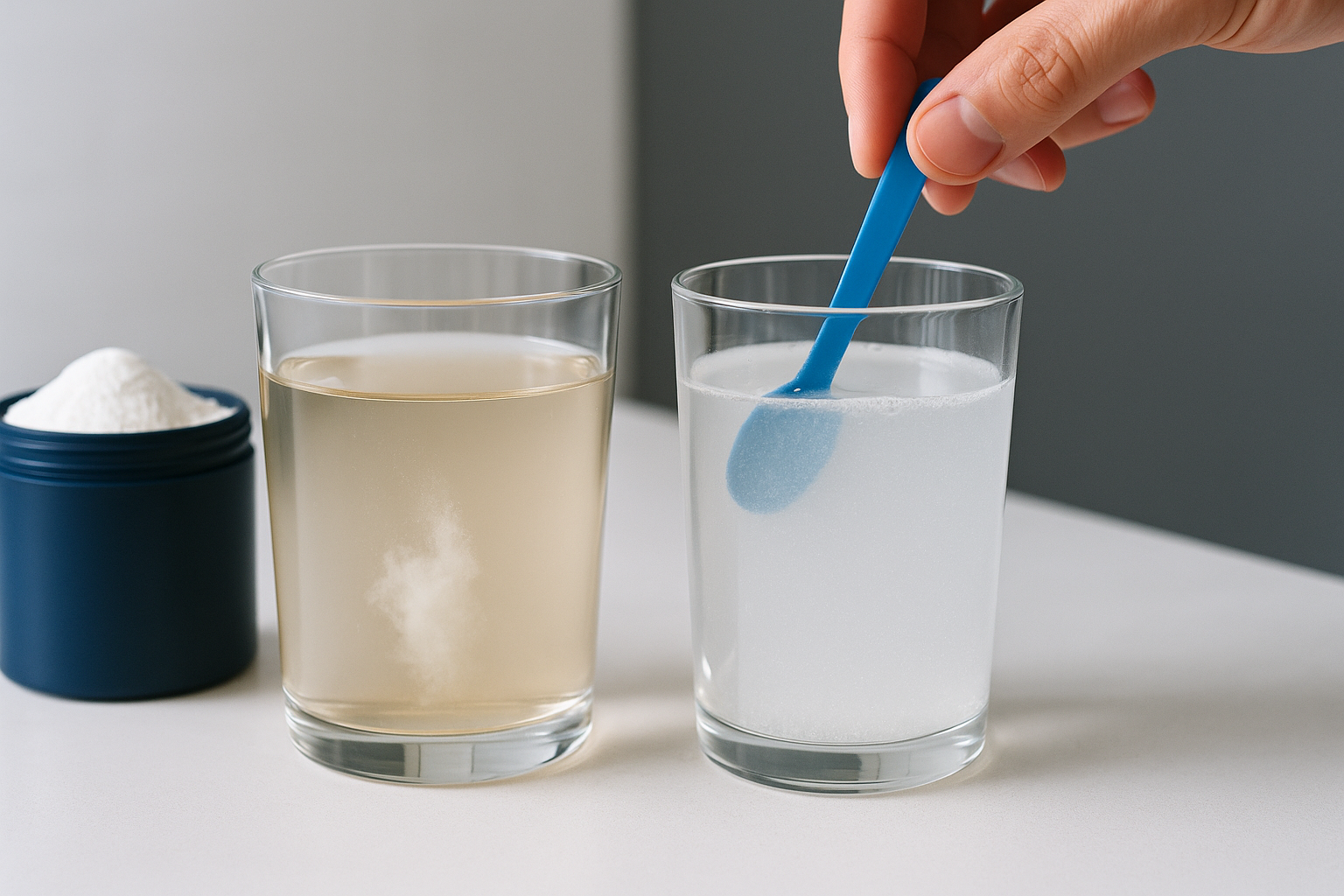
Creatine dissolves better in warm water because higher temperature generally increases molecular motion, which helps the powder disperse and enter solution more easily. In plain English, warmth makes creatine mix faster and reduces the chalky residue you often notice in cold water.
Creatine monohydrate is not highly soluble compared with many flavoured drink powders, which is why even a good product can seem sandy. This is a physical property of the ingredient, not a sign of low quality by itself. When water is warmer, the liquid can hold dissolved creatine more readily, so fewer crystals remain sitting at the bottom. That is why many people find that mixing creatine with warm water feels smoother and requires less shaking.
However, there is an important nuance: better dissolved does not necessarily mean better absorbed. Once you swallow creatine, your digestive tract does the real work. If some particles were suspended rather than fully dissolved, they can still be absorbed after ingestion. That is why a glass that looks imperfect can still deliver the same practical result, especially if you consume the full dose.
Micronized creatine can make this easier. Micronized powder has a smaller particle size, which improves dispersion and mouthfeel. It does not consistently outperform standard monohydrate for results, but it can be more pleasant to drink. If texture bothers you, compare options in our best creatine rankings or browse the creatine product catalog.
Here is the practical hierarchy for dissolving creatine:
- Warm water: mixes easiest, least grit.
- Room-temperature water: usually good enough.
- Cold water: works, but often leaves more sediment.
- Ice-cold water: usually the grittiest.
If you want a smoother drink without heating anything, try these simple tricks:
- Use more water instead of less.
- Stir for longer than you think you need.
- Shake in a bottle, then let it sit for 30 to 60 seconds and shake again.
- Add the creatine to liquid first, then shake before it clumps on the bottom.
Temperature affects your cup far more than it affects your gains. That is the key concept to remember.
Does heat damage creatine? Here is what degradation really means
Normal warm-water mixing does not meaningfully ruin your creatine, but prolonged exposure to heat after mixing can increase degradation over time. The practical concern is not a few seconds in warm water; it is leaving creatine sitting in hot liquid for extended periods, especially if the drink is also acidic.
Creatine can convert into creatinine, a breakdown product, when conditions favour degradation. This conversion is more relevant when creatine stays dissolved in liquid for a long time rather than when it is stored dry in a sealed tub. Heat can accelerate that process, and acidity can contribute as well. That is why pre-mixing creatine far in advance, especially in hot coffee or acidic juice, is less ideal than mixing and drinking it relatively soon.
This is also one reason stable liquid creatine products have historically faced scrutiny. Creatine is most reliable as a dry powder that you mix shortly before drinking. The 2021 JISSN paper on common questions and misconceptions about creatine reinforces that many practical fears around creatine are overstated, but it also supports using well-established forms and protocols rather than gimmicks. See Antonio et al. (2021), Common questions and misconceptions about creatine supplementation — JISSN.
Use this simple rule set:
- Warm water: fine.
- Hot water: generally fine if you drink it soon.
- Boiling water: unnecessary and not recommended.
- Hot liquid left for hours: avoid.
If you like creatine in coffee or tea, the safest practical approach is to stir it in and drink it fairly promptly rather than making a large batch and sipping it all morning. If this topic interests you, our related guide on creatine with coffee covers caffeine, heat, and timing in more detail.
A useful way to think about it is this: dry creatine in a well-sealed container is stable enough for normal use, but creatine dissolved in a hot drink is more time-sensitive. That does not mean you need to fear heat; it means you should avoid treating a hot mixed drink like long-term storage.
So yes, heat degradation is a real concept, but in everyday practice it is often overblown. Warm mixing is sensible. Long hot soaking is not.
Exactly how to mix creatine in hot, warm, or cold water for the best result
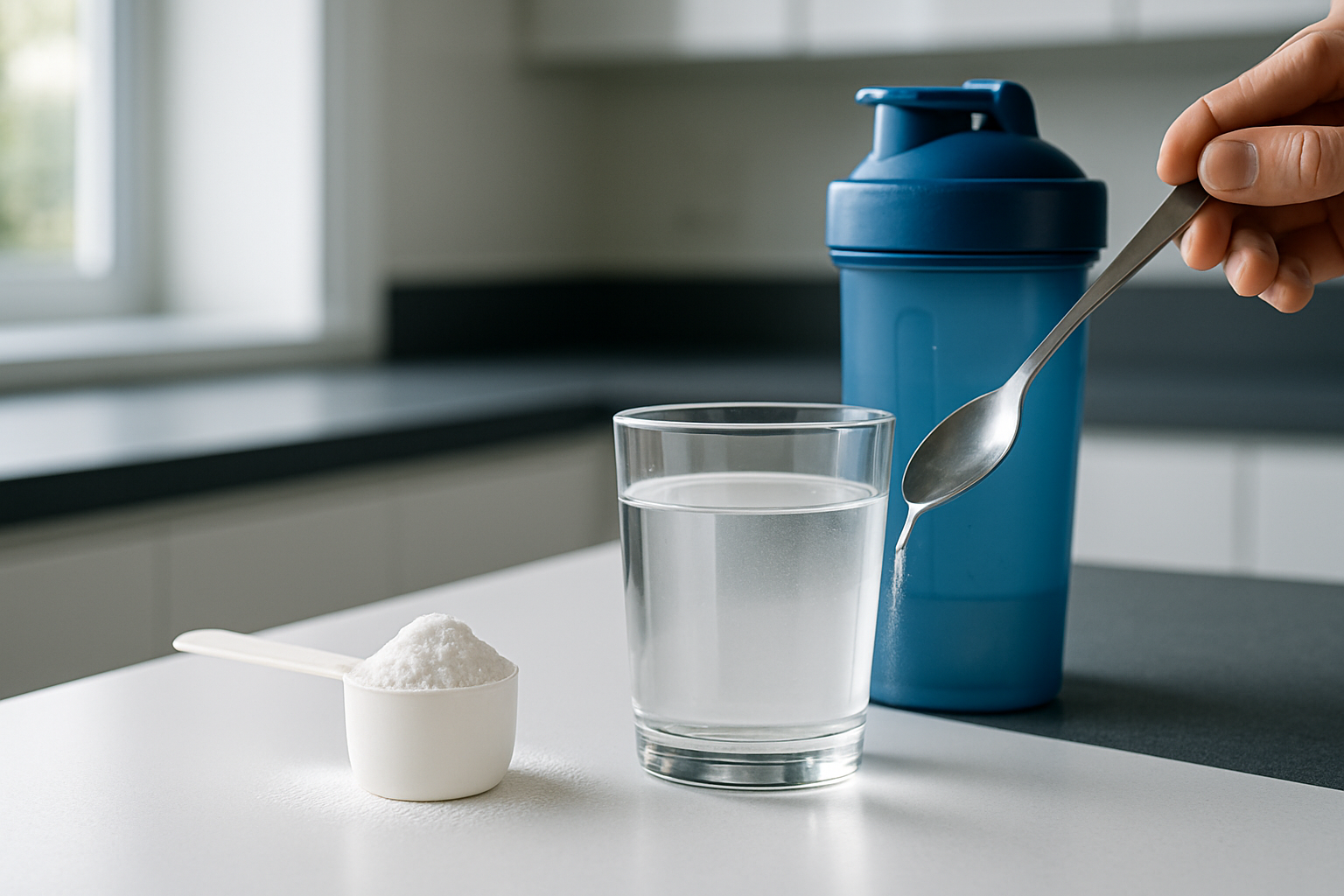
The best way to mix creatine is to use 3 to 5 grams in room-temperature or warm water, stir or shake thoroughly, and drink it soon after mixing. This approach gives you the easiest balance of convenience, solubility, and stability.
Here is the simplest step-by-step protocol for most people:
- Measure your dose. Use 3 to 5 g for a standard daily dose, or follow your loading plan if you are loading. If you are unsure, use our creatine dosage calculator.
- Add liquid first. Put roughly 250 to 400 mL of water into a glass or shaker. More water usually means less grittiness.
- Choose your temperature. Room-temperature water is easiest. Warm water mixes even better. Cold water is fine but needs more shaking.
- Add creatine and mix hard. Stir 20 to 30 seconds or shake 10 to 15 seconds. Let it settle briefly, then mix again.
- Drink all of it. If sediment remains, add a splash more water, swirl, and finish the residue.
- Repeat daily. Daily consistency matters far more than perfect mix quality.
If you prefer specific methods, use these:
- For minimal grit: warm water, larger volume, shaker bottle.
- For post-workout convenience: mix with your protein shake. See creatine and protein powder.
- For travel: pre-portion dry scoops in small containers and mix when ready to drink.
Common troubleshooting fixes:
- Clumps: break them with a spoon first, then shake. Clumping often reflects moisture exposure, not useless creatine.
- Stomach discomfort: use a smaller dose, more water, and take it with food.
- Powder stuck at the bottom: add another 50 to 100 mL of water and swirl before finishing.
Do not dry scoop creatine. It is less comfortable, no more effective, and easier to cough or under-hydrate. If your powder repeatedly mixes badly even in warm water, compare it with other options in our creatine brand reviews.
The best mixing method is the one you will actually follow every day. Warm water simply makes that routine smoother.
Best creatine dose by body weight and goal, regardless of water temperature
The right creatine dose depends more on your body size and goal than on whether you use hot or cold water. For most adults, 3 to 5 grams per day is sufficient for maintenance, while a loading phase of 20 grams per day split into 4 doses for 5 to 7 days saturates muscles faster.
The most useful fact here is that water temperature does not change the standard evidence-based dose. The dose works by gradually increasing intramuscular creatine stores until your muscles are closer to saturation. If you want faster results, loading can help. If you prefer simplicity and fewer digestive issues, daily maintenance without loading works too; it just takes longer.
| Body weight | General daily dose | Best for | Notes |
|---|---|---|---|
| Under 60 kg | 3 g/day | Beginners, smaller adults, low-friction routine | Often enough to maintain elevated stores over time |
| 60-90 kg | 3-5 g/day | Most gym-goers and athletes | The most common evidence-based maintenance range |
| Over 90 kg | 5 g/day | Larger lifters and field athletes | Helps ensure adequate daily intake |
| Any body weight, rapid saturation | 20 g/day for 5-7 days in 4 x 5 g doses | People who want quicker results | Then drop to 3-5 g/day maintenance |
Goal-specific examples:
- Strength and muscle gain: 5 g/day is a practical default.
- General fitness and recovery: 3 to 5 g/day works well.
- Older adults: 3 to 5 g/day alongside resistance training is the usual evidence-based starting point.
- Vegetarians and vegans: 3 to 5 g/day often works especially well because baseline creatine stores may be lower.
If you want a fully individualized intake, use the creatine dosage calculator or read how much creatine per day. If you are considering loading, see creatine loading phase.
The big takeaway is this: a well-dosed creatine routine in cold water beats a poorly dosed one in perfect warm water every time. Temperature fine-tunes texture; dose determines results.
When to take it, how long it takes to work, and what you should notice
Creatine timing is flexible, and what you should expect depends mainly on whether you load or not. If you load with 20 grams per day for 5 to 7 days, many people notice weight and training changes within the first week; if you take 3 to 5 grams daily without loading, noticeable effects often build over roughly 3 to 4 weeks.
The reason timing matters less than consistency is that creatine is not a stimulant. It does not need to create an acute “kick” the moment you drink it. Instead, it raises muscle creatine and phosphocreatine stores over time. Once those stores are elevated, you may perform better in repeated high-intensity efforts, recover a bit better between sets, and gradually support better training quality.
What you might notice week by week:
- Week 1 with loading: less grit if you use warm water, possible 1 to 2 kg scale increase from intracellular water, fuller muscles, maybe better repeated sprint or rep performance.
- Weeks 1-2 without loading: little dramatic change yet, but consistency is building saturation.
- Weeks 3-4 without loading: more likely to notice extra reps, improved power output, or better training volume.
- Weeks 4-8: training benefits become easier to appreciate if your program is solid.
The best time to take creatine is the time you reliably remember. Many people take it after training because it fits their routine. Others take it with breakfast on rest days and training days alike. For deeper timing nuance, see when to take creatine and creatine on rest days.
Signs it is working include:
- slightly better performance in short, hard sets
- a small increase in body mass from water inside muscle
- better ability to maintain quality across repeated efforts
Signs temperature is the problem are rare. If you are not seeing results, the more likely issues are underdosing, skipping days, poor training, or unrealistic expectations. Our guide on creatine not working can help troubleshoot that.
Take-home point: warm water may improve the drinking experience today, but saturation over days and weeks is what changes performance.
Who should choose warm water, who can use cold, and who benefits most from creatine overall
Warm water is best for people who dislike gritty texture or get mild stomach upset, while cold water is completely acceptable for anyone who simply prefers it. The bigger question is not hot versus cold; it is whether creatine is a good fit for your training and life stage, and for most healthy adults the answer is yes.
Beginners often overcomplicate creatine. They worry about the perfect liquid, the perfect timing, or the perfect brand, when the real win is starting a repeatable routine. If you are new, warm or room-temperature water is often the easiest onboarding method because it dissolves better and feels smoother.
Women do not need a special temperature protocol. The same basic mixing guidance applies: use whatever lets you take it consistently. Creatine is not a steroid, does not inherently make women bulky, and can support strength, training capacity, and lean mass goals. Older adults also benefit from simplicity; a daily 3 to 5 g dose mixed into warm water, tea-adjacent warm beverages, or a shake can be an easy habit, especially when paired with resistance training.
Athletes in power, sprint, team-sport, and repeated-effort settings are among the most obvious beneficiaries because the phosphocreatine system directly supports explosive and repeated high-intensity work. Endurance athletes may also use creatine strategically, though small water-weight changes matter more in some sports.
People who may especially appreciate warm mixing:
- Beginners who hate sandy supplements
- Older adults who prefer a smoother drink
- Anyone with mild digestive sensitivity who does better with a fully dispersed dose
- People using plain unflavoured monohydrate rather than sweetened blends
People who can use cold water without concern:
- anyone using a shaker bottle and willing to shake longer
- people mixing creatine into a post-workout shake
- those who simply prefer cold drinks and will finish the full serving
If you are deciding whether to start at all, see creatine for beginners, creatine for women, and creatine for older adults.
In short, warm water improves compliance for some users, and compliance is what drives results.
Safety, stomach issues, hydration, and smart storage when mixing creatine
Creatine is well-supported for safety in healthy people at standard doses, and water temperature mainly affects comfort, not risk. The most common practical issues are stomach upset from taking too much at once, not drinking enough fluid with the dose, or storing powder poorly so it clumps.
The ISSN position stand and later reviews consistently support creatine monohydrate as safe and effective when used appropriately. The Mayo Clinic summary is also broadly aligned with the mainstream view that creatine is generally safe for many people when used as directed. You can review Mayo Clinic — Creatine for a consumer-friendly overview.
Here is how to reduce side effects:
- Use the right dose. More is not better once maintenance needs are met.
- Split loading doses. Four 5 g doses are usually easier than one large 20 g hit.
- Use more fluid. A fuller glass is often gentler on the stomach.
- Try warm or room-temperature water. Better dispersion may feel easier to tolerate.
- Take it with food if an empty stomach bothers you.
Common side effects people ask about:
- Bloating: some people notice transient water retention, especially during loading, but this is usually intracellular water in muscle, not fat gain.
- GI upset: usually dose-related and manageable.
- Dehydration or cramps: these are common myths, not established outcomes when hydration is normal.
Storage matters too. Keep creatine dry, sealed, and away from humidity. Clumping does not automatically mean it is bad, but moisture exposure is not ideal. Store the tub tightly closed in a cool, dry cupboard, not above a steaming kettle or in a humid bathroom. For more detail, see how to store creatine and why creatine clumps.
If you have kidney disease, are pregnant, are breastfeeding, or take medications that require caution, speak with a qualified healthcare professional first. For everyone else, the major safety question is usually not hot versus cold water; it is whether you are using an evidence-based dose from a trustworthy product.
Common mistakes and myths about creatine water temperature, debunked
The biggest myth is that creatine in cold water “doesn’t work”; it absolutely can work as long as you take the full dose consistently. Most temperature-related mistakes are convenience problems masquerading as science problems.
Let’s clear up the most common misconceptions.
- Myth: Creatine must fully dissolve to be absorbed.
Reality: Full dissolution improves texture, but undissolved particles can still be absorbed after ingestion. - Myth: Hot water destroys creatine instantly.
Reality: Normal warm mixing does not instantly ruin creatine. The bigger concern is leaving it in hot liquid for long periods. - Myth: Cold water blocks creatine absorption.
Reality: Cold water mainly lowers solubility, not effectiveness. - Myth: If your drink is gritty, the product is fake.
Reality: Creatine monohydrate is naturally not very soluble, especially in cold liquid. - Myth: You need a fancy transport system or buffered formula.
Reality: Standard monohydrate remains the most studied and cost-effective form.
The 2021 JISSN review specifically addressed many persistent creatine misconceptions and reinforced that a lot of supplement marketing overstates the need for alternative forms or special protocols. Monohydrate remains the benchmark. For a broader evidence digest, Examine.com — Creatine evidence summary is useful as a plain-language reference.
Real mistakes worth fixing:
- Underdosing. A tiny half-scoop taken randomly will not reliably saturate muscle.
- Skipping rest days. Daily use matters.
- Leaving residue in the glass. If you choose cold water, finish the sediment too.
- Buying heavily marketed forms before trying monohydrate.
- Expecting stimulant-like effects. Creatine works gradually.
If you want more myth-busting, see creatine myths debunked and creatine myths vs. facts.
The shortest debunk possible is this: creatine success is mostly boring. Use monohydrate, take enough, take it daily, and do not let water temperature distract you from the basics.
What to buy in Canada: monohydrate, NPNs, third-party testing, and value
The best creatine to buy in Canada is usually plain creatine monohydrate powder with a clear dose per serving, a Health Canada NPN, and ideally third-party testing. Water temperature will not rescue a poor product, so quality and label transparency matter more than mixing tricks.
In Canada, many natural health products carry an NPN, or Natural Product Number, which indicates authorization under Health Canada’s framework. An NPN is not a magic quality guarantee, but it is a useful legitimacy signal. Competitive athletes may also want third-party testing such as NSF Certified for Sport or Informed Sport, depending on the brand.
Here is a simple buyer’s comparison:
| What to look for | Why it matters | Best practical choice |
|---|---|---|
| Form | Most evidence and best value | Creatine monohydrate |
| Dose per serving | Helps you hit evidence-based intake | 3 g, 5 g, or clearly measured scoop |
| NPN | Canadian regulatory legitimacy signal | Present on label where applicable |
| Third-party testing | Extra reassurance on purity and banned substances | Helpful, especially for tested athletes |
| Flavouring | Affects taste and cost, not core efficacy | Unflavoured for best value; flavoured for convenience |
| Micronized vs regular | Mostly a texture choice | Micronized if you hate grit |
Red flags include proprietary blends that hide the actual creatine dose, dramatic claims that a special form absorbs far better without comparable evidence, and products that are disproportionately expensive per gram. Our best creatine rankings, creatine brand reviews, and creatine product catalog can help you compare actual options available to Canadians.
If you want deeper buying guidance, related reads include best creatine monohydrate in Canada, third-party tested creatine in Canada, and Canadian supplement regulations.
Good creatine is boring by design: monohydrate, transparent dose, fair price, clean label, and ideally third-party verification. Once you have that, mix it in warm or cold water according to preference and move on with your training.
Bottom line: use the temperature that helps you take creatine every day
Creatine dissolves better in warm or hot water, but it works in both warm and cold water as long as you take the correct daily dose consistently. If you want the shortest answer possible, use warm water for better mixing, cold water if you prefer it, and do not leave creatine sitting in very hot liquid for long.
Everything important flows from that. Creatine monohydrate does not build muscle because it looked smooth in a glass; it works because repeated daily intake raises muscle creatine and phosphocreatine stores, helping your body regenerate ATP during short, intense work. Better training quality over time is what drives the real benefit.
If you want the simplest evidence-based protocol, here it is:
- Buy plain creatine monohydrate from a reputable brand.
- Take 3 to 5 g daily, every day.
- Use warm or room-temperature water if you want less grit.
- Load only if you want faster saturation: 20 g/day split into 4 doses for 5 to 7 days, then 3 to 5 g/day.
- Store the tub dry and sealed.
- Judge results over weeks, not one workout.
For most readers, that is all you need. If you want to go deeper, the best next reads are how to take creatine, how long creatine takes to work, is creatine safe, and the complete creatine guide.
The final verdict: warm water improves solubility and drinking experience, not muscle saturation itself. Choose the temperature that makes your routine easiest to stick to, because consistency is the part that actually changes your results.
Creatine in Hot vs. Cold Water: The Numbers That Matter
- 3-5 g/day Standard maintenance dose — The evidence-based daily range for most adults using creatine monohydrate.
- 20 g/day Typical loading dose — Usually split into 4 doses for 5-7 days to saturate muscles faster.
- 5-7 days Loading timeline — Common timeframe to raise muscle creatine stores quickly.
- 3-4 weeks No-loading timeline — A realistic window to approach saturation with daily maintenance-only use.
Frequently Asked Questions
Does creatine dissolve better in hot water?
Yes, creatine generally dissolves better in hot or warm water than in cold water. Higher temperature improves solubility, so the powder mixes faster and leaves less grit, but that does not necessarily make it more effective once consumed.
Can you dissolve creatine in hot water safely?
Yes, you can dissolve creatine in hot water safely if you drink it soon after mixing. The main caution is not the hot water itself, but leaving creatine sitting in a hot liquid for a long time, which can increase degradation in solution.
Is creatine less effective in cold water?
No, creatine is not meaningfully less effective in cold water if you consume the full dose. Cold water mainly makes creatine less soluble and more gritty, but muscle benefits depend on total daily intake and long-term saturation, not drink temperature.
Does heat destroy creatine?
No, normal mixing heat does not instantly destroy creatine. Heat can contribute to degradation over time, especially when creatine stays dissolved in a hot or acidic liquid for extended periods, which is why immediate use is better than long storage after mixing.
Can I put creatine in warm water every day?
Yes, putting creatine in warm water every day is a practical and often ideal way to take it. Warm water improves mixability, can reduce grittiness, and may be easier on the stomach for some people, while still fitting standard evidence-based dosing.
Should I mix creatine with hot or cold water after a workout?
You can mix creatine with either hot or cold water after a workout, but warm or room-temperature water usually mixes better. Post-workout convenience matters more than temperature, so the best option is the one you will actually use consistently.
Why is my creatine gritty in cold water?
Your creatine is gritty in cold water because creatine monohydrate is not highly soluble, especially at lower temperatures. This does not mean the product is bad; it simply means more particles remain undissolved unless you use warmer liquid, more water, or longer shaking.
Can I mix creatine in coffee or tea?
Yes, you can mix creatine in coffee or tea, but it is best to drink it relatively soon after mixing. Warm beverages help it dissolve, yet prolonged time in a hot liquid is less ideal than mixing fresh and consuming it promptly.
Does fully dissolved creatine absorb better?
Not necessarily in a way that changes real-world results for most users. Fully dissolved creatine improves drinking experience and may help some people tolerate it better, but absorbed dose over time is what matters most for muscle saturation.
What is the best water temperature for creatine?
The best water temperature for creatine is usually room temperature or warm. That range offers easier mixing and less grit without the unnecessary downside of leaving creatine in very hot liquid, and it is convenient enough for daily use.