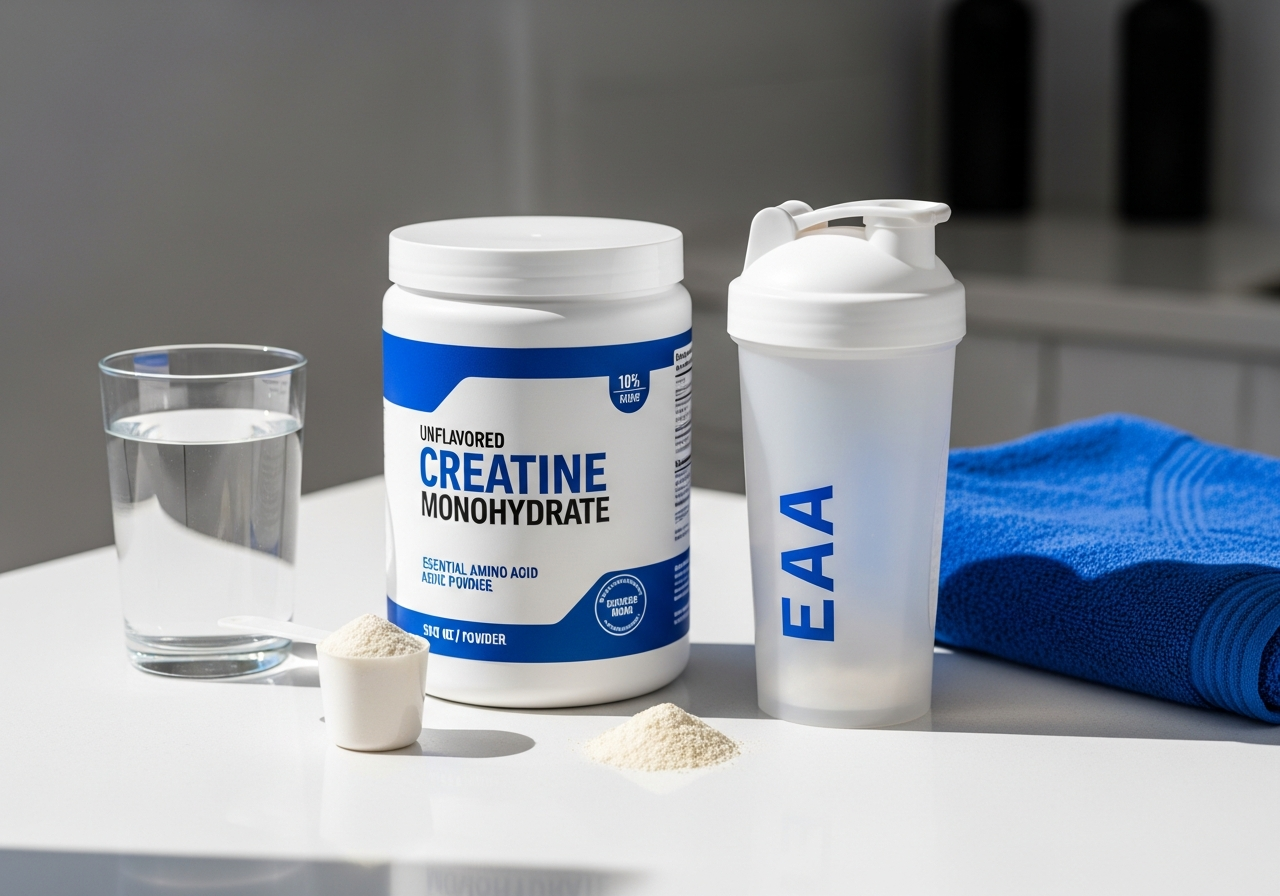
Creatine vs EAAs: Key Differences, Benefits, and Which to Take First
By The Creatine Canada Research Team — Evidence-based supplement analysts
Creatine is usually the better first buy than EAAs because it has stronger evidence for improving strength, power, training performance, and lean mass when your diet already contains enough protein. EAAs can help in narrower situations, especially when total protein intake is low, training is fasted, or older adults struggle to hit protein targets from whole food.
Evidence-based · Cites 4 sources · Editorial standards
Key Takeaways
- If you can only buy one, creatine monohydrate usually beats EAAs for gym performance and muscle gain.
- Creatine works by raising muscle phosphocreatine stores; EAAs work by supplying the amino acids needed to build muscle protein.
- Take creatine every day, not just on workout days: 3-5 g/day is the standard maintenance dose.
- EAAs make the most sense when your protein intake is inconsistent, low, or hard to digest from food alone.
- You can take creatine and EAAs together because they do different jobs and do not cancel each other out.
- For most lifters eating enough protein, EAAs are optional; creatine is the more evidence-based staple.
- In Canada, prioritize plain creatine monohydrate with a Natural Product Number and reputable third-party testing where possible.
Creatine vs EAAs: the short answer for most people
Creatine is the better first-choice supplement for most people comparing creatine vs EAAs. If your goal is more strength, better high-intensity training performance, and a better chance of gaining lean mass over time, creatine monohydrate has broader and stronger support than essential amino acids.
That direct answer matters because these supplements are often compared as if they compete for the same job, but they do not. Creatine and essential amino acids work through different mechanisms, solve different problems, and can be useful for different people. Creatine mainly improves the muscle energy system used for short, hard efforts. EAAs mainly provide the building blocks required to stimulate and support muscle protein synthesis, which is the process of building new muscle protein.
So, are EAAs or creatine better? If you already eat enough total daily protein, creatine usually gives you more noticeable results per dollar. If you do not reliably hit protein targets, train fasted, eat very lightly around workouts, follow a restrictive diet, or are an older adult with lower appetite, EAAs become more relevant.
The 2017 ISSN position stand concluded that creatine monohydrate is the most effective nutritional supplement currently available for increasing high-intensity exercise capacity and lean body mass during training. That is why creatine tends to win this comparison for the average gym-goer. For the core creatine basics, see what creatine is and what it does and our full evidence-based creatine benefits guide.
Here is the practical hierarchy:
- Best first buy: creatine monohydrate.
- Best if protein intake is low or inconsistent: EAAs can help.
- Best stack if budget allows and there is a clear need: creatine daily, EAAs selectively.
In other words, creatine vs essential amino acids is not really an either-or question unless your budget forces one. If you can only pick one, pick creatine. If you already use creatine and have a specific nutrition gap, EAAs may be worth adding.
What creatine and EAAs actually are, and why people confuse them
Creatine is a compound stored mostly in muscle to help regenerate ATP, while EAAs are the nine amino acids your body cannot make and must obtain from diet. People confuse them because both are sold for muscle support, but they act at different stages of the process.
Creatine is made from amino acids in the body and also obtained from foods such as meat and fish, but it is not itself a protein or an essential amino acid. In muscle, some creatine is stored as phosphocreatine, which is creatine bound to phosphate and used to rapidly regenerate ATP, the immediate energy currency for hard efforts like sprinting, jumping, and lifting.
EAAs stands for essential amino acids, meaning the amino acids you must consume because your body cannot synthesize them in adequate amounts. They include leucine, isoleucine, valine, lysine, methionine, phenylalanine, threonine, tryptophan, and histidine. These are raw materials for building proteins throughout the body, including muscle proteins.
Creatine helps you perform more quality work in training, while EAAs help supply the ingredients needed to repair and build tissue. That difference is why they are not direct substitutes. A creatine supplement can improve your ability to complete extra reps or sustain power across repeated efforts. An EAA drink cannot fill muscle phosphocreatine stores. Likewise, creatine cannot replace inadequate dietary protein.
The practical takeaway is simple:
- Use creatine when you want stronger evidence for performance and lean mass support.
- Use EAAs when whole-food protein intake is low, delayed, or difficult.
- Use both when you want performance support from creatine and targeted amino acid support around training.
If you are a beginner, start with the simpler question: are you already eating enough protein and taking the right daily creatine dose? If yes, EAAs are often optional. If no, fix those basics first before buying more complex stacks.
How they work in the body: energy system support vs muscle-building ingredients
Creatine works by increasing intramuscular phosphocreatine stores, whereas EAAs work by increasing the availability of amino acids needed for muscle protein synthesis. That is the key mechanistic difference in creatine vs EAA science.
During short bursts of intense activity, ATP is used rapidly. Phosphocreatine helps recycle ATP quickly, letting you maintain force output for a bit longer or recover faster between repeated efforts. Over time, that can mean more training volume, better sprint repeatability, and stronger performance in resistance training. Creatine does not directly build muscle tissue the way dietary protein does; it improves the training stimulus and cellular environment that make better adaptations more likely.
EAAs act farther downstream. Resistance training turns on signalling pathways involved in muscle remodelling, but muscle still needs amino acids available in the bloodstream to build new tissue. Leucine is especially important because it helps trigger muscle protein synthesis, but all essential amino acids are needed to complete the process. An EAA supplement is therefore better understood as a protein-support tool than a performance-ergogenic tool.
This difference also explains why the two supplements feel different in real life:
- Creatine benefits are usually noticed in the gym: extra reps, better repeat efforts, stronger sets, and faster progress over weeks.
- EAA benefits are usually indirect: helping you meet amino acid needs when meals are poorly timed, small, or absent.
According to Kreider et al. (2017), ISSN Position Stand: Safety and Efficacy of Creatine — JISSN, creatine monohydrate remains the most studied and most effective form of creatine for increasing high-intensity exercise capacity and lean mass. The 2021 JISSN review on creatine misconceptions also reinforced that creatine is among the best-supported sports supplements available.
So when people ask, “creatine vs essential amino acids for muscle?” the honest answer is this: creatine usually has the stronger edge for improving the training side of muscle gain, while EAAs are mainly useful if dietary amino acid intake is not already covered by adequate protein.
Who should choose creatine, who might benefit from EAAs, and who should use both
Most healthy lifters, team-sport athletes, and beginners should choose creatine first, while EAAs make more sense for people with protein-intake gaps or special nutrition constraints. The best supplement depends less on hype and more on what problem you actually need to solve.
Choose creatine first if you are:
- A beginner starting resistance training and wanting the highest-value supplement.
- A strength or hypertrophy trainee aiming for more reps, power, and lean mass.
- A sprinter, CrossFit athlete, field-sport player, swimmer, or combat-sport athlete doing repeated high-intensity efforts.
- A vegetarian or vegan, who may respond particularly well because baseline dietary creatine intake is often lower. See creatine for vegetarians.
EAAs may be useful if you are:
- Struggling to eat enough protein overall.
- Training early without a meal and not wanting a full protein shake.
- Dieting aggressively and under-eating around workouts.
- An older adult with low appetite or difficulty hitting protein targets consistently.
- Someone who cannot tolerate large whole-food meals close to training.
Using both can make sense if:
- You want creatine's performance benefits and also have gaps in meal timing or protein intake.
- You are in-season and need convenient nutrition around training sessions.
- You are an older adult combining resistance training with protein support and daily creatine. See creatine for older adults.
Women should not assume these supplements are “for men.” Creatine is well suited to women for strength, performance, and lean-mass support, and EAAs can also help when appetite, dieting, or meal timing make protein intake inconsistent. For a focused guide, see creatine for women.
Older adults deserve a special note. Creatine can support training quality and lean mass retention, while protein quality and total intake become increasingly important with age. That means the comparison is often less adversarial in this group: creatine and adequate amino acid intake may both matter.
If you are choosing with a tight budget, ask one question first: Do I already eat enough protein every day? If yes, creatine wins. If no, fix total protein intake before treating EAAs as a magic shortcut.
Creatine and EAAs together: yes, and here is when the stack makes sense
You can take creatine and EAAs together because they do different jobs, and there is no good evidence that the combination is harmful or that one blocks the other. The better question is not whether you can combine them, but whether doing so adds anything useful for your specific routine.
Creatine needs to build up through repeated daily use. EAAs are more situational and are usually taken when a meal or protein shake is absent, delayed, or impractical. That means the stack makes most sense in these scenarios:
- Morning training before breakfast: creatine daily plus EAAs during or after training if you are not eating protein soon.
- Long training sessions: EAAs may be used in a flavoured drink during training while creatine remains part of the daily routine.
- Cutting phases: creatine supports training quality, and EAAs may help when calories and protein intake are constrained.
- Older adults: creatine daily plus extra amino acid support when appetite is poor.
Here is a simple stack that works for most people who actually need both:
- Take 3-5 g creatine monohydrate daily, every day, with any meal or shake.
- Use EAAs around training only when a normal protein feeding is not practical.
- Do not treat EAAs as a replacement for your total daily protein target.
- Track whether the stack solves a real problem: better compliance, easier fasted training, or better protein coverage.
If you already drink a complete protein shake or eat a protein-rich meal around training, EAAs often add little. That is the key budget-saving point many people miss. Whole protein sources already contain essential amino acids. A whey shake, for example, generally makes a separate EAA supplement less necessary for that feeding.
For day-to-day setup, our step-by-step guide to taking creatine and when to take creatine can help you build the simplest routine possible.
Exact dosing: how much creatine or EAAs to take by goal and body size
For creatine, 3-5 g per day is the standard evidence-based maintenance dose, while a loading phase of about 20 g per day split into 4 doses for 5-7 days can saturate muscles faster. EAA dosing is less universal because the need depends heavily on total protein intake and meal timing.
For creatine, the easiest practical rule is this: take 3-5 g daily, every day, regardless of training schedule. Larger athletes and people with more lean mass often sit toward the upper end of that range. Some protocols also use body-weight scaling of about 0.1 g/kg/day in certain contexts, but for general use, 3-5 g/day covers most adults well.
Examples:
- 60 kg person: 3 g/day is a sensible maintenance dose.
- 75 kg person: 3-5 g/day works well.
- 90 kg person: 5 g/day is a practical default.
- 100 kg+ strength athlete: 5 g/day is still common; some choose slightly more, but more is not automatically better.
If you want faster saturation, a classic loading phase is:
- 20 g/day for 5-7 days, split as 4 doses of 5 g.
- Then 3-5 g/day ongoing.
If you skip loading and just take 3-5 g/day, full saturation usually takes longer, often roughly a few weeks. For a tailored plan, use our creatine dosage calculator and read whether a loading phase is necessary.
EAA products vary widely, so label instructions differ. The practical use case is usually one serving around training when you are not getting a complete protein feeding nearby. If you already have a solid protein meal or a whey shake, that EAA serving often becomes redundant.
| Goal | Creatine approach | EAA approach | Best choice |
|---|---|---|---|
| Strength and power | 3-5 g daily; optional loading | Usually optional if protein is adequate | Creatine |
| Muscle gain with good diet | 3-5 g daily | Usually optional | Creatine |
| Fasted morning training | 3-5 g daily | Useful around workout if no protein meal soon | Both can fit |
| Low appetite or poor protein intake | 3-5 g daily | Useful as a stopgap, not a full replacement for protein | Often both |
| Older adults lifting weights | 3-5 g daily | Potentially useful if protein intake is low | Often both |
Timing, results timeline, and how to tell whether it is working
Creatine timing matters far less than daily consistency, while EAA timing matters mainly because it is intended to fill gaps around training or between meals. If you want results, think daily saturation for creatine and strategic use for EAAs.
For creatine, the best time is the time you will remember every day. Taking it with a meal or a shake can make adherence easier and may reduce stomach upset in some people. On workout days, before or after training is fine. On rest days, still take it. For the full timing breakdown, see when to take creatine and whether to take creatine on rest days.
What to expect from creatine:
- Days 1-7 with loading: some people notice a quick increase in body weight from intracellular water stored in muscle, better workout feel, or improved repeat efforts.
- Weeks 2-4 without loading, or after loading settles: performance benefits become easier to notice, especially on repeated hard sets or sprints.
- Weeks 4-12: progress in strength and lean mass may outpace what you would likely achieve from training alone, assuming your programme and nutrition are solid.
How to tell if creatine is working:
- Your body weight may rise modestly early on, especially if you load.
- You recover a bit better between hard sets.
- You get an extra rep or slightly more total volume at a given load.
- Your performance trend improves over several weeks, not just one workout.
EAAs are different. You usually do not “feel” EAAs the way some people feel better training on saturated creatine. Their value is mostly nutritional: they help cover amino acid intake when meals are not ideal. A useful test is whether they improve your consistency. Are you now getting useful amino acids near training instead of nothing at all? If yes, they may be helping.
According to Antonio et al. (2021), Common questions and misconceptions about creatine supplementation — JISSN, creatine's benefits are best understood in the context of regular use and training, not as an acute stimulant-like effect.
Safety, side effects, and myths: what is real and what is marketing noise
Creatine monohydrate is well studied and generally considered safe for healthy individuals at recommended doses, while EAAs are usually well tolerated but are often oversold as necessary for muscle gain. Safety questions matter, but so does separating real risk from supplement folklore.
The major creatine myths are familiar: kidney damage, dehydration, cramping, hair loss, bloating, and the idea that creatine is a steroid. The better evidence does not support most of these claims in healthy users taking normal doses. The ISSN position stand and the 2021 JISSN review both support creatine's strong safety profile in healthy populations when used appropriately. Mayo Clinic also notes that creatine appears to be generally safe when used for up to several years, while still encouraging medical guidance for people with relevant conditions.
That said, nuance matters. People with kidney disease, significant medical conditions, pregnancy-related concerns, or prescription-medication interactions should speak with a qualified clinician before using any supplement. Creatine can also increase blood creatinine, which is a breakdown marker often used in lab testing, without necessarily meaning kidney damage. That confusion is common and important.
Common creatine side effects and fixes:
- Stomach upset: split the dose, take it with food, or avoid aggressive loading.
- Temporary scale increase: usually water stored in muscle, not fat. See does creatine make you gain weight.
- Bloating complaints: often reduced by using plain monohydrate correctly and avoiding massive single doses. See does creatine cause bloating.
EAAs are generally straightforward, but the biggest “side effect” is often wasted money. If your daily protein intake is already sufficient and you routinely consume complete protein around training, EAAs are often redundant rather than harmful.
For a deeper safety review, read is creatine safe and our creatine myths debunked resource. In practice, the biggest risk in creatine vs essential amino acids is not usually safety. It is buying the wrong tool for the job.
The biggest mistakes people make when comparing creatine vs essential amino acids
The most common mistake is treating EAAs as a replacement for adequate daily protein and treating creatine like a pre-workout that only matters before training. Both misunderstandings lead to disappointing results.
Here are the biggest practical errors:
- Buying EAAs before fixing total protein intake. If your diet is low in protein, address whole-food meals or a complete protein powder first.
- Taking creatine inconsistently. Creatine works by saturation, not by a one-off workout hit.
- Overdosing because more sounds better. For most adults, 3-5 g/day of creatine is enough after saturation.
- Using proprietary blend products. These often hide underdosed creatine or include flashy extras that do not improve outcomes.
- Confusing EAAs with BCAAs. Branched-chain amino acids are only three amino acids, while EAAs include all nine essential amino acids. Neither replaces adequate protein intake.
- Ignoring label quality in Canada. A licensed natural health product should carry an NPN, which stands for Natural Product Number, indicating Health Canada licensing for that product category.
When buying in Canada, keep it boring in the best way. Plain creatine monohydrate is still the smartest buy for most people. You can compare reputable options through our best creatine rankings, browse the creatine product catalog, or review brands in our creatine brand reviews.
What to look for on a Canadian label:
- Ingredient simplicity: ideally just creatine monohydrate.
- NPN on the label: relevant for regulated sale in Canada.
- Third-party testing or strong manufacturing transparency: useful quality signal.
- Clear gram dose per scoop: avoid vague serving language.
For EAAs, look for transparent dosing, reasonable flavouring, and a clear rationale for buying them. If the product is expensive and your protein intake is already solid, it may be solving no meaningful problem. The supplement industry often markets convenience as necessity. That is rarely true.
Side-by-side comparison: which one wins for strength, muscle, recovery, dieting, and value
Creatine wins for strength, power, repeated high-intensity performance, and overall value, while EAAs mainly win for convenience when protein intake is suboptimal. This is the most useful way to compare creatine and EAAs in real life.
| Category | Creatine | EAAs | Winner |
|---|---|---|---|
| Strength and power | Strong evidence for high-intensity performance support | Not a primary ergogenic for power output | Creatine |
| Lean mass support | Strong support when combined with resistance training | Can help if protein intake is inadequate | Creatine for most; EAAs only in specific gaps |
| Workout performance | Helps repeated hard efforts via phosphocreatine system | Little direct acute performance effect in protein-fed lifters | Creatine |
| Recovery support | Indirect via better training adaptation and possible recovery support | Nutritional support when meals are absent | Context-dependent |
| Fasted training | Still useful daily but not acutely “felt” by timing | More useful if no protein feeding is available | EAAs in this niche |
| Cutting / low-calorie phases | Excellent for preserving training quality | Useful if food intake is low | Often both |
| Value for money | Usually excellent, especially monohydrate | Often lower value if protein intake is already adequate | Creatine |
| Evidence depth | Extensive and well established | More context-dependent and less compelling as a universal need | Creatine |
The International Olympic Committee consensus on supplements recognises that only a relatively small number of supplements have strong evidence for specific performance uses, and creatine is consistently one of the standouts in that conversation. You can review the IOC overview here: International Olympic Committee consensus on dietary supplements (2018).
If your question is “are EAAs or creatine better for building muscle?”, the best concise answer is this: creatine is the better standalone supplement for most lifters, but EAAs may still help if your protein intake is otherwise not doing its job.
Exactly what to do next: a simple decision tree for beginners and experienced lifters
If you want the simplest evidence-based plan, start creatine monohydrate at 3-5 g per day and only add EAAs if you identify a real protein-timing or protein-intake gap. That approach is cheap, effective, and easy to maintain.
Follow this step-by-step process:
- Check your goal. If your priority is strength, power, gym performance, lean mass, or repeated sprint ability, creatine should be your first choice.
- Check your protein intake honestly. If you already eat high-quality protein across the day, EAAs are probably optional.
- Start creatine monohydrate. Take 3-5 g daily. Mix it with water, coffee, a shake, or a meal. Keep it simple.
- Decide on loading only if you want faster saturation. Use about 20 g/day split into 4 x 5 g doses for 5-7 days, then go back to 3-5 g/day.
- Use EAAs only when needed. Good examples are fasted training, travel, appetite issues, or long gaps without protein.
- Track objective signs. Log body weight, reps, total volume, sprint repeatability, and training quality for 4-8 weeks.
- Troubleshoot before changing products. If creatine seems not to work, the usual issues are inconsistency, underdosing, unrealistic timeline expectations, or poor training. See why creatine may not seem to work.
A good beginner template looks like this:
- Breakfast: 3-5 g creatine in water or a shake.
- Workout days only if needed: one EAA serving during or after training when no proper protein meal is available.
- Rest days: still take creatine.
If you want to keep it even simpler, you can ignore EAAs entirely for the first month and focus on consistency with creatine, training, and adequate protein intake from food. That single change will outperform a complicated supplement stack for most people.
Bottom line: which earns a permanent spot in your stack?
Creatine earns the permanent spot first for most people, while EAAs earn a spot only when your nutrition pattern leaves a specific gap that whole-food protein is not already covering. That is the clearest verdict in the creatine vs EAAs debate.
If you lift weights, sprint, play field or court sports, do CrossFit, or simply want a high-value supplement with decades of research behind it, creatine monohydrate is the smarter default. It is inexpensive, well studied, and effective when taken consistently. For most protein-fed trainees, creatine gives more return than EAAs.
EAAs are not useless. They are just narrower. They can be a practical tool for fasted sessions, poor appetite, travel, aggressive dieting, older adults, or anyone who frequently misses complete protein feedings. In those contexts, creatine and EAAs together can make sense because they address different needs.
If you are still deciding, use this one-line rule: Choose creatine if you want performance and body-composition support; choose EAAs only if you need help covering amino acid intake; use both only when both problems actually exist.
Before spending more, master the fundamentals: a sensible training programme, enough total daily protein, and a consistent creatine routine. If you want the next step, compare the top options in our best creatine rankings or learn more about which form of creatine is actually best through our related guides.
The simplest winning stack for most people in 2026 is still boring: plain creatine monohydrate, adequate protein intake, and patience.
Creatine vs EAAs at a glance
- 3-5 g/day Standard creatine maintenance dose — Evidence-based daily dose for most adults after saturation.
- 20 g/day Typical loading dose — Usually split into 4 doses for 5-7 days to saturate faster.
- 5-7 days Classic loading timeline — After loading, shift to 3-5 g/day maintenance.
- 9 Essential amino acids — EAAs are the nine amino acids the body must obtain from the diet.
Frequently Asked Questions
Is creatine better than EAAs for muscle growth?
Yes, creatine is usually the better standalone supplement for muscle growth if your protein intake is already adequate. Creatine improves training quality and high-intensity performance, which helps drive better long-term gains, while EAAs are mainly useful when you are not consistently getting enough complete protein from meals or shakes.
Can you take creatine and EAAs together?
Yes, you can take creatine and EAAs together because they do different jobs. Creatine helps saturate muscle stores to support hard training, while EAAs provide amino acids when a proper protein feeding is missing or delayed, so the combination can make sense in fasted or low-intake situations.
Are EAAs or creatine better for beginners?
Creatine is better for most beginners because it has stronger evidence, simpler dosing, and a clearer payoff for strength and gym performance. EAAs are usually a secondary purchase unless the beginner struggles to eat enough protein or regularly trains without meals nearby.
Do EAAs replace protein powder?
No, EAAs do not fully replace protein powder for most people. EAAs provide the essential amino acids, but a complete protein powder usually delivers more total protein, is more filling, and does a better job of helping you reach your daily protein target.
Should I take EAAs if I already use whey protein?
Usually no, if you already use whey protein around training and hit your daily protein target, EAAs are often redundant. Whey is already a complete protein rich in essential amino acids, so adding an EAA supplement often adds cost more than benefit.
What is the best time to take creatine and EAAs?
The best time to take creatine is simply whenever you will remember it daily, because consistency matters more than timing. EAAs are most useful around workouts or during long gaps without food, especially when no complete protein meal or shake is available.
Do EAAs help performance like creatine does?
Not in the same way, because EAAs do not raise muscle phosphocreatine stores or directly support repeated high-power output. Their main role is nutritional support for muscle protein synthesis, not the energy-system boost that makes creatine so effective for intense training.
Which is better during a cut: creatine or EAAs?
Creatine is usually the better foundation during a cut because it helps preserve training quality and performance while calories are lower. EAAs can also help during a cut if reduced food intake makes it hard to get enough high-quality protein, so some people use both.
Are EAAs worth it if I eat enough protein?
Usually not, because adequate daily protein intake already provides the essential amino acids your muscles need. In that situation, creatine is generally the more worthwhile supplement, while EAAs become more of a convenience product than a necessity.
What type of creatine should I buy when comparing creatine vs essential amino acids?
Buy plain creatine monohydrate unless you have a specific reason not to. Creatine monohydrate is the most studied, most cost-effective, and most consistently supported form, which is why it remains the default recommendation over more heavily marketed creatine variants.