Creatine for Softball: Bat Speed, Throwing Power, and Sprint Speed
By The Creatine Canada Research Team — Evidence-based supplement analysts
Yes—creatine for softball can help, especially for the explosive actions that decide plays: bat speed, harder throws, first-step quickness, repeated sprints, and strength training quality. For most softball players, 3 to 5 g of creatine monohydrate daily is the simplest, best-supported way to improve high-intensity performance over time.
Evidence-based · Cites 4 sources · Editorial standards
Key Takeaways
- Creatine helps softball most in short, explosive efforts, not steady-state endurance.
- Creatine monohydrate is the most studied, most effective, and usually the best-value form.
- A standard maintenance dose is 3 to 5 g daily; loading is optional, not required.
- Most players notice gym performance first, then better repeat sprint and power output over weeks.
- A small increase in body mass from water inside muscle is common and is not body fat.
- Women, beginners, and many teen athletes can use creatine, but younger players should involve a parent, coach, or clinician.
- For Canadian buyers, look for a Natural Product Number and ideally third-party testing.
Does creatine help softball players? Yes—if your game depends on power, speed, and repeat efforts
Yes, creatine for softball players is worth considering because softball is built on repeated explosive efforts, and creatine directly supports that energy system. Hitting, throwing, stealing, accelerating out of the box, reacting in the infield, and producing force late in a game all rely heavily on the phosphocreatine system, which is your muscle’s fastest way to regenerate ATP, the immediate fuel used for hard, brief efforts.
That matters because softball is not an endurance sport in the classic sense. A single play is usually short and violent: one swing, one throw, one sprint, one dive, one explosive push off the bag. Creatine tends to help most when training or competition involves bursts lasting roughly a few seconds up to about half a minute, especially when those efforts repeat with incomplete recovery. That profile fits softball better than many athletes realise.
In practical terms, does creatine help softball? Usually, yes—but indirectly as well as directly. Creatine may help you:
- Train harder in the weight room, which can improve strength and power over time.
- Maintain output across repeated sprints, such as multiple base-running efforts or defensive plays in a tournament setting.
- Support bat speed and throwing power by improving the force you can produce.
- Recover better between high-intensity efforts during practices and games.
The strongest evidence is not specifically from softball-only trials; it comes from decades of sports-performance research on sprinting, resistance training, power output, and repeated high-intensity efforts. The 2017 ISSN position stand concluded that creatine monohydrate is the most effective nutritional supplement currently available for increasing high-intensity exercise capacity and lean body mass during training.
That does not mean every softball player should expect magic from one scoop. Creatine will not fix poor mechanics, low skill, weak programming, bad sleep, or under-eating. It is a force multiplier, not a shortcut. If your training already includes sprinting, lifting, medicine-ball power work, and sport practice, creatine is one of the few supplements with a realistic case for better on-field performance.
If you are completely new to supplementation, start with our creatine product catalog and creatine dosage calculator to keep the process simple.
How creatine can improve bat speed, throwing power, and sprint speed in softball
Creatine helps bat speed, throwing power, and sprint performance by increasing intramuscular phosphocreatine stores, which lets your muscles regenerate ATP faster during explosive work. In softball terms, that means more available energy for the exact moments that matter most: a violent rotational swing, a hard crow-hop throw, or an aggressive first three steps.
Here is the mechanism in plain English. Your muscles store a limited amount of ATP, and they burn through it fast during maximal effort. Phosphocreatine acts like a rapid backup battery. When ATP is broken down for energy, phosphocreatine can donate a phosphate to help rebuild ATP almost immediately. Supplementing with creatine increases those muscle stores, so you have a larger reserve for repeated powerful contractions.
Why this matters specifically for softball:
- Bat speed: A faster, more forceful swing depends on rapid force production through the hips, trunk, and upper body. Creatine does not teach swing mechanics, but it can support the power qualities that contribute to better exit velocity.
- Throwing power: Hard throws depend on explosive sequencing from the lower body through the arm. Creatine can support training adaptations that improve strength and rate of force development.
- Sprint speed: Creatine is particularly relevant to first-step acceleration and repeated sprint ability, where immediate energy supply is critical.
- Practice quality: Creatine may let you maintain higher output across sets of jumps, sprints, lifts, and power drills, which adds up across weeks.
The biggest softball-specific advantage may be repeated power. One swing is important, but tournaments, doubleheaders, long practice blocks, and extra innings reward the athlete who can reproduce force over and over. Creatine can help preserve that output when fatigue starts to build.
Creatine also tends to increase cellular hydration inside muscle tissue. That is one reason scale weight may rise slightly at first. This is not the same as getting “puffy” or gaining fat. In many cases, that increase is simply part of the saturation process that supports better training capacity.
For a deeper primer on the basics, see what creatine is and what it does and our guide to creatine for sprinting. If your main question is whether creatine bat speed benefits are real, the honest answer is that the mechanism and broader power evidence are strong, even though direct bat-speed studies are far fewer than general power and sprint studies.
The best creatine for softball is still plain monohydrate—not the flashier forms
The best creatine for softball is creatine monohydrate because it is the most studied, the most consistently effective, and usually the most affordable form per gram. If your goal is better softball performance rather than fancy marketing, monohydrate is the benchmark all other forms are trying to beat.
This is one of the clearest areas in sports nutrition. The research advantage belongs to monohydrate by a wide margin. Other forms—HCl, buffered creatine, ethyl ester, nitrate, gummies, liquids, and blends—are often sold as cleaner, better absorbed, or gentler on the stomach. In practice, those claims usually do not translate into better real-world results than a standard dose of monohydrate.
The 2021 JISSN review on common creatine questions and misconceptions reinforces that creatine monohydrate remains the preferred form based on safety, efficacy, and body of evidence. For most softball athletes, that settles the issue.
| Form | Best use case | Evidence for performance | Value for softball players |
|---|---|---|---|
| Creatine monohydrate | Nearly everyone | Strongest by far | Best overall choice |
| Micronized monohydrate | People who want easier mixing | Equivalent to monohydrate | Good option if price is fair |
| Creatine HCl | People who prefer capsules or tiny servings | Limited advantage over monohydrate | Usually overpriced |
| Buffered or “pH” creatine | Marketing-heavy products | No clear superiority | Hard to justify |
| Gummies/liquids | Convenience-first users | Can work if full dose is delivered | Often expensive per effective dose |
For Canadian shoppers, keep the label check simple:
- Look for creatine monohydrate as the main ingredient.
- Check for a Natural Product Number (NPN), which means the product is regulated as a natural health product by Health Canada.
- Prefer brands that disclose third-party testing or sport certifications when relevant.
- Avoid under-dosed blends that hide actual creatine grams.
If you want help choosing, start with our best creatine rankings and creatine brand reviews. For most players, unflavoured monohydrate powder is the low-cost, low-drama answer that simply works.
How to take creatine for softball: the simplest step-by-step plan that works
The simplest way to take creatine for softball is to use 3 to 5 g of creatine monohydrate every day, including rest days, and keep doing it consistently. You do not need a complicated stack, and you do not need to time it perfectly for results.
- Choose creatine monohydrate. Buy a plain powder from a reputable brand. If you compete in tested sport, choose a product with third-party certification when possible.
- Pick your daily dose. Most softball players do well with 3 to 5 g daily. Lighter athletes can stay near 3 g; larger athletes often use 5 g.
- Decide whether to load. If you want faster saturation, use about 20 g per day split into 4 doses for 5 to 7 days, then drop to 3 to 5 g daily. If you do not want loading, just start with your maintenance dose and wait longer.
- Take it daily. Take creatine on practice days, game days, travel days, and off days. Muscle saturation is built by consistency.
- Mix it in something easy. Water, juice, a protein shake, or a smoothie are all fine. The best option is the one you will actually use every day.
- Stay normally hydrated. You do not need absurd water intake, but you should not be chronically under-hydrated either.
- Track what changes. Watch gym performance, repeat sprint quality, training volume, recovery between drills, and small changes in body weight.
Two realistic starting examples:
- High-school fastpitch beginner: 3 g daily with breakfast or after training.
- College or competitive adult player lifting 3 to 5 times weekly: 5 g daily after practice, with a post-workout shake, or at any consistent time.
If you miss a day, do not double up. Just resume your normal dose the next day. Creatine works through saturation, not one-time acute stimulation. That is why it feels different from a pre-workout.
If you want a more tailored protocol, use our creatine dosage calculator, and see how to take creatine plus our loading phase guide. The best routine is the one you can follow for months, because that is where the compounding benefit shows up.
Creatine dosing for softball by body weight, season, and performance goal
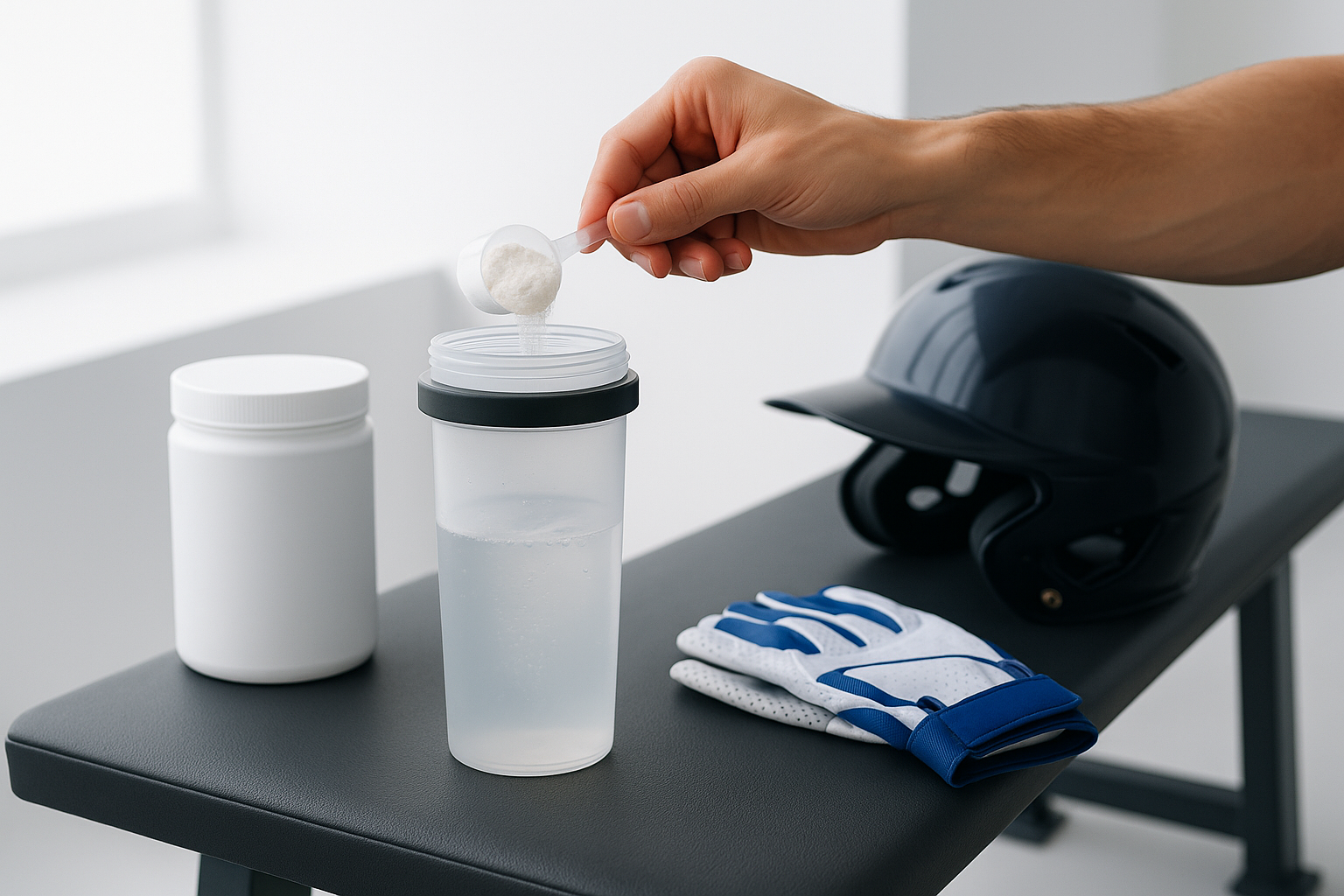
For softball players, the right creatine dose is usually 3 to 5 g daily, with optional loading at roughly 20 g daily split into 4 doses for 5 to 7 days if you want faster saturation. Body weight matters at the margins, but consistency matters more than precision.
A good way to think about dosing is by goal, not just size. A player looking for general support during training camp does not need a different supplement from a power hitter chasing bat speed; both usually need the same evidence-based range.
| Athlete profile | Daily maintenance dose | Loading option | Best for |
|---|---|---|---|
| Under ~60 kg | 3 g/day | 20 g/day split for 5 to 7 days, then 3 g/day | General performance support |
| ~60 to 90 kg | 3 to 5 g/day | 20 g/day split for 5 to 7 days, then 3 to 5 g/day | Most softball players |
| Over ~90 kg or very muscular | 5 g/day | 20 g/day split for 5 to 7 days, then 5 g/day | Larger athletes or high training loads |
Goal-based guidance:
- In-season maintenance: 3 to 5 g daily is enough.
- Pre-season ramp-up: Loading can make sense if you want full stores within a week.
- Tournament stretch or showcase prep: Loading only helps if you are starting from unsupplemented status; it is not a game-day booster.
- Strength and power phase: 5 g daily is a common practical choice.
Without loading, most athletes reach effective muscle saturation in roughly 3 to 4 weeks of daily use. With loading, it happens much faster. That timeline matters if your season starts soon. If tryouts or a major tournament are next month, starting now is still worthwhile. If your event is tomorrow, creatine is not a last-minute fix.
For players who want exact math and examples, see how much creatine per day and our maintenance dose guide. If you are a smaller-framed athlete worried that 5 g is “too much,” it usually is not dangerous, but you likely do not need more than 3 g daily to get the job done.
The big mistake is not being slightly above or below the perfect number. The big mistake is taking it randomly, taking a half dose forever, or confusing one scoop size with one true dose when labels vary by brand.
When to take creatine for softball, how long it takes to work, and what you should notice first
The best time to take creatine for softball is whenever you will remember it every day, because timing matters far less than consistency. Most athletes can take it before practice, after lifting, with a meal, or on rest days at any convenient time and get the same core benefit.
If you prefer a routine, these are all sensible options:
- After training: Easy to pair with a protein shake or meal.
- With breakfast: Great for athletes who forget later in the day.
- Before practice: Fine if it helps habit formation, but do not expect a stimulant-like effect.
Creatine does not work like caffeine. You usually will not “feel it” on day one. It works by gradually increasing muscle creatine stores over days and weeks.
What to expect on a realistic timeline:
- Days 1 to 7 with loading: Possible slight body-mass increase, fuller muscles, and sometimes better training output quickly.
- Weeks 2 to 4 without loading: More likely to notice improved lifting performance, better repeated sprint quality, and less drop-off across hard sets.
- Weeks 4 to 8: Training adaptations become more visible: stronger lifts, more reps at a given load, more stable power output, and possibly better explosiveness in sport drills.
- Months 2 to 3: If training and nutrition are solid, this is where performance carryover to bat speed, first-step pop, and throwing intent may become more obvious.
How do you tell if creatine softball benefits are actually showing up? Track outcomes that matter:
- Weight-room numbers on squats, trap-bar deadlifts, presses, and pull work
- Repeat sprint times or times that fall off less across reps
- Medicine-ball throw distances
- Broad jump or vertical jump consistency
- How your body feels late in practice or during multi-game weekends
If nothing changes after a month, the problem is usually one of four things: under-dosing, missed days, poor training stimulus, or expectations that are too acute. See how long creatine takes to work, when to take creatine, and our troubleshooting guide for deeper detail.
The bottom line on timing is simple: choose the most repeatable time, not the most hyped time.
Who should use creatine in softball: beginners, women, fastpitch athletes, and masters players
Creatine for softball players makes sense for most athletes who want more power, better repeat sprint ability, and stronger training sessions, including beginners, women, fastpitch players, and older adults. It is not only for bodybuilders, and it is not only for men.
Beginners: Creatine is absolutely not wasted on beginners. In fact, new lifters and new softball athletes often benefit because creatine supports the exact training qualities they are trying to build: strength, explosive output, and better-quality practice. A beginner still needs proper technique, coaching, and a sensible lifting plan, but creatine can support that process well.
Women and girls in softball: Creatine for women is one of the most underused evidence-based strategies in sport. It does not inherently make women bulky, and the initial scale increase many notice is typically water drawn into muscle, not fat gain. For fastpitch softball athletes who value speed, rotational power, and resilience through dense training schedules, creatine is highly relevant. See our guide to creatine for women for detail.
Teen softball players: Creatine is commonly discussed for high-school athletes because softball demands are high and schedules are packed. The practical standard is to involve a parent or guardian, prioritise a food-first foundation, and use creatine only when training is structured and the athlete can follow directions consistently. For younger athletes, the supervision piece matters as much as the supplement itself. Our teen guide goes deeper.
Vegetarian and vegan players: Athletes who eat little or no meat may respond especially well because dietary creatine intake is lower to begin with. That can make supplementation more noticeable in training response.
Masters and older softball players: Creatine is also useful for older adults playing competitive or recreational softball because it supports strength, lean mass retention, and high-intensity work capacity. For players in their 40s, 50s, and beyond, that can mean better training support and less decline in explosive capacity. See creatine for older adults.
Who may not need it as much? Athletes who do almost no resistance training, dislike any possible weight increase, or are focused only on long-duration aerobic conditioning may see less sport-specific payoff. Even then, creatine is often still useful if the sport includes repeated explosive bursts—which softball clearly does.
Is creatine safe for softball players? What the evidence says about kidneys, bloating, and weight gain
Yes, creatine is generally safe for healthy softball players when used at standard doses, and this is one of the best-supported conclusions in sports nutrition. The major modern reviews consistently report that creatine monohydrate has a strong safety profile in healthy people when taken as directed.
The ISSN position stand and the 2021 JISSN misconceptions review both push back against long-running myths about dehydration, cramping, and kidney harm in healthy users. The Mayo Clinic also notes that creatine appears to be generally safe when used orally at appropriate doses for up to several years in healthy people.
Common questions, answered directly:
- Does creatine hurt your kidneys? In healthy people with no kidney disease, standard-dose creatine has not been shown to damage kidneys. It can, however, raise blood creatinine, which is a breakdown marker and can confuse lab interpretation.
- Does creatine cause bloating? Some people notice transient stomach discomfort or a fuller feeling, especially during loading or if they take too much at once. True “bloating” is usually manageable by splitting doses or using a simpler protocol.
- Does creatine make you gain weight? Often yes, a little at first, but usually from water inside muscle tissue, not body fat. For many softball players, this is a feature, not a flaw.
- Does creatine dehydrate you or cause cramps? The evidence does not support creatine as a dehydration or cramp culprit in healthy athletes using it properly.
Possible side effects are usually mild and dose-related:
- Stomach upset from large single doses
- Temporary water-weight increase
- Grittiness or poor mixing leading to digestive annoyance
Use extra caution and speak with a healthcare professional if you have known kidney disease, are under medical evaluation for renal issues, are pregnant or breastfeeding, or take medications where medical oversight is appropriate. For healthy athletes, though, creatine is one of the lowest-drama, highest-evidence supplements available.
For more, read is creatine safe, the kidney myth explained, and water weight vs fat gain.
Common creatine mistakes softball players make—and the myths that still won’t die
The most common creatine mistakes in softball are buying the wrong product, taking too little, forgetting rest days, expecting instant game-day effects, and quitting because of harmless scale changes. Most creatine “failures” are not because creatine does not work; they happen because the protocol was poor.
Here are the mistakes to avoid:
- Using proprietary blends: If the label does not clearly list how many grams of creatine you get, skip it.
- Taking it only on workout days: Creatine works by maintaining saturated stores, so off days count.
- Dry scooping or taking huge single doses: This adds no benefit and can increase stomach issues.
- Stopping after one week without loading: Without a loading phase, benefits usually build over several weeks.
- Confusing water gain with getting “soft”: Small early scale increases are usually intracellular water, not fat.
- Switching forms constantly: Monohydrate works; novelty rarely helps.
Now the main myths:
Myth: Creatine is a steroid.
False. Creatine is a naturally occurring compound involved in energy metabolism, not an anabolic steroid. The International Olympic Committee’s 2018 consensus identified creatine as one of the few supplements with strong evidence for performance benefits in specific contexts.
Myth: Creatine is only for bodybuilders.
False. Any athlete doing repeated high-intensity efforts may benefit, and softball clearly fits that profile.
Myth: Creatine makes female athletes bulky.
False. Creatine can support lean mass and performance, but it does not override training, diet, and genetics to make someone suddenly large.
Myth: Creatine causes cramping and dehydration.
This has been repeated for years, but the better evidence does not support it as a routine effect in healthy athletes.
Myth: You need to cycle creatine.
No. There is no established need to cycle on and off if you tolerate it well.
For a fuller breakdown, see our creatine myths debunked page and myths vs facts guide. If you want creatine for fastpitch softball to be boring and effective, the formula is simple: monohydrate, full daily dose, every day, for long enough to matter.
How to buy creatine in Canada for softball: what to check on the label before you spend a dollar
When buying creatine in Canada for softball, the smartest move is to choose a plain creatine monohydrate with clear dosing, a Natural Product Number, and preferably third-party testing if you compete. Good buying decisions are less about hype and more about label quality, purity, and cost per effective gram.
Here is a practical Canadian checklist:
- Ingredient line: Ideally just creatine monohydrate, with no fluff.
- NPN: A Natural Product Number indicates the product is licensed by Health Canada as a natural health product.
- Serving size clarity: The label should make it obvious how many grams of creatine you get per scoop.
- Third-party testing: Helpful for athletes who care about contamination risk or tested sport.
- Cost per gram: Ignore tub size marketing and compare what you actually pay for each usable gram.
Softball players often do not need a “softball supplement” blend. In fact, many sport-branded all-in-one products are worse value than a basic creatine tub plus normal food and protein intake. If a product combines creatine with stimulants, sugar, or under-dosed extras, ask whether you are paying for performance or just packaging.
Canadian athletes should also be aware that product selection can vary by province and retailer, and imported products are not always the best buy once shipping, duty, or authenticity concerns enter the picture. That is why local reputation and transparent testing matter.
If you want help narrowing the field, use our best creatine rankings, brand reviews, and product catalog. If you want broader context, the IOC consensus on dietary supplements is a useful reminder that athletes should focus on supplements with a real evidence base and quality assurance.
A final buying rule: if a product promises better softball power because it is “advanced,” “hyper-absorbing,” or “scientifically engineered,” but it still provides ordinary creatine at a higher price, the burden of proof is on the marketer. Monohydrate keeps winning because it has earned that position.
Bottom line: should you use creatine for softball?
Yes—most softball players who want more explosive performance should strongly consider creatine monohydrate, because it is one of the few supplements with a robust evidence base for high-intensity exercise capacity. If your game depends on bat speed, throwing force, acceleration, repeat sprint ability, and productive strength training, creatine is a sensible tool.
The best protocol is not complicated:
- Use creatine monohydrate.
- Take 3 to 5 g daily.
- Use an optional loading phase of about 20 g daily split into 4 doses for 5 to 7 days only if you want faster saturation.
- Keep taking it on rest days and game days.
- Track results over weeks, not hours.
The athletes most likely to benefit are those who train seriously enough to take advantage of the extra capacity creatine provides. That includes fastpitch softball players, hitters chasing more pop, defenders who need better first-step explosiveness, catchers and infielders who repeat high-force throws, and older players who want to preserve strength and power.
The trade-offs are modest. You may gain a little water weight inside muscle, and some people need to split doses to avoid stomach discomfort. But those are usually manageable issues, not deal-breakers. For healthy athletes, creatine has one of the strongest safety profiles in the supplement world.
If you are still deciding, the practical question is not “Is creatine for softball legal and useful?” It is “Do I want to leave one of the most evidence-based performance supplements off the table?” For many players, the answer is no.
Next steps: use our creatine dosage calculator, compare options in the product catalog, and read creatine for beginners if this will be your first tub.
Creatine for Softball: The numbers that actually matter
- 3–5 g/day Standard maintenance dose — Fits most softball players using creatine monohydrate.
- 20 g/day Typical loading dose — Usually split into 4 doses for 5 to 7 days.
- 5–7 days Fastest common saturation window — Applies when using a standard loading phase.
- 3–4 weeks Typical time to similar saturation without loading — Daily maintenance dosing works too; it just takes longer.
Frequently Asked Questions
Does creatine help softball players hit farther?
Creatine can help softball players hit farther indirectly by improving the strength and power qualities that contribute to bat speed and exit velocity. It will not fix swing mechanics, but when combined with lifting and rotational power training, better force production can translate into harder contact over time.
Is creatine good for fastpitch softball?
Yes, creatine is a strong fit for fastpitch softball because the sport depends on explosive efforts repeated throughout games and tournaments. It is especially relevant for hitters, catchers, infielders, and base runners who need quick acceleration, powerful throws, and high training output.
What is the best creatine for softball players?
The best creatine for softball players is plain creatine monohydrate. It has the strongest evidence, the best value, and the most consistent performance benefits, while more exotic forms rarely show clear superiority in real athletic outcomes.
How much creatine should a softball player take?
Most softball players should take 3 to 5 g of creatine monohydrate daily. A loading phase of about 20 g per day split into 4 doses for 5 to 7 days is optional if you want faster saturation, but it is not necessary for long-term benefit.
When should softball players take creatine?
Softball players should take creatine whenever they are most likely to remember it every day. Post-workout, with breakfast, or with any regular meal all work well, because total daily consistency matters much more than exact timing.
Will creatine make a softball player slower because of weight gain?
Creatine usually does not make a softball player slower, even though a small increase in body weight is common at first. That early gain is typically water stored inside muscle, and many athletes find the added power and training benefits outweigh the modest scale change.
Can softball players take creatine during the season?
Yes, softball players can take creatine during the season, and many should. In-season use can help maintain muscle creatine stores, support repeat high-intensity output, and preserve training quality without needing to cycle off.
Is creatine safe for female softball players?
Yes, creatine is generally safe for healthy female softball players when used at standard doses. It does not inherently cause bulky weight gain, and it may be especially useful for women who want to improve strength, power, and recovery from repeated high-intensity training.
Do teenage softball players use creatine?
Yes, many teenage softball players use creatine, but it should be approached responsibly. The best practice is to prioritise proper training and diet first, involve a parent or guardian, and use a straightforward monohydrate product with clear dosing rather than flashy blends.
Does creatine work for bat speed?
Creatine can support bat speed by improving the underlying power output that contributes to a faster swing. The evidence is stronger for general power and high-intensity performance than for bat-speed-only studies, but the mechanism and training carryover are very plausible for hitters.