Creatine for Recreational Athletes: Is It Worth It If You're Not Competing?
By The Creatine Canada Research Team — Evidence-based supplement analysts
Yes—creatine is absolutely worth considering for recreational athletes, casual gym goers, and weekend warriors, not just competitors. For most healthy adults, 3 to 5 g of creatine monohydrate per day is a low-cost, well-studied way to improve high-intensity performance, support strength and lean mass gains, and make training feel more productive over time.
Evidence-based · Cites 4 sources · Editorial standards
Key Takeaways
- Creatine helps recreational athletes too, especially if you lift, sprint, do HIIT, team sports, or repeated hard efforts.
- Creatine monohydrate is the best-studied, most effective, and most cost-effective form.
- A simple maintenance dose of 3 to 5 g daily works well for most people; loading is optional.
- You do not need to be a bodybuilder or competitive athlete to benefit from creatine.
- Most benefits show up through better training quality over weeks, not a stimulant-like immediate boost.
- Mild water-weight gain is common at first, but it is usually intracellular muscle water, not body fat.
- In Canada, choose products with an NPN and preferably third-party testing or strong brand transparency.
Yes, creatine is worth it for non-competitive athletes if your training includes hard, repeated effort
Yes, creatine for recreational athletes is often worth it, because creatine improves the energy system used during short, hard, repeated efforts whether you compete or not. If you are a casual gym goer, hobbyist athlete, weekend warrior, or general fitness enthusiast, the same physiology applies to you as it does to elite athletes: your muscles still rely on phosphocreatine, the stored form of creatine that helps rapidly regenerate ATP, your cells’ immediate energy currency.
That matters most when your activity includes strength training, sprinting, jumping, intervals, repeated shifts, or stop-and-go sport. In plain English, creatine is most useful when you want to squeeze out an extra rep, maintain power across multiple sets, hit better repeated sprints, or recover enough between hard bursts to keep quality high. Over time, those small improvements in training quality can add up to better strength, more lean mass, and more consistent performance.
The evidence here is not fringe. The 2017 ISSN position stand concluded that creatine monohydrate is the most effective ergogenic nutritional supplement currently available for increasing high-intensity exercise capacity and lean body mass during training. That conclusion is highly relevant to non-professional athletes, because most recreational training goals still depend on the same outputs: strength, power, work capacity, and recovery between hard efforts.
Creatine is less impressive if your only goal is long, steady-state aerobic output with no sprint, hill, surge, or strength component. A purely easy-pace runner or casual walker may notice less. But many so-called non-competitive athletes are not actually doing purely aerobic work. Recreational hockey players, CrossFit members, pickup basketball players, weekend soccer players, skiers, and gym casuals doing circuits all perform repeated high-intensity bouts where creatine can help.
For most healthy adults, the practical answer is simple: if you train at least two to four times per week and care about getting more from that training, creatine is one of the few supplements with a strong evidence base. If you want a more general primer first, see what creatine is, or jump to our creatine dosage calculator to estimate a practical daily dose.
How creatine actually works in casual gym goers, weekend warriors, and hobbyist athletes
Creatine works by increasing muscle phosphocreatine stores, which helps you regenerate ATP faster during short, intense effort. That is the core mechanism, and it applies just as much to a recreational athlete doing goblet squats and bike sprints as it does to a sprinter on a national team.
Your body stores most creatine in skeletal muscle. During hard efforts lasting roughly a few seconds to about half a minute, the phosphocreatine system is a major contributor to energy supply. When you supplement, muscle creatine stores rise toward saturation, meaning your muscles have more readily available substrate to recycle ATP quickly. In training, that can mean one more rep at a given load, slightly better peak power, better repeated sprint output, or less drop-off between efforts.
Creatine’s effects are not limited to immediate energy buffering. Higher training quality can indirectly support hypertrophy, which is muscle growth, and strength progress over weeks and months. Creatine also tends to increase intracellular water in muscle cells. That initial rise in water content can make muscles look and feel fuller, but more importantly, it may create a cellular environment that supports training adaptations.
For recreational athletes, the practical takeaway is that creatine is a consistency amplifier. It does not replace progressive overload, adequate protein, or sleep. It helps your existing training work better. If you do not train, or you only perform low-intensity activity, the payoff is smaller. But if you train with any intent at all, creatine can make productive sessions more productive.
The evidence summary from Examine.com and the review by Antonio et al. (2021) both reinforce a key point: creatine’s reputation as a bodybuilder supplement is too narrow. It supports repeated high-intensity muscular work across many sports and activity patterns, including recreational ones.
This is why creatine for casual gym goers, creatine non competitive use, and creatine for fitness enthusiasts all make sense. The benefit is not tied to your competitive status. It is tied to your activity demands. If your workouts involve effort that feels explosive, heavy, fast, or repeated, the mechanism matches your goal.
Who should consider creatine most: beginners, women, older adults, and plant-based recreational athletes
Creatine is especially worth considering for beginners, women, older adults, and vegetarians or vegans who train recreationally, because these groups often have clear upside with a straightforward daily protocol. You do not need to be advanced to benefit, and in some cases beginners may notice the effects sooner because nearly any support to training quality stands out.
Beginners: If you are new to lifting or HIIT, creatine can support early progress by helping you maintain rep quality and recover between hard sets. It is not necessary to wait until you are “serious enough.” If you train consistently, you are serious enough. A full beginner guide is at creatine for beginners.
Women: Women respond to creatine too. The myth that creatine is only for men or that it automatically causes bulky weight gain is inaccurate. Most women use the same 3 to 5 g daily range as men, with body size and preference guiding the exact dose. For more, see creatine for women.
Older adults: Recreational athletes over 40, 50, or 60 can benefit from creatine because preserving muscle, strength, and training capacity matters more with age, not less. Creatine is especially compelling when paired with resistance training. If this is your situation, our older adults guide goes deeper.
Vegetarians and vegans: People who eat little or no meat often start with lower muscle creatine stores, so they may respond particularly well to supplementation. If you train on a plant-based diet, creatine is one of the most rational supplements to consider.
Weekend warriors and recreational sport players: If you play pickup hockey, soccer, basketball, racquet sports, or do recreational CrossFit, your sport likely involves repeated accelerations, jumps, and bursts. That is exactly where creatine is most relevant.
The people who may care less are those doing only low-intensity activity, or those who strongly dislike even a small temporary increase in body mass. A runner preparing for a race where any scale increase feels unacceptable may choose to delay starting. But even endurance-oriented recreational athletes can benefit in some contexts, especially if their training includes hills, intervals, or gym work.
The exact dose that works for most recreational athletes, with loading and body-weight examples
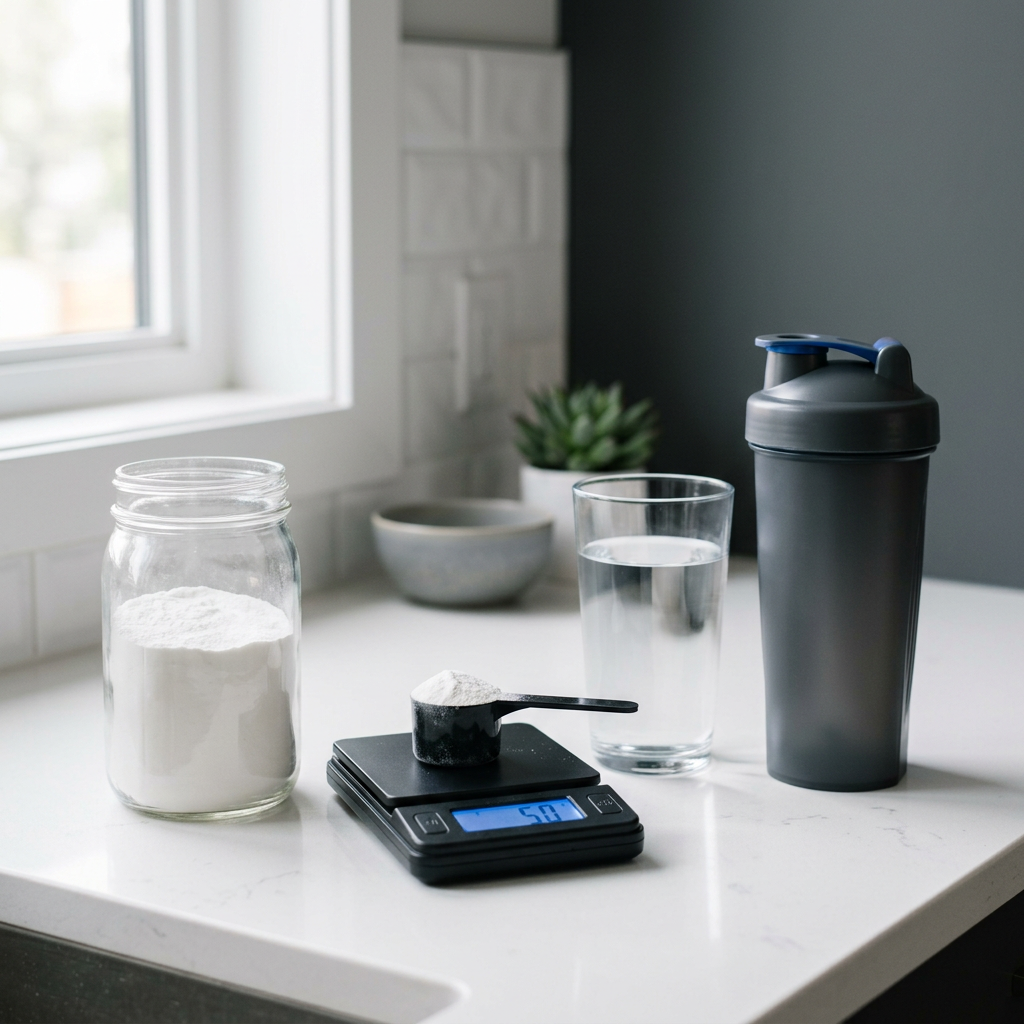
For most recreational athletes, the right creatine dose is 3 to 5 g of creatine monohydrate per day, every day. That maintenance range is enough for most casual gym goers and non-professional athletes to raise muscle stores over time, especially if consistency is good.
You have two evidence-based ways to start:
- No loading: Take 3 to 5 g daily. Muscle saturation rises gradually, usually over about 3 to 4 weeks.
- Loading phase: Take about 20 g per day, split into 4 doses of 5 g, for 5 to 7 days, then continue with 3 to 5 g daily. This saturates muscles faster but can cause more stomach upset in some people.
If you want a calculator-based estimate, use our creatine dosage calculator or read how much creatine per day. A larger body size can justify the upper end of the usual range, but most people do well without overcomplicating it.
| Body weight | Simple daily dose | Best for |
|---|---|---|
| Under 60 kg | 3 g/day | Smaller adults, beginners, lower-cost simple protocol |
| 60-90 kg | 3-5 g/day | Most recreational lifters and team-sport players |
| Over 90 kg | 5 g/day | Larger athletes, higher training volume |
Goal matters too:
- General gym progress: 3 to 5 g/day is enough.
- Faster saturation before a training block or trip: use loading, then 3 to 5 g/day.
- Sensitive stomach: skip loading and split your daily dose if needed.
Creatine monohydrate remains the reference standard because it is the most studied form and consistently works. Fancy forms often cost more without better real-world outcomes. If you are comparing formats and labels, see best creatine rankings and creatine brand reviews.
The main rule is not precision to the decimal point. The main rule is daily adherence. Taking 5 g three times a week is worse than taking 3 g every day. Creatine works through saturation, not through a one-time pre-workout hit.
A simple step-by-step plan: how to take creatine if you are a casual gym goer
The best way for a casual gym goer to take creatine is to pick one daily dose, tie it to an existing habit, and keep doing it for weeks. Creatine works best when your muscle stores stay elevated, so simplicity beats supplement theatre.
- Buy plain creatine monohydrate. Look for a straightforward product with creatine monohydrate as the ingredient. In Canada, check for an NPN, which is a Natural Product Number showing the product is licensed for sale by Health Canada under the natural health product framework.
- Choose your dose. Most people should take 3 to 5 g daily. If you are small or cautious, start with 3 g. If you are larger or training hard, 5 g is a sensible default.
- Decide whether to load. If you want faster results, use 20 g/day split into 4 doses for 5 to 7 days. If you prefer comfort and simplicity, skip loading.
- Mix it in a way you will repeat. Stir it into water, a shake, or a smoothie. If you want better texture, warm liquid can help it dissolve more easily. For practical mixing tips, see how to mix creatine.
- Take it every day, including rest days. Rest-day use matters because creatine works by maintaining saturation. Our guide on creatine on rest days covers this in more detail.
- Train normally and track something meaningful. Track reps, loads, sprint times, or how many hard intervals you can sustain before form falls off.
- Give it enough time. Without loading, assess after 3 to 4 weeks. With loading, you may notice performance changes within 1 to 2 weeks.
What should you expect? Many recreational athletes first notice one of three things: slightly better rep endurance, less power drop-off across sets, or a small bump in body weight from intracellular water. They usually do not “feel” creatine like caffeine. It is subtler than that.
If you want a complete protocol, read how to take creatine. If you miss a day, do not double up dramatically the next day; just resume your normal routine. The system is forgiving as long as you stay consistent most of the time.
Timing matters far less than consistency, but here is the most practical approach
The best time to take creatine is the time you will remember to take it every day, because consistency matters much more than clock timing. Creatine is not a stimulant and does not need to be taken immediately before exercise to “kick in.”
Once your muscles are saturated, the key benefit comes from maintaining elevated creatine stores. That is why daily intake beats perfect timing. For most recreational athletes, the easiest habit is one of these:
- Take it with breakfast every morning.
- Mix it into your post-workout shake on training days and with any meal on rest days.
- Keep it beside your protein powder or coffee setup so you do not forget it.
Some people prefer taking creatine near workouts because that is when they already use a shaker. That is fine. Others take it at night. That is also fine. The literature has not established a meaningful, universal advantage of pre-workout versus post-workout timing for most users. If there is any small edge, it is far less important than whether you take it daily for months.
What about taking it with food? Many people tolerate creatine better with food, and mixing it into a meal-related shake can reduce stomach discomfort. Taking it with carbohydrate or protein is not mandatory, but it is perfectly reasonable and may support uptake in a practical sense because you are more likely to remember it.
What about coffee or pre-workout? Most recreational users can combine creatine with caffeine without issue. The old idea that caffeine cancels out creatine is overstated and not a practical reason to separate them for most people. If you want the details, read when to take creatine and creatine and caffeine.
The direct answer for creatine gym casual users is this: pick one repeatable time, use 3 to 5 g every day, and stop worrying about the minute-by-minute timing. In real life, remembering the dose beats biohacking the schedule.
What recreational athletes can realistically expect in week 1, week 4, and month 3

Recreational athletes should expect creatine to work gradually, with the clearest benefits showing up through better training performance over several weeks. If you expect a stimulant-like rush, you will likely think it is not working when it actually is.
Week 1: If you used a loading phase, your muscles may be close to saturation within 5 to 7 days. You may notice slightly fuller muscles, a modest increase in body weight, and perhaps better output on repeated hard sets. If you started with 3 to 5 g/day only, you may not notice much yet.
Weeks 2 to 4: This is when many no-loading users start to notice benefits. Common signs include getting an extra rep on later sets, recovering better between sprints or circuits, and seeing small upward trends in training volume. Some people also notice less flattening out during dieting because muscles retain more intracellular water.
Months 2 to 3: This is where creatine’s real value often becomes obvious. The benefit is usually not that creatine directly built muscle on its own. The benefit is that better training quality, repeated over dozens of sessions, helped you progress more than you otherwise would have.
How do you know whether creatine is helping? Look for objective markers:
- An extra rep at the same load
- Slightly better repeated sprint or interval consistency
- Improved gym volume across the week
- Small increases in body weight without increased waist size
- Better maintenance of power during a caloric deficit
Not everyone feels a dramatic change. Response varies based on baseline muscle creatine stores, diet, muscle fibre profile, body size, and training type. A vegetarian beginner doing hard resistance training may notice more than a meat-eating recreational runner doing mostly easy mileage. That does not mean the supplement is broken; it means the context changes the visible payoff.
If results feel underwhelming, troubleshoot adherence, dose accuracy, and whether your training actually stresses the high-intensity systems creatine supports. Our guides on how long creatine takes to work and why creatine may not seem to work can help.
Safety, side effects, and who should be cautious before taking creatine
Creatine monohydrate is widely considered safe for healthy adults when used at recommended doses, but that does not mean every concern is imaginary or every person should use it without context. The strongest evidence supports its safety in healthy individuals, especially at typical intakes such as 3 to 5 g per day.
The ISSN position stand and the 2021 review on common questions and misconceptions both conclude that creatine is safe for healthy people across a broad range of populations studied. The Mayo Clinic overview likewise notes that creatine appears to be safe when used appropriately.
Common side effects are usually mild and manageable:
- Temporary water-weight gain: often from greater intracellular water in muscle, not fat gain.
- Stomach upset or loose stools: more likely with large single doses or aggressive loading.
- Bloating sensation: often improved by splitting doses or switching to plain monohydrate taken with meals.
Who should be cautious?
- People with known kidney disease should speak to a qualified clinician before using creatine.
- People taking medications that affect kidney function should also ask a clinician first.
- Anyone pregnant or breastfeeding should use extra caution because evidence is still limited compared with the sports-performance literature.
One frequent source of confusion is bloodwork. Creatine can raise creatinine, a breakdown marker often used in kidney panels, without meaning the kidneys are damaged. That is a testing interpretation issue, not proof of harm. If you get labs done, tell your clinician you use creatine. If this topic worries you, see our kidney guide and our full safety guide.
The practical safety bottom line for creatine for non professional athletes is straightforward: healthy adults using 3 to 5 g/day of monohydrate are generally operating within the best-studied and lowest-drama use case in sports nutrition.
The biggest creatine myths casual lifters and weekend warriors still believe
Most myths about creatine for recreational athletes are leftovers from gym folklore, not conclusions from modern evidence. If you are hesitating because you think creatine is a steroid, ruins kidneys, causes dehydration, or only matters for bodybuilders, you are likely reacting to myths rather than the data.
Myth 1: Creatine is only for competitive bodybuilders. False. Creatine helps anyone doing repeated high-intensity muscular work, including casual gym goers, hobbyist athletes, and weekend warriors.
Myth 2: Creatine is a steroid. False. Creatine is not an anabolic steroid. It is a naturally occurring compound involved in energy metabolism. The mechanism is entirely different. See is creatine a steroid.
Myth 3: Creatine makes you fat. False. Early weight gain is usually water retained inside muscle cells. That is not fat mass. Our guide on creatine and weight gain breaks this down.
Myth 4: You must cycle creatine. False for most healthy users. There is no requirement to cycle on and off if you tolerate it well and wish to keep muscle stores elevated.
Myth 5: Creatine dehydrates you or causes cramps. The evidence does not support creatine as a universal dehydration or cramping trigger. In practice, normal hydration habits are sufficient for most users.
Myth 6: Fancy forms work better than monohydrate. Usually unsupported. Monohydrate remains the benchmark because it has the strongest evidence base and best cost-effectiveness.
Myth 7: If you do not feel it, it is not working. False. Creatine is subtle. The better question is whether your output, recovery between hard efforts, and training progression improve over time.
Why do these myths persist? Because creatine often causes visible scale changes, gets lumped in with bodybuilding culture, and is discussed online by people who confuse anecdotes with mechanism. If you want a deeper myth-by-myth review, read creatine myths debunked or creatine myths vs. facts.
The short version is this: creatine gym casual use is normal, evidence-based, and much less dramatic than social media makes it sound.
How to choose the best creatine in Canada without overpaying for hype
The best creatine for most Canadians is plain creatine monohydrate from a reputable brand with transparent labelling, a valid NPN where applicable, and a sensible cost per gram. You do not need a proprietary blend, influencer formula, or exotic creatine form to get the core benefit.
When buying creatine in Canada, prioritize these factors:
- Form: creatine monohydrate first.
- Ingredient list: ideally just creatine monohydrate, especially if you want dose accuracy and fewer digestive surprises.
- NPN: a Natural Product Number can provide reassurance that the product is licensed under Health Canada’s natural health product framework.
- Third-party testing: especially useful if you care about purity, contamination control, or sport-safe assurances.
- Cost per gram: often the most honest value metric.
| Option | Pros | Cons | Best fit |
|---|---|---|---|
| Unflavoured monohydrate powder | Best evidence, lowest cost, flexible dosing | Can feel gritty if poorly mixed | Most recreational athletes |
| Micronized monohydrate | Often mixes better | Sometimes costs more for similar results | People bothered by texture |
| Capsules | Convenient for travel | More expensive, many capsules needed | People who hate powders |
| Gummies or flavoured formats | Easy and palatable | Higher cost, sometimes lower dose per serving | Convenience-first users |
For shopping help, browse our creatine product catalog, best creatine rankings, and brand reviews. If you want the Canadian regulatory angle, our guides on NPNs and buying in Canada go deeper.
The main buying mistake recreational athletes make is paying a premium for claims like superior absorption, zero bloat, or stronger pumps when the product still delivers the same basic creatine job. Monohydrate still wins because the evidence is mature, the dose is known, and the value is hard to beat.
Why creatine seems not to work for some recreational athletes, and how to fix it
When creatine seems not to work for a recreational athlete, the usual problem is not that creatine failed; it is that the protocol, expectations, or training context were off. Most troubleshooting is surprisingly simple.
Mistake 1: Not taking it daily. Creatine depends on saturation. Missing doses occasionally is fine, but inconsistent use prevents stores from staying elevated.
Fix: Pair your dose with a daily anchor habit such as breakfast or your post-workout shake.
Mistake 2: Taking too little. Tiny under-dosed scoops or “one gummy” servings often underdeliver.
Fix: Confirm you are actually getting 3 to 5 g of creatine daily.
Mistake 3: Expecting immediate energy. Creatine does not feel like caffeine. Its benefits show up in repeated effort and training progression.
Fix: Judge it by workout logs, not by a buzz.
Mistake 4: Using the wrong training for the supplement. If you only do low-intensity cardio, creatine may feel underwhelming.
Fix: Expect the biggest benefit in lifting, HIIT, sprinting, jumping, and stop-and-go sport.
Mistake 5: Quitting after one week without loading. Daily maintenance dosing takes longer to saturate muscles.
Fix: Give it 3 to 4 weeks before deciding.
Mistake 6: Large single doses causing stomach issues. This often happens during loading.
Fix: Split doses, take with meals, or skip loading entirely.
Mistake 7: Buying on marketing instead of basics. Expensive designer forms often distract from consistency.
Fix: Use plain monohydrate and spend the saved money on quality food or coaching.
There is also genuine variation in response. People with already high muscle creatine stores may notice less than those starting lower. That does not mean no effect; it may mean a smaller visible effect. If you want a deeper diagnostic checklist, read common creatine mistakes and creatine non-responders.
For most hobbyist athletes, the formula is boring but effective: correct dose, every day, enough time, and training that actually creates a need for repeated high-intensity energy.
Bottom line: should a recreational athlete take creatine if they are not competing?
Yes—if you train with any regularity and your workouts include strength, power, sprinting, intervals, or repeated hard efforts, creatine is one of the most worthwhile supplements you can take even if you never compete. The reason is simple: creatine supports the exact energy system many recreational workouts depend on, and the evidence for creatine monohydrate is far stronger than for most supplements marketed to the same audience.
The ideal recreational-athlete protocol is uncomplicated:
- Choose plain creatine monohydrate.
- Take 3 to 5 g daily.
- Use a loading phase only if you want faster saturation.
- Keep taking it on rest days.
- Track training performance for at least 3 to 4 weeks.
Who gets the best value? Casual gym goers who lift two or more times per week, recreational team-sport players, HIIT fans, people returning to training, women who want strength support without hype, older adults protecting muscle, and plant-based athletes who may start with lower creatine stores.
Who may care less? People doing only easy steady-state cardio, or those who strongly dislike even a modest temporary increase in scale weight. Even then, the answer is not necessarily no; it is simply more goal-dependent.
If you want one sentence to remember, make it this: creatine for recreational athletes is not overkill; it is a practical, low-cost, evidence-based tool to help ordinary training produce better results. You do not need a competition calendar to benefit from better ATP regeneration, better repeated effort, and more productive weeks in the gym.
Next steps: calculate your dose with our creatine dosage calculator, compare products in our catalog, and read best creatine monohydrate options before you buy.
Creatine for Recreational Athletes: The Numbers That Matter
- 3-5 g/day Standard daily maintenance dose — Appropriate for most healthy recreational athletes using creatine monohydrate
- 20 g/day Typical loading dose — Usually split into 4 doses for 5-7 days to saturate muscle faster
- 5-7 days Time to near-saturation with loading — Most users then continue with 3-5 g/day
- 3-4 weeks Time to feel effects without loading — Daily maintenance dosing works more gradually
Frequently Asked Questions
Is creatine worth it for casual gym goers?
Yes, creatine is worth it for many casual gym goers if their workouts include lifting, hard circuits, sprinting, or repeated intense effort. It helps by increasing muscle phosphocreatine stores, which can improve rep quality, repeated effort, and long-term training progress. If you only do very light exercise, the payoff is smaller.
Can non-competitive athletes take creatine?
Yes, non-competitive athletes can absolutely take creatine, and competition status has nothing to do with whether it works. Creatine supports a normal muscle energy system used during hard efforts, so recreational trainees, weekend warriors, and hobbyist athletes can benefit just as much as competitive athletes with similar training demands.
How much creatine should a recreational athlete take?
Most recreational athletes should take 3 to 5 g of creatine monohydrate per day. That daily range is enough for most healthy adults to maintain elevated muscle creatine stores. A loading phase of about 20 g/day split into 4 doses for 5 to 7 days is optional if you want faster saturation.
Do I need a loading phase if I am just a weekend warrior?
No, a loading phase is not necessary if you are a weekend warrior or casual exerciser. Loading simply speeds up muscle saturation, while 3 to 5 g per day gets you there more gradually over about 3 to 4 weeks. Many recreational users skip loading to keep the routine simpler and reduce the chance of stomach upset.
Will creatine make a recreational athlete gain weight?
Creatine can make a recreational athlete gain a small amount of weight at first, but that is usually water held inside muscle cells rather than fat gain. Many people see this as a normal sign that muscle creatine stores are increasing. Over the long term, any additional body weight may also reflect improved lean mass if training is consistent.
Is creatine safe for beginners who are not serious athletes?
Yes, creatine is generally considered safe for healthy beginners at recommended doses, even if they are not serious athletes. The usual beginner-friendly approach is 3 to 5 g of creatine monohydrate per day. People with kidney disease or relevant medical conditions should speak with a clinician before starting.
What is the best type of creatine for hobbyist athletes?
The best type of creatine for hobbyist athletes is creatine monohydrate. It is the most studied form, the form used in the majority of positive research, and usually the cheapest per effective dose. Most people do not need a premium form to get excellent results.
Does creatine help weekend sports like hockey, soccer, or basketball?
Yes, creatine can help weekend sports like hockey, soccer, and basketball because those activities involve repeated sprints, accelerations, jumps, and hard efforts. Creatine is especially relevant when performance depends on maintaining power across multiple bouts rather than just producing one short burst.
When should a casual athlete take creatine?
A casual athlete should take creatine whenever they are most likely to remember it every day. Timing is much less important than consistency because creatine works by saturating muscle stores over time. Taking it with breakfast or a post-workout shake is often the easiest routine.
Is creatine only useful if I want to build muscle?
No, creatine is not only useful for building muscle. It is also useful for improving repeated high-intensity performance, supporting strength, helping maintain output across sets or sprints, and potentially making training more productive overall. Muscle gain is just one of several practical reasons recreational athletes use it.