Creatine and Metabolism: Energy, Calories, and Body Composition
By The Creatine Canada Research Team — Evidence-based supplement analysts
Creatine does not directly speed up metabolism in the way a thermogenic stimulant does, and it does not meaningfully raise resting metabolic rate on its own. What creatine does is improve short-burst energy metabolism inside muscle, which can help you train harder, gain or retain more lean mass over time, and indirectly increase daily energy expenditure and body-composition results.
Evidence-based · Cites 4 sources · Editorial standards
Key Takeaways
- Creatine is not a thermogenic and is not a meaningful direct calorie-burner.
- Creatine supports ATP regeneration through the phosphocreatine system, especially during short, intense efforts.
- A standard maintenance dose is 3-5 g daily; loading is optional at 20 g daily split into 4 doses for 5-7 days.
- Any metabolism effect is mostly indirect: better training output, better muscle retention, and sometimes more lean mass over time.
- Early scale gain is usually water stored in muscle, not body fat.
- Creatine monohydrate remains the most studied, most effective, and most cost-effective form.
- In Canada, look for a Natural Product Number (NPN) and ideally third-party testing when buying creatine.
Creatine and metabolism: the short answer most people actually want
Creatine does not directly increase metabolism in the sense of meaningfully raising your resting metabolic rate, and it does not act like a thermogenic fat burner. The honest answer to does creatine increase metabolism is: not directly, but it can influence total energy use indirectly by improving high-intensity training performance and helping you build or preserve lean mass.
That distinction matters because the word metabolism gets used to mean several different things. In everyday conversation, people often mean calorie burn or resting metabolic rate (RMR), which is the energy your body uses at rest to keep you alive. In exercise physiology, metabolism also refers to the chemical systems your cells use to produce energy. Creatine has a clear, well-established role in energy metabolism, especially during short, hard efforts, but that is different from saying it makes you burn substantially more calories all day long.
Creatine’s main job is to help regenerate ATP, or adenosine triphosphate, which is the cell’s immediate energy currency. That is why creatine is associated with better performance in repeated sprints, heavy sets, jumps, and explosive training. According to the 2017 ISSN position stand, creatine monohydrate is the most effective nutritional supplement for increasing high-intensity exercise capacity and lean body mass during training.
If your goal is fat loss, the better question is usually not whether creatine is a thermogenic, because it is not. The better question is whether creatine helps you keep training quality high while dieting, preserve muscle, and improve body composition over time. That answer is often yes, which is why this topic overlaps with does creatine help you lose fat, but it is not the same question.
It also helps to separate metabolism from subjective energy. Creatine can support cellular energy turnover in muscle without feeling like caffeine or a stimulant. You should not expect a buzz; you should expect better training capacity once your muscles are saturated.
The bottom line is simple: creatine and metabolism are connected through energy systems and body composition, not through a direct thermogenic effect.
What “metabolism” means here: resting calories vs exercise energy systems
When people ask about creatine metabolic rate, they are usually mixing up two different ideas: resting calorie burn and exercise energy production. Creatine has a strong role in energy production during intense exercise, but little evidence that it directly raises resting calorie burn by a meaningful amount.
Here is the simplest way to think about it:
- Resting metabolic rate (RMR): calories burned at rest to support breathing, circulation, temperature control, and other essential functions.
- Total daily energy expenditure (TDEE): your RMR plus activity, exercise, digestion, and non-exercise movement.
- Energy metabolism in exercise: how your muscles make ATP during movement.
Creatine works mainly in that third category. It supports the phosphocreatine system, which helps rapidly replenish ATP during short bursts of effort. That is why creatine is valuable for lifting, sprinting, jumping, team sports, and repeated high-intensity intervals. It is much less about revving your body up at rest.
This is where supplement marketing often gets sloppy. A product can support cellular energy metabolism without being a calorie-burning supplement. Creatine is the clearest example. It does not contain stimulants, and by itself it is not a meaningful metabolism booster in the fat-burner sense. If you are specifically wondering does creatine have calories, pure creatine monohydrate itself does not contribute meaningful calories the way carbs, protein, or fat do.
There can still be indirect effects on energy expenditure. If creatine helps you complete an extra rep on several working sets, maintain sprint speed late in a session, or preserve training quality while cutting, you may burn slightly more through performance and activity. Over months, if creatine supports more lean mass, your RMR may rise modestly because lean tissue is metabolically active. But those changes are secondary and gradual, not a quick jump in calorie burn.
For beginners, this distinction prevents disappointment. Take creatine because it improves the muscle’s energy system and supports better training results, not because it will feel like a thermogenic. If you want the full basics first, see what is creatine.
How creatine affects energy metabolism: the phosphocreatine-ATP system explained simply
Creatine supports energy metabolism by increasing the amount of phosphocreatine stored in muscle, which helps regenerate ATP faster during short, intense work. That is the core mechanism behind nearly all proven performance benefits of creatine.
ATP, or adenosine triphosphate, is the immediate fuel your muscles use to contract. The problem is that your muscles store only a small amount of ATP at any one time. During a heavy set of squats, a short sprint, or a maximal jump, ATP gets used up very quickly. Phosphocreatine is a stored high-energy compound in muscle that can donate a phosphate group to help rebuild ATP rapidly. More stored phosphocreatine means faster ATP resynthesis during very intense effort.
That matters most in activities lasting roughly a few seconds up to about 10 seconds, and in repeated bouts of hard effort with incomplete rest. In practical terms, creatine can help with:
- one more rep before failure
- slightly heavier loads across sets
- better repeated sprint performance
- less drop-off in power output during intervals
- better long-term training volume and quality
Over time, those small session-by-session advantages can add up to bigger training adaptations. That is why creatine is linked to improvements in strength and lean mass with resistance training. The 2021 JISSN review on common questions and misconceptions about creatine also reinforces that creatine’s best-supported benefits relate to performance, training adaptations, and safety, not stimulant-like energy or direct fat burning.
Creatine may also influence cell hydration and training recovery in ways that support an anabolic training environment, but the most established mechanism remains ATP regeneration through phosphocreatine. If you want a separate deep dive on the sensation people describe as “energy,” read does creatine give you energy.
The key point for creatine energy metabolism is this: creatine helps your muscles recycle immediate energy faster when intensity is high. That is a real metabolic effect, but it is not the same thing as increasing resting calorie burn.
Does creatine burn calories or increase resting metabolic rate?
Creatine does not directly burn calories in a meaningful way, and current evidence does not support calling creatine a thermogenic supplement. If you are searching does creatine burn calories or creatine thermogenic, the most accurate answer is no.
Thermogenic supplements typically aim to increase energy expenditure through stimulants or compounds that raise heat production, heart rate, or sympathetic nervous system activity. Creatine does not work through those pathways. It is not a stimulant, does not provide a caffeine-like lift, and is not generally associated with a meaningful direct increase in resting metabolic rate.
So why do some people think creatine “boosts metabolism”? Usually for three reasons:
- Better workouts: if you perform more total work, you may expend slightly more energy during training.
- More lean mass over time: muscle gain can modestly increase RMR, though the effect is gradual rather than dramatic.
- Body recomposition confusion: people may look leaner or perform better and assume creatine itself is burning fat.
The indirect path is real, but it is still indirect. Creatine helps you protect performance in a calorie deficit, preserve muscle during weight loss, and potentially support more lean mass when training is in place. Those are useful outcomes for body composition, but they are not the same as saying creatine itself speeds up your metabolism. For the fat-loss-specific angle, see does creatine help you lose fat.
If anything, the most common short-term scale change with creatine is increased intracellular water in muscle, not a big change in calorie burn. That is why many people misread the first one to two weeks. The scale may go up while training quality improves, even though body fat has not increased. We break that down in detail in does creatine make you gain weight.
Bottom line: creatine and metabolism are linked, but mostly through exercise performance and lean mass support, not through direct calorie burning at rest.
The real metabolism effect: more training output, better muscle retention, and body composition changes
Creatine’s practical effect on metabolism is mostly indirect: it can help you train harder, recover enough to maintain quality, and retain or gain more lean mass over time. That is why creatine is often helpful during both muscle-gain and fat-loss phases even though it is not a thermogenic.
Here is the chain of events that makes creatine useful for body composition:
- You take creatine daily and gradually increase muscle creatine stores.
- Your phosphocreatine system becomes better supported during repeated intense efforts.
- You may complete slightly more quality work in training, such as extra reps, more total volume, or less performance drop-off.
- Over weeks and months, that can translate into better strength progress and more lean mass retention or gain.
- More lean mass and better training adherence can improve body composition, and may modestly affect total energy expenditure.
This is especially relevant during a cut. When calories are lower, training performance often suffers. Creatine can help preserve the quality of high-intensity work, which helps you send a stronger “keep this muscle” signal to the body. That is one reason creatine is often recommended during fat loss even though it does not directly burn fat.
There is also a glucose and insulin angle worth mentioning briefly. Creatine is not a blood-sugar supplement, but research has explored how creatine may interact with glucose handling, particularly when combined with exercise. That area is interesting but more context-specific than the core performance evidence. If you have diabetes or are monitoring blood sugar closely, read creatine and diabetes for a more careful breakdown.
For some people, the indirect effect is larger than expected. Older adults trying to preserve muscle, vegetarians starting from lower baseline creatine stores, and hard-training athletes may notice meaningful training benefits once saturated. For others, especially less active people, the “metabolism boost” will feel underwhelming because the supplement works best when paired with training.
The takeaway is straightforward: creatine does not shortcut energy balance, but it can improve the variables that help body composition over time.
How to take creatine for the best metabolic and body-composition payoff
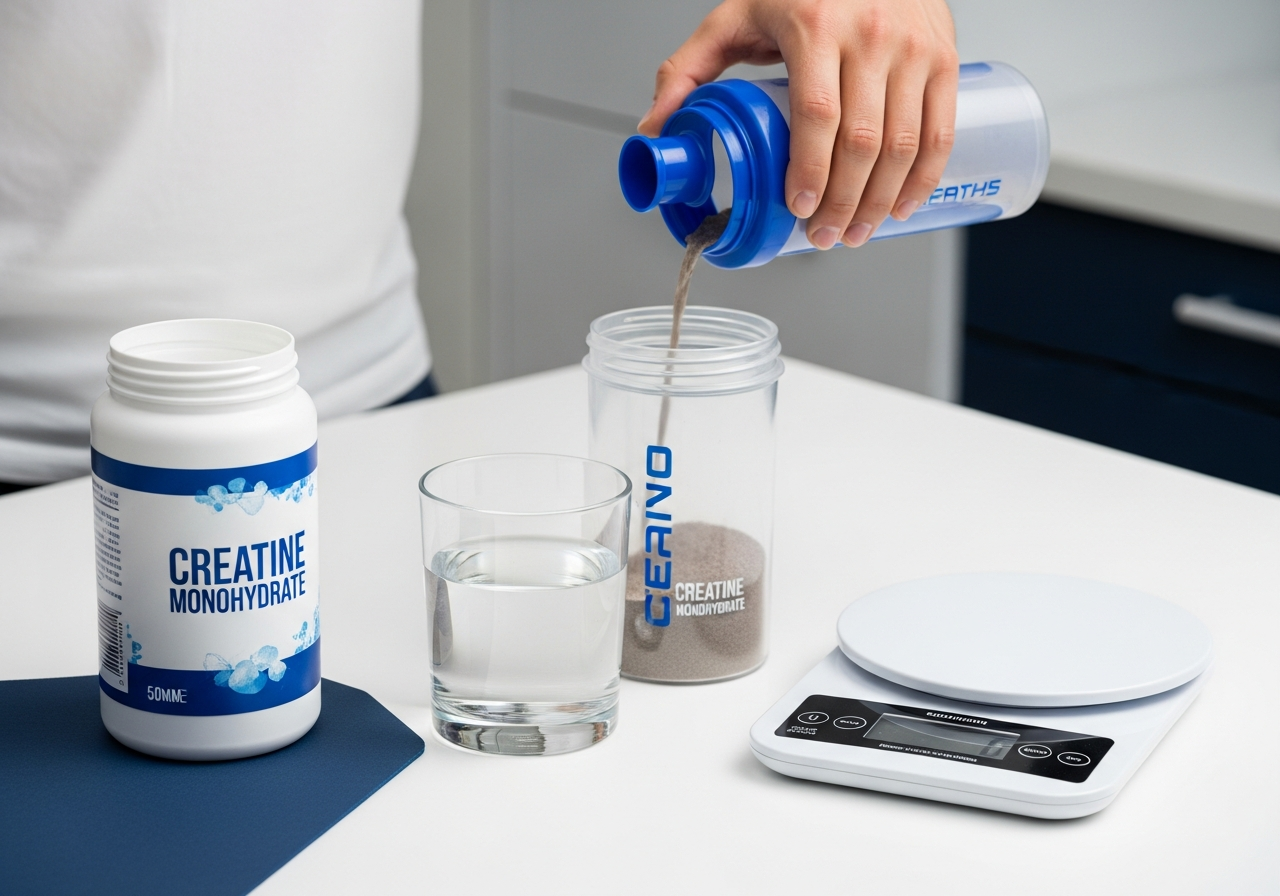
The best way to use creatine is simple: take creatine monohydrate every day, reach muscle saturation, and pair it with progressive training. If you want the biggest real-world payoff from creatine and metabolism, consistency matters more than timing tricks.
Use this step-by-step approach:
- Choose creatine monohydrate. It is the most studied, most effective, and usually the best value. Compare options in our best creatine rankings or browse the creatine product catalog.
- Decide whether to load. A loading phase of 20 g daily split into 4 doses for 5-7 days saturates muscles faster. If you prefer, skip loading and take 3-5 g daily; saturation just takes longer.
- Take a maintenance dose daily. Most people do well on 3-5 g per day. Use our creatine dosage calculator if you want a more tailored estimate.
- Take it every day, including rest days. Creatine works by keeping muscle stores elevated, not by creating a one-day acute effect like caffeine.
- Mix it in water or a shake. Warm liquid may dissolve powder more easily, but the key is simply taking it consistently. See how to take creatine if you want a full walkthrough.
- Keep training hard. Creatine is most useful when paired with resistance training, sprints, HIIT, or sport-specific explosive work.
What to expect:
- Week 1 with loading: possible small scale increase from muscle water; some people notice better repeat-effort performance quickly.
- Weeks 2-4 without loading, or after loading stabilizes: more consistent training quality and better performance across hard sets.
- Weeks 4-12: stronger evidence of indirect body-composition benefit through better training output and lean mass support.
If your main question is timing, the evidence suggests timing is less important than taking it regularly. You can go deeper in when to take creatine.
One practical rule: do not judge creatine by whether you feel a buzz. Judge it by improved training performance, better maintenance of strength while cutting, and gradual changes in lean mass over time.
Creatine dose by body weight and goal: practical numbers you can use today
For most adults, 3-5 g of creatine monohydrate per day is the right maintenance dose, while loading at 20 g per day split into 4 doses for 5-7 days is the fastest way to saturate muscle stores. Those are the mainstream evidence-based numbers that matter most.
If you want a more tailored framework, body size and goal can help guide your decision. Larger athletes and people with more lean mass may prefer the upper end of the maintenance range. Smaller adults and casual lifters often do fine at the lower end once saturated.
| Body weight / goal | Loading option | Maintenance dose | Best use case |
|---|---|---|---|
| Under 60 kg, general fitness | 20 g/day split into 4 doses for 5-7 days, optional | 3 g/day | Beginners who want simplicity |
| 60-90 kg, muscle or strength focus | 20 g/day split into 4 doses for 5-7 days, optional | 3-5 g/day | Most lifters and team-sport athletes |
| Over 90 kg or very muscular | 20 g/day split into 4 doses for 5-7 days, optional | 5 g/day | Larger athletes wanting reliable saturation |
| Fat-loss phase / cutting | Optional | 3-5 g/day | Muscle retention and training quality |
| Older adults | Usually optional | 3-5 g/day | Support resistance training and muscle preservation |
Who benefits most from creatine’s metabolic role?
- Beginners: good for learning consistent habits and improving training quality once resistance training is established.
- Women: creatine works for women too, and does not inherently cause “bulking.” See creatine for women.
- Older adults: especially useful when combined with strength training to help preserve muscle and function.
- Athletes: most useful in sports with repeated explosive efforts.
- Vegetarians and vegans: may respond well because baseline muscle creatine stores can be lower.
If you want exact dosing help beyond the table, read how much creatine per day. If you want to accelerate results, see creatine loading phase.
The key is not finding a magical dose for metabolism. The key is reaching and maintaining saturation so the supplement can support training performance.
Timing, hydration, and how to tell if creatine is actually working
Creatine timing is a minor detail compared with daily consistency, and the easiest way to tell if creatine is working is by looking for better training performance over several weeks, not by looking for a stimulant-like feeling. That is the practical truth most users need.
Take creatine at any time you are likely to remember it. Post-workout in a shake, with breakfast, or with another daily routine all work fine. If you want to read the nuance, see when to take creatine. The reason timing matters less is that creatine works through saturation of muscle stores, not an immediate acute effect.
Hydration does matter, but not because creatine dehydrates you. Creatine increases water stored inside muscle cells, which is one reason early body weight can rise. That does not mean the supplement is pulling dangerous amounts of water away from the rest of the body. Drink normally and be sensible around training, heat, and sweat loss. For more, see how much water should you drink with creatine.
Signs creatine is working:
- you recover better between repeated hard efforts
- you maintain power better across sets or intervals
- you add reps or small amounts of load over time
- you hold onto strength better during a cut
- your muscles may feel a bit fuller after saturation
Common troubleshooting points:
- “I do not feel anything.” That is common. Creatine is subtle and performance-based, not a buzz.
- “The scale went up.” Early weight gain is usually muscle water, not fat. Read does creatine make you gain weight.
- “My stomach feels off.” Try smaller doses, take it with food, or avoid cramming a full loading dose at once. See creatine digestive side effects.
- “I missed a day.” Just resume your normal dose. Missing one day does not erase saturation.
The best test is simple: compare your training log over 4 to 8 weeks, not your feelings over 40 minutes.
Safety, side effects, and who should be more careful with creatine
Creatine monohydrate is one of the most studied sports supplements available, and it is considered safe for healthy people when used at evidence-based doses. That conclusion is supported by the ISSN position stand and by broad expert reviews such as the Mayo Clinic overview.
The most common side effects are practical rather than dangerous:
- water-weight gain: usually due to increased intracellular water in muscle
- digestive upset: more likely with large single doses, poor mixing, or aggressive loading
- temporary bloated feeling: more often a dosing issue than a sign creatine is unsuitable
There are also a few persistent myths worth addressing directly. Creatine is not a steroid. Creatine does not inherently damage healthy kidneys at standard doses, though it can raise creatinine, a breakdown marker that may confuse lab interpretation. Creatine does not appear to dehydrate users when hydration is otherwise normal. We cover those topics in more depth at is creatine safe and is creatine bad for your kidneys.
Who should be more careful?
- people with known kidney disease or significant kidney concerns should speak with a clinician first
- people taking medications that affect kidney function should check before starting
- pregnant or breastfeeding individuals should use extra caution because evidence is still limited
- anyone with a medical condition involving fluid balance or specialised dietary management should confirm fit with their healthcare team
For healthy adults, the biggest safety mistake is usually not the creatine itself but poor supplement quality or taking much more than needed. There is no metabolism advantage to mega-dosing once you are saturated. More is not better.
Bottom line: creatine’s safety profile is strong, but sensible dosing and product quality still matter.
Myths, water weight, and how to buy smart in Canada
The biggest myth about creatine and metabolism is that scale weight gain means fat gain or a slower metabolism. In reality, the most common short-term weight increase with creatine is water drawn into muscle, which is a normal part of how the supplement works.
That water-weight effect is one reason people wrongly think creatine “ruined” their cut or changed their metabolism. If body weight rises in the first week or two, but gym performance improves and waist measurements stay steady, that usually points to intracellular water rather than fat gain. The right response is usually patience, not panic. If that topic is your main concern, read does creatine cause bloating and does creatine make you gain weight.
Another myth is that fancy creatine forms are better for metabolism. In practice, creatine monohydrate remains the benchmark because it is the most studied and most cost-effective. Newer forms may market easier absorption or less bloating, but they have not displaced monohydrate as the evidence leader. If you want a product comparison path, start with our creatine brand reviews and best creatine rankings.
For Canadian shoppers, a few checks help separate good products from noisy marketing:
- Look for an NPN. An NPN, or Natural Product Number, means the product is licensed as a natural health product by Health Canada.
- Prefer simple labels. Plain creatine monohydrate with minimal extras is usually the best value.
- Check third-party testing where possible. This adds confidence around identity and purity.
- Be cautious with “fat-burning” creatine blends. Those products often rely on added stimulants, not creatine itself.
Market-research and industry estimates in 2026 continue to show strong consumer interest in creatine beyond bodybuilding, especially among general fitness users, women, and healthy aging shoppers. That popularity is good in one sense because it has improved availability in Canada, but it also means more confusing claims. The safest rule is the simplest one: buy evidence first, marketing second.
Why the metabolism question is trending in 2026 — and the real bottom line
The metabolism question is trending because creatine has moved far beyond the old “bulking supplement” stereotype, but consumer curiosity is now outrunning the science in some corners of the market. Industry and market-research estimates suggest creatine demand in 2026 is being driven by broader audiences, including women, older adults, and everyday gym-goers looking for body-composition help, energy support, and clean-label products.
That broader demand has created a predictable wave of claims around calorie burning, thermogenesis, and “faster metabolism.” The science does not support most of those direct claims. What it does support is more useful and more believable: creatine improves high-intensity energy metabolism in muscle, and that can support better training outcomes that matter for body composition.
If you want the single-sentence answer to quote, use this one: creatine does not directly raise resting metabolic rate in a meaningful way, but it can indirectly support better metabolism-related outcomes by improving short-burst performance and helping preserve or build lean mass over time.
That is why creatine can still be a smart supplement during a cut, during healthy aging, or during performance-focused training blocks. It is not because it burns calories like a fat burner. It is because it helps you keep muscle, produce force, and maintain training quality. Those are often the limiting factors that decide body-composition progress.
So should you take creatine if your main goal is “boost metabolism”? Yes, if by that you really mean you want better gym performance, better muscle retention, and a better setup for long-term body recomposition. No, if you are expecting a direct thermogenic effect or a noticeable rise in resting calorie burn without training.
The cleanest conclusion is this: creatine and metabolism are linked through ATP recycling, exercise performance, and lean mass support, not through direct fat burning. Used that way, creatine earns its place. Misunderstood as a thermogenic, it does not.
Creatine and Metabolism: the numbers that matter
- 3-5 g/day Standard maintenance dose — Enough for most adults to maintain muscle creatine saturation over time.
- 20 g/day Typical loading dose — Usually split into 4 doses for 5-7 days to saturate faster.
- 5-7 days Typical loading timeline — Fastest route to fuller muscle creatine stores.
- 2026 Creatine’s mainstream moment — Market-research and industry estimates point to expanding demand beyond bodybuilding, especially around body composition, healthy aging, and clean-label buying.
Frequently Asked Questions
Does creatine increase metabolism?
Creatine does not directly increase metabolism in the sense of meaningfully raising resting metabolic rate. What it does do is improve short-burst energy metabolism in muscle, which can help you train harder, preserve lean mass, and indirectly support body-composition changes over time.
Does creatine burn calories?
Creatine does not directly burn calories the way a thermogenic or stimulant-based fat burner aims to. Any increase in calorie expenditure is indirect, usually because better training performance can increase workout output and because more lean mass over time can modestly affect daily energy use.
Is creatine a thermogenic supplement?
No, creatine is not a thermogenic supplement. Creatine works by helping regenerate ATP through the phosphocreatine system during high-intensity effort, not by raising body heat production, heart rate, or resting calorie burn.
Can creatine help with fat loss if it does not boost metabolism directly?
Yes, creatine can still help with fat-loss phases even without directly boosting metabolism. Its main value during a cut is helping you maintain training quality, strength, and muscle mass, which improves the conditions for better body composition while dieting.
Why does the scale go up when I start creatine?
The scale often goes up because creatine increases water stored inside muscle, not because it suddenly adds body fat. This early water-weight change is common and can happen within the first days or weeks, especially if you use a loading phase.
How long does creatine take to affect performance?
Creatine can start affecting performance within about a week if you use a loading phase, or over several weeks if you take a steady daily dose without loading. The key factor is reaching muscle saturation, not the clock time you take it each day.
What is the best creatine dose for body composition goals?
For most people, 3-5 g of creatine monohydrate per day is the best long-term dose for body composition goals. If you want faster saturation, a common loading strategy is 20 g per day split into 4 doses for 5-7 days, followed by a 3-5 g daily maintenance dose.
Does creatine work for women and older adults too?
Yes, creatine works for women and older adults as well as for younger men. In these groups, it can be especially useful for supporting resistance training, preserving lean mass, and improving functional performance over time.
Can creatine affect blood sugar or insulin?
Creatine is not a primary blood-sugar supplement, but some research has explored how it may interact with glucose handling, especially when combined with exercise. The topic is promising but more nuanced than the core performance evidence, so people with diabetes should look at the condition-specific context.
What type of creatine is best if I care about metabolism and performance?
Creatine monohydrate is still the best choice if you care about metabolism and performance because it is the most studied, most effective, and usually the most cost-effective form. Claims that other forms uniquely boost metabolism are not supported by stronger evidence than monohydrate.