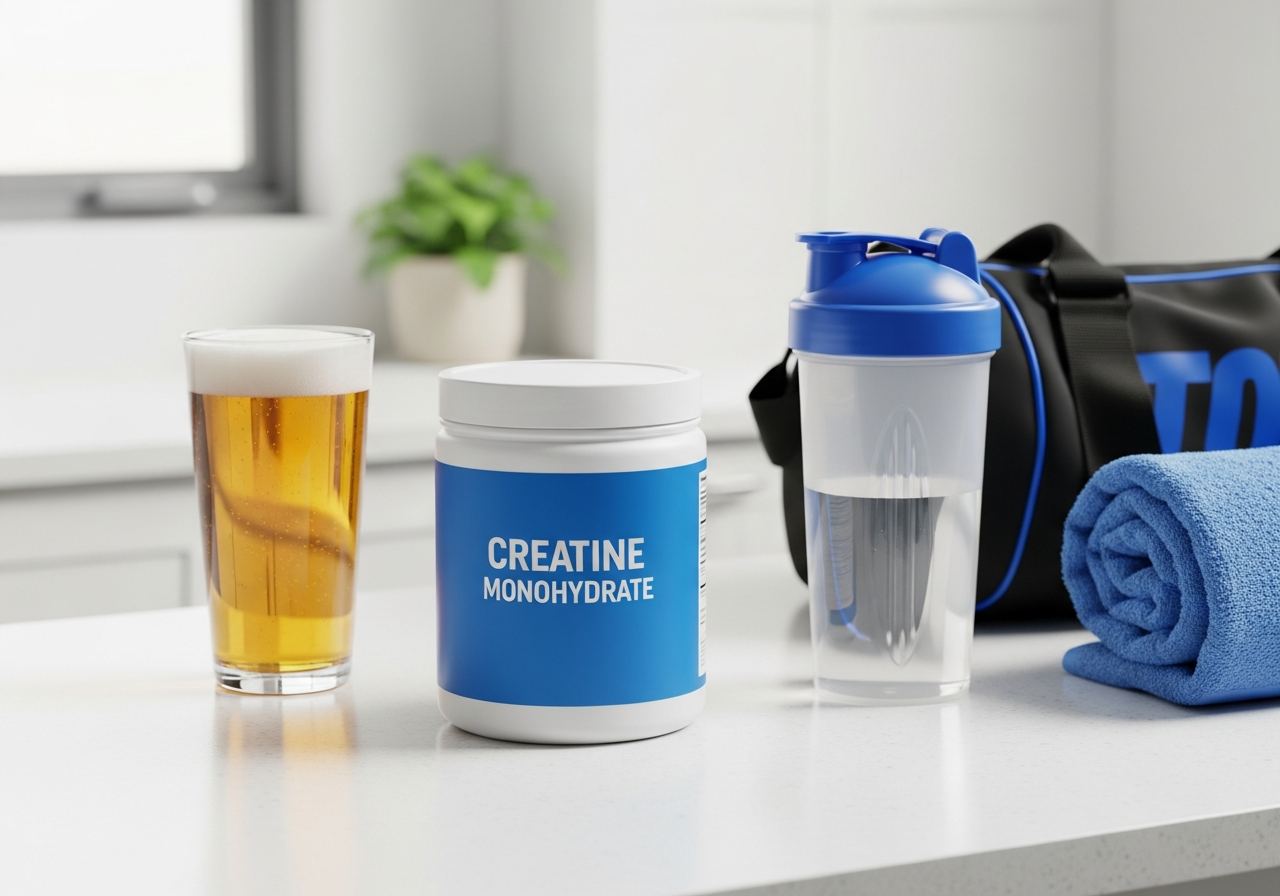
Creatine and Alcohol: Does Drinking Affect Your Results?
By The Creatine Canada Research Team — Evidence-based supplement analysts
Yes, you can drink alcohol while taking creatine, and having a drink does not “cancel out” creatine or block it from working. The real issue is that heavy drinking can worsen dehydration, recovery, sleep, muscle protein synthesis, and training quality, which can reduce the results you would otherwise get from a well-run creatine routine.
Evidence-based · Cites 4 sources · Editorial standards
Key Takeaways
- Creatine and alcohol are not a dangerous chemical combination for most healthy adults, but heavy drinking can undermine your training results.
- Alcohol does not appear to meaningfully block creatine absorption, so the bigger concern is hydration, recovery, and workout performance.
- A standard creatine maintenance dose is 3-5 g per day, and consistency matters more than the exact time you take it.
- If you drink, take creatine as usual, eat normally, and deliberately replace fluids and sodium to limit dehydration.
- Avoid using alcohol as your post-workout drink, because alcohol can impair rehydration, sleep, and muscle recovery.
- High creatine kinase on a blood test is more commonly linked to muscle damage, hard training, or trauma than to creatine itself.
- If you have kidney disease, liver disease, are pregnant, or take medications that affect fluid balance, speak with a clinician before combining regular drinking and supplements.
Can you drink alcohol while taking creatine? Yes — but it may still hurt your results
Yes, you can drink alcohol while taking creatine, and for most healthy adults this is not inherently dangerous or incompatible. The more accurate answer is that alcohol does not seem to stop creatine from entering your system, but drinking — especially heavy or frequent drinking — can still reduce the performance and recovery benefits you hoped to get from creatine.
Creatine works by increasing muscle phosphocreatine, which is stored creatine bonded to phosphate and used to rapidly regenerate ATP, the cell’s immediate energy currency, during short, intense efforts. That is why creatine is most useful for sprinting, lifting, repeated high-intensity efforts, and training volume over time. Alcohol works in a very different way: it can impair coordination, reduce sleep quality, worsen next-day recovery, and make it easier to become dehydrated if your fluid intake is poor.
So if you are asking, can I drink alcohol on creatine, the practical answer is yes. If you are asking whether drinking helps you make the most of creatine, the answer is no. A few drinks on a social occasion will not erase muscle creatine stores overnight, because those stores remain elevated when you supplement consistently. But a pattern of hard drinking can absolutely chip away at the things creatine is supposed to support: better workouts, more total quality training, and stronger recovery between sessions.
This distinction matters because many people imagine a direct “creatine plus alcohol” reaction in the glass or in the stomach. That is not the main issue. The main issue is that creatine supports training adaptation, while alcohol can interfere with the behaviours and physiology that drive adaptation. The 2017 ISSN position stand concluded that creatine monohydrate is the most effective ergogenic nutritional supplement currently available for increasing high-intensity exercise capacity and lean mass gains during training. Alcohol does not turn that off, but it can make it harder to benefit fully from it.
If you are new to supplementation, start with plain monohydrate, keep your intake steady, and judge the combination by your hydration, sleep, performance, and recovery rather than by myths. For foundational dosing help, see our creatine dosage calculator and complete guide on how to take creatine.
Does alcohol affect creatine absorption? Probably not in any meaningful way
Alcohol does not appear to meaningfully block creatine absorption, so the concern is not that your 3-5 g dose suddenly becomes useless if you have a beer later. Creatine absorption from the gut is generally efficient, and your day-to-day muscle saturation depends much more on taking enough creatine consistently than on avoiding alcohol entirely.
People often ask, can I take creatine and alcohol at the same time or can I take creatine with beer. From an absorption standpoint, there is no strong evidence that a normal serving of alcohol prevents creatine from being absorbed into circulation. What matters more is whether the broader context of drinking affects your training week. If alcohol reduces appetite, displaces food, worsens GI tolerance, or leads to poor hydration, then your overall plan suffers even if the creatine itself was absorbed.
Creatine is not a stimulant and does not rely on an acute “hit” you feel right after taking it. It works through saturation, meaning your muscles gradually increase their creatine stores over days to weeks until they are topped up relative to baseline. A single dose mixed with water, juice, or a meal contributes to that saturation process. Missing perfection on one day matters far less than the long-term pattern.
The 2021 JISSN review on common questions and misconceptions about creatine noted that creatine monohydrate remains the most studied form and that many fears around its use are exaggerated or unsupported. In practice, if your stomach tolerates it, you can take creatine with your usual meal or beverage and get on with your day. If you know you will be drinking that evening, the best move is simply to take creatine earlier with food and water, then keep hydrating later.
It is also useful to separate absorption from effectiveness. Even if alcohol does not block absorption, heavy drinking can still reduce the quality of training adaptations by affecting sleep, coordination, glycogen restoration, and next-day effort. That is why the smartest question is not “does beer destroy creatine absorption,” but “does this drinking pattern help or hurt the results I am trying to get?” For more on timing myths, read when to take creatine and our guide on whether to take creatine with or without food.
Why alcohol can blunt your progress even if creatine still works
Alcohol can hurt your results because it affects recovery systems that creatine cannot fully rescue. Creatine helps replenish ATP during repeated high-intensity efforts, but alcohol can interfere with hydration, sleep quality, motor control, decision-making, and the overall quality of the training stimulus.
Here is the simplest way to think about it. Creatine supports performance from the inside of the muscle cell by increasing phosphocreatine availability. Alcohol, especially in larger amounts, can reduce what you do with that extra capacity. If you lift less well, recover less well, or skip training because you feel rough the next day, your real-world return on creatine drops.
- Hydration: Alcohol can increase fluid loss and can displace better hydration habits, especially when it replaces water or electrolyte-containing drinks.
- Sleep: Alcohol often makes people fall asleep faster but sleep worse overall, and poor sleep impairs recovery, mood, and performance.
- Recovery: Drinking after hard training can compromise rehydration and post-exercise recovery behaviours, including eating enough protein and carbohydrate.
- Training quality: Reduced coordination, lower motivation, and worse next-day readiness can lower volume, intensity, and consistency.
- Body composition: Alcohol can make it easier to overshoot calories and harder to stick to protein and meal structure.
This is why two people can both “take creatine and drink alcohol,” yet get very different outcomes. The one who has one or two drinks occasionally, keeps eating, hydrates properly, and still trains hard is unlikely to notice much downside. The one who binge drinks on weekends, sleeps poorly, under-eats protein, and misses sessions may conclude creatine “doesn’t work,” when the real problem is that alcohol is eroding the routine creatine is meant to enhance.
For athletes, the stakes are higher. The International Olympic Committee consensus on dietary supplements recognises creatine as one of the few supplements with strong evidence for specific performance uses. That evidence assumes training quality remains high. Alcohol is not just a nutrition issue in that context; it is a recovery-management issue.
If your goal is strength, muscle, sprint power, or repeated-effort performance, think of alcohol as something that can reduce your return on investment rather than something that chemically neutralises creatine.
Can you take creatine before or after drinking? Yes — here is the practical playbook
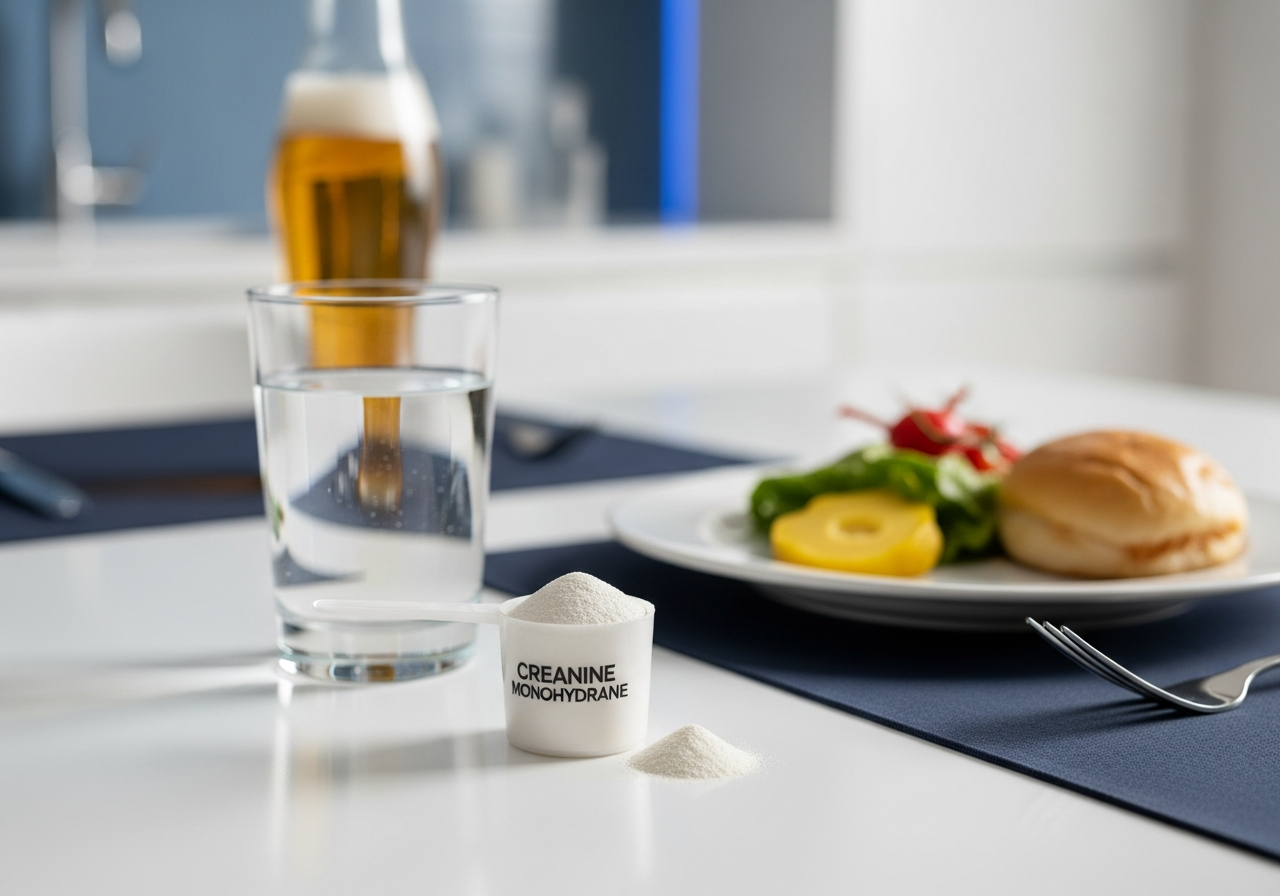
Yes, you can take creatine before drinking alcohol, after drinking alcohol, or on a day when you drink; the key is to keep your daily dose consistent and manage hydration deliberately. If you want the simplest rule, take your creatine at a normal time with food and water, then treat alcohol as a separate recovery and hydration issue.
- Take your usual dose: Use 3-5 g of creatine monohydrate per day. If you are loading, use 20 g per day split into 4 doses for 5-7 days, then return to maintenance. More on that in our loading phase guide.
- Do not “double up” because you drank: Alcohol does not create a need for extra creatine. Doubling your dose is more likely to cause stomach upset than extra benefit.
- Take it with food and water if possible: This improves routine adherence and often improves stomach comfort.
- Hydrate before bed: If you drank in the evening, have water and ideally some sodium from food. Creatine itself is not dehydrating, but drinking can leave you under-hydrated by morning.
- Resume normal supplementation the next day: If you forgot your dose because you were out, just take your normal dose the next day. Do not try to “catch up” with a large bolus.
This means the answers to common searches are straightforward. Can I take creatine after alcohol? Yes. Can I take creatine after drinking alcohol? Yes, if your stomach feels fine. Can I drink alcohol after taking creatine? Yes. Can I drink beer after taking creatine? Yes. None of those combinations are inherently prohibited for healthy adults.
What you should avoid is using creatine as if it cancels out bad decisions. Creatine does not protect you from intoxication, poor sleep, or a weak training week. It also does not replace basic post-workout nutrition. If you train late and plan to drink afterwards, get your protein, carbohydrate, and fluids in first, then keep alcohol moderate if performance matters.
If you tend to forget doses on social weekends, build a routine around breakfast or another fixed meal. Our step-by-step guide on taking creatine on rest days and article on missing a day of creatine can help keep the habit simple.
Best creatine dose if you drink alcohol: the same dose, matched to your goal and body size
If you drink alcohol, your best creatine dose is still the standard evidence-based dose: 3-5 g per day for maintenance, with an optional loading phase of 20 g per day split into 4 doses for 5-7 days. Alcohol does not require a special creatine formula or a special “party-day” dose.
The reason is simple: creatine works by saturating muscle stores over time. Once stores are elevated, you maintain them with a relatively small daily amount. Your need is driven more by body size, muscle mass, and training goal than by whether you had a beer.
| Person / goal | Practical daily dose | When to use it |
|---|---|---|
| Smaller adult under about 70 kg | 3 g/day | Good maintenance dose if taken consistently |
| Most adults about 70-100 kg | 3-5 g/day | Best all-purpose evidence-based range |
| Larger adult over about 100 kg or high muscle mass | 5 g/day | Useful simple maintenance target |
| Rapid saturation phase | 20 g/day split into 4 x 5 g | For 5-7 days, then 3-5 g/day |
| Slow saturation approach | 3-5 g/day | Reach saturation in roughly 3-4 weeks without loading |
Examples help. A 60 kg beginner who trains three days per week can do perfectly well on 3 g/day. An 82 kg lifter trying to improve gym performance can take 5 g/day. A 105 kg strength athlete can also use 5 g/day as a practical maintenance dose. If any of them drinks socially, the recommendation does not change.
What should change is the hydration plan. Drinking days are the days to be more intentional about fluid intake, sodium, meals, and sleep. That is particularly true if you are in a hot environment, doing long shifts on your feet, or training hard the same day. If you need exact maths, use our creatine dosage calculator and detailed guide on how much creatine per day.
If you get bloating or stomach upset, the fix is usually smaller doses, not stopping creatine entirely. Split 5 g into 2-3 smaller servings, take it with meals, and use monohydrate powder rather than gimmicky blends. For product selection help in Canada, browse our best creatine rankings and creatine brand reviews.
Who can usually mix creatine and alcohol, and who should be more cautious
Most healthy adults can use creatine and drink alcohol occasionally without a special safety issue, but some groups should be more cautious because fluid balance, recovery, health conditions, or performance demands matter more. The creatine side of the equation is generally well-supported; the caution usually comes from the alcohol side or from individual medical context.
Beginners: If you are new to creatine, keep things simple. Use plain monohydrate, 3-5 g/day, and avoid judging the supplement based on how you feel after a night out. Beginners often confuse alcohol-related fatigue, sodium swings, or poor sleep with “creatine side effects.”
Women: Women can use creatine exactly as men do, and there is no special reason alcohol and creatine are uniquely problematic for women. The main issue is the same one: drinking can reduce recovery quality. For more, see our guide on creatine for women.
Older adults: Older adults may benefit from creatine for strength, lean mass support, and healthy ageing, but they should be more careful with hydration and with medications that affect kidneys or fluid balance. Alcohol tolerance may also be lower.
Athletes: Competitive athletes should think beyond “is it allowed” and ask “does this support performance?” If you train hard, travel, cut weight, or compete in hot conditions, alcohol is more likely to interfere with what creatine is helping you build.
Vegetarians and vegans: People with lower baseline dietary creatine intake often respond especially well to supplementation. That benefit still depends on consistency, so avoid letting social drinking make your routine erratic.
People who should speak to a clinician first:
- Anyone with known kidney disease or significantly reduced kidney function
- Anyone with liver disease or heavy chronic alcohol use
- Anyone taking diuretics or medications affecting renal function
- Anyone who is pregnant or breastfeeding
- Anyone with a history of recurrent severe dehydration or rhabdomyolysis
For most readers, the key point is reassuring: drinking occasionally while on creatine is not automatically bad. But if you already have medical or recovery stressors, stacking regular alcohol use on top of hard training and supplements is where caution becomes more important.
Safety, dehydration, and high creatine kinase: what is actually worth worrying about
The main safety concern with creatine and alcohol is not a toxic interaction; it is the possibility that alcohol worsens dehydration, poor recovery habits, or health problems that already deserve attention. Creatine monohydrate itself has a strong safety record in healthy people when used at recommended doses, as summarised by the ISSN position stand and the Mayo Clinic overview.
One common fear is that creatine plus alcohol will “damage your kidneys.” For healthy individuals, standard creatine use has not been shown to cause kidney damage. The confusion often comes from creatinine, a breakdown product measured on blood tests, which can rise slightly with creatine use without reflecting actual kidney injury. If you want the full distinction, read creatine vs creatinine and is creatine bad for your kidneys.
Another common question is can alcohol cause high creatine kinase levels. Yes, alcohol can be associated with elevated creatine kinase, but not because it directly converts creatine into creatine kinase. Creatine kinase, or CK, is an enzyme released when muscle tissue is stressed or damaged. Hard training, contact sports, long races, falls, trauma, prolonged immobilisation, and in more serious cases rhabdomyolysis can all elevate CK. Alcohol can contribute indirectly by increasing risk of muscle injury, dehydration, or prolonged immobility, especially during binge drinking episodes.
Creatine supplementation itself is not a known cause of dangerous CK elevation in healthy users at standard doses. If your CK is high on a blood test, the more relevant questions are what your recent training looked like, whether you were sick, whether you were injured, and whether you had heavy alcohol intake or prolonged exertion. Our guide on creatine kinase levels covers this in more depth.
Typical creatine side effects are much more mundane: temporary water-weight gain, occasional bloating, or GI discomfort if the dose is too large at once. Alcohol can make those feel worse if you are under-hydrated or have an irritated stomach. The fix is usually to reduce single-dose size, take creatine with meals, and keep alcohol moderate.
Myths and mistakes: what people get wrong about alcohol and creatine
Most myths about creatine and alcohol come from mixing up hydration, blood tests, and gym folklore. The evidence-based view is simpler: creatine is well-studied, alcohol does not magically deactivate it, and the biggest mistakes are behavioural rather than biochemical.
- Myth: Alcohol cancels out creatine.
Reality: Alcohol does not appear to meaningfully block creatine absorption or instantly empty muscle creatine stores. What it can do is reduce the training and recovery quality that makes creatine useful. - Myth: You need to stop creatine on days you drink.
Reality: Consistency is better. Taking your normal daily dose is usually the smartest approach. - Myth: Creatine dehydrates you, so combining it with alcohol is automatically dangerous.
Reality: Creatine does not act like a diuretic. The dehydration risk comes primarily from alcohol, sweating, heat, and poor fluid intake. - Myth: Creatine causes high CK or kidney damage.
Reality: Standard creatine doses in healthy people are not known to cause kidney damage, and CK is a marker of muscle stress or damage, not a sign that creatine itself is toxic. - Myth: If you drink, you should take extra creatine the next day.
Reality: Extra creatine is unlikely to help and may just upset your stomach. Resume your normal dose.
The most common real-world mistakes are easy to fix:
- Taking huge single doses because you missed a day
- Using alcohol in place of proper post-workout food and fluids
- Assuming a bad workout after drinking means creatine “isn’t working”
- Choosing fancy creatine blends instead of plain monohydrate
- Ignoring Health Canada labelling, NPNs, and third-party testing when buying in Canada
If you shop in Canada, look for a product with a Natural Product Number, or NPN, which shows it has been licensed by Health Canada as a natural health product. An NPN is not a guarantee of perfection, but it is a useful compliance signal. Third-party testing and a short ingredient list also matter. Our creatine product catalog, best creatine rankings, and creatine myths debunked can help you sort useful products from marketing noise.
Bottom line: do not overcomplicate the chemistry. Creatine is the easy part. Managing drinking habits, recovery, and consistency is the part that determines whether you actually see better results.
Best creatine to use if you drink socially: keep it boring, tested, and Canadian-compliant
If you drink socially and want the most reliable creatine choice, use plain creatine monohydrate from a reputable brand with clear dosing, an NPN, and preferably third-party testing. You do not need a special “hydration creatine,” “party recovery creatine,” or alcohol-proof formula.
The reason monohydrate still wins is that it has the largest body of evidence for performance, lean mass support, and safety. The 2021 JISSN review on creatine misconceptions and the broader evidence summaries continue to support monohydrate as the reference form, while many alternative forms cost more without proving better outcomes. Examine’s creatine evidence summary also reflects this consensus.
Here is what to look for in Canada:
- Creatine monohydrate as the only active ingredient
- 3-5 g serving size clearly stated
- Natural Product Number (NPN) on the label where applicable
- Third-party testing or strong quality documentation
- No unnecessary stimulant blend if you may already be drinking alcohol socially
Avoid products that imply you need extra electrolytes, detox herbs, or proprietary “liver support” just because you sometimes drink. Those claims are usually more marketing than physiology. If hydration is your concern, it is often better to buy a plain monohydrate and manage fluids and sodium separately.
If you are deciding between powder, capsules, and gummies, choose the form you will actually take consistently. Powder is usually the simplest and most cost-effective. Capsules are convenient for travel but can require many capsules per full dose. Gummies can work if the dose is transparent, but they are often pricier per gram.
For buying help, compare options in our best creatine rankings, browse brand reviews, or see our product catalog. If you want a deeper primer on forms, read best type of creatine and why monohydrate still wins.
Bottom line: creatine and alcohol can coexist, but your habits decide the outcome
Yes, you can take creatine and still drink alcohol, and occasional drinking does not erase the benefits of creatine supplementation. The most honest bottom line is that alcohol is not a direct creatine blocker, but it can absolutely reduce the results creatine helps you earn if it leads to worse hydration, sleep, diet, training, and recovery.
If you want the short version, do this:
- Take 3-5 g of creatine monohydrate every day.
- Do not stop creatine on drinking days.
- Do not double the dose after drinking.
- Take creatine with food and water if that improves tolerance and consistency.
- Hydrate aggressively and eat properly if you drink, especially after training.
- Keep alcohol moderate if performance or body composition matters.
If you are a healthy adult asking, can I drink alcohol while taking creatine, the answer is yes. If you are asking whether regular or heavy drinking is ideal for maximising strength, muscle, sprint performance, or recovery, the answer is clearly no. Creatine supports adaptation; alcohol often compromises the habits that adaptation depends on.
For most people, the winning approach is not perfection. It is consistency. Pick a plain, reputable monohydrate, take it daily, stay hydrated, and keep drinking from becoming the reason your training week falls apart. That is how you get the benefits of creatine in the real world, not just on paper.
If you want to dial in your plan from here, start with our guides on creatine for beginners, how to take creatine, how much water to drink with creatine, and whether creatine is safe.
Creatine and Alcohol: The Numbers That Actually Matter
- 3-5 g/day standard creatine maintenance dose — Best-supported daily range for most adults using creatine monohydrate.
- 20 g/day common loading dose — Typically split into 4 doses for 5-7 days, then reduced to maintenance.
- 5-7 days time to load creatine stores quickly — A loading phase speeds saturation but is not required.
- 3-4 weeks time to saturate without loading — Daily 3-5 g dosing reaches similar muscle saturation more gradually.
Frequently Asked Questions
Can I drink alcohol after taking creatine?
Yes, you can drink alcohol after taking creatine, and a drink later in the day does not negate the dose you took. The bigger concern is that alcohol can worsen hydration, sleep, and recovery, so your overall results may suffer if drinking becomes frequent or heavy.
Can I take creatine after drinking alcohol?
Yes, you can take creatine after drinking alcohol if your stomach feels fine. The best move is usually to resume your normal dose with water and food rather than taking a larger catch-up dose, which is more likely to cause GI discomfort than extra benefit.
Does alcohol affect creatine absorption?
Probably not in a meaningful way for most people. Creatine absorption is generally efficient, and your muscle creatine levels depend far more on consistent daily dosing over time than on whether alcohol was consumed near the same day.
Is it bad to drink alcohol with creatine?
Not necessarily, because there is no well-established harmful interaction for most healthy adults at normal creatine doses. It becomes a bad idea when drinking reduces hydration, sleep, food intake, training quality, or recovery, because those factors directly hurt the progress creatine is meant to support.
Can I take creatine and alcohol at the same time?
Yes, you can take creatine and alcohol at the same time, but it is not the most practical way to do it. Taking creatine with water and a meal earlier in the day is usually better for routine, hydration, and stomach comfort.
Can I drink beer while on creatine?
Yes, you can drink beer while on creatine. Beer does not chemically cancel creatine, but multiple drinks can still impair recovery, increase calorie intake, and reduce next-day performance if your goal is muscle, strength, or body composition.
Can alcohol cause high creatine kinase levels?
Yes, alcohol can be associated with high creatine kinase, or CK, but usually indirectly through muscle injury, dehydration, prolonged immobility, or severe physiological stress. CK is a marker of muscle damage or stress, and hard training is also a very common reason it rises.
Should I skip creatine on days I drink?
No, you generally should not skip creatine on drinking days. Creatine works best when taken consistently every day, and stopping it on social days only makes your routine less reliable without offering a clear benefit.
Should I take extra creatine after a night of drinking?
No, taking extra creatine after drinking is not recommended. A larger dose will not undo poor sleep or dehydration, and it is more likely to upset your stomach than improve your recovery.
What is the best way to use creatine if I drink socially?
The best way is to take 3-5 g of creatine monohydrate daily, anchor it to a regular meal, and stay intentional with fluids, sodium, and sleep on drinking days. In other words, keep creatine routine boring and let your alcohol strategy focus on damage control rather than supplement tricks.