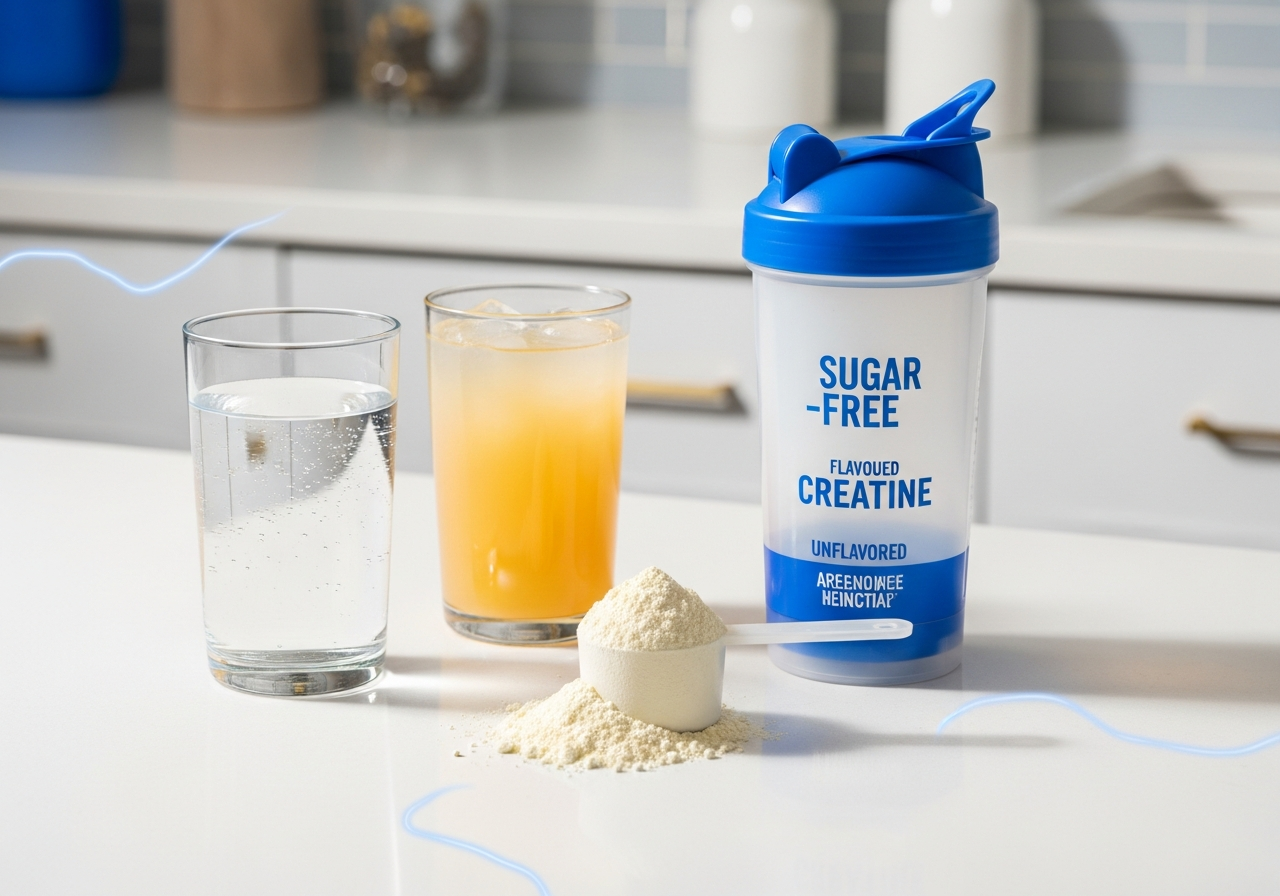
Does Sweetener Affect Creatine? Sugar, Artificial Sweeteners, and Uptake
By The Creatine Canada Research Team — Evidence-based supplement analysts
No, sweetener does not meaningfully reduce creatine’s effectiveness. Creatine monohydrate works mainly by saturating muscle creatine stores over days to weeks, and while carbohydrate or carbohydrate-plus-protein meals can slightly increase uptake by raising insulin, sugar and artificial sweeteners are optional rather than necessary for most people.
Evidence-based · Cites 4 sources · Editorial standards
Key Takeaways
- Creatine monohydrate works without sugar, juice, or any sweetener if you take 3-5 g daily.
- Sugar can modestly increase creatine uptake, but the real-world advantage is usually small once muscles become saturated.
- Artificial sweeteners do not appear to damage creatine, cancel it out, or stop absorption.
- Juice is fine for mixing creatine, but it is not better than water for most users.
- Consistency matters more than timing, flavouring, or the type of sweetener in your drink.
- If sweetened drinks upset your stomach, switch to plain water, a shake, or a meal-based dose.
- Choose plain creatine monohydrate first; flavoured or sugar-free versions are convenience choices, not performance upgrades.
Does sweetener affect creatine? Here’s the short answer most people need
No, sweetener does not meaningfully affect whether creatine works. Creatine monohydrate increases muscle phosphocreatine, the stored form of creatine used to rapidly regenerate ATP, your muscles’ immediate energy currency, and that saturation process depends far more on total daily intake than on whether you mix it with sugar, juice, stevia, sucralose, or plain water.
The practical answer is simple: if you take enough creatine consistently, it will work with or without sweetener. The most established protocol remains either 3-5 g per day with no loading, or a loading phase of about 20 g per day split into 4 doses for 5-7 days followed by 3-5 g per day. The 2017 ISSN position stand concluded that creatine monohydrate is the most effective ergogenic nutritional supplement currently available for increasing high-intensity exercise capacity and lean mass, and that conclusion does not depend on taking it with sugar. Kreider et al. (2017)
Where confusion comes from is the phrase creatine with sugar. Carbohydrate can raise insulin, and insulin can help move nutrients into muscle, so some research has shown that taking creatine with a large amount of carbohydrate can increase retention. That is a real mechanism, but it is often overstated in practice. For most gym-goers, the key benefit of creatine comes from getting muscles saturated over time, not from chasing a tiny absorption edge in one serving.
Artificial sweetener and creatine is even less dramatic than people think. Non-caloric sweeteners such as sucralose, stevia, or aspartame are used for taste, not for transport, and there is no good evidence that they neutralize creatine, break it down, or prevent it from entering muscle.
If you are brand new, start here: buy plain creatine monohydrate, take it daily, and mix it however you will actually keep using it. Our creatine dosage calculator, how to take creatine guide, and creatine for beginners article can help you set up the basics correctly from day one.
Why carbs can help creatine uptake, but not enough to make sugar mandatory
Carbohydrate can modestly increase creatine uptake, but sugar is not required to get the main benefits of supplementation. The reason is physiological: creatine enters muscle through a transporter, and insulin can enhance creatine retention, especially when creatine is taken alongside a substantial amount of carbohydrate or carbohydrate plus protein.
Here is the mechanism in plain English. After you ingest creatine, it is absorbed from the gut into the bloodstream and then transported into skeletal muscle by the creatine transporter. Insulin, the hormone released after eating carbohydrate and to a lesser extent protein, appears to support this process. That is why older studies on creatine and carbs uptake found greater creatine retention when large carbohydrate doses were used compared with creatine alone.
But there are two important realities. First, the insulin effect usually requires a fairly large carbohydrate load, not a tiny sprinkle of sugar or a sugar-free sweetener packet. Second, the advantage matters most during the process of filling your muscle stores, not once you are already close to saturation from regular daily use.
That means the difference between taking creatine with water versus with juice is usually much smaller than supplement marketing suggests. If you already eat mixed meals and take creatine every day, your muscles will still saturate. The 2021 JISSN review on common creatine questions and misconceptions reinforces the broader point that creatine’s benefits are well-supported, while many smaller usage details get exaggerated online. Antonio et al. (2021)
A useful way to think about it is this:
- Daily dose drives the result. Missed doses matter more than drink choice.
- Total diet matters more than one scoop. If you eat regular meals, you are already creating insulin responses during the day.
- Loading is where co-ingestion matters most. Even then, it is optional, not essential.
So yes, creatine with sugar can slightly improve retention under certain conditions. No, that does not mean sugar-free creatine is inferior, nor does it mean plain creatine in water is ineffective. If your goal is a simple, evidence-based setup, use monohydrate and prioritise consistency over micro-optimising insulin spikes.
Artificial sweetener and creatine: what actually happens in the shaker
Artificial sweeteners do not appear to block creatine absorption or make creatine ineffective. In practice, sucralose, stevia, aspartame, acesulfame potassium, and similar sweeteners are mostly there to improve taste in flavoured powders, and they do not replace carbohydrate’s insulin effect in any meaningful way.
This is where people often mix up two different questions:
- Does artificial sweetener harm creatine itself? There is no good evidence that normal use of artificial sweeteners chemically destroys creatine in a freshly mixed drink.
- Does artificial sweetener increase creatine uptake like sugar can? Not to the same extent, because non-caloric sweeteners do not provide the same carbohydrate load or insulin response as actual carbs.
Those are very different issues. Saying artificial sweeteners do not mimic a big carb dose is not the same as saying they are bad for creatine. A sugar-free flavoured creatine can still work perfectly well if it provides a proper creatine dose.
What about mixing stability? Creatine monohydrate is generally stable as a dry powder. Once mixed in liquid, it is best consumed within a reasonable time rather than left sitting for very long periods, especially in acidic liquids. That is a storage issue, not a sweetener issue. A sweetened zero-sugar drink is not automatically a problem; the bigger concern is simply avoiding premixing and forgetting it in a bottle all day. For more on this, see our guides on how to mix creatine and does creatine expire.
For people watching calories, blood sugar, or dental health, sugar-free creatine drinks can be a very practical choice. They let you keep the habit without forcing extra liquid calories. For people doing endurance training or trying to refuel after hard sessions, a carb-containing drink may fit naturally into the bigger nutrition plan. Both can be valid.
The key point is straightforward: artificial sweetener affects flavour and calories far more than it affects creatine results. If a sugar-free drink helps you take creatine every day, that benefit is likely more important than any theoretical loss from not pairing it with carbohydrate.
Creatine with sugar, juice, or water: which option is best for absorption and convenience?
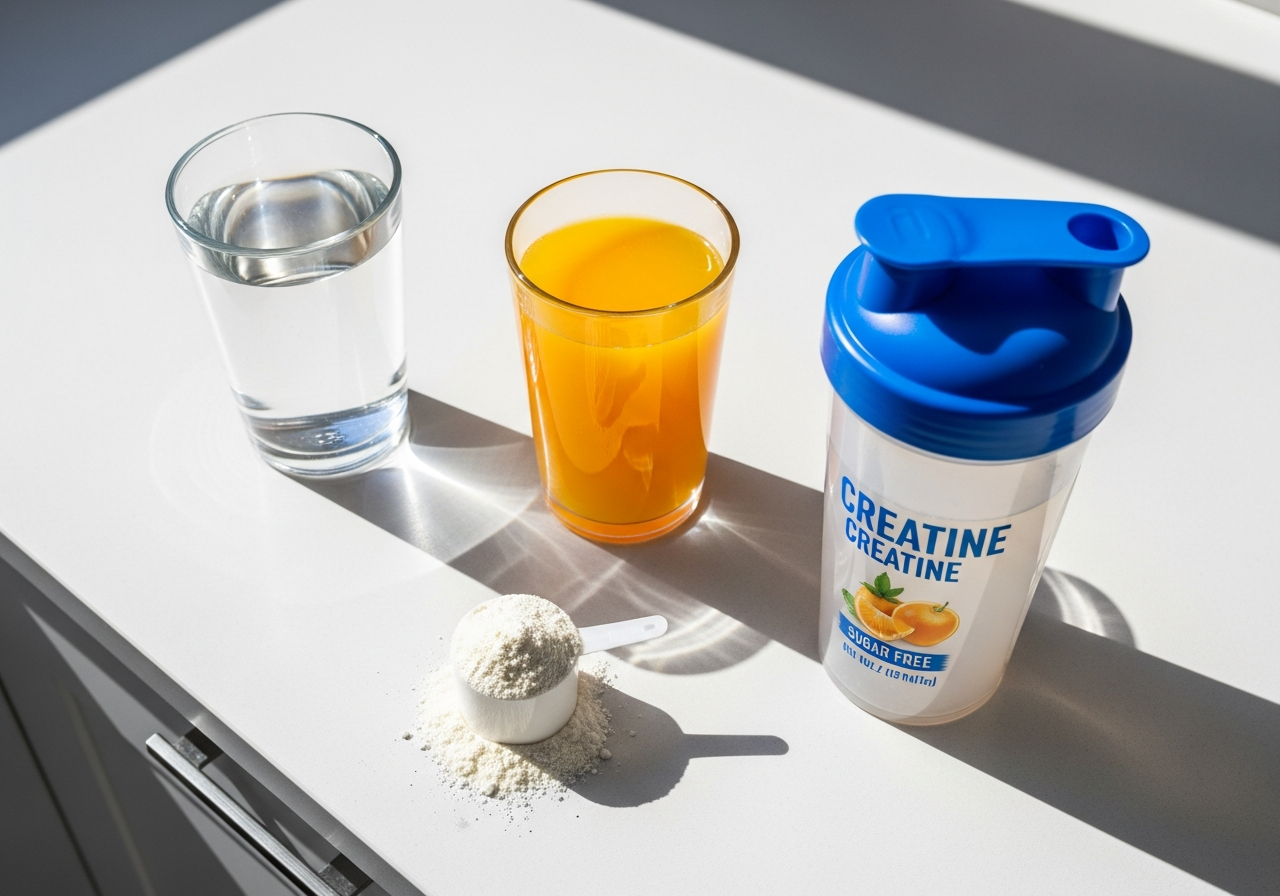
For most people, water is best for simplicity, juice is fine for convenience, and sugar is optional rather than superior. The best mixing liquid is the one that helps you take the correct dose every day without stomach upset, excess calories you do not want, or unnecessary hassle.
People often search for creatine with juice absorption because juice feels more “anabolic” than water. The truth is more modest. Juice contains carbohydrate, so it can contribute to an insulin response, which may slightly improve creatine retention during the initial saturation period. But the practical edge is usually small compared with the big effect of simply taking creatine daily.
| Mixing option | What it does | Best for | Main downside |
|---|---|---|---|
| Water | Delivers creatine effectively with no added calories or sugar | Most beginners, daily maintenance, cutting phases | No carb-assisted uptake boost; flavour may be bland |
| Juice | Adds carbohydrate that can modestly support creatine retention | Loading phase, post-workout meals, people who dislike plain creatine | Extra sugar and calories |
| Sports drink | Adds carbs and fluid, sometimes sodium | Long or intense training days | Can be expensive and unnecessary for short sessions |
| Protein shake | Convenient way to pair creatine with a meal-like feeding | Muscle gain phases, breakfast shakes, post-workout routines | May foam or feel heavier on the stomach |
| Sugar-free flavoured drink | Improves taste without calories; does not impair creatine | Fat-loss phases, everyday adherence | No meaningful carb effect on uptake |
If you like juice, use juice. If you prefer plain water, use water. If you want a sweeter sugar-free option, that is fine too. The evidence does not support the idea that creatine must be taken with a sugary drink to work.
As a rule of thumb, use:
- Water if you want the simplest, cheapest default.
- Juice or a meal if you are loading or already having carbs anyway.
- Sugar-free flavouring if it improves compliance without adding calories.
If you are comparing products, plain monohydrate still offers the best value. Our best creatine rankings, creatine brand reviews, and creatine product catalog can help you compare unflavoured versus flavoured options without getting distracted by label hype.
Exactly how to take creatine if you want the benefits without overthinking sweeteners
The best way to take creatine is to choose a dose you can repeat daily, then mix it in any drink you tolerate well. If you want a step-by-step answer to does sweetener affect creatine, here is the practical version that works for almost everyone.
- Choose creatine monohydrate. It is the most studied, most cost-effective form and the form supported most strongly by the evidence.
- Pick your dosing approach. Use either 3-5 g daily from day one, or load with about 20 g daily split into 4 doses for 5-7 days, then switch to 3-5 g daily.
- Choose your liquid based on adherence. Water, juice, a protein shake, milk, or a sugar-free drink are all workable options.
- Take it with a meal if that feels easiest. A mixed meal naturally includes insulin-stimulating nutrients, so you do not need to force sugar.
- Drink it soon after mixing. This is especially sensible if you use acidic drinks like juice.
- Repeat every day. Rest days count because muscle saturation is built through consistent intake, not only workout-day use.
For beginners, the easiest routine is often 5 g once daily with breakfast or after training. For people who get mild stomach upset, taking smaller doses such as 2-3 g twice daily can be easier. If you are using a loading phase, splitting doses matters more than adding sugar because large single doses are more likely to cause GI discomfort.
Here are three realistic examples:
- Busy office worker cutting fat: 3-5 g in water with lunch.
- Student bulking: 5 g in a post-workout shake or juice.
- Older adult starting resistance training: 3 g with breakfast daily to build the habit.
If you are unsure how much to use, check our creatine dosage calculator, how much creatine per day, and creatine loading phase guides. If you want a bigger-picture routine, our creatine with or without food guide pairs well with this one.
The takeaway is refreshingly boring: choose a form you trust, a dose that fits your size and goal, and a drink you will actually use daily. That is how creatine works in the real world.
Dosing by body weight and goal: when carbs might help a little more
Most adults do well with 3-5 g of creatine monohydrate per day, but larger bodies and aggressive loading strategies can make co-ingestion with food or carbs slightly more useful. Sweetener still is not the deciding factor; total creatine intake and consistency remain the foundation.
Mainstream sports nutrition guidance often uses either a flat dose or a body-weight approach. A common loading method is 0.3 g/kg/day for 5-7 days, followed by maintenance of roughly 0.03 g/kg/day. In practice, that often works out close to the familiar 20 g loading and 3-5 g maintenance model.
| Body weight | No-loading daily plan | Loading option for 5-7 days | Best note on sweeteners/carbs |
|---|---|---|---|
| 50-65 kg | 3 g/day | 15-20 g/day split into 4 doses | Take with any meal or drink; sugar not needed |
| 65-90 kg | 3-5 g/day | 20 g/day split into 4 doses | Juice or carbs may slightly help loading, but consistency matters more |
| 90 kg+ | 5 g/day | 20-25 g/day split into 4-5 doses | Meal-based dosing can improve comfort and simplify adherence |
Goal matters too:
- Strength and muscle gain: 5 g daily is the standard practical choice.
- General wellness or beginner lifting: 3-5 g daily is typically enough.
- Older adults: 3-5 g daily, ideally alongside resistance training and adequate protein.
- Vegetarians and vegans: 3-5 g daily may feel especially worthwhile because baseline muscle creatine stores can be lower.
- Athletes wanting faster saturation: Loading is reasonable, and taking doses with meals or carbs can be convenient, but it is still optional.
If you use sugar strategically, use it because it fits your nutrition plan, not because you think creatine fails without it. For example, a hockey player or sprinter already using carbohydrate around training can easily add creatine to that drink. A person dieting on lower calories may reasonably prefer water or a zero-sugar flavoured option.
Week by week, expect little to happen in the first few days unless you load. By roughly 2-4 weeks on a daily maintenance dose, many users notice better training volume, a small increase in body mass from intracellular water, or slightly improved repeated-effort performance. If you want a deeper timeline, see how long creatine takes to work.
Does timing matter more than sweetener? Usually no, but meals can make creatine easier
Timing matters less than daily consistency, and taking creatine with a meal is usually more useful than chasing the perfect sugary window. If you are wondering about pre-workout versus post-workout versus with juice, the evidence does not show a game-changing difference compared with simply hitting your daily dose.
The logic behind meal timing is straightforward. Meals commonly contain carbohydrate, protein, or both, which create the hormonal and digestive environment that may modestly support creatine retention. That does not make breakfast, lunch, or post-workout shakes magical; it simply means that taking creatine with food is an easy, low-effort choice.
Here is the practical hierarchy:
- Best: Any time you reliably remember every day.
- Very good: With a regular meal or shake.
- Potentially useful: During a loading phase, with carb-containing meals if you already eat them.
- Least important detail: Whether the drink is sweetened with sugar, juice, or an artificial sweetener.
For training-day use, these are all reasonable:
- 5 g in your pre-workout meal shake
- 5 g in a post-workout protein shake
- 5 g with lunch on rest days and workout days alike
What should you avoid? Avoid making creatine intake so complicated that you skip doses. Athletes often lose more progress to inconsistency than to imperfect timing. The International Olympic Committee consensus on supplements supports creatine as one of the more evidence-backed performance supplements in sport, but elite sport practice still centres on total protocol quality, not magical mixing hacks. IOC consensus (2018)
If you want to pair this with a separate timing deep dive, read when to take creatine and creatine on rest days. If you are also wondering about caffeine-containing drinks, our creatine with coffee and creatine and caffeine guides cover that nuance.
Bottom line: sweetener is a minor variable, meals are a useful convenience, and daily adherence is the real driver of results.
Who might actually care about taking creatine with carbs, and who can ignore it
Most people can ignore the sugar question entirely, but a few groups may care more about carb co-ingestion for practical or performance reasons. The average beginner, recreational lifter, woman, or older adult will usually do perfectly well taking creatine in water or with a normal meal.
Beginners should care least. If you are just starting, your biggest wins come from regular use, not optimisation. Take 3-5 g daily and focus on good training, protein intake, and sleep.
Women do not need sugar for creatine to work. Creatine monohydrate is effective for women at the same evidence-based dosing ranges used in men, and there is no female-specific need to pair it with juice. If a sugar-free option helps adherence or fits calories better, that is often the smarter choice.
Older adults can also keep things simple. Taking 3-5 g daily with breakfast or another regular meal is usually practical and well tolerated. The bigger issue is pairing creatine with resistance training and adequate protein, not sweetener choice.
Team-sport and power athletes may care a bit more during rapid loading. If you are a sprinter, hockey player, football player, or CrossFit athlete trying to saturate stores quickly before a block of intense training, taking creatine doses alongside carb-containing meals or sports drinks can make sense because those carbohydrates may modestly improve retention while also supporting training energy.
People with diabetes or those closely managing blood sugar should not assume sugar is required. In many cases, it is more sensible to use plain creatine monohydrate with meals and discuss broader nutrition strategy with a qualified clinician if needed. Creatine can still be used without forcing high-sugar drinks.
People prone to stomach upset should prioritise comfort over theory. Very sweet drinks, fruit juice, or large loading doses can all be more irritating than plain water or split doses. See creatine digestive side effects if that sounds familiar.
The user profile that benefits most from a carb-containing creatine strategy is narrower than social media makes it seem. For almost everyone else, the best answer is still the boring one: monohydrate, daily use, simple routine.
Safety, side effects, and what to look for on creatine labels in Canada
Sweetener choice does not meaningfully change creatine’s core safety profile, but the rest of the formula can affect tolerance, calories, and label quality. Creatine monohydrate is well-studied and generally considered safe for healthy people when used at recommended doses, as summarised by the ISSN position stand and mainstream medical references such as Mayo Clinic. Mayo Clinic — Creatine
The main side effects people actually notice are usually not from creatine itself being “harsh,” but from how it is taken:
- GI upset: More likely with large single doses, fast loading, or very sweet drinks.
- Temporary water weight gain: Common as intramuscular water increases; this is not the same as gaining fat.
- Texture issues: Grittiness can make some people think the product is bad when it is simply less dissolved.
Artificial sweeteners can matter here only indirectly. Some people tolerate sucralose- or sugar alcohol-heavy formulas poorly, while others have no issue at all. If a flavoured product bloats you, that does not mean creatine is the problem; it may mean the flavour system or sweetener blend is.
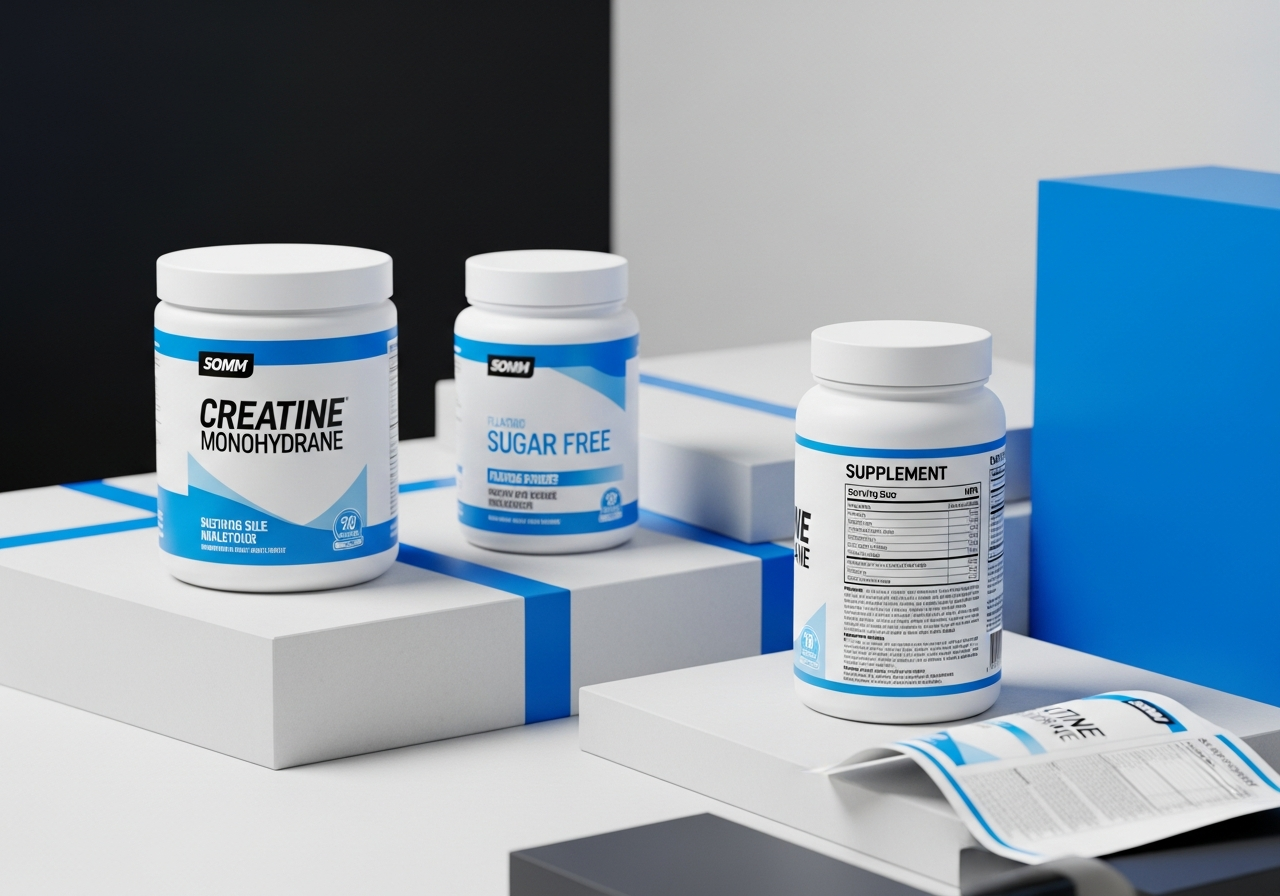
In Canada, a few label checks matter:
- Look for an NPN, which is the Natural Product Number used by Health Canada for licensed natural health products.
- Prioritise third-party testing or reputable manufacturing quality if possible.
- Check the actual creatine dose per serving, especially on flavoured products where fillers can crowd the scoop.
- Read the sweetener panel if you are sensitive to sucralose, stevia, sugar alcohols, or added sugar.
For a plain, reliable product, unflavoured monohydrate is still the safest bet from a value and evidence perspective. Flavoured or sugar-free options can be totally fine, but they should be chosen for convenience, not because the sweetener makes them more effective.
If you want help sorting good products from flashy labels, start with best creatine monohydrate in Canada, is creatine approved in Canada, and Canadian supplement regulations.
Common mistakes and myths: the sugar myths around creatine that keep spreading
The biggest myth is that creatine needs sugar to work, and that claim is false. Creatine works by raising muscle creatine and phosphocreatine stores over time, and while large carbohydrate intakes can modestly improve retention, they are not a requirement for effectiveness.
Here are the mistakes and myths to stop repeating:
- Myth: Creatine with sugar is always better.
Reality: It can slightly increase retention during loading, but the difference is usually minor for everyday users who take creatine consistently. - Myth: Artificial sweetener kills creatine absorption.
Reality: There is no good evidence that common non-caloric sweeteners stop creatine from working. - Myth: Juice is the best way to take creatine.
Reality: Juice is just one convenient carb-containing option, not a requirement or a proven superior choice for most users. - Myth: You need a massive insulin spike to “shuttle” creatine into muscle.
Reality: Muscles saturate with regular creatine intake even without engineered insulin spikes. - Myth: If you do not feel an immediate effect, your drink choice is wrong.
Reality: Creatine is not a stimulant; its effects build over days to weeks. - Myth: Flavoured creatine is more advanced.
Reality: Flavouring changes taste, and sometimes adherence, but plain monohydrate remains the benchmark form.
A common beginner error is changing too many variables at once: loading aggressively, mixing with juice, taking it only on training days, and then blaming the sweetener if stomach issues appear. A cleaner approach is to simplify. Start with 3-5 g daily, preferably with a meal or water, and see how you respond before adding more complexity.
Another error is assuming sweetness equals quality. Some heavily flavoured products provide smaller actual creatine doses per scoop, so users think they are taking 5 g when they are not. Always read the label carefully.
If you want a broader fact-check on supplement folklore, our creatine myths debunked and creatine myths and facts guides go deeper into the most persistent misunderstandings.
Bottom line: when to use sugar, when to skip it, and the simplest winning routine
Sweetener does not make or break creatine. If you want the shortest practical answer, use 3-5 g of creatine monohydrate daily, mix it in whatever drink you tolerate and enjoy, and do not add sugar unless it already fits your meal or training plan.
Use this simple decision guide:
- Choose water if you want zero fuss, zero extra calories, and excellent effectiveness.
- Choose juice or carbs if you are loading, already eating carbs around training, or simply prefer the taste.
- Choose a sugar-free sweetened option if it helps you stay consistent while keeping calories lower.
- Avoid overthinking if you are a beginner, because adherence beats optimisation.
If you want a one-week setup, here it is:
- Buy plain creatine monohydrate from a reputable brand.
- Take 5 g once daily for the next 30 days.
- Mix it with water, a shake, or juice based on preference, not internet superstition.
- Take it at roughly the same time each day so you do not forget.
- Track body weight, gym performance, and repeated-effort capacity over 2-4 weeks.
How do you know it is working? Many people notice one or more of these: slightly fuller muscles, a small increase on the scale from intracellular water, one or two extra reps at a given weight, better repeat sprint or set performance, or improved recovery between hard bouts. If none of that happens after several weeks, the issue is more likely dose consistency, training quality, or unrealistic expectations than the presence or absence of sweetener.
The most evidence-based conclusion is also the least glamorous: creatine monohydrate works with sugar, without sugar, with juice, and with artificial sweeteners. Carbs can help a bit, but they are optional. The big rocks are the right dose, the right form, and taking it every day.
Sweetener, Sugar, and Creatine: What Actually Matters
- 3-5 g/day Standard creatine maintenance dose — Enough for most adults whether mixed with water, juice, or a sugar-free drink.
- 20 g/day Typical loading dose — Usually split into 4 doses for 5-7 days to saturate muscles faster.
- 5-7 days Typical loading timeline — Carbs may modestly help retention during this stage, but are not required.
- 2-4 weeks Common timeline without loading — Many users notice training benefits after consistent daily intake over this period.
Frequently Asked Questions
Does sweetener affect creatine absorption?
No, sweetener does not meaningfully reduce creatine absorption in normal use. Sugar can modestly increase creatine retention because carbohydrate raises insulin, but artificial sweeteners do not appear to block absorption or cancel out creatine’s effects. For most people, taking the right dose every day matters much more than the sweetener in the drink.
Is creatine with sugar better than creatine with water?
Creatine with sugar is not automatically better than creatine with water. A large carbohydrate intake can slightly improve creatine uptake during loading, but water still works very well for daily supplementation. In the real world, consistency, dose, and using creatine monohydrate matter more than adding sugar.
Can I mix creatine with juice for better absorption?
Yes, you can mix creatine with juice, and juice may modestly support uptake because it contains carbohydrate. That said, the benefit is usually small for most users once muscle stores are saturating over time. Juice is a convenience option, not a requirement for creatine to work.
Do artificial sweeteners ruin creatine?
No, artificial sweeteners do not ruin creatine under normal use. Common sweeteners such as sucralose or stevia mainly change taste and calories, not creatine’s core function. If a flavoured product bothers your stomach, the issue is more likely the formula or dose size than creatine being neutralized.
Does sugar-free creatine work as well as regular creatine?
Yes, sugar-free creatine can work just as well as regular creatine if it provides an effective dose of creatine monohydrate. The lack of sugar does not stop muscles from becoming saturated over days to weeks. The main trade-off is that sugar-free products do not provide the small carb-related uptake boost that sugary drinks can.
Should I take creatine with carbs after a workout?
You can take creatine with carbs after a workout, but you do not need to. Post-workout carbs and protein can be a convenient time to take creatine because you are already eating, which may slightly help retention and improve adherence. Still, missing the post-workout window does not make creatine ineffective.
What is the best drink to mix creatine with?
The best drink to mix creatine with is the one you will use consistently and tolerate well. Water is the simplest default, juice is fine if you want carbs, and a sugar-free flavoured drink is useful if taste helps you stay regular. There is no single mandatory drink for creatine absorption.
Does taking creatine with sugar build more muscle?
Taking creatine with sugar does not reliably produce meaningfully more muscle for most people. Sugar may slightly improve creatine retention, especially during loading, but muscle gain still depends mainly on training, protein intake, total calories, and taking creatine consistently over time.
Can I take creatine if I am avoiding sugar?
Yes, you can absolutely take creatine if you are avoiding sugar. Plain creatine monohydrate in water or a sugar-free drink still works well, and many people use it successfully during fat-loss phases or blood-sugar-conscious eating patterns. You do not need juice or a sugary sports drink to get results.
Does sweetener matter more during a creatine loading phase?
Sweetener matters slightly more during loading only if it comes from real carbohydrate, not because sweetness itself does anything special. Carb-containing meals or drinks can modestly increase creatine retention while stores are filling quickly. Even then, loading works without sugar as long as total creatine intake is high enough.