Does Creatine Reduce DOMS? Muscle Soreness, Recovery, and What the Research Shows
By The Creatine Canada Research Team — Evidence-based supplement analysts
Creatine can reduce delayed onset muscle soreness (DOMS) for some people in some situations, but it is not a reliable soreness-killer. The best reading of the evidence is that creatine may modestly reduce muscle damage and recovery-related soreness after hard training, especially repeated high-intensity or eccentric work, while its bigger proven benefit is helping you perform and recover training capacity over time.
Evidence-based · Cites 4 sources · Editorial standards
Key Takeaways
- Creatine may modestly reduce DOMS, but the effect is inconsistent across studies.
- Its strongest benefit is better power output, training quality, and repeat performance—not pain relief.
- Use creatine monohydrate at 3–5 g daily; consistency matters more than timing.
- A loading phase of 20 g/day split into 4 doses for 5–7 days can saturate muscles faster.
- Creatine may help recovery by improving phosphocreatine availability, cell hydration, and training resilience.
- If you want less soreness, combine creatine with smart programming, sleep, protein, and gradual progression.
- For Canadians, choose plain creatine monohydrate with an NPN and ideally third-party testing.
Does creatine reduce DOMS? Yes, sometimes—but that is not its main job
Yes, creatine can reduce DOMS in some contexts, but the effect is usually modest and not guaranteed. If you are asking whether creatine and DOMS have a clear one-to-one relationship, the short answer is that creatine may help with muscle soreness after hard training, yet the strongest evidence for creatine is still improved high-intensity performance, lean mass gains, and training capacity rather than consistent soreness reduction.
DOMS, or delayed onset muscle soreness, is the stiffness, tenderness, and reduced force production that typically peaks about 24 to 72 hours after unfamiliar, high-volume, or eccentric training. Eccentric training means the muscle is lengthening under load, such as the lowering phase of a squat, the descent of a curl, or downhill running. DOMS is linked to microscopic muscle disruption, inflammation, swelling, altered calcium handling, and sensitized pain receptors. Because DOMS is a multi-factor response, no supplement completely shuts it off.
Creatine supplementation works by increasing muscle creatine stores and phosphocreatine, the rapidly available high-energy compound your body uses to help regenerate ATP, or adenosine triphosphate, during short, intense efforts. That energy role is why creatine shines for repeated sprints, explosive lifting, and training volume. Some research also suggests creatine may reduce markers of muscle damage or blunt the perceived recovery hit after strenuous exercise, which is why people often search for phrases like creatine muscle soreness, creatine and post workout soreness, or does creatine help with soreness.
The practical takeaway is simple: take creatine if you want better performance, better long-term training output, and possibly a small recovery benefit. Do not take it expecting it to work like ibuprofen. If your goal is fewer ruined-leg-days after squats or less post-run soreness, creatine can be part of the plan, but it should sit alongside sensible volume progression, adequate protein, and sleep. If you need a broader primer first, see what creatine is and our guide to creatine for muscle recovery.
What the research actually shows on creatine, muscle soreness, and muscle damage
The research on creatine delayed onset muscle soreness shows mixed but plausible benefits. Some studies report lower soreness ratings or lower blood markers associated with muscle damage after intense exercise, while others show little or no meaningful difference, which is why the honest answer is that creatine is promising for recovery soreness but not uniformly effective for DOMS itself.
The most important high-level source remains the 2017 ISSN position stand, which concluded that creatine monohydrate is the most effective ergogenic nutritional supplement currently available for increasing high-intensity exercise capacity and lean body mass during training. That statement is not about DOMS specifically, but it matters because better recovery between efforts and across sessions is one of the main ways creatine influences how beat up you feel. The 2021 JISSN review on common questions and misconceptions about creatine also reinforced that monohydrate is the reference form and that many fears around side effects are overstated.
Where does DOMS fit in? Studies that do find a benefit often look at damaging exercise models: repeated sprints, heavy resistance work, eccentric protocols, or endurance events that create substantial muscle disruption. In those settings, creatine and muscle damage markers such as creatine kinase, lactate dehydrogenase, or inflammatory responses sometimes improve. But a lower lab marker does not always equal noticeably less soreness, and soreness itself is highly subjective.
This is why two apparently conflicting statements can both be true. First: creatine may reduce post-workout soreness in some people. Second: the evidence is not strong enough to call creatine a dependable anti-DOMS supplement. The most evidence-based framing is that creatine can support recovery processes that may lower soreness indirectly, especially when training stress is high and you are using a proper daily dose long enough to saturate muscle.
If you want to evaluate a claim online, ask three questions: Was the exercise damaging enough to cause real DOMS? Was creatine loaded or used long enough to saturate muscle? And did the study measure soreness, function, or both? Those details explain why headlines around creatine and soreness often overpromise.
How creatine could help soreness: the mechanisms that make sense
Creatine could reduce DOMS by helping muscles maintain energy balance, cellular hydration, and training resilience after hard exercise. The key word is could, because the mechanisms are biologically plausible and supported to varying degrees, but they do not guarantee that you will feel dramatically less sore after every workout.
The first mechanism is phosphocreatine support. Phosphocreatine is the stored form of creatine in muscle that donates a phosphate group to rapidly regenerate ATP during short, intense work. Better phosphocreatine availability can help maintain force output during repeated sets or intervals. When the same workout costs you slightly less metabolically, the downstream disruption may also be lower. In simple terms, a better-fuelled muscle often tolerates hard training better.
The second mechanism is cell hydration. Creatine pulls more water into muscle cells, increasing intracellular water. That is not “bloating” in the usual sense; it is largely water stored inside muscle tissue. A better-hydrated cell may support protein turnover, glycogen storage, and cellular signalling linked to recovery. This is one reason some users report that muscles feel fuller and recover better even if soreness does not vanish.
The third mechanism is a possible effect on secondary muscle damage and inflammatory signalling. Some studies suggest creatine may blunt rises in certain damage-related or inflammatory markers after strenuous exercise. That does not mean creatine is an anti-inflammatory drug, but it may reduce the total recovery burden in demanding training blocks.
The fourth mechanism is indirect but important: improved training capacity. When creatine helps you perform more total quality work over weeks and months, your body adapts better to that workload. That repeated adaptation can reduce how dramatically sore you get from the same training. In other words, creatine may lower soreness not just by changing biology after one workout, but by helping you become more robust over time.
That last point matters for beginners. If you are brand new to lifting, the biggest cause of DOMS is novelty and excess volume. Creatine can support adaptation, but it cannot fully protect you from doing too much too soon. For the clearest explanation of the underlying energy system, see creatine and ATP and creatine saturation.
How to take creatine if your goal is better recovery and less soreness
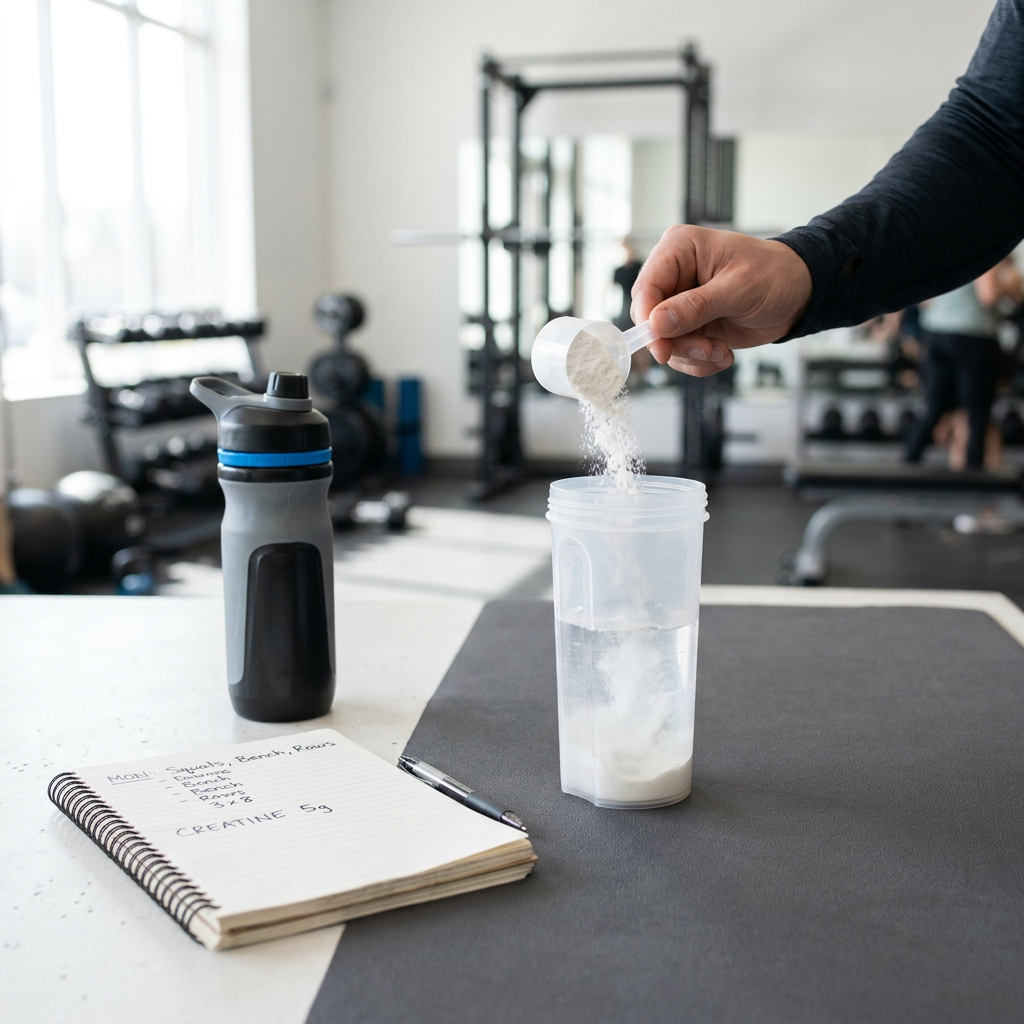
If you want to use creatine for recovery soreness, the best approach is simple: take creatine monohydrate every day, reach muscle saturation, and keep training sensibly. Creatine works through steady muscle saturation, not by acting like an instant pre-workout pain reliever.
- Choose creatine monohydrate. Monohydrate is the most-studied, most cost-effective, and best-supported form for performance and recovery. Fancy forms have not consistently outperformed it.
- Decide whether to load. A loading phase is optional. If you want faster saturation, take 20 g per day split into 4 doses of 5 g for 5 to 7 days. If you prefer simplicity, take 3 to 5 g per day and reach full saturation more gradually over several weeks. Learn more in our loading phase guide.
- Take a maintenance dose daily. After loading, take 3 to 5 g per day. On a no-load approach, just stay with 3 to 5 g daily from day one.
- Take it consistently, including rest days. Creatine on off-days helps maintain muscle stores. It is not a workout-only supplement.
- Mix it with any convenient fluid or meal. Water is fine. A protein shake is fine. A post-workout meal is fine. Timing matters far less than adherence.
- Train with progression, not punishment. If your soreness is mainly from giant jumps in volume, creatine will not rescue bad programming.
- Give it time. Judge creatine over 2 to 6 weeks, not after one workout.
What should you expect? Some people notice slightly less post-workout soreness, better repeat performance, or less drop-off between sets once saturation builds. Others mainly notice better strength progress and exercise tolerance with little change in soreness ratings. Both responses are normal.
If you miss a dose, do not double up aggressively the next day. Just resume your usual dose. If you want help with exact serving size, use our creatine dosage calculator or read how to take creatine. The supplement only does part of the recovery job; sleep, protein, hydration, and smart progression still matter more for DOMS than any scoop does.
Best creatine dose for DOMS, recovery, strength, and body weight
The best creatine dose for soreness and recovery is the same dose used for performance: enough to saturate muscle stores consistently. For most adults, that means 3 to 5 g of creatine monohydrate daily, with optional loading at 20 g per day split into 4 doses for 5 to 7 days if you want faster results.
| Goal | Best approach | Daily dose | What to expect |
|---|---|---|---|
| General fitness and recovery | No loading, steady saturation | 3–5 g/day | Gradual benefits over several weeks |
| Faster start for hard training block | Loading, then maintenance | 20 g/day for 5–7 days split into 4 x 5 g, then 3–5 g/day | Quicker saturation and earlier performance benefits |
| Larger athletes with high lean mass | Upper end maintenance | 5 g/day | Practical default for most bigger lifters |
| Smaller athletes or sensitive stomachs | Lower end maintenance | 3 g/day | Often easier on digestion with slower saturation |
Body weight matters somewhat, but not as much as many people think. A practical rule is that smaller adults can often do well on 3 g per day, while larger athletes usually choose 5 g per day. If you want a more individual estimate, our daily dose guide and dosage calculator are the easiest place to start.
Examples:
- 55–65 kg beginner: 3 g daily is often enough, especially if you are not rushing saturation.
- 65–90 kg regular lifter: 5 g daily is the standard practical choice.
- 90 kg+ athlete training hard: 5 g daily remains reasonable; some prefer loading first to feel the effects sooner.
Do not overcomplicate creatine by chasing soreness-specific dosing. There is no special “anti-DOMS dose” supported by mainstream evidence. The same saturation-based protocol that supports power and training volume is the one most likely to help any recovery-related benefit show up.
If digestive comfort is a problem, split your dose into smaller servings and take it with food. If you load, spreading 20 g across the day usually feels better than taking one large serving at once. For more on side effects and troubleshooting, see creatine digestive side effects.
When to take creatine for post-workout soreness, and what to expect week by week
Creatine timing matters far less than daily consistency, so take it whenever you are most likely to remember it. If your main question is whether creatine and post workout soreness improve more when you take it before or after training, the answer is that there is no strong evidence that one timing window meaningfully changes DOMS outcomes as long as total daily intake is consistent.
A practical timing hierarchy looks like this:
- Best: the time you will take it every day.
- Good: with a meal or shake, especially if that helps routine and digestion.
- Also fine: pre-workout, post-workout, morning, or evening.
Here is a realistic timeline if you use creatine monohydrate properly:
- Days 1–7 with loading: muscle creatine stores rise quickly. Some people notice fuller muscles, slight scale weight increase from intracellular water, and better repeat effort. DOMS changes, if they happen, are usually subtle at first.
- Weeks 2–4 without loading, or week 2 after loading: saturation is building or already established. You may notice less drop-off from set to set, better training quality, and sometimes less “wrecked” feeling after hard sessions.
- Weeks 4–8: the clearest effects are usually improved strength progression, slightly better work capacity, and better tolerance of demanding sessions. Any soreness benefit is more likely to show up as recovering function faster rather than never getting sore.
- Months 2–3: the value of creatine becomes increasingly cumulative. Better training quality over time generally matters more than any single-day soreness rating.
The best sign creatine is “working” is not that soreness disappears. It is that you maintain performance better, recover between hard sets and sessions more effectively, and accumulate more productive training. That is why people often think creatine is not working when in fact they are using the wrong success metric.
For timing details, read when to take creatine. For expectations, see how long creatine takes to work. If you are using creatine specifically because your legs are destroyed for three days after each workout, focus just as much on training dosage as supplement timing.
Who is most likely to notice a recovery benefit from creatine?
The people most likely to notice a recovery benefit from creatine are those doing repeated high-intensity, high-volume, or muscle-damaging training. That includes lifters, team-sport athletes, sprinters, CrossFit athletes, and beginners who are adapting to strength training, although beginners should expect creatine to help performance more reliably than it erases soreness.
Beginners: Creatine is absolutely reasonable for beginners, but it is not a substitute for sensible volume. New lifters often get severe DOMS because every stimulus is novel. Creatine may help them tolerate training better over time, yet the biggest fix is avoiding marathon leg days and adding volume gradually. Our beginner guide covers the basics.
Women: Women can benefit from creatine just as men can. The idea that creatine is only for male bodybuilders is false. Women may use the same evidence-based doses, and creatine can support training quality, lean mass retention, and recovery. For more, see creatine for women.
Older adults: Older adults may benefit from creatine because maintaining muscle function and training quality becomes more important with age. While DOMS is not the main concern in this group, better recovery from resistance training can improve adherence and strength progress. See creatine for older adults.
Athletes in repeated-effort sports: Hockey, soccer, football, basketball, sprinting, and racquet sports all involve repeated explosive efforts where phosphocreatine matters. In these settings, creatine can improve repeat performance and potentially reduce how much fatigue and tissue stress accumulate across a session or match week.
Vegetarians and vegans: People with lower baseline dietary creatine intake may respond particularly well because they often start with lower muscle creatine stores. Better saturation can produce more noticeable benefits in performance and recovery. See is creatine vegan.
The people least likely to notice a major soreness-specific effect are those expecting creatine to instantly fix pain after random all-out workouts. Creatine rewards structured training. It works best when you train regularly enough for improved energy availability and adaptation to matter.
Safety, side effects, and how to choose a good creatine in Canada
Creatine monohydrate is widely considered safe for healthy people when used at evidence-based doses, and soreness relief is not a reason to choose a sketchy or overhyped product. The ISSN position stand and the IOC consensus on dietary supplements both place creatine among the most evidence-backed sports supplements available.
Common side effects are usually mild and manageable:
- Temporary weight increase: often from increased intracellular water, especially during loading.
- Stomach upset or loose stool: more likely with large single doses, poor mixing, or taking too much at once.
- Perceived bloating: some people feel this early on, though true water retention is mostly inside muscle.
What about kidneys? In healthy people, creatine has not been shown to harm kidney function at standard doses, but it can raise blood creatinine, which is a normal breakdown product that may confuse lab interpretation. If you have kidney disease, are under medical care for renal issues, or take medications that affect kidney function, speak with your clinician first. That nuance is important and often lost online.
For Canadians, buying well matters. Look for:
- Creatine monohydrate as the main and ideally only active ingredient.
- NPN, or Natural Product Number, on regulated products sold in Canada.
- Third-party testing or sport certifications if you are drug-tested or highly risk-averse.
- Transparent label claims without proprietary blends or miracle recovery promises.
If you want a vetted shortlist, browse our best creatine rankings, creatine brand reviews, and product catalog. If you want to understand claims better, read creatine myths debunked.
In practice, the best buy for recovery is usually plain, unflavoured creatine monohydrate from a reputable brand. You do not need a “recovery matrix,” a premium designer salt, or a soreness blend to get the benefits creatine can actually deliver.
Why creatine might not help your soreness: mistakes and myths to fix first
If creatine is not helping your soreness, the most common reason is not that creatine failed—it is that your expectations or overall recovery plan are off. Creatine and DOMS are related, but creatine does not cancel poor programming, low sleep, low protein, dehydration, or extreme jumps in training volume.
Mistake 1: Expecting same-day pain relief. Creatine is not an analgesic. It does not work like a painkiller. Its benefits depend on muscle saturation and repeated use.
Mistake 2: Using creatine only on workout days. This is one of the biggest beginner errors. Creatine works best when taken daily, including rest days, so muscle stores stay elevated.
Mistake 3: Judging it only by soreness. The better question is whether you are performing more quality work, recovering force faster, and progressing better. DOMS alone is a poor scorecard.
Mistake 4: Blaming creatine for every stomach issue. Many digestive complaints come from taking too much at once. Split doses or use a simple 3–5 g maintenance protocol.
Mistake 5: Buying expensive forms marketed for recovery. Monohydrate remains the benchmark. As Antonio et al. (2021) discussed, many alternative forms are heavily marketed without showing superior real-world results to monohydrate.
Now the myths:
- Myth: Creatine prevents all muscle damage. False. Hard training still creates mechanical and metabolic stress. Creatine may reduce some damage markers, not eliminate adaptation stress.
- Myth: More soreness means more gains, so reducing DOMS is bad. False. DOMS is not a direct measure of muscle growth. You can gain muscle with modest soreness and get brutally sore from unproductive novelty.
- Myth: Creatine only helps bodybuilders. False. It helps many people doing repeated high-intensity work, including women, older adults, and team-sport athletes.
- Myth: If you do not feel different in a week, it is not working. False. Without loading, creatine may take several weeks to fully show its effects.
Bottom line: if you want creatine to help with recovery soreness, fix the basics first. Gradual progression, enough protein, enough sleep, and enough hydration amplify whatever small DOMS benefit creatine may offer.
Best type of creatine for DOMS and recovery: monohydrate vs everything else
The best type of creatine for soreness and recovery is creatine monohydrate. There is no strong evidence that HCl, buffered creatine, ethyl ester, gummies, or flashy recovery blends reduce DOMS better than monohydrate when equivalent creatine intake is achieved.
| Form | Evidence for performance | Evidence for DOMS/recovery | Value | Best use case |
|---|---|---|---|---|
| Creatine monohydrate | Strongest | Best-supported by overall creatine literature | Usually best | Default choice for nearly everyone |
| Micronized monohydrate | Strong, effectively same active ingredient | No proven extra DOMS benefit | Good if price is similar | People who want easier mixing |
| Creatine HCl | Limited compared with monohydrate | No proven superiority for soreness | Usually pricier | Only if you strongly prefer the format |
| Buffered or pH-altered forms | Weak case for superiority | No proven superiority for soreness | Often poor | Generally not necessary |
| Gummies/capsules | Can work if dose is adequate | No special soreness effect | Often worse cost per gram | Convenience-first users |
Why does monohydrate still win? Because it is the form used in the overwhelming bulk of successful creatine research. When people ask whether a newer form is better for creatine muscle soreness or creatine for recovery soreness, the honest answer is that the burden of proof sits with the newer form, and that proof is usually missing.
There are practical reasons you might choose a different format. Capsules are convenient for travel. Micronized powder can mix more easily. Gummies may help adherence for some people. But those are convenience differences, not evidence that the active creatine works better against DOMS.
If you are shopping, the safest framework is: pick monohydrate first, verify the label, check for an NPN in Canada, and compare cost per gram rather than marketing language. For deeper product-selection guidance, see best type of creatine, best creatine monohydrate in Canada, and how to choose creatine.
Bottom line: should you take creatine if soreness is your main concern?
Yes, you can take creatine if soreness is your main concern, but you should do it for the broader recovery and performance benefits rather than expecting a dramatic anti-DOMS effect. The best evidence-based answer to “does creatine reduce DOMS?” is that it may modestly help some people, especially during demanding training, but it is not a dependable standalone fix for muscle soreness.
If you train hard, especially with repeated sprinting, resistance training, or eccentric work, creatine is still one of the smartest supplements you can buy. It is inexpensive, well-studied, and likely to improve the quality of your training over time. That improvement in training resilience is often more valuable than a small shift in soreness ratings.
Here is the simplest action plan:
- Buy plain creatine monohydrate from a reputable brand.
- Take 3 to 5 g daily, every day.
- Optionally load with 20 g daily split into 4 doses for 5 to 7 days if you want faster saturation.
- Keep your training progression sensible.
- Support recovery with sleep, protein, hydration, and rest days.
- Judge success by better performance and recovery between sessions, not only by whether you feel zero soreness.
If your real goal is to recover better so you can train more consistently, creatine is a strong yes. If your real goal is to numb soreness after doing too much too soon, creatine is only a partial answer. Start with the proven basics, let muscle stores saturate, and evaluate over a few weeks.
For next steps, read the complete creatine guide, compare options in our best creatine rankings, or use the creatine dosage calculator to set your daily plan.
Creatine and DOMS: The numbers that matter
- 3–5 g/day Standard maintenance dose — The usual evidence-based daily dose for creatine monohydrate.
- 20 g/day Typical loading dose — Usually split into 4 doses for 5–7 days to saturate muscles faster.
- 24–72 hours Typical DOMS peak window — Muscle soreness usually peaks one to three days after hard or unfamiliar exercise.
- 5–7 days Fastest common saturation window — A loading phase can raise muscle creatine stores within about a week.
Frequently Asked Questions
Does creatine reduce DOMS after lifting?
Creatine may reduce DOMS after lifting, but the effect is usually modest and inconsistent. The more reliable benefit is that creatine supports training performance and may help you recover function better between sessions, especially after high-volume or eccentric lifting.
Does creatine help with muscle soreness the next day?
Creatine can help with next-day muscle soreness for some people, but it is not a guaranteed next-day fix. Its effects depend on regular use, muscle saturation, and the type of training you are doing rather than a single pre- or post-workout dose.
Is creatine good for recovery soreness?
Yes, creatine is a reasonable supplement for recovery soreness, mainly because it supports muscle energy availability and repeat performance. The strongest evidence supports better recovery capacity and training quality, while direct soreness reduction is less consistent.
Can creatine reduce muscle damage?
Creatine may reduce some markers associated with muscle damage after strenuous exercise. That said, lower damage markers do not always translate into clearly less soreness, so it is best viewed as a recovery-support supplement rather than a guaranteed muscle-damage blocker.
Should I take creatine before or after a workout for soreness?
You can take creatine before or after a workout, but timing is much less important than taking it daily. For soreness and recovery, the key is keeping muscle creatine stores elevated over time, not hitting a narrow timing window.
How long does creatine take to help with recovery?
Creatine can start supporting recovery once muscle stores begin to rise, which is usually within 5–7 days with loading or over several weeks without loading. Most people should evaluate recovery benefits over at least 2–6 weeks, not after one workout.
What is the best creatine dose for muscle soreness?
The best practical dose is the standard creatine monohydrate dose: 3–5 g daily, with optional loading at 20 g per day split into 4 doses for 5–7 days. There is no special soreness-only dose that has stronger evidence than the standard saturation approach.
Does creatine stop soreness completely?
No, creatine does not stop soreness completely. DOMS is caused by multiple factors including mechanical strain, novelty, and inflammation, so creatine may only blunt part of the recovery burden rather than eliminate soreness.
Why am I still sore even though I take creatine?
You can still be sore on creatine because creatine is not a painkiller and hard training still creates muscle stress. Common reasons include too much training volume, unfamiliar exercises, poor sleep, low protein intake, dehydration, or not taking creatine consistently long enough to saturate muscle.
Is creatine monohydrate the best form for DOMS and recovery?
Yes, creatine monohydrate is the best-supported form for DOMS and recovery because it is the form used in most of the evidence base. Other forms may be convenient, but they have not shown superior soreness or recovery benefits compared with monohydrate.