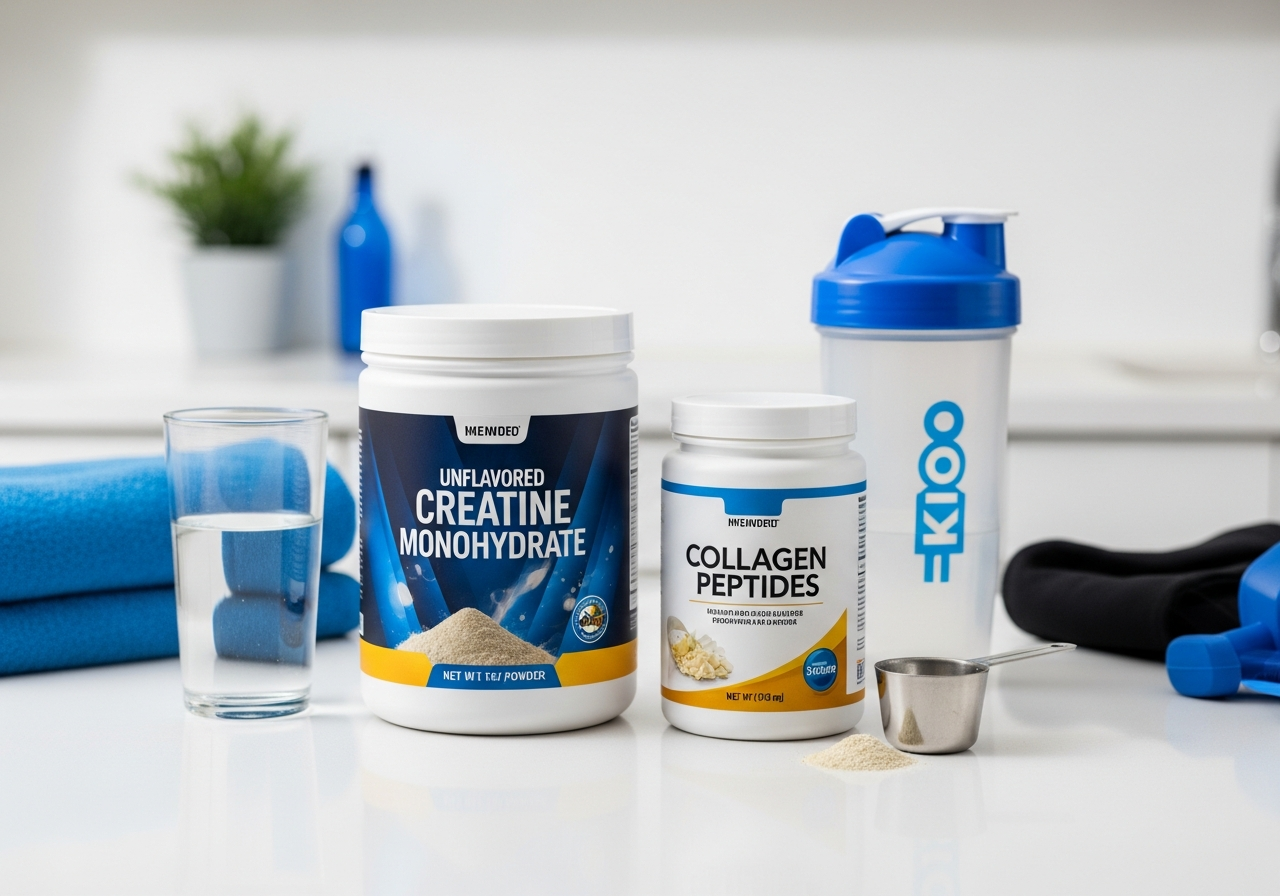
Creatine vs Collagen: Muscle vs Joints and Skin
By The Creatine Canada Research Team — Evidence-based supplement analysts
Creatine and collagen are not interchangeable: creatine is the better choice for strength, power, lean mass, and high-intensity performance, while collagen is more relevant for connective tissue support and may help some joint, tendon, or skin goals. You can take creatine and collagen together, but they solve different problems and should be chosen based on the result you actually want.
Evidence-based · Cites 4 sources · Editorial standards
Key Takeaways
- Choose creatine if your main goal is muscle, strength, gym performance, or training capacity.
- Choose collagen if your main goal is connective tissue support, joint comfort, tendon rehab support, or skin-related goals.
- For muscle growth, collagen is not a substitute for creatine or a high-quality complete protein.
- Yes, you can take creatine and collagen together because they work through different mechanisms.
- The standard creatine dose is 3-5 g daily, with an optional loading phase of 20 g/day split into 4 doses for 5-7 days.
- Collagen is commonly taken in gram-level daily doses, often paired with vitamin C, but evidence is stronger for some joint/tendon uses than for visible skin changes.
- In Canada, prioritise plain creatine monohydrate with an NPN and ideally third-party testing rather than flashy proprietary blends.
Creatine vs collagen in one sentence: pick the one that matches the tissue you want to improve
Creatine vs collagen comes down to target tissue and goal: creatine mainly supports muscle energy and training performance, while collagen mainly supplies specific amino acids used in connective tissues such as tendons, ligaments, cartilage, and skin.
If you are asking collagen or creatine for better workouts, more reps, stronger lifts, or more lean mass, creatine is the clearer winner. The evidence base for creatine is broad and mature. The 2017 ISSN position stand concluded that creatine monohydrate is the most effective nutritional supplement currently available for increasing high-intensity exercise capacity and lean body mass during training.
If you are asking creatine vs collagen for muscle, creatine is the more useful supplement because it helps you produce energy faster during repeated hard efforts, which can improve training quality over time. Collagen is a protein source, but it is not a complete protein in the same practical sense as whey, milk, eggs, meat, soy, or a balanced mixed meal, and it is not the best standalone choice for stimulating muscle protein synthesis.
If your main issue is nagging tendons, joint discomfort, heavy impact training, or a clinician-directed connective tissue rehab plan, collagen may be more relevant. That does not mean collagen rebuilds joints overnight, and it does not mean every user will feel a dramatic change. It means the rationale for collagen is different: it is aimed at connective tissue support rather than phosphocreatine-based energy production.
The most common mistake is comparing them as if they compete for the same job. They do not. Creatine is best thought of as a performance and muscle-support supplement. Collagen is best thought of as a connective tissue protein supplement. For many people, the right answer is not creatine or collagen but which goal matters most right now.
If you are new to creatine, start with our creatine dosage calculator or read creatine product catalog options to see what plain monohydrate products look like in practice.
How creatine and collagen actually work in the body
Creatine and collagen work through completely different mechanisms, which is why they can complement each other rather than cancel each other out.
Creatine is a naturally occurring compound made from the amino acids arginine, glycine, and methionine and stored largely in muscle. Inside muscle, some of it is stored as phosphocreatine, which is creatine bound to a phosphate group. Phosphocreatine helps rapidly regenerate ATP, the cell's immediate energy currency, during short, intense efforts such as sprinting, jumping, and heavy lifting. More intramuscular creatine means a larger rapid-energy buffer, which can help you squeeze out an extra rep, hold power a bit longer, and recover faster between hard sets.
That mechanism matters because small improvements in training performance can compound. Better set quality today can translate into more total training volume this week and more adaptation over the next several months. The 2021 JISSN review on common questions and misconceptions about creatine notes that creatine is one of the most researched and effective ergogenic aids for exercise performance.
Collagen works differently. Collagen is a structural protein, not a rapid-energy compound. It is rich in amino acids such as glycine, proline, and hydroxyproline, which are common building blocks in connective tissues. When people supplement with collagen peptides, the theory is not that collagen creates an acute performance boost. The theory is that regular intake can provide raw materials relevant to tissues such as tendons, ligaments, cartilage, and skin, especially when paired with appropriate training or rehab loading.
This is why creatine and collagen benefits should not be lumped together. Creatine benefits are strongest for strength, power, lean mass support, and repeated high-intensity work. Collagen benefits are discussed more often in the context of joint comfort, tendon support, and skin appearance, with evidence that is promising in some areas but not as universally strong or as performance-focused as creatine.
For a deeper primer on the basics, see what is creatine and what are the benefits of creatine.
For muscle, creatine wins clearly and collagen is a supporting player at best
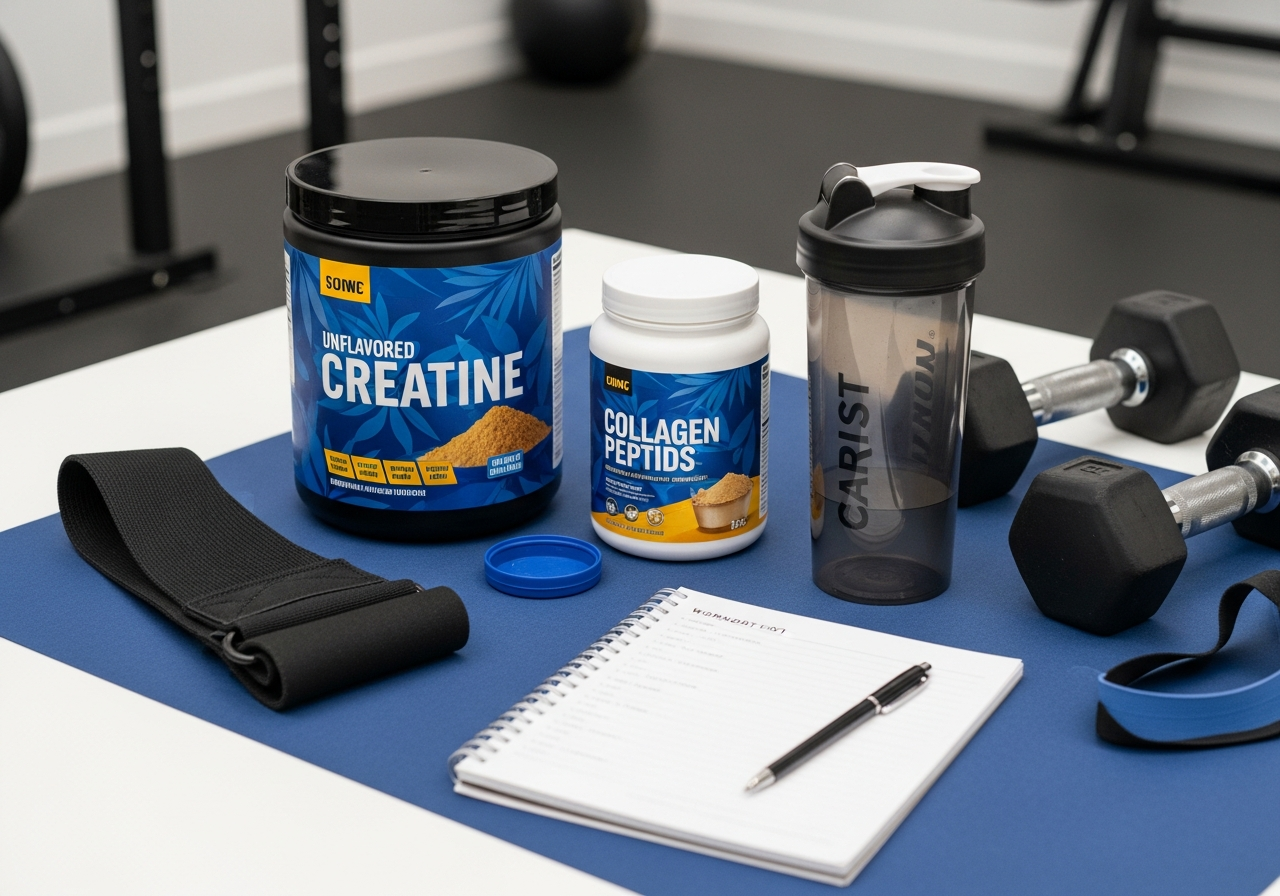
If your question is specifically creatine vs collagen for muscle, choose creatine first because collagen does not do the main job that drives muscle gain as well as creatine plus proper total protein intake.
Muscle growth depends on progressive resistance training, adequate total calories for the goal, sufficient total protein, and recovery. Creatine helps on the training side by improving high-intensity work capacity. That can mean more total reps, heavier repeat efforts, better sprint output, or greater ability to maintain quality across a session. Over time, that helps support lean mass gains.
Collagen, by contrast, is not generally the best protein to centre a muscle-building diet around. Its amino acid profile is skewed toward connective tissue needs rather than the amino acid balance most associated with maximally stimulating muscle protein synthesis. In plain English, collagen is not junk, but it is not your best muscle protein and it is not a replacement for creatine.
A practical hierarchy for muscle looks like this:
- Meet your daily protein needs from complete foods and complete proteins.
- Use creatine monohydrate daily.
- Add collagen only if you also have a connective tissue, joint, tendon, or skin reason to use it.
This matters for beginners because supplement marketing often blurs categories. A person who wants larger glutes, a better bench press, or more visible progress in the gym will usually get more value from plain creatine monohydrate than from collagen. A person rehabbing an irritated patellar tendon may reasonably care about collagen as part of a broader plan, but that is a different outcome.
Women, older adults, and vegetarian or vegan trainees can all benefit from creatine for muscle and performance. Creatine is especially interesting for people who eat little or no meat because baseline dietary creatine intake is lower, so the response can be more noticeable in some cases. For more on that, see creatine for women and creatine for older adults.
If your budget only allows one supplement for muscle, choose creatine over collagen nearly every time.
Can you take creatine and collagen together? Yes, and for some people it makes sense
Yes, you can take creatine and collagen together, and there is no known reason that normal doses of one would block the basic absorption or function of the other.
This is one of the most common search questions, and the short answer is simple: combining them is fine because creatine and collagen work through different pathways. Creatine helps saturate muscle stores of creatine and phosphocreatine. Collagen provides peptides and amino acids relevant to connective tissues. They are not redundant, and they do not need to be separated by hours to “work”.
A simple way to think about stacking them:
- Take creatine daily for saturation. Daily consistency matters more than precise timing.
- Take collagen when it best fits your routine. Some people place it near rehab or tendon-loading sessions, often with a source of vitamin C from food or a supplement.
- Keep expectations separate. Do not judge collagen by your squat numbers, and do not judge creatine by skin hydration or tendon comfort.
Good candidates to take both include:
- Lifters pushing hard in the gym who also have recurring tendon irritation.
- Older adults trying to maintain muscle and support connective tissues.
- Field and court sport athletes who need power but also take a lot of impact.
- People who care about gym performance and also want to experiment with skin or joint support.
One caution: taking both does not compensate for weak fundamentals. If your protein intake is low, sleep is poor, and training is inconsistent, adding more powders will not fix the base. Creatine is a strong evidence-based add-on, but it is still an add-on. Collagen is even more context-dependent.
If you want the cleanest possible stack, plain monohydrate plus plain collagen peptides is usually easier to evaluate than a proprietary blend. In Canada, look for clear labels, an NPN where applicable, and ideally third-party testing. You can compare plain options in our best creatine rankings and creatine brand reviews.
Exact dosing, timing, and body-weight examples for real people
For creatine, the evidence-based default is 3-5 g per day, every day, while collagen dosing is goal-specific and usually taken in gram-level amounts rather than tiny “proprietary blend” amounts.
Creatine dosing is straightforward because muscle saturation is the main target. You can either load or skip loading:
- Loading option: 20 g/day for 5-7 days, split into 4 doses of 5 g, then 3-5 g/day.
- No-loading option: 3-5 g/day from day one; full saturation takes longer, often around 3-4 weeks.
Body weight can help fine-tune, but most adults do well within that standard range. Larger athletes often sit at the upper end. If you want help personalising it, use the creatine dosage calculator and read how much creatine per day.
| Person | Main goal | Creatine plan | Collagen role |
|---|---|---|---|
| 60 kg beginner lifter | General strength and muscle | 3 g/day or load then 3 g/day | Optional unless joints/tendons or skin are a priority |
| 75 kg recreational athlete | Performance and lean mass | 3-5 g/day or load then 5 g/day | Optional for connective tissue support |
| 90+ kg strength athlete | Strength, repeated power output | 5 g/day or load then 5 g/day | May be useful if tendon stress is high |
| Older adult | Maintain muscle with training | 3-5 g/day consistently | May fit if joint comfort or connective tissue goals exist |
Timing matters less for creatine than consistency. Take it whenever you will remember it: with breakfast, after training, or on rest days with any meal. For a deeper timing breakdown, see when to take creatine and creatine on rest days.
For collagen, timing is less about muscle saturation and more about convenience or pairing with a connective tissue plan. Many people take it in coffee, a smoothie, yoghurt, or a shake. If you are using collagen with tendon rehab or joint-focused training, consistency and the rehab programme itself matter more than treating collagen like a pre-workout.
Bottom line on dose: creatine has a very clear, standardised evidence-based dosing pattern; collagen is more dependent on why you are using it.
What to expect week by week from creatine, and what not to expect from collagen
Creatine usually produces noticeable gym-related effects within days to weeks depending on whether you load, while collagen is typically a slower, less dramatic supplement whose results depend heavily on the specific tissue problem you are trying to influence.
With creatine loading, some people notice improved training performance, better repeat efforts, or a fuller muscle feel within the first week. Without loading, those changes more often show up after a few weeks as muscle stores gradually saturate. It is also common to see a modest scale increase early on from increased intracellular water, meaning water drawn into muscle cells, not body fat. If that topic concerns you, read does creatine make you gain weight.
A realistic creatine timeline:
- Days 1-7 with loading: Muscle stores rise quickly; some users notice gym performance and bodyweight changes.
- Weeks 2-4: Training quality may feel more consistent, especially on repeated hard sets or sprints.
- Weeks 4-12: The bigger payoff is cumulative if you are training hard and eating well.
How do you tell creatine is working? Look for practical signs:
- An extra rep at a given weight.
- Less drop-off across repeated sets.
- Better sprint or interval repeatability.
- A slight increase in body mass without a soft, fat-gain look.
Collagen is different. Most people will not feel an obvious “kick” from collagen. If collagen helps, it is usually judged over longer periods and against a specific outcome such as tendon comfort during rehab, joint tolerance to impact, or skin hydration/appearance. That makes it easier to overestimate or underestimate. If you start collagen and also change your training, rehab load, sleep, and diet, it is difficult to know what actually caused the improvement.
This is why creatine is easier to recommend as a first supplement: the outcome is clearer, the mechanism is clearer, and the evidence is stronger for common fitness goals. For more on timing expectations, see how long does creatine take to work.
Who should choose creatine, who should choose collagen, and who may benefit from both

Most gym-goers should choose creatine first, while collagen makes the most sense for people with a specific connective tissue, joint, tendon, or skin reason to use it.
Here is the practical decision tree:
- Beginners: Choose creatine first if you lift, sprint, play sport, or want better body-composition results from training. It is simpler, more proven, and easier to notice.
- Women: Creatine is highly relevant for strength, lean mass support, training quality, and healthy aging. Collagen may be added if joint comfort or skin is a priority, but it should not replace your protein basics. See creatine for women.
- Older adults: Creatine is especially useful when paired with resistance training because maintaining muscle and function matters with age. Collagen may be a secondary add-on for joint or connective tissue goals.
- Athletes: Team-sport, sprint, power, and repeated-effort athletes usually benefit more directly from creatine. The 2018 IOC consensus on dietary supplements recognises creatine as one of the few supplements with strong support for certain performance contexts.
- Rehab cases: If your physio or sports medicine team has you on a tendon-loading or connective tissue protocol, collagen may deserve more attention.
- Skin-focused users: Collagen may be reasonable if skin-related goals are your main priority, but that is outside creatine's primary job.
Vegetarians and vegans deserve a special note. Creatine is either absent or much lower in typical plant-based diets than in omnivorous diets, so supplementation can be particularly practical. Collagen, however, is animal-derived, so it will not fit vegan diets.
People who are training hard and also carrying old tendon aches often do well with a “both, but for different reasons” approach. Just keep your priorities honest. If you are mostly chasing hypertrophy, power, and progressive overload, creatine deserves the front seat.
For first-time users, our guides on creatine for beginners and how to take creatine walk through the basics step by step.
Safety, side effects, and the real cautions most people should know
Creatine monohydrate is well-studied and generally safe for healthy people at standard doses, while collagen is also generally well tolerated but is less often discussed with the same depth of sports-performance evidence.
The big creatine safety point is that myths often outrun evidence. The 2021 JISSN review addressed common misconceptions and did not support the idea that creatine causes dehydration, cramping, or kidney damage in healthy users at recommended doses. The Mayo Clinic overview also describes creatine as likely safe for up to several years when used appropriately.
Possible creatine side effects are usually practical rather than dramatic:
- Water weight gain: Often early and usually due to more water in muscle, not fat gain.
- Stomach upset: More likely if you take too much at once, use a poorly mixed dose, or load aggressively.
- Bloating sensation: Often reduced by splitting doses or choosing plain micronised monohydrate.
Collagen side effects are commonly mild, such as digestive discomfort or dislike of taste/texture, depending on the product. The bigger issue with collagen is not danger but overselling. People sometimes expect collagen to build muscle like creatine, rebuild cartilage quickly, or replace complete protein. Those are not reasonable expectations.
Who should be cautious with creatine? Anyone with known kidney disease, a complex medical condition, or medications that warrant medical review should speak with a qualified healthcare professional first. That is a caution, not an accusation that creatine is harmful. It is simply sensible screening. The same common-sense rule applies to collagen if you have ingredient sensitivities or require a specific dietary pattern.
If digestive issues are your concern, plain creatine monohydrate in divided doses is usually the best starting point. See creatine digestive side effects, is creatine safe, and creatine myths debunked for deeper myth-busting.
The biggest mistakes people make when comparing collagen and creatine
The biggest mistake is treating creatine and collagen as substitutes when they are designed for different outcomes and have very different evidence quality for performance and muscle.
Here are the most common myths and the straight answers:
- “Collagen builds muscle like creatine.” No. Collagen is not the better tool for improving high-intensity performance or lean mass gain from training.
- “Creatine is only for bodybuilders.” No. Creatine is relevant for beginners, women, older adults, recreational lifters, and many athletes.
- “You must cycle creatine.” No. Healthy users generally do not need to cycle creatine; daily use is standard. See do you need to cycle creatine.
- “Creatine makes you bloated and fat.” Not in the usual sense. Early weight gain is typically water held in muscle tissue, not fat mass.
- “Collagen replaces protein powder.” Not well for muscle-building purposes. Collagen can be part of total protein intake, but it should not be your main muscle-building protein strategy.
- “More is better.” Usually no. Extra-large creatine doses after saturation mostly increase the chance of stomach upset rather than results.
Another mistake is buying flashy forms of creatine instead of plain monohydrate. Monohydrate remains the reference form because it has the most research and is generally the most cost-effective. If a product claims “no water retention” or “better absorption” without convincing evidence, be sceptical. Our best creatine rankings and creatine brand reviews can help you filter marketing from substance.
Finally, do not judge a supplement outside its job description. If creatine does not improve your skin, that is not a failure. If collagen does not add 10 kg to your squat, that is not a failure either. The right question is whether each supplement moved the outcome it is actually supposed to target.
How to buy creatine or collagen smartly in Canada
In Canada, the safest buying strategy is to prioritise simple formulas, transparent labels, and products that comply with Health Canada requirements rather than paying extra for vague performance claims.
For creatine, the gold-standard purchase is usually plain creatine monohydrate with minimal added ingredients. If a product is sold as a natural health product in Canada, check for an NPN, which stands for Natural Product Number, on the label. An NPN indicates the product has been authorised by Health Canada for sale under the Natural and Non-prescription Health Products framework. It does not guarantee perfection, but it is an important legitimacy signal.
Also look for:
- Third-party testing where available.
- Clear dose per serving in grams, not a “matrix”.
- No unnecessary fillers if you just want creatine.
- Cost per 5 g serving, not just tub price.
For collagen, buying smart means first deciding why you want it. If your main reason is connective tissue support, choose a straightforward collagen peptide product with transparent grams per serving. If your main reason is skin, understand that product marketing is often stronger than the practical certainty of results.
| Buying factor | Creatine | Collagen |
|---|---|---|
| Best evidence-backed form | Monohydrate | Depends on product type; compare actual grams and source |
| Main label check | 5 g serving, monohydrate, NPN if applicable | Actual collagen grams, source, simplicity |
| What to avoid | Proprietary blends, underdosed gummies, hype forms | Tiny doses hidden in “beauty blends” |
| Best value lens | Cost per effective daily dose | Cost per meaningful serving for your goal |
If you are comparing options, start with our creatine product catalog, best creatine rankings, and creatine brand reviews. If you want the short version: plain monohydrate is still the smartest creatine buy for most Canadians.
Bottom line: which should you take first?
Take creatine first if your goal is muscle, strength, power, gym performance, or better training adaptation; take collagen first only if your main priority is connective tissue support, joint comfort, tendon-focused rehab, or skin-related goals.
If you are still torn between creatine vs collagen, use this simple rule:
- Want better workouts and more muscle-supporting training quality? Choose creatine.
- Want support for tendons, joints, or skin? Consider collagen.
- Want both sets of potential benefits and tolerate both well? You can take creatine and collagen together.
For the average person in a gym, creatine is the higher-priority buy because the evidence is stronger, the effect on performance is more direct, the dosing is clearer, and the return on cost is usually better. That is especially true if you lift weights, do repeated sprints, play power-based sports, or are trying to add lean mass over time.
Collagen is not useless. It is just more specialised. It is better viewed as a targeted supplement for connective tissue or skin-related goals, not as a replacement for creatine, a complete protein, or disciplined training.
If you want the simplest action plan:
- Buy plain creatine monohydrate.
- Take 3-5 g every day.
- Train hard and track performance for 4-8 weeks.
- Add collagen only if you have a genuine connective tissue, joint, tendon, or skin reason to test it.
That is the evidence-based answer to collagen or creatine for most active people: start with creatine, then layer collagen only if your goals justify it.
Creatine vs Collagen at a Glance
- 3-5 g/day Standard creatine maintenance dose — The evidence-based daily range used by most adults.
- 20 g/day Typical creatine loading dose — Usually split into 4 x 5 g doses for 5-7 days.
- 5-7 days Fastest common creatine loading timeline — Loading can speed up muscle saturation compared with starting at maintenance only.
- 3-4 weeks Approximate time to saturate without loading — Daily 3-5 g use generally works well even if you skip a loading phase.
Frequently Asked Questions
Is creatine better than collagen for muscle growth?
Yes, creatine is better than collagen for muscle-related goals because it directly supports high-intensity training capacity and has much stronger evidence for improving lean mass alongside resistance training. Collagen is not the best standalone protein for muscle growth and is better thought of as a connective tissue supplement.
Can I take creatine and collagen together?
Yes, you can take creatine and collagen together because they work through different mechanisms and are used for different goals. Creatine mainly supports muscle energy and performance, while collagen is mainly used for connective tissue or skin-related goals.
Collagen or creatine: which should I buy first?
Buy creatine first if you train and your main goal is strength, muscle, or performance. Buy collagen first only if your main priority is tendon, joint, connective tissue, or skin support and you understand it is not a replacement for creatine or complete protein.
Does collagen help build muscle like creatine?
No, collagen does not help build muscle like creatine. Collagen provides structural amino acids useful for connective tissues, but creatine is far more relevant for improving gym performance and supporting the training quality that drives muscle gain.
What are the benefits of taking creatine and collagen together?
The main benefit of taking creatine and collagen together is that you can target different tissues at the same time. Creatine may help training performance, strength, and lean mass support, while collagen may fit connective tissue, joint, tendon, or skin goals.
Should I take creatine or collagen for joint pain?
If joint or connective tissue support is your main goal, collagen is generally the more logical first choice than creatine. Creatine is excellent for muscle and performance, but it is not primarily used as a joint supplement.
Can women take both creatine and collagen?
Yes, women can take both creatine and collagen if both fit their goals. Creatine is useful for women interested in strength, training quality, lean mass support, and healthy aging, while collagen may be added for connective tissue or skin priorities.
When should I take creatine and collagen?
Take creatine whenever you can be consistent, because daily intake matters more than exact timing. Take collagen at whatever time best fits your routine or around a connective tissue-focused rehab plan if that is why you are using it.
Does creatine affect skin the way collagen does?
No, creatine is not primarily used for skin benefits the way collagen is marketed and used. Creatine's main purpose is to support muscle energy metabolism, repeated high-intensity performance, and lean mass gains with training.
Is creatine safer than collagen?
Creatine is not necessarily 'safer' so much as more thoroughly studied in sports nutrition, especially creatine monohydrate at standard doses in healthy people. Both are generally well tolerated, but creatine has a deeper evidence base for clear dosing, effects, and common misconceptions.