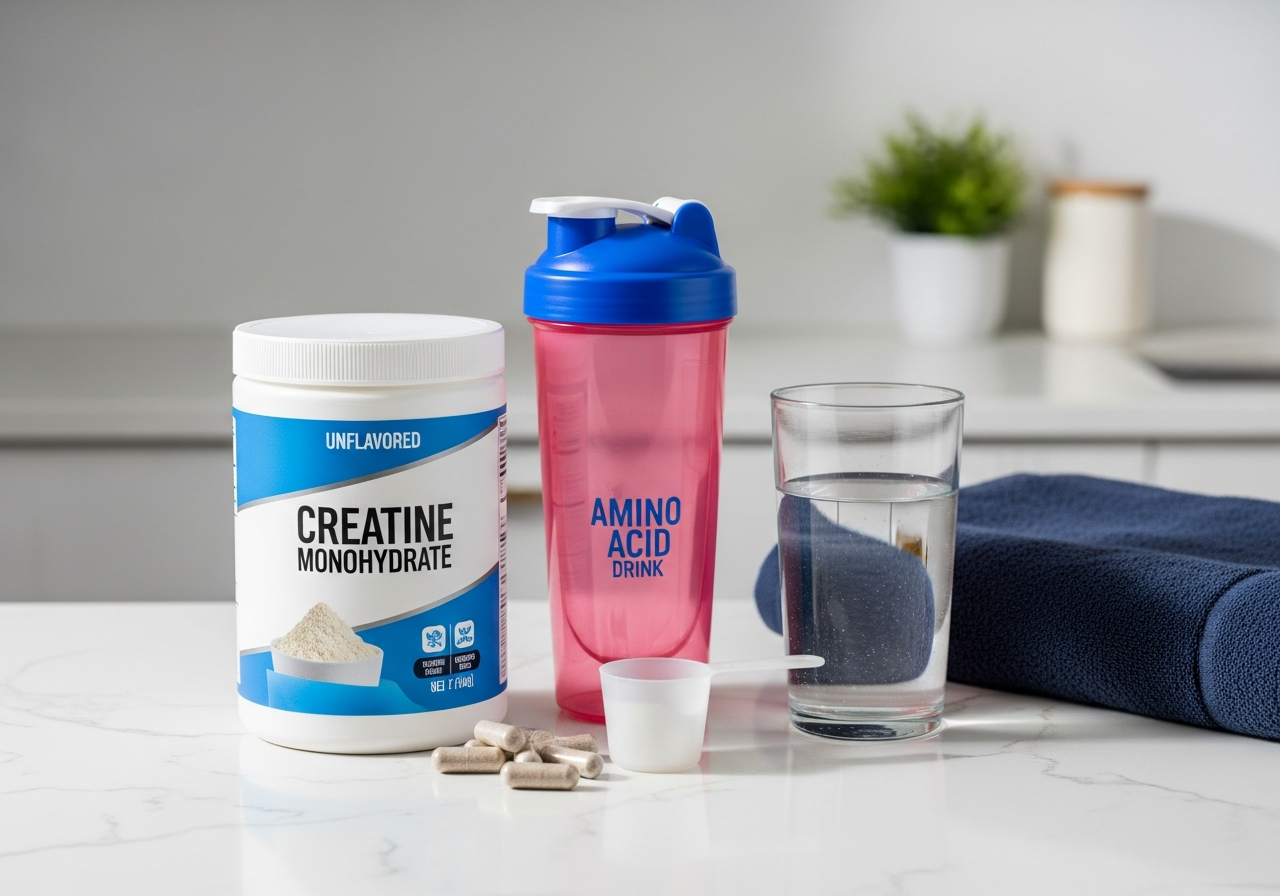
Creatine vs BCAAs: Which Supplement Is Worth Your Money?
By The Creatine Canada Research Team — Evidence-based supplement analysts
Creatine is usually the better buy than BCAAs for most people who want more muscle, strength, and training performance. If your diet already includes enough total protein, BCAAs add little, while creatine monohydrate has much stronger evidence for improving high-intensity performance, helping you train harder, and supporting long-term gains.
Evidence-based · Cites 4 sources · Editorial standards
Key Takeaways
- For muscle and strength, creatine beats BCAAs on evidence, reliability, and value.
- Creatine works by increasing muscle phosphocreatine stores; BCAAs are just three amino acids from protein.
- Most people do not need BCAAs if they already eat enough complete protein each day.
- A simple creatine dose is 3-5 g daily, every day, with or without workouts.
- BCAAs can make more sense only in narrow cases, such as fasted training or low-protein diets.
- You can take creatine and BCAAs together, but stacking them is usually unnecessary for most lifters.
- In Canada, choose plain creatine monohydrate with an NPN and preferably third-party testing.
Creatine vs BCAAs: the direct answer most people need
Creatine is the better supplement for most people deciding between creatine vs BCAAs. If your goal is to gain muscle, get stronger, improve repeated high-intensity performance, or make your training more productive over time, creatine monohydrate deserves the first dollars in your supplement budget.
The reason is simple: creatine and BCAAs do different jobs, and one job is far more broadly useful. Creatine helps regenerate ATP, the body’s immediate energy currency, during short, hard efforts. That means better support for sets of lifting, sprints, jumps, repeated intervals, and the training quality that drives adaptation. BCAAs, or branched-chain amino acids, are three amino acids: leucine, isoleucine, and valine. They are involved in muscle protein synthesis, but they do not provide all the essential amino acids needed to build new muscle tissue on their own.
So, are BCAAs or creatine better? For most gym-goers, creatine is better because it solves a more common bottleneck: high-energy output and training capacity. BCAAs are far less useful when total daily protein intake is already adequate from complete protein sources such as whey, meat, dairy, eggs, soy, or a well-planned mixed diet.
The 2017 ISSN position stand concluded that creatine monohydrate is the most effective nutritional supplement currently available for increasing high-intensity exercise capacity and lean body mass during training. That is a much stronger claim than can be made for BCAAs in well-fed lifters.
If you are choosing only one supplement, choose creatine monohydrate. If you want a deeper primer first, see what creatine is and what it does. If you want the practical short version, the beginner-friendly move is 3 to 5 g of creatine monohydrate daily, every day, and then focus the rest of your nutrition on total protein, calories, and consistent training.
The main exception is context. If you train fasted, struggle to hit protein targets, or cannot tolerate larger protein feedings around training, BCAAs may have a niche use. But for creatine vs bcaa for muscle, the stronger default answer is still creatine.
How creatine and BCAAs actually work in the body
Creatine and BCAAs work through completely different mechanisms, which is why comparing them properly matters. Creatine primarily affects energy availability during hard exercise, while BCAAs primarily relate to amino acid signalling and substrate supply.
Creatine is stored in muscle partly as phosphocreatine, a high-energy compound that helps rapidly regenerate ATP during short bursts of intense effort. When you do a heavy set of squats, a sprint, or repeated explosive efforts, ATP is used quickly. Higher phosphocreatine stores help restore ATP faster between contractions, which can let you squeeze out an extra rep, hold output a little longer, or recover slightly better between bouts. That small edge compounds across sessions and weeks into better training volume and, often, better strength and muscle gains.
BCAAs are leucine, isoleucine, and valine. Leucine is the most important of the three for triggering muscle protein synthesis, the process by which the body builds new muscle proteins. But muscle protein synthesis is not like turning on a light switch and getting a whole house powered. Leucine can help trigger the process, but you still need all the essential amino acids, not just three of them, to actually build tissue efficiently. That is why a complete protein source or an essential amino acid product generally makes more physiological sense than BCAAs alone.
This is the key mistake in the creatine or bcaa debate: people compare a proven performance supplement with an incomplete amino acid product and assume both are equally necessary for muscle growth. They are not. Creatine helps you perform and adapt better. BCAAs may contribute in narrow scenarios, but they do not replace adequate protein intake.
The 2021 JISSN review on creatine misconceptions reinforced that creatine’s benefits are well-established across performance and lean mass outcomes, particularly with creatine monohydrate. For a broader evidence overview, Examine’s creatine summary is also useful.
In plain English: creatine helps power the work that stimulates progress, while BCAAs may only matter if your diet is missing something. That is why creatine usually wins on both mechanism and real-world results.
Which is better for muscle, strength, recovery, and fat loss phases?
For muscle and strength, creatine is usually better than BCAAs, and for most people that remains true during both bulking and cutting phases. Creatine has stronger evidence for improving training quality, lean mass gains, and performance in repeated high-intensity work.
When people ask, “creatine vs bcaa for muscle,” they usually mean one of three things: which helps me grow more, which helps me recover better, and which is worth buying first. On all three, creatine is the default winner unless protein intake is poor.
- Muscle gain: Creatine supports more productive training and greater long-term lean mass gains when combined with resistance training.
- Strength and power: Creatine clearly outperforms BCAAs because its main mechanism directly supports ATP regeneration in short, hard efforts.
- Recovery: Creatine may help recovery indirectly by improving training tolerance and possibly reducing some exercise-induced stress markers, but it is not a magic recovery powder. BCAAs may reduce perceived soreness for some people, but the practical effect is often modest, especially when total protein is already high.
- Cutting or fat loss: Creatine is useful during a cut because preserving strength and training performance helps defend muscle. BCAAs are often marketed for cutting, but complete protein is a better foundation.
There is also a budget reality. If you can afford only one product beyond protein, creatine offers a clearer return. That is especially true for beginners, because beginners tend to get more from simply training consistently, eating enough protein, and using one well-supported supplement rather than collecting multiple weakly useful ones.
For recovery-focused readers, creatine does not replace sleep, food, or smart programming, but it can support the kind of repeated effort needed for progress. If that is your main goal, our guide on creatine for muscle recovery goes deeper. If your focus is pure hypertrophy, see does creatine build muscle.
The practical verdict is straightforward: creatine is not just “better than BCAAs” in the abstract; it is better for the outcomes most buyers actually care about.
Do you need BCAAs with creatine, or is that stack mostly marketing?
No, you do not need BCAAs with creatine if you already consume enough complete protein each day. Taking creatine and BCAAs together is generally safe for healthy adults, but for most lifters the stack is more optional than essential.
This question matters because many supplement labels bundle creatine with amino acids and imply synergy. There is nothing inherently wrong with combining them, but “can stack” is not the same as “should stack.” Creatine saturates muscle stores over time and works through daily use. BCAAs are simply amino acids that you probably already get from food and protein powder.
Here is when BCAAs may have a rational role alongside creatine:
- You regularly train fasted and do not want a full protein feeding beforehand.
- You struggle to meet protein targets because of appetite, travel, or digestive preferences.
- You follow a very low-protein diet, which should be fixed first.
- You prefer a flavoured intra-workout drink that helps you sip fluids and train longer, even if the amino acid benefit itself is limited.
Here is when BCAAs are usually unnecessary with creatine:
- You already eat enough daily protein from complete sources.
- You use whey, casein, soy isolate, or another complete protein around training.
- Your budget is limited and you need to prioritise what works best.
A better stack for most people is creatine plus adequate protein, not creatine plus BCAAs. If you want to pair supplements intelligently, plain creatine monohydrate with a complete protein source does more to cover both energy support and muscle-building nutrition. For example, 3 to 5 g of creatine daily plus enough total daily protein is a far stronger base than buying BCAAs and hoping for extra gains.
If you are deciding what to buy first, use our creatine dosage calculator and then compare products in the creatine product catalog. If your concern is stacking creatine with other powders, our guide on mixing creatine with protein powder is more relevant to real-world results than a BCAA stack is.
Bottom line: you can take BCAAs with creatine, but most people do not need to.
Exactly how much to take, when to take it, and what to expect
For creatine, the standard evidence-based dose is 3 to 5 g daily, while BCAA dosing is far less essential and much more context-dependent. If you want the simplest plan that works, take 3 to 5 g of creatine monohydrate every day and do not overthink timing.
Creatine dosing has two common approaches. A loading phase means about 20 g per day split into 4 doses of 5 g for 5 to 7 days, followed by 3 to 5 g per day. This saturates muscle stores faster. The no-loading option is simply 3 to 5 g daily from day one, which typically reaches similar saturation in about 3 to 4 weeks. If you want full details, see the creatine loading phase guide and how long creatine takes to work.
BCAAs, when used, are commonly taken around workouts rather than as a daily saturation supplement. But again, if your meals already provide enough protein, the added value may be minimal.
| Goal or situation | Creatine plan | BCAA plan | Best practical choice |
|---|---|---|---|
| Beginner wanting muscle and strength | 3-5 g daily | Usually unnecessary | Creatine only |
| Need faster saturation | 20 g/day split into 4 doses for 5-7 days, then 3-5 g/day | Optional only | Creatine loading |
| Cutting phase | 3-5 g daily | Only if protein intake is poor or training fasted | Creatine plus full protein intake |
| Fasted morning training | 3-5 g daily, any time | May be used around training | Creatine, and consider complete protein first |
| Vegetarian or vegan athlete | 3-5 g daily; often especially worthwhile | Usually unnecessary if protein is adequate | Creatine is high priority |
By body size, larger athletes often sit comfortably at the upper end of the 3 to 5 g daily range, but the mainstream recommendation is still the same range for most adults. If you want more personalised guidance, read how much creatine per day.
As for timing, consistency matters more than the exact minute. Take creatine whenever you will remember it. On rest days, still take it. BCAAs, if used, are usually taken before, during, or after training rather than at random times.
A simple step-by-step plan: which supplement should you actually buy first?
If you are choosing between creatine or BCAA and want a practical answer today, buy creatine first unless you have a specific protein-intake problem. The easiest path is to fix the basics in order: protein, calories, training, sleep, then creatine.
- Check your protein intake. If you already eat enough complete protein daily, BCAAs move way down the priority list. If you do not, spend money on food or protein powder before BCAAs.
- Choose plain creatine monohydrate. It is the most studied and usually the best value. Fancy forms rarely outperform it in a meaningful way.
- Take 3 to 5 g every day. Mix it with water, juice, or a shake. If you miss a day, just resume the next day.
- Train hard enough to benefit. Creatine is most useful when your training includes resistance work, sprints, or repeated hard intervals.
- Track a few signs it is working. Look for slightly better reps, better repeat effort, improved gym volume, and sometimes a small early increase in body weight from intracellular water.
- Only consider BCAAs if a real need exists. Good examples are fasted training, low appetite, or difficulty eating complete protein around sessions.
For a Canadian buyer, also check the label quality. Look for a Natural Product Number, or NPN, which is a Health Canada identifier for licensed natural health products. An NPN does not automatically prove elite quality, but it is a useful baseline for compliant Canadian retail products. Third-party testing is another plus when available. If you are comparing options, start with our best creatine rankings and creatine brand reviews.
If you are a complete beginner, do not let supplement marketing make this feel complicated. A tub of monohydrate plus a consistent routine beats a shelf full of niche products. If you need a step-by-step beginner walkthrough, read creatine for beginners and how to take creatine.
The best “stack” for most people is boring but effective: creatine, sufficient protein, hard training, and patience for a few weeks.
Who should choose creatine, who might still use BCAAs, and who needs extra caution
Creatine is appropriate for far more people than BCAAs, especially beginners, women, older adults, vegetarians, and athletes doing strength or repeated high-intensity work. BCAAs have narrower use cases and are rarely a first-priority supplement in a well-fed adult.
Beginners: Creatine is usually the best first supplement because it is simple, affordable, and well-supported. Beginners gain more from improving training quality than from sipping isolated amino acids.
Women: Creatine works for women too, and the common fear that it automatically causes bulky fat gain is mistaken. It may increase intracellular water and help support training quality and lean mass. For women comparing creatine vs bcaa, the same rule applies: if protein intake is already adequate, creatine usually adds more value.
Older adults: Creatine can be especially useful when paired with resistance training because preserving strength and lean mass matters more with age. BCAAs alone are not a substitute for adequate total protein and structured resistance exercise.
Vegetarians and vegans: Creatine often deserves even higher priority because dietary creatine intake is lower when you do not eat meat or fish. Plant-based athletes may notice solid benefits from supplementation when training hard.
Power and team-sport athletes: Creatine is particularly relevant for sports with repeated sprints, jumps, accelerations, collisions, or explosive efforts. The 2018 IOC consensus on dietary supplements recognised creatine as one of the better-supported sport supplements.
Endurance athletes: Creatine can still help some endurance athletes, particularly those who need sprint finishes, hill surges, or gym support work, though body-mass changes may matter in certain events. BCAAs are not automatically superior just because the sport is endurance-based.
Who needs caution: People with kidney disease, major medical conditions, pregnancy or breastfeeding considerations, or those advised by a clinician to restrict certain supplements should speak with a qualified healthcare professional first. Healthy adults generally tolerate creatine well, but personalised caution is still sensible.
In short, creatine has the wider audience and clearer upside. BCAAs are more niche, not more advanced.
Safety, side effects, and the concerns people mix up with this comparison
Creatine is one of the most studied sports supplements and is generally considered safe for healthy adults when used at recommended doses, while BCAAs are also generally well tolerated but often less useful. The bigger issue in this comparison is not danger; it is whether you are paying for something that meaningfully helps.
According to the ISSN position stand and the Mayo Clinic overview, creatine monohydrate is generally safe for healthy individuals at standard dosages. Common annoyances, when they occur, are usually digestive and are more likely with large single doses, poor mixing, or aggressive loading. Splitting doses or using a daily 3 to 5 g plan often solves that.
What to expect with creatine:
- A small early increase in scale weight is common because creatine draws more water into muscle cells.
- This is not the same as gaining body fat.
- Some people notice mild stomach upset if they take too much at once.
- It does not need to be cycled in healthy adults.
What BCAAs may cause:
- Usually very little besides the cost and a flavoured drink experience.
- Occasionally digestive upset or taste fatigue with heavily sweetened formulas.
- Potential confusion that they “cover” protein needs when they do not.
One reason BCAAs stay popular is that they feel sporty: colourful drink, training ritual, sweet intra-workout taste. There is nothing wrong with that, but ritual is not results. Creatine may feel less exciting, yet it usually offers more measurable return.
If safety myths are holding you back, see creatine myths debunked plus our deeper guides on creatine safety, digestive side effects, and creatine weight gain. Most concerns become much less scary once you separate water retention, creatinine lab confusion, and internet myth from actual evidence.
The biggest mistakes people make with creatine vs BCAA
The biggest mistake in the creatine vs BCAA debate is treating them like interchangeable muscle builders when they do different things and one is usually much more useful. Most wasted supplement money comes from poor prioritisation, not from choosing a slightly imperfect product.
Mistake 1: Buying BCAAs before fixing total protein. If your diet lacks enough complete protein, BCAAs are a partial patch at best. Food or protein powder should come first.
Mistake 2: Expecting creatine to work like a stimulant. Creatine does not feel like caffeine. It works by saturating muscle over days to weeks, not by creating an instant buzz.
Mistake 3: Judging creatine after only a few days without loading. If you use 3 to 5 g per day without a loading phase, it commonly takes around 3 to 4 weeks to fully saturate muscle stores.
Mistake 4: Thinking BCAAs are required to prevent all muscle breakdown. Training adaptation depends heavily on total protein, energy intake, programme quality, and recovery, not just sipping amino acids during a workout.
Mistake 5: Paying extra for trendy creatine forms or flashy blends. Monohydrate remains the benchmark because it is the most studied and usually the most cost-effective.
Mistake 6: Confusing water gain with bloating or fat gain. Creatine often increases intracellular water, which can make muscles feel fuller. That is not the same as getting softer or fatter.
Mistake 7: Using BCAAs as a hydration product. If your real problem is fluid and electrolyte intake, BCAAs are not the main solution.
The cleanest way to avoid these mistakes is to ask one question before buying anything: what actual problem am I trying to solve? If the answer is strength, power, muscle gain, or preserving training performance during a cut, creatine is usually the answer. If the answer is “I do not hit my protein target,” then the answer is better protein intake, not automatically BCAAs.
This is why the phrase “do you need BCAAs with creatine” usually has a short answer: no, not if the basics are already handled.
Buying creatine in Canada: what to look for, what to ignore, and where value usually is
In Canada, the smartest buy is usually plain creatine monohydrate with a clear ingredient list, an NPN, and preferably some form of third-party quality assurance. You do not need a heavily branded BCAA blend to get results, and in many cases you do not need BCAAs at all.
Start with the label. A Natural Product Number, or NPN, indicates the product is licensed by Health Canada as a natural health product. That is a useful compliance signal for Canadian shoppers. It is not the only thing that matters, but it helps separate standard retail products from sketchier listings. Next, look at the ingredient panel. The best creatine products are often the simplest: creatine monohydrate and little else.
What to prioritise when shopping:
- Form: Creatine monohydrate first.
- Simplicity: Fewer filler ingredients are usually better.
- Dose transparency: Easy to measure 3 to 5 g servings.
- Quality signals: NPN, reputable manufacturing, and third-party testing where available.
- Cost per effective dose: Compare price by grams of creatine, not by marketing language.
What to be sceptical of:
- “Proprietary blends” that hide exact amounts.
- Expensive creatine alternatives claiming superior absorption without strong proof.
- BCAA products pitched as mandatory for muscle growth even when your diet is already protein-rich.
- Mega-dose tubs with tiny scoops that make accurate daily dosing awkward.
If you are shopping right now, compare options through our best creatine rankings, browse the product catalog, or use brand reviews to spot differences in purity, flavouring, and value. If you are unsure whether a fancy formula is worth it, our guide on the best type of creatine will usually steer you back to monohydrate.
The Canadian buyer’s bottom line is very simple: spend first on the product with the best evidence, the clearest label, and the lowest cost per proven dose. In this matchup, that is usually creatine monohydrate, not BCAAs.
Bottom line: which supplement is worth your money?
Creatine is worth your money more often than BCAAs because it has stronger evidence, broader usefulness, and a clearer payoff for muscle, strength, and performance. If you are choosing just one, choose creatine monohydrate.
Here is the shortest honest answer to “are BCAAs or creatine better?” Creatine is better for most people who lift weights, do team sports, sprint, perform HIIT, or want to preserve muscle and training quality during a cut. BCAAs are mostly optional when total daily protein intake is already adequate.
If you want a practical decision tree, use this:
- Want more strength, power, and gym progress? Take creatine.
- Already eat enough protein? Skip BCAAs.
- Train fasted or rarely hit protein targets? Consider complete protein first, then BCAAs only if needed.
- On a budget? Creatine gives better return per dollar.
The best real-world setup for most readers is boring in the best way: a good training plan, enough total daily protein, enough calories for your goal, and 3 to 5 g of creatine monohydrate every day. If you do that consistently for several weeks, you have covered the supplement choice that matters more in this comparison.
If you want to keep learning, the most useful next reads are how much creatine per day, when to take creatine, best creatine monohydrate in Canada, and creatine vs EAAs.
Final verdict: for nearly everyone asking “creatine or bcaa,” creatine earns the spot, and BCAAs are a maybe, not a must.
Creatine vs BCAAs at a glance
- 3-5 g/day Standard creatine maintenance dose — Evidence-based daily amount for most healthy adults.
- 20 g/day Typical loading protocol — Usually split into 4 doses for 5-7 days.
- 3-4 weeks Time to saturate without loading — Approximate timeline at 3-5 g/day.
- 3 amino acids What BCAAs actually are — Leucine, isoleucine, and valine; not a complete protein.
Frequently Asked Questions
Is creatine better than BCAAs for building muscle?
Yes, creatine is usually better than BCAAs for building muscle because it has stronger evidence for improving training performance and supporting lean mass gains over time. BCAAs may help only in narrower situations, especially if protein intake is low, but they do not replace complete protein or match creatine’s overall usefulness.
Do you need BCAAs if you take creatine?
No, most people do not need BCAAs if they take creatine and already eat enough complete protein each day. Creatine and BCAAs can be taken together, but in a protein-adequate diet the extra benefit from BCAAs is often small or negligible.
Can I take creatine and BCAAs together?
Yes, you can take creatine and BCAAs together, and there is no inherent problem with combining them for healthy adults. The better question is whether you need both, and for most people the answer is no if total protein intake is already solid.
Are BCAAs or creatine better for recovery?
Creatine is usually the more worthwhile choice overall, although BCAAs may slightly help perceived soreness for some users. In practice, recovery depends much more on sleep, calories, and total protein than on BCAAs, while creatine can help you maintain training output and recover between hard efforts.
Should beginners choose creatine or BCAAs first?
Beginners should usually choose creatine first because it is more evidence-based, simpler to use, and more likely to improve gym performance. BCAAs are lower priority unless a beginner regularly trains fasted or struggles badly to consume enough protein.
Is creatine or BCAA better during a cut?
Creatine is usually better during a cut because preserving strength and training performance helps protect muscle mass. BCAAs are often marketed for cutting, but if protein intake is already adequate, they usually add less value than creatine does.
When should I take creatine vs BCAAs?
Creatine should be taken daily whenever you will remember it, because consistency matters more than exact timing. BCAAs, if used at all, are usually taken before, during, or after training rather than as a daily saturation supplement.
Do BCAAs make creatine work better?
No, BCAAs do not meaningfully make creatine work better in most people. Creatine works by increasing muscle phosphocreatine stores over time, while BCAAs are amino acids whose usefulness depends largely on whether your overall protein intake is lacking.
What if I already use whey protein?
If you already use whey protein, BCAAs are usually even less necessary because whey is a complete protein rich in essential amino acids and naturally contains BCAAs. In that setup, adding creatine is generally a smarter move than adding a separate BCAA product.
Is creatine worth it if I do not work out fasted?
Yes, creatine is still worth it if you do not work out fasted because its main benefits come from saturating muscle stores and improving repeated high-intensity performance. Fasted status matters far more to the limited use case for BCAAs than it does to creatine.