Creatine Morning vs. Night: Does Timing Around Sleep Actually Matter?
By The Creatine Canada Research Team — Evidence-based supplement analysts
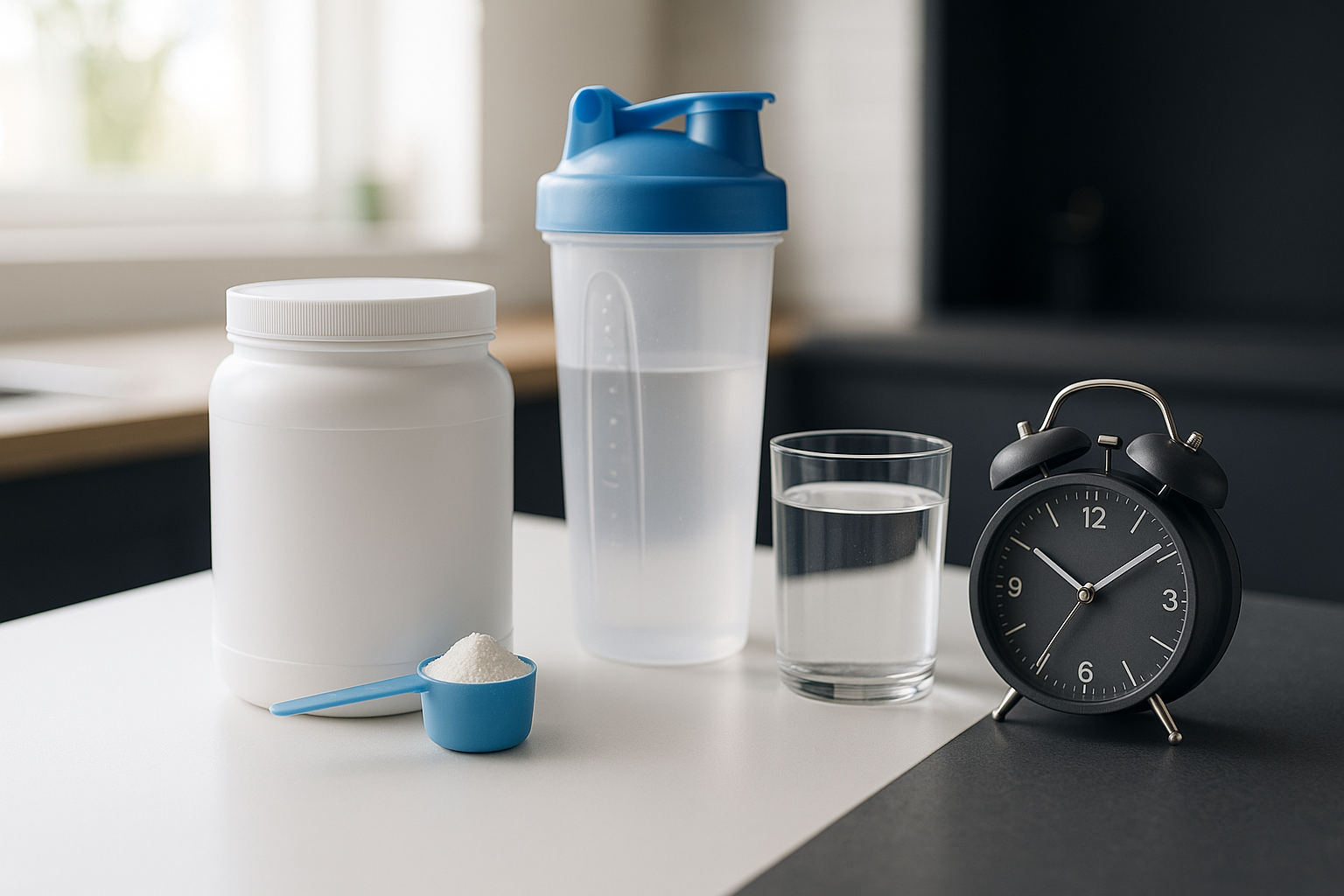
Creatine morning vs night matters far less than taking creatine every day. For most people, the best time to take creatine is simply the time you will remember consistently, because muscle creatine saturation builds over days and weeks rather than hinging on a narrow morning or bedtime window.
Evidence-based · Cites 4 sources · Editorial standards
Key Takeaways
- Morning or night both work; daily consistency beats clock time.
- The standard maintenance dose is 3-5 g of creatine monohydrate per day.
- A loading phase of 20 g/day split into 4 doses for 5-7 days saturates muscles faster, but it is optional.
- Creatine does not act like a stimulant, so taking it at night does not directly 'give energy' the way caffeine can.
- If creatine upsets your stomach before bed, move it earlier or take it with food.
- Post-workout timing may offer a small practical advantage for some people, but the evidence does not show a major morning-versus-evening effect.
- Beginners, women, older adults, and athletes can all use the same timing rule: pick the easiest repeatable time and stick to it.
Creatine morning vs. night: the direct answer most people need
Creatine morning vs night is not a major performance variable; taking it consistently every day matters much more than whether you use it in the morning, evening, or before bed. That is the practical answer for almost everyone asking when to take creatine morning or night.
Creatine works by gradually increasing your muscle stores of creatine and phosphocreatine, the stored high-energy compound used to help regenerate ATP, your cells' immediate energy currency, during short, hard efforts. Because this process depends on saturation, meaning how full your muscles are with creatine over time, there is no strong evidence that a precise AM or PM schedule dramatically changes results.
The 2017 ISSN position stand concluded that creatine monohydrate is the most effective ergogenic nutritional supplement currently available for increasing high-intensity exercise capacity and lean body mass during training. Just as importantly for the timing question, that body of evidence supports regular daily intake rather than a magic clock-based window. If you want a fuller overview of the basics, start with what creatine is and what it does.
So should you take creatine in the morning? Yes, if mornings are easiest. Can you take creatine at night time? Also yes, if evenings fit your routine better. Can you take creatine before bed vs morning? Yes again, provided it does not bother your stomach or become a habit you forget.
- Take it in the morning if you already have a breakfast or coffee routine.
- Take it at night if you reliably remember supplements with dinner or a bedtime shake.
- Take it after training if attaching it to workouts improves consistency.
- Take it on rest days too, because muscle saturation is maintained by daily intake, not only workout-day use.
For most people, the best time to take creatine morning or night is the time that becomes automatic. If you miss doses because you are chasing a theoretically perfect schedule, you are losing more than you could ever gain from a tiny timing difference.
If you want the simple version: choose one daily anchor habit, use plain monohydrate, and hit your 3-5 g every day.
Why timing matters less than saturation: how creatine actually works in your body
Creatine timing matters less than daily intake because creatine is a saturation supplement, not an acute stimulant. In plain English, it works by filling up muscle stores over time rather than by producing an immediate 'kick' at the moment you take it.
Your body stores most creatine in skeletal muscle, where some of it exists as phosphocreatine. During very short, intense efforts such as heavy sets, jumps, sprints, or repeated intervals, phosphocreatine donates a phosphate group to help rebuild ATP. That ATP regeneration is one reason creatine can improve performance in repeated high-intensity efforts and support better training quality over time.
This is the key morning-or-evening point: the scoop you take at 8 a.m. is not only helping your 9 a.m. workout, and the scoop you take at 9 p.m. is not only helping you overnight. The real effect comes from keeping total muscle creatine stores elevated day after day. Once stores are topped up, the body draws on that bigger reservoir whenever needed.
That is why creatine AM or PM is mostly a scheduling question, not a physiology deal-breaker. Some nutrient timing topics, like caffeine before training, are highly time-sensitive because the effect is acute. Creatine is different. As Kreider et al. (2017), ISSN Position Stand: Safety and Efficacy of Creatine — JISSN and Antonio et al. (2021), Common questions and misconceptions about creatine supplementation — JISSN both reinforce, the established benefit is from regular use.
There are still a few timing-related nuances worth knowing:
- Taking creatine near meals may help some people remember it and reduce stomach upset.
- Taking creatine near training may be practical because it becomes part of your workout routine.
- Taking creatine late at night is fine for most people, but a large fluid intake right before bed can wake some people to urinate.
If you think of creatine like charging a battery, the exact minute you plug it in matters less than whether you keep it charged. That is also why missed single doses are rarely catastrophic, and why loading can speed results but is not mandatory. For more on the day-to-day protocol, see how to take creatine step by step and when to take creatine.
Morning or evening? What the research actually suggests, without overclaiming
The best reading of the evidence is that morning vs. night creatine timing probably has little effect for most people, while total daily intake and training consistency drive the meaningful outcomes.
This is where many articles oversimplify. You may see claims that morning is best because metabolism is 'primed', or that night is best because recovery happens during sleep. Those ideas sound plausible, but they are not strongly established by the creatine literature. The evidence base for creatine is very strong overall, yet the evidence for a major AM-versus-PM advantage is much weaker.
Some studies and reviews have explored whether taking creatine closer to exercise, particularly post-workout, could offer a slight edge. That is a different question from creatine before bed vs morning. Even there, any advantage appears small at best compared with the larger effect of simply getting muscles saturated. If workout-adjacent timing helps you remember the dose or stack it with protein and carbs, great. If not, do not force it.
Here is the evidence-grounded way to think about it:
- Strong evidence: creatine monohydrate improves high-intensity exercise capacity and supports lean mass gains with resistance training when taken consistently.
- Moderate practical evidence: taking creatine around training may be convenient and may help adherence.
- Weak or limited evidence: a large, reliable benefit of morning over evening, or evening over morning.
If you train early, taking creatine in the morning with breakfast or your pre/post-workout shake is sensible. If you train after work, taking creatine in the evening with dinner or a shake is equally sensible. If you are asking, 'best time to take creatine morning or night?' the honest answer is that the best time is whichever slot you consistently hit seven days per week.
People sometimes interpret small changes in how they feel as proof that one timing is superior. Be careful there. Creatine does not usually create an immediate noticeable sensation after a single dose. What you are more likely to notice after days or weeks is slightly better repeat power, better training volume, a fuller muscle look, or a small increase in scale weight from intracellular water. If you want realistic expectations, see how long creatine takes to work.
Bottom line: the literature supports creatine; it does not strongly support obsessing over clock time.
The best time to take creatine depends on your routine, not the clock
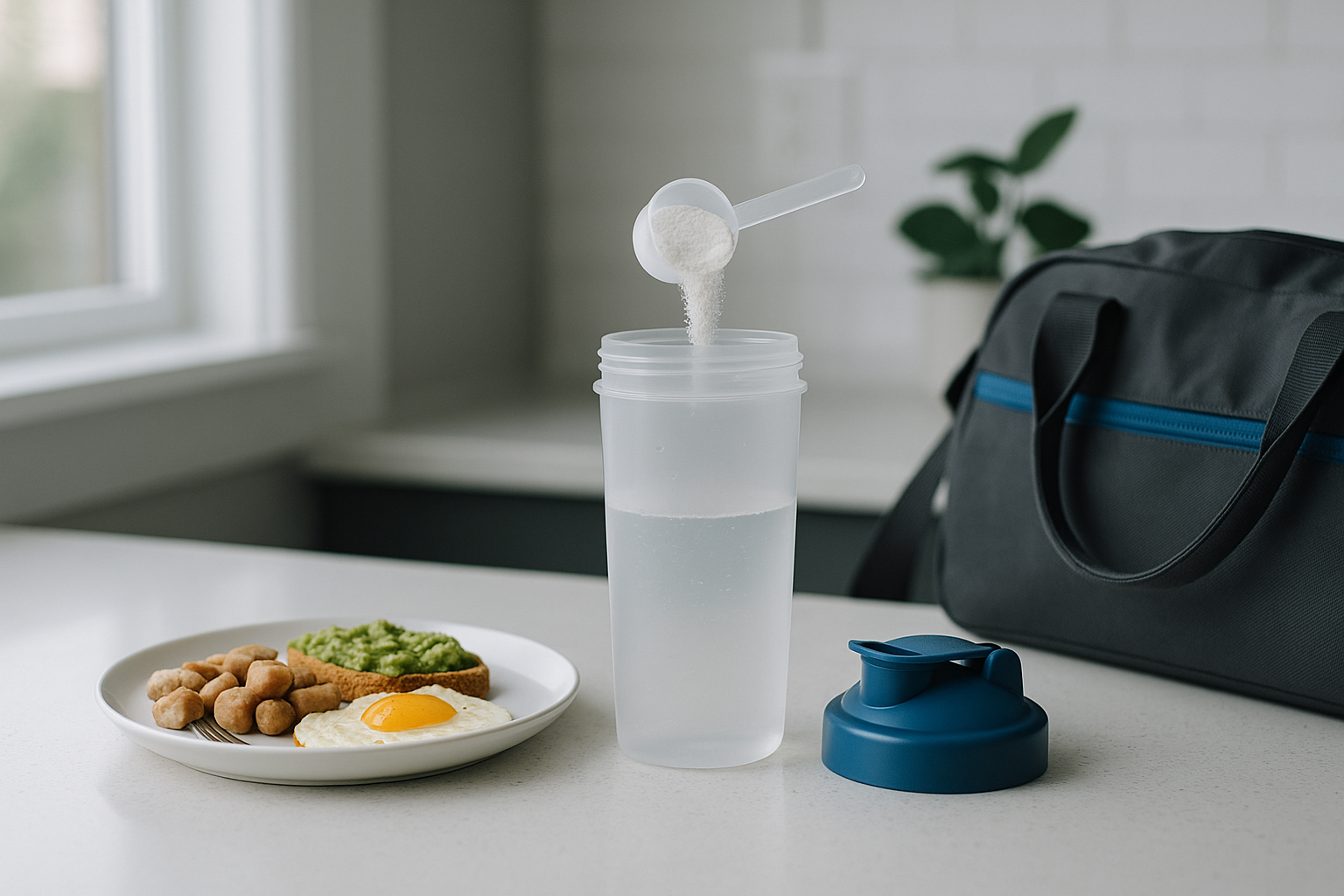
The best time to take creatine morning or night is the time that fits your routine so well that you stop needing to think about it. That sounds simple because it is.
Instead of asking whether creatine morning or evening is superior in theory, ask which of these routines you can execute for months:
- Breakfast routine: mix 3-5 g into water, a smoothie, oats, yoghurt, or a protein shake right after waking.
- Post-workout routine: add 3-5 g to your post-training shake or recovery meal.
- Dinner routine: stir 3-5 g into water or take it with your evening meal.
- Before-bed routine: take 3-5 g one to two hours before sleep if late-night fluids do not disrupt you.
Here is how to choose:
- Choose morning if you are forgetful later in the day or like stacking supplements early.
- Choose evening if mornings are rushed and dinner is your most consistent meal.
- Choose pre- or post-workout if training is your strongest habit anchor.
- Choose any meal if taking creatine on an empty stomach bothers you.
There is no rule saying creatine has to be tied to exercise. On rest days, keep the same habit. If your weekday schedule changes a lot, use a universal anchor such as brushing your teeth, packing your lunch, or making your daily shake. The goal is to remove decision-making.
Many people also do best with the simplest product: plain creatine monohydrate. It is the most studied and usually the most cost-effective form. If you are comparing options, our best creatine rankings, creatine brand reviews, and creatine product catalog can help narrow your shortlist.
In Canada, also check for clear labelling and, where relevant, a Natural Product Number, or NPN, which is the Health Canada identifier used on licensed natural health products. Competitive athletes may want third-party tested options to reduce contamination risk.
If you want the shortest recommendation possible, it is this: take creatine whenever you are least likely to skip it.
Exact dosing: how much creatine to take by body weight and goal
For nearly all adults, 3-5 g of creatine monohydrate per day is the standard maintenance dose, and a loading phase of 20 g/day split into 4 doses for 5-7 days is optional if you want faster saturation.
The dosing question matters more than the morning-vs-night question, because underdosing or inconsistent dosing can slow or blunt results. Creatine is usually dosed in one of two ways:
- Standard daily method: 3-5 g once daily, every day.
- Loading method: 20 g/day split into four 5 g doses for 5-7 days, then 3-5 g/day.
Body weight can help fine-tune the dose, especially for larger athletes, but most people do well within the standard range. If you want a calculator, use our creatine dosage calculator or read how much creatine per day.
| Body weight | Simple daily dose | Optional loading approach | Best for |
|---|---|---|---|
| Under 60 kg | 3 g/day | 20 g/day split into 4 doses for 5-7 days, then 3 g/day | Smaller adults, lower body mass |
| 60-90 kg | 3-5 g/day | 20 g/day split into 4 doses for 5-7 days, then 3-5 g/day | Most gym-goers |
| Over 90 kg | 5 g/day | 20 g/day split into 4 doses for 5-7 days, then 5 g/day | Larger lifters and field athletes |
Goal also matters:
- Strength and muscle gain: 3-5 g/day, optionally loaded for faster results.
- General fitness or healthy aging: 3-5 g/day is still appropriate.
- Vegetarians or vegans: the same dosing works, but benefits may feel more noticeable because baseline stores can be lower.
A common mistake is taking only workout-day doses. That is not the ideal protocol. Creatine should be taken on training days and rest days alike to keep muscle stores elevated. Another common mistake is underdosing with gummy or capsule products because the serving size looks convenient but supplies less total creatine than expected.
If you are deciding between one scoop in the morning or one scoop at night, focus first on whether that scoop actually contains your full intended dose. Accurate measurement matters more than timing.
A simple step-by-step plan you can start today
If you want the easiest creatine protocol, take 3-5 g of creatine monohydrate once daily at the same general time, with enough fluid to comfortably swallow it, and continue on both training and rest days.
Here is the most beginner-friendly system:
- Buy plain creatine monohydrate. It has the strongest evidence and is usually the best value per gram.
- Choose a daily anchor. Pick breakfast, post-workout, dinner, or before bed.
- Measure your dose. Use a scoop that matches the label or a scale for accuracy.
- Mix it in water or a shake. It does not need a fancy transport system to work.
- Take it every day. Weekends and rest days count.
- Stay reasonably hydrated. You do not need extreme water loading, just normal adequate fluid intake.
- Track for 4-8 weeks. Monitor body weight, gym performance, and training quality.
If you want faster saturation, add an optional loading phase:
- Take 5 g four times per day for 5-7 days.
- Space doses across meals to reduce stomach upset.
- Then drop to 3-5 g/day for maintenance.
Week-by-week, here is what many people notice:
- Week 1 with loading: possible slight scale increase from intracellular water and fuller muscles.
- Weeks 2-4: better repeat efforts, slightly stronger sets, improved training volume.
- Weeks 4-8: more noticeable performance carryover if training and nutrition are in place.
How do you know it is working? Look for:
- an extra rep on working sets
- slightly less drop-off across repeated sprints or intervals
- improved training volume at the same effort
- a modest increase in body weight that is not fat gain
If nothing changes after several weeks, the issue is usually not that you chose creatine morning or evening. The more likely reasons are inconsistent intake, too low a dose, unrealistic expectations, or training that does not challenge the phosphocreatine system much. For troubleshooting, see why creatine may seem not to be working.
Consistency, correct dose, and enough training intensity will beat timing hacks every time.
Creatine before bed vs. morning: does nighttime use affect sleep?
Creatine before bed is generally fine for most people and is not a stimulant, so it should not directly disrupt sleep in the way caffeine can. That is the short answer to the creatine night time question.
Creatine does not work by raising heart rate or triggering the central nervous system the way typical pre-workout ingredients do. It supports cellular energy buffering. So if you are deciding between creatine before bed vs morning because you are worried about being 'too energised', that concern is usually misplaced.
That said, bedtime use is not perfect for everyone. There are a few practical reasons some people prefer earlier timing:
- Large late fluid intake can wake you up to urinate.
- Taking it on a very full stomach may feel uncomfortable right before lying down.
- Some people mistake a flavoured pre-workout or stimulant blend for plain creatine; the issue is often the other ingredients, not creatine itself.
If you want to take creatine at night, use these simple rules:
- Use plain creatine monohydrate, not a caffeinated pre-workout containing creatine.
- Take it 1-2 hours before bed if you are sensitive to late fluids.
- Mix it with a moderate amount of water rather than a huge shaker if overnight bathroom trips are a problem.
- Take it with dinner or an evening snack if you get stomach upset on an empty stomach.
There is also some emerging interest in creatine and sleep-related resilience under sleep deprivation, particularly in cognitive contexts, but that is separate from whether bedtime dosing improves sleep itself. The established guidance remains straightforward: creatine is primarily a performance and muscle-saturation supplement, and there is no strong evidence that nighttime dosing is superior for recovery simply because you sleep afterwards.
If sleep quality is already fragile, the safest move is not to avoid creatine altogether; it is to avoid unnecessary bedtime variables. In that case, morning may feel cleaner. If sleep is normal and evening is the easiest routine, creatine PM is perfectly reasonable. For deeper context, see our guide on taking creatine before bed and our guide on creatine and sleep.
What timing makes the most sense for beginners, women, older adults, and athletes
Different groups do not usually need different creatine timing physiology, but they may benefit from different routines that improve adherence and comfort.
Beginners: Morning is often easiest because it reduces missed doses. New supplement users tend to do best when creatine is attached to an existing habit like breakfast or a protein shake. If you are new, read creatine for beginners.
Women: Women can use the same evidence-based dosing and timing as men. There is no rule that women need a special nighttime or daytime protocol. In practice, many women prefer taking it with a meal to avoid stomach upset and to make the habit effortless. For the broader topic, see our guide to creatine for women.
Older adults: Earlier-in-the-day timing can be practical if late fluids interfere with sleep. Creatine is often paired with resistance training in older adults because the main value is still muscle function, strength support, and lean mass retention over time. The same daily 3-5 g logic applies.
Competitive athletes: Timing is still secondary to consistency, but athletes often benefit from linking creatine to their post-training recovery routine so it never gets forgotten during travel, double sessions, or competition blocks. Athletes should also prioritise product quality and third-party testing. The International Olympic Committee consensus on supplements supports evidence-based supplement use while stressing safety, contamination control, and sport-specific context.
Vegetarians and vegans: Morning or evening both work, but adherence matters because this group may have lower baseline stores and therefore more to gain from regular use.
People training late at night: If your workout ends close to bedtime and a late shake hurts sleep, take creatine earlier in the day. You do not lose the benefit by moving it.
The common thread across all groups is simple: no population has convincing evidence that creatine AM or PM is biologically superior in a major way. What changes is the most sustainable habit pattern. If you are comparing products for your situation, look for clear labels, monohydrate as the main ingredient, and credible quality signals relevant to Canadian buyers.
Safety, side effects, and what to do if morning or night creatine bothers you
Creatine monohydrate is well supported as safe for healthy people when used at recommended doses, and timing-related side effects are usually practical issues like stomach upset or late-night fluid intake rather than dangerous reactions.
The major safety concerns people worry about online usually have little to do with AM versus PM timing. According to the ISSN position stand and subsequent reviews, creatine monohydrate has a strong safety profile when used appropriately. The Mayo Clinic — Creatine overview also reflects that creatine is generally considered likely safe for many people when used as directed.
Common manageable side effects include:
- Stomach discomfort: more likely with large single doses, especially during loading.
- Loose stools: often from taking too much at once or poor mixing.
- Mild water-weight increase: usually due to increased intracellular water, not fat gain.
- Night-time bathroom trips: typically from drinking a lot of water right before bed.
Troubleshooting is straightforward:
- If morning creatine makes you nauseous, take it with breakfast or move it later.
- If night creatine disrupts sleep, reduce the fluid volume or take it with dinner instead of right before bed.
- If loading causes GI upset, skip loading and use 3-5 g/day only.
- If the powder feels gritty, mix it in warm water or a shake and let it sit briefly.
Who should use extra caution? People with kidney disease, those under active medical evaluation for kidney issues, and anyone taking medications or managing a medical condition should speak with a qualified clinician first. That is not because creatine morning or evening changes the risk, but because the underlying health context matters more than timing.
In Canada, product quality also matters. Choose products with straightforward ingredient lists and reputable manufacturing. If you want a deeper review of risks, lab values, and side effects, see is creatine safe, creatine digestive side effects, and the creatinine and kidney confusion explained.
Most timing problems are solved by moving the same dose to a more comfortable part of the day.
Myths to ignore: 'night creatine keeps you awake', 'morning is anabolic', and other bad advice
Most popular creatine timing myths confuse creatine with stimulants or overstate tiny theoretical differences that do not matter in real-world use.
Myth 1: Creatine at night keeps you awake.
Plain creatine is not a stimulant. If you feel wired after a 'creatine' product at night, check whether it also contains caffeine or other pre-workout ingredients.
Myth 2: Morning creatine is more anabolic.
There is no strong evidence that the morning environment makes creatine meaningfully more muscle-building than later dosing. Muscle gain comes from saturation plus effective training and adequate nutrition.
Myth 3: You must take creatine immediately before your workout.
Creatine does not function like a fast-acting pump or focus ingredient. Taking it two hours earlier, later in the day, or on a rest day still contributes to maintaining saturation.
Myth 4: If you do not feel it right away, it is not working.
Creatine often works quietly. Better repeated effort capacity, slightly more volume, and gradual body-composition changes matter more than a noticeable buzz.
Myth 5: You need sugar or a special transporter to absorb creatine.
Creatine can be taken with water, meals, or shakes and still work well. While insulin can influence nutrient handling, the real-world necessity of a sugar-heavy 'transport matrix' is overmarketed.
Myth 6: Nighttime creatine causes bloating.
Creatine-associated water retention mainly occurs within muscle tissue and is not uniquely caused by evening timing. If you feel bloated, the issue may be dose size, product additives, or GI sensitivity.
These myths persist because timing is easy to market. A brand can sell complexity more easily than it can sell consistency. But evidence-based creatine use is refreshingly simple: monohydrate, correct dose, daily intake, patience.
If you want a broader myth breakdown, visit creatine myths debunked and our full myths vs. facts guide. The biggest unlock for most users is not discovering a secret morning or evening window; it is refusing to be distracted by one.
Choosing the right creatine in Canada: what matters more than AM or PM timing
If you are buying creatine in Canada, the features that matter most are form, purity, dose accuracy, and quality assurance, not whether the label suggests a morning or nighttime protocol.
The simplest winning choice is usually creatine monohydrate. It is the most studied form, the most cost-effective per gram, and the reference standard against which other forms are compared. Many premium products are micronized for easier mixing, but the underlying ingredient is still monohydrate.
Here is what to look for:
- Ingredient simplicity: ideally just creatine monohydrate.
- Transparent serving size: know exactly how many grams of creatine you get per scoop.
- Minimal fluff: avoid unnecessary proprietary blends.
- Quality signals: reputable manufacturing, lot traceability, and third-party testing where relevant.
- Canadian compliance: where applicable, check for an NPN on natural health product labels.
| Feature | What to prefer | Why it matters |
|---|---|---|
| Form | Creatine monohydrate | Best-studied, best-supported, usually best value |
| Daily dose | 3-5 g clearly stated | Helps you hit effective intake without guesswork |
| Testing | Third-party tested if possible | Especially important for athletes and cautious buyers |
| Label clarity | Simple ingredient panel | Reduces confusion with stimulant blends |
| Format | Powder for value, capsules for convenience | Choose the one you will actually use daily |
If you are comparing products, our best creatine rankings, brand reviews, and product catalog can help you sort by quality and value. For readers who want a broader evidence summary, Examine.com — Creatine evidence summary is also a useful external resource.
The irony is that many people spend more time worrying about whether creatine morning or night is better than they spend checking whether their product actually provides a full, verified dose of monohydrate. Get the basics right first. Timing is the fine print; quality and consistency are the headline.
Bottom line: should you take creatine in the morning, evening, or before bed?
You can take creatine in the morning, evening, or before bed, and for most people the best option is simply the time they will remember every single day.
If you want the most practical final recommendation:
- Take 3-5 g of creatine monohydrate daily.
- Use an optional loading phase only if you want faster saturation.
- Do not overthink AM vs PM.
- Move the dose earlier only if bedtime fluids or stomach discomfort become an issue.
- Keep taking it on rest days.
For someone searching when to take creatine morning or night, here is the real answer in one sentence: creatine works through sustained muscle saturation, so the best time is the repeatable time, not the supposedly perfect time.
Choose morning if you like simple routines. Choose evening if dinner is your most dependable anchor. Choose post-workout if it fits naturally. Choose before bed only if it feels comfortable and does not disrupt sleep. All four can work.
If you are still refining your setup, the next most useful pages are usually how much creatine per day, how to take creatine, creatine on rest days, and creatine maintenance dose.
The best creatine protocol is often the least glamorous one: plain monohydrate, the right dose, every day, for months. That is what actually moves results.
Creatine Morning vs. Night: The Numbers That Actually Matter
- 3-5 g/day standard maintenance dose — The evidence-based daily amount that works for most adults.
- 20 g/day optional loading dose — Usually split into 4 doses for 5-7 days to saturate muscles faster.
- 5-7 days typical loading timeline — Loading speeds saturation, but it is not required.
- Morning or night both can work — Daily consistency matters more than exact clock time.
Frequently Asked Questions
Is it better to take creatine in the morning or at night?
No, it is not clearly better to take creatine in the morning or at night for most people. The main driver of results is taking 3-5 g consistently every day so your muscles stay saturated. Choose the time that best fits your routine and causes the fewest side effects.
Can I take creatine before bed?
Yes, you can take creatine before bed if it does not upset your stomach or lead to late-night bathroom trips. Creatine is not a stimulant, so plain creatine monohydrate should not directly keep you awake. If bedtime fluids bother your sleep, take it with dinner instead.
Should I take creatine in the morning on an empty stomach?
Yes, some people can take creatine in the morning on an empty stomach, but it is not necessary. If you feel nausea, cramping, or stomach discomfort, take it with breakfast or a shake instead. Absorption does not require an empty stomach to be effective.
Does creatine at night affect sleep?
Plain creatine usually does not affect sleep directly because it is not a stimulant. The more common issue is drinking a large amount of water too close to bedtime, which can wake you up to urinate. If that happens, move the dose earlier or use less fluid.
What is the best time to take creatine on rest days?
The best time to take creatine on rest days is whenever you are most likely to remember it. Rest-day timing does not need to mimic workout timing because the goal is maintaining muscle saturation. Breakfast, lunch, or dinner are all fine as long as you are consistent.
Do I need to take creatine right after my workout?
No, you do not need to take creatine right after your workout for it to work. Post-workout timing can be convenient and may help some people build the habit, but the evidence does not show that missing a narrow window ruins results. Daily intake matters more.
Can I split my creatine between morning and night?
Yes, you can split your creatine between morning and night, especially if larger single doses upset your stomach. This is common during a loading phase, when 20 g/day is often divided into four 5 g servings. For maintenance, a single 3-5 g dose is usually simpler.
How long does it take for creatine to work if I take it at night?
Taking creatine at night does not meaningfully slow how long it takes to work compared with morning use. With loading, many people reach higher muscle saturation within 5-7 days; without loading, it often takes several weeks of daily use. The timeline depends more on dose and consistency than time of day.
Is creatine AM or PM better for muscle gain?
Creatine AM or PM is not clearly better for muscle gain in a meaningful way. Muscle gain from creatine depends on maintaining elevated muscle creatine stores and training hard enough to benefit from improved repeated effort and training volume. Pick the timing you can repeat long term.
What if I forget my morning creatine dose?
If you forget your morning creatine dose, just take it later that day. Missing the exact morning slot is not a big problem because creatine works through ongoing saturation, not a narrow immediate window. The goal is to keep your daily habit intact, not to be perfect with the clock.