How to Choose a Creatine Supplement: The Complete Buyer's Framework
By The Creatine Canada Research Team — Evidence-based supplement analysts
To choose a creatine supplement, buy plain creatine monohydrate from a reputable brand, verify the dose in grams, and prefer products with transparent testing over flashy claims. For most Canadians, the right pick is an unblended monohydrate powder with a clear label, sensible cost per 5 g serving, and either an NPN or strong third-party quality controls.
Evidence-based · Cites 4 sources · Editorial standards
Key Takeaways
- Creatine monohydrate is the best creatine to choose for most people because it is the most-studied, most effective, and usually the best value.
- Look for a simple label: one active ingredient, dose listed in grams, minimal additives, and no proprietary blend.
- A standard maintenance dose is 3-5 g daily; loading is optional at 20 g daily split into 4 doses for 5-7 days.
- Powder is usually the cheapest and easiest format to dose accurately; capsules and gummies cost more per effective dose.
- If you are drug-tested, prioritize third-party tested products such as NSF Certified for Sport or Informed Sport.
- In Canada, check for an NPN when applicable and buy from reputable retailers with clear lot, expiry, and contact information.
How to choose creatine in one minute: buy plain monohydrate, verify the label, skip the hype
The best answer to how to choose creatine supplement is simple: pick creatine monohydrate, make sure the label gives you a real dose in grams, and buy from a brand that can demonstrate quality. If you are asking what creatine should I buy or how do I choose creatine, that three-part filter will solve the decision for almost everyone.
Creatine monohydrate is the form backed by the largest body of sports-nutrition research, and it remains the reference standard in 2026. The 2017 ISSN position stand concluded that creatine monohydrate is the most effective nutritional supplement currently available for increasing high-intensity exercise capacity and lean body mass during training. That matters because when a company claims its special creatine form is "stronger", the correct question is not whether it sounds advanced, but whether it has actually outperformed monohydrate in human data.
Here is the short buying checklist:
- Form: choose creatine monohydrate first.
- Dose: the label should clearly provide about 3-5 g per serving, or tell you how many capsules or gummies equal that dose.
- Ingredients: one active ingredient is ideal; avoid underdosed blends if your goal is simple creatine supplementation.
- Quality: look for reputable manufacturing, batch details, and preferably third-party testing if you are an athlete.
- Value: compare cost per 5 g serving, not just tub price.
- Format: powder is usually the most practical; capsules and gummies are convenience products.
If you want a faster shortlist, start with our best creatine rankings, then use this guide to confirm the product actually fits your goals, budget, and tolerance. If you are completely new, our guide on creatine product catalog can help you compare formats before buying.
The big idea is that choosing the right creatine is mostly about avoiding bad selection criteria. Taste, branding, influencer hype, and buzzwords like "buffered", "esterified", or "anabolic matrix" matter far less than form, dose, quality, and price per effective serving.
Why creatine works at all, and why the form you choose matters less than marketers say
Creatine works by helping your muscles regenerate ATP faster during short, hard efforts, and that is why the form with the best evidence matters more than the form with the most marketing. ATP, or adenosine triphosphate, is the immediate energy currency your muscle uses for explosive contractions, while phosphocreatine is the stored high-energy compound that helps rebuild ATP quickly.
When you supplement with creatine, your muscle creatine stores rise over time until they approach saturation. More stored creatine generally means more phosphocreatine available to rapidly donate phosphate and restore ATP during repeated sprints, heavy sets, jumps, and other high-intensity work. In practice, that often shows up as an extra rep here, a small bump in power there, or better quality across repeated efforts. Those small training improvements can add up to more strength and muscle over weeks and months.
This mechanism is why creatine is particularly useful for:
- strength training
- sprinting and repeated high-intensity intervals
- team sports with repeated bursts
- older adults trying to preserve muscle and training capacity
It is also why choosing a supplement form that actually delivers enough creatine into muscle is more important than buying one with a clever absorption story. The evidence base consistently favours monohydrate because it raises muscle creatine stores effectively, has been studied for decades, and does so at a low cost. The 2021 JISSN review on creatine questions and misconceptions reinforced that many common claims about superior alternative forms are not supported by stronger evidence than monohydrate.
That does not mean every other form is fake; it means they are usually harder to justify. If a product contains creatine hydrochloride, nitrate, buffered creatine, or another variant, the burden of proof is on the seller to show a meaningful real-world advantage. For most buyers, that proof is not there. If you want the version with the highest probability of working as expected, plain monohydrate remains the smartest pick.
For a deeper science primer, see what creatine is and how saturation influences results over time.
What type of creatine should you buy? Monohydrate usually wins, with a few practical caveats
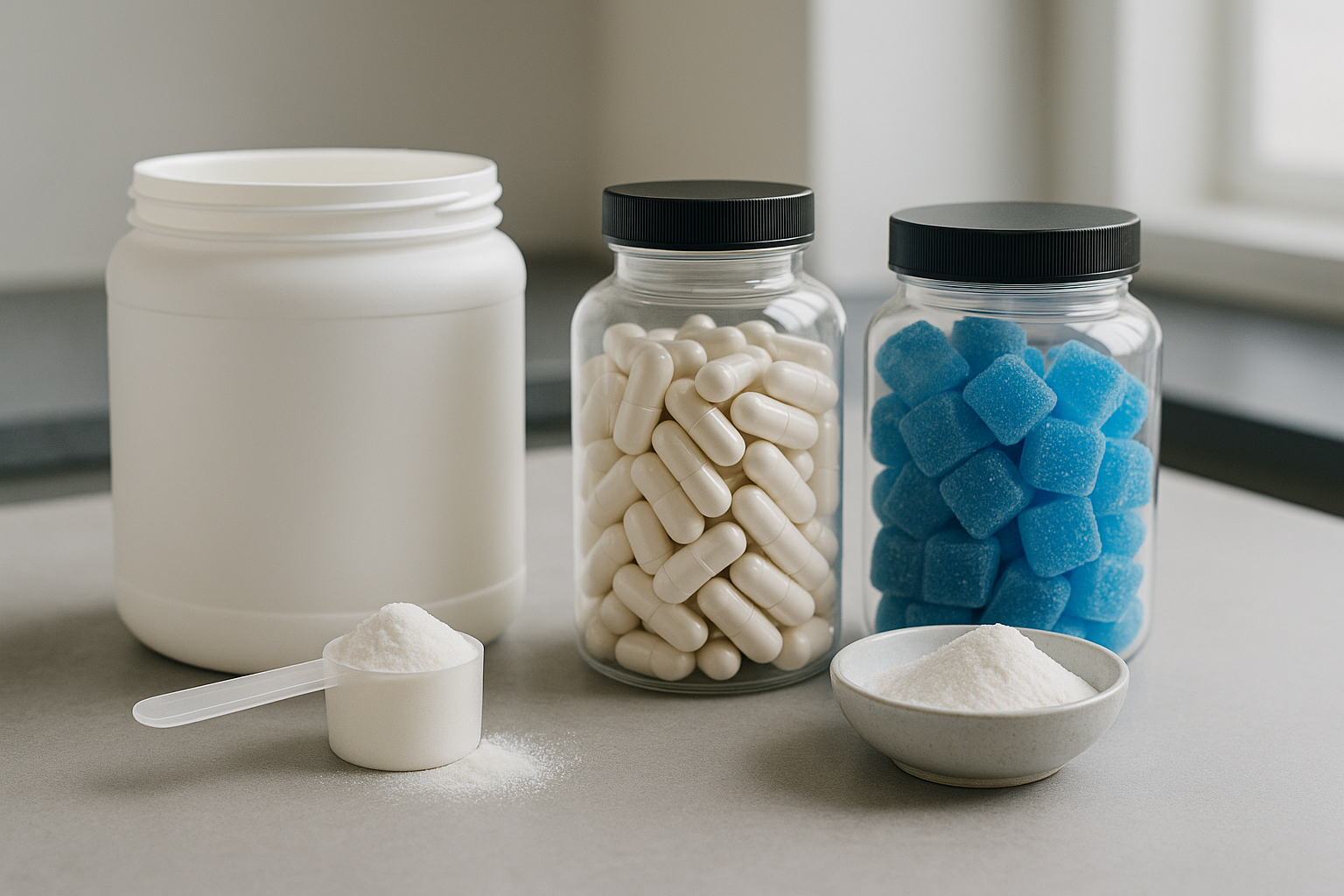
If you are wondering what creatine should I buy, buy creatine monohydrate unless you have a very specific reason not to. Monohydrate is the default recommendation because it combines the strongest evidence, reliable effectiveness, and the lowest cost per useful dose.
That recommendation gets even clearer when you compare the actual trade-offs.
| Type | Evidence | Typical dose | Pros | Cons |
|---|---|---|---|---|
| Creatine monohydrate | Strongest and longest research base | 3-5 g/day; optional loading 20 g/day for 5-7 days | Effective, inexpensive, widely available | Can feel gritty; some users get GI upset with large single doses |
| Micronized monohydrate | Same ingredient with smaller particle size | 3-5 g/day | May mix more easily; same active form | Sometimes priced higher for a minor convenience benefit |
| Creatine HCl | Limited compared with monohydrate | Varies by product | Smaller servings, often marketed as easier on the stomach | Usually more expensive; not proven superior |
| Buffered, ester, nitrate, blends | Weak or mixed compared with monohydrate | Varies widely | Marketing appeal | Higher cost and less dependable evidence |
| Gummies or capsules | Depends on the creatine form inside | Must total 3-5 g/day | Convenient, portable | Higher cost per dose; many require multiple pieces or capsules |
The practical caveat is this: if plain monohydrate consistently upsets your stomach even after you reduce dose size and take it with food, then a different format or a micronized monohydrate may be worth trying. But that is a troubleshooting decision, not a first-choice evidence decision.
Another caveat is convenience. Some people genuinely take capsules more consistently because they travel or hate mixing powders. A slightly pricier format you actually use every day can outperform a perfect powder tub that sits untouched in your cupboard.
If you want a deeper head-to-head, read creatine monohydrate vs. HCL or our guide to the best type of creatine. But for the average gym-goer, athlete, woman, older adult, or beginner, the answer remains plain: monohydrate first, everything else second.
How to read a creatine label like a smart buyer, not an easy target
The fastest way to pick the right creatine is to read the label for substance, not branding. A good creatine label should tell you exactly what form you are buying, exactly how many grams you get per serving, and exactly what else is in the product.
Start with the ingredient panel. Ideally, it says something close to creatine monohydrate and little else. Flavoured products may also include acids, sweeteners, flavour systems, anti-caking agents, or colour, which is not automatically a problem, but it does increase the chance of extra cost for non-essential ingredients.
Then check the serving size. Some labels create confusion by listing a serving as one capsule, two gummies, or one teaspoon without clearly stating the gram amount of creatine. The only number that really matters is how much creatine you get in grams. If a product gives 1 g per gummy, you need 3-5 gummies daily to reach a standard maintenance dose. If a capsule provides 750 mg, you may need 4-7 capsules to get the equivalent of a standard dose.
Watch for these red flags:
- Proprietary blends: you cannot verify the real creatine dose.
- Underdosed servings: a product that sounds convenient may require many servings per day.
- Overblown claims: "no loading needed" or "10 times more absorbed" often overstate weak evidence.
- Hidden cost inflation: a small tub with many low-dose servings can look cheap until you calculate the real daily dose.
If you are in Canada, it is also worth checking whether the product displays an NPN, or Natural Product Number, when applicable. An NPN indicates the product has been licensed by Health Canada as a natural health product. It is not a guarantee of athletic superiority, but it is a useful legitimacy signal in the Canadian market. Brand transparency, lot numbers, expiry dating, and clear contact information also matter.
For practical comparisons, our creatine brand reviews and best creatine rankings break down labels, doses, and value. And if you want the most important label metric explained, read the guide on cost-per-gram value before you buy.
A simple rule helps here: if you cannot tell the exact form, exact dose, and exact number of effective daily servings within 30 seconds, the label is not working hard enough for you.
A step-by-step creatine buying framework you can use today
If you want a concrete creatine buying guide, use this five-step process: choose the form, choose the format, verify the dose, verify the quality, then compare the real cost. This framework works whether you are a beginner asking how to pick a creatine or a veteran trying to avoid overpaying.
- Choose the form. Start with creatine monohydrate. If you already know monohydrate bothers your stomach even in smaller doses, consider micronized monohydrate before moving to more expensive alternatives.
- Choose the format. Powder is usually best for value and dose accuracy. Capsules are useful for travel. Gummies are the most convenient but often the worst value per effective dose.
- Verify the effective dose. Confirm that one full day of use gives you about 3-5 g of creatine. Ignore marketing language until you find this number.
- Verify quality signals. Look for reputable retail channels, batch details, expiry date, transparent manufacturing, and ideally third-party testing if you compete in tested sport. The IOC consensus on supplements notes that contamination risk is a real issue in sports nutrition, which is why certification matters for athletes.
- Compare cost per useful serving. Divide the tub price by the number of 5 g servings you actually get. That is more useful than comparing flashy sale stickers.
Here is an example. Suppose Product A is a 300 g monohydrate powder and Product B is a gummy tub with 60 gummies at 1 g each. Even if the gummy product looks cheaper at checkout, Product A gives about 60 effective 5 g servings, while Product B gives only 12 effective 5 g servings. That makes the powder far better value for anyone taking a standard daily dose.
Next, match the product to your lifestyle. If you train at home and do not mind mixing, buy unflavoured powder. If you travel for hockey tournaments or business, capsules may help consistency. If taste is the only thing stopping you from starting creatine, a lightly flavoured monohydrate can be reasonable provided the dose stays clear and the price stays sensible.
If you want help calculating exact daily intake once you buy, use our creatine dosage calculator and then read how to take creatine for a simple daily routine.
How much creatine should your product deliver? Dosing by body weight, goal, and timeline
The creatine you choose should make it easy to hit an evidence-based dose, which for most adults means 3-5 g daily, with optional loading if you want faster saturation. If a product makes that simple, it is doing its job; if it makes it confusing, it is probably the wrong product.
For most buyers, maintenance dosing is enough. Taking 3-5 g of creatine monohydrate daily will gradually increase muscle creatine stores and typically reaches near-saturation in roughly 3-4 weeks. A loading phase of 20 g daily, usually split into 4 doses of 5 g for 5-7 days, speeds that process. After loading, you drop to 3-5 g daily to maintain stores.
Body weight can help you fine-tune within that standard range:
- Under 60 kg: 3 g daily is often reasonable.
- 60-90 kg: 3-5 g daily is the usual sweet spot.
- Over 90 kg or very muscular athletes: 5 g daily is often the simplest default.
Goal matters too:
- General fitness or beginners: 3-5 g daily, no loading required.
- Fast performance bump for an upcoming block: load for 5-7 days, then maintain.
- Older adults training for strength and function: consistent daily use matters more than timing tricks.
- Vegetarians or vegans: standard dosing still applies, but response may be more noticeable because baseline stores are often lower.
What should you expect? In the first week of loading, some people notice a modest increase in body mass from increased intracellular water, meaning water pulled into muscle cells rather than fat gain. Without loading, effects are subtler at first. Over 2-4 weeks, many people notice better training quality, especially on repeated hard sets. Over 6-12 weeks, the benefits show up more clearly in performance and lean mass when training and protein intake are in place.
If a product serving is awkward, do the math before buying. A 2 g serving is not wrong, but it means you need multiple servings daily. That may hurt compliance and inflate cost.
For exact protocols, see how much creatine per day, creatine loading phase, and how long creatine takes to work.
Timing, mixing, and format: what actually matters once you have chosen a product
Once you have picked a good creatine supplement, taking it consistently matters far more than taking it at the perfect time. Daily intake drives muscle saturation, so the best timing is the one you will follow every day.
Most people can take creatine any time of day. Some prefer post-workout because it is easy to remember alongside a shake or meal, while others take it with breakfast. The evidence does not support obsessing over minute-by-minute timing for most users. The key is consistency across days and weeks. If you want more nuance, our guide on when to take creatine covers the before-versus-after debate in depth.
Mixing is straightforward. Creatine monohydrate can be stirred into water, juice, or a protein shake. Warm water often helps it dissolve a bit better, especially if the powder is not micronized. Some settling at the bottom of a glass is normal and does not mean the product is poor quality. If gritty texture bothers you, shake it harder, use more liquid, or choose a micronized powder next time.
Format choice comes down to practicality:
- Powder: best value, easiest to adjust dose, ideal for daily home use.
- Capsules: best for travel and convenience, but often require several capsules.
- Gummies: easiest to take, but usually expensive per 3-5 g and often include sugar or fillers.
- Flavoured powder: useful if taste improves compliance, but compare cost and ingredient quality carefully.
Take creatine with or without food based on comfort. Some people with sensitive digestion tolerate it better when taken with a meal. If you are stacking it with protein, that is fine; if you are mixing it with coffee, that is generally fine too. These details matter much less than hitting the daily dose. For practical how-to help, see how to mix creatine and our article on taking creatine with protein.
One more useful buying note: if you know you hate gritty powders, spend a bit more for micronized monohydrate rather than abandoning creatine entirely. Convenience is not the science, but convenience often decides whether the science helps you in real life.
Who should choose creatine, and how the best pick changes for women, beginners, older adults, and athletes
Creatine is a sensible choice for most healthy adults doing resistance training, sprint work, team sport, or age-related strength training, but the ideal product format can differ by user. The underlying supplement is usually the same; what changes is the emphasis on simplicity, certification, or convenience.
Beginners should usually choose plain monohydrate powder because it is cheap, easy to learn, and hard to mess up. A beginner does not need a multi-ingredient pre-workout blend just to start creatine. If you are new, our creatine for beginners guide walks through the full start-to-finish setup.
Women should choose creatine the same way men do: by form, dose, quality, and value, not by pink packaging or "toning" claims. Standard daily dosing still applies. If a women-specific product costs more without offering better testing or a clearer dose, it is usually marketing, not substance. For more, see creatine for women.
Older adults often benefit from choosing a product they will take consistently for months, not just weeks. That may mean an easy-mixing powder or convenient capsules if hand arthritis, travel, or routine complexity is a barrier. In this group, adherence may matter more than getting the absolutely cheapest tub.
Competitive athletes, especially in drug-tested sport, should care more about certification and contamination control. The IOC supplement consensus highlights that accidental ingestion of banned substances through supplements is a real risk. For that reason, third-party tested creatine products can justify a higher price if you compete under anti-doping rules.
Vegetarians and vegans often make excellent creatine candidates because dietary creatine intake from meat and fish is lower or absent. The product choice is still usually monohydrate, and synthetic creatine supplements are generally suitable for vegan users, though you should still verify the rest of the ingredient list if the product includes capsules, flavours, or excipients.
Endurance athletes should be more strategic. Creatine can help repeated surges, sprint finishes, gym work, and recovery capacity, but any early water-weight increase may be less desirable close to races where body mass matters. In that case, choose a plain product but plan your start date intelligently.
So who should buy creatine? Most lifters, field-sport athletes, masters athletes, and active adults can make good use of it. The best creatine to choose is rarely the most aggressively branded one; it is the one that fits your context and gets taken regularly.
Safety, side effects, and Canadian quality signals: what to check before you buy
Creatine is well-supported for safety in healthy people when used at recommended doses, but buying a good product still matters because poor formulation, contamination, and bad dosing can create unnecessary problems. The strongest evidence base supports creatine monohydrate as both effective and generally safe when used appropriately.
The ISSN position stand and later reviews have consistently reported that creatine supplementation is safe for healthy individuals at standard doses. The main side effects people actually notice are usually practical rather than dangerous: stomach upset from taking too much at once, temporary water-weight gain, or occasional bloating feelings during loading. These issues are usually dose-management problems, not reasons to fear creatine itself.
To reduce side effects:
- Take smaller divided doses if you load.
- Use 3-5 g daily instead of loading if your stomach is sensitive.
- Take it with food if an empty stomach bothers you.
- Use enough fluid to mix it comfortably.
Who should be cautious? People with pre-existing kidney disease, people under medical supervision for renal issues, and anyone taking medications that affect kidney function should speak with a healthcare professional before starting. It is also sensible to review special situations such as pregnancy, breastfeeding, or complex medication use individually rather than assuming sports-nutrition advice automatically applies.
In Canada, quality signals help separate solid products from risky ones. Useful checks include:
- NPN: a Natural Product Number can indicate Health Canada licensing where applicable.
- Third-party testing: especially important for tested athletes.
- Lot number and expiry date: signs of a real quality system.
- Transparent company information: a legitimate brand should be easy to contact.
The Mayo Clinic’s creatine overview and the JISSN reviews broadly align on the point most consumers need: creatine is not a steroid, is not inherently dangerous to healthy kidneys at recommended use, and has one of the better evidence bases in supplements. If safety is your main concern, read is creatine safe, creatine and kidney safety, and creatine myths debunked.
A smart buyer does not just ask whether creatine is safe in theory; they ask whether the exact product in front of them looks trustworthy in practice.
The biggest creatine buying mistakes and myths that cost people money or results
The most common mistake when choosing creatine is paying extra for marketing instead of paying for evidence, dose, and quality. If you want help picking the right creatine, avoid the traps below first.
- Mistake 1: assuming the most expensive form is the best. Higher price often reflects branding or convenience, not better muscle saturation.
- Mistake 2: buying a proprietary blend. If the label hides the exact grams of creatine, you cannot confirm an effective dose.
- Mistake 3: underdosing through convenience formats. A gummy or capsule can work, but only if you take enough to reach about 3-5 g daily.
- Mistake 4: expecting instant visible muscle. Creatine supports training output and muscle hydration; it is not a magic overnight mass gainer.
- Mistake 5: quitting because of minor water-weight gain. Early scale changes are usually water in muscle, not fat gain.
- Mistake 6: thinking you need to cycle. Routine cycling is not required for most users.
Now the myths.
Myth: fancy forms absorb better, so they must work better. Better solubility or a smaller serving does not automatically mean better outcomes. The question is performance and muscle creatine storage, and monohydrate still sets the benchmark.
Myth: creatine is only for bodybuilders. In reality, it is relevant for women, older adults, vegans, team-sport athletes, and recreational lifters too.
Myth: creatine is a steroid. It is not. Creatine is a naturally occurring compound involved in energy metabolism.
Myth: if you miss perfect timing, it will not work. Daily consistency matters much more than timing precision.
Myth: creatine always causes bloating. Some people notice GI discomfort or temporary fullness, especially during aggressive loading, but many do not when using moderate daily doses.
These myths matter because bad assumptions lead to bad purchases. A buyer who chases trendy forms, tiny servings, or exaggerated promises often ends up with a worse product than the boring monohydrate tub they skipped.
If you suspect your current product is not delivering, our guides on why creatine may not be working and common beginner mistakes can help you troubleshoot before you abandon supplementation.
Bottom line: the simplest framework for choosing the right creatine supplement
If you only remember one thing from this guide, remember this: the right creatine supplement is usually a plain creatine monohydrate product that gives you 3-5 g daily, comes from a trustworthy brand, and fits your budget well enough to use consistently. That is the complete answer to how to select creatine supplement for the vast majority of people.
Use this final framework when you shop:
- Default to creatine monohydrate.
- Pick powder unless capsules or gummies clearly improve your consistency.
- Confirm the label gives an effective daily dose in grams.
- Prefer simple formulas over proprietary blends.
- Check quality signals, especially if you are in tested sport.
- Compare cost per 5 g serving, not just shelf price.
For most Canadians, that means an unflavoured or lightly flavoured monohydrate powder from a reputable retailer or brand page, with transparent labelling and sensible pricing. If you want fast saturation, you can load; if you prefer simplicity, just take 3-5 g daily and let stores build over a few weeks.
What should you expect after buying the right product? Within a few weeks of consistent use, many people notice better repeat performance in the gym, stronger top sets, an extra rep on hard work, or slightly fuller muscles from increased intracellular water. Over months, those small training advantages can compound into meaningful strength and lean-mass progress.
If you are ready to choose, compare options in our best creatine rankings, browse the creatine product catalog, or use the creatine dosage calculator to match your dose to your body size and goal.
The smartest creatine buyer is not the person who finds the most exotic formula. It is the person who buys the most proven one, doses it correctly, and sticks with it long enough to let the evidence work.
Creatine buying guide: the numbers that matter
- 3-5 g/day standard maintenance dose — The usual daily range for most adults using creatine monohydrate.
- 20 g/day optional loading dose — Typically split into 4 doses for 5-7 days to saturate faster.
- 5-7 days loading timeline — How long a classic loading phase usually lasts.
- 3-4 weeks time to near-saturation without loading — Typical timeline when taking maintenance doses daily.
Frequently Asked Questions
How do I choose creatine if I am a beginner?
Choose plain creatine monohydrate powder if you are a beginner. It is the most studied form, usually the cheapest per effective dose, and easy to use at 3-5 g daily. Skip proprietary blends and advanced-sounding forms until you have a real reason to need a different format.
What creatine should I buy for muscle gain?
For muscle gain, buy creatine monohydrate that delivers 3-5 g daily. Creatine helps support better training quality and lean mass gains over time, but it works best alongside resistance training and adequate protein intake. Fancy forms have not consistently beaten monohydrate in the evidence.
What should I look for in a creatine supplement?
Look for the form, dose, ingredient simplicity, quality signals, and cost per effective serving. A good product clearly lists creatine monohydrate, tells you exactly how many grams you get, avoids proprietary blends, and comes from a reputable brand or retailer with transparent labelling.
Is creatine monohydrate the best creatine to choose?
Yes, creatine monohydrate is the best creatine to choose for most people. It has the strongest research support for performance and lean mass, is widely available, and usually costs less than alternative forms that claim superior absorption without stronger real-world results.
Should I buy creatine powder, capsules, or gummies?
Buy powder if you want the best value and easiest dose accuracy. Capsules are useful for travel and convenience, while gummies are the easiest to take but often the most expensive per 3-5 g daily dose. The best format is the one that helps you take an effective dose consistently.
How can I tell if a creatine product is underdosed?
A creatine product is likely underdosed if one serving provides well under 3 g and the label makes it hard to see how many servings you need per day. Always convert the serving into grams of creatine and ask whether a realistic daily routine gets you to about 3-5 g.
Do I need third-party tested creatine?
You do not always need third-party tested creatine, but it is strongly worth considering if you are a tested athlete or especially cautious about contamination. Certification can reduce the risk of banned substances or quality problems, which matters more in competitive sport than in casual gym use.
How do Canadians choose a safe creatine supplement?
Canadians should choose creatine by checking form, dose, retailer reputation, and quality signals such as clear lot numbers, expiry dating, and an NPN where applicable. Buying from established Canadian retailers or brand-direct channels can add confidence compared with anonymous marketplace listings.
Is more expensive creatine better?
No, more expensive creatine is not automatically better. Higher price often reflects format convenience, branding, or added flavours rather than greater effectiveness. Compare products by form, quality, and cost per effective 5 g serving instead of assuming premium pricing means premium results.
How do I know if I picked the right creatine?
You likely picked the right creatine if it is monohydrate, you can take 3-5 g daily easily, and the product is affordable enough to use consistently. In the following weeks, you may notice better repeated effort performance, improved training quality, or modest water-related fullness in muscle.