
Creatine Stacking Guide: The Best Supplements to Combine for Maximum Results
By The Creatine Canada Research Team — Evidence-based supplement analysts
The best supplements to stack with creatine are protein powder, beta-alanine, caffeine-based pre-workout, carbohydrates when they help you train harder, and in some cases electrolytes. The right creatine stack depends on your goal: for muscle gain, pair creatine with protein; for repeated high-intensity performance, add beta-alanine; and for workout energy, use a well-formulated pre-workout without overcomplicating the basics.
Evidence-based · Cites 4 sources · Editorial standards
Key Takeaways
- Creatine monohydrate is the foundation; most people only need 3-5 g daily to stay saturated.
- The best creatine and protein stack supports muscle gain because protein supplies amino acids while creatine improves training output.
- Creatine and beta-alanine is one of the strongest evidence-based performance stacks for repeated hard efforts.
- A creatine and pre-workout stack can work well, but the key is checking labels so you do not underdose creatine or double up stimulants.
- You do not need BCAAs, testosterone boosters, or exotic creatine forms to build an effective creatine stack.
- Timing matters less than consistency; take creatine every day and place the other supplement around when it helps adherence and performance.
- In Canada, look for a Natural Product Number (NPN) where required and prefer brands with third-party testing for purity and sport safety.
The best supplements to stack with creatine, ranked by goal
The best supplements to stack with creatine are protein powder for muscle gain, beta-alanine for repeated high-intensity performance, and pre-workout formulas for energy and training quality. If you want the short answer to what to take with creatine, start with one of those three based on your main goal and skip the flashy extras until your training, sleep, and diet are in order.
Creatine works by increasing muscle phosphocreatine, the stored form of creatine that helps rapidly regenerate ATP, your cells' immediate energy currency for short, hard efforts. Because creatine improves your ability to produce force across sets, the smartest stacks are the ones that either support that extra training output or solve a different limiting factor. Protein helps repair and build tissue after you train harder. Beta-alanine helps buffer acidity during sustained high-intensity work. Caffeine can improve alertness, effort, and power output in the session itself.
The 2017 International Society of Sports Nutrition position stand concluded that creatine monohydrate is the most effective ergogenic nutritional supplement currently available for increasing high-intensity exercise capacity and lean mass during training. That is why every effective creatine stacking guide begins with monohydrate rather than fancy blends or niche forms. If you still need a refresher on the base supplement itself, see what creatine is and our best creatine rankings.
| Goal | Best stack with creatine | Why it works | Who it suits |
|---|---|---|---|
| Build muscle | Creatine + whey or other protein | Creatine supports training output; protein supplies amino acids for repair and growth | Beginners, lifters, women, older adults |
| Repeated sprints or hard intervals | Creatine + beta-alanine | Creatine supports ATP regeneration; beta-alanine raises muscle carnosine to buffer acidity | Team-sport athletes, CrossFit, combat sports |
| Workout energy and focus | Creatine + pre-workout | Creatine supports performance over time; pre-workout improves session readiness | Morning trainers, fatigued trainees |
| Bulk or gain size | Creatine + protein + carbs as needed | Supports training, protein intake, and calorie surplus | Hardgainers, high-volume lifters |
| Hot-weather training | Creatine + electrolytes | Does not enhance creatine directly but helps fluid and sodium replacement | Sweaty athletes, endurance and field sports |
For most people, the best creatine stack is simple rather than crowded. Use plain creatine monohydrate, take it daily, and add only the supplement that fills your biggest gap.
Why a creatine stack works: the mechanisms that matter
A good creatine stack works because each supplement targets a different bottleneck in performance or recovery rather than trying to do the same job twice. The strongest stacks are complementary, not redundant.
Creatine's main job is to increase intramuscular phosphocreatine stores. Phosphocreatine donates a phosphate group to help regenerate ATP during short bursts such as heavy sets, sprints, jumps, and explosive repeats. That is why creatine shines in activities lasting seconds rather than long steady-state exercise. Once your muscles are more saturated with creatine, you can often maintain slightly better power output, get an extra rep, preserve bar speed longer, or recover faster between hard efforts.
Protein does something different. Protein provides essential amino acids, especially leucine-rich sources such as whey, that stimulate muscle protein synthesis after training. Creatine does not replace protein, and protein does not replace creatine. They work well together because one improves the training stimulus and the other supports adaptation to that stimulus. Our guide on creatine and protein powder covers this pairing in more detail.
Beta-alanine also does something different. Beta-alanine raises muscle carnosine over time, and carnosine helps buffer the hydrogen ions associated with the burning sensation and drop in pH during hard efforts lasting roughly 30 seconds to a few minutes. This makes creatine and beta-alanine a logical stack for repeated intervals, metcons, combat rounds, rowing pieces, and stop-start sports. The pairing is useful because creatine supports the fast-energy system while beta-alanine helps tolerate the metabolic stress that builds when the effort lasts longer.
Caffeine-based pre-workout operates mostly through the nervous system. Caffeine can improve alertness, reaction time, and perceived effort, which may help you train harder on a given day. That means a creatine and pre-workout stack often works because creatine builds your capacity over weeks while caffeine enhances the session in front of you. For the caffeine question specifically, see creatine and caffeine.
What does not usually add much? BCAAs if your protein intake is already adequate, most proprietary “anabolic” blends, and expensive alternative forms of creatine that have not beaten monohydrate in evidence or value. According to Antonio et al. (2021), JISSN, many popular beliefs about needing special forms or elaborate protocols are misconceptions rather than evidence-based necessities.
The principle is simple: combine creatine with a supplement that covers a different job, and keep the stack minimal enough that you can use it consistently.
Creatine and protein is the best stack for muscle gain, body recomposition, and beginners
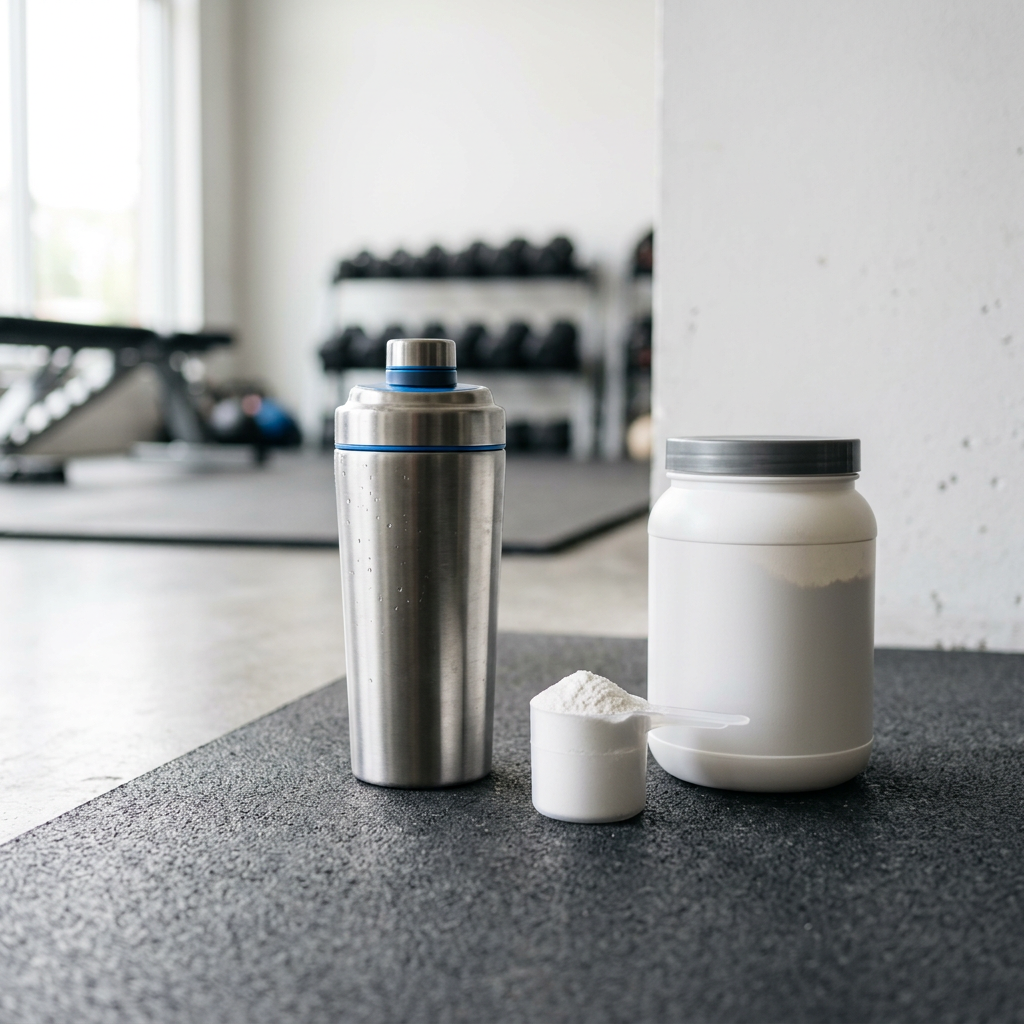
The best supplement to combine with creatine for most lifters is protein powder because it makes it easier to hit your daily protein target while creatine improves training quality. If you are asking for the single best all-around creatine supplement combination, this is it.
This stack is especially effective for beginners because the first months of training are often limited by two simple issues: inconsistent protein intake and inconsistent performance across sessions. Creatine helps with the second problem; protein helps with the first. When you fix both, you usually recover better, progress faster, and make the supplement routine much easier to follow.
How to do it in practice is straightforward:
- Take creatine monohydrate daily, usually 3-5 g per day.
- Use protein powder only as needed to help reach your daily protein goal from food plus shakes.
- On training days, mix creatine into your post-workout shake or have it with any meal if that is easier.
- On rest days, take the same creatine dose with breakfast, lunch, or another routine meal.
For body-weight examples, a 60 kg person may do well with 3 g of creatine daily, while many 75-100 kg lifters simply use 5 g daily for convenience. If you want exact intake math, use our creatine dosage calculator and read how much creatine per day.
What should you expect? In the first 1-3 weeks, especially if you load, many people notice better training “pop,” slightly improved rep performance, and a small increase in scale weight from greater water stored inside muscle. Over 6-12 weeks of solid training, the payoff is more likely to show up as better strength progression and lean mass gains than as a dramatic short-term transformation. If you want realistic timelines, see how long creatine takes to work.
This stack suits women, men, vegetarians, and older adults. It is also budget-friendly because protein and creatine each have clear jobs and decades of evidence behind them. If you can only buy two sports supplements, creatine monohydrate and a protein powder that fits your digestion and budget are the highest-yield pair for most people.
Creatine and beta-alanine is the best stack for repeated high-intensity performance
Creatine and beta-alanine is one of the best evidence-based stacks for sports and training styles built on repeated hard efforts. If your workouts include sprints, circuits, intervals, rowing pieces, combat rounds, or high-volume hypertrophy work with short rests, this is the creatine stack to consider first.
Here is why. Creatine helps you resynthesise ATP rapidly during brief maximal efforts. Beta-alanine increases muscle carnosine stores over time, and carnosine acts as an intracellular buffer during intense exercise. In plain English, creatine helps you produce more high-power effort, while beta-alanine helps you tolerate the burn that accumulates when the effort continues or repeats. They do not compete with each other; they target different energy constraints.
Dosing matters because beta-alanine is not an acute “feel it today” supplement. A practical starting point is 3.2-6.4 g of beta-alanine per day, usually split into smaller doses to reduce tingling, plus your normal 3-5 g of creatine monohydrate daily. That pins-and-needles sensation, called paraesthesia, is common and harmless for most people, but splitting the dose often makes it more comfortable.
A simple protocol looks like this:
- Take creatine every day at 3-5 g.
- Take beta-alanine daily, not just pre-workout.
- Split beta-alanine into 2-4 servings if tingling bothers you.
- Commit for at least 4 weeks before judging the stack.
Who benefits most? Team-sport athletes, CrossFit athletes, sprinters, hockey players, combat athletes, and lifters doing dense training blocks. Who benefits less? Someone walking for fitness or doing mostly long, easy cardio. This is a specialised stack, not a universal one.
A common mistake is buying a pre-workout with a token amount of beta-alanine and assuming you are fully covered. Many products include it, but if the daily total is too low or used inconsistently, muscle carnosine will not rise as intended. A dedicated beta-alanine product often works better if this stack is central to your plan.
If you are deciding between these two supplements rather than using both, read creatine vs. beta-alanine. If your training is explosive and repeated rather than purely strength-based, the answer is often not either-or but both, used properly.
A creatine and pre-workout stack can work well if you read the label like a sceptic
A creatine and pre-workout stack works well when your pre-workout is there for energy and focus, not as a substitute for a proper daily creatine dose. The main rule is simple: do not assume your pre-workout contains enough creatine, and do not let stimulants distract you from consistency.
Many pre-workouts include creatine, but some underdose it, use blends that hide the exact amount, or rely on forms that cost more without better outcomes than monohydrate. The safest play is often to treat creatine as its own daily supplement and treat pre-workout as optional session support. That keeps your creatine intake steady on both training and rest days.
Use this checklist before building a creatine and pre-workout stack:
- Check the creatine dose: if the product provides less than your target daily amount, top up separately.
- Check the caffeine dose: more is not always better, especially if you train at night or are stimulant-sensitive.
- Check for beta-alanine: useful if dosed adequately across the full day, not just in one scoop.
- Avoid proprietary blends: if the label hides doses, it is harder to know what you are getting.
Timing is easy. Take pre-workout about 20-60 minutes before training if it helps you perform better. Take creatine whenever it fits best, either in the same drink or separately. The research does not support obsessing over the minute-by-minute timing of creatine nearly as much as daily adherence. Our detailed timing guide at when to take creatine explains this fully.
What about caffeine “cancelling” creatine? The current evidence does not support a blanket rule that you must separate them. The practical question is not whether they can coexist, but whether caffeine helps or harms your training, sleep, and total recovery. If pre-workout makes you anxious, disrupts sleep, or leaves you dragging the next day, it is a poor stack even if it boosts one session on paper.
For athletes subject to testing, product quality matters even more. In Canada, consider products with a clear NPN where applicable and prefer third-party testing such as NSF Certified for Sport or Informed Sport when contamination risk matters. Our creatine brand reviews and creatine product catalog can help you compare options.
Carbs, electrolytes, and a few practical add-ons: useful in context, not mandatory
Carbohydrates and electrolytes can be useful with creatine, but they are situational add-ons rather than universally “best” supplements. They are worth using when they solve a real problem such as low training fuel, heavy sweating, or trouble hitting calories.
Carbohydrates can complement creatine in two practical ways. First, they can support training performance by improving glycogen availability, especially in hard gainers, field-sport athletes, and people doing high-volume training. Second, taking creatine with a meal or shake that includes carbohydrate is a simple adherence strategy and may help some people tolerate it better. You do not need sugar to “activate” creatine, but if carbs help you train harder or eat enough to grow, they are a valuable part of a muscle-building stack.
Electrolytes do not directly make creatine work better inside muscle, but they can support hydration and fluid balance when you sweat heavily. This matters for hockey, football, summer conditioning, CrossFit, and endurance athletes who are also using creatine for sprint capacity or strength work. If you are a salty sweater, train in heat, or cramp when underhydrated, electrolytes may be more useful than another trendy ergogenic.
What about mixing creatine with coffee, juice, milk, or sports drinks? In practical terms, most of these are fine if they help you actually take it. See can you mix creatine with coffee and how to mix creatine for specifics.
Useful add-ons that sometimes make sense:
- Carb powder or sports drink: helpful during long, hard training or when bulking calories are difficult.
- Electrolytes: helpful for heavy sweaters, hot environments, and two-a-day sessions.
- Mass gainer: only if whole food plus protein shakes still do not get calories high enough.
Overrated add-ons for most people:
- BCAAs: usually unnecessary if daily protein intake is adequate.
- “Test boosters”: weak evidence compared with basic nutrition and training.
- Multiple creatine forms in one product: usually higher cost without superior results over monohydrate.
The bottom line is that the best supplements with creatine are the ones that fix your actual limiting factor. Fuel, fluid, and sodium can absolutely matter, but they are tools for the right situation, not magic extras you need by default.
How to build the right creatine stack in 4 steps

The best way to build a creatine stack is to choose one primary goal, set a simple daily creatine dose, add one complementary supplement, and run the plan long enough to judge it fairly. Most stack failures happen because people pile on too many products and cannot tell what is helping.
- Choose your goal. If your goal is muscle gain, pick protein. If your goal is repeated intense performance, pick beta-alanine. If your goal is workout energy, pick pre-workout. If you sweat heavily or train in heat, add electrolytes.
- Set your creatine base. Use creatine monohydrate at 3-5 g daily. A loading phase of about 20 g per day split into 4 doses for 5-7 days is optional if you want faster saturation, followed by maintenance. If you prefer the slow route, daily maintenance alone still works. See creatine loading phase and how to take creatine.
- Add only one key partner. This keeps cost, complexity, and digestive risk lower. After 4-8 weeks, decide whether the stack is doing what you wanted.
- Track outcomes. Use training log data, not vibes alone. Watch for extra reps, slightly better repeated sprint quality, more stable body weight during a bulk, or easier protein adherence.
Here are simple body-weight examples:
- 60 kg beginner wanting lean muscle: 3 g creatine daily plus protein powder as needed to hit daily protein intake.
- 80 kg lifter in a bulk: 5 g creatine daily plus whey and extra carbs around training if calorie intake is lagging.
- 90 kg hockey or CrossFit athlete: 5 g creatine daily plus beta-alanine every day, plus electrolytes during heavy sweat sessions.
Week-by-week expectations are modest but real. Week 1 may feel unchanged unless you load. By weeks 2-4, some people notice better repeated effort performance and fuller muscles. By weeks 4-8, the difference usually shows up more clearly in training volume, strength progression, or maintaining performance deeper into sessions. By 8-12 weeks, the right stack should be visible in the logbook and body-composition trend, not just in the mirror.
If your stack feels confusing, strip it back to creatine monohydrate plus one partner supplement. Simpler stacks outperform complicated ones because people can actually sustain them.
Dosing, timing, and mixing: exactly how to take creatine with other supplements
The correct way to take creatine with other supplements is usually the simplest one: take creatine every day, take the partner supplement when its mechanism makes sense, and prioritise consistency over precision timing. This is where many people overthink a straightforward process.
Creatine dose: the standard maintenance dose is 3-5 g per day of creatine monohydrate. Larger athletes often default to 5 g daily for convenience, while smaller athletes may use 3 g. If you want faster saturation, you can load at about 20 g per day split into 4 servings for 5-7 days, then drop to maintenance.
Protein timing: take protein whenever it best helps you hit total daily intake. Post-workout is convenient, but the big driver is total protein across the day rather than one magical window.
Beta-alanine timing: daily consistency matters more than workout timing because the goal is to raise muscle carnosine over time. Split doses if tingling is bothersome.
Pre-workout timing: usually 20-60 minutes before training, depending on the formula and your stimulant tolerance.
Electrolyte timing: before, during, or after sessions where you sweat a lot.
You can mix creatine with water, juice, a protein shake, or your pre-workout unless the product label says otherwise. Warm liquid may dissolve it more easily, but complete dissolution is not required for it to work. If creatine upsets your stomach, take it with food, split the dose, or use micronised monohydrate. Our troubleshooting guides on creatine digestive side effects and creatine bloating may help.
A realistic minimalist protocol looks like this:
- Rest day: 3-5 g creatine with breakfast.
- Training day for muscle gain: 3-5 g creatine in a shake plus protein after training.
- Training day for intense conditioning: 3-5 g creatine daily, beta-alanine split across the day, pre-workout before training if useful.
The practical rule is easy to remember: creatine is a daily saturation supplement, not a “take only when you lift” supplement. Once you understand that, stacking becomes much simpler.
Who each creatine stack is best for: beginners, women, older adults, and athletes
The best creatine stack depends on the person in front of you, not just the ingredient list. Beginners, women, older adults, and competitive athletes can all benefit from creatine, but the smartest stack around it changes with the goal and context.
Beginners: start with creatine plus protein. This is the highest-value, lowest-confusion option because it supports the two basics most newcomers miss: enough protein and enough quality training. Beginners rarely need three or four supplements on day one.
Women: creatine is absolutely not just for men, and women usually do well with the same evidence-based monohydrate protocol. The best stack is often creatine plus protein or creatine plus electrolytes if training volume, appetite, or hydration are the limiting factors. If you want a dedicated guide, read creatine for women.
Older adults: creatine plus protein is again the front-runner, especially when paired with resistance training. Older adults often care less about pumps and more about preserving muscle, strength, function, and recovery. A simple daily routine tends to work better than stimulant-heavy stacks. See creatine for older adults.
Strength and power athletes: creatine plus beta-alanine can be useful during dense training phases, while pre-workout may help on key sessions if tolerated well. Drug-tested athletes should prioritise certified products.
Team-sport and stop-start athletes: creatine plus beta-alanine, with electrolytes added for heavy sweat loss, often makes the most sense.
Endurance athletes: creatine is more situational here. It may help sprint finishes, interval quality, gym strength, or during certain training blocks, but not every endurance athlete wants extra water weight. The stack often leans toward creatine plus electrolytes rather than creatine plus mass-building supplements.
Vegetarians and vegans: creatine can be especially helpful because dietary creatine intake from meat and fish is lower or absent. A creatine plus protein stack is often high value if protein intake also needs support.
The smartest question is not “what is the best creatine stack for everyone?” It is “what single add-on best complements creatine for my training and nutrition gap?” For most people, that answer remains protein first, beta-alanine second, and pre-workout only if energy and focus are actual obstacles.
Safety, side effects, and what Canadians should check before buying a stack
Creatine is well-supported for safety in healthy people when used at standard doses, but a stack can become less safe or less tolerable when extra ingredients are layered on without checking doses and quality. The safest stack is the one built from straightforward products you can identify, dose, and tolerate clearly.
The 2017 ISSN position stand and later reviews concluded that creatine monohydrate is not only effective but also well supported for safety in healthy populations when used appropriately. The common side effects people notice are usually mild and practical: temporary water-weight gain, occasional stomach upset if large doses are taken at once, and clumping or gritty texture if the powder is mixed poorly. Those issues are not the same as serious harm. For a fuller review, see Kreider et al. (2017), JISSN and our guide on is creatine safe.
What changes when you stack supplements? The main added risks usually come from the other ingredient:
- Protein powder: usually low risk, but some people get bloating or lactose-related digestive issues.
- Beta-alanine: tingling is common and dose-related.
- Pre-workout: caffeine can affect sleep, anxiety, heart rate, and training late in the day.
- Mass gainers or carb powders: easy to overshoot calories if you are not tracking intake.
Who should be more cautious? Anyone with kidney disease, significant medical conditions, pregnancy or breastfeeding considerations, or medication interactions should speak to a qualified healthcare professional before starting creatine or a stack. That is especially true for multi-ingredient pre-workouts.
For Canadians, label quality matters. A Natural Product Number, or NPN, is a Health Canada identifier used on many natural health products that indicates the product has been assessed for sale under its regulatory category. An NPN does not guarantee sports certification or perfection, but it is a useful legitimacy signal. For competitive athletes, third-party testing such as NSF Certified for Sport or Informed Sport is even more valuable because it reduces contamination risk.
When comparing products, prefer plain creatine monohydrate from reputable brands, transparent labels, and testing you can verify. Our creatine myths debunked page also addresses common fears about kidneys, bloating, hair loss, and dehydration.
Common creatine stacking mistakes, myths to ignore, and the final verdict
The biggest creatine stacking mistakes are overcomplicating the stack, underdosing creatine, and chasing products that sound advanced but add little beyond cost. If you remember only one thing from this guide, make it this: creatine monohydrate plus one well-chosen partner supplement beats a cupboard full of mediocre blends.
Here are the most common errors:
- Thinking you need a giant stack to benefit. Most people do best with creatine plus protein, or creatine plus beta-alanine if performance demands it.
- Only taking creatine on workout days. Creatine works through saturation, so daily use matters more than acute timing.
- Assuming every pre-workout contains enough creatine. Many do not.
- Using BCAAs as a default add-on. If daily protein is sufficient, BCAAs are often redundant.
- Confusing water weight with fat gain. Early scale increases are often due to more water stored inside muscle, not body-fat gain.
- Buying exotic forms over monohydrate. Monohydrate remains the most studied and cost-effective choice.
Now the myths. No, you do not need sugar to make creatine work. No, creatine is not a steroid. No, stacking more ingredients does not automatically mean better results. And no, a “best creatine stack” is not a universal shopping list. It is a goal-matched protocol.
The final verdict is simple:
- Best overall stack: creatine + protein
- Best performance stack: creatine + beta-alanine
- Best training-energy stack: creatine + pre-workout, if caffeine suits you
- Best situational hydration stack: creatine + electrolytes for heavy sweaters
If you are still unsure where to start, buy a plain monohydrate product, use 3-5 g daily, and add only the supplement that solves your biggest problem right now. That is the evidence-based answer to what to combine with creatine for maximum results.
For a deeper master reference, the Examine creatine evidence summary is also a useful overview of the broader literature. Then keep your own plan simple enough to follow for months, because adherence is where good science turns into real progress.
Best Creatine Stacks: The Numbers That Matter
- 3-5 g/day Standard creatine maintenance dose — Use daily to maintain muscle saturation.
- 20 g/day Typical loading protocol — Usually split into 4 doses for 5-7 days, then reduced to maintenance.
- 3.2-6.4 g/day Typical beta-alanine intake — Split doses often improve comfort and reduce tingling.
- 4-8 weeks Reasonable trial period for a new stack — Long enough to assess performance, recovery, and adherence.
Frequently Asked Questions
What is the best supplement to take with creatine?
The best supplement to take with creatine for most people is protein powder. Creatine helps you train harder and recover better between hard efforts, while protein helps you hit the amino acid intake needed to repair and build muscle, so the combination is practical, effective, and beginner-friendly.
Can you take creatine and beta-alanine together?
Yes, you can take creatine and beta-alanine together, and they are one of the best performance-focused stacks. Creatine supports rapid ATP regeneration for short explosive efforts, while beta-alanine raises muscle carnosine over time to help buffer acidity during repeated high-intensity work.
Can you mix creatine with pre-workout?
Yes, you can mix creatine with pre-workout if the ingredients and stimulant dose suit you. The main thing to check is whether the pre-workout already contains creatine and whether it provides enough to meet your daily target, because many products underdose it.
Should I take protein and creatine at the same time?
Yes, you can take protein and creatine at the same time, and many people simply add creatine to a protein shake. There is no requirement to separate them, and combining them is an easy way to improve consistency while supporting both training output and recovery.
What should you not stack with creatine?
You do not need to avoid many supplements with creatine, but you should be cautious with multi-ingredient products that hide doses or add too much caffeine. The bigger problem is not a dangerous creatine interaction in healthy people; it is wasting money, doubling ingredients, or worsening side effects from the other supplement.
Is creatine and pre-workout the same thing?
No, creatine and pre-workout are not the same thing. Creatine is a daily saturation supplement that builds muscle phosphocreatine stores over time, while pre-workout is usually an acute formula designed to increase energy, focus, or pump before a session.
Do you need carbs with creatine for it to work?
No, you do not need carbs with creatine for it to work. Creatine monohydrate is effective on its own, although taking it with a meal or shake that includes carbohydrate can be convenient and may fit better for people trying to fuel hard training or gain weight.
What is the best creatine stack for beginners?
The best creatine stack for beginners is usually creatine monohydrate plus protein powder. That combination covers the most common beginner gaps by supporting daily protein intake and improving training performance without adding unnecessary complexity or cost.
What is the best creatine stack for muscle gain?
The best creatine stack for muscle gain is creatine plus protein, with extra carbohydrates added only if you struggle to eat enough calories. Creatine helps you do more quality work in the gym, and protein gives your body the building blocks needed to turn that work into muscle growth.
Is it safe to stack creatine with other supplements every day?
Yes, it is generally safe for healthy adults to stack creatine with common supplements like protein or beta-alanine every day at standard doses. The main safety concerns usually come from other ingredients such as high caffeine doses, poor-quality products, or individual medical conditions that require professional advice.