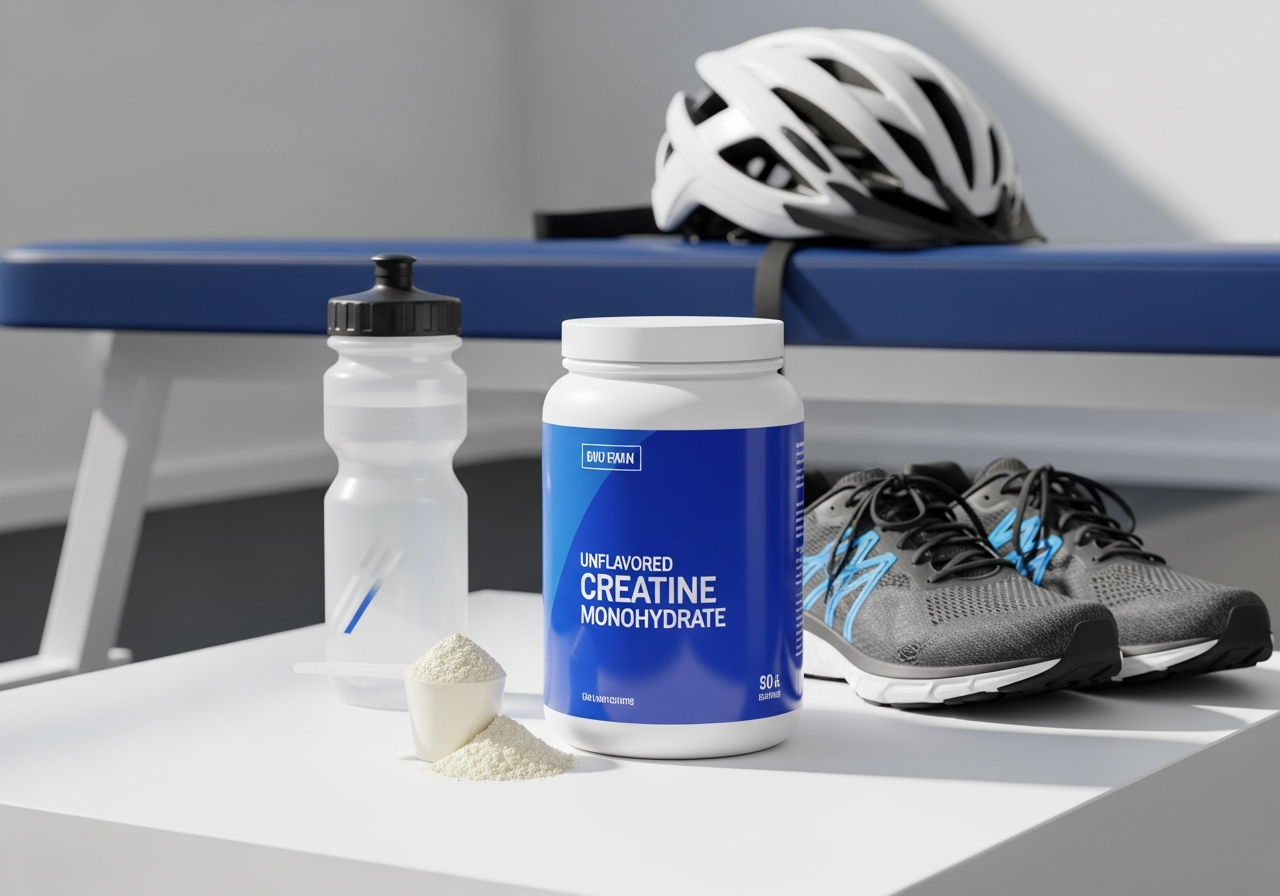
Creatine for Endurance Athletes: Runners, Cyclists, and More
By The Creatine Canada Research Team — Evidence-based supplement analysts
Creatine for endurance athletes can help, but not in the simple "more cardio = more benefit" way many people expect. For runners, cyclists, triathletes, and team-sport endurance athletes, creatine is most useful for repeated surges, sprint finishes, hill attacks, gym work, and recovery support, while its value for steady long-duration pace is smaller and sometimes offset by temporary water-weight gain.
Evidence-based · Cites 4 sources · Editorial standards
Key Takeaways
- Creatine monohydrate is the best-studied form and the first choice for endurance athletes.
- A standard maintenance dose is 3-5 g daily; loading is optional if you want faster saturation.
- Creatine helps most with repeated high-intensity efforts, sprint finishes, and strength training that supports endurance performance.
- Pure steady-state endurance performance usually improves less than power or repeat-sprint ability.
- Some athletes gain 0.5-2.0 kg of water weight in the first 1-3 weeks, which matters more in running than in cycling or rowing.
- Timing matters less than consistency; before running, after cardio, or on rest days can all work if you take it daily.
- Canadian buyers should prefer products with a Natural Product Number (NPN) and ideally third-party testing.
Should endurance athletes take creatine? Yes—if your sport includes surges, sprints, hills, gym work, or hard training blocks
Yes, many endurance athletes can benefit from creatine, but the benefit is strongest when performance depends on repeated high-intensity efforts rather than only steady aerobic output. That means creatine is often more useful for runners, cyclists, triathletes, rowers, swimmers, and team-sport athletes who need to surge, attack, sprint, climb, lift, or recover between hard sessions than for someone judged only on smooth, even-paced endurance.
Creatine is a naturally occurring compound stored in muscle, where it helps regenerate ATP, the cell's immediate energy currency. ATP powers muscular contraction in every sport, but creatine's most direct role is in short, hard efforts lasting roughly a few seconds up to about half a minute, and in repeated bursts with incomplete recovery. That is why the research story is clearer for sprinting, strength, and repeated-interval performance than for a pure marathon-pace effort.
So, is creatine good for runners? It can be, especially for middle-distance runners, trail runners, athletes doing lots of hills, and distance runners using strength training to stay durable. Does creatine help cardio performance? Sometimes, but the effect is usually indirect: better training quality, higher power in intervals, stronger gym sessions, and potentially better recovery can add up over weeks.
For cyclists, the case is often stronger than for road runners because a small increase in body mass usually hurts running economy more than cycling performance. A rider who needs repeated attacks, sprint finishes, short climbs, or a stronger gym block may find creatine especially worthwhile. That is one reason you will absolutely find endurance athletes, elite runners, and pro cyclists who use creatine strategically.
The most evidence-based choice is creatine monohydrate, not expensive alternative forms. The 2017 ISSN position stand concluded creatine monohydrate is the most effective ergogenic nutritional supplement currently available for increasing high-intensity exercise capacity and lean mass during training. If you need a broader primer first, see what creatine is and what it does.
How creatine can help endurance without being a classic 'endurance supplement'
Creatine can help endurance athletes mainly by improving the parts of endurance performance that depend on power, repeatability, and resilience. In plain English, creatine is not a magic marathon supplement, but it can make the training and race moments around a long event better.
Here is the mechanism. Muscle stores creatine partly as phosphocreatine, a high-energy compound that rapidly donates a phosphate to regenerate ATP during hard contractions. More intramuscular phosphocreatine means your muscles can restore ATP faster during short intense efforts and recover a bit better between repeated efforts. That matters in:
- surging to cover a move in a race
- kicking at the finish
- repeated climbs or accelerations
- track intervals and VO2 max sessions
- strength and plyometric sessions that support economy and injury resistance
Creatine may also help by increasing training quality over time. If you can lift slightly heavier, complete an extra rep, maintain power deeper into intervals, or tolerate hard sessions better, you may accumulate more useful training over a block of 4-12 weeks. That is often where endurance athletes notice the real payoff.
Does creatine help with running? It can, but often through supporting the systems around running: stronger calves, quads, glutes, and hip stabilisers; better repeated speed; and improved ability to hold form under fatigue. Does creatine help with cardio? For pure steady-state aerobic metabolism, the direct effect is limited because long-duration endurance relies more on oxygen delivery, mitochondrial function, glycogen management, and pacing than on the phosphocreatine system.
There is also a practical tradeoff. Creatine increases water inside muscle cells, which is normal and not fat gain. That can be beneficial for cell hydration and training adaptation, but extra mass may slightly hurt weight-sensitive activities like uphill running or long-distance racing if the athlete gains enough water to affect economy. If that concerns you, skip loading and use a lower daily dose to saturate more gradually. For a full overview of timelines, see how long creatine takes to work.
What runners, cyclists, and other endurance athletes can realistically expect
Runners and cyclists should expect creatine to help most with hard efforts layered on top of endurance, not necessarily with easy-zone pace. The realistic expectation is better support for training and race-specific power rather than a dramatic drop in 5K, 10K, marathon, or long sportive times from creatine alone.
For runners: creatine is often most useful for 800 m to 10K runners, trail runners, obstacle-course racers, and field-sport athletes who run a lot. It may support faster interval sessions, stronger sprint finishes, better hill repeat quality, and improved strength-training output. It can also help preserve lean mass during heavy mileage or calorie deficits. However, for marathoners and lighter runners obsessed with running economy, temporary water-weight gain can be a meaningful downside.
For cyclists: creatine often fits better because the performance cost of small body-mass increases is usually lower outside steep climbing. It can support attack power, sprinting, repeated anaerobic bursts, gym work in the off-season, and stage-race or block-training durability. That is why cyclists frequently ask, "Do cyclists take creatine?" Yes, many do, particularly sprinters, track cyclists, criterium racers, and road riders in strength or power-focused phases.
For triathletes and hybrid athletes: the answer depends on event distance and your limiter. If your weakness is swim starts, bike surges, transition power, or strength maintenance, creatine may help. If every extra kilogram hurts your run split and you already do little intensity, the payoff may be smaller.
For older endurance athletes: creatine may be especially attractive because it can support lean mass, strength, and training capacity as age-related muscle loss becomes more relevant. Women may also benefit meaningfully; if that is your focus, read our guide to creatine for women.
The most honest answer to "does creatine benefit runners?" is this: it benefits some runners quite a lot, but mainly through speed-endurance, repeated efforts, and training support, while others doing purely steady long-distance work may notice little besides fuller muscles and a small scale increase.
Best creatine dose for endurance athletes: simple daily use, plus body-weight examples
The best creatine dose for most endurance athletes is 3-5 g of creatine monohydrate every day. That dose is enough to raise and maintain muscle creatine stores in most adults, and it is the easiest starting point for runners, cyclists, and beginners.
You have two valid ways to start:
- No loading: take 3-5 g once daily. Full saturation usually takes around 3-4 weeks.
- Loading phase: take about 20 g per day split into 4 doses of 5 g for 5-7 days, then switch to 3-5 g daily. This saturates muscles faster but more often causes stomach upset or a faster jump in water weight.
If you want help calculating the right amount, use our creatine dosage calculator or read how much creatine per day.
| Athlete | Conservative daily plan | Faster-start plan | Best for |
|---|---|---|---|
| 55-65 kg runner | 3 g daily | 15-20 g/day for 5-7 days, then 3 g/day | Weight-sensitive athletes, smaller women, distance runners |
| 66-85 kg athlete | 4-5 g daily | 20 g/day for 5-7 days, then 4-5 g/day | Most recreational runners and cyclists |
| 86 kg+ athlete | 5 g daily | 20 g/day for 5-7 days, then 5 g/day | Larger athletes, power-endurance or heavy gym blocks |
For endurance athletes, the conservative approach is often smarter than loading because it reduces the chance of digestive issues and may limit abrupt water-weight gain. A 60 kg marathoner might choose 3 g daily, while an 82 kg cyclist in a hard interval block might choose 5 g daily.
If you are plant-based or eat little red meat or fish, you may notice a more obvious response because baseline muscle creatine stores can be lower. If you are already highly muscular and eat creatine-rich foods regularly, the effect may feel subtler.
Once you start, do not cycle on and off without a reason. Daily consistency matters more than fancy protocols. If you miss a day, simply resume the next day; you do not need to double up. More guidance is in our loading guide and maintenance-dose explainer.
Before running, after cardio, or anytime? Timing matters less than saturation
You can take creatine before running, after cardio, or at any other consistent time of day, because the main goal is muscle saturation rather than an acute stimulant-like effect. Creatine does not work like caffeine; it works by gradually building up intramuscular stores over days and weeks.
That means all of these are acceptable:
- Before running: convenient if it helps you remember, though some athletes prefer not to take a large dose immediately before a hard run if they are prone to stomach upset.
- After running: also fine, and often easy to pair with a recovery shake or meal.
- With any meal: excellent for consistency, especially on rest days.
So, can you take creatine before running? Yes. Can you take creatine after cardio? Yes. Is creatine good after running? Yes, in the sense that post-run intake still contributes to daily saturation and can fit neatly into a recovery routine.
If you are sensitive to GI discomfort, the best practice is simple:
- Take 3-5 g once daily.
- Mix it fully in water or a shake.
- Have it with food if your stomach is touchy.
- Avoid dry scooping.
- Split the dose into 2 smaller servings if needed.
Many endurance athletes like to put creatine into a post-session protein shake because habit beats theory. If that sounds convenient, see mixing creatine with protein powder and how to take creatine properly.
The bigger timing question for endurance athletes is not hour-by-hour timing but phase timing. Creatine is often most useful during off-season strength blocks, pre-season power work, race phases involving surges and intervals, and heavy training camps where recovery matters. Some marathoners choose to stop loading well before race day or avoid loading entirely during peak race season to minimise transient weight gain. That is a strategic choice, not a safety requirement.
What to expect in the first month: timeline, signs it is working, and how to judge results
Creatine usually works gradually, so the best way to judge it is by training markers over 2-4 weeks, not by how you feel after one scoop. If you load, changes may show up within a week; if you start with 3-5 g daily, noticeable effects often appear after 2-4 weeks.
Week 1 with loading: you may notice slightly fuller muscles, a small scale increase, and sometimes improved snap in short efforts. Some people also notice mild stomach upset if doses are too large or poorly mixed.
Week 1-2 without loading: often very little dramatic feeling, which is normal. Creatine is still accumulating in muscle.
Week 2-4: this is when many endurance athletes first notice practical benefits such as holding power better in repeated intervals, recovering a bit faster between hard reps, or feeling stronger in the gym.
Good signs creatine may be helping include:
- slightly better repeat sprint or hill-repeat quality
- less drop-off from first to last hard interval
- improved strength numbers in squats, split squats, deadlifts, calf raises, or jumps
- better ability to maintain pace changes late in a session
- stable or improved recovery quality during high-volume blocks
Less useful signs include obsessing over the scale or expecting immediate endurance breakthroughs. Creatine is not supposed to feel like a stimulant rush.
The best way to test it is to keep one or two anchor metrics for 4-6 weeks, such as:
- average wattage across 6 x 2-minute cycling repeats
- pace consistency on 10 x 400 m with equal rest
- peak sprint power at the end of a long ride
- key gym lifts supporting your sport
If you see no benefit after 4-6 weeks of consistent dosing, you may still be taking it correctly. Some athletes are simply less responsive, especially if they already have relatively high muscle creatine stores. Our guides on creatine non-responders and how long creatine takes to work can help you assess that without guessing.
Who should consider creatine most—and who may want to be more selective
Creatine is most worth considering for endurance athletes who do high-intensity intervals, race tactically, strength train, or want to preserve lean mass during hard training. It is less compelling for athletes doing almost exclusively low-intensity steady-state work and who are highly sensitive to any extra body mass.
Good candidates include:
- middle-distance runners and track athletes
- road cyclists, track cyclists, and criterium racers
- trail runners and mountain athletes who need repeated climbing surges
- triathletes with a power limiter
- endurance athletes in the gym 2-3 times per week
- vegetarians and vegans, who may start with lower creatine stores
- older athletes trying to maintain muscle and power
Use more selectively if:
- you are peaking for a weight-sensitive race like a marathon or mountain run
- you are already struggling with GI issues in training
- you have a medical reason to avoid unsupervised supplementation
Should runners take creatine? If you are a runner who wants better interval quality, more robust strength work, improved sprint ability, or lean-mass support during heavy mileage, yes, it is often a smart option. If you are a featherweight marathon specialist whose top priority is absolute running economy at race weight, the answer may be "maybe, but test it in training first."
Do elite runners take creatine? Some do, especially in power, speed-endurance, or gym-focused phases. Do marathon runners take creatine? Some do, but more selectively because the body-mass tradeoff matters more. Do endurance athletes take creatine? Yes, many do, but usually for strategic reasons rather than because they expect it to directly transform long steady-state output.
If you are new to supplements, start simple: one ingredient, one dose, four weeks, and a training log. You do not need a giant stack. If safety is your first concern, see our full safety guide and who should not take creatine.
Safety, water weight, and side effects: what endurance athletes need to know
Creatine monohydrate is widely considered safe for healthy people when used at standard doses, but endurance athletes should understand two practical issues clearly: temporary water-weight gain and occasional digestive upset. Those are the main reasons some runners dislike it, not because creatine is inherently harmful.
The 2021 JISSN review on common creatine questions and misconceptions and the Mayo Clinic overview both reflect the mainstream view that creatine is generally safe when used appropriately in healthy individuals. The IOC consensus on supplements also recognises creatine as one of the sports supplements with the strongest evidence base for specific performance uses.
Common, normal effects:
- Water-weight gain: often about 0.5-2.0 kg early on, especially with loading. This is mostly intracellular water stored in muscle, not fat.
- Digestive upset: more likely if you take too much at once, take it dry, or use poor mixing habits.
- Fuller muscles: common and expected.
What creatine does not reliably do:
- dehydrate you
- cause muscle cramps in healthy users
- damage healthy kidneys at standard doses
- require cycling
For endurance athletes, hydration still matters, but creatine is not a diuretic. Drink to thirst, follow your normal training hydration plan, and do not confuse sensible hydration with overdrinking. If you want the details, read creatine and dehydration and how much water to drink with creatine.
You should speak to a physician before use if you have known kidney disease, are under medical monitoring for renal issues, are pregnant, or have another condition requiring supplement review. Also remember that creatine can increase creatinine on a blood test, which can confuse interpretation if your clinician does not know you supplement. That is a lab-marker issue, not proof of kidney damage. We cover that in creatine vs. creatinine.
The biggest mistakes endurance athletes make with creatine
The biggest creatine mistake endurance athletes make is expecting it to act like a pre-workout for a long run. Creatine is a saturation supplement, not an acute buzz supplement, so the payoff comes from consistent use and the right expectations.
Mistake 1: choosing the wrong goal. If your only goal is improving easy conversational-pace cardio, creatine is unlikely to feel dramatic. If your goal is stronger intervals, sprint finishes, gym performance, or preserving muscle during hard blocks, it is much better matched.
Mistake 2: loading right before an important race. A rapid loading phase can increase water weight fast. That may be fine in a cycling training block, but less ideal the week before a goal road race if you have never tested it.
Mistake 3: blaming creatine for normal scale changes. Creatine does not cause fat gain by itself. Early weight gain is usually water pulled into muscle cells.
Mistake 4: buying fancy forms over monohydrate. Monohydrate remains the most studied and cost-effective form. Claims that HCl, buffered, liquid, or gummy formats are inherently superior are not well supported.
Mistake 5: taking huge doses. More is not better once you are saturated. Standard maintenance is enough.
Mistake 6: stopping because you "don't feel it" in three days. That is especially common without loading.
Common myths worth debunking directly:
- "Creatine is only for bodybuilders." False. Its mechanism is relevant to any sport involving repeated hard efforts.
- "Creatine is bad for runners." Too broad to be true. It helps some runners and is neutral or less useful for others.
- "Creatine ruins endurance." Not inherently. Any downside is usually about body-mass tradeoffs, not a direct impairment of aerobic physiology.
- "You must cycle off creatine." False for healthy users taking standard doses.
For a deeper myth breakdown, see creatine myths debunked and our facts guide.
What to buy in Canada: the best creatine form, labels that matter, and what to avoid
The best creatine for endurance athletes in Canada is usually a plain creatine monohydrate powder with a Natural Product Number and preferably third-party testing. For most buyers, that means choosing simplicity, not the flashiest label.
What to look for:
- Creatine monohydrate as the main and ideally only active ingredient
- NPN, which stands for Natural Product Number, indicating the product is licensed for sale in Canada as a natural health product
- transparent grams per serving, ideally 3 g or 5 g
- minimal fillers, colours, or unnecessary proprietary blends
- third-party testing or a strong brand quality record
| Option | Best use case | Pros | Cons |
|---|---|---|---|
| Unflavoured monohydrate powder | Most athletes | Best evidence, best value, flexible dose | Needs mixing |
| Micronized monohydrate | Athletes who dislike grit | Often mixes a bit easier, same core ingredient | May cost slightly more |
| Capsules | Travel or convenience | No mixing, easy to carry | Many capsules needed to reach 3-5 g |
| Flavoured blends | Taste-first users | More enjoyable for some | Often pricier, may include extras you do not need |
| Alternative forms like HCl or buffered | Usually not necessary | Marketing appeal | Less evidence, often worse value |
In Canada, buying from reputable retailers matters because lot quality, accurate dosing, and product freshness are more important than flashy claims. Start with our best creatine rankings, browse the product catalog, compare creatine brand reviews, or read how to choose the best creatine monohydrate in Canada.
The simplest rule is still the best one: if an endurance athlete asks what to buy today, the answer is usually plain creatine monohydrate from a reputable Canadian seller.
Bottom line: creatine is a smart tool for many endurance athletes, but not every race goal
Creatine for endurance athletes is worth considering when your performance depends on repeated hard efforts, sprint ability, strength training, or staying robust through demanding training. It is less of a direct endurance enhancer for long, even-paced efforts, and temporary water-weight gain can be a real tradeoff for runners in weight-sensitive events.
If you want the practical version, here it is:
- Buy creatine monohydrate.
- Take 3-5 g daily.
- Skip loading if you are worried about water-weight gain or stomach upset.
- Use it for at least 4 weeks before judging it.
- Track interval quality, sprint finish, hill power, and gym performance.
- Keep it if those improve and the body-mass tradeoff is acceptable.
So, is creatine good for running and cardio? It can be, especially for runners and cyclists who train hard, lift, sprint, or race tactically. Should a runner take creatine? Often yes, but test it in training, not by guesswork right before an important race. Can you take creatine for cardio? Absolutely, as long as you understand that its best-supported benefits sit at the intersection of endurance, power, and training quality.
If you want a personalised next step, use the dosage calculator, read creatine for runners, creatine for cyclists, and when to take creatine, then choose the simplest protocol you will actually follow.
Creatine for Endurance Athletes: Key Numbers
- 3-5 g/day Standard maintenance dose — Suitable for most runners, cyclists, and recreational endurance athletes.
- 20 g/day Typical loading dose — Usually split into 4 doses for 5-7 days to saturate muscles faster.
- 2-4 weeks Common timeline without loading — How long daily creatine often takes to meaningfully raise muscle stores.
- 0.5-2.0 kg Typical early water-weight increase — Varies by dose, size, baseline stores, and whether a loading phase is used.
Frequently Asked Questions
Is creatine good for runners?
Creatine can be good for runners, especially if they do intervals, hills, sprint finishes, or strength training. It is usually less impressive for pure steady-state distance performance, and some runners dislike the temporary water-weight gain, so the best approach is to test it in training rather than right before a goal race.
Does creatine help with endurance?
Creatine can help with endurance indirectly by improving repeated hard efforts, interval quality, gym performance, and recovery between intense bouts. Its direct effect on long, steady aerobic output is smaller than its effect on power and repeated high-intensity work.
Can runners take creatine every day?
Yes, runners can take creatine every day, and daily use is the standard way it works best. A consistent 3-5 g daily maintenance dose is more important than precise workout timing because creatine works by saturating muscle stores over time.
Can you take creatine before running?
Yes, you can take creatine before running, but it does not act like an immediate performance booster. If taking it right before a run bothers your stomach, move it to after the run or take it with a meal later in the day.
Can you take creatine after cardio?
Yes, taking creatine after cardio is perfectly fine and is often convenient. Post-workout timing may help with routine adherence, but the main priority is simply getting your full daily dose consistently.
Do cyclists take creatine?
Yes, many cyclists take creatine, particularly sprinters, track cyclists, criterium racers, and road riders in strength or power-focused phases. Cycling tends to tolerate small increases in water weight better than running, which can make creatine more attractive for many riders.
Do marathon runners take creatine?
Some marathon runners do take creatine, but they tend to be more selective about when and how they use it. It may be useful in gym blocks or interval-heavy periods, but concerns about race-weight and running economy make some marathoners prefer lower daily dosing without loading.
Does creatine help cardio performance?
Creatine can help cardio performance when the event includes accelerations, repeated surges, or hard interval training, but it is not primarily an aerobic booster. Its best-supported role is improving the high-intensity component layered onto endurance performance.
Should runner take creatine if they are trying to stay light?
A runner trying to stay light can still try creatine, but should usually use a conservative protocol such as 3 g daily without a loading phase. That slower approach may reduce abrupt water-weight changes while still allowing the athlete to evaluate whether the training benefits outweigh the mass tradeoff.
Is creatine good after running for recovery?
Creatine after running can fit well into a recovery routine, especially when combined with a post-run meal or shake. It is not a recovery miracle on its own, but daily use may support training quality and muscle-energy restoration over time.