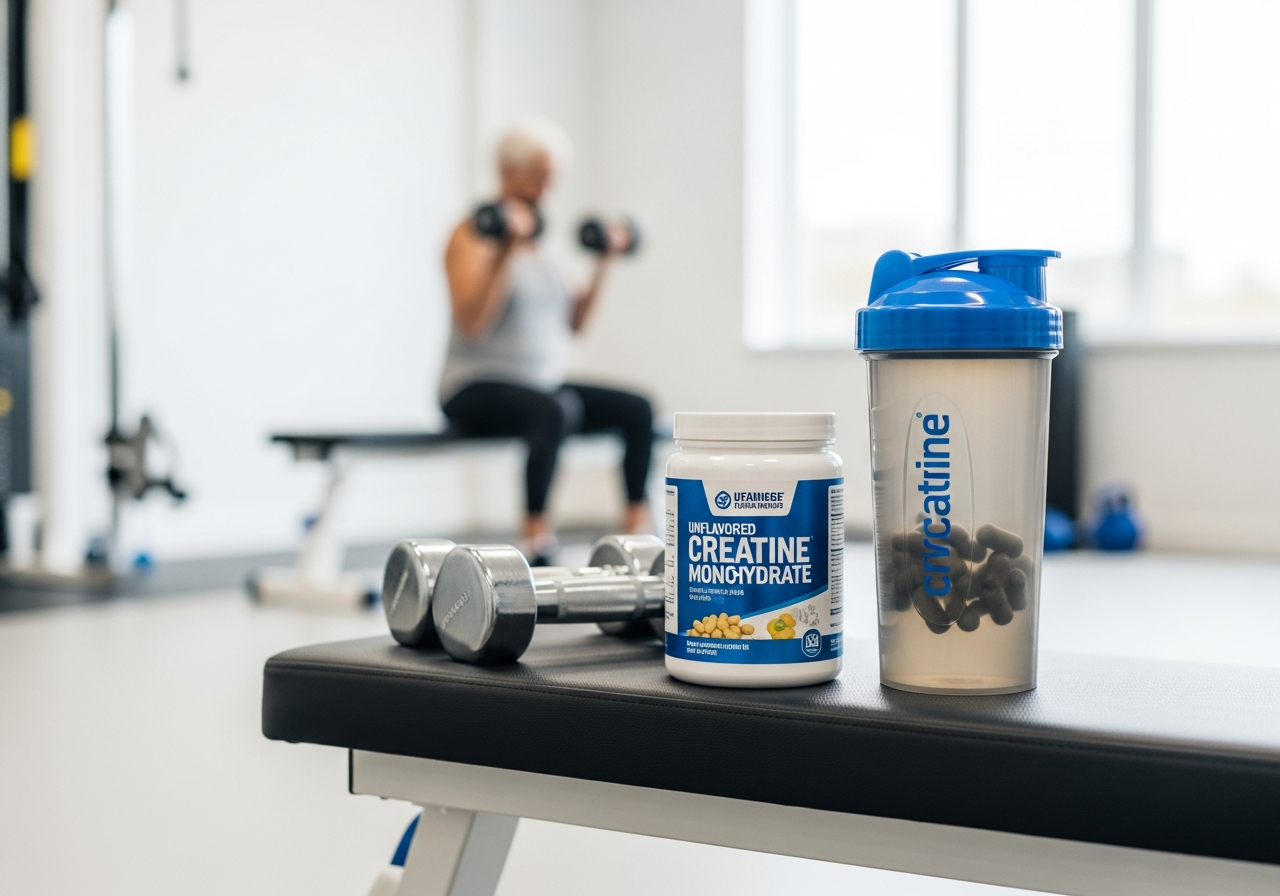
Creatine and Sarcopenia: Fighting Age-Related Muscle Loss
By The Creatine Canada Research Team — Evidence-based supplement analysts
Creatine can help with sarcopenia, but the strongest evidence is for creatine combined with resistance training, not creatine on its own. In older adults, creatine monohydrate at typical research doses can modestly improve lean mass and strength versus training alone, making it a useful adjunct for fighting age-related muscle loss when paired with exercise, adequate protein, and medical guidance.
Evidence-based · Cites 4 sources · Editorial standards
Key Takeaways
- Creatine and sarcopenia is best understood as a training support strategy, not a stand-alone fix for age-related muscle loss.
- The most-studied approach in adults 50+ is creatine monohydrate at 3-5 g/day or about 0.1 g/kg/day.
- Meta-analyses suggest creatine plus resistance training can improve lean mass and strength more than training alone in older adults.
- Creatine without resistance training appears to offer little or inconsistent benefit for sarcopenia.
- Older adults should also address protein intake, vitamin D status, progressive strength training, and fall-risk factors.
- Creatine is generally considered safe for healthy older adults, but kidney concerns, medications, and medical conditions should be reviewed with a healthcare provider first.
- In Canada, choose plain creatine monohydrate from reputable brands with an NPN and preferably third-party testing.
What creatine can, and cannot, do for sarcopenia
Creatine can support sarcopenia management, but it works best as part of a larger plan built around resistance training, protein, and healthy aging care. That is the direct answer to the question behind creatine and sarcopenia: yes, creatine can help age-related muscle loss, but the evidence is strongest when older adults lift weights or do structured strength training.
Sarcopenia is the age-related loss of muscle mass, muscle strength, and physical function. In practical terms, it matters because less muscle usually means less reserve for daily tasks like climbing stairs, standing from a chair, carrying groceries, and catching yourself during a trip or slip. Sarcopenia is not just about looking smaller or weaker; it is tied to independence, frailty, falls, hospitalization risk, and quality of life.
Creatine does not directly “cure” sarcopenia. What it does is raise intramuscular creatine and phosphocreatine stores. Phosphocreatine is a stored high-energy compound in muscle that helps rapidly regenerate ATP, the cell’s immediate energy currency, during short, hard efforts. In older adults, that can translate into better training quality: a few more reps, slightly heavier loads, better repeated efforts, and over time a stronger signal for muscle retention and growth.
That distinction matters. If you are searching for creatine age related muscle loss, the evidence-based message is that creatine is an adjunct, not a replacement for exercise. Research in older adults consistently looks better when creatine is paired with progressive resistance training than when it is taken without training. If you want the more practical playbook for daily use after 50, see our guide to creatine for older adults.
For most people, the most defensible conclusion is this: creatine monohydrate is one of the few supplements with a credible evidence base for supporting muscle and strength gains in older adults, but its effect size is modest and depends heavily on whether the person is actually doing resistance exercise.
- Best use case: adults 50+ doing strength training and trying to preserve or improve muscle.
- Less convincing use case: sedentary older adults expecting creatine alone to reverse sarcopenia.
- Not a substitute for: protein, mobility work, balance training, medical assessment, or rehabilitation when needed.
Sarcopenia is more than muscle loss: why it affects strength, falls, and independence
Sarcopenia matters because muscle loss with aging is not only a body-composition issue; it is a function and independence issue. The older adult who loses muscle often loses power, balance margin, walking speed, and resilience during illness or inactivity.
Clinically, sarcopenia is usually discussed as a combination of low muscle mass plus reduced strength and/or physical performance. Strength often declines faster than muscle size, which is why someone can have visibly “decent” muscle but still struggle with grip strength, stair climbing, or rising from a chair. Aging muscle also becomes less responsive to anabolic stimuli, a phenomenon often called anabolic resistance, meaning older adults generally need a stronger training and nutrition signal to build or maintain muscle.
Why does this happen? Several processes stack together:
- Lower physical activity and fewer high-effort muscle contractions.
- Reduced dietary protein intake or less efficient protein use.
- Hormonal changes with aging.
- Neuromuscular decline, including reduced motor unit function.
- Inflammation, chronic disease, and periods of bed rest or hospitalization.
This is where creatine becomes relevant. Creatine does not solve every driver of sarcopenia, but it does target one important bottleneck: the muscle’s capacity to rapidly regenerate energy during demanding contractions. If a senior can train slightly harder, recover repeated efforts better, and maintain more training volume over months, that can help preserve lean tissue and strength.
The public interest here is growing. Market-research and industry estimates increasingly point to creatine moving beyond the bodybuilding category and into healthy aging, women’s health, and everyday longevity conversations. That does not prove creatine treats sarcopenia, but it does explain why more older adults are asking whether creatine muscle loss elderly searches reflect real science. They do, with an important caveat: the science supports creatine as a useful tool, not a miracle intervention.
If you are new to the basics, what creatine is and what it does explains the compound itself, while this article stays focused on sarcopenia-specific questions.
How creatine helps aging muscle: the mechanism behind strength and lean-mass support
Creatine helps aging muscle mainly by improving high-energy phosphate availability, which can make resistance training more productive over time. That mechanism is why creatine’s benefits for sarcopenia are usually indirect but still meaningful.
About 95% of the body’s creatine is stored in skeletal muscle, mostly as free creatine and phosphocreatine. During brief, intense muscular work, phosphocreatine donates a phosphate group to ADP to rapidly regenerate ATP. Older muscle still uses this system, but age-related declines in muscle quantity, activity levels, and training quality can reduce the overall stimulus needed to maintain muscle.
When creatine stores are increased through supplementation, several things may happen that matter for creatine aging muscle outcomes:
- Better training performance: more total work, slightly heavier loading, or extra repetitions across a session.
- Improved cell hydration: creatine draws water into muscle cells, which may support a more anabolic intracellular environment.
- Potential satellite cell and glycogen effects: some studies suggest creatine may support muscle repair and adaptation pathways, though this is less central than its energy role.
- Lower functional decline during training interruptions: not guaranteed, but a plausible benefit in some contexts.
The key practical point is that creatine is not acting like a hormone, and it is not a steroid. It is a naturally occurring compound synthesized from amino acids and found in foods like red meat and fish. The 2017 ISSN position stand concluded that creatine monohydrate is the most effective ergogenic nutritional supplement available for increasing high-intensity exercise capacity and lean body mass during training, and that conclusion is highly relevant to older adults doing supervised or independent resistance exercise. See Kreider et al. (2017), ISSN Position Stand.
Mechanistically, that is also why creatine without exercise tends to disappoint. If the muscle is not being challenged, more phosphocreatine in storage does not automatically turn into larger or stronger muscles. It mostly improves the capacity to perform demanding work; the work still has to happen.
For a broader myth check, our creatine myths debunked page covers common misunderstandings around water retention, hormones, and safety.
What the research actually shows in adults 50+: creatine works best with resistance training
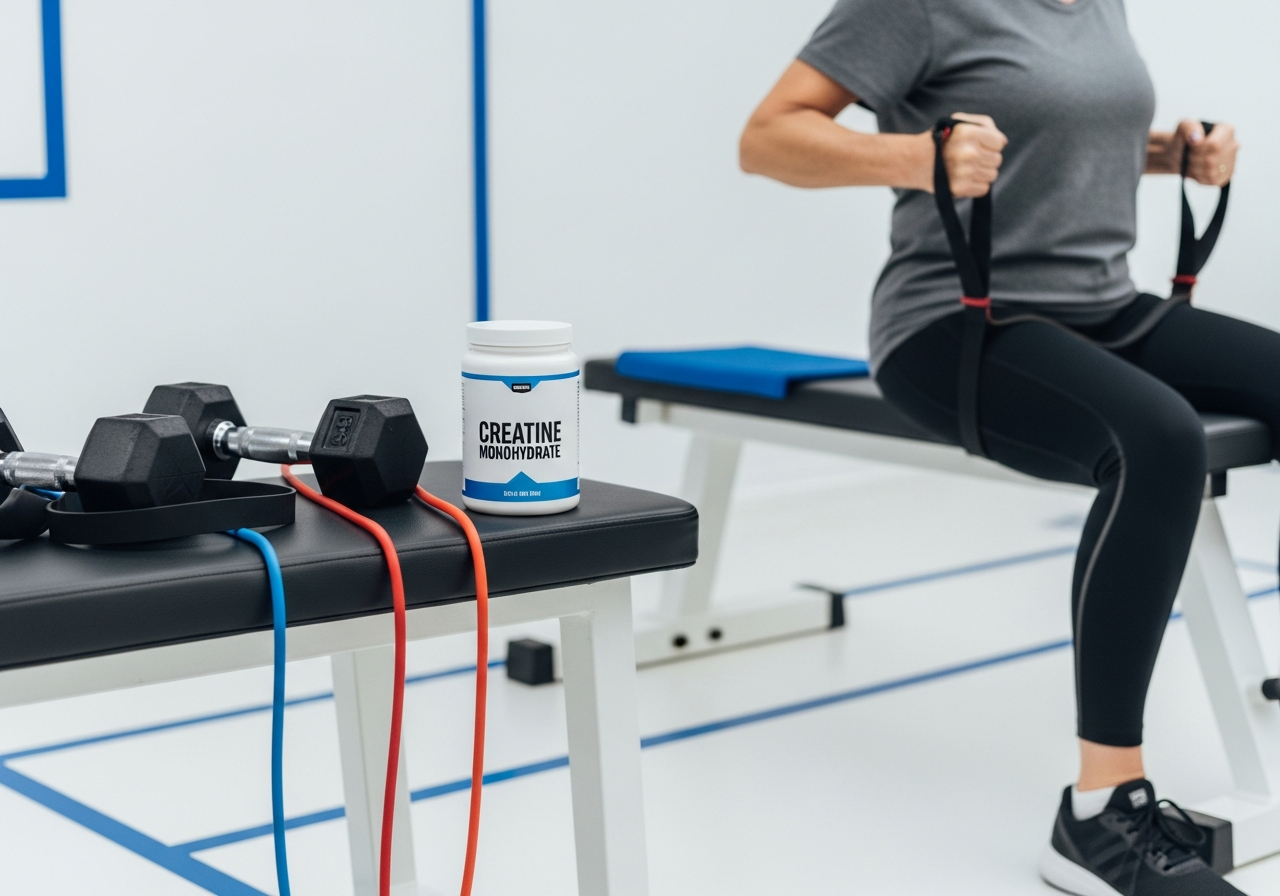
The research in adults 50 and older supports creatine most clearly when it is combined with resistance training. That is the simplest accurate summary of the evidence on sarcopenia supplements creatine.
Across trials and meta-analyses in older adults, creatine plus resistance training has generally produced greater gains in lean mass and some measures of strength than resistance training alone. The benefits are not enormous, but they are consistent enough to matter in real life, especially when accumulated over months. In plain language, creatine often helps older adults get a bit more from the same training plan.
The pattern is especially important because strength and function are what matter most in sarcopenia. Adding even modest muscle and strength improvements can make day-to-day tasks easier and may reduce how quickly age-related decline progresses. However, the evidence is not perfectly uniform. Not every study shows a benefit, and outcomes vary based on training quality, dose, sex, baseline diet, age, and whether participants were already active or frail.
Just as importantly, creatine without resistance training shows little benefit or inconsistent results in older adults. That honest limitation should be stated clearly. If an older adult is sedentary, undernourished, or unable to train because of pain or illness, creatine alone is unlikely to produce a meaningful anti-sarcopenia effect. In those cases, the first priorities are medical assessment, physical therapy or supervised exercise where appropriate, and nutrition support.
The broader evidence reviews from Examine.com’s creatine evidence summary and the ISSN position stand are aligned on two practical points: creatine monohydrate is the best-studied form, and it is most useful when paired with training.
This does not mean only gym-goers benefit. For older adults, “resistance training” can include:
- Machines in a fitness facility
- Free weights
- Resistance bands
- Chair stands, step-ups, and loaded carries progressed over time
- Supervised rehab-style strength work
The takeaway is straightforward: if your goal is to use creatine for seniors muscle support, pair it with a deliberate strengthening plan. If exercise is not possible yet, treat creatine as secondary until the main barrier to movement is addressed.
A practical step-by-step plan for using creatine against age-related muscle loss
The best way to use creatine for sarcopenia is to combine a simple daily dosing routine with a progressive strength program and adequate protein. This section gives the practical framework without replacing personalised medical advice.
- Confirm you are an appropriate candidate. If you have kidney disease, take medications that affect kidney function, have major chronic illness, or are unsure how creatine fits your medical history, discuss it with a healthcare provider first. Our kidney guide explains the creatinine confusion in more detail.
- Choose creatine monohydrate. It is the most studied, most cost-effective, and the form used in most older-adult trials. Start with plain powder unless capsules are easier for adherence.
- Use a research-consistent dose. Most older adults use 3-5 g daily, or roughly 0.1 g/kg/day. You can estimate your intake with our creatine dosage calculator.
- Take it every day, not only on workout days. Creatine works by saturating muscle stores over time. Daily consistency matters more than exact timing.
- Strength train 2-4 times per week. Focus on major movement patterns: squat or chair stand, hinge, push, pull, carry, and calf work. Use loads that feel challenging but controlled.
- Support it with protein. Older adults often need more intentional protein distribution across meals to support muscle protein synthesis.
- Reassess after 8-12 weeks. Look for changes in strength, exercise tolerance, body weight, and daily function.
What should you expect if it is working?
- Within 1-2 weeks of loading, or roughly 3-4 weeks without loading, muscles are more saturated with creatine.
- Within several weeks, training may feel slightly stronger or more repeatable.
- Within 8-12 weeks, some people notice better performance on chair stands, leg press, rowing, or daily tasks.
- Body weight may rise modestly at first because creatine increases intracellular water, not body fat.
If you want the detailed day-by-day routine, mixing methods, rest-day use, and troubleshooting, see how to take creatine and creatine for older adults. This page focuses on the sarcopenia evidence and how to use it intelligently, not on repeating every practical detail covered elsewhere.
Dosing for older adults: exact grams, body-weight examples, loading, and how long it takes
For most older adults concerned about sarcopenia, 3-5 g/day of creatine monohydrate is the standard evidence-based dose. A body-weight approach of about 0.1 g/kg/day is also commonly used in research and is especially useful for larger or smaller individuals.
Here is the simplest way to think about dosing:
| Body weight | 0.1 g/kg/day example | Practical daily dose | Best use case |
|---|---|---|---|
| 50 kg | 5 g/day | 3-5 g/day | Most older adults |
| 60 kg | 6 g/day | 5 g/day | Active older adults |
| 70 kg | 7 g/day | 5 g/day | Common maintenance target |
| 80 kg | 8 g/day | 5 g/day, sometimes modestly higher under guidance | Larger adults using body-weight dosing |
| 90 kg | 9 g/day | 5 g/day or body-weight based plan | Heavier individuals with structured training |
Do you need a loading phase? No. Loading is optional. A standard loading protocol is about 20 g/day split into 4 doses for 5-7 days, followed by a maintenance dose of 3-5 g/day. Loading saturates muscle faster, but it is not necessary for long-term results. For many older adults, especially those with sensitive digestion, simply taking 3-5 g/day is easier and more comfortable.
How long does creatine take to work?
- With loading: muscle stores can rise within about a week.
- Without loading: saturation usually builds over roughly 3-4 weeks.
- Visible functional benefit: often depends on several weeks of training, not just creatine saturation itself.
Exact timing during the day is less important than consistency. Taking creatine with a meal or post-workout can be convenient, but daily adherence is what matters most. For timing nuance, see when to take creatine. For dose specifics, how much creatine per day goes deeper.
If an older adult is eating little red meat or fish, or follows a vegetarian pattern, they may start with lower baseline creatine stores and sometimes notice a more obvious response. That is not guaranteed, but it is a biologically plausible reason why some people feel a bigger difference than others.
Creatine works better in the right context: protein, vitamin D, and resistance training still lead
Creatine should be viewed as an add-on to the fundamentals of sarcopenia care, not a replacement for them. The three pillars are resistance training, adequate protein, and correction of obvious nutritional gaps such as low vitamin D where clinically relevant.
Resistance training is still the main driver of anti-sarcopenia adaptation. Creatine helps because it can improve the quality of training, but the training itself is what provides the growth and strength signal. For many older adults, this means 2-4 sessions per week targeting major muscle groups with progressive overload, meaning the exercises gradually become harder over time.
Protein matters because older muscle is less sensitive to smaller protein doses. If an older adult is under-eating protein, creatine cannot fully compensate. A practical pattern is to include a meaningful protein source at each meal. Some people will use whey protein to make this easier; if so, mixing creatine with protein powder is perfectly reasonable.
Vitamin D is not a creatine substitute, but low vitamin D can impair broader musculoskeletal health. That is why many sarcopenia discussions mention it alongside protein and exercise. It should be assessed in the context of the person’s overall health rather than added blindly just because creatine is being used.
Other lifestyle factors matter too:
- Sleep and recovery affect training adaptation.
- Hydration helps comfort and consistency, even though creatine is not a dehydrating supplement.
- Periods of inactivity, illness, or hospitalization can rapidly worsen age-related muscle loss.
The practical hierarchy is worth repeating. If an older adult asks whether they should spend effort on training, protein, or creatine, the order is usually:
- Start or restore safe resistance training.
- Get protein intake into a sensible range.
- Consider creatine monohydrate to support the training response.
That is why the best evidence for creatine for seniors muscle consistently sits inside a bigger system rather than in isolation. Creatine is useful precisely because it complements the interventions that already work.
Safety in older adults: what is well-established, what to watch, and when to ask your doctor
Creatine monohydrate is generally considered safe for healthy older adults, but individual medical context matters more with age than it does in a healthy 22-year-old lifter. That is the balanced answer on safety.
The 2017 ISSN position stand and the 2021 review of common creatine misconceptions both support the overall safety profile of creatine monohydrate when used at recommended doses in healthy people. See Antonio et al. (2021) and Kreider et al. (2017). Mayo Clinic also notes that creatine appears safe when used appropriately, while sensibly advising medical supervision for some populations. See Mayo Clinic — Creatine.
The most common side effects are not dangerous but can be annoying:
- Mild stomach upset, especially with large single doses
- Temporary scale-weight increase from increased water inside muscle
- Occasional bloating sensation in some users
The kidney issue needs careful wording. Creatine can increase creatinine, a breakdown product often measured on blood tests. That does not automatically mean kidney damage. Creatinine is also a marker used to estimate kidney function, so supplementation can complicate interpretation. However, if an older adult already has kidney disease, reduced kidney function, or is taking nephrotoxic medications, creatine should be discussed with a physician or pharmacist first. For that deeper explanation, see is creatine bad for your kidneys? and creatine vs creatinine.
Who should be more cautious?
- People with known kidney disease
- People with complex chronic illness or multiple medications
- People with unexplained swelling, dehydration risk, or recurrent GI intolerance
- Anyone told by their clinician to avoid it based on individual labs or diagnosis
For most healthy older adults, daily creatine monohydrate at standard doses is a reasonable supplement to discuss with a healthcare provider, especially if the goal is preserving muscle and strength during aging.
Common mistakes and myths: why creatine sometimes seems not to work for elderly muscle loss
Creatine often “fails” for age-related muscle loss because people expect it to work without training, under-dose it, or stop before muscle stores have had time to saturate. Most disappointing results come from setup errors, not from creatine being useless.
Here are the biggest mistakes:
- Taking it without resistance training: this is the number one reason expectations outrun reality.
- Using tiny or inconsistent doses: a sporadic half-scoop a few times a week is not a proper protocol.
- Stopping after a week: without loading, creatine takes roughly 3-4 weeks to saturate muscle well.
- Ignoring protein intake: inadequate protein can blunt the overall muscle-building environment.
- Buying exotic forms instead of monohydrate: more expensive does not mean more effective.
And here are the myths worth debunking:
- “Creatine is a steroid.” False. Creatine is a naturally occurring compound involved in cellular energy, not an anabolic steroid.
- “Creatine only helps young bodybuilders.” False. Some of the most practical research use cases are older adults doing strength training.
- “Any weight gain means fat gain.” False. Early weight gain from creatine is usually water retained inside muscle cells, not body fat. See does creatine make you gain weight?
- “You need to cycle it.” False for most users. Daily use is standard; cycling is not required. See do you need to cycle creatine?
- “More is better.” False. For most older adults, standard doses work fine and higher amounts mostly increase the chance of GI discomfort.
There is also normal response variability. Some people notice a clear training benefit; others notice only subtle changes. A lower response can happen if baseline muscle creatine stores were already relatively high, if training is not progressive enough, or if the person’s limiting factor is pain, mobility, nerve function, or illness rather than energy availability.
That is why the right question is not just “Does creatine work?” but “Is creatine supporting the real bottleneck in this person’s sarcopenia?” Sometimes the answer is yes. Sometimes the bigger win is better rehab, better protein intake, or simply getting stronger consistently.
How to choose creatine in Canada: monohydrate, NPNs, testing, and value
In Canada, the best creatine for sarcopenia is usually a plain creatine monohydrate product from a reputable company with transparent labelling and, ideally, third-party testing. The product choice is simpler than the marketing makes it seem.
Look for these features first:
- Creatine monohydrate as the only active ingredient
- NPN on the label, meaning a Natural Product Number issued under Health Canada’s natural health product framework
- Transparent serving size in grams, not vague “scoops” only
- Third-party testing or clear quality assurance statements where available
- Minimal extras if digestion, medication interactions, or cost are concerns
The cleaner the product, the easier it is to dose consistently and judge tolerance. Micronized powder can mix more easily, but it is still just creatine monohydrate. It is not a different active ingredient.
| Option | Pros | Cons | Best for |
|---|---|---|---|
| Plain monohydrate powder | Best evidence, lowest cost, easy to adjust dose | Needs mixing | Most older adults |
| Micronized monohydrate | Mixes a bit better, same evidence base | Sometimes costs more | People bothered by texture |
| Capsules | Convenient, portable, no taste | More pills, usually higher cost per gram | People who dislike powders |
| Novel forms like HCL or buffered | Marketed as easier on the stomach | Less evidence, usually pricier | Only if monohydrate is not tolerated |
Market-research and industry estimates suggest Canadian buyers are increasingly favouring clean-label creatine, simple formulas, and trusted quality signals over flashy blends. That trend fits older adults especially well: the ideal sarcopenia product is not exciting, it is boringly reliable.
If you are comparing products, start with our best creatine rankings, creatine brand reviews, and creatine product catalog. If you specifically want the Canadian monohydrate buying angle, best creatine monohydrate in Canada goes deeper.
Why interest is rising now: healthy aging, women’s health, and the shift beyond bodybuilding
Interest in creatine and sarcopenia is rising because creatine has moved from a niche gym supplement to a mainstream healthy-aging conversation. Market-research and industry estimates increasingly place creatine inside broader trends around longevity, menopause, active aging, and evidence-based supplementation.
That trend is important context, not proof of clinical effectiveness. Search demand and product growth do not validate a treatment. What they do show is that more people now recognise creatine as something other than a bodybuilding powder. For older adults, that matters because the old stigma often kept useful conversations from happening in clinics, rehab settings, and family care discussions.
Several forces are driving that change:
- Healthy aging awareness: more adults are actively trying to preserve muscle, bone, and function rather than waiting for decline.
- Women’s creatine education: menopause and post-menopause conversations have expanded interest in muscle-preserving strategies.
- Cleaner products: plain monohydrate with clear labels fits the evidence better than “muscle matrix” blends.
- Digital health content: clinicians, physiotherapists, and science communicators now talk about creatine in a much more nuanced way.
In practical terms, this wider awareness can be positive if it leads older adults toward realistic expectations: use creatine as one small but worthwhile tool in a muscle-health plan. It becomes unhelpful only when trend-driven marketing oversells creatine as a one-step answer to frailty or muscle loss.
Canadian consumers should be especially alert here. The most trustworthy products for older adults are often the least flashy: unflavoured monohydrate, an NPN, clear dosing, and strong brand transparency. That fits the 2026 supplement landscape well, where the smart buyer increasingly values evidence and quality control over aggressive claims.
For adjacent healthy-aging questions, you may also want our guides on creatine and menopause and creatine and the brain. Those topics are related to healthy aging, but the evidence for sarcopenia remains most convincing on the muscle-and-training side.
Bottom line: should older adults use creatine for sarcopenia?
Yes, many older adults can reasonably consider creatine for sarcopenia, but only with the right expectations: creatine is most useful when paired with resistance training and good nutrition. That is the bottom line.
If you are dealing with age-related muscle loss, the evidence supports creatine monohydrate as one of the better-studied supplements available. In adults 50+, it can modestly improve lean mass and strength when combined with a structured training plan. That makes it relevant for preserving function, not just gym performance.
At the same time, it is important not to overstate it. Creatine alone is unlikely to meaningfully reverse sarcopenia in someone who is inactive, undernourished, recovering from illness, or limited by pain and disability. In those situations, the foundation remains medical assessment, strength-focused rehabilitation or exercise, adequate protein, and broader fall-prevention strategies.
A sensible non-prescriptive decision framework looks like this:
- If you are an older adult doing or starting resistance training, creatine monohydrate is worth discussing with your healthcare provider.
- If you are not yet able to train, solve that barrier first; creatine is secondary.
- If you have kidney disease, complex health issues, or medication concerns, get personalised guidance before supplementing.
- If you do use it, stick to plain monohydrate and a consistent daily dose.
For most healthy older adults, that means a simple, evidence-based routine rather than an elaborate stack. Daily creatine, progressive strength training, enough protein, and patience over months will do more than any flashy product promise.
If you want to turn this into an actual routine, continue with creatine for older adults, how long creatine takes to work, and creatine maintenance dose.
Creatine and Sarcopenia: The Numbers That Matter
- 3-5 g/day Typical maintenance dose — Standard daily creatine monohydrate range used in practice and many studies.
- 0.1 g/kg/day Common body-weight dosing approach — Frequently used research-based alternative, especially in larger or smaller adults.
- 20 g/day Optional loading dose — Usually split into 4 doses for 5-7 days, then reduced to maintenance.
- 50+ Main age group studied for this topic — Older-adult creatine and resistance-training research commonly focuses on adults over 50.
Frequently Asked Questions
Does creatine help sarcopenia?
Yes, creatine can help sarcopenia, but mainly when it is combined with resistance training. The strongest evidence in older adults shows modest improvements in lean mass and some strength outcomes compared with training alone, while creatine without exercise tends to show little or inconsistent benefit.
Can elderly people take creatine for muscle loss?
Yes, many elderly people can take creatine for muscle loss if they are otherwise appropriate candidates and their healthcare provider agrees. Creatine monohydrate is generally considered safe for healthy older adults at standard doses, but kidney disease, complex medication use, and chronic illness deserve individual review first.
What is the best creatine dose for seniors?
For most seniors, 3-5 g/day of creatine monohydrate is the standard evidence-based dose. Some studies also use about 0.1 g/kg/day, which can be useful for body-weight-based planning, but daily consistency matters more than chasing a perfect milligram target.
Does creatine work without exercise in older adults?
Usually not very well. Creatine without resistance training appears to provide little or inconsistent benefit for age-related muscle loss because its main advantage is helping muscles perform high-effort work better, and that benefit only matters if the muscle is being trained.
How long does creatine take to help aging muscle?
Creatine can saturate muscle within about a week if you use a loading phase, or in roughly 3-4 weeks with standard daily dosing alone. Functional benefits for aging muscle usually take longer because they depend on weeks to months of consistent resistance training, not just creatine saturation.
Is creatine safe for older adults with kidney concerns?
Creatine may be safe for many healthy older adults, but anyone with kidney disease or kidney-related concerns should speak with a healthcare provider before using it. Creatine can raise creatinine on bloodwork, which can confuse kidney-function interpretation even when actual kidney damage is not present.
Should older women take creatine for age-related muscle loss?
Older women may benefit from creatine for age-related muscle loss, especially if they are strength training. The logic is the same as for men: creatine supports training capacity and can modestly improve lean mass and strength outcomes, but it should be paired with exercise and adequate protein rather than used alone.
What type of creatine is best for sarcopenia?
Creatine monohydrate is the best type of creatine for sarcopenia because it is the most studied, most cost-effective, and the form used in the majority of supportive research. More heavily marketed forms are usually more expensive without stronger evidence for older adults.
Can creatine prevent falls in seniors?
Creatine should not be described as a proven fall-prevention supplement on its own. It may indirectly support factors related to falls, such as strength and physical function, when combined with training, but fall risk is multifactorial and also depends on balance, medications, vision, home hazards, and medical conditions.
Do seniors need protein and vitamin D if they already take creatine?
Yes, seniors still need to address protein intake and broader nutrition even if they take creatine. Creatine complements muscle-health basics, but it does not replace the role of sufficient protein, appropriate vitamin D assessment, and a progressive strength program in managing age-related muscle loss.