Jacked Factory Creatine Review: NSF Certified and Worth the Price?
By The Creatine Canada Research Team — Evidence-based supplement analysts
Jacked Factory Creatine Monohydrate is a solid, straightforward creatine monohydrate product, but whether it is worth the price depends on the batch testing, certification status, and your cost per gram in Canada. For most buyers, the right verdict is this: if you can verify current third-party certification and the Canadian label is legitimate, it is a good option, but plain monohydrate from a cheaper, equally tested brand often delivers the same performance.
Evidence-based · Cites 4 sources · Editorial standards
Key Takeaways
- Jacked Factory creatine is a basic creatine monohydrate product, and monohydrate is still the best-studied form.
- NSF certification matters most for tested athletes, but you should verify the exact product and current listing, not assume every tub is certified.
- The evidence-based dose is 3-5 g daily, or about 20 g daily split into 4 doses for 5-7 days if you want to load.
- Performance benefits come from saturating muscle creatine stores, not from a special brand-specific formula.
- In Canada, check for proper Health Canada/NPN labelling when applicable, seller legitimacy, and landed cost before buying.
- If the price per gram is high, you are usually paying for branding, flavouring, or certification rather than extra effectiveness.
Our direct verdict: good creatine, but not automatically the best buy in Canada
Jacked Factory Creatine Monohydrate is likely a perfectly effective creatine if the label accurately delivers pure creatine monohydrate, because creatine monohydrate works through a well-established mechanism that is not brand dependent. The most important point for anyone searching "jacked factory creatine review" is that this product lives or dies on three practical factors: purity, certification, and price per gram.
Creatine monohydrate works by increasing muscle phosphocreatine, which is stored creatine bound to phosphate and used to rapidly regenerate ATP, the cell's immediate energy currency, during short, hard efforts. The 2017 ISSN position stand concluded that creatine monohydrate is the most effective ergogenic nutritional supplement currently available for increasing high-intensity exercise capacity and lean mass during training. That statement applies to the ingredient, not to a specific Instagram-friendly brand.
So is Jacked Factory creatine worth it? Yes, if you want plain monohydrate and the product you are buying is current, legitimate, and priced competitively. No, if you are paying a large premium without getting meaningful extra value such as verified third-party testing, athlete-safe certification, or materially better Canadian availability.
For Canadian buyers, this is where the review gets more practical. Cross-border brands can look appealing online, but your true cost includes shipping, exchange, possible import friction, and whether the tub sold into Canada carries appropriate local labelling. If you just want a reliable benchmark, start with our best creatine rankings and compare Jacked Factory against products with clearly stated testing standards and dependable Canadian fulfilment.
Bottom line: Jacked Factory creatine monohydrate should work just as well as any other quality creatine monohydrate at the same dose, but it only stands out if the certification is current and the total cost in Canada makes sense.
Is Jacked Factory creatine NSF certified? Verify the exact SKU, not the brand name
If you are asking "is Jacked Factory creatine NSF certified", the safest answer is to verify the exact product listing directly rather than assume certification applies across the whole brand. Third-party certification is product specific, flavour specific in some cases, and time specific, so a brand can have certified products without every version being certified forever.
NSF Certified for Sport is one of the most meaningful supplement certifications for competitive athletes because it is designed to reduce the risk of banned-substance contamination. The International Olympic Committee consensus on dietary supplements stresses that contamination risk is real and that athletes should use batch-tested or independently certified products when possible. For a recreational lifter, certification is valuable but not essential. For a drug-tested athlete, it can be the difference between a reasonable choice and a risky one.
Here is the practical review standard we use:
- Best case: the exact Jacked Factory creatine SKU appears on a current NSF or equivalent certification directory.
- Good case: the product has credible third-party purity testing, even if not sport certification.
- Weak case: the label mentions testing in general terms but offers no specific certifier, no lot testing detail, and no directory match.
- Red flag: marketplace sellers or imported stock with outdated packaging, vague claims, or no clear chain of custody.
If you compete in a tested federation, look beyond the front label. Check the certifier's website, match the product name, and confirm the exact tub format you plan to buy. If you do not compete, the question becomes more about trust and transparency than eligibility.
Canadian shoppers should also care about retail channel quality. Buying from an authorized seller matters more than people think, especially for cross-border brands. If you want a framework for comparing certified options sold domestically, our guides on creatine brand reviews and creatine product catalog are a better starting point than random marketplace listings.
In short: Jacked Factory creatine may be a strong option if the exact product is currently certified, but you should never infer NSF status from brand reputation alone.
Why Jacked Factory creatine monohydrate works: the ingredient matters more than the logo
Jacked Factory creatine works, if it works, because it contains creatine monohydrate, not because it has a proprietary edge over other monohydrate powders. Creatine monohydrate increases intramuscular creatine stores, especially phosphocreatine, which helps muscles rapidly regenerate ATP during repeated bouts of high-intensity effort such as sprinting, lifting, jumping, and hard intervals.
That mechanism explains why the biggest benefits show up in short-duration, high-output work rather than steady easy cardio. More available phosphocreatine means you can often squeeze out an extra rep, hold power slightly longer, or recover faster between repeated efforts. Over weeks, that small bump in training quality can translate into better strength and lean-mass gains.
The science here is unusually strong for a sports supplement. The ISSN position stand and the 2021 JISSN review on creatine misconceptions both reinforce the same core point: creatine monohydrate is the reference form because it is the most studied, consistently effective, and typically the most cost-effective option. You do not need esterified, buffered, hydrochloride, or flashy blends to get the proven effect. See Antonio et al. (2021) and Examine's creatine summary for a concise synthesis.
What can you realistically expect? Most users notice one or more of these:
- slightly better performance on repeated hard sets or sprints
- improved training volume over time
- an increase in body mass from intracellular water, often early on
- better muscle fullness once stores are saturated
What it does not do is act like a stimulant. Creatine does not create a wired feeling the way caffeine does. If you take it and feel nothing acute, that is normal. Success is measured over days and weeks, not over 20 minutes.
This is why our review lens is simple: for Jacked Factory creatine monohydrate, the key question is not whether the ingredient works. It does. The key question is whether the product is pure, accurately dosed, easy to use, and fairly priced relative to other monohydrate options such as those in our guide to best creatine rankings.
Exactly how much to take, how fast it works, and what to expect week by week
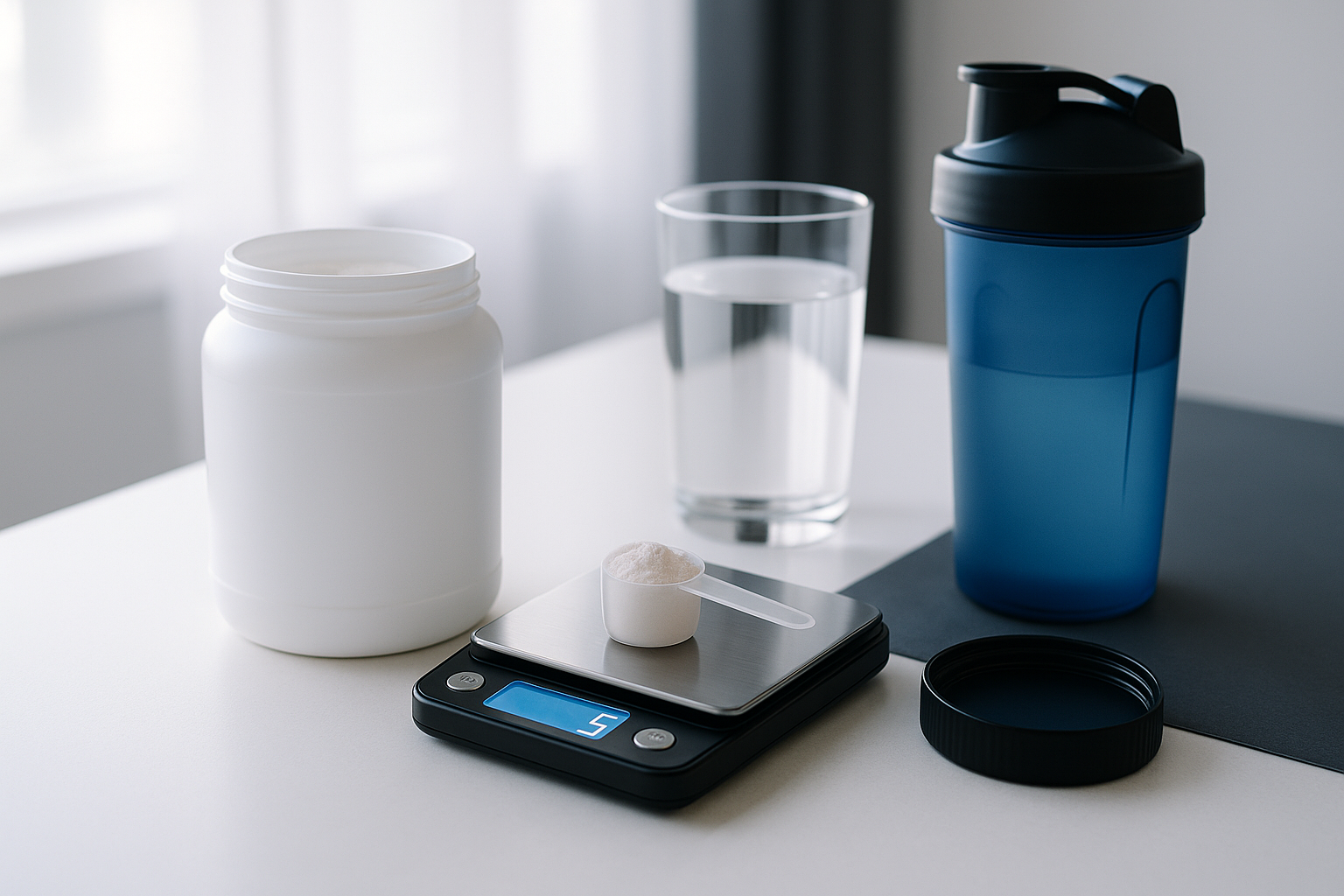
The right dose for Jacked Factory creatine is the same as for any other creatine monohydrate: 3-5 g per day for maintenance, with an optional loading phase of about 20 g per day split into 4 doses for 5-7 days if you want faster saturation. Those numbers are mainstream, evidence-based guidance and do not change because of branding.
For most adults, a simple daily 5 g dose is enough. A body-weight approach can be useful for larger athletes, but the practical reality is that 3-5 g daily covers most recreational lifters well. If you want help personalizing it, use our creatine dosage calculator or read how much creatine per day.
| Goal / Body Size | Loading Option | Daily Maintenance | What to Expect |
|---|---|---|---|
| General fitness beginner | Skip loading or 20 g/day for 5-7 days | 3-5 g/day | Gradual saturation; subtle strength and fullness changes over 2-4 weeks without loading |
| Larger strength athlete | 20 g/day for 5-7 days split into 4 doses | 5 g/day | Faster water-weight increase and earlier training benefits |
| Older adult using resistance training | Usually optional | 3-5 g/day | Best results when paired with consistent strength training |
| Weight-class or aesthetic athlete | Usually skip loading to limit rapid scale movement | 3-5 g/day | Slower saturation, less abrupt water-weight change |
A realistic timeline looks like this:
- Days 1-7 with loading: muscle stores rise faster, and scale weight may increase modestly from intracellular water.
- Weeks 2-4 without loading: stores gradually saturate and training performance may start to feel more repeatable.
- Weeks 4-8: the biggest visible benefit is often not magic muscle gain but better training quality and muscle fullness.
- Months 2-3: if your program and diet are in place, the compounding effect on strength and lean mass becomes more noticeable.
If Jacked Factory creatine is “not working,” the usual reason is not the brand. It is usually underdosing, inconsistency, poor training, or expecting a pre-workout sensation. For more on timelines and saturation, see how long creatine takes to work and creatine loading phase.
How to use Jacked Factory creatine properly: a simple step-by-step plan
The best way to use Jacked Factory creatine is to take it consistently every day at an evidence-based dose and stop overthinking the timing. Creatine works by maintaining saturated muscle stores, so your weekly consistency matters far more than whether you drink it at 8:00 a.m. or right after your last set.
- Pick your dose. Use 5 g daily if you want the simplest default. If you are smaller, sedentary, or very cautious with digestion, 3 g daily is still reasonable.
- Decide whether to load. If you want faster results, take about 20 g daily split into 4 doses for 5-7 days, then drop to 3-5 g daily. If you do not care about speed, skip loading.
- Mix it in water or a shake. Plain creatine monohydrate can be slightly gritty. Warm water often improves mixing. You can also stir it into a protein shake.
- Take it daily, including rest days. Rest-day use matters because saturation is maintained over time, not just around workouts.
- Track a few useful markers. Watch your body mass, training volume, and repeated-set performance over 4-8 weeks.
If timing helps you remember, take it with breakfast or post-workout. The difference between pre-workout and post-workout timing is small compared with the effect of actually taking it every day. If that topic matters to you, read when to take creatine and how to take creatine.
Practical mixing tips:
- Use enough fluid that you are not swallowing a paste.
- If the powder settles, swirl and drink the rest.
- Do not dry scoop it; there is no benefit and only more irritation risk.
- If you have mild stomach upset, split the dose into smaller servings.
How do you know it is working? Most people do not feel an immediate rush. Instead, signs include slightly better repeat performance, a modest increase in scale weight from water held inside muscle, and improved training quality over time. Those are the right signals to judge any Jacked Factory creatine review, because brand-level differences are far smaller than protocol-level differences.
If you want to compare formats, our creatine product catalog can help you decide whether powder, capsules, or another delivery form fits your routine better.
Who Jacked Factory creatine is best for, and who should choose something else
Jacked Factory creatine is best for people who want a plain creatine monohydrate product without unnecessary extras, but it is not automatically the best fit for every Canadian buyer. The right buyer is someone who values simplicity and is satisfied once purity, dose accuracy, and legitimate sourcing are confirmed.
It is generally a strong fit for:
- Beginners: because monohydrate is the easiest and most evidence-based place to start.
- Women: because creatine's mechanism is not male-specific, and women can benefit for strength, training capacity, and lean mass support without the old “bulky” myth.
- Older adults: because creatine paired with resistance training can support muscle function and healthy aging outcomes.
- Vegetarians and vegans: because people eating little or no meat often start with lower creatine stores and may respond especially well.
- Power and team-sport athletes: because repeated sprint and repeated effort demands align well with the phosphocreatine system.
It may be a weaker fit for:
- Drug-tested athletes if the exact Jacked Factory product you are considering does not have current sport certification.
- Budget-focused buyers if the landed cost in Canada is notably higher than domestic alternatives with similar testing quality.
- People wanting flavoured convenience if they dislike plain powder texture and would adhere better to a different format.
For women and older adults especially, it is worth repeating a key evidence-based point: creatine is not a steroid, and its benefits are not limited to bodybuilders. The 2021 JISSN review directly addressed common misconceptions around safety and use across populations. If you want a broader background first, our beginner-friendly guides on creatine for beginners and what creatine is are useful.
Canadian reality check: if you are an NCAA-style or national-level athlete, product certification may matter more than brand aesthetics. If you are a general gym-goer, value and trust usually matter more. In other words, Jacked Factory creatine quality is good enough only if the product checks the boring boxes that actually matter: clear ingredient list, verified source, and a fair total price.
Safety, side effects, and the myths that still confuse buyers
Creatine monohydrate is one of the most studied sports supplements and is generally considered safe for healthy people when used at recommended doses, but mild side effects can occur and a few cautions still matter. The strongest evidence-based concerns with Jacked Factory creatine are the same as with any monohydrate product: digestive tolerance, transient water-weight gain, and suitability for people with relevant medical conditions.
The Mayo Clinic and major sports-nutrition reviews both describe creatine as generally safe when used appropriately, with the best evidence supporting monohydrate rather than exotic forms. See Mayo Clinic's creatine overview for a mainstream clinical summary.
Common side effects that are real:
- Water-weight increase: usually from more water being held inside muscle, not from fat gain.
- Mild stomach upset or loose stools: more common with large single doses, especially during loading.
- Temporary scale changes: especially in the first one to two weeks if you load.
Common myths that need debunking:
- “Creatine hurts healthy kidneys.” In healthy people using recommended doses, evidence does not support that blanket claim, although people with kidney disease should speak to a clinician.
- “Creatine is a steroid.” False. It is a naturally occurring compound involved in energy metabolism.
- “Creatine dehydrates you or causes cramps.” That claim is not supported the way supplement folklore suggests.
- “You need to cycle it.” No. Routine cycling is not required for efficacy or safety.
Who should be more cautious? Anyone with kidney disease, complex medical conditions, pregnancy or breastfeeding questions, or medication concerns should get individual medical advice before using creatine. That is not because creatine is inherently dangerous, but because personal context matters more than generic internet reassurance.
If side effects are your main concern, troubleshoot the protocol before blaming the product. Lower the dose to 3 g daily, take it with food, split servings, and avoid dry scooping. For deeper myth-busting, read our creatine myths debunked guide and supporting safety content like is creatine safe.
So in this Jacked Factory creatine review, safety is not a unique brand advantage. It is mainly about using a well-made monohydrate product correctly and buying from a trustworthy seller.
Jacked Factory creatine quality and third-party testing: what Canadians should actually check
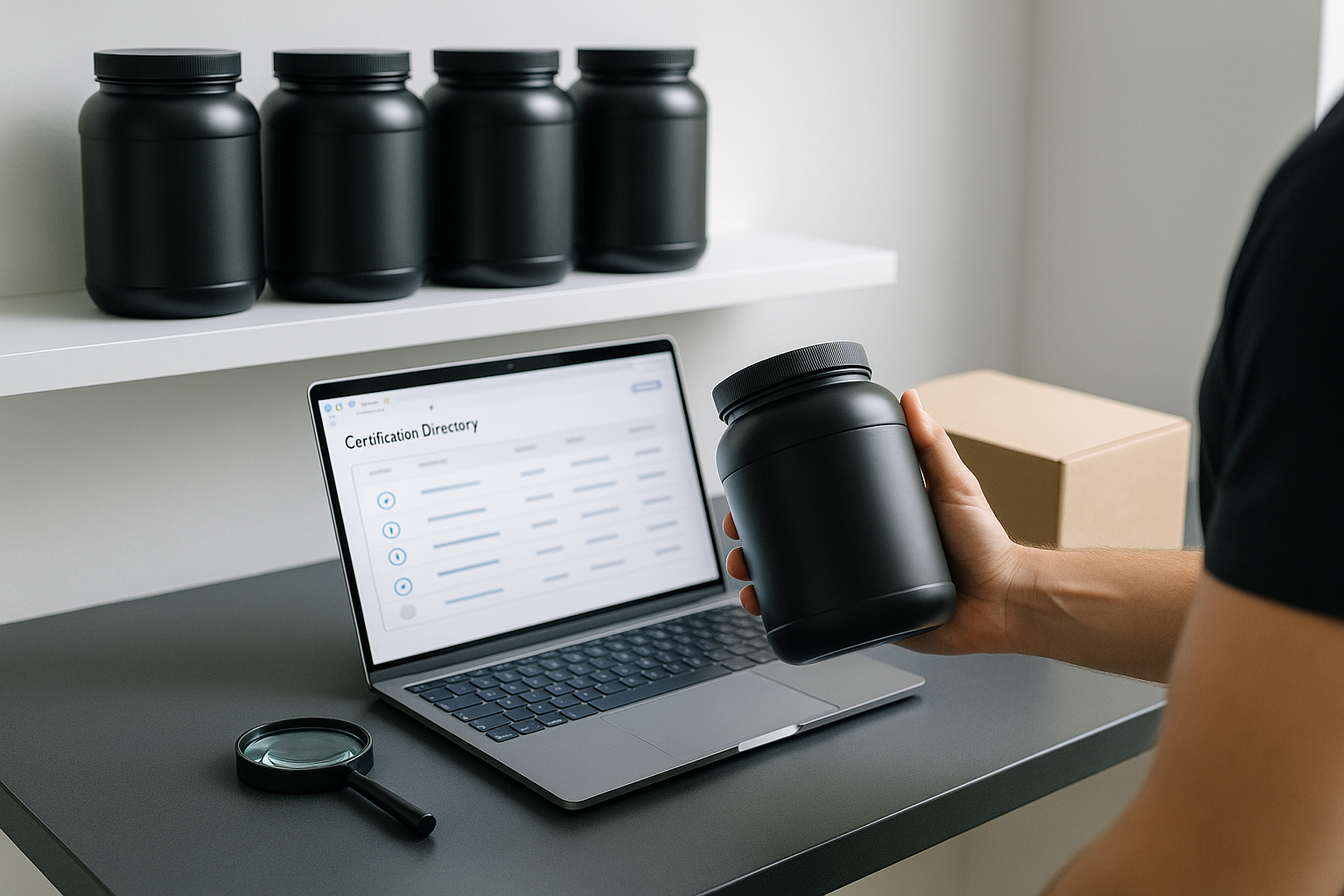
When people search "jacked factory creatine quality" or "jacked factory creatine third party", the correct question is not whether the branding looks premium; it is whether the product has verifiable quality controls that reduce the odds of mislabelling or contamination. Creatine monohydrate is a simple ingredient, which means product quality should also be simple to evaluate.
Use this checklist before buying:
- Ingredient simplicity: ideally just creatine monohydrate, especially for unflavoured products.
- Dose clarity: the label should clearly state grams per serving, not hide behind scoop sizes without gram context.
- Third-party testing: look for specific certifiers or stated testing programs, not vague “lab tested” language.
- Seller legitimacy: use authorized retailers where possible.
- Canadian compliance: confirm the product sold here uses proper local packaging where required and is not a questionable grey-market import.
In Canada, supplement buyers should understand one local term: NPN, or Natural Product Number, which is a Health Canada product licence identifier used on many natural health products. Not every supplement-shopping conversation online addresses Canadian compliance, but it matters for legitimacy and label transparency. If a creatine product is being sold broadly in Canada, review the label and seller details carefully rather than assuming a U.S. listing tells the full story.
Another practical note: marketplace listings are where quality ambiguity tends to rise. Even a good brand can become a bad purchase if the seller chain is weak. This matters more for imported products than for established domestic distribution.
If you are comparing Jacked Factory against options more readily available here, review our buyer resources on best creatine rankings, creatine brand reviews, and related guides such as third-party tested creatine in Canada if available in your browsing path. The key principle is simple: buy the product with the clearest proof of identity, purity, and seller authenticity at the best cost per gram.
That is why our final quality take is measured rather than flashy: Jacked Factory creatine may be high quality, but quality is only meaningful when the testing and sourcing claims are specific enough to verify.
Timing, mixing, and hydration: the little details that matter less than people think
The best time to take Jacked Factory creatine is the time you will reliably remember every day, because creatine timing has a much smaller effect than total daily intake and long-term saturation. People spend far too much energy debating pre-workout versus post-workout when the real determinant of success is simple adherence.
Here is the practical hierarchy:
- Most important: take 3-5 g daily.
- Second most important: keep taking it on rest days.
- Third: use enough fluid and a routine that agrees with your stomach.
- Least important: chasing the supposedly perfect minute of the day.
With or without food both work. Some people prefer to take creatine with a meal or a post-workout protein shake because it improves habit consistency and may be gentler on the stomach. You can mix it with water, juice, or protein powder. Warm water may improve dissolving, but full dissolution is not required for effectiveness. If some granules settle at the bottom, that is a texture issue, not a potency failure.
Hydration also gets overstated. You do not need a special gallon-a-day protocol just because you started creatine. You should simply maintain normal good hydration habits, especially if you train hard or sweat heavily. Creatine does not act like a diuretic in the way many beginners fear.
If you are using Jacked Factory creatine during a loading phase and feel bloated or unsettled, the fix is usually to split the dose into smaller servings rather than abandon the supplement. If you are not in a rush, skip loading and use a steady daily dose instead.
For specific practical guides, see when to take creatine, how to mix creatine, and how much water with creatine. Those implementation details will influence your real-world results more than brand marketing copy.
In short: Jacked Factory creatine timing does not need to be fancy, and better consistency beats better theorizing every time.
Jacked Factory vs other creatine options: what you are really paying for
Jacked Factory creatine should be compared against other plain creatine monohydrate products on criteria that actually affect outcomes: form, dose accuracy, testing, Canadian availability, and cost per gram. If two products contain the same pure creatine monohydrate and both are legitimate, they should produce essentially the same physiological effect at the same dose.
| Comparison Factor | Jacked Factory Creatine Monohydrate | Typical Budget Monohydrate | Premium Certified Monohydrate |
|---|---|---|---|
| Active ingredient | Creatine monohydrate | Creatine monohydrate | Creatine monohydrate |
| Expected effectiveness | High if pure and accurately dosed | High if pure and accurately dosed | High if pure and accurately dosed |
| Main differentiator | Branding, sourcing, possible testing status | Low cost per gram | Certification and athlete reassurance |
| Best for | Buyers who like the brand and can verify quality claims | Value-focused users | Drug-tested athletes or buyers prioritizing independent verification |
| Potential downside | Can be overpriced in Canada | Testing transparency may be weaker | Higher price per gram |
This is the central buying truth many reviews miss: the extra money does not buy extra creatine effectiveness once purity and dose are equal; it usually buys convenience, certification, flavouring, or brand trust.
So how should you evaluate the premium? Ask these questions:
- Is the product currently third-party tested in a way I can verify?
- Is it easier to buy reliably in Canada than competing products?
- Is the scoop accurately giving me the stated grams?
- Am I paying materially more for a result I could get from another reputable monohydrate?
If you are choosing between Jacked Factory and other brands sold in Canada, compare them side by side using our best creatine rankings, creatine brand reviews, and buying guides like best creatine monohydrate in Canada where relevant in site navigation. The smart buyer metric is not “which tub looks hardestcore?” It is “which product gives me verified creatine monohydrate at the best total value with acceptable certification for my needs?”
The most common mistakes people make with Jacked Factory creatine
The biggest mistakes with Jacked Factory creatine are not unique to the brand; they are the same mistakes that make people think creatine “doesn't work” when the problem is really poor use. Most creatine disappointments come from inconsistency, unrealistic expectations, or paying for the wrong buying priorities.
- Taking it only on workout days. Creatine works best when taken daily because muscle saturation is the goal.
- Underdosing. Half a scoop here and there is not a real protocol. Use 3-5 g daily unless you have a reason to customize.
- Expecting a stimulant effect. Creatine is not pre-workout; you may feel nothing acutely.
- Stopping after one week. Without loading, it often takes a few weeks to reach meaningful saturation.
- Overpaying for branding. A premium tub is not automatically a premium result.
- Ignoring certification needs. Competitive athletes should not treat contamination risk casually.
- Blaming mild water-weight gain. Early scale changes often reflect intracellular water, not fat gain.
Another common mistake in Canada is buying from whichever listing is cheapest without checking the seller. A bargain is not a bargain if the stock is old, the chain of custody is unclear, or the tub is not intended for the Canadian market. This is especially relevant for cross-border supplements.
If your goal is to get the most from Jacked Factory creatine, use this quick troubleshooting flow:
- Have you taken at least 3-5 g daily for 3-4 weeks, or loaded properly?
- Are you training hard enough to notice repeated-effort improvements?
- Have you tracked body mass, reps, or workload rather than relying on “feel”?
- Are you buying a legitimate product from a trusted seller?
If the answer to any of those is no, fix that first. For a deeper walkthrough, related guides like creatine not working, common creatine mistakes, and does creatine make you gain weight are the next read.
The sharpest summary is this: most failed creatine experiences are user-error problems, not ingredient problems, and certainly not proof that one monohydrate brand is uniquely ineffective.
Bottom line: should Canadians buy Jacked Factory creatine?
Canadians should buy Jacked Factory creatine only if the exact product is legitimate, the current testing or certification status meets their needs, and the total delivered price is competitive with other pure monohydrate options. That is the fairest, most evidence-based answer to the question behind this entire Jacked Factory creatine review.
If all you want is proven creatine performance, remember the non-negotiable science: 3-5 g per day of creatine monohydrate is the protocol that matters most. The ingredient has decades of supportive evidence. The logo on the tub matters far less than accurate dosing, purity, and consistency.
Buy Jacked Factory if:
- you want a plain monohydrate formula
- you can verify current third-party testing or certification where relevant
- the cost per gram in Canada is reasonable after shipping and exchange
- you trust the seller and packaging
Skip it and buy another monohydrate if:
- the certification status is unclear and you are a tested athlete
- the product is significantly more expensive than equally credible Canadian options
- you cannot verify that the listing is authentic or intended for the Canadian market
For most general gym-goers, the smartest move is often not brand chasing but selecting a dependable, well-tested monohydrate from a trusted retailer and then using it consistently for at least 4-8 weeks. If you are still comparing, browse our best creatine rankings, creatine brand reviews, and creatine product catalog to benchmark Jacked Factory against alternatives.
Final verdict: Jacked Factory creatine monohydrate appears to be a credible product category-wise, but it is only worth the price when its testing transparency and Canadian total value are genuinely competitive.
Jacked Factory Creatine Review: the numbers that actually matter
- 3-5 g/day Standard maintenance dose — Evidence-based daily intake for most adults using creatine monohydrate
- 20 g/day Typical loading dose — Usually split into 4 doses for 5-7 days to saturate faster
- 5-7 days Loading timeline — Fastest common protocol for raising muscle creatine stores
- 2-4 weeks No-loading timeline — Typical time to approach saturation with steady daily dosing
Frequently Asked Questions
Is Jacked Factory creatine NSF certified?
Maybe, but you should verify the exact product listing rather than assume the whole brand is NSF certified. Certification is product specific and can change over time, so the safest approach is to confirm the exact SKU on the certifier's current directory before buying, especially if you are a tested athlete.
Is Jacked Factory creatine monohydrate a good creatine?
Yes, Jacked Factory creatine monohydrate can be a good creatine if it is pure, accurately dosed, and sold through a legitimate channel. Because creatine monohydrate is the most studied and most consistently effective form, the main differences between brands are testing transparency, price per gram, and retailer trust rather than muscle-building power.
Does Jacked Factory creatine work better than other monohydrate brands?
No, Jacked Factory creatine should not work better than another equally pure, accurately dosed creatine monohydrate. Once the ingredient and dose are the same, performance differences are expected to be minimal, so certification, value, and Canadian availability become the real buying criteria.
How much Jacked Factory creatine should I take per day?
Most people should take 3-5 g of Jacked Factory creatine per day. If you want faster saturation, you can use a loading phase of about 20 g per day split into 4 doses for 5-7 days, then continue with 3-5 g daily.
When should I take Jacked Factory creatine?
Take Jacked Factory creatine whenever you are most likely to remember it consistently every day. Pre-workout, post-workout, or with a meal are all acceptable, because creatine benefits depend much more on long-term saturation than on precise timing.
Can I buy Jacked Factory creatine in Canada?
Yes, Canadians can often buy Jacked Factory creatine online, but the better question is whether the seller, labelling, and total landed price make it a smart purchase. Check for legitimate Canadian-facing retail channels, clear packaging, and whether shipping or exchange rates erase its value advantage.
Is Jacked Factory creatine third-party tested?
It may be, but you should look for specific third-party testing details rather than vague quality claims. A trustworthy listing should identify a certifier or testing standard clearly enough that you can verify it independently.
Does Jacked Factory creatine cause bloating or weight gain?
Jacked Factory creatine can cause a modest early increase in body weight, but that is usually from water being stored inside muscle rather than from fat gain. Some people describe this as bloating, although true digestive bloating is more often linked to large doses or poor tolerance during loading.
Is Jacked Factory creatine safe?
For healthy adults using recommended doses, Jacked Factory creatine should be as safe as other creatine monohydrate products, assuming the product is legitimate and accurately labelled. People with kidney disease, medical conditions, or medication concerns should speak with a clinician before use.
Is Jacked Factory creatine worth the price?
Jacked Factory creatine is worth the price only if its testing, certification, and Canadian delivered cost compare well with other pure monohydrate products. If it is much more expensive without stronger verification or athlete-safe certification, it is usually not the best value.