Cheapest Creatine in Canada: Best Value Per Gram (Without Sacrificing Quality)
By The Creatine Canada Research Team — Evidence-based supplement analysts
The cheapest creatine in Canada is almost always plain, unflavoured creatine monohydrate powder bought by cost per gram, not by tub price or flashy branding. If you want the best cheap creatine without sacrificing quality, choose a single-ingredient monohydrate with a valid NPN, then compare the total grams of creatine, not the number of servings or the scoop size.
Evidence-based · Cites 4 sources · Editorial standards
Key Takeaways
- For most Canadians, the best cheap creatine is plain creatine monohydrate powder with no extras.
- Judge creatine price in Canada by cost per gram, because tub size and serving counts can be misleading.
- A standard maintenance dose is 3-5 g/day, so 1 kg of creatine lasts roughly 200-333 days depending on dose.
- Loading is optional: 20 g/day split into 4 doses for 5-7 days saturates faster, but costs more upfront and can increase stomach upset.
- Flavoured powders, gummies, capsules, and proprietary blends usually raise the price without improving results.
- In Canada, look for a Natural Product Number (NPN) and ideally third-party testing if you are a tested athlete.
- The cheapest creatine is only a good deal if it is pure, accurately dosed, and practical enough that you will actually take it daily.
What is the cheapest creatine in Canada? The direct answer most shoppers actually need
The cheapest creatine in Canada is usually plain creatine monohydrate powder in a larger size, because monohydrate is the most studied, most effective, and typically the lowest-cost form per gram. If you are searching for cheapest creatine Canada, cheapest creatine, affordable creatine Canada, or budget creatine, the practical answer is simple: buy a single-ingredient monohydrate and compare cost per gram of actual creatine.
This matters because supplement labels are built to distract you. A cheaper-looking tub may have fewer grams, a tiny scoop size, added flavour systems, or a "performance blend" that reduces how much real creatine you get. A product marketed as discount creatine can cost more in the long run than a larger plain tub once you calculate the grams you are actually buying.
For most people, the best cheap creatine is:
- Creatine monohydrate, not HCL, gummies, capsules, or blends
- Unflavoured, because flavouring adds cost but not performance
- Single ingredient, ideally only "creatine monohydrate" on the label
- Larger sizes, which often lower the cost per gram
- Canadian-compliant, meaning it should have an NPN, or Natural Product Number, showing it is licensed for sale in Canada
The evidence base strongly supports this approach. The 2017 ISSN position stand concluded that creatine monohydrate is the most effective ergogenic nutritional supplement currently available for increasing high-intensity exercise capacity and lean mass during training. That is exactly why you should not pay extra for more heavily marketed forms unless you have a very specific reason.
If you want a shortlist of strong options after you understand the value math, see our best creatine rankings and browse the current creatine product catalog. If you want the one-sentence rule, here it is: the creatine best price is the product with the lowest cost per gram of plain monohydrate that still meets quality and compliance standards.
Creatine cost per gram: the only pricing metric that reliably finds the best value
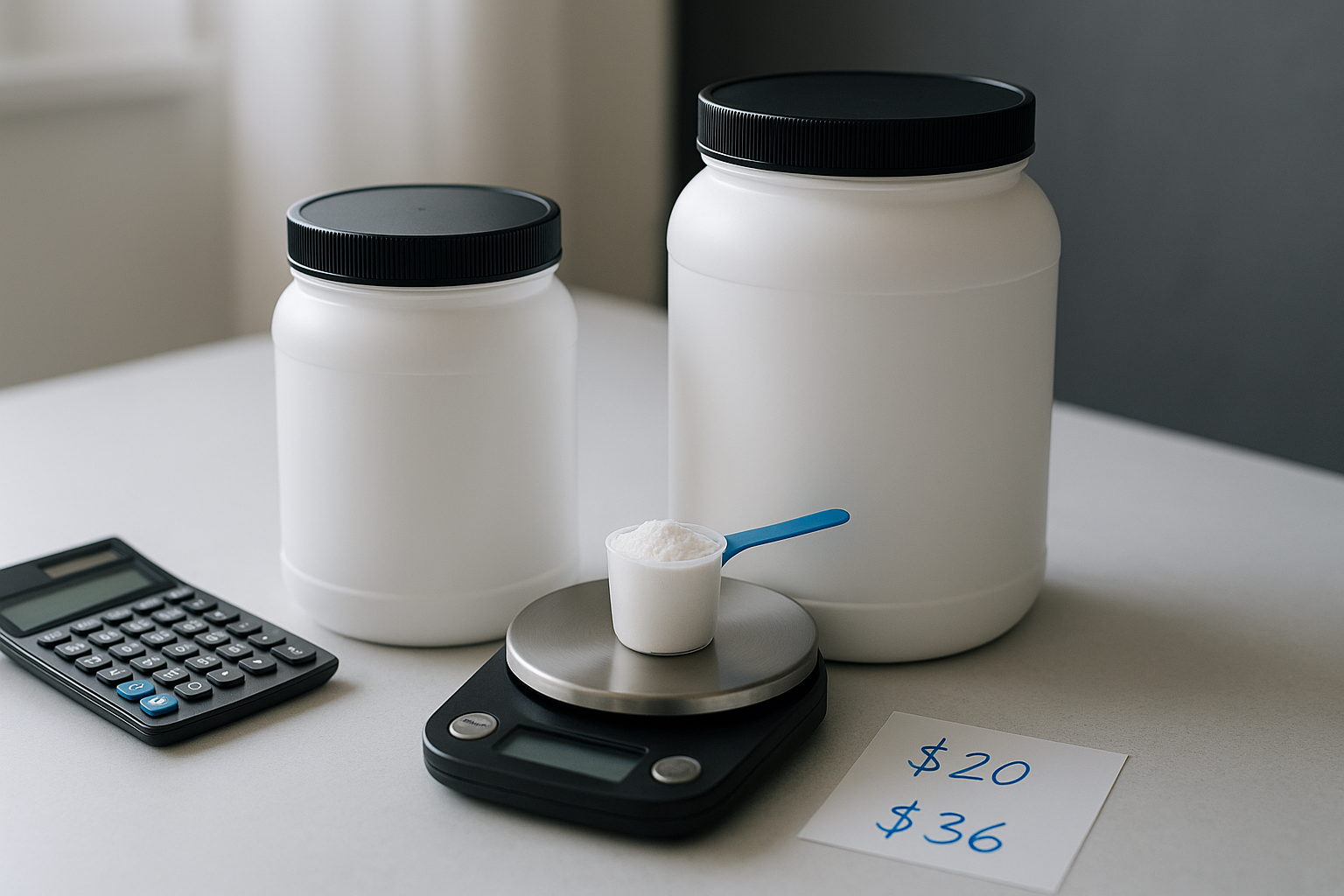
The best way to find inexpensive creatine is to calculate cost per gram, because tub price, servings, and scoop claims are all easy to manipulate. If you want the cheapest creatine monohydrate, divide the total price by the total grams of creatine in the container.
Use this formula:
Cost per gram = Total price ÷ Total grams of creatine
Then use a second practical calculation:
Daily cost = Cost per gram × your daily dose
Here is a simple comparison example:
| Product type | Container size | Price | Cost per gram | Daily cost at 5 g |
|---|---|---|---|---|
| Plain monohydrate powder | 300 g | $24 | $0.08/g | $0.40/day |
| Plain monohydrate powder | 1,000 g | $55 | $0.055/g | $0.275/day |
| Flavoured creatine blend | 300 g total product | $35 | Varies; often worse value because not all grams are creatine | Usually higher |
| Capsules | 120 capsules | $30 | Usually higher than powder | Usually much higher |
Notice the trap: the cheapest-looking tub at checkout is not always the cheapest creatine. A bigger tub with a higher sticker price can be the superior value by a wide margin. This is why shoppers searching creatine price Canada, creatine best price, or creatine on sale Canada should compare the price against net creatine weight, not branding.
Also watch for these label tricks:
- "Servings" inflation: a serving may be 3 g instead of 5 g, making the tub look bigger on paper
- Blend formulas: total powder weight is not the same as creatine weight
- Flavouring and sweeteners: they raise cost per gram without improving saturation
- Gummies and chews: convenience is real, but value is usually poor
If you do not want to do the arithmetic yourself every time, our creatine dosage calculator helps with dose planning, and our guide on creatine brand reviews can help you assess whether a low price still comes with acceptable quality. The bottom line is straightforward: for value shopping, cost per gram beats cost per tub every time.
Why cheap creatine monohydrate still beats fancy forms on both evidence and price
The best cheap creatine is still creatine monohydrate because it has the strongest evidence, the most predictable dosing, and usually the lowest cost per effective gram. In 2026, that conclusion is still well-established, not controversial.
Creatine works by increasing muscle stores of phosphocreatine, the stored high-energy compound that helps regenerate ATP, or adenosine triphosphate, during short, hard efforts. More stored phosphocreatine means you can often perform slightly more total work in repeated sprints, heavy sets, jumps, or explosive efforts. Over weeks and months, that higher training quality can translate into better strength and lean-mass gains.
The key point for buyers is that this mechanism depends on getting enough creatine into muscle consistently, not on buying a premium-sounding form. The 2021 JISSN review on common questions and misconceptions about creatine notes that creatine monohydrate remains the form with the most evidence for efficacy and safety. Alternative forms may be marketed as needing smaller doses or causing less bloating, but those claims are not supported strongly enough to justify a routine premium for most users.
Why monohydrate wins for budget shoppers:
- It is the reference form used in most research
- It works at standard doses of 3-5 g/day
- It is widely available in Canada
- It is typically the lowest price per effective dose
- It avoids paying extra for weakly supported marketing claims
Micronized monohydrate can be a reasonable middle ground if you want slightly better mixability, but it is still monohydrate. That means it may justify a small premium for convenience, not for superior physiological effects.
If you are comparing monohydrate against HCL or niche forms, start with our guide to best creatine rankings and then read deeper on creatine myths debunked. For almost everyone chasing discount creatine or affordable creatine Canada, the decision tree is simple: buy monohydrate first, then evaluate quality, then evaluate price. Anything else usually flips that order and makes you pay more for less proof.
How to buy affordable creatine in Canada without accidentally buying low-quality powder
You can buy cheap creatine safely in Canada if you screen for purity, compliance, and practicality before you chase the lowest price. The smartest budget strategy is not "buy the cheapest tub"; it is "buy the cheapest legit tub that you will use consistently."
Use this step-by-step checklist:
- Confirm the ingredient list. Ideally it should list only creatine monohydrate.
- Check for an NPN. In Canada, a Natural Product Number indicates the product is licensed as a natural health product.
- Look at the grams, not just servings. Compare total grams of creatine in the container.
- Calculate cost per gram. This is the real value metric.
- Check third-party testing if relevant. Tested athletes should value NSF Certified for Sport or Informed Sport-style screening where available.
- Consider shipping and border costs. A US bargain often stops being cheap after shipping, duties, exchange, or customs delays.
- Avoid unnecessary formats. Capsules, gummies, flavoured blends, and RTDs nearly always increase cost.
In Canada, quality clues include:
- NPN on label
- Lot number and expiry
- Clear serving information in grams
- No proprietary blend hiding the dose
- Reputable retailer or brand page
Who should care most about extra verification? Competitive athletes, people subject to drug testing, and buyers who want stricter contamination screening. The International Olympic Committee consensus on dietary supplements highlights the need for athletes to manage contamination risk carefully. In practical terms, that means the absolute cheapest product is not always the best buy if it comes with vague sourcing or weak testing.
For general gym users, however, a plain monohydrate from a reputable seller is usually enough. You can compare options in our creatine product catalog and then dig into specific creatine brand reviews if two products look similarly priced.
The money-saving rule is this: pay for purity and reliability first, then strip away every non-essential extra. That is how you find the best cheap creatine instead of a cheap-looking product that disappoints.
The best tub size for budget creatine: when bigger really is cheaper, and when it is not
The cheapest creatine Canada shoppers can buy is often a larger tub or pouch, but only if you will finish it before it picks up moisture or if the seller is not inflating shipping. Bigger is usually better for value, but not automatically.
At a maintenance intake of 3-5 g/day:
- 300 g lasts about 60-100 days
- 500 g lasts about 100-166 days
- 1,000 g lasts about 200-333 days
That means a 1 kg bag can be excellent value if you take creatine daily year-round, which is what evidence-based use generally looks like. The issue is not shelf life so much as storage and convenience. Creatine powder is fairly stable when kept dry, but repeated exposure to humid air can cause clumping. Clumping does not automatically mean the product is ruined, but it can make measuring and mixing annoying.
As a practical buying rule:
- Choose 300-500 g if you are new, testing tolerance, or unsure you will use it daily
- Choose 1,000 g or more if you already know you are consistent and the cost per gram drops meaningfully
- Skip giant bulk buys if shipping costs are high or you live in a humid environment and leave tubs open often
Canadian buyers should also factor in regional shipping. A creatine best price deal online can lose its edge if you are paying a premium to remote provinces or territories. If free-shipping thresholds push you to buy more, make sure the extra quantity truly lowers your annual cost and does not just increase cart size.
Good storage habits protect value:
- Keep the lid tightly sealed
- Store it somewhere cool and dry, not beside a steamy shower
- Use a dry scoop every time
- Do not refrigerate unless moisture is controlled
If you want the shortest answer: the best value tub is the largest plain monohydrate size you can use consistently, store properly, and buy at a genuinely lower cost per gram after shipping. That is how you turn cheap creatine monohydrate into a real long-term saving rather than a cupboard full of damp powder.
Creatine dosing that saves money: exact grams by goal, body weight, and whether you load
The most cost-effective creatine dose for most people is 3-5 g/day of creatine monohydrate, because it maintains muscle saturation without unnecessary overspending. If you are price-conscious, your dosing strategy matters almost as much as the product you buy.
There are two standard evidence-based approaches:
| Approach | Protocol | Who it suits | Budget impact |
|---|---|---|---|
| Loading + maintenance | 20 g/day split into 4 doses for 5-7 days, then 3-5 g/day | People who want faster saturation | Higher upfront use |
| Steady daily dosing | 3-5 g/day every day | Most beginners and budget buyers | Lowest cost and simplest routine |
Body weight can guide dosing nuance, although a flat 3-5 g/day works well for most adults:
- Under 60 kg: 3 g/day is often sufficient
- 60-90 kg: 3-5 g/day fits most users
- Over 90 kg: 5 g/day is a practical default
Goal also matters:
- General fitness or beginners: 3-5 g/day
- Strength and hypertrophy focus: 5 g/day is common
- Older adults training for muscle function: 3-5 g/day is typically appropriate
- Vegetarians or vegans: 3-5 g/day is still standard, though response may be more noticeable because baseline stores can be lower
Loading is not necessary for results. It simply saturates muscles faster. If money, simplicity, or digestion matters most, daily 3-5 g is the best cheap creatine strategy. If speed matters because you want to feel the benefit sooner, loading is a valid option, but it burns through more powder in the first week.
To personalise your dose, use our creatine dosage calculator, then read more in how much creatine per day and creatine loading phase. The budgeting takeaway is simple: you do not need high doses forever, and taking more than you need does not create proportionally better results.
When to take cheap creatine, how long it takes to work, and how to tell your money is paying off
The best time to take affordable creatine is simply the time you will remember it every day, because consistency matters far more than precise timing. If you are using the cheapest creatine monohydrate correctly, the biggest indicator of value is not the clock; it is whether your muscle stores reach saturation and stay there.
What to expect:
- With loading: many people notice body-weight changes and training effects within 1-2 weeks
- Without loading: saturation usually builds gradually over roughly 3-4 weeks
- Longer-term: the real payoff shows up over months of harder, more productive training
Signs your creatine is working can include:
- A small increase in scale weight early on due to more intracellular water
- Improved repeat performance on hard sets, sprints, or intervals
- Slightly better training volume, such as one more rep or an extra set at the same load
- Gradual improvement in strength or lean mass over time when training and diet are dialled in
Creatine does not feel like a stimulant. There is usually no immediate rush. That is one reason people sometimes think inexpensive creatine is "not working" when it is actually doing exactly what it should. Creatine is a saturation supplement, not an acute buzz supplement.
For routine timing, pick one of these:
- With breakfast every day
- In your post-workout shake on training days and with any meal on rest days
- At the same daily time using a habit anchor such as brushing your teeth or making coffee
The budget angle is important here. Missing doses makes even discount creatine expensive because unused potential is wasted money. The cheapest tub in Canada becomes poor value if you forget to take it. That is why practical adherence matters more than theoretical perfection.
For timing nuance, see when to take creatine, and if you want a realistic expectation-setting guide, read how long does creatine take to work. The short answer: take it daily, expect gradual performance improvements, and judge value by months of consistent use rather than one workout.
Who budget creatine is perfect for, and who should spend extra on testing or format
Budget creatine is ideal for most healthy adults who want proven results at the lowest effective cost, but some buyers should pay extra for testing, convenience, or sport-specific assurance. Cheap does not have to mean low-end; it just means stripping away non-essential costs.
Beginners are often the best candidates for plain monohydrate. It is simple, well researched, and easy to dose at 3-5 g/day. New users do not need advanced formulas; they need a product they can understand and afford to take consistently.
Women can use the same evidence-based monohydrate approach as men. The common myth that women need a special creatine is mostly marketing. In reality, the same cheap creatine monohydrate often makes the most sense, though some women may prefer smaller tubs or finer powders for easier mixing. For more, see creatine for women.
Older adults can also do very well with basic monohydrate, especially when paired with resistance training. There is no inherent need for a premium form. What matters is tolerance, adherence, and clarity of dosing. More detail is in creatine for older adults.
Vegetarians and vegans are often especially good candidates for creatine supplementation because dietary intake of creatine is lower without meat or fish. Again, plain monohydrate is usually the most rational buy.
Competitive or tested athletes are the group most likely to justify paying more. Not because monohydrate stops working, but because certification and contamination screening can matter. If your sport, league, or federation uses strict anti-doping rules, paying a premium for stronger third-party testing may be the wisest value choice overall.
People with sensitive digestion may prefer micronized monohydrate or smaller divided doses. That is a practical reason to pay a little more if it genuinely helps compliance.
Who may need extra caution? Anyone with a relevant medical condition, anyone taking medications with possible interactions, or anyone under direct medical supervision should check with a clinician before starting. Creatine has a strong safety record in healthy people, but individual context matters.
The bottom line is this: for the vast majority of Canadians, affordable creatine Canada means plain monohydrate; the main reasons to spend more are certified testing, convenience, or personal tolerance.
Is the cheapest creatine safe? What the evidence says, plus the red flags to avoid
Cheap creatine can be safe if it is genuine creatine monohydrate from a legitimate source, because safety depends more on product integrity and dosing than on premium branding. The evidence base on creatine monohydrate is broad and reassuring for healthy users taking standard doses.
The Mayo Clinic overview of creatine and the ISSN position stand both reflect a mainstream scientific view: creatine monohydrate is generally considered safe for healthy people when used appropriately. Common side effects, when they occur, are usually mild and practical rather than dangerous.
Most common issues:
- Stomach upset, especially with large single doses
- Temporary water-weight gain, often early in use
- Grittiness or poor mixability, which is annoying but not harmful
How to reduce side effects without spending much more:
- Take 3-5 g/day instead of aggressive loading if you have a sensitive stomach
- Split doses during loading instead of taking all 20 g at once
- Mix in plenty of fluid
- Take it with food if your stomach prefers that
Quality red flags matter more when buying discount creatine:
- No NPN on a product sold in Canada when one should reasonably be present
- Vague ingredient list or proprietary blend language
- No clear gram amount per serving
- Seller with poor traceability or questionable marketplace sourcing
- Claims that it is "300% better than monohydrate" without evidence
One important medical nuance: creatine can increase creatinine on a blood test, and creatinine is a breakdown marker often used in kidney assessment. That does not automatically mean kidney damage. It can simply reflect higher creatine turnover. If you have kidney disease or a clinician has asked you to avoid certain supplements, get individual medical advice first.
For deeper myth-busting, read creatine myths debunked and our safety content on related concerns. But for a healthy adult using a reputable product, the simple verdict is: the cheapest creatine is safe enough when it is plain monohydrate, properly labelled, and used at standard doses.
The buying and dosing mistakes that quietly turn cheap creatine into an expensive supplement
The most common reason people overpay for creatine is not choosing the wrong molecule; it is making avoidable buying and dosing mistakes that destroy value. If you want the best cheap creatine, avoid the habits that make a low sticker price meaningless.
Mistake 1: Buying by sale tag instead of cost per gram. A product labelled creatine on sale Canada can still be poor value if the tub is small or full of non-creatine extras.
Mistake 2: Paying for flavour, gummies, or capsules. These can be convenient, but they are rarely the cheapest creatine option. If budget is your top priority, powder wins.
Mistake 3: Confusing scoop size with creatine content. A larger scoop does not mean more creatine if part of the scoop is flavouring, acids, or sweeteners.
Mistake 4: Taking too much daily. Once muscle stores are saturated, more is not necessarily better. Overshooting your needed dose wastes money.
Mistake 5: Inconsistent use. Missing days repeatedly undermines saturation, slowing or blunting results and reducing the value you get from every dollar spent.
Mistake 6: Buying from sketchy marketplaces. A bargain is not a bargain if the source is questionable, storage is poor, or authenticity is uncertain.
Mistake 7: Importing a US deal without calculating the true landed cost. Exchange rates, shipping, duties, and delays can make an imported tub more expensive than a Canadian listing with an NPN and faster delivery.
Here is the smart correction path:
- Buy plain monohydrate
- Choose a reputable Canadian seller
- Calculate cost per gram after shipping
- Take 3-5 g/day consistently
- Store it properly so the powder stays easy to use
If you are troubleshooting results rather than shopping, our guides on creatine for beginners and how to take creatine are useful next reads. The broad lesson is simple: cheap creatine only stays cheap when you buy the right format, dose it correctly, and actually take it every day.
A practical Canadian shopping framework: how to compare creatine deals in 60 seconds
The fastest way to compare creatine deals in Canada is to use a 60-second framework that checks legality, purity, and true price in the right order. If you follow this sequence, you can screen most products immediately.
- Check the form. If it is not creatine monohydrate, ask why you are paying more.
- Check the ingredient list. Single-ingredient products are easiest to price and trust.
- Check the NPN. In Canada, that is a useful compliance signal.
- Check total grams. Ignore the marketing headline and find the actual net creatine amount.
- Calculate cost per gram after shipping. This is the true deal score.
- Check testing and seller credibility. Especially important for athletes.
- Check practical fit. If it tastes awful, clumps badly, or comes in an inconvenient size, adherence may suffer.
Use this mental ranking system:
- Best value: plain monohydrate, low cost per gram, NPN, reputable seller
- Good value: micronized monohydrate, slightly higher price, improved mixability
- Fair value for specific users: certified sport-tested monohydrate, higher price justified by testing
- Poor value: flavoured blends, capsules, gummies, liquid shots, proprietary formulas
This is also where internal comparison resources help. Our creatine product catalog lets you scan available options quickly, and the best creatine rankings can help if you want a curated starting point rather than a spreadsheet. For product-specific deep dives, use our creatine brand reviews.
If you find yourself hesitating between two products, ask one question: Will the pricier one improve my outcome, or just my perception? In many cases, especially for general lifters, the answer is perception. Monohydrate either saturates muscle stores or it does not. That is why the creatine best price usually belongs to the product with the fewest unnecessary frills.
The Canadian bottom line: the winning deal is the licensed, reputable monohydrate with the lowest cost per gram after all checkout costs, not the most aggressively marketed "sale".
Bottom line: the smartest way to buy the cheapest creatine in Canada
The smartest way to buy the cheapest creatine in Canada is to choose a reputable, single-ingredient creatine monohydrate powder, verify the NPN, and compare total cost per gram after shipping. That is the answer for almost every search variation on this topic, including cheapest creatine Canada, affordable creatine Canada, best cheap creatine, and inexpensive creatine.
If you remember only five rules, make them these:
- Buy monohydrate. It is the most studied and usually the cheapest effective form.
- Buy unflavoured if budget matters. Extras raise price without improving results.
- Compare cost per gram, not tub price. This is the single best value filter.
- Take 3-5 g/day consistently. Cheap powder only works if you use it daily.
- Pay extra only when there is a real reason. Sport certification, better mixability, or personal tolerance can justify a premium; hype cannot.
Creatine is one of the rare supplements where the evidence and the budget answer point in the same direction. The product with the strongest research support is also usually the product with the lowest long-term cost. That is unusually consumer-friendly.
If you want to go one step further, use our creatine dosage calculator to estimate your personal daily needs, then compare current options in the creatine product catalog. From there, our best creatine rankings and creatine brand reviews can help you narrow your shortlist.
The final verdict is crisp: the cheapest creatine worth buying in Canada is plain creatine monohydrate from a compliant, trustworthy seller at the lowest true cost per gram. If a pricier product cannot beat that standard with better testing or a practical advantage you genuinely need, it is not a better buy.
Cheapest Creatine in Canada: The Numbers That Matter
- 3-5 g/day Standard maintenance dose — The usual daily intake for most adults once using creatine consistently.
- 20 g/day Optional loading dose — Typically split into 4 doses for 5-7 days to saturate muscle stores faster.
- 5-7 days Typical loading timeline — How long a standard loading phase usually lasts.
- 200-333 days How long 1 kg can last — At 5 g/day it lasts about 200 days; at 3 g/day it lasts about 333 days.
Frequently Asked Questions
What is the cheapest type of creatine?
The cheapest type of creatine is usually plain creatine monohydrate powder. It is typically less expensive per gram than capsules, gummies, flavoured blends, or alternative forms like HCL, and it is also the form with the strongest evidence for performance and muscle benefits.
Is cheap creatine as effective as expensive creatine?
Yes, cheap creatine can be just as effective as expensive creatine if both products provide genuine creatine monohydrate at the right dose. What matters most is the form, purity, and consistent daily intake, not premium packaging or added flavours.
How do I calculate creatine cost per gram?
To calculate creatine cost per gram, divide the total price by the total grams of creatine in the container. For example, a 1,000 g tub that costs $50 works out to $0.05 per gram, which is a better value metric than servings or tub size alone.
Is creatine monohydrate the best cheap creatine?
Yes, creatine monohydrate is the best cheap creatine for most people because it combines the best research support with the lowest usual cost per effective dose. It is the standard form used in most studies and usually the easiest format to compare on price.
Should I buy creatine in bulk to save money in Canada?
Yes, buying creatine in bulk often saves money in Canada if the cost per gram drops and shipping stays reasonable. The catch is that you should only buy larger sizes if you will use creatine consistently and can store the powder properly in a cool, dry place.
Why is some creatine much more expensive?
Some creatine is more expensive because of format, flavouring, branding, testing, or added ingredients rather than superior effectiveness. Capsules, gummies, and flavoured blends usually cost more per gram, while certified sport-tested products may cost more for legitimate quality-control reasons.
Can I get good discount creatine in Canada without sacrificing safety?
Yes, you can get good discount creatine in Canada without sacrificing safety if you choose a reputable creatine monohydrate product with clear labelling and an NPN. Low price alone is not the problem; poor sourcing, vague labels, and questionable sellers are the real risks.
What should I look for on a Canadian creatine label?
On a Canadian creatine label, look for creatine monohydrate as the main ingredient, the total grams per serving, and an NPN. It is also helpful to see lot information, expiry details, and clear serving instructions instead of vague proprietary blend language.
Is flavoured creatine worth the extra money?
Flavoured creatine is usually not worth the extra money if your main goal is value. It can improve taste and convenience for some people, but it rarely improves results, and it usually raises the cost per gram compared with plain unflavoured monohydrate.
How much does creatine really cost per day?
Creatine usually costs very little per day when bought as plain monohydrate, because the standard maintenance dose is only 3-5 g/day. Your exact daily cost depends on the product's cost per gram, which is why comparing price this way is so useful.