Third-Party Tested Creatine in Canada: NSF, Informed Sport & What It Means
By The Creatine Canada Research Team — Evidence-based supplement analysts
Third-party tested creatine in Canada means a creatine supplement has been independently checked for identity, purity, label accuracy, and sometimes banned substances, which makes it the smartest choice for athletes and cautious buyers. If you want the shortest answer, buy creatine monohydrate from a brand that clearly lists third-party testing or a sport certification such as NSF Certified for Sport or Informed Sport, and verify the claim before you buy.
Evidence-based · Cites 4 sources · Editorial standards
Key Takeaways
- The best third party tested creatine in Canada is usually plain creatine monohydrate, not a fancy alternative form.
- NSF Certified for Sport and Informed Sport matter most for competitive athletes because they add banned-substance screening.
- A Health Canada NPN is useful in Canada, but it is not the same thing as third-party testing.
- A good tested creatine supplement should state the form, grams per serving, lot details, and certification or testing standard clearly.
- The evidence-based dose is 3 to 5 g daily, or about 20 g daily split into 4 doses for 5 to 7 days if you want to load.
- If a brand says third party tested, verify it on the certifier's website or ask for a recent certificate of analysis.
- Third-party testing reduces risk, but consistency and correct dosing still matter more for results than timing or flavour.
What third-party tested creatine in Canada actually means
Third party tested creatine in Canada means an independent laboratory or certification body has checked a creatine product beyond the brand's own internal claims. In practical terms, that testing can cover raw material identity, creatine purity, ingredient accuracy, microbial safety, heavy metals, and, in sport-specific programs, screening for substances banned in competition.
That definition matters because shoppers often confuse three different things:
- Health Canada compliance: In Canada, many creatine products are sold as Natural Health Products and carry an NPN, or Natural Product Number. An NPN means the product has been authorized for sale under Health Canada rules. It does not automatically mean independent sport certification or batch-by-batch banned-substance testing.
- Third-party lab testing: This usually means a separate lab analysed the product or raw ingredient for purity and contaminants. The exact scope varies by brand.
- Sport certification: Programs such as NSF Certified for Sport and Informed Sport go further by combining quality controls with testing for substances that could trigger a positive doping test.
If your goal is general gym performance, a reputable third party tested creatine monohydrate is usually enough. If your goal is to protect eligibility in tested sport, NSF Certified for Sport creatine or Informed Sport creatine is the safer standard because the certification specifically addresses banned-substance risk.
The reason this matters is simple: creatine monohydrate itself is one of the best-supported supplements in sports nutrition, but the biggest real-world risk is rarely the molecule. The bigger buying risk is poor manufacturing, sloppy labels, or contamination from multi-ingredient facilities. The International Olympic Committee consensus on supplements makes the point clearly: athletes should use supplements only when necessary and should prefer products with strong quality-assurance systems because contamination is a genuine issue.
For most Canadians, the practical hierarchy is this: choose monohydrate first, then choose a product with transparent testing, then verify the claim. If you want help comparing options after reading labels, our best creatine rankings and creatine brand reviews are the next logical step.
NSF, Informed Sport, and basic lab testing are not the same thing
NSF Certified for Sport and Informed Sport are stronger assurances than a vague “third-party tested” claim because they are formal certification programs with sport-focused standards. A product that simply says “lab tested” may be perfectly good, but you need to know what was actually tested, how often, and whether the final product or only the raw ingredient was assessed.
Here is the easiest way to think about the main categories Canadian buyers see:
| Type | What it usually means | Best for | Main limitation |
|---|---|---|---|
| Health Canada NPN | Authorized for sale as a Natural Health Product in Canada | General Canadian compliance | Not the same as sport certification |
| Third-party lab tested | Independent testing for purity, identity, or contaminants | General buyers who want cleaner quality control | Scope varies widely by brand |
| Informed Sport | Certification program focused on batch testing and banned-substance screening | Tested athletes | Usually costs more |
| NSF Certified for Sport | Certification with facility review, label verification, and banned-substance testing | Elite and collegiate-level athletes | Fewer creatine products carry it |
NSF certified creatine in Canada is especially appealing for athletes because NSF Certified for Sport is widely recognized by sport organizations and professional teams. Informed Sport creatine plays a similar role and is also a credible option for buyers who need extra confidence around banned-substance screening.
By contrast, a generic “tested creatine supplement” claim can mean almost anything from one-time raw material verification to regular finished-product analysis. That does not make it worthless; it just means you should ask sharper questions:
- Was the finished product tested, or only the raw creatine ingredient?
- Was testing done per batch, periodically, or only once?
- Did the test include heavy metals and microbes?
- Did the product undergo banned-substance screening?
- Can the brand provide a recent certificate of analysis?
For most non-tested gym users, third-party lab testing plus solid manufacturing transparency is enough. For any athlete subject to anti-doping rules, the better answer is to narrow your search to certified creatine Canada options with NSF Certified for Sport or Informed Sport status and to confirm the certification directly on the certifier's website before ordering.
Why creatine monohydrate is still the best tested creatine form
The best tested creatine monohydrate remains the default recommendation because creatine monohydrate is the most studied, most consistently effective, and usually the most cost-effective form. The testing badge matters, but the form still matters more than marketing.
The 2017 ISSN position stand concluded that creatine monohydrate is the most effective ergogenic nutritional supplement currently available for increasing high-intensity exercise capacity and lean body mass during training. That is why plain monohydrate keeps beating newer versions that promise better absorption, less bloating, or smaller doses without stronger evidence. You can read that position stand directly in JISSN.
Mechanistically, creatine works by increasing intramuscular phosphocreatine, which is the stored form used to help regenerate ATP, the cell's immediate energy currency, during short, explosive efforts. More phosphocreatine means you can often perform slightly more reps, maintain power a bit longer, or recover faster between repeated sprints or sets. Over weeks of training, those small session-level advantages can add up to more strength and muscle.
Why does monohydrate still win even in 2026?
- It is the reference form used in the bulk of human studies.
- It works at standard doses of 3 to 5 g daily for most adults.
- It is stable and widely available in powder form.
- It is usually cheapest per effective dose.
- It is the form most likely to appear in serious third-party testing and sport certification programs.
That last point matters for Canadian buyers searching terms like nsf creatine supplement or best third party tested creatine. Most credible tested options are plain monohydrate, often unflavoured, with no proprietary blend and no filler ingredients to complicate testing.
If a brand pushes HCL, buffered creatine, gummies, or “ultra-absorbed” blends, ask a hard question: does it offer a better testing standard or better evidence than monohydrate? Usually the answer is no. For a broader breakdown of forms, see our guide to creatine product catalog and related comparisons such as monohydrate versus newer formats.
The practical takeaway is blunt: if you want the best tested creatine supplement, start with tested monohydrate, not a trendier form with weaker data.
How to verify a third-party tested claim before you spend a dollar
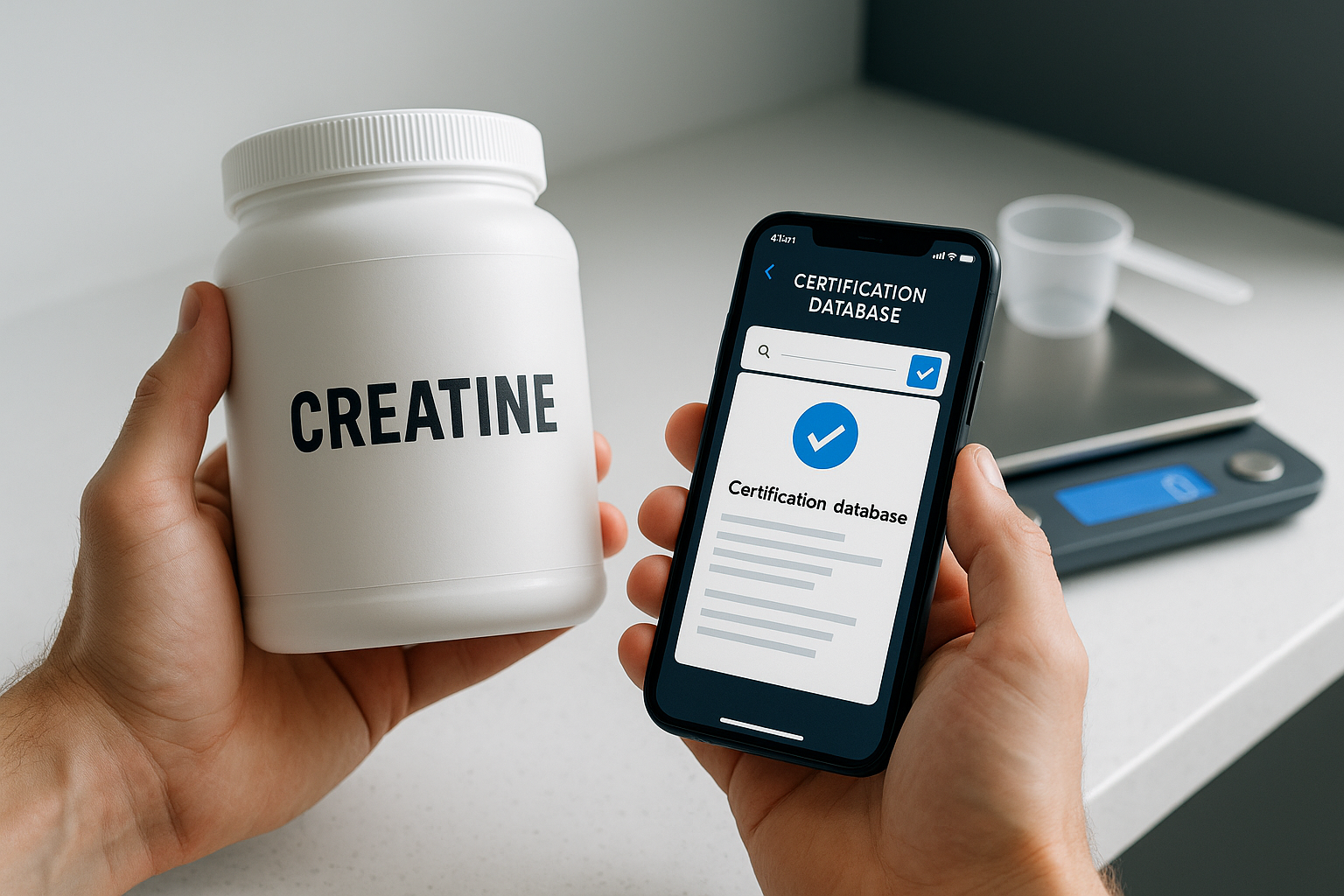
The safest way to buy third party tested creatine in Canada is to verify the testing claim yourself instead of trusting front-label language. Good brands make verification easy; weak brands hide behind vague wording.
- Read the front and side labels carefully. Look for exact wording such as NSF Certified for Sport, Informed Sport, third-party tested, lot tested, or certificate of analysis available.
- Check for an NPN if the product is sold in Canada as a Natural Health Product. An NPN is not proof of sport certification, but it does show the product has gone through the Canadian regulatory process.
- Visit the certifier's website. Search the product name in the NSF Certified for Sport or Informed Sport directory rather than assuming the logo is current.
- Ask the brand what was tested. A legitimate company should be able to tell you whether testing covered identity, purity, microbes, and heavy metals, and whether finished batches are tested.
- Ask for a recent certificate of analysis. You do not need a chemistry degree; you mainly want proof that the batch was actually analysed and that creatine content matches the label.
- Prefer simple formulas. A one-ingredient creatine monohydrate powder is easier to evaluate than a flavoured pre-workout-style blend.
- Buy from established retailers or directly from the brand. This lowers the chance of stale stock, mishandled product, or marketplace mix-ups.
Here are the label clues that deserve extra scepticism:
- “Pharmaceutical grade” with no explanation
- “Lab tested” with no lab name, no scope, and no documentation
- “Certified creatine” with no certifying body named
- Proprietary blends that do not clearly list grams of creatine monohydrate
In Canada, this process is especially useful because imported products, marketplace listings, and duplicate ASIN-style listings can create confusion. A clean listing, a valid NPN where applicable, and a verifiable certification are a much stronger combination than flashy claims.
If you are new to reading supplement labels, our guides on choosing and comparing creatine can save time: start with the creatine dosage calculator to know your target dose, then cross-check labels using the creatine product catalog. The buyer who knows the exact dose they need is much harder to mislead.
The right dose for tested creatine monohydrate, by body weight and goal
For nearly all adults, the evidence-based maintenance dose for a tested creatine monohydrate supplement is 3 to 5 g per day, every day. Loading is optional, not mandatory.
The standard protocols are well established:
- Maintenance-only approach: 3 to 5 g daily. This is the simplest plan and usually reaches muscle saturation over roughly 3 to 4 weeks.
- Loading approach: about 20 g daily, split into 4 doses of 5 g, for 5 to 7 days, followed by 3 to 5 g daily. This reaches saturation faster and is useful if you want results sooner.
Those recommendations are consistent with mainstream guidance summarised in the ISSN position stand and broad evidence reviews such as Examine's creatine summary.
A practical body-weight approach can help fine-tune the maintenance dose:
| Body weight | Simple daily maintenance | Who this usually fits |
|---|---|---|
| Under 60 kg | 3 g | Smaller adults, some women, lighter endurance athletes |
| 60-90 kg | 3-5 g | Most adults |
| Over 90 kg | 5 g | Larger lifters, heavier field athletes |
Goal-specific guidance is straightforward:
- Strength and hypertrophy: 3 to 5 g daily, with loading if you want faster saturation.
- Team-sport and repeated-sprint performance: 3 to 5 g daily; loading can be useful in pre-season.
- General fitness and healthy aging: 3 to 5 g daily without overthinking timing.
- Weight-class athletes: You may skip loading if temporary water gain is a concern.
Do not confuse a tested product with a different dosing rule. Third-party testing changes quality assurance, not the amount of creatine your muscles need. The right dose for an NSF certified for sport creatine is still the same dose as any other quality creatine monohydrate.
If you want a more tailored estimate, use our creatine dosage calculator or read the full guide on daily dosing. The biggest mistake beginners make is not underdosing by a little; it is taking creatine inconsistently, skipping rest days, or quitting after one week because they expected a stimulant-like effect.
When to take tested creatine, and what to expect week by week
The best time to take third party tested creatine is the time you will remember to take it every day, because consistency matters far more than timing. Creatine is not an acute pre-workout in the way caffeine is; it works by raising muscle stores over time.
That is why the usual advice is simple: pick a repeatable daily habit. Many people take it with breakfast, after training with a shake, or at the same meal each day. Taking it with food can be easier on the stomach for some people, but it is not required for effectiveness.
Here is a realistic timeline:
- Days 1-7 with loading: Muscle stores rise quickly. Some users notice a small body-weight increase from intracellular water, which means water moving into muscle cells, not fat gain.
- Weeks 2-4 without loading, or week 2 after loading: Workouts may start to feel slightly stronger or more repeatable, especially on later sets, repeated sprints, or explosive efforts.
- Weeks 4-8: The benefits become more obvious if training and nutrition are in place. You may add reps at a given weight, maintain power better, or recover a bit faster between hard intervals.
- Months 2-3: The main payoff is cumulative. More quality training can translate into better strength and lean-mass progress.
How do you know it is working?
- You can complete one or two more reps on some working sets.
- Your sprint or interval quality drops less across repeats.
- You feel fuller muscles or see a small scale increase early on.
- You recover between sets a bit more effectively.
How do you know it is not “not working” prematurely? If you have taken 3 to 5 g daily for fewer than 3 weeks without loading, it is too early to judge. Creatine saturation takes time. For detailed timing guidance, see when to take creatine and how long creatine takes to work.
The direct answer for buyers searching best third party tested creatine is this: once quality is sorted, your results depend mainly on consistent daily intake and appropriate training, not on whether you take it at 7 a.m. or 7 p.m.
Who should prioritize certified creatine most: athletes, beginners, women, and older adults
Anyone can benefit from a high-quality tested creatine supplement, but competitive athletes should prioritize certification most aggressively because they face the highest downside from contamination. For everyone else, the decision is still smart, just less urgent.
Here is who should care most about certified creatine Canada options:
- Tested athletes: If you compete under anti-doping rules, choose NSF Certified for Sport creatine or Informed Sport creatine whenever possible. The extra cost is small compared with the cost of a contaminated supplement.
- Beginners: New lifters often get distracted by flashy blends. A one-ingredient, third party tested creatine monohydrate keeps things simple and reduces the chance of buying junk. Our creatine myths debunked page is useful if you are worried about side effects or “unnatural” gains.
- Women: Women do not need a “women's creatine” formula. The same tested monohydrate works, and the same 3 to 5 g daily range usually applies. The value of testing is quality assurance, not sex-specific physiology.
- Older adults: Older adults using creatine to support muscle and function benefit from choosing plain, well-tested products with minimal additives and clear dosing.
- Vegetarians and vegans: People with lower dietary creatine intake may respond particularly well to supplementation, so choosing a reliable daily product matters.
The 2021 JISSN paper on common creatine questions and misconceptions reinforces several important points: creatine is not a steroid, it is generally safe for healthy individuals at recommended doses, and many common fears are overstated or unsupported. You can read that review here: Antonio et al. (2021) in JISSN.
Where caution is warranted:
- People with pre-existing kidney disease or complex medical issues should speak with a clinician first.
- Pregnancy and breastfeeding require more individualized medical guidance because sport-performance data do not automatically answer those questions.
- Teen athletes should involve a parent, coach, and ideally a qualified practitioner, especially in high-level sport settings.
The core point is simple: a tested creatine supplement is not only for elite athletes. It is the cleanest default for any buyer who wants less guesswork and better quality control.
Safety, side effects, and what third-party testing does and does not protect you from
Creatine monohydrate is well supported as safe for healthy people at recommended doses, but third-party testing improves product assurance rather than changing your body's basic response to creatine. In other words, testing lowers quality-related risk; it does not make overdosing sensible or guarantee zero side effects.
Mainstream evidence summaries, including the ISSN position stand and the Mayo Clinic overview, agree that creatine is generally safe when used appropriately. The most common issues are mild and manageable:
- Temporary water-weight gain: Often occurs early, especially with loading, because creatine draws water into muscle cells.
- Stomach upset: More likely if you take large single doses, dry scoop, or use a poorly mixed drink.
- Loose stools: Usually a dosing problem, not a creatine problem. Splitting doses often solves it.
What third-party testing may help reduce:
- Risk of contamination from poor manufacturing controls
- Risk that the product contains less creatine than the label states
- Risk of undeclared ingredients in lower-quality products
- For sport-certified products, risk of banned-substance exposure
What third-party testing does not do:
- It does not prevent water retention inside muscle.
- It does not eliminate the need for correct dosing.
- It does not make creatine safe for every medical condition without individual review.
- It does not mean a product will work better than another equally good monohydrate dose.
A common medical point deserves mention: creatine can raise creatinine, a breakdown marker often used in bloodwork, without meaning your kidneys are damaged. That is one reason context matters when interpreting lab results. If you have a kidney history, discuss supplementation and labs with your physician before starting.
Canadian buyers should also note that simple, unflavoured powders are easier to tolerate and easier to evaluate. A long ingredient list adds more variables without improving the fundamental effect of creatine itself. For a fuller safety deep-dive, read is creatine safe and creatine digestive side effects.
The biggest buying mistakes and myths around tested creatine
The biggest mistake shoppers make is assuming every “third-party tested creatine” claim means the same level of scrutiny, because it does not. The second biggest mistake is paying a premium for a trendy form when a well-tested monohydrate would do the job better.
Let us clear up the most common myths directly:
- Myth: NPN means sport certified.
Fact: An NPN means the product is authorized for sale in Canada as a Natural Health Product. It is not the same thing as NSF Certified for Sport or Informed Sport. - Myth: More expensive creatine is automatically purer.
Fact: Price can reflect certification costs, branding, flavouring, or import overhead. It does not prove better performance. - Myth: Micronized, buffered, HCL, or gummy formats work better than monohydrate.
Fact: Monohydrate still has the strongest evidence base. Alternative forms may improve convenience or mixability, but not necessarily results. - Myth: A tested creatine supplement should work immediately.
Fact: Creatine works through saturation over days to weeks, not as a stimulant hit. - Myth: Certified creatine is only for pro athletes.
Fact: Athletes need it most, but any Canadian buyer can benefit from cleaner quality assurance. - Myth: Creatine causes fat gain.
Fact: Early scale changes are typically water in muscle, not body fat.
There are also three easy buying errors to avoid:
- Ignoring grams per serving. Some products use tiny scoops or awkward serving sizes that make the price look lower than it is.
- Buying blends when you only want creatine. Pre-workout hybrids complicate dosing and testing.
- Trusting marketplace listings without cross-checking. Always verify the exact product and format.
If you want the best tested creatine monohydrate, your buying checklist should stay boring: plain monohydrate, clear grams, verifiable testing, straightforward label, and a seller you trust. Boring is good here.
For deeper myth-busting, our creatine myths debunked guide pairs well with product comparisons in the creatine brand reviews hub. The less you rely on marketing language, the easier it becomes to spot real quality.
How to choose the best third-party tested creatine in Canada without overpaying
The best third party tested creatine in Canada is the product that combines plain monohydrate, transparent testing, trustworthy retail channels, and a sensible cost per effective daily dose. You do not need the most expensive tub; you need the clearest value.
Use this practical buyer framework:
- Start with the ingredient line. It should ideally say creatine monohydrate and little else.
- Check the testing standard. Best case for athletes: NSF Certified for Sport or Informed Sport. Good for general users: credible third-party testing with documentation.
- Check Canadian compliance. Look for an NPN where applicable and complete bilingual-style labelling when sold in Canada.
- Calculate servings properly. Divide the total grams in the tub by your actual daily dose, not the marketing serving size.
- Assess added ingredients. Flavours, sweeteners, and blends can raise price without improving efficacy.
- Buy from reliable channels. Direct brand sites and established Canadian retailers usually beat random marketplace sellers.
What should you expect on a good label?
- Clear amount of creatine per serving in grams
- Lot or batch traceability
- Testing or certification details that can be verified
- Simple use instructions, typically 3 to 5 g daily
When does it make sense to pay more?
- If you are a tested athlete and want formal sport certification
- If you prefer a retailer or brand with stronger transparency and customer support
- If a product offers unusually clear batch documentation
When does it not make sense to pay more?
- For “enhanced absorption” claims with no better evidence
- For proprietary blends that hide exact creatine dose
- For premium flavour systems if you would be fine with unflavoured powder
Two useful next steps are to compare products in our best creatine rankings and check specific options in the creatine product catalog. If you want a deeper buying framework, related guides like how to choose creatine, cost-per-gram analysis, and where to buy in Canada are the logical follow-up.
The smartest Canadian buyer asks one question above all: “Can I verify the quality claim?” If the answer is yes, the rest is mostly dose, budget, and convenience.
Bottom line: the smart Canadian buyer's rule for tested creatine
If you want the safest, simplest answer on third party tested creatine Canada, buy plain creatine monohydrate from a brand with verifiable independent testing, and choose NSF Certified for Sport or Informed Sport if you compete in tested sport.
That answer holds up because it matches both the science of creatine and the reality of supplement buying. The science says creatine monohydrate is the gold-standard form, effective at 3 to 5 g daily for most people, with optional loading at about 20 g daily split into 4 doses for 5 to 7 days if faster saturation matters. The buying reality says the main quality risks are poor transparency, weak manufacturing controls, and contamination, especially for athletes subject to anti-doping rules.
So the final framework is straightforward:
- For general gym users: a reputable third-party tested creatine monohydrate with clear labelling is the best balance of cost, evidence, and confidence.
- For tested athletes: prioritize NSF certified for sport creatine or Informed Sport creatine and verify the certification yourself.
- For beginners: avoid blends, avoid hype, and stick to one ingredient and one daily habit.
- For Canadians: look for clear compliance, trustworthy domestic sellers, and transparent product pages.
If you still feel stuck, simplify further. Pick a tested monohydrate powder, take 3 to 5 g daily, keep training, and reassess after 4 to 8 weeks. That boring protocol beats nearly every complicated one.
For your next step, use the creatine dosage calculator, compare options in our best creatine rankings, or browse creatine brand reviews to narrow down a product you can verify and afford long term.
One quotable rule to remember: the best creatine is not the one with the loudest claims; it is the plain monohydrate you can verify, dose correctly, and take consistently.
Third-Party Tested Creatine: The Numbers That Matter
- 3-5 g/day Standard maintenance dose — The evidence-based daily intake for most adults using creatine monohydrate.
- 20 g/day Typical loading dose — Usually split into 4 doses for 5 to 7 days to saturate muscles faster.
- 5-7 days Loading timeline — The common period used to raise muscle creatine stores quickly.
- 3-4 weeks Time to saturate without loading — Roughly how long daily maintenance dosing takes to reach similar saturation.
Frequently Asked Questions
What is third party tested creatine?
Third party tested creatine is creatine that has been independently analysed by a lab or certification body rather than only by the manufacturer. Depending on the program, testing may cover identity, purity, label accuracy, contaminants such as heavy metals or microbes, and sometimes banned substances relevant to sport.
Is NSF certified creatine available in Canada?
Yes, NSF certified creatine can be available in Canada, but availability changes by brand and retailer. The key step is to verify the exact product in the NSF directory instead of relying only on a store listing, because not every creatine sold by a brand is necessarily certified.
Is Informed Sport creatine good enough for tested athletes?
Yes, Informed Sport creatine is a strong option for tested athletes because the program focuses on banned-substance risk reduction alongside quality assurance. It is still wise to verify the current listing yourself and buy through reputable channels so you know you are getting the exact certified product.
Is an NPN the same as third-party testing in Canada?
No, an NPN is not the same as third-party testing. An NPN means the product has been authorized for sale by Health Canada as a Natural Health Product, while third-party testing refers to independent analysis of the product's quality or certification against a testing standard.
What is the best third party tested creatine form?
The best third party tested creatine form for most people is plain creatine monohydrate. It has the strongest evidence base, the standard effective dose is well established, and it is usually the easiest format to test, compare, and buy cost-effectively.
How much third-party tested creatine should I take per day?
Most adults should take 3 to 5 g of creatine monohydrate per day, even if the product is third-party tested or sport certified. Testing changes product assurance, not your physiological dose requirement, and loading at about 20 g per day for 5 to 7 days is optional if you want faster saturation.
Do I need NSF Certified for Sport creatine if I only lift recreationally?
No, most recreational lifters do not strictly need NSF Certified for Sport creatine if they are not subject to anti-doping rules. A reputable third-party tested monohydrate from a transparent brand is usually enough, though formal certification can still add peace of mind if your budget allows.
How can I verify a creatine supplement is really third-party tested?
You can verify a creatine supplement by checking the certifier's online directory, reviewing the brand's testing documentation, and asking whether the finished product is tested by batch. If a company cannot explain what was tested or refuses to provide any proof, treat the claim cautiously.
Are certified creatine supplements safer?
Certified creatine supplements are generally safer from a quality-control perspective because they reduce the chance of contamination, mislabelling, or banned-substance exposure. They do not change the basic safety profile of creatine itself, which still depends on proper dosing and individual health context.
Is the best tested creatine monohydrate worth paying more for?
Yes, paying somewhat more for the best tested creatine monohydrate can be worth it when the extra cost reflects verifiable certification, stronger testing, or better retail trust. It is usually not worth paying more for flashy forms, unnecessary flavours, or vague premium claims without better evidence.