Creatine for Pickleball: Agility, Reaction Time, and Sustained Play
By The Creatine Canada Research Team — Evidence-based supplement analysts
Yes—creatine for pickleball can help many players improve repeated bursts of movement, explosive first steps, and late-match consistency, especially during long rallies and back-to-back games. It is unlikely to transform skill or touch on its own, but creatine monohydrate is one of the best-supported supplements for racket-sport style efforts that rely on quick, repeated high-intensity actions.
Evidence-based · Cites 4 sources · Editorial standards
Key Takeaways
- Creatine helps pickleball most by improving repeated short bursts, not by replacing skill or practice.
- The standard evidence-based dose is 3-5 g of creatine monohydrate per day.
- A loading phase of 20 g/day split into 4 doses for 5-7 days works faster but is optional.
- Most players notice benefits after 2-4 weeks without loading, or within about 1 week with loading.
- For pickleball, timing matters far less than daily consistency and full muscle saturation.
- Older adults, women, vegetarians, and frequent players may benefit at least as much as younger male gym-goers.
- Choose plain monohydrate with a Canadian NPN and ideally third-party testing over flashy 'sport-specific' blends.
Does creatine help pickleball players? Yes—but mostly for repeated explosiveness and staying sharp deep into play
Yes, creatine for pickleball can help performance, but the benefit is specific: it supports the energy system used for quick accelerations, lunges, directional changes, and repeated high-effort points rather than finesse, strategy, or paddle skill. If you want better dinks, cleaner decision-making under pressure, and stronger court positioning, creatine is not a magic fix. If you want to hold your pop, movement quality, and repeat-sprint capacity deeper into long sessions, it is one of the most evidence-based supplements available.
Pickleball sits in an interesting middle ground between endurance and power. The sport includes many low-intensity seconds, but winning points often depends on very short, very fast efforts: exploding to the kitchen line, recovering after a wide ball, braking and re-accelerating, or firing through several quick exchanges in a row. That is exactly where creatine tends to help most. The 2017 ISSN position stand concluded that creatine monohydrate is the most effective nutritional supplement currently available for increasing high-intensity exercise capacity and lean mass during training.
For pickleball players, the practical upside usually looks like this:
- Stronger repeated first steps during long rallies and tournament play.
- Less drop-off in explosiveness across multiple games in one session.
- Better support for off-court training, especially strength work, plyometrics, and sprint intervals.
- Potentially better recovery between intense points and games because the phosphocreatine system helps regenerate ATP quickly.
That last point matters. ATP is your cells' immediate energy currency, and phosphocreatine is stored creatine with a phosphate group attached that helps rapidly regenerate ATP during short, intense efforts. Creatine supplementation raises muscle phosphocreatine stores, which can improve your ability to reproduce force again and again with less drop-off.
If you are new to supplementation, start with 3-5 g of creatine monohydrate daily. If you want a broader primer first, see our creatine dosage calculator or the beginner-focused guide on creatine product options. Bottom line: creatine and pickleball performance are a good match when your goal is more repeatable explosiveness, better training quality, and steadier play over time.
Why creatine makes sense for pickleball and other racket sports
Creatine makes sense for pickleball because pickleball is a repeated-burst racket sport, not a continuous steady-state activity. The same basic logic applies to tennis, badminton, squash, and similar court sports: every point asks for short, powerful actions separated by partial recovery, and creatine helps refill the fuel source that powers those actions.
The key mechanism is the phosphocreatine energy system. During very short high-intensity efforts—roughly the first few seconds of a hard movement—your body relies heavily on stored phosphocreatine to regenerate ATP quickly. When muscle creatine stores are higher, you can generally produce more high-quality effort before fatigue causes that subtle but important drop in foot speed, force output, or reaction quality.
In pickleball, that can matter during:
- rapid kitchen exchanges
- hard serve-return sequences
- short chases to wide balls
- repeat lunges and recoveries
- multiple matches in a tournament setting
- strength and conditioning sessions that support your on-court game
Creatine is especially useful when your sport includes repeated accelerations with incomplete rest. That is why it has long been popular in power and team sports. The International Olympic Committee's 2018 consensus on supplements placed creatine among the few supplements with a strong evidence base for performance use in appropriate settings. In plain terms, creatine is not a fringe add-on—it is one of the established staples of sports nutrition.
There is another layer that matters for pickleball players over 40, 50, and 60. Creatine can also improve training quality in the gym, which may help maintain muscle, power, and function as you age. That does not mean the supplement itself creates better movement patterns; it means higher-quality resistance training and repeated-power work can accumulate into better court movement over weeks and months.
For players wondering about creatine for racket sports more broadly, the answer is similar across disciplines: the more your sport rewards repeated explosive efforts, the more likely creatine is to be useful. If your main goal is all-day low-intensity hiking, it is less central. If your sport is stop-start and reactive, it is much more relevant. For a deeper overview, compare this page with our related guides on best creatine rankings and creatine brand reviews before you buy.
Agility, reaction time, and sustained play: what creatine can and cannot actually improve
Creatine can improve the physical foundation behind agility and sustained play, but it does not directly teach reaction time, anticipation, or court IQ. That distinction is important because many players searching for does creatine help pickleball really mean, “Will I move faster and play better?” The evidence-based answer is yes for some physical qualities, but only indirectly for the perceptual and technical parts of the game.
Here is what creatine can plausibly improve in a pickleball context:
- Explosive movement quality, especially the first step and repeated push-offs.
- Power maintenance across repeated bouts of effort.
- Training output in resistance training, jumps, sprints, and high-intensity intervals.
- Recovery between hard efforts because phosphocreatine helps restore ATP rapidly.
Here is what creatine does not directly do:
- teach better shot selection
- fix poor split-step timing
- replace footwork practice
- instantly sharpen reflexes if fatigue, sleep, or vision are the main issue
Why then do some players report better “reaction time”? Often because a fresher, less-fatigued athlete appears quicker. If your legs produce force faster late in the session, you reach balls earlier. If your off-court training improves, you also move with more intent on court. That can feel like a reaction-time boost even when the main effect is improved repeated power output rather than pure neural reflex speed.
There is also ongoing interest in creatine's role in the brain. Some research suggests creatine may support aspects of cognition and mental energy under certain conditions, but that evidence is still less established for healthy recreational athletes than its effects on muscular high-intensity performance. If mental sharpness is your main goal, treat that as a possible bonus, not the primary reason to use creatine. For a fuller discussion, see our guide on creatine myths debunked and the broader research summary at Examine.com's creatine evidence page.
The practical takeaway is simple: creatine and pickleball performance pair best when your limiting factor is repeated explosiveness, fatigue across games, or the ability to train for stronger legs and better court movement. It is less useful if your main issue is tactical decision-making, hand skills, or inconsistent technique.
Exactly how to take creatine for pickleball: the simplest step-by-step plan
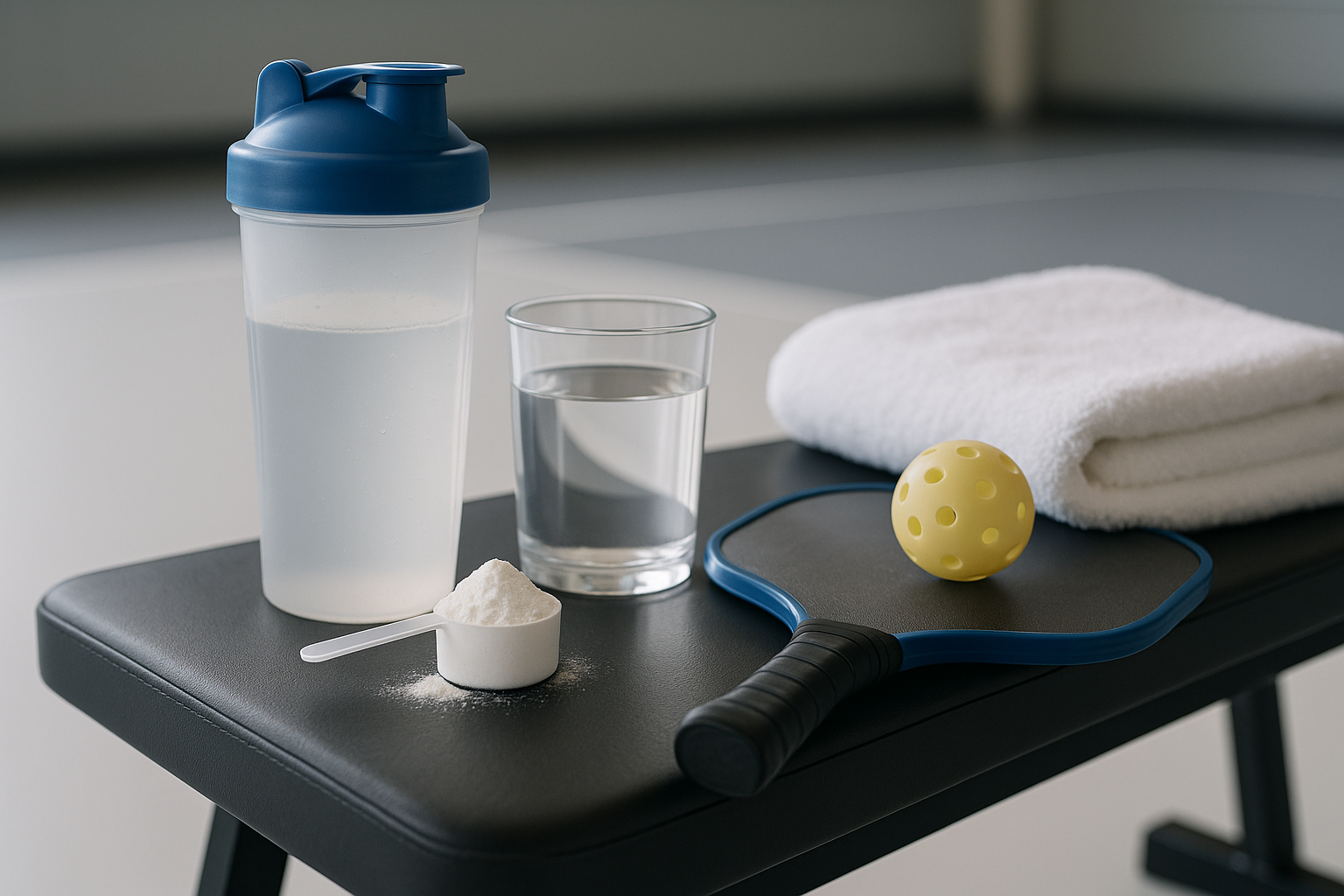
The best way to take creatine for pickleball is to use 3-5 g of creatine monohydrate every day, including rest days, until your muscles are saturated. You do not need a complicated protocol, a proprietary blend, or perfect timing. Daily consistency is what matters most.
- Buy the right form. Choose plain creatine monohydrate powder. It is the most studied, most reliable, and usually the best value. If you want help choosing, start with best creatine rankings.
- Pick your dose. Most pickleball players do well with 3-5 g daily. Larger athletes and those doing more intense training usually sit closer to 5 g.
- Decide whether to load. If you want faster results, take 20 g/day for 5-7 days split into 4 doses of 5 g, then drop to 3-5 g/day. If you want fewer digestive issues, skip loading and just use 3-5 g/day from day one.
- Take it at a time you will remember. Post-workout, with breakfast, or after dinner are all fine. The best time is the time you will stick to daily. Our detailed timing guide at creatine dosage calculator can help you set a routine.
- Mix it well. Stir into water, juice, or a protein shake. Warm water can help it dissolve more fully, but this is about convenience, not effectiveness.
- Stay normally hydrated. You do not need to force extreme water intake, but you should drink like an active adult, especially during long court sessions. If you need specifics, read our creatine product and usage guidance alongside your usual hydration strategy.
- Keep taking it on non-playing days. Creatine works by saturating muscle stores over time, not by acting like an acute stimulant.
What should you expect? Without loading, many players feel little in the first week, then begin noticing better repeatability in hard efforts after about 2-4 weeks. With loading, that timeline can shorten to around a week. You may also notice a small increase in body mass from intracellular water, meaning water drawn into muscle cells rather than “fat gain.”
If you miss a day, do not panic and do not double up aggressively the next day. Just resume your normal dose. Creatine works over weeks, not by a single dose. For a more complete daily setup, also see common creatine mistakes and myths.
Creatine dosage for pickleball by body weight, schedule, and goal
The right creatine dose for pickleball is usually 3-5 g per day, but your body size, training load, and urgency can make the upper or lower end more sensible. For most recreational players, there is no need to overthink it. Start with 5 g daily if you are average-to-large, 3 g daily if you are smaller or cautious about digestion, and use a loading phase only if you want faster saturation.
| Player profile | Daily dose | Best use case | Notes |
|---|---|---|---|
| Smaller adult under ~60 kg | 3 g/day | General play, maintenance | Often enough for full benefits over time |
| Most adults ~60-90 kg | 3-5 g/day | Regular pickleball and gym training | 5 g/day is the common default |
| Larger adult over ~90 kg | 5 g/day | Frequent play, strength training | Useful upper end for maintaining saturation |
| Fast-start protocol | 20 g/day for 5-7 days, then 3-5 g/day | Tournament prep or quick saturation | Split into 4 x 5 g doses to reduce stomach upset |
Your goal also matters:
- Casual recreational player: 3-5 g/day is enough.
- Frequent player doing 3+ sessions per week: 5 g/day is usually the simplest choice.
- Player adding gym work for strength and speed: 5 g/day makes sense because creatine supports the training that supports your court game.
- Older adult focusing on power retention and muscle maintenance: 3-5 g/day is appropriate, especially combined with resistance training.
Do you need body-weight precision, such as 0.1 g/kg/day? In research contexts that can be useful, but in real-world supplementation, 3-5 g/day is the mainstream, practical standard. The exception is loading, where the classic evidence-based approach is about 20 g/day split across the day for 5-7 days. More than that usually adds cost and stomach trouble, not extra benefit.
If you want a more exact intake based on your size and routine, use our creatine dosage calculator. If you are comparing form factors or labels before buying, our creatine brand reviews and product catalog can help you avoid underdosed “performance” blends that hide the actual grams of creatine per serving.
Best timing for pickleball players, plus a realistic week-by-week results timeline
The best time to take creatine for pickleball is whenever you will take it every day, because saturation matters far more than clock time. Pre-match and post-match timing are minor details compared with total daily intake and staying consistent long enough to raise muscle creatine stores.
If you prefer structure, use one of these simple timing options:
- After training or after play: easy to remember and easy to pair with a shake or meal.
- With breakfast: great for players with inconsistent court schedules.
- At the same meal daily: often the best adherence strategy of all.
There is no good reason to treat creatine like a stimulant. It will not kick in 30 minutes later the way caffeine can. If you take your first 5 g dose on tournament morning without already being saturated, do not expect an immediate on-court effect.
Here is a realistic timeline for what many pickleball players experience:
- Days 1-7 with loading: muscle stores rise quickly; some players notice fuller muscles or a small body-mass increase; on-court benefits may begin by the end of the week.
- Week 1 without loading: little obvious change yet beyond routine compliance.
- Weeks 2-4: many players begin to notice better repeatability in explosive movement or less drop-off late in sessions.
- Weeks 4-8: benefits become clearer, especially if you also lift, sprint, or do power-based court conditioning.
- After 8+ weeks: the main advantage often shows up as accumulated training improvements, not just a “feeling” from the supplement itself.
How can you tell it is working? Look for:
- slightly better repeat-sprint or shuffle quality
- less fade in leg pop after several games
- better gym numbers in squats, split squats, jumps, or sled work
- easier maintenance of output during tournament weekends
If nothing changes after a month, review the basics: are you actually taking 3-5 g daily, using monohydrate, and training in a way that gives creatine something to amplify? Creatine enhances the capacity for high-intensity work; it does not replace training stimulus. For deeper timing questions, see related guidance like which form to choose and broader evidence discussions from Mayo Clinic.
Who should consider creatine for pickleball: beginners, women, older adults, and competitive players
Creatine for pickleball is not just for young male weightlifters. It can be a smart option for beginners, women, older adults, vegetarians, and tournament players because the underlying energy system it supports is universal, while some groups may actually have more room to benefit.
Beginners: Yes, beginners can use creatine. In fact, starting early is reasonable if you are also building a base of strength, mobility, and court movement. Creatine will not substitute for lessons or drilling, but it can support your physical development and recovery as you learn the sport.
Women: Women can absolutely take creatine, and the common fear of “bulking up” is misplaced. Creatine may cause a small increase in water held inside muscle cells, but that is not the same as gaining body fat or suddenly becoming large. Many women benefit from improved training quality, better power expression, and support for muscle retention. If this is relevant to you, our guide on product selection can help you pick a simple monohydrate rather than a pink-marketed blend.
Older adults and masters players: This group may be among the best candidates. Pickleball is hugely popular with adults over 50, and age-related declines in muscle mass and power can directly affect first-step speed, balance, and resilience. Creatine, especially when paired with resistance training, can support muscle function and training quality. That does not make it anti-aging magic; it means it is a practical tool for preserving the physical qualities that matter on court.
Vegetarians and vegans: People who eat little or no meat may start with lower creatine stores because creatine is naturally found in animal foods. That can make supplementation especially useful. If you are plant-based, creatine monohydrate itself is generally considered suitable because commercial creatine is synthesised rather than extracted from meat.
Competitive and tournament players: If you play multiple matches in a day, repeated-power support matters more. Creatine is often more valuable in that setting than for someone who plays one casual doubles session on the weekend.
The main people who should pause and speak with a healthcare professional first are those with relevant kidney disease, complex medical conditions, or medication considerations. For everyone else, pickleball supplements creatine belongs near the top of the shortlist because it is one of the rare options with a deep evidence base instead of marketing-first claims.
Safety, side effects, and the weight question every pickleball player asks
Creatine monohydrate is widely considered safe for healthy people when used at standard doses, and the most common side effects are mild digestive upset and a small increase in body mass from water stored inside muscle. The 2021 JISSN paper on common creatine questions and misconceptions reinforces that many popular fears about creatine are overstated or unsupported when the supplement is used appropriately.
The side effects pickleball players are most likely to notice are:
- Water-weight gain: often modest, especially early on, because creatine draws water into muscle cells.
- Stomach upset: more likely with large single doses, poor mixing, or aggressive loading.
- Temporary bloating sensation: usually manageable by splitting doses or skipping loading.
For pickleball, the weight question is fair. Does a small increase in body mass hurt agility? Usually, for recreational and masters players, the answer is no or not meaningfully. The performance upside from better repeated power and training quality often outweighs a minor increase on the scale. This is different from sports with strict weight classes or extreme body-mass sensitivity. In pickleball, better leg drive and less late-session drop-off are often more relevant than being a kilogram lighter.
What about dehydration, cramps, kidneys, or hair loss? These are common myths. The available evidence does not support the blanket claim that creatine causes dehydration or cramps in healthy users, and concerns about kidney harm are often confused with the fact that creatine can raise creatinine, a breakdown marker seen on blood tests, without necessarily indicating kidney damage. Hair-loss claims remain unproven and far weaker than internet discussion suggests. If you want the full myth-by-myth breakdown, see creatine myths debunked.
When should you be cautious? If you have diagnosed kidney disease, are pregnant or breastfeeding, take medications with kidney implications, or have a complex medical history, get personalised medical advice before starting. That is not because creatine is uniquely dangerous; it is because broad safety conclusions for healthy people should not replace individual guidance in higher-risk cases.
The practical safety checklist is simple: choose a reputable monohydrate, use 3-5 g/day, avoid giant single doses, and stay sensibly hydrated during play. For a deeper evidence review, read Antonio et al. (2021) and compare labels carefully before purchase.
What to buy in Canada: the best creatine type, label checks, and how to avoid overpriced blends
The best creatine for pickleball is almost always plain creatine monohydrate, ideally with a Natural Product Number, or NPN, on the label in Canada and preferably some form of quality assurance or third-party testing. Fancy versions are usually more expensive, less proven, or both.
Here is the buying hierarchy that makes the most sense:
- Creatine monohydrate first. This is the gold standard for evidence, cost-effectiveness, and reliability.
- Micronized monohydrate second if you prefer easier mixing. It is still monohydrate, just a finer powder.
- Avoid paying a premium for HCl, buffered, or “advanced” forms unless you have a very specific reason and understand the evidence is weaker.
When buying in Canada, check for:
- NPN: the product has been authorised as a natural health product for sale in Canada.
- Clear ingredient list: ideally just creatine monohydrate, or monohydrate plus flavouring if flavoured.
- Dose transparency: know how many grams of actual creatine you get per scoop.
- Third-party testing or sport certification: especially useful for competitive athletes concerned about contamination risk.
- Value per gram: large plain tubs often beat trendy single-serve formats.
| Option | Best for | Pros | Cons |
|---|---|---|---|
| Unflavoured monohydrate powder | Most players | Best evidence, best value, flexible dosing | Can taste bland or feel slightly gritty |
| Micronized monohydrate | Players who hate texture | Mixes easier, same core ingredient | Sometimes slightly pricier |
| Capsules | Travel convenience | No mixing needed | Usually higher cost and many capsules per dose |
| Flavoured blends | Players who want taste | More palatable | May add sweeteners, cost, or underdosing |
Be sceptical of “pickleball supplements creatine” products that bundle tiny creatine doses with stimulants, electrolytes, or joint ingredients and market them as sport-specific breakthroughs. Most of the time, you will do better with a standalone creatine plus your normal hydration and nutrition plan. To compare options, browse creatine brand reviews, product catalog, and our buyer-focused best creatine rankings.
The biggest creatine mistakes pickleball players make, and the myths still holding people back
The biggest creatine mistakes in pickleball are choosing the wrong form, taking it inconsistently, expecting instant effects, and quitting because of myths about bloating, kidneys, or “unnatural” performance. Creatine is simple, but people often make it complicated enough to sabotage the result.
Mistake 1: Buying a fancy form instead of monohydrate. The best-supported form is still creatine monohydrate. If a company claims a newer form is “absorbed better,” ask whether it has actually outperformed monohydrate in meaningful outcomes.
Mistake 2: Only taking it on game days. Creatine is not a pre-workout stimulant. If you only take it before pickleball, you are missing the point. It works through saturation over time.
Mistake 3: Under-dosing. Many blends hide small amounts of creatine under a “performance matrix.” If the label does not clearly provide 3-5 g/day, it may not deliver full benefit.
Mistake 4: Stopping after a few days because “nothing happened.” Without loading, most players need a few weeks to notice a difference. That is normal.
Mistake 5: Confusing water gain with fat gain. Early scale changes are usually water inside muscle cells, not body-fat gain. That is one reason muscles can feel slightly fuller.
Now the myths:
- Myth: Creatine is a steroid. False. Creatine is a naturally occurring compound involved in energy metabolism, not an anabolic steroid.
- Myth: Creatine damages healthy kidneys. False as a blanket claim. Standard-dose creatine is considered safe for healthy people, though those with kidney disease need medical guidance.
- Myth: Creatine dehydrates you or causes cramps. Not supported by the overall evidence in healthy users.
- Myth: Creatine is only for bodybuilders. False. It is relevant to any athlete who relies on repeated high-intensity effort, including pickleball players.
There is also a more subtle myth: that if creatine does not make you feel dramatically different, it is not working. Often the benefit is not a buzz or rush. It is better maintenance of output, slightly improved training quality, and more consistent movement over time. That is exactly the kind of benefit that matters in racket sports. For a deeper breakdown of false claims and practical fixes, see creatine myths debunked and cross-check claims against the ISSN position stand.
Bottom line: when creatine is worth it for pickleball, and when it is not
Creatine for pickleball is worth it if you want better repeated explosiveness, stronger support for off-court training, and less physical drop-off across long sessions or tournament days. It is not worth expecting it to replace drilling, footwork practice, sleep, hydration, or good programming. In other words, creatine is a high-value supplement for the physical side of the game, not a shortcut for the skill side.
If you are deciding whether to start, use this quick filter:
- Yes, it is probably worth it if you play frequently, train in the gym, want to move better late in matches, or are a masters player trying to preserve power.
- Maybe if you only play casually once in a while and do little or no high-intensity training off court.
- Pause and get medical advice first if you have kidney disease, significant medical complexity, or medication concerns.
The best protocol for most players is still the boring one: creatine monohydrate, 3-5 g daily, every day. Load if you want faster saturation; skip loading if you prefer simplicity or a gentler start. Timing is not critical. Product quality matters more than branding. Consistency matters more than hacks.
What should you expect in the real world? Not overnight miracles. Expect a subtle but useful improvement in repeated high-effort performance, especially if you also strength train. Expect a better chance of maintaining pop and movement quality through long rec sessions or multiple tournament matches. Expect the benefit to be clearer after several weeks than after several hours.
Among pickleball supplements creatine deserves serious consideration because it is one of the few options backed by decades of sports nutrition research rather than trend-driven marketing. That is why it remains relevant in 2026: not because it is flashy, but because it keeps working.
If you are ready to start today, keep it simple. Use our creatine dosage calculator, compare options in the creatine product catalog, and shortlist trusted picks with the best creatine rankings. For most players, that is enough to go from “thinking about creatine” to actually using it correctly.
Creatine for Pickleball: the numbers that matter
- 3-5 g/day Standard daily dose — Evidence-based maintenance range for most adults using creatine monohydrate
- 20 g/day Optional loading dose — Typically split into 4 x 5 g doses for 5-7 days
- 5-7 days Fast saturation timeline — Approximate timeline when using a classic loading phase
- 2-4 weeks Typical no-load timeline — Many users notice benefits after daily use without loading
Frequently Asked Questions
Does creatine help pickleball performance?
Yes, creatine can help pickleball performance by improving the ability to produce repeated short bursts of force and maintain movement quality across long sessions. It is most useful for explosive first steps, quick recoveries between points, and supporting off-court strength and power training rather than directly improving touch or strategy.
Is creatine good for racket sports like pickleball and tennis?
Yes, creatine is a good fit for many racket sports because they rely on repeated high-intensity actions with short recovery periods. Pickleball, tennis, badminton, and squash all involve accelerations, braking, lunging, and quick exchanges that draw on the phosphocreatine system creatine helps support.
What is the best creatine dose for pickleball players?
The best creatine dose for most pickleball players is 3-5 g of creatine monohydrate per day. Smaller players may do well with 3 g daily, while larger players or those training hard in the gym often default to 5 g daily for simplicity and full long-term saturation.
Should I take creatine before or after pickleball?
You can take creatine before or after pickleball, but the truth is that timing is much less important than taking it every day. Creatine works by gradually saturating your muscles over time, so the best timing is the one that helps you stay consistent without missing doses.
How long does creatine take to work for pickleball?
Creatine usually takes about 2-4 weeks to noticeably help if you start with a standard daily dose and no loading phase. If you use a classic loading phase of 20 g per day split into smaller doses for 5-7 days, benefits can appear sooner because muscle creatine stores rise faster.
Will creatine make me slower on the pickleball court because of water weight?
Usually no, creatine does not meaningfully make most pickleball players slower, even if it causes a small increase in scale weight from water inside muscle cells. For many players, the gain in repeated power and better training quality outweighs the slight increase in body mass.
Can older pickleball players take creatine safely?
Yes, many older pickleball players can take creatine safely if they are otherwise healthy and use standard doses. It may be especially useful for masters athletes because preserving muscle, power, and training quality becomes more important with age, though anyone with kidney disease or medical complexity should check with a healthcare professional first.
Is creatine safe for women who play pickleball?
Yes, creatine is generally considered safe for healthy women who play pickleball when used at standard doses such as 3-5 g per day. It does not inherently cause bulky muscle gain, and many women use it to support training quality, power output, and muscle retention.
What type of creatine is best for pickleball supplements?
Plain creatine monohydrate is the best type of creatine for pickleball supplements because it is the most studied, most cost-effective, and most consistently effective form. In Canada, it is smart to look for clear dosing, an NPN on the label, and ideally some third-party testing or sport certification.
Can I take creatine even if I only play recreational pickleball?
Yes, recreational pickleball players can still benefit from creatine, especially if they play more than once a week or do any gym training alongside the sport. The benefits may be subtler than for tournament players, but better repeated effort and stronger support for training can still make it worthwhile.