Creatine for Hockey: Power, Repeated Shifts, and On-Ice Performance
By The Creatine Canada Research Team — Evidence-based supplement analysts
Yes—creatine can help hockey players by improving high-intensity power, repeated sprint output, and training quality, which are all central to hard shifts, explosive skating, and battle strength. For ice hockey, the best-supported option is creatine monohydrate at 3–5 g daily, with benefits showing fastest after a 5–7 day loading phase or more gradually over 3–4 weeks.
Evidence-based · Cites 4 sources · Editorial standards
Key Takeaways
- Creatine for hockey is most useful for explosive skating, repeated hard efforts, and gym-based strength and power work.
- The best form for hockey players is creatine monohydrate because it is the most studied, most effective, and usually the best value.
- A loading phase of 20 g/day split into 4 doses for 5–7 days works fastest; otherwise take 3–5 g/day and expect a slower build-up.
- Most players notice benefits more in repeated shifts, sprint power, and training performance than in steady-state conditioning.
- A small body-mass increase from extra intramuscular water is common, especially in the first 1–2 weeks, and is not the same as gaining fat.
- Daily consistency matters more than exact timing, but taking creatine after practice or with a meal can make the habit easier.
- In Canada, choose a plain monohydrate product with an NPN and, ideally, third-party testing or a well-vetted brand.
Does creatine help hockey players? Yes—especially for explosive skating and repeated hard shifts
Yes, creatine helps many hockey players because ice hockey is built on short, repeated bursts of maximal or near-maximal effort rather than one long continuous output. Creatine is most relevant when you need fast acceleration, powerful first strides, hard board battles, repeated shifts with incomplete recovery, and higher-quality strength training off the ice.
The practical answer is simple: creatine for hockey players is most likely to improve the energy system used for explosive efforts lasting roughly a few seconds up to about 30 seconds, especially when those efforts are repeated. That matches the demands of skating bursts, chasing loose pucks, quick changes of direction, and repeated work across a period or game.
The evidence base on creatine is strongest for strength, power, lean mass, repeated sprint performance, and training capacity. The 2017 ISSN position stand concluded that creatine monohydrate is the most effective nutritional supplement currently available for increasing high-intensity exercise capacity and lean body mass during training. For hockey, that matters because better gym performance often carries over to stronger legs, more force into the ice, and more resilience over a long season.
What creatine does not do is magically make a player skilled, tactical, or aerobically elite. It will not replace skating technique, conditioning, or good programming. It also does not work like a stimulant. You do not take a scoop and feel an instant buzz before a game. Instead, creatine works by gradually increasing muscle creatine stores so your body can regenerate ATP, the cell's immediate energy currency, faster during repeated high-power efforts.
For most players, the best expectation is not “I suddenly skate like McDavid.” The better expectation is:
- slightly more pop in repeated sprints and starts,
- better maintenance of power later in drills or shifts,
- better performance in strength and power sessions, and
- over weeks, better support for lean mass and force output.
If you are new to the supplement, start with plain monohydrate and use a consistent daily dose. If you want a broader primer, see creatine product catalog options and our guide to best creatine rankings.
How creatine works for skating power, acceleration, and repeated-shift recovery
Creatine helps hockey by increasing phosphocreatine in muscle, and phosphocreatine is the stored high-energy compound your body uses to rapidly rebuild ATP during explosive efforts. In plain English, creatine improves the speed at which your muscles can recharge for the next hard stride, sprint, or collision.
Hockey is a classic repeated-sprint sport. A shift often includes fast accelerations, decelerations, stops, starts, edge work, checks, and battles, with incomplete recovery before the next effort. In these situations, the phosphagen system does a huge amount of work. When muscle creatine stores are higher, you generally have more substrate available to help regenerate ATP quickly between bursts.
That is why creatine ice hockey use makes the most sense for:
- first-step explosiveness, because rapid ATP turnover supports forceful contractions;
- repeated skating efforts, because faster phosphocreatine resynthesis helps maintain output across intervals;
- power training, because more total quality reps in the gym can improve long-term adaptation;
- contact and puck-protection situations, because maximal strength and body mass can aid force production.
There is also a secondary effect that matters over months, not just days: creatine can help players train harder. If you get one or two more quality reps in a heavy split squat, produce more power on a bike sprint, or maintain output across repeated sled pushes, that improved training stimulus can compound over an off-season.
Creatine may also support recovery between repeated efforts, but it is important to be precise. Creatine is not the same thing as a recovery drink or carbohydrate refuelling strategy. It does not primarily restore glycogen or fix dehydration. Its “recovery” role is more about helping restore high-energy phosphate availability between intense efforts and supporting better training adaptation over time.
The 2021 JISSN review on creatine misconceptions reinforced that creatine is one of the most studied sports supplements and that many common concerns have been overstated or unsupported. The broader evidence summary at Examine also consistently points to creatine's strongest effects in high-intensity, short-duration performance rather than endurance-only tasks.
For hockey players asking about creatine for skating power, the mechanism fits the sport very well. The better your game depends on repeated acceleration and force production, the more likely creatine is to be useful.
The best type of creatine for hockey is still plain monohydrate
The best creatine for hockey players is creatine monohydrate because it is the most studied, most consistently effective, and usually the most cost-effective form on the market. Despite aggressive marketing around HCL, buffered creatine, gummies, and proprietary blends, monohydrate remains the reference standard in 2026.
For practical use, hockey players do not need a “sport-specific” creatine. Your muscles do not care whether the label says hockey, sprint, power, or general fitness. What matters is that the product provides enough actual creatine, is accurately labelled, dissolves well enough for regular use, and comes from a reputable manufacturer.
| Form | Best use case | Evidence strength | Practical verdict for hockey |
|---|---|---|---|
| Creatine monohydrate | Daily supplementation for power, strength, repeated efforts | Strongest by far | Best default choice for nearly every player |
| Micronized monohydrate | Same ingredient, finer powder for easier mixing | Same core evidence as monohydrate | Good if you want better mixability |
| Creatine HCl | Often marketed for solubility and lower dose | Much weaker than monohydrate | Usually not worth the price premium |
| Buffered/Kre-Alkalyn | Marketed as more stable or requiring less | Weak comparative support | No convincing advantage |
| Gummies/capsules | Convenience and portability | Depends on total dose delivered | Can work, but often pricier per gram |
If you want the shortest buying rule possible, use this: choose a plain monohydrate powder with minimal extra ingredients. If you are sensitive to texture, a micronized version may be easier to drink, but the active ingredient is still monohydrate.
In Canada, check for an NPN, which means Natural Product Number, on the label. An NPN indicates the product has been authorised by Health Canada as a natural health product within the applicable framework. That is not a guarantee of athletic suitability on its own, but it is a helpful baseline. Competitive players should also prefer brands that disclose third-party testing or otherwise demonstrate strong quality control. You can compare options in our creatine brand reviews and browse the creatine product catalog.
If you have been wondering whether a trendy form beats monohydrate for creatine ice hockey performance, the evidence-based answer is no. Monohydrate still wins.
How to take creatine for hockey: the exact step-by-step plan for players
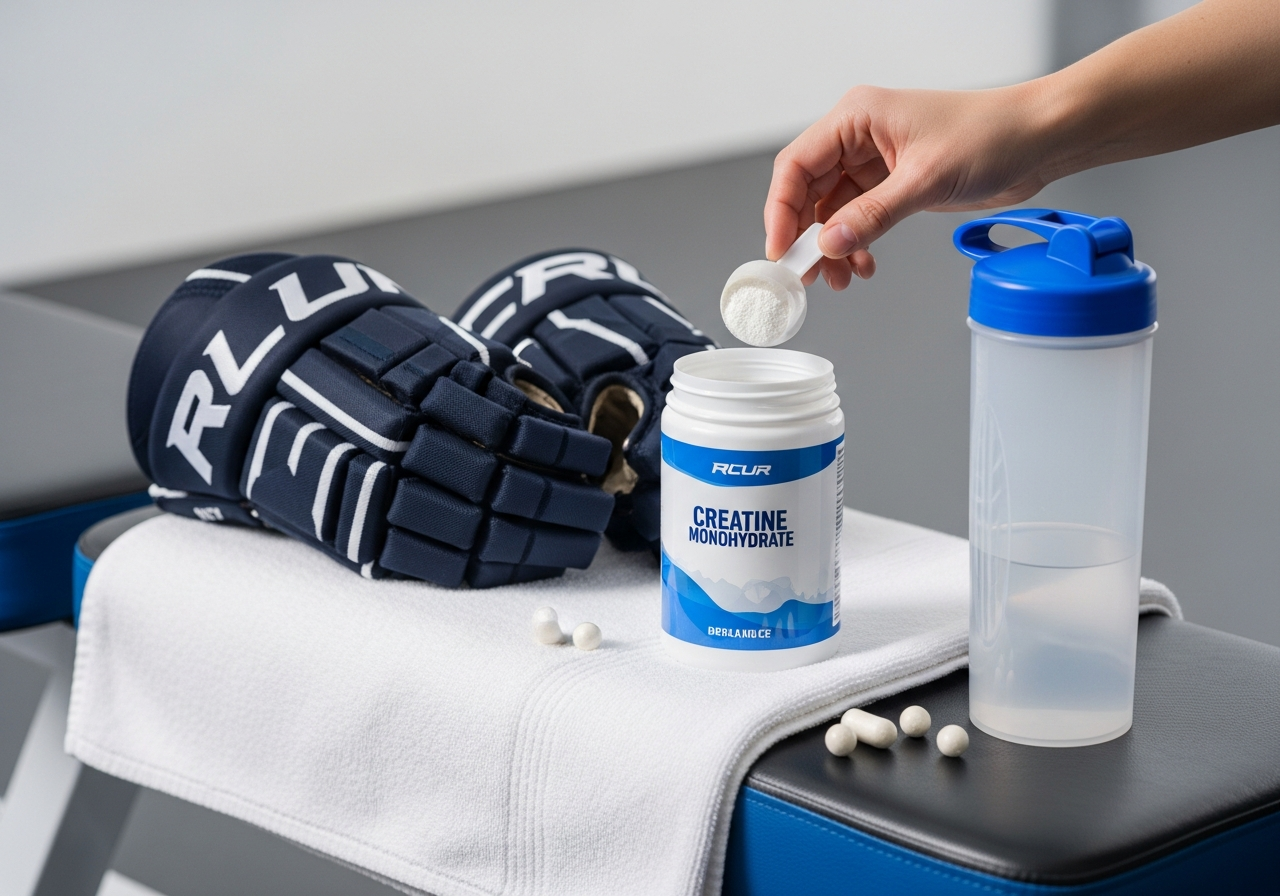
The simplest way to take creatine for hockey is to choose plain creatine monohydrate, decide whether you want to load, and then take it every day without missing long stretches. Consistency matters more than timing, flavour, or fancy stacking.
- Pick your form. Use creatine monohydrate powder unless you specifically need capsules or gummies for convenience.
- Choose a loading strategy. If you want faster saturation, take 20 g/day for 5–7 days split into 4 doses of 5 g. If you prefer a slower approach, skip loading and take 3–5 g/day from day one.
- Take a maintenance dose. After loading, take 3–5 g/day. Larger athletes with more muscle mass often sit at the higher end.
- Mix it in a routine-friendly way. Stir it into water, a protein shake, or a post-practice drink. If you want mixing help, see creatine dosage calculator and the practical guides linked throughout the site.
- Take it on training days and rest days. Muscle saturation is the goal, so off-days still count.
- Track what matters. Watch your sprint repeatability, gym numbers, body mass, and how your legs feel late in sessions.
A sample hockey-specific setup looks like this:
- Off-season strength block: load for 5–7 days, then 5 g/day while training hard 4–6 days per week.
- Pre-season camp: if you start late, a loading phase helps you saturate quickly before intense on-ice volume.
- In-season maintenance: 3–5 g/day is usually enough; keep it simple and attach it to breakfast or your post-skate shake.
What should you expect week by week?
- Days 1–7 with loading: some players notice slight body-mass gain and fuller muscles before they notice performance changes.
- Weeks 2–3: repeated sprint work and gym volume may start to feel stronger or more sustainable.
- Weeks 4+: the clearer effects are often better training quality, power maintenance, and gradual support for lean mass.
What if you miss a day? Do not panic and do not double up aggressively the next day. Just resume your usual dose. Creatine works through saturation over time, not through one perfect daily moment.
If you want a deeper beginner walk-through, our guides on best creatine rankings and creatine myths debunked can help you avoid rookie mistakes.
Creatine dose for hockey by body weight, phase, and goal
The right creatine dose for hockey players is usually 3–5 g/day for maintenance, with an optional loading phase of 20 g/day split into four 5 g doses for 5–7 days if you want faster results. Body weight and muscle mass can help fine-tune where you sit within that proven range.
Although the standard 3–5 g/day recommendation works for most adults, it is reasonable in practice to bias lighter players toward 3 g/day and bigger, more muscular players toward 5 g/day once saturated. The bigger goal question is not “What is the perfect gram?” so much as “Am I taking enough, every day, for long enough?”
| Player size / goal | Loading option | Maintenance dose | Best use case |
|---|---|---|---|
| Smaller player under about 60–70 kg | 20 g/day in 4 x 5 g doses for 5–7 days, or skip | 3 g/day | Skill-forward players wanting low-fuss maintenance |
| Average adult player around 70–90 kg | 20 g/day in 4 x 5 g doses for 5–7 days | 3–5 g/day | Most junior, recreational, and competitive adult players |
| Larger or very muscular player over about 90 kg | 20 g/day in 4 x 5 g doses for 5–7 days | 5 g/day | Players prioritising strength, mass, and repeated-power output |
| Urgent pre-camp or pre-season start | Use loading | 3–5 g/day after loading | Fastest path to saturation |
| Gradual, low-risk start | Skip loading | 3–5 g/day from day one | Players prone to mild stomach upset |
For hockey-specific goals, here is how I would think about dosing:
- Skating power and repeated shifts: load if you want results sooner, then maintain daily.
- Off-season size and strength: 5 g/day after loading is a sensible default for larger players training hard.
- Players worried about water-weight gain: skip loading and use 3 g/day to let body-mass changes come on more gradually.
If you are unsure where to start, 5 g/day is a safe, standard, evidence-based answer for most adult hockey players. If you want more personalised math, use the creatine dosage calculator and read our related guide on how much creatine per day.
One final point: do not confuse “more” with “better.” Taking far above proven doses is unlikely to improve hockey performance further and is more likely to increase the chance of stomach upset.
Best time to take creatine for hockey practices, games, and rest days
The best time to take creatine for hockey is the time you will remember every day, because long-term saturation matters far more than minute-by-minute timing. If you want a practical default, take it after training or with a meal.
This is where a lot of athletes overcomplicate things. Creatine is not like caffeine, where timing can strongly affect the immediate session. Its main job is to keep muscle creatine stores elevated over days and weeks. That means a consistent 3–5 g/day routine beats a theoretically perfect timing protocol you cannot stick to.
Good hockey-specific timing options include:
- After practice or gym sessions: easy to pair with your recovery shake or meal.
- With breakfast on rest days: simple habit anchor that prevents missed doses.
- With a carb-and-protein meal: helpful if it improves tolerance and adherence.
What about before games? You can take creatine before a game, but do not expect an acute performance jolt from that one dose. If taking it pre-game makes your stomach feel heavy, move it earlier in the day or after the game. The creatine is still doing its job as long as daily intake remains steady.
For tournament weekends, road trips, and busy schedules:
- pack pre-measured servings in small containers or sachets,
- take it with your first full meal if the day is chaotic,
- keep it separate from any superstition about “game-day only” supplements.
If you stack creatine with protein powder, that is fine. If you mix it with coffee, it is generally fine too, assuming your stomach tolerates it and the habit helps consistency. The key is not the beverage; the key is the total daily dose.
Hockey players often ask whether they should cycle creatine during the season. For most healthy athletes, routine cycling is not necessary. The evidence base and mainstream sports-nutrition guidance support ongoing daily use. The 2018 International Olympic Committee consensus on dietary supplements includes creatine among the few supplements with strong support for specific performance uses.
If timing is your sticking point, simplify it: training day, take it after practice; rest day, take it with breakfast. That solves the problem for almost everyone.
Who should use creatine in hockey: beginners, women, teens, and older players
Creatine can be useful for many hockey players, including beginners, women, vegetarian athletes, and older adults, as long as the decision fits their health status, training needs, and level of supervision. The biggest factor is not gender or experience level; it is whether the player would benefit from better repeated high-intensity performance and strength adaptation.
Beginners: yes, beginners can use creatine, but it should come after the basics of eating enough, training properly, hydrating, and sleeping. For a newer recreational player who is lifting two or three times per week and skating once or twice, creatine is still a reasonable, low-complexity supplement.
Women hockey players: creatine works for women too. The common fear that it automatically causes “bulking” is wrong. Some women notice a small early increase in scale weight from more water stored inside muscle, not fat gain. For many female players, the value is better training quality, strength, and repeated-power output. Related reading: creatine product catalog and our site’s women-specific guides.
Vegetarian or low-meat athletes: creatine may matter even more here because baseline muscle creatine stores can be lower when dietary creatine intake is lower. That can make response more noticeable in some athletes.
Older adult hockey players: masters players trying to maintain muscle, skating pop, and training output can absolutely consider creatine. The same evidence base supporting strength and lean-mass gains in training is relevant for staying powerful and resilient as you age.
Teen hockey players: this is the group where context matters most. Creatine is widely discussed among youth athletes, but the right approach is conservative and supervised. Teen players should first have structured training, solid nutrition, and informed parent or guardian involvement. If a family is considering creatine, it is worth reviewing broader safety guidance and getting advice from a qualified sports dietitian or physician who understands adolescent sport.
Who should be more cautious? Anyone with significant kidney disease, complicated medical conditions, or a clinician telling them to avoid it should get personalised advice first. For healthy athletes, however, creatine monohydrate has one of the best safety profiles in sports nutrition when used at standard doses. If you are comparing whether it fits your situation, see creatine myths debunked and creatine brand reviews for quality considerations.
Safety, side effects, hydration, and weight gain: what hockey players should realistically expect
Creatine is generally safe for healthy hockey players at standard doses, and the most common side effects are mild digestive upset and a small early increase in body mass from extra water stored inside muscle. The evidence does not support the old myths that creatine inherently damages healthy kidneys, causes dehydration, or triggers muscle cramps in normal use.
The ISSN position stand and the 2021 misconceptions review both support creatine's strong safety profile in healthy populations when used appropriately. Mayo Clinic also describes creatine as likely safe for many people when used as directed.
What side effects are actually common?
- Water-weight gain: often shows up in the first 1–2 weeks, especially with loading, because more water is drawn into muscle cells.
- Stomach upset: more likely if you take too much at once, dry scoop it, or use poor mixing habits.
- Temporary scale changes: relevant for players who are especially sensitive to body mass or who monitor weight closely.
For hockey players, the weight-gain question deserves nuance. A small increase in mass can be helpful for some athletes because it accompanies fuller muscles, better training, and potentially more force. But for players highly sensitive to speed-to-weight ratio, that early gain can feel psychologically uncomfortable. If that is you, skip loading and use 3 g/day so saturation builds more gradually.
Hydration matters in hockey regardless of supplementation because rinks, equipment, travel, and hard intervals can all complicate fluid status. Creatine does not replace hydration strategy, and it does not mean you need absurd amounts of water. A sensible approach is simply to drink enough fluids to support normal hydration, especially around practices, games, and travel days.
To reduce side effects:
- split large doses during loading,
- take creatine with a meal or shake if your stomach is sensitive,
- avoid mega-dosing,
- use a reputable product.
If you have a kidney condition, are under active medical monitoring, or have been told to limit certain supplements, ask your clinician before starting. For the average healthy hockey player, though, creatine's risk-benefit profile is very favourable.
The biggest creatine mistakes and myths in hockey, debunked clearly
The biggest creatine mistakes in hockey are choosing the wrong product type, taking it inconsistently, expecting an instant stimulant effect, and overreacting to small scale-weight changes. Most “creatine did not work for me” stories come down to poor expectations or poor execution, not a broken supplement.
Here are the most common myths and what the evidence-based answer actually is:
- Myth: Creatine only helps bodybuilders.
Fact: Creatine helps any athlete whose sport relies on repeated high-intensity effort, and hockey fits that profile extremely well. - Myth: Creatine makes you slow because you gain weight.
Fact: Some players gain a small amount of water weight, but that does not automatically reduce performance, and many gain more than enough power and training benefit to offset it. - Myth: You must cycle creatine.
Fact: Routine cycling is not necessary for most healthy athletes using standard doses. - Myth: Creatine is bad for healthy kidneys.
Fact: This is a persistent confusion, often mixed up with creatinine blood tests; standard creatine use in healthy people is not shown to damage healthy kidneys. - Myth: More is better.
Fact: Once muscle stores are saturated, taking far above standard doses is usually pointless and may increase GI issues. - Myth: If you do not feel a buzz, it is not working.
Fact: Creatine is not a stimulant; its benefits are usually seen in performance trends over days and weeks.
The most common real-world mistakes are just as important:
- Buying under-dosed blends. If the label hides exact grams, move on.
- Using game-day only. Creatine works through saturation, so this is one of the least effective ways to use it.
- Stopping after four days. Without loading plus maintenance, that is usually too soon to judge.
- Dry scooping. It adds no benefit and increases the chance of coughing or stomach discomfort.
- Blaming normal water retention on “bloating”. Intramuscular water is part of the mechanism, not a sign of fat gain.
If you want a deeper myth breakdown, our creatine myths debunked page is a good next stop. For product selection errors, compare the best creatine rankings and detailed creatine brand reviews.
For hockey players, the smartest mindset is not magical thinking. It is disciplined execution of one of the few supplements that genuinely earns its place.
How to buy creatine in Canada for hockey: labels, NPNs, and what actually matters
The best way to buy creatine in Canada for hockey is to choose a plain creatine monohydrate product from a reputable brand, verify the label shows a clear dose per serving, and look for an NPN and strong quality assurance. Fancy claims matter far less than ingredient identity, dosage accuracy, and trustworthiness.
If you are shopping in Canada, here is the quick screening checklist:
- Ingredient: creatine monohydrate should be the primary and ideally only active ingredient.
- Dose transparency: the label should clearly show grams per serving.
- NPN: a Natural Product Number is a useful sign the product has been authorised for sale under Health Canada rules.
- Brand quality: prefer companies with third-party testing, lot transparency, or a strong track record.
- Format: powder is usually the best value; capsules and gummies can be convenient but often cost more per effective dose.
What should you ignore? Most proprietary “explosive performance” wording, form hype, and athlete-specific marketing. A tub labelled for hockey is not inherently better than a plain, well-made monohydrate used by lifters, sprinters, and team-sport athletes.
For competitive players, supplement contamination is a real concern in principle, even if plain creatine itself is legal and mainstream. That is why quality control matters more than influencer branding. If you are a serious junior, university, or high-level amateur player, buy from brands that give you a reason to trust their manufacturing standards.
Price matters too. Because monohydrate is effective at small daily doses and has excellent evidence behind it, the best “value” product is often the boring one: unflavoured monohydrate powder in a straightforward tub. You can compare options through our creatine product catalog, see the best creatine rankings, or drill into creatine brand reviews.
If you want one final Canadian buying rule: plain monohydrate, accurate grams, reputable company, NPN on label, and no unnecessary extras. For nearly every hockey player, that is the right answer.
Bottom line: when creatine is worth it for hockey, and when it is not
Creatine is worth it for hockey players when the goal is better explosive power, stronger repeated efforts, and improved training quality over time. It is not worth expecting as a magic game-day stimulant, a skill shortcut, or a substitute for hard training, fuelling, and sleep.
If you want the shortest evidence-based recommendation, it is this: take creatine monohydrate daily, use 3–5 g/day or load with 20 g/day split into four doses for 5–7 days if you want faster saturation, and stay consistent for at least several weeks before judging the results.
Creatine for skating power makes sense because hockey repeatedly taxes the exact energy system creatine helps support. Creatine for repeated shift recovery makes sense because better phosphocreatine availability can help you maintain output across repeated high-intensity efforts. Creatine for hockey players also makes sense off the ice, where more productive strength and power training can pay back all season.
The best candidates are players who:
- want more pop in starts and short bursts,
- lift regularly and care about strength and lean mass,
- play a repeated-sprint style of hockey,
- can commit to daily use.
The players who should think more carefully are those who:
- are highly anxious about even small short-term scale changes,
- have medical issues requiring clinician input,
- are looking for a supplement to compensate for poor training or nutrition habits.
If you start today, the practical plan is straightforward:
- Buy a plain creatine monohydrate product from a reputable Canadian seller.
- Choose loading or straight maintenance.
- Take it daily for at least 4 weeks, or sooner if you load.
- Track body mass, gym numbers, and repeat-sprint quality.
- Keep your expectations realistic and performance-focused.
For most players, creatine is one of the few supplements that genuinely deserves consideration. If you want to dial in your dose, use the creatine dosage calculator. If you are still comparing products, see the best creatine rankings. And if you are worried about side effects or misconceptions, start with creatine myths debunked.
In one sentence: yes, creatine helps hockey—especially for power, repeated high-intensity efforts, and the quality of the training that builds better on-ice performance.
Creatine for Hockey: The Numbers That Matter
- 3–5 g/day Standard maintenance dose — The evidence-based daily range that keeps muscle creatine stores elevated for most adult players.
- 20 g/day Typical loading dose — Usually split into 4 doses of 5 g for 5–7 days to saturate muscle faster.
- 5–7 days Fastest route to saturation — A loading phase works faster than maintenance-only dosing.
- 3–4 weeks Slower no-loading timeline — How long it commonly takes to approach saturation when taking only 3–5 g/day.
Frequently Asked Questions
Does creatine help hockey players?
Yes, creatine helps many hockey players by supporting high-intensity power, repeated sprint ability, and better strength-training output. It is most useful for explosive skating, repeated hard shifts, and off-ice power work, not for skill development or immediate stimulant-like energy.
Is creatine good for skating power?
Yes, creatine is well matched to skating power because it supports the rapid energy system used in explosive strides and accelerations. It will not improve technique by itself, but it can help you produce and repeat high force more effectively when your training and skating mechanics are already in place.
Can creatine improve repeated shift recovery in hockey?
Yes, creatine can help repeated shift recovery in the specific sense of restoring high-energy phosphate availability between intense efforts more effectively. It is not a replacement for carbs, hydration, or overall recovery habits, but it can help you maintain output across repeated bursts.
What is the best creatine for hockey players?
The best creatine for hockey players is plain creatine monohydrate. It has the strongest evidence, the best value, and the most consistent support for strength, power, and repeated high-intensity performance compared with newer, more heavily marketed forms.
How much creatine should a hockey player take?
Most hockey players should take 3–5 g of creatine monohydrate per day. If you want faster saturation, use a loading phase of 20 g/day split into four 5 g doses for 5–7 days, then continue with 3–5 g/day.
When should hockey players take creatine?
Hockey players should take creatine whenever they can be most consistent, because daily saturation matters more than exact timing. A practical option is after practice, after lifting, or with a regular meal on rest days.
Will creatine make hockey players gain weight?
Creatine can cause a small early increase in body mass, mainly from extra water stored inside muscle rather than fat gain. Some players welcome that, while others prefer to skip loading and use a slower daily dose to reduce sudden scale changes.
Is creatine safe for hockey players?
Yes, creatine is generally safe for healthy hockey players when used at standard doses. The best-supported concerns are mild digestive upset in some users and temporary water-weight gain, while major myths about dehydration, cramps, and healthy-kidney damage are not supported by the mainstream evidence.
Should hockey players load creatine or just take 5 grams a day?
Both approaches work, but loading works faster. Choose loading if you want quicker saturation before camp, pre-season, or a hard training block; choose 3–5 g/day without loading if you prefer a simpler routine and a more gradual start.
Is creatine allowed in hockey?
Yes, creatine is a legal and widely used sports supplement, and it is not an anabolic steroid. The real issue for competitive players is product quality, so choose reputable products to reduce the broader risk of contamination from poor manufacturing.