
Creatine in Your 50s: Combating Sarcopenia, Brain Fog, and Energy Decline
By The Creatine Canada Research Team — Evidence-based supplement analysts
Yes—creatine for people in their 50s is one of the most evidence-based, low-cost supplements for supporting strength, training capacity, and age-related muscle preservation, especially when paired with resistance training. For many adults 50 plus, a simple daily dose of creatine monohydrate can help counter muscle loss, improve workout quality, and potentially support mental energy, though it is not a cure-all for sarcopenia or brain fog on its own.
Evidence-based · Cites 4 sources · Editorial standards
Key Takeaways
- Creatine monohydrate is the best-studied form for adults in their 50s and remains the default first choice.
- A maintenance dose of 3-5 g daily works well for most 50 year olds; loading is optional, not required.
- Creatine works best when combined with strength training, adequate protein, and consistency over weeks, not days.
- Expect faster high-effort performance and a small early increase in scale weight from water stored inside muscle, not body fat.
- For muscle loss in your 50s, creatine is supportive rather than magical: training is still the main driver.
- Healthy adults generally tolerate creatine well, but anyone with kidney disease, relevant medications, or medical concerns should ask their clinician first.
- In Canada, look for a product with an NPN and, ideally, third-party testing or strong brand transparency.
Is creatine worth taking in your 50s? Yes—especially if muscle loss is on your radar
Yes, creatine for people in their 50s is usually worth considering because it helps replenish the rapid-energy system your muscles use for lifting, sprinting, climbing stairs quickly, and repeated hard efforts. For adults in their 50s, the most practical reason to use creatine is not chasing bodybuilding-style size; it is protecting performance and muscle function as age-related muscle loss, called sarcopenia, gradually becomes more relevant.
The direct answer is simple: creatine over 50 can help you train harder, preserve more lean mass over time, and improve strength-related outcomes when combined with resistance exercise. The evidence is strongest for muscle, power, and training capacity. The evidence for brain-related benefits such as reduced mental fatigue or improved memory is promising but less settled, so it should be viewed as a possible bonus rather than the main promise.
People often search for “creatine for 50s”, “creatine in your 50s”, or “creatine for adults 50 plus” because they notice the same pattern: recovery feels slower, muscle comes on harder, and inactivity punishes the body faster than it did at 30. Creatine addresses part of that by increasing intramuscular phosphocreatine, the stored form of creatine that helps regenerate ATP, your cells’ immediate energy currency, during short bursts of effort.
That is why creatine 50s fitness use makes sense for more than gym enthusiasts. It can be relevant if you:
- are beginning strength training in midlife
- already train and want to keep strength moving up
- have lost muscle during dieting, illness, or inactivity
- eat little red meat or follow a vegetarian diet
- want a simple, inexpensive supplement with unusually strong evidence
The 2017 ISSN position stand concluded that creatine monohydrate is the most effective ergogenic, meaning performance-enhancing, nutritional supplement currently available for increasing high-intensity exercise capacity and lean body mass during training. That matters in your 50s because better training quality is often the difference between slowly declining and steadily improving.
If you are brand new, start with the basics: plain monohydrate, one daily dose, and a beginner lifting plan. If you want a primer on the fundamentals first, see our creatine dosage calculator and creatine product catalog.
How creatine helps after 50: the mechanism behind muscle, power, and mental energy
Creatine helps after 50 by increasing phosphocreatine stores in muscle, which improves your ability to rapidly regenerate ATP during high-effort activity. In plain English, it gives your working muscles a bigger rechargeable buffer for short, intense efforts, and that often translates into better reps, slightly heavier loads, and more total quality work over time.
That mechanism matters more with age because adults in their 50s often lose muscle mass, power, and type II muscle fibre function faster than they realise. Type II fibres are the fast-twitch fibres used for explosive movement and force production, and they are especially relevant for preventing frailty. Creatine does not stop ageing, but it can support the training stimulus that helps preserve those fibres.
Here is how creatine and muscle loss in 50s typically connect:
- More phosphocreatine availability: better support for repeated sets of resistance training or interval work.
- Higher training quality: one extra rep per set or a small increase in load adds up over months.
- Cell hydration: creatine draws water into muscle cells, which can support a more anabolic, meaning tissue-building, environment.
- Recovery support: some people experience better readiness between hard efforts, though this is not as robust as the strength evidence.
For brain fog and energy decline, the picture is more nuanced. The brain also uses creatine and phosphocreatine for energy buffering, which is why researchers have explored creatine and cognition. Some studies suggest benefits in mentally demanding conditions, sleep deprivation, or in populations with lower baseline creatine intake. But in healthy, well-rested adults, the cognitive effects are less predictable than the muscular effects. That is why “creatine for older adults 50s” should be framed primarily as a muscle and performance tool, with possible cognitive upside.
The 2021 JISSN review on common misconceptions about creatine notes that many long-standing fears about creatine have not held up under the evidence, including myths around dehydration and kidney harm in healthy users. You can read that review here: Antonio et al. (2021).
If you want the deeper physiology, our guides on what creatine is and best creatine rankings can help you separate mechanism from marketing.
Who should consider creatine in their 50s, and who may benefit most
Creatine in your 50s makes the most sense for people who want to improve strength, preserve muscle, or get more out of exercise, and it may be especially useful if you are a beginner, a woman in peri- or post-menopause, a vegetarian, or a masters athlete. The common thread is simple: if maintaining muscle and performance matters to you, creatine is relevant.
The highest-value groups often include:
- Beginners starting resistance training: creatine can make productive training feel more productive sooner.
- Adults returning after a long layoff: it can support faster reacclimation to lifting or interval work.
- Women in their 50s: creatine can be particularly appealing during hormonal transitions when maintaining lean mass becomes harder; it does not act like a steroid and does not automatically make you bulky.
- Vegetarians and low-meat eaters: baseline creatine stores may be lower, which can make supplementation more noticeable.
- Active 50 year olds: racquet sport players, hikers, cyclists doing intervals, and recreational lifters can all benefit from improved repeated-effort performance.
Creatine for 50 year olds is not only for hard-training athletes. It also fits adults who simply want to age with more reserve: better grip on muscle, better ability to carry loads, better ability to get up from the floor, and more training tolerance week to week.
Still, not everyone needs it. If you dislike supplements entirely, do not strength train, and have no plan to start, creatine will likely do less for you. Creatine can still raise muscle stores without training, but the visible payoff is much smaller. The largest practical benefit comes when creatine amplifies a good programme.
You should be more cautious and seek medical input first if you:
- have diagnosed kidney disease
- have been told to limit certain supplements or fluids
- take medications with potential kidney implications
- have unexplained swelling, severe GI issues, or complex chronic disease management
The safest mental model is this: creatine is a high-upside support tool, not a substitute for lifting, walking, sleep, protein, and overall health care. If you want a broader ageing-focused overview, see related topics like creatine brand reviews for product selection and the guide cluster around healthy ageing and performance.
Exact creatine dosage for people in their 50s: by body weight, goal, and urgency
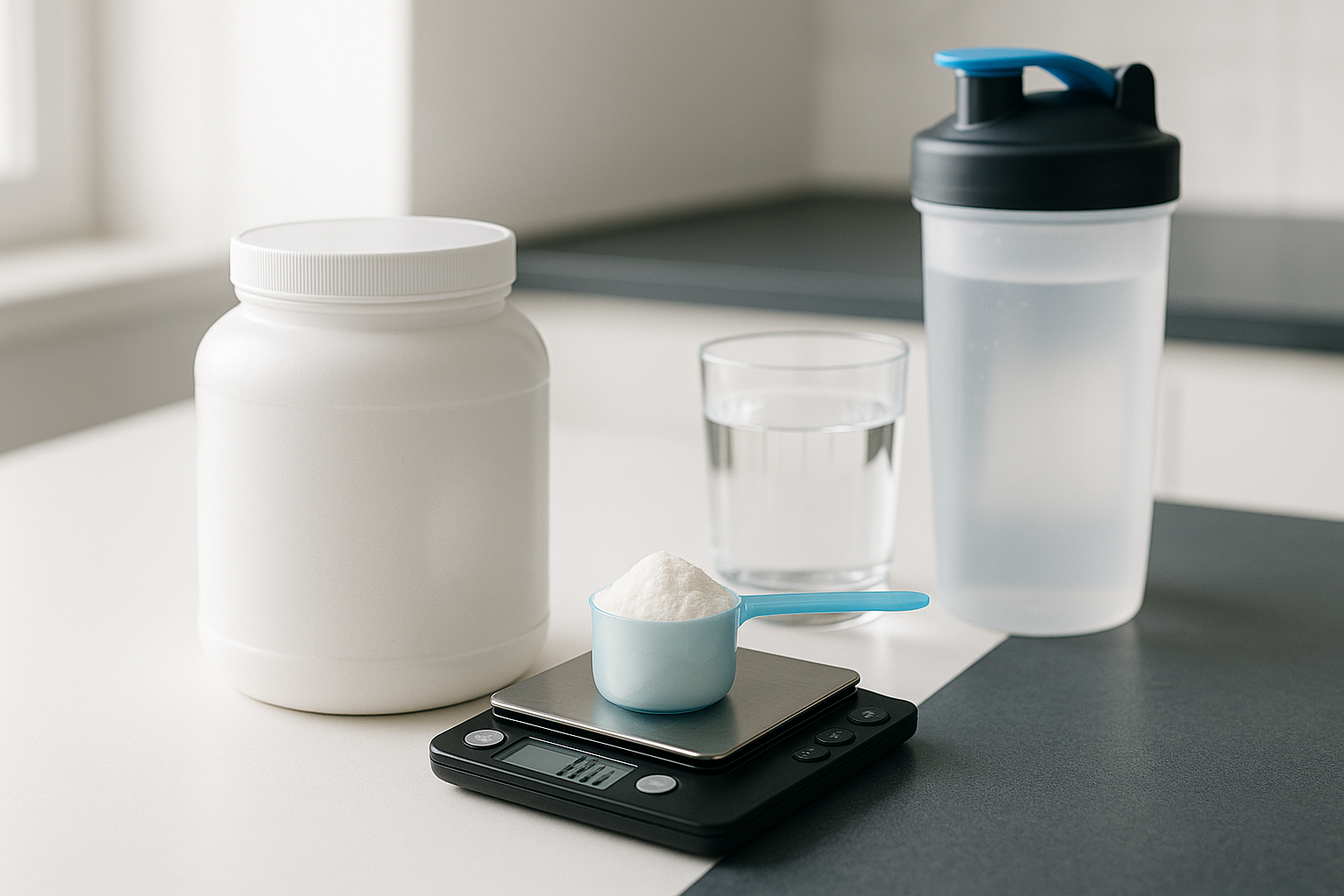
For most people in their 50s, the right creatine dose is 3-5 g of creatine monohydrate per day, every day, with or without food. That maintenance range is enough for most adults 50 plus to gradually saturate muscle stores and keep them elevated.
Loading is optional. A classic loading phase uses about 20 g per day, split into 4 doses of 5 g, for 5-7 days, followed by 3-5 g daily. Loading gets you to saturation faster, but it is not required, and some people in their 50s prefer to skip it to reduce stomach upset or simplify the routine.
Use this practical dosing table:
| Body weight / goal | Simple daily plan | Faster plan | Best for |
|---|---|---|---|
| Under 70 kg, general fitness | 3 g daily | 20 g/day split into 4 doses for 5-7 days, then 3 g daily | Beginners, smaller adults |
| 70-100 kg, strength or body composition | 5 g daily | 20 g/day split into 4 doses for 5-7 days, then 5 g daily | Most adults in their 50s |
| Over 100 kg, higher lean mass | 5 g daily | 20 g/day split into 4 doses for 5-7 days, then 5 g daily | Larger lifters, experienced trainees |
| Brain/healthy ageing interest without hard training | 3-5 g daily | Usually not necessary | People prioritizing simplicity |
Why not chase huge doses? Because more is not meaningfully better once muscle creatine stores are full. The established evidence base supports modest daily dosing, not megadosing. For most people searching “creatine for 50 year old” or “creatine over 50”, the smartest protocol is boringly consistent: one scoop per day, indefinitely.
A few practical examples:
- 62 kg woman beginning strength training: 3 g daily is reasonable.
- 81 kg man lifting three times per week: 5 g daily is the simplest choice.
- 93 kg recreational hockey player in his 50s: 5 g daily, with optional loading if faster results are desired.
If you want more personalised math, use our creatine dosage calculator or read best creatine rankings alongside creatine product catalog to find a product with clear serving size labelling.
How to start creatine in your 50s: a simple step-by-step plan you can begin today
The easiest way to start creatine in your 50s is to buy plain creatine monohydrate, take 3-5 g daily, and pair it with two to four weekly strength sessions. That simple plan beats complicated stacks for almost everyone.
- Choose the form. Buy plain creatine monohydrate powder. It is the most studied, usually the least expensive per gram, and the reference form used in most research. For help choosing, see best creatine rankings and creatine brand reviews.
- Pick your dose. If you are smaller-bodied or cautious, start at 3 g daily. If you are average-sized or larger, 5 g daily is standard.
- Decide on loading or not. If you want faster saturation, use 20 g per day split into 4 x 5 g doses for 5-7 days, then shift to maintenance. If you value convenience or have a sensitive stomach, skip loading and just take your maintenance dose daily.
- Take it consistently. Mix it into water, a protein shake, or another non-acidic beverage you already use. Consistency matters more than perfect timing.
- Train for the goal you want. For sarcopenia risk, do resistance training at least two times weekly, ideally covering squat, hinge, push, pull, carry, and calf work.
- Track results realistically. Monitor gym performance, repetitions, recovery confidence, and body measurements more than day-to-day scale weight.
A beginner-friendly weekly template for people in their 50s might look like this:
- 2-3 strength days: 5-8 exercises, 2-4 sets each
- 2-5 walking or cardio days: zone 2 or brisk walks
- Daily creatine: regardless of whether you train that day
What should you expect week by week?
- Week 1 with loading: possible small weight increase from intramuscular water, not fat.
- Weeks 2-4: slightly better repeated effort, more stable energy in lifting sessions, sometimes improved confidence under load.
- Weeks 4-8: clearer strength and training-volume benefits if your programme is solid.
- Months 2-3: the real value shows up as accumulated progress, not a dramatic single-day effect.
If you miss a day, do not panic and do not double up aggressively. Just resume your normal dose the next day. For more on routine-building, see creatine myths debunked and our broader how-to content cluster.
When to take creatine in your 50s, and how to tell it is actually working
The best time to take creatine in your 50s is the time you will remember to take it every day, because total daily intake matters far more than precise timing. Pre-workout, post-workout, morning, or evening can all work if your dose is consistent.
There is no strong reason for most 50 year olds to overthink timing. Some people prefer taking it after training with protein or a meal because it fits their routine; others find breakfast easiest. The key is maintaining saturated stores over time, not chasing an acute stimulant-like effect. Creatine is not caffeine. You do not “feel” it kick in the same way.
How do you know it is working? Look for these signs:
- you complete an extra rep on hard sets
- your weights or training volume creep upward
- repeated efforts feel slightly less flat
- muscles look a bit fuller
- body weight increases slightly early on without an increase in body fat
What you should not expect:
- an immediate buzz or surge of energy
- fat loss by itself
- major muscle gain without resistance training
- dramatic cognitive change in every user
For adults searching “creatine 50s fitness” or “creatine for older adults 50s”, the most important mindset is that creatine improves the conditions for progress. It can make training more productive and help you preserve or build muscle more efficiently, but the gym work still has to happen.
Timing details that do matter a little:
- Take it on rest days too. Daily use is how you keep stores elevated.
- Take with food if your stomach is sensitive. This often improves tolerance.
- Mix well and drink enough fluids. Normal hydration is sufficient; you do not need extreme water intake.
If you want a timing deep dive, pair this guide with related reading on when to take creatine, how long it takes to work, and how much water to drink with it. Those details can refine the plan, but they do not change the big picture: daily consistency wins.
Safety after 50: side effects, kidney questions, and what bloodwork can show
For healthy adults in their 50s, creatine is generally considered safe at standard doses, and the strongest recurring side effects are mild digestive upset and a small increase in body weight from water stored inside muscle. The long-running fear that creatine inherently damages healthy kidneys is not supported by the bulk of evidence.
The 2017 ISSN position stand and the 2021 JISSN misconceptions review both support creatine’s safety profile in healthy users when taken at evidence-based doses. Mayo Clinic also notes that creatine appears to be safe for many people when used appropriately, while still advising caution in certain medical contexts. See Mayo Clinic — Creatine.
The important nuance for adults 50 plus is not panic, but context:
- Healthy kidneys: standard creatine use is generally well tolerated.
- Existing kidney disease: speak with your physician or nephrologist before use.
- Routine bloodwork: creatinine may rise slightly because creatinine is a breakdown product related to creatine metabolism; this can confuse interpretation if the clinician does not know you supplement.
- Medications: if you take nephrotoxic or kidney-relevant medications, ask before starting.
Common side effects and fixes:
- Stomach discomfort: split the dose, take with meals, or skip loading.
- Bloating sensation: choose monohydrate powder, ensure dose accuracy, and remember that true creatine water retention is mainly intramuscular, not necessarily a puffy look.
- Scale weight increase: usually a normal early effect, not fat gain.
When to stop and get medical advice: new swelling, persistent gastrointestinal symptoms, concerning changes in urination, or any symptom that feels out of proportion to a basic supplement. Creatine is safe, but “safe” does not mean “ignore your body.”
If you are safety-focused, the best approach is to pick a straightforward monohydrate product, stay within the standard dose range, and tell your clinician you use creatine before blood tests. For further reading, see our internal resources on kidney concerns and general creatine safety, plus creatine myths debunked.
Myths about creatine over 50: what is true, false, and overstated
Most myths about creatine over 50 are either false or badly exaggerated, and clearing them up matters because older adults often avoid one of the most useful supplements they could take. The biggest myths are that creatine is a steroid, ruins kidneys, causes dehydration, or only benefits young male bodybuilders.
Let’s deal with the common ones directly.
- Myth: Creatine is a steroid.
Fact: Creatine is not a steroid. It is a naturally occurring compound made from amino acids and stored in muscle to help regenerate ATP. - Myth: Creatine is only for men in their 20s.
Fact: Creatine can be highly relevant for women, beginners, and older adults because preserving muscle and strength becomes more—not less—important with age. - Myth: Creatine makes you fat.
Fact: Creatine may increase body weight early, but that is usually water inside muscle and does not mean body fat gain. - Myth: You need to cycle creatine.
Fact: Routine cycling is not required; steady daily intake is the standard evidence-based approach. - Myth: If you are not a competitive athlete, creatine is pointless.
Fact: Recreational lifters and adults trying to fight muscle loss in their 50s may have just as much practical reason to use creatine as competitors do. - Myth: More expensive forms work better than monohydrate.
Fact: Monohydrate remains the gold standard because it is the best-studied and most cost-effective form.
One more nuanced myth deserves special mention: “creatine fixes brain fog.” This is too strong. Creatine may support brain energy metabolism, and there is legitimate research interest in cognition, fatigue, and neuroprotection. But the evidence is not strong enough to promise every adult in their 50s a noticeable improvement in focus or memory. Treat that benefit as plausible and individual, not guaranteed.
For a wider myth breakdown, visit creatine myths debunked. If you are comparing forms or marketing claims, our creatine brand reviews and creatine product catalog can help you avoid paying extra for weakly supported features.
Best creatine to buy in Canada in your 50s: what actually matters on the label
The best creatine for people in their 50s in Canada is usually a plain creatine monohydrate powder with a clear dose per serving, a Natural Product Number, and preferably third-party testing or strong quality transparency. Fancy blends are rarely necessary.
In Canada, supplement labels often include an NPN, or Natural Product Number, which indicates the product has been licensed by Health Canada as a natural health product. An NPN is not a guarantee of elite quality, but it is a useful legitimacy signal for Canadian buyers.
Here is what to prioritize:
- Form: creatine monohydrate
- Dose clarity: 3 g or 5 g per scoop clearly stated
- Minimal extras: ideally unflavoured if you want best value per gram
- Quality signals: third-party testing, sport certification, or a well-documented manufacturing standard
- Value: compare cost per gram, not just tub price
| Feature | What to look for | Why it matters for adults 50 plus |
|---|---|---|
| Creatine form | Monohydrate | Best-studied, reliable, affordable |
| Serving size | Clearly lists grams of creatine, not just scoop size | Prevents underdosing or confusion |
| NPN | Present on Canadian product label | Useful regulatory legitimacy signal |
| Third-party testing | NSF, Informed Sport, or equivalent brand transparency | Helpful for purity and contamination concerns |
| Flavour system | Minimal if you want lower cost and fewer additives | Usually better value and simpler tolerance |
For most buyers, there is no need to pay a premium for hydrochloride, buffered creatine, gummies, or “senior” formulas unless convenience matters more to you than cost. The International Olympic Committee’s consensus on dietary supplements also places creatine among the few supplements with strong performance evidence, which is another reason to keep the product choice simple: IOC consensus on dietary supplements.
If you are shopping now, start with best creatine rankings, creatine brand reviews, and creatine product catalog. Those resources are especially useful if you want to compare Canadian availability, label quality, and value per gram without falling for flashy claims.
The most common creatine mistakes people in their 50s make
The biggest creatine mistakes in your 50s are inconsistency, expecting instant results, and taking creatine without doing the training that makes it worthwhile. Fortunately, all three are easy to fix.
Here are the mistakes we see most often with creatine for 50s:
- Using it only on workout days. Creatine works through saturation, so daily use is the point.
- Switching forms too fast. People abandon monohydrate after a few days and chase expensive alternatives when the real issue is impatience or poor mixing.
- Stopping because the scale went up. A small increase early on is usually water inside muscle, not fat gain.
- Underdosing with gummies, blends, or tiny scoops. Many convenience products make it harder to reach the evidence-based dose economically.
- Blaming creatine for every symptom. Sleep debt, low protein, poor programming, and dehydration are often the real culprits.
- Ignoring resistance training. Creatine can help without training, but its strongest benefits show up when you lift.
- Not mentioning it before bloodwork. This can create confusion if serum creatinine rises slightly.
The fix is straightforward:
- Take 3-5 g every day.
- Stay with the protocol for at least 4-8 weeks.
- Lift 2-4 times weekly with progressive overload.
- Eat enough protein and total calories for your goal.
- Judge progress by strength, function, and body composition trends, not by one weigh-in.
A practical troubleshooting rule for creatine 50 year olds: if you are not noticing anything after six to eight weeks, first check compliance, dose accuracy, training quality, and whether your product is actually plain monohydrate. Only after that should you wonder whether you are simply a less noticeable responder.
If you need help debugging your setup, use the creatine dosage calculator, revisit creatine myths debunked, and compare your product against the options in best creatine rankings.
Bottom line: should adults 50 plus take creatine?
Yes, many adults 50 plus should seriously consider creatine monohydrate because it is one of the few supplements with strong evidence for improving high-effort performance and supporting lean mass gains during training. For people worried about muscle loss in their 50s, that makes it unusually relevant.
The most accurate bottom line is this: creatine for people in their 50s is not magic, but it is one of the highest-value additions to a muscle-preserving lifestyle. If you strength train, want to start, or care about staying capable as you age, creatine deserves a place near the top of your supplement shortlist.
Keep the plan simple:
- buy plain creatine monohydrate
- take 3-5 g daily
- consider loading only if you want faster saturation
- pair it with progressive resistance training
- stay patient for several weeks
- talk to your clinician first if you have kidney disease or relevant medical complexity
For “creatine for older adults 50s”, the evidence is strongest for muscle and performance, moderate for function-related healthy ageing, and still emerging for broad cognitive benefits. That honest hierarchy matters. Creatine can help you train better and preserve more of what age tries to take away, but it works best as part of a bigger system: lifting, walking, protein, sleep, and consistency.
If you are ready to act today, use our creatine dosage calculator, compare options in creatine product catalog, and shortlist trustworthy picks via creatine brand reviews. If you want the shortest possible answer, it is this: for most healthy 50 year olds, 3-5 g of creatine monohydrate daily is a safe, evidence-based place to start.
Creatine in Your 50s: the numbers that matter most
- 3-5 g/day Typical maintenance dose — Standard daily range for most adults after saturation.
- 20 g/day Classic loading protocol — Usually split into 4 doses for 5-7 days, then reduced to maintenance.
- 5-7 days Time to saturate with loading — Without loading, saturation usually takes several weeks of daily use.
- 2-4x/week Ideal strength training frequency — Creatine works best when paired with regular resistance training.
Frequently Asked Questions
Is creatine good for people in their 50s?
Yes, creatine is a good option for many people in their 50s because it can support strength, training capacity, and lean mass preservation when paired with resistance exercise. Its strongest evidence is for muscle and high-effort performance, while possible brain-related benefits are promising but less consistent.
Can a 50 year old take creatine every day?
Yes, a healthy 50 year old can usually take creatine every day, and daily use is actually the standard way to keep muscle creatine stores elevated. Most people do well with 3-5 g of creatine monohydrate per day, but anyone with kidney disease or medication concerns should check with a clinician first.
Does creatine help with muscle loss in your 50s?
Yes, creatine can help with muscle loss in your 50s, but mainly by improving the quality of your training and supporting better long-term adaptations to resistance exercise. It is supportive rather than curative, which means lifting and adequate protein still do most of the heavy lifting.
Is creatine safe over 50?
Yes, creatine is generally considered safe over 50 for healthy adults when used at standard doses such as 3-5 g daily. The main caveats are existing kidney disease, relevant medications, and the need to tell your clinician about creatine before bloodwork because it can affect creatinine interpretation.
Should women in their 50s take creatine?
Yes, many women in their 50s may benefit from creatine, especially if they want to maintain muscle, strength, and training quality through peri- or post-menopause. Creatine is not a steroid, does not automatically cause bulking, and is often most useful when combined with a sensible strength programme.
How much creatine should adults 50 plus take?
Most adults 50 plus do well with 3-5 g of creatine monohydrate per day. A loading phase of 20 g per day split into four doses for 5-7 days is optional if faster saturation matters to you, but it is not necessary for good long-term results.
Can creatine help brain fog in your 50s?
Possibly, but the evidence is less definitive than it is for muscle and strength. Creatine supports brain energy metabolism, and some research suggests benefits for mental fatigue or cognition in certain situations, but it should not be sold as a guaranteed fix for brain fog in every adult over 50.
Will creatine make you gain weight in your 50s?
Yes, creatine may cause a small early increase in body weight, but that is usually from water being stored inside muscle rather than body fat gain. For many adults in their 50s, that is a normal sign that muscle creatine stores are increasing, not a sign the supplement is making them heavier in a harmful way.
Do you need to work out for creatine to help after 50?
No, you do not strictly need to work out for creatine to raise creatine stores, but the biggest and most reliable benefits happen when it is combined with resistance training. If your goal is fighting sarcopenia or improving body composition, training is what turns creatine from mildly useful into highly useful.
What is the best creatine for older adults in Canada?
The best creatine for older adults in Canada is usually a plain creatine monohydrate powder with a clear serving size, an NPN on the label, and ideally third-party testing or strong brand transparency. In most cases, simple unflavoured monohydrate gives the best mix of evidence, value, and dose accuracy.