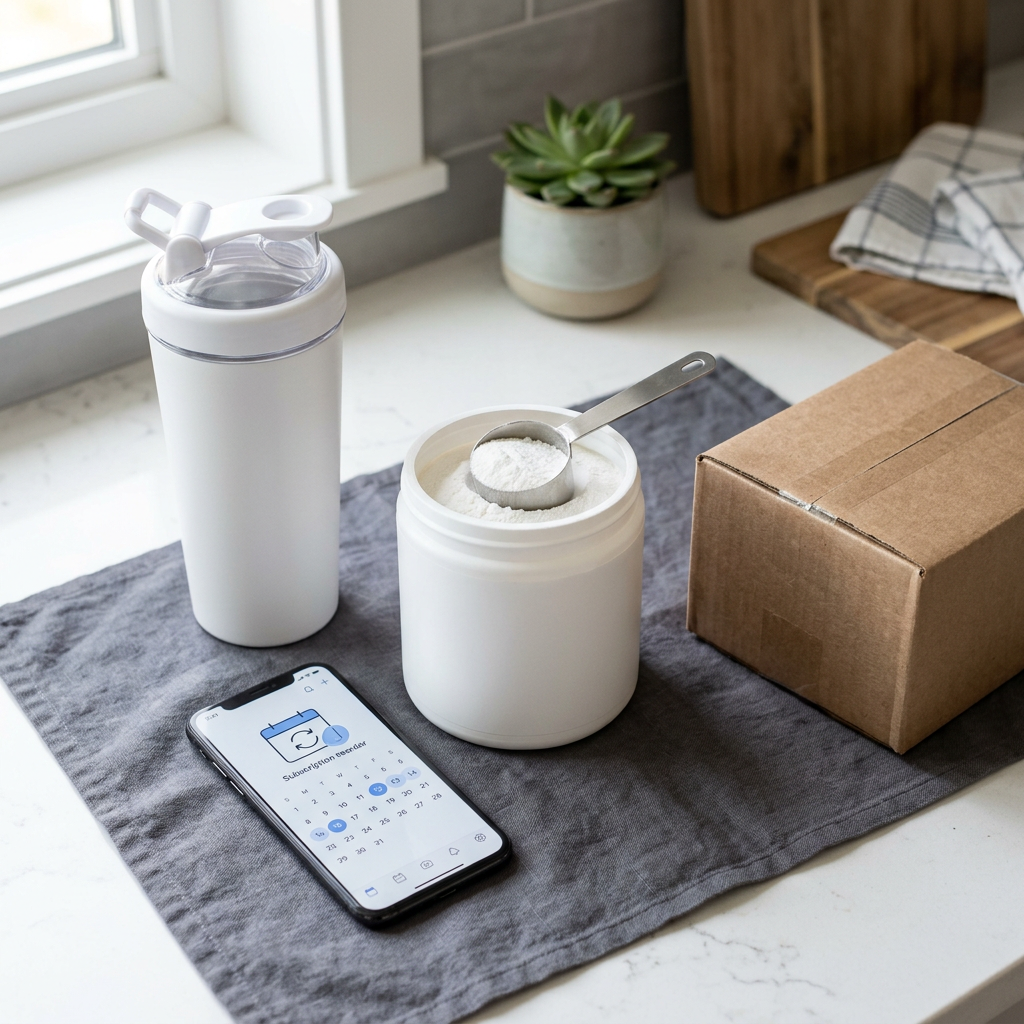
Creatine Subscriptions in Canada: Save More With Auto-Ship Programs
By The Creatine Canada Research Team — Evidence-based supplement analysts
A creatine subscription service in Canada can save money and prevent missed doses, but only if the plan delivers plain creatine monohydrate at the right cadence, with transparent pricing, easy skip/cancel controls, and reliable Canadian shipping. For most people, the best creatine auto-ship Canada option is a simple recurring order for unflavoured monohydrate timed to your actual daily dose and tub size.
Evidence-based · Cites 4 sources · Editorial standards
Key Takeaways
- The best creatine subscription Canada setup is usually plain creatine monohydrate on a 30-, 45-, or 60-day recurring order.
- Most adults do well with 3-5 g per day; your delivery schedule should match that dose, not a generic monthly plan.
- Loading is optional: about 20 g per day split into 4 doses for 5-7 days saturates muscle faster, then you switch to 3-5 g daily.
- A good subscribe and save creatine plan should let you skip, pause, or cancel easily before every shipment.
- In Canada, check for an NPN, clear ingredient labelling, and ideally third-party testing if you are drug-tested or extra quality-conscious.
- Powder is usually the best value for creatine monthly delivery Canada; capsules and gummies cost more per effective dose.
- If your creatine recurring order causes bloating or stomach upset, reduce the single serving size and split the dose.
What a creatine subscription service in Canada actually is, and who should use one
A creatine subscription service Canada shoppers use is simply an automatic recurring order that ships creatine to your door on a set schedule, usually every 30, 45, or 60 days. The practical benefit is not that subscription creatine works better than regular creatine; the benefit is that auto-ship makes consistent daily use easier, and consistency is what keeps muscle creatine stores topped up.
Creatine works best when you take it regularly enough to maintain saturation, meaning your muscles stay stocked with higher phosphocreatine levels. Phosphocreatine is the stored form that helps rapidly regenerate ATP, the immediate energy currency used during short, hard efforts like lifting, sprinting, jumping, and repeated high-intensity intervals. If you keep forgetting to reorder, your supply runs out, and your habit breaks, a creatine monthly delivery Canada plan solves a real problem.
This kind of plan is most useful for:
- Beginners who want a simple default routine.
- Busy lifters who do not want to remember reorders.
- Older adults using creatine year-round for strength training support.
- Women who want a low-friction daily supplement routine without complicated stacks.
- Athletes who cannot afford to run out close to competition blocks.
A subscription is less useful if you are still deciding whether creatine agrees with your digestion, or if you frequently switch between powders, capsules, and flavoured options. In that case, buy one tub first from a trusted listing in a creatine product catalog or compare formats in our best creatine rankings.
The best creatine subscription service is boring in the best possible way: one-ingredient creatine monohydrate, fair price per gram, predictable Canadian shipping, and complete control over pause, skip, and cancel. That matters because the evidence strongly supports creatine itself, not marketing extras. The 2017 ISSN position stand concluded that creatine monohydrate is the most effective ergogenic nutritional supplement currently available for increasing high-intensity exercise capacity and lean mass during training, which is why that should be your default starting point: Kreider et al. (2017), JISSN.
Why creatine auto-ship in Canada improves results in real life, even though the powder is the same
Creatine auto ship Canada plans improve results mainly through adherence, not through a superior ingredient. If the same monohydrate powder arrives before you run out, you are more likely to take 3-5 g every day, and that steady intake is what maintains muscle creatine saturation.
This matters because creatine is not a stimulant you feel instantly from one scoop. Its main performance effect comes from raising intramuscular creatine and phosphocreatine stores over time. Once those stores rise, your body can resynthesise ATP more quickly during repeated high-effort work. In plain English, you can often squeeze out an extra rep, hold power output a bit better across sets, or recover slightly faster between intense bursts. Over weeks and months, that small training advantage can compound into better strength and lean-mass gains.
That is why missed days matter less than missed weeks. One forgotten serving is not a disaster, but running out for 10-14 days because you forgot to reorder can slowly reduce the saturation you built. A good creatine recurring order reduces that risk.
Here is the mechanism in simple sequence:
- You take creatine monohydrate daily.
- Muscle total creatine stores gradually rise.
- Phosphocreatine availability increases.
- ATP regeneration during short, intense work improves.
- Training quality improves slightly but meaningfully over time.
- Better training supports better strength, power, and muscle gain outcomes.
This is one reason creatine is often worth subscribing to and pre-workouts are often not. Creatine only needs steady daily use; it does not depend on a perfect workout window. If you want to understand that deeper, see our guides on creatine dosage calculator and creatine brand reviews.
The evidence base here is mature. The 2021 JISSN review on common questions and misconceptions about creatine notes that creatine monohydrate remains the most extensively studied form and that many popular fears are overstated or unsupported: Antonio et al. (2021), JISSN. So when you evaluate a subscribe and save creatine offer, think less about flashy claims and more about whether the plan helps you follow the evidence-based protocol consistently.
How to set up the right creatine monthly delivery schedule for your dose, tub size, and goal
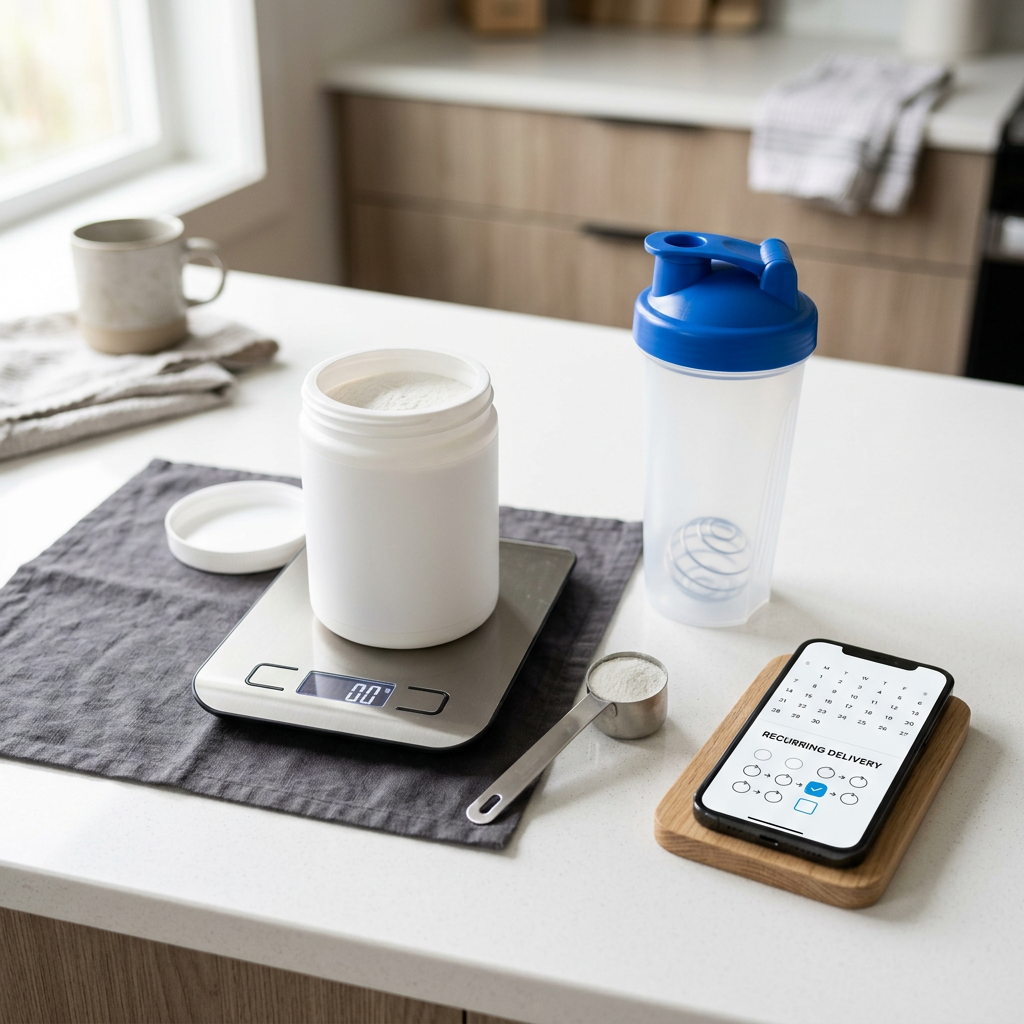
The right creatine monthly delivery Canada schedule starts with your real daily dose, then works backward to the number of servings in your tub. Most people make the mistake of choosing a default 30-day subscription even when the tub lasts 40, 50, or 80 days.
Use this step-by-step process:
- Choose the form. Start with creatine monohydrate powder unless you have a strong reason to prefer capsules.
- Set your daily dose. For most adults, 3-5 g daily is the evidence-based maintenance range.
- Decide on loading or no loading. If you want faster saturation, load with about 20 g daily split into 4 doses for 5-7 days, then drop to maintenance.
- Check the tub size in grams. Example: a 300 g tub lasts 60 days at 5 g per day, but 100 days at 3 g per day.
- Add a shipping buffer. In Canada, weather, holidays, and rural delivery can delay parcels, so build in roughly 1-2 weeks of extra supply.
- Pick the interval. If a tub lasts 60 days, a 45- or 50-day auto-ship is usually safer than a 60-day one.
- Test the first cycle. See whether you are finishing too early or piling up unopened tubs, then adjust.
Examples:
- 60 kg beginner at 3 g/day: a 300 g tub lasts about 100 days, so a 75-90 day subscription often works better than monthly delivery.
- 80 kg lifter at 5 g/day: a 300 g tub lasts about 60 days, so a 45-55 day recurring order is practical.
- 90 kg athlete loading first: expect higher first-week use, then return to 5 g/day for normal scheduling.
If you are unsure what your long-term dose should be, our creatine dosage calculator and related guide on how much creatine per day can help you personalise the plan. If you want the simplest beginner option, a plain tub from the creatine product catalog with a flexible 45- or 60-day plan is usually better than a complicated bundle.
The bottom line is simple: the best best creatine subscription plan Canada choice is the one that arrives slightly before you need it, not far too early and definitely not after you have already run out.
Best type of creatine for subscribe-and-save: monohydrate vs capsules, gummies, and fancy forms
For a creatine subscription service, creatine monohydrate powder is the best default choice because it is the most studied, the most cost-effective, and the easiest format to dose accurately. Most people shopping for a creatine subscription canada plan are trying to save money and reduce friction, and powder usually wins both tests.
Monohydrate has the strongest evidence base by far. Other forms are often marketed as cleaner, gentler, or better absorbed, but those claims usually exceed the evidence. In practice, plain monohydrate works extremely well for most users, especially when mixed properly and taken consistently.
| Format | Best for | Main advantage | Main drawback | Subscription verdict |
|---|---|---|---|---|
| Creatine monohydrate powder | Almost everyone | Best evidence, best value, easy 3-5 g dosing | Some grit if poorly mixed | Best overall |
| Micronized monohydrate | People who dislike texture | Often mixes a bit better | Sometimes higher price for similar effect | Good option |
| Capsules | Travel or convenience users | No mixing needed | Usually more expensive and many capsules per dose | Only if convenience matters most |
| Gummies/chews | Taste-driven users | Easy to take | Usually poor value per effective dose | Usually not ideal for auto-ship |
| HCL/other specialty forms | Brand-loyal buyers | Marketing claims around solubility | Weaker evidence and often higher cost | Rarely the best value |
In Canada, also check the label quality. You want a straightforward ingredient panel, serving size clearly stated in grams, and ideally an NPN, which stands for Natural Product Number, the licence identifier used on many Health Canada-regulated natural health products. If you are a tested athlete, look for meaningful third-party testing as an added layer of reassurance.
If you want help comparing actual products rather than formats, start with our best creatine rankings or browse the creatine brand reviews. If you are deciding between monohydrate and more expensive alternatives, our related guide on best type of creatine and the monohydrate-vs-HCL topic is the smarter place to go next.
For most households, the best subscribe and save creatine strategy is plain, unflavoured monohydrate in a tub size large enough to reduce price per gram but small enough that you will finish it well before shelf-life concerns become relevant.
Exact dosing for a creatine recurring order: by body weight, training goal, and loading preference
Most people on a creatine recurring order should take 3-5 g of creatine monohydrate per day, with optional loading at about 20 g per day split into 4 doses for 5-7 days. That standard protocol is well established and fits the overwhelming majority of users.
Here is the practical breakdown:
- General fitness or beginners: 3 g/day is often enough, especially for smaller bodies and people mainly seeking convenience and long-term consistency.
- Strength, hypertrophy, or team-sport athletes: 5 g/day is the common, evidence-based maintenance target.
- Vegetarians and vegans: still typically 3-5 g/day, but some may notice stronger benefits because baseline muscle creatine stores can be lower.
- Older adults: usually 3-5 g/day, ideally paired with resistance training.
Loading is optional, not mandatory. If you want faster results, use roughly 20 g/day divided into 4 doses of 5 g for 5-7 days, then continue with 3-5 g/day. Without loading, daily maintenance still works; it just takes longer to fully saturate muscle creatine stores, often closer to several weeks.
What to expect:
- With loading: you may notice scale weight rise modestly within the first week because creatine draws more water into muscle.
- Without loading: changes are subtler at first, but by a few weeks many users notice better training quality or fuller muscles.
- Longer term: better repeat performance and improved training output are the real payoff.
If you want a more personalised estimate, use our creatine dosage calculator. For deeper dosing guidance, see the related guides on how much creatine per day, creatine maintenance dose, and creatine loading phase.
A common mistake in creatine monthly delivery Canada plans is forgetting that loading burns through a surprising amount of product in week one. If your first tub is only barely large enough for a month's maintenance, and you load, you may run short. In that case, either start with a larger first order or skip loading entirely.
As a practical rule, if you want the lowest-maintenance subscription, take 5 g once daily and schedule shipments around that. If you want the gentlest digestion, split the same daily total into smaller servings. Both methods work, because total daily intake matters more than perfect timing.
When to take it, how long it takes to work, and how to tell your subscription is paying off
The best time to take creatine is the time you will actually remember every day, and most users should expect noticeable benefits over days to weeks rather than from a single serving. For a creatine auto ship Canada customer, timing matters far less than habit consistency.
Creatine does not need a narrow anabolic window. You can take it in the morning, after training, with a meal, or on rest days at any convenient time. Daily adherence matters more than exact timing because creatine works by increasing total muscle stores over time, not by acutely stimulating the nervous system like caffeine.
A realistic timeline looks like this:
- Days 1-7 with loading: muscle saturation rises faster; some users notice modest water-weight gain and slightly fuller muscles.
- Weeks 2-4 without loading, or after loading maintenance begins: many users notice improved rep quality, better repeated efforts, or less drop-off between sets.
- Weeks 4-12: the cumulative effect usually shows up as better strength progression, more training volume, and potentially more lean-mass gain than training alone.
How do you know it is working?
- You stop missing doses because the subscription arrives on time.
- Your body weight may rise slightly early on, mostly from intracellular water, not fat.
- Your workouts feel a touch stronger on repeated hard efforts.
- You may get an extra rep on compound lifts or recover better between sets.
- Over months, your logbook improves faster than it did before.
What not to expect: a dramatic buzz, pump, or instant surge in energy. If that is what you want, you are thinking of a pre-workout, not creatine. If you miss a day, do not double up in panic; just resume your normal daily dose.
For more on timing, see the related guide on when to take creatine, and for expectations, the guide on how long does creatine take to work is the relevant next read. If you are worried it is not doing anything, our internal troubleshooting content in creatine myths debunked can help distinguish normal expectations from exaggerated supplement marketing.
The simplest success metric is this: if your creatine subscription service keeps you consistent for months, and your training quality improves gradually, the system is doing exactly what it should.
Who should use a creatine subscription plan: beginners, women, older adults, athletes, and plant-based Canadians
A creatine subscription plan is best for people who expect to use creatine continuously for months, because the main benefit is uninterrupted daily intake. That includes far more than bodybuilders.
Beginners are excellent candidates. If you are just starting resistance training, creatine monohydrate is one of the few supplements with a strong evidence base for performance support. A simple recurring order prevents decision fatigue and removes the “I forgot to reorder” problem.
Women can use the exact same creatine monohydrate as men. There is no need for a pinked-up formula or a lower “women's-only” maintenance dose unless the serving is simply tailored for convenience. Creatine does not inherently make women bulky; it supports training quality and often causes only modest water shifts inside muscle, not body-fat gain. Readers who want a deeper female-specific lens should see the related guide on creatine for women.
Older adults may benefit from a long-term subscription because consistency is especially important when creatine is paired with resistance training for muscle and functional support. The value here is routine and supply stability.
Athletes, especially those in power, sprint, repeated-effort, and team sports, often do best with predictable stock on hand. If you are drug-tested, a subscription should prioritise quality control, straightforward labels, and ideally third-party testing.
Vegetarians and vegans are often especially good candidates because dietary creatine intake from meat and fish is lower or absent. That can mean greater room to benefit from supplementation. If that applies to you, plain monohydrate is still the first choice.
A subscription may be a poor fit if:
- You have not yet tested your tolerance to creatine.
- You frequently move or travel and cannot predict delivery windows.
- You only plan to take creatine sporadically, which is not ideal anyway.
- You have a medical condition requiring clinician guidance before use.
The International Olympic Committee consensus on supplements recognises creatine as one of the few performance supplements with strong evidence in appropriate sporting contexts: IOC consensus (2018). That does not mean everyone needs a subscription, but it does support year-round use for many training populations.
In short, the best best creatine subscription plan Canada setup is for people who want the evidence-based supplement that keeps working only when the habit stays uninterrupted.
Canadian buying checklist: NPNs, third-party testing, shipping, and how to compare subscription value

When comparing a creatine subscription service Canada buyers should prioritise legal labelling, quality signals, shipping reliability, and cost per gram rather than flashy discounts. The sticker discount on a subscribe and save creatine offer can be misleading if the base price is already inflated.
Use this Canadian checklist before you subscribe:
- NPN on label: An NPN, or Natural Product Number, is a Health Canada licensing identifier used for many natural health products sold in Canada. Its presence is a useful legitimacy signal.
- Ingredient simplicity: For unflavoured monohydrate, the ingredient list should ideally be just creatine monohydrate.
- Serving transparency: The label should make the gram amount per scoop easy to verify.
- Third-party testing: Especially relevant for competitive athletes or cautious buyers concerned about contamination risk.
- Canadian warehouse and shipping: Faster, more predictable delivery and fewer cross-border surprises.
- Pause/skip/cancel controls: A recurring order is only a deal if you can manage it easily.
- Price per gram: This is the fairest apples-to-apples comparison metric.
| What to compare | Why it matters | Good sign | Red flag |
|---|---|---|---|
| Price per gram | Shows true value | Large tub with modest markup | Big subscription discount on small expensive servings |
| Form | Affects evidence and cost | Plain monohydrate | Proprietary blend or underspecified form |
| Shipping origin | Affects speed and duties risk | Ships from Canada | Unclear cross-border fulfilment |
| Subscription controls | Prevents waste | Easy self-serve pause/skip | Hard-to-find cancellation policy |
| Quality assurance | Reduces risk | NPN and testing details | No quality information at all |
If you want product-specific comparisons, our best creatine rankings, creatine brand reviews, and creatine product catalog are the best next stops. For label literacy, related guides on Canadian supplement regulations, third-party tested creatine in Canada, and how to read a creatine label are especially useful.
The key Canadian insight is that convenience only counts if fulfilment is reliable. A creatine monthly delivery Canada plan that saves a few dollars but arrives late in remote regions or during winter disruptions is not actually the best plan for adherence.
Safety, side effects, and how to troubleshoot bloating, stomach upset, and creatinine confusion
Creatine monohydrate is generally considered safe for healthy people when used at evidence-based doses, and the most common issues are mild digestive complaints or temporary water-weight changes rather than serious harm. A good subscription should make it easy to stay consistent, but consistency should never mean ignoring tolerance issues.
The strongest evidence-based side effects to know are:
- Water-weight gain: often modest and usually related to more water stored inside muscle.
- Stomach upset or loose stools: more likely with large single doses, especially during loading.
- Perceived bloating: often improved by splitting doses or choosing a plain unflavoured powder.
Practical fixes:
- Take creatine with a meal or shake if it sits better that way.
- Split 5 g into smaller servings if one full scoop bothers you.
- Use room-temperature or warm water if mixing texture is the main issue.
- Avoid unnecessary mega-dosing beyond standard loading protocols.
- Check that your product is actually pure monohydrate rather than a blend with sweeteners or other actives you may not tolerate.
A major point of confusion is creatinine, a breakdown product measured on blood tests. Creatine supplementation can increase creatinine somewhat without meaning your kidneys are being damaged. That is why context matters. The ISSN position stand and later reviews consistently note that creatine is safe for healthy individuals at recommended intakes, though anyone with known kidney disease, concerning symptoms, or clinician-directed restrictions should speak with a qualified healthcare professional before use.
For a broad mainstream medical summary, see Mayo Clinic — Creatine. For deeper evidence and myth-busting, see Antonio et al. (2021), JISSN.
If you are frequently uncomfortable on a creatine recurring order, do not assume creatine is the problem forever. Often the real issue is dose size, poor mixing, or a heavily flavoured product. We also cover many of these concerns in creatine myths debunked. If you have a history of renal disease, are pregnant or breastfeeding, or take medications that raise a meaningful interaction question, get individual medical advice first.
Common subscription mistakes and creatine myths that cost Canadians money or results
The biggest mistakes with creatine subscriptions are buying the wrong format, scheduling deliveries badly, and expecting effects that creatine was never supposed to produce. Most poor experiences come from logistics or misinformation, not from the core supplement itself.
Here are the most common errors:
- Picking capsules for savings: Capsules can be convenient, but they are rarely the cheapest way to run a long-term subscription.
- Choosing a 30-day plan by default: Your tub may last much longer, causing waste or subscription fatigue.
- Ignoring the first loading week: If you load, your first tub disappears faster.
- Chasing exotic forms: Fancy creatine types often cost more without outperforming monohydrate in the evidence.
- Stopping on rest days: Creatine is a saturation supplement, so rest-day dosing still matters.
- Thinking water gain equals fat gain: Early scale changes are usually from water in muscle, not body fat.
- Believing you need to cycle: Routine cycling is generally unnecessary for most healthy users.
Now the myths:
- “Creatine is a steroid.” False. Creatine is a naturally occurring compound involved in energy metabolism, not an anabolic steroid.
- “Creatine damages healthy kidneys.” The evidence does not support that claim in healthy people using recommended doses.
- “Women should avoid creatine.” False. Women can use creatine monohydrate effectively and safely under the same general evidence-based framework.
- “You must take it right after training.” No. Daily consistency matters more than exact timing.
- “If you miss a day, the whole cycle is ruined.” No. Resume normal intake; do not overreact.
If you want a deeper evidence breakdown, browse creatine myths debunked and our related guides on do you need to cycle creatine, does creatine make you gain weight, and is creatine a steroid. If you are shopping right now, a quick compare in the creatine product catalog can also prevent buying the wrong form for your needs.
The smartest creatine subscription service mindset is simple: buy the least glamorous product that still meets your quality standards, then make the schedule fit your usage rather than the retailer's default checkout settings.
Bottom line: the best creatine subscription plan in Canada for most people
The best creatine subscription plan Canada buyers can choose is plain creatine monohydrate powder from a reputable Canadian seller, set on a flexible recurring order that matches your actual daily dose and leaves a small delivery buffer. That is the most evidence-based, cost-effective, and beginner-friendly answer.
If you want the shortest version:
- Buy plain creatine monohydrate.
- Take 3-5 g daily.
- Load only if you want faster saturation.
- Choose an interval based on tub size and your dose, not a generic monthly default.
- Prioritise NPN labelling, transparent ingredients, and preferably third-party testing when relevant.
- Use skip/pause features so the subscription stays useful instead of becoming clutter.
For most Canadians, that means an unflavoured powder on a 45- to 60-day subscription if taking 5 g/day from a medium-size tub, or longer if you use 3 g/day or buy in larger bulk. If you live in a rural or remote area, shorten the interval slightly to build in a shipping cushion. If you are a tested athlete, quality assurance should outrank tiny price differences.
Remember what you are really buying with a creatine subscription canada plan: not magic powder, but reliable continuity. Creatine works because your muscles stay topped up, and your muscles stay topped up because you keep taking it. Auto-ship is valuable only when it supports that boring, proven routine.
If you are ready to compare products now, start with our best creatine rankings, browse the creatine brand reviews, or use the creatine dosage calculator to set the right delivery cadence. For broader reading, the most relevant next guides are how to take creatine, how much creatine per day, and where to buy creatine in Canada.
The smartest recurring creatine order is the one you barely think about because it delivers plain monohydrate on time, at a fair cost per gram, and keeps your daily habit uninterrupted.
Creatine subscription service Canada: the numbers that matter
- 3-5 g/day Standard maintenance dose — Fits most adults using creatine monohydrate long term.
- ~20 g/day Typical loading dose — Usually split into 4 doses for 5-7 days, then reduced to maintenance.
- 5-7 days Fast saturation window with loading — Without loading, full saturation usually takes longer.
- 45-60 days Common smart auto-ship interval — Often a better fit than 30 days for many 5 g/day powder users, depending on tub size.
Frequently Asked Questions
What is the best creatine subscription service in Canada?
The best creatine subscription service in Canada is usually the one that delivers plain creatine monohydrate at the lowest fair cost per gram with easy skip, pause, and cancel options. Look for Canadian shipping reliability, clear gram-based serving sizes, simple ingredients, and ideally an NPN and quality-testing details.
Is a creatine auto-ship plan worth it in Canada?
Yes, a creatine auto-ship plan is worth it if you take creatine year-round and are prone to forgetting reorders. The value is convenience and adherence, because creatine works best when taken consistently enough to maintain muscle saturation rather than in short, inconsistent bursts.
How often should a creatine monthly delivery Canada plan arrive?
A creatine monthly delivery Canada plan should arrive based on your daily dose and tub size, not automatically every 30 days. Many users taking 5 g/day from a medium tub do better with a 45- to 60-day schedule, while 3 g/day users may need an even longer interval.
Can I subscribe and save on creatine monohydrate in Canada?
Yes, you can subscribe and save on creatine monohydrate in Canada, and monohydrate is usually the best form to subscribe to. It is the most studied, most cost-effective, and easiest to compare across brands because the evidence strongly supports it over more expensive novelty forms.
Should I choose powder or capsules for a creatine recurring order?
Powder is usually better for a creatine recurring order because it gives you accurate 3-5 g dosing at a lower cost per effective serving. Capsules are convenient for travel and zero-mix routines, but they often cost more and may require several capsules to reach a full daily dose.
Do I need to load creatine if I have a subscription service?
No, you do not need to load creatine just because you use a subscription service. Loading at about 20 g/day split into 4 doses for 5-7 days can saturate muscles faster, but taking 3-5 g/day consistently still works and is often simpler for long-term auto-ship users.
What should Canadians check before starting a creatine subscription?
Canadians should check the product form, ingredient simplicity, NPN status, shipping origin, cost per gram, and the subscription cancellation rules before enrolling. If you are a competitive athlete, also check for credible third-party testing to reduce contamination and banned-substance risk.
Can women use the same creatine subscription plan as men?
Yes, women can generally use the same creatine subscription plan as men because the supplement itself is the same. The main adjustment is practical rather than sex-specific: choose a delivery cadence that matches your real daily intake, preferred format, and how quickly you finish each tub.
What happens if I miss a shipment or run out of creatine?
If you miss a shipment or run out of creatine, nothing catastrophic happens, but your muscle creatine stores can gradually drift down if the gap is long enough. Resume your normal 3-5 g daily dose when you restock, and consider shortening your next subscription interval to build a buffer.
Is creatine subscription delivery safe in hot or cold Canadian weather?
Yes, creatine delivery is generally safe in hot or cold Canadian weather because creatine monohydrate powder is fairly stable in normal supplement packaging. The more important issue is moisture after delivery, so store the tub sealed and dry once it arrives.