What Reddit Actually Says About Creatine in 2026 — 30 Years of Community Consensus
Reddit has been talking about creatine since the early 1990s — longer than most clinical trials have been running. We went deep on the top community discussions to find the actual consensus on efficacy, side effects, practical tips, and why one 12-week null-finding study caused so much noise.
Key Takeaways
- The Reddit consensus on creatine efficacy is overwhelmingly positive and has been consistent for over 30 years.
- Most users report roughly 10% strength improvement and 4 lbs of early water weight gain as typical first-month experiences.
- The brain health debate is real, but the community correctly notes that standard 5 g/day gym doses may not be enough to raise brain creatine levels significantly.
- Heat degrades creatine into creatinine — mixing in hot coffee or storing powder in a hot car are genuine concerns.
- A 12-week study that found minimal lean mass gains at 5 g/day caused controversy; the community consensus is that study design was the issue, not creatine.
- Kidney disease is the one firm contraindication the community agrees on — anyone with CKD should consult their nephrologist before supplementing.
Thirty years and still the most-discussed supplement on Reddit
Creatine holds a peculiar distinction in the supplement world: it is simultaneously one of the most scientifically studied compounds in exercise science and one of the most organically discussed by everyday users online. Reddit discussions — from r/Fitness to r/Supplements to r/longevity — have been accumulating real-world feedback on creatine since the early 1990s when, as one commenter memorably put it, creatine "had a major boom in use when Gen Xers were in middle school."
That's not a small data pool. Reddit's creatine threads collectively represent millions of user-experiences — loading protocols that worked, GI problems that didn't, strength gains that held and water weight that did not, and now a wave of discussion around cognitive and brain health benefits that the scientific literature is just starting to catch up with.
This piece synthesises the most substantive recent community discussions and cross-references them with peer-reviewed evidence. The goal isn't to validate or debunk Reddit — it's to show where community experience lines up with the science and where it diverges. Creatine is a well-characterised compound; the community has had 30 years to test it at scale.
The community consensus: creatine works, and most people feel it
Strip away the edge cases and the community verdict is remarkably consistent: creatine produces real, measurable improvements in strength and endurance for most people who use it consistently. The most-cited figure across dozens of threads is a ~10% improvement in strength — often expressed in concrete terms: "If you can do 20 push-ups, creatine gets you to 22."
That figure aligns well with the published literature. A comprehensive meta-analysis of resistance training studies found creatine supplementation improved bench press and squat performance by 8–14% compared to placebo when combined with a structured training programme. The mechanism is well-established: creatine expands your phosphocreatine reserves, the fast-access energy buffer your muscles use for maximal efforts lasting under 10 seconds.
Beyond raw strength, Reddit users also report:
- Faster recovery between sets — being able to maintain effort across a full session, not just the first couple of sets
- Improved muscular endurance — particularly in repeated sprint or HIIT contexts
- Better performance in the 6–12 rep range — the range most relevant to hypertrophy training
These match the categories where the clinical evidence is strongest. Creatine for athletes performing repeated high-intensity efforts has more robust support than, say, creatine for single-effort endurance sports.
One point the community consistently makes: the gains don't stay permanently. Several threads note that strength acquired while on creatine fades back toward baseline after stopping — though the actual muscle built during that period does not. This is consistent with what the phosphocreatine mechanism predicts: creatine doesn't build muscle on its own, it allows you to train harder, and that training stimulus is what drives muscle growth.
The water weight conversation: 4 lbs, why it happens, and why it matters
Ask any experienced Reddit user what to expect in the first two weeks of creatine use and the answer is almost always the same: expect to gain water weight, expect to look fuller, and don't panic when the scale goes up. The commonly cited figure is 2–5 lbs of water weight, with 4 lbs appearing most frequently in community reports.
This happens because creatine is osmotically active inside muscle cells. As muscle creatine stores fill up, water is drawn into the cell alongside them — a process called cell volumisation. This is not the same as the subcutaneous bloating that gives a "puffy" look; it happens within the muscle itself, which is why many users report looking bigger even as the scale climbs.
The community has largely made peace with this effect, though it does prompt some practical debate:
- Users tracking weight for sport or aesthetic goals learn to distinguish creatine water weight from actual fat or muscle changes
- Some athletes who compete in weight classes (combat sports, rowing, powerlifting) time their creatine use carefully around competition weigh-ins
- A consistent finding: the water weight comes back off within 1–2 weeks of stopping creatine — which is why the community correctly notes that stopping creatine does not cause fat gain
Hydration matters here: because creatine draws water into muscle cells, staying well-hydrated ensures that pull doesn't dehydrate other tissues. Most experienced users settle on an extra 500–750 ml of water per day above their normal intake while supplementing.
What Reddit gets right about the research — including the funding question
One of the more sophisticated discussions in creatine threads concerns research quality and conflict of interest. The supplement industry has a troubled relationship with science — many compounds are backed primarily by industry-funded trials with cherry-picked endpoints. The Reddit community is appropriately sceptical, and they apply that lens to creatine as well.
The honest answer: creatine sits in an unusual position. Examine.com rates creatine at 93/100 for evidence quality — one of the highest scores of any supplement. But as community members note, a meaningful share of that research has been funded by Creapure and AlzChem, the primary manufacturers of pharmaceutical-grade creatine monohydrate.
The community's counter-argument is compelling, and the science supports it: replication at scale effectively neutralises the conflict-of-interest concern. When independent academic groups across multiple countries — with no industry funding — repeatedly find the same effects, the funding source of any individual study becomes less relevant. Creatine's performance effects have been replicated across hundreds of independent studies over four decades. That's a different situation from, say, a supplement backed by five industry-funded trials and nothing else.
The community also correctly identifies one genuine limitation: much of the industry-funded research focuses narrowly on the outcomes most favourable to marketing (peak strength, bench press max). Independent research has been more willing to study longer-term effects, non-responder rates, and contexts where creatine underperforms. The full picture is more nuanced than supplement marketing suggests — but the core efficacy claim holds up.
The 12-week null-finding study: did it prove creatine does not work?
In recent months, Reddit discussions have repeatedly circled back to a study that found "combining resistance training with creatine at the usual 5 grams a day barely affects lean body mass over 12 weeks compared to just resistance training." The threads that followed were long, sometimes heated, and reveal a lot about how the community navigates conflicting evidence.
First, what the study actually showed: in a relatively short trial, with a standard supplementation dose, the lean mass difference between the creatine and placebo groups was not statistically significant. That is a real finding, and the community's instinct to take it seriously is correct.
However, the pushback is also well-reasoned:
- 12 weeks may not be enough. Creatine's hypertrophy benefit compounds over time — it allows you to train harder in every session, and that accumulated training stimulus drives muscle growth over months and years. Short trials often undercapture this.
- Lean body mass is a blunt tool. Changes in muscle creatine water content, fat mass shifts, and measurement error can all obscure modest lean mass differences over 12 weeks. Studies using muscle biopsy or MRI tend to find clearer effects.
- The null finding is for lean mass specifically. The same study and the broader literature consistently show strength and power improvements even when lean mass changes are small. Strength ≠ mass.
- Small sample sizes amplify noise. Several threads flagged that the study had under 40 participants — a size that lacks statistical power to detect modest effects reliably.
The community's conclusion: one study with methodological limitations does not overturn 30 years of replicated evidence. But it is a useful reminder that creatine is primarily a performance supplement — the muscle growth is a downstream effect of training harder, not a direct anabolic effect of creatine itself.
Practical wisdom: mixing, heat, coffee, and the kidney warning
Beyond efficacy debates, Reddit is an excellent source of practical supplement wisdom built up over decades of trial and error. Here is what the community has collectively figured out about creatine use:
On mixing and grittiness
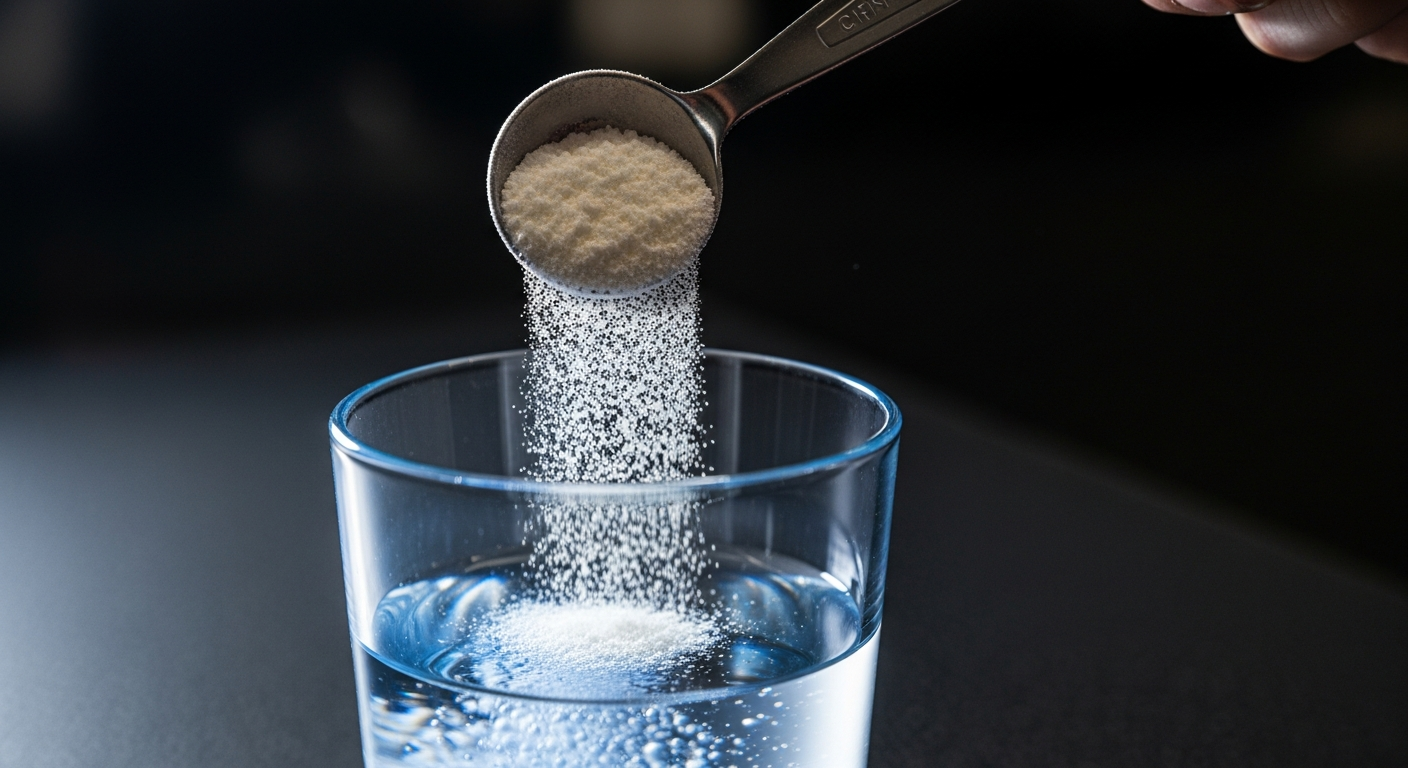
Creatine monohydrate does not dissolve well in cold water — it requires warm-to-hot water or vigorous stirring to go fully into solution. Users report "grittiness" as the primary texture complaint, and the fix is straightforward: use warm water or mix into warm beverages, stir thoroughly, and drink immediately. Fine-milled (micronized) creatine dissolves more easily and is worth considering for anyone who finds standard monohydrate unpleasant to drink.
The hot coffee problem
One practical concern that appears repeatedly: heat degrades creatine into creatinine, the inert metabolic waste product it eventually becomes anyway. Mixing creatine into a piping hot coffee and letting it sit essentially accelerates that conversion and reduces the active dose you're actually consuming. The community fix: let your coffee cool to below 60°C before stirring in creatine, or mix it into room-temperature water and drink the coffee separately.
On loading vs maintenance
The community is divided but increasingly pragmatic on loading: a 20 g/day loading phase for 5–7 days will saturate muscles faster, but the same saturation is achieved with 3–5 g/day over 3–4 weeks without the GI distress that high doses cause for many people. Unless you have a specific reason to load quickly (competition approaching, late start), the community consensus leans toward skipping the load and just being consistent.
The kidney disease warning — non-negotiable
One point on which Reddit has no debate: creatine is not appropriate for people with chronic kidney disease (CKD). Creatine metabolism produces creatinine, which is filtered by the kidneys. In healthy individuals, this poses no problem — decades of evidence confirm no kidney damage from standard doses in healthy people. But in people with compromised kidney function, adding exogenous creatine can stress an already-strained filtration system. The community consensus is firm: if you have any history of kidney problems, consult your nephrologist before supplementing, full stop. For everyone else, the kidney concern has been studied extensively and creatine has not been found to damage healthy kidneys at standard doses.
The bottom line: what the community agrees on
After 30 years and millions of user experiences, the Reddit community's verdict on creatine is one of the most consistent in supplement discourse. The short version:
- It is one of the most cost-effective, evidence-backed supplements available. At roughly $0.10–0.20 per dose for a quality monohydrate, the cost-to-benefit ratio is exceptional — particularly for anyone engaged in strength training, team sports with repeated sprints, or high-intensity conditioning.
- The effects are real but modest. Roughly 10% strength improvement, faster recovery between sets, and marginally more reps at a given weight. For someone training hard, those margins compound into meaningful long-term gains. They don't turn an average lifter into an elite one.
- Consistency matters more than timing. Taking creatine every day, at whatever time is easiest to remember, beats elaborate timing protocols. Muscle creatine stores take weeks to saturate — daily consistency is the variable that matters most.
- Non-responders exist. Roughly 25% of people see minimal response to creatine supplementation, often because their baseline muscle creatine stores are already close to saturation (typically seen in people who eat a lot of red meat). This is not a failure of the supplement — it is a metabolic reality.
The community's most common advice to new users: try it for 6–8 weeks, track your performance metrics honestly, and let the results speak. It is cheap, safe, and well-studied enough that there is little reason not to find out whether you're a responder. Use our creatine dose calculator to find your optimal daily maintenance dose by body weight.
And if you're curious about the increasingly discussed cognitive and brain health applications, that is a separate — and genuinely interesting — conversation. Read our deep dive on what Reddit and the science say about creatine for brain health.
Reddit's creatine consensus at a glance
- ~10% Typical strength improvement reported by users and confirmed in meta-analyses
- 4 lbs Average water weight gain in the first 2 weeks as muscle creatine stores fill
- 93/100 Examine.com evidence quality score — one of the highest of any supplement
Frequently Asked Questions
How much stronger does creatine actually make you?
Community reports and clinical research both converge on roughly a 10% improvement in strength for most users. The most common way Reddit puts it: if you can do 20 push-ups, creatine gets you to about 22. This effect appears most consistently in sets lasting 6–15 reps or explosive efforts under 10 seconds — the range where the phosphocreatine energy system dominates.
Does creatine cause noticeable water weight gain?
Yes, typically 2–5 lbs in the first 2–3 weeks as muscle creatine stores fill and draw water into muscle cells. This is intramuscular water (cell volumisation), not subcutaneous bloating. Most users find they look fuller or more muscular as a result. The water weight leaves within 1–2 weeks of stopping creatine.
Can I mix creatine in hot coffee?
You can, but you shouldn't let it sit. Heat converts creatine into creatinine — the inert metabolic byproduct — which means a hot cup of creatine-coffee left sitting for 10–20 minutes delivers significantly less active creatine. Either let your coffee cool before stirring in creatine, or mix into room-temperature water separately.
What does Reddit say about creatine for people with kidney problems?
There is essentially no debate: creatine is strongly contraindicated in anyone with chronic kidney disease (CKD) or compromised kidney function. Creatine metabolism produces creatinine, which the kidneys must filter. For healthy kidneys this is no problem — the evidence over four decades is reassuring. For already-stressed kidneys it is a different calculation. Always consult a nephrologist before supplementing if you have any kidney history.
Did a 12-week study actually prove creatine doesn't build muscle?
A 12-week study found no statistically significant difference in lean mass between creatine and placebo groups. The community's response: study design matters. Twelve weeks is short for lean mass accumulation, lean body mass is a blunt measurement tool, and the study had fewer than 40 participants. The broader literature — including longer trials with better measurement methods — consistently shows creatine allows harder training, which over months drives greater muscle gains.
Is creatine really the most-researched supplement?
It is among the most researched, and the claim holds up in practice. Examine.com gives it a 93/100 evidence quality score. Hundreds of independent studies from academic institutions with no industry funding have replicated its core performance effects. A meaningful portion of funding has come from Creapure/AlzChem — the community notes this fairly — but replication at that scale across independent groups effectively neutralises the conflict-of-interest concern.