Creatine Cost Per Gram: The Only Metric That Actually Matters When You Buy
By The Creatine Canada Research Team — Evidence-based supplement analysts
Creatine cost per gram comparison is the smartest way to compare products because it shows what you actually pay for the active ingredient, not the prettiest tub, biggest scoop, or loudest marketing claim. For most Canadians, the best value creatine is plain creatine monohydrate powder with a low cost per gram, minimal extra ingredients, and trustworthy quality signals such as an NPN and third-party testing where relevant.
Evidence-based · Cites 4 sources · Editorial standards
Key Takeaways
- Cost per gram is calculated as total price divided by total grams of creatine, and it beats price per tub or price per serving for true value.
- The cheapest creatine per gram is usually unflavoured creatine monohydrate powder, not gummies, capsules, or blends.
- A standard maintenance dose is 3-5 g/day, so even small differences in cost per gram add up over months.
- Price per serving can mislead when brands use tiny servings, added fillers, or underdosed blends.
- Micronized monohydrate can be worth a small premium for mixability, but fancy forms rarely justify a major price jump.
- In Canada, check for an NPN, clear grams per serving, ingredient simplicity, and shipping cost before calling any product a deal.
- If two products have similar cost per gram, choose the one with better testing, cleaner labelling, and easier dosing.
What creatine cost per gram actually means, and why it is the buying metric that matters most
Creatine cost per gram means the amount of money you pay for each gram of actual creatine in a product, and it is the best single metric for comparing value. If you remember one thing from this guide, make it this: tubs do not compete with tubs, and servings do not compete with servings; grams of creatine compete with grams of creatine.
Many shoppers compare the sticker price on the front of the container. That is understandable, but it is also how people overpay. A $24 tub can be a worse deal than a $34 tub if the cheaper-looking product contains fewer total grams of creatine, smaller servings, or lots of flavouring and filler. A "60 serving" label can also be misleading if each serving only provides 3 g rather than 5 g, or if the serving includes non-creatine ingredients.
The formula is simple:
- Cost per gram = total product price ÷ total grams of creatine
For example, if a product costs $30 and contains 300 g of creatine, the cost per gram is $0.10. If another costs $40 and contains 500 g, the cost per gram is $0.08. The second product is the better buy, even though the tub costs more up front.
This matters because creatine is not a one-week supplement. Most people take 3-5 g daily for months or years. At 5 g/day, a 300 g container lasts about 60 days, while a 500 g container lasts about 100 days. Small differences in price efficiency become meaningful over time.
It also matters because the evidence-based form is straightforward. The 2017 ISSN position stand concluded that creatine monohydrate is the most effective ergogenic nutritional supplement currently available for increasing high-intensity exercise capacity and lean body mass. Once you know that, paying a big premium for exotic forms often stops making sense. Read more on best creatine rankings and our creatine product catalog.
As a rule, compare products in this order:
- Total grams of creatine
- Cost per gram
- Form: monohydrate first
- Ingredient simplicity
- Quality signals: NPN, batch testing, sport certification if needed
- Shipping and subscription impact
Bottom line: creatine cost analysis starts with the active ingredient, not the package, not the flavour, and not the marketing story.
How to calculate creatine price per gram in under 30 seconds
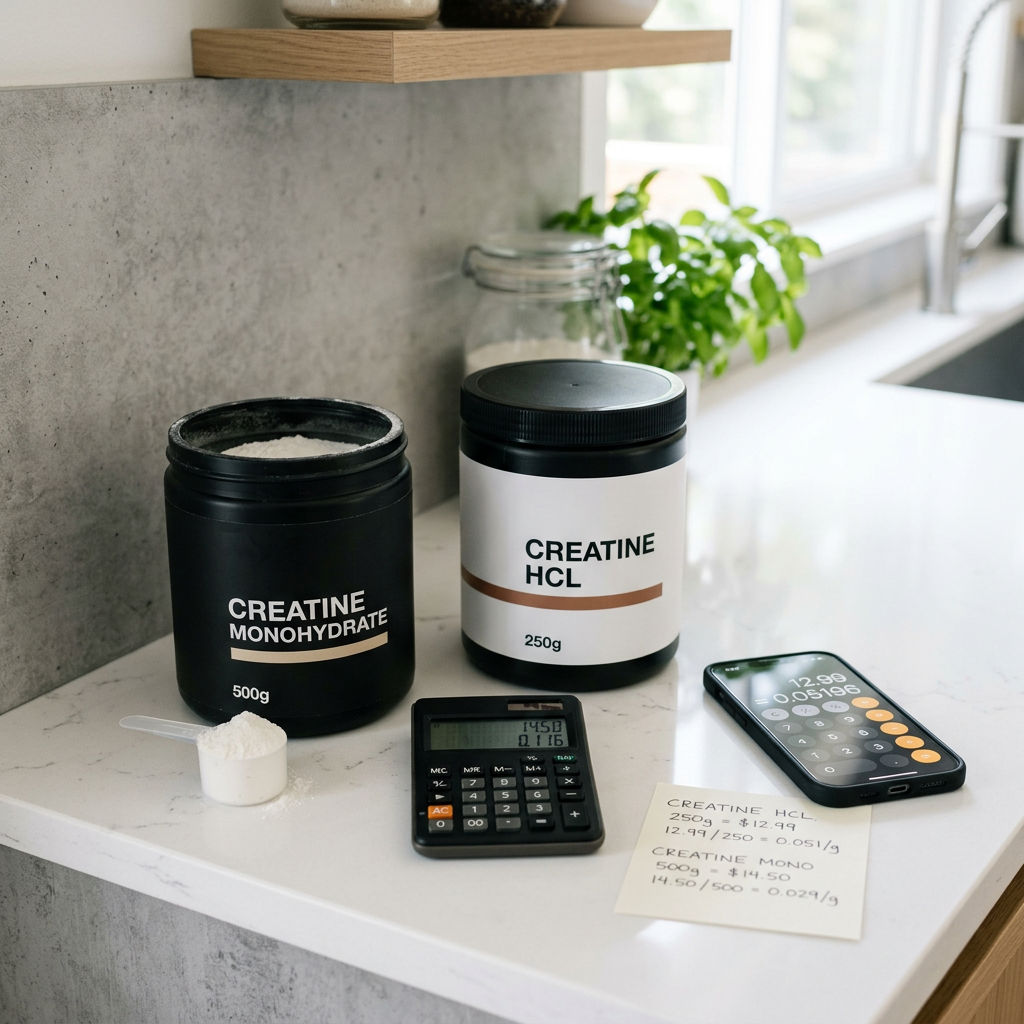
You can compare creatine prices properly in under 30 seconds if you look for total grams of creatine, not just servings or scoop size. This is the fastest way to find the best value creatine and avoid paying premium prices for convenience or branding alone.
- Find the total price. Use the real delivered price if you are shopping online in Canada, including shipping when it is not free.
- Find total grams of creatine. If the label says 5 g per serving and 80 servings, that equals 400 g total. If it is a blend, make sure the full 5 g is actually creatine.
- Divide price by grams. Example: $35 ÷ 400 g = $0.0875 per gram.
- Optionally calculate cost per day. Multiply the cost per gram by your daily dose. At 5 g/day, $0.0875 per gram equals about $0.44 per day.
- Compare apples to apples. Compare monohydrate powder to monohydrate powder first, then decide whether capsules or flavoured versions are worth the premium.
Here is a practical comparison framework:
| Product type | What to check | Common value issue | Usually best for |
|---|---|---|---|
| Unflavoured monohydrate powder | Total grams, purity, NPN | Few; easiest product to compare | Best bang for buck |
| Micronized monohydrate | Total grams, price premium | May cost more for better mixability only | People who hate gritty powder |
| Capsules | Grams per capsule, pills needed per dose | High cost per gram | Travel and convenience |
| Gummies/chews | Total creatine per serving, sugar, total units | Often expensive and lower-dose | People prioritizing convenience over value |
| Blends/pre-workouts | Exact creatine amount | Creatine buried in a proprietary formula | Only if you want the whole formula |
A common mistake is using price per serving as your main metric. That only works when every product has the same grams of creatine per serving, which they often do not. Another mistake is forgetting shipping. A product with a slightly higher listed price but free shipping can beat a cheaper product with a delivery fee.
If labels are confusing, use a calculator. Our creatine dosage calculator helps you estimate daily needs, and our creatine brand reviews can help you decode what brands are actually offering.
Bottom line: price divided by total grams tells you the truth faster than any front-label claim.
Why creatine monohydrate usually wins on both science and value for money
Creatine monohydrate is usually the best value creatine because it combines the strongest evidence base with the lowest cost per gram. That is why most honest creatine price comparison work ends with plain monohydrate near the top.
Mechanistically, creatine works by increasing intramuscular phosphocreatine, the stored form that helps rapidly regenerate ATP, the cell's immediate energy currency, during short, hard efforts. More phosphocreatine means a better capacity to repeat high-intensity work, which can improve training quality over time. The form of creatine that has been studied most extensively for this job is monohydrate.
The Kreider et al. (2017), ISSN Position Stand: Safety and Efficacy of Creatine — JISSN position stand remains the key reference here. It supports monohydrate as the gold standard for efficacy and safety. The Antonio et al. (2021), Common questions and misconceptions about creatine supplementation — JISSN review also addresses many of the marketing claims used to sell more expensive versions.
That does not mean every alternative form is useless. Micronized creatine is still monohydrate; its smaller particle size mainly improves dispersion and mouthfeel. Capsules are convenient. Some people prefer flavoured products because they help adherence. But from a cost analysis standpoint, these formats usually raise the price without changing the basic physiology.
Forms and features that commonly raise cost per gram include:
- Capsules and tablets
- Gummies and chewables
- Flavour systems and sweeteners
- Branded raw materials with premium positioning
- Pre-workout blends with creatine included
- Claims about superior absorption not backed by better real-world outcomes
For most beginners, recreational lifters, women, older adults, and team-sport athletes, the right default choice is simple: buy plain monohydrate unless you have a specific reason not to. If you want a deeper primer, start with best creatine rankings and creatine myths debunked.
Bottom line: when the most-studied form is also usually the cheapest creatine per gram, the burden of proof shifts to the premium product, not to monohydrate.
The serving-size traps that make bad creatine deals look cheaper than they are
Many creatine products look cheap only because the label is framed around servings instead of grams, which can hide poor value. If you want true creatine bang for buck, you need to spot the label tricks quickly.
The most common trap is a small serving that makes the cost per serving look low. Imagine one product with a 3 g serving and another with a 5 g serving. If both list a similar price per serving, the 3 g product is almost always the worse buy on a cost-per-gram basis. Since many people use 3-5 g/day, the higher-dose product may actually deliver your real daily intake more economically.
The second trap is blended formulas. A pre-workout may headline creatine, but part of the scoop might be caffeine, beta-alanine, citrulline, taurine, flavouring, sweeteners, or electrolytes. That does not make the product bad, but it does mean you are not buying pure creatine. If your goal is cheapest creatine per gram, blended products are rarely competitive.
The third trap is convenience packaging. Single-serve sticks, capsules, and gummies often command a premium because manufacturing and packaging costs are higher. Again, that can be worth it if portability matters to you, but it is not the same as best value.
Watch for these red flags:
- "Serving" is highlighted but total grams are hard to find
- "Proprietary blend" language hides exact creatine amount
- Scoop size is large, but creatine content is modest
- Front label emphasizes flavour or lifestyle branding over grams
- Container count sounds large, but daily dose requires multiple units
A capsule example is especially revealing. If each capsule contains 750 mg of creatine, you need roughly 4 capsules for 3 g or nearly 7 capsules for 5 g. That is not inherently wrong, but it often pushes both cost and inconvenience higher than buyers realize.
This is also why comparing by container size alone fails. A tub that weighs 600 g may include flavouring and acids, while another 500 g tub is nearly all creatine. The second product may provide more usable creatine despite a lighter container.
For help decoding labels and comparing formats, see our creatine product catalog and creatine brand reviews.
Bottom line: if a deal only looks good when you ignore total creatine grams, it is probably not a good deal.
The Canadian buying checklist: NPN, shipping, third-party testing, and other hidden cost factors
In Canada, the best creatine price comparison includes more than the shelf price, because NPN status, shipping, and testing can change the real value of a product. A cheap tub is not automatically the best buy if it creates risk, uncertainty, or extra costs.
First, look for an NPN, which stands for Natural Product Number. An NPN indicates a natural health product has been licensed for sale by Health Canada. It is not a magic proof of superiority, but it is a meaningful compliance signal for Canadian buyers. An NPN can help you verify that the product is being sold within Canada's regulatory framework and has a proper label.
Second, account for shipping. This matters especially outside major centres and in remote regions. A product with a lower listed price can lose badly once shipping is added, while a slightly pricier product with free shipping or subscription savings can become the better long-term value. If you buy repeatedly, consider your annual spend rather than one checkout screen.
Third, consider third-party testing when your use case demands it. Competitive athletes may want NSF Certified for Sport or Informed Sport style assurance because contamination risk matters more than saving a few cents per gram. Recreational users may prioritize purity statements, lot testing, and a reputable retailer. The International Olympic Committee consensus on dietary supplements (2018) emphasizes that supplement use carries contamination considerations, which is especially relevant for tested athletes.
Here is a practical Canadian checklist:
- NPN present and clearly listed
- Exact grams of creatine per serving and per container
- Ingredient list is simple if you want value
- Shipping cost and delivery speed are reasonable
- Retailer is reputable and product storage looks appropriate
- Third-party testing if you are drug-tested or risk-averse
- Return policy and damaged-product policy are clear
Also check whether the product is sold by a direct brand storefront, a known Canadian retailer, or a third-party marketplace seller. Marketplace listings can sometimes create confusion around freshness, authenticity, or final landed cost.
If you want more on safe buying, see best creatine rankings and creatine brand reviews. If regulations matter to your decision, our related guide on Canadian labelling is worth reading as well.
Bottom line: in Canada, the best-value creatine is the product with the lowest real delivered cost per gram that still clears your quality and compliance standards.
Which format is actually cheapest per gram: powder, capsules, gummies, flavoured mixes, or blends?
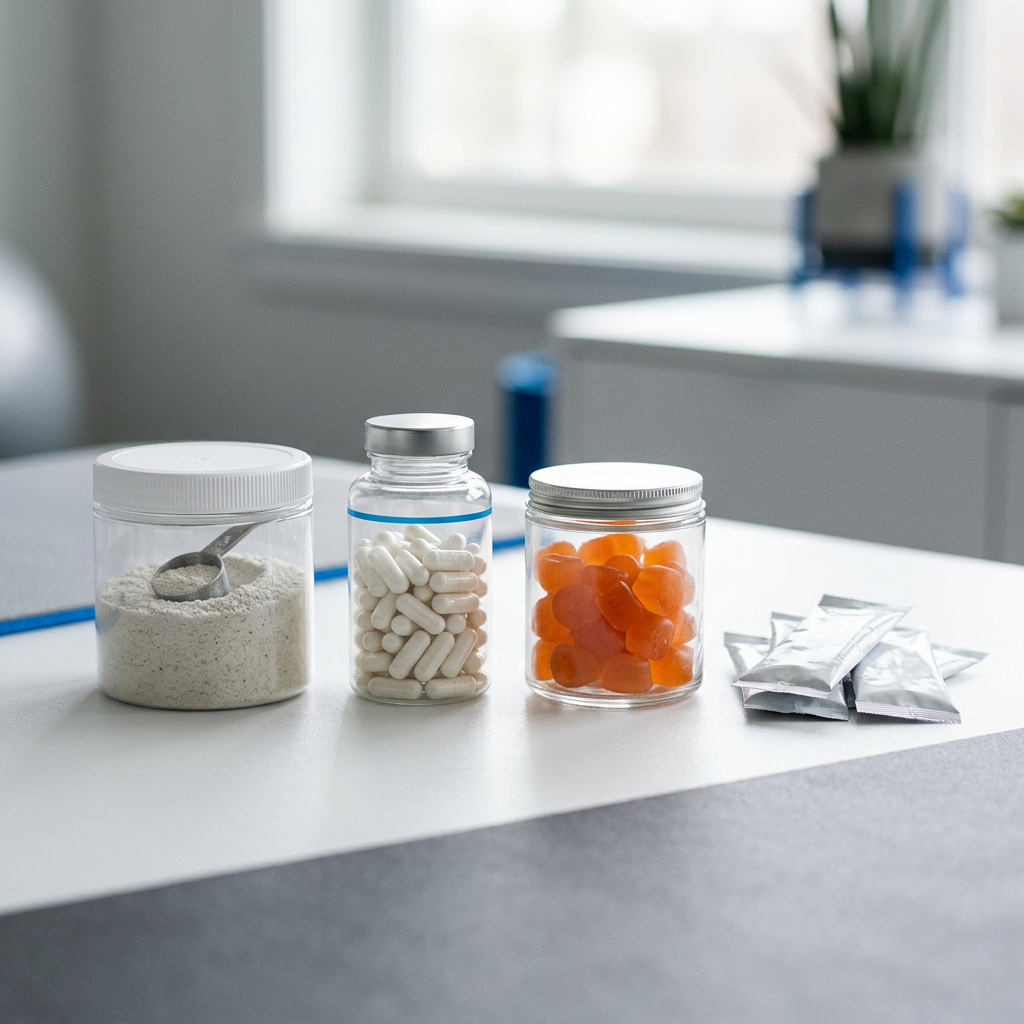
Powder is almost always the cheapest creatine per gram, while capsules, gummies, and flavoured convenience formats usually cost more for the same active ingredient. That pattern holds because packaging, flavour systems, and convenience formats add manufacturing cost without changing the core dose requirement.
If your only goal is best value creatine, plain unflavoured monohydrate powder should be your default benchmark. Everything else has to justify why it costs more. In practice, the main reasons people accept a higher cost per gram are taste, portability, easier digestion, or precise pre-portioned use.
Here is how formats usually rank on value:
- Unflavoured monohydrate powder — best cost efficiency
- Micronized monohydrate powder — slightly higher cost, often better mixability
- Flavoured powder — higher cost due to sweeteners, acids, flavouring
- Capsules/tablets — higher cost and often many pills per full dose
- Gummies/chews — often highest cost per gram and sometimes lower daily dosing
- Pre-workout or recovery blends — poor pure-creatine value, though they may offer other benefits
That said, cheapest is not always best for every person. If capsules make you far more consistent, the more expensive product could still be the better practical purchase for you. Adherence matters because creatine works through saturation over time, not through one perfectly optimized scoop. Similarly, if flavoured powder helps you take it daily without dread, that premium may be rational.
There is also a subtle value point around waste. A giant bargain tub is not a bargain if it clumps from poor storage, expires before you finish it, or tastes so bad you stop using it. Convenience can be expensive, but inconsistency is expensive too.
If you are choosing between formats, cross-check with creatine product catalog, best creatine rankings, and related guidance on powder versus capsules and gummy formats.
Bottom line: for pure price efficiency, powder wins; for lifestyle fit, other formats can be worth a premium, but you should know that you are paying for convenience, not stronger creatine effects.
What creatine really costs per day at 3 g, 5 g, and loading doses
The real-world way to judge creatine value is to translate cost per gram into cost per day based on your dose. This is where creatine price per serving often falls apart, because your actual daily use determines what you spend.
The mainstream evidence-based dosing options are well established. The ISSN position stand supports either a loading phase of about 20 g/day split into 4 doses for 5-7 days, followed by 3-5 g/day, or simply taking 3-5 g/day from the start and reaching saturation more gradually. See our creatine dosage calculator and best creatine rankings if you want product-specific math.
Here is the simple daily-cost formula:
- Daily cost = cost per gram × grams per day
Examples:
- If your creatine costs $0.08/g, then 3 g/day = $0.24/day and 5 g/day = $0.40/day.
- If your creatine costs $0.12/g, then 3 g/day = $0.36/day and 5 g/day = $0.60/day.
- If you load at 20 g/day, then daily cost is four times your 5 g cost during that short phase.
Body weight can influence what people choose within the usual maintenance range, though for most adults the standard 3-5 g/day works well:
- Smaller adults often do well at 3 g/day.
- Larger athletes often use 5 g/day.
- People wanting faster saturation may load for 5-7 days, then drop to maintenance.
By goal:
- Beginners: 3-5 g/day, no need to overcomplicate it.
- Strength and muscle gain: 5 g/day is a practical default.
- Older adults: 3-5 g/day, ideally paired with resistance training.
- Vegetarians or vegans: 3-5 g/day may be especially worthwhile because baseline muscle creatine stores can be lower.
The cost lesson is simple. A more expensive format hurts most when you take it every day, which is exactly how creatine is meant to be used. If two products differ only in convenience, convert both into a 30-day and 90-day cost before deciding.
Bottom line: use cost per gram to calculate your real daily spend, because that is what determines long-term value.
Who should pay a premium for creatine, and who almost certainly should not
Most people should not pay a large premium for creatine, but a few groups may rationally choose a higher-cost product for convenience, testing, or adherence. The trick is knowing when extra cost buys something useful and when it only buys prettier marketing.
Beginners usually do best with plain monohydrate powder. You do not need a designer formula to benefit from creatine. A basic daily protocol works extremely well for new lifters, recreational gym-goers, and anyone trying to improve strength, repeated effort performance, and lean mass over time.
Women do not need a special "women's creatine" product to get results. The physiology is the same: muscle creatine saturation matters, not pink packaging. If a women-focused product has the same dose but a higher price per gram, it is not automatically a better choice. For a deeper discussion, see related guides on creatine for women and beginners.
Older adults may care more about easy mixing, digestibility, and habit consistency than absolute lowest price. A small premium for micronized powder can be reasonable if it improves day-to-day use. The evidence base for creatine alongside resistance training in older adults is meaningful enough to focus on consistency first.
Competitive and drug-tested athletes may be the clearest case for paying more. If a product carries strong sport-certification or third-party testing, that assurance can be worth the premium because contamination risk matters more than raw bargain pricing.
Travellers and shift workers sometimes benefit from capsules or stick packs. Yes, the cost per gram is often worse, but the format may increase compliance. A supplement only works if you actually take it.
Who likely should not pay extra?
- People choosing HCL or exotic forms only because of superior-absorption marketing
- Shoppers buying gummies for everyday use purely on convenience
- Anyone impressed by large scoop sizes without checking actual grams of creatine
- People paying more for flavoured creatine when they already mix it into shakes
If you want help shortlisting products that make sense for your situation, our best creatine rankings, creatine brand reviews, and creatine dosage calculator are a good next step.
Bottom line: pay more only when the premium solves a real problem such as testing, portability, or adherence; otherwise, keep your money and buy plain monohydrate.
How to buy safe, high-quality creatine without paying more than you need to
You can buy safe, effective creatine without overpaying by prioritizing monohydrate, clear dosing, regulatory compliance, and sensible quality checks rather than flashy claims. Price matters, but quality still matters enough that the absolute cheapest option is not always the smartest option.
Creatine monohydrate has one of the strongest safety records in sports nutrition. The ISSN position stand and subsequent reviews support its safety for healthy individuals when used in standard doses. The Mayo Clinic — Creatine page also reflects the mainstream view that creatine is generally safe when used appropriately.
Common side effects are usually practical, not dangerous:
- Temporary water-weight gain, especially during loading or the first weeks
- Stomach upset if you take too much at once
- Grittiness or poor mixing with some powders
These issues are often easy to manage. Splitting doses during a loading phase, taking creatine with food if needed, and choosing micronized powder for texture can all help. If you want more detail, see our broader safety and digestive guides.
Do not confuse safe with magical. Creatine does not need a giant ingredient list to work. In fact, a shorter ingredient list is often better for value-focused buyers. For pure creatine, the label ideally looks something like this:
- Ingredient: creatine monohydrate
- Serving size clearly stated in grams
- Total grams per container listed or easy to calculate
- NPN visible for Canadian sale
- Lot, expiry, and manufacturer information present
Myths also distort buying decisions. Creatine is not a steroid. It does not need to be cycled. It does not work only for men. And higher price does not equal higher effectiveness. The 2021 JISSN misconceptions paper is especially useful for separating evidence from supplement-industry storytelling.
When in doubt, ask three questions before buying:
- Is it monohydrate?
- How much am I paying per gram of actual creatine?
- Does the product have the level of testing and regulatory clarity I need?
Bottom line: high-quality creatine is usually simple creatine, and simple creatine is often cheaper than the products trying hardest to look advanced.
The biggest creatine value mistakes and myths that cost buyers money
The biggest mistakes in creatine cost analysis are comparing tubs instead of grams, overvaluing fancy forms, and ignoring hidden costs such as shipping and underdosed servings. These errors are why many people think they found the best deal when they actually bought convenience or branding at a premium.
Myth 1: The cheapest tub is the best value. False. Total grams of creatine matter more than shelf price. A larger up-front spend can produce a lower cost per gram and a lower cost per day.
Myth 2: Price per serving tells you enough. False. Price per serving only helps when serving sizes deliver comparable creatine doses. Brands know many shoppers stop at that number.
Myth 3: More expensive forms absorb better, so they save money in the long run. Usually false. Monohydrate already works extremely well. Premium forms need strong evidence of superior outcomes, not just better marketing copy.
Myth 4: Flavoured creatine is always a rip-off. Not always. If flavour dramatically improves adherence for you, the higher cost may still be worthwhile. Good value is partly about consistent use, not just spreadsheet math.
Myth 5: You need a loading phase, so cheap products disappear too fast. Misleading. Loading is optional. You can take 3-5 g/day and still reach saturation, just more gradually. If you hate the idea of burning through a tub quickly, skip loading.
Common money-wasting mistakes include:
- Buying capsules without calculating how many you need for 5 g/day
- Paying for a blend when you mainly wanted creatine
- Ignoring subscription discounts on products you already know you tolerate well
- Choosing ultra-bulk sizes without thinking about storage and shelf life
- Assuming a sport-certified product is necessary when you are not a tested athlete
Another subtle mistake is buying based on influencer preference rather than use case. A travel-friendly creatine packet may be perfect for an athlete on the road, but it is rarely best bang for buck for everyday home use.
If you want a myth-focused deep dive, visit creatine myths debunked. If you want to compare real options, start with creatine product catalog and creatine brand reviews.
Bottom line: the best value creatine purchase is usually boring, simple, and repeatable, which is exactly why it works.
A step-by-step creatine buying framework you can use today
The best way to compare creatine prices is to use a simple buying framework: start with monohydrate, calculate cost per gram, then screen for quality, format, and personal fit. This lets you make a fast, rational purchase without getting lost in supplement marketing.
- Choose your base form. Start with creatine monohydrate unless you have a very specific reason to choose another format.
- List the real delivered price. Include shipping and tax if you are comparing close calls.
- Calculate total grams. Multiply grams per serving by servings per container, or use the total weight if it is a pure creatine powder.
- Calculate cost per gram. This is your main comparison metric.
- Estimate cost per month. Multiply your daily dose by 30 so the decision reflects actual use.
- Check label quality. Look for a clear ingredient list, NPN, lot information, and exact dosing.
- Decide whether convenience is worth paying for. Capsules, flavoured mixes, and travel packs are lifestyle purchases, not potency upgrades.
- Check athlete-specific needs. If you are tested, prioritize reputable sport certification.
- Buy the smallest sensible amount first if tolerance is unknown. Once you know you like the product, bulk buying often improves value.
Here is a practical decision rule many Canadians can use:
- If a plain monohydrate powder has a clearly lower cost per gram, buy it.
- If two monohydrate powders are close in cost, choose the one with cleaner labelling and stronger quality signals.
- If a premium format costs more, make sure you can explain exactly what the extra money buys you.
This framework works for beginners, women, older adults, strength athletes, and recreational gym users because the underlying physiology is the same. The product still needs to deliver enough creatine consistently over time to saturate muscle stores.
Useful next reads include creatine dosage calculator, best creatine rankings, creatine brand reviews, and our broader guide to creatine product catalog.
Bottom line: the right buying process is simple enough to use in one shopping session, and strong enough to prevent most expensive mistakes.
Bottom line: the best value creatine in Canada for most people
For most Canadians, the best value creatine is plain unflavoured creatine monohydrate powder with a low cost per gram, clear dosing, an NPN, and quality signals appropriate to your needs. That is the direct answer to "how to compare creatine prices" and "what is the best creatine bang for buck".
The science is not complicated here. Creatine works by increasing muscle phosphocreatine stores, which supports rapid ATP regeneration during hard efforts. The evidence-backed form is monohydrate. The evidence-backed maintenance dose is generally 3-5 g/day. Because creatine works through daily use over time, the buying question becomes straightforward: how cheaply and reliably can you get those grams into your routine?
If you are a typical gym-goer, beginner, woman, older adult, or field/court athlete, your smartest first purchase is almost never the trendiest product. It is the one that gives you the most actual creatine for your money without compromising sensible quality standards. If you are a tested athlete, paying a bit more for strong certification can be justified. If you travel constantly, capsules or stick packs might be worth the premium. But those are exceptions, not the default.
A final quick checklist:
- Choose monohydrate first
- Calculate cost per gram
- Convert that into cost per day at your dose
- Check NPN and label clarity
- Factor in shipping
- Pay extra only for a real benefit such as certification or convenience
If you want help picking specific options, browse our best creatine rankings, compare labels in the creatine product catalog, use the creatine dosage calculator, and review real-world experiences in creatine brand reviews. If you are still on the fence about basic claims, see creatine myths debunked.
Bottom line: the only metric that consistently reveals creatine value for money is cost per gram of actual creatine, and plain monohydrate usually wins that contest by a wide margin.
Creatine Value at a Glance
- 3-5 g/day Standard maintenance dose — Mainstream evidence-based daily range for most adults
- 20 g/day Typical loading dose — Usually split into 4 doses for 5-7 days
- 5-7 days Typical loading phase length — Speeds muscle saturation compared with straight maintenance dosing
- 1 formula Cost per gram = price ÷ total grams — The fastest way to compare creatine value for money
Frequently Asked Questions
How do you calculate creatine cost per gram?
You calculate creatine cost per gram by dividing the total product price by the total grams of creatine in the container. If a tub costs $32 and contains 400 g of creatine, the cost per gram is $0.08, which is the most useful number for comparing true value across brands and formats.
Is cost per serving or cost per gram better for comparing creatine?
Cost per gram is better for comparing creatine because serving sizes are not always equivalent. A product can look cheap per serving while providing less creatine per scoop, which makes it a worse deal once you compare actual grams of the active ingredient.
What is usually the cheapest creatine per gram?
Plain unflavoured creatine monohydrate powder is usually the cheapest creatine per gram. It tends to avoid the extra packaging, flavour systems, and convenience costs that raise prices for capsules, gummies, and blended products.
Are creatine capsules worth the higher price?
Creatine capsules can be worth the higher price if portability and convenience help you take creatine consistently. They are rarely the best value per gram, though, because you usually need several capsules to reach a full 3-5 g daily dose.
Why do some creatine products seem cheap but are not good value?
Some creatine products seem cheap because they use small serving sizes, hide total grams, or include lots of non-creatine ingredients. They can also look affordable before shipping, then become expensive once the full delivered cost is added.
Is expensive creatine better than cheap creatine?
Expensive creatine is not automatically better than cheap creatine if both are legitimate creatine monohydrate products with clear dosing and acceptable quality standards. Higher price sometimes buys convenience or third-party testing, but it often does not buy stronger performance effects.
What should Canadians check before buying creatine?
Canadians should check the cost per gram, creatine form, NPN, ingredient list, and shipping cost before buying. If you are a tested athlete, you should also consider reputable sport certification because contamination risk matters more in that context.
Does micronized creatine offer better value?
Micronized creatine can offer better practical value if better mixability helps you use it consistently, but it does not usually change the core physiological effect because it is still creatine monohydrate. It is worth only a modest premium, not a dramatic one.
How much creatine do I actually need per day?
Most adults need 3-5 g of creatine per day to maintain effective muscle saturation. A loading phase of about 20 g/day split into 4 doses for 5-7 days is optional if you want to reach saturation faster.
What is the best value creatine for beginners?
The best value creatine for beginners is usually plain creatine monohydrate powder with a low cost per gram and a simple label. Beginners do not need special blends or premium forms to get the evidence-backed benefits of creatine.