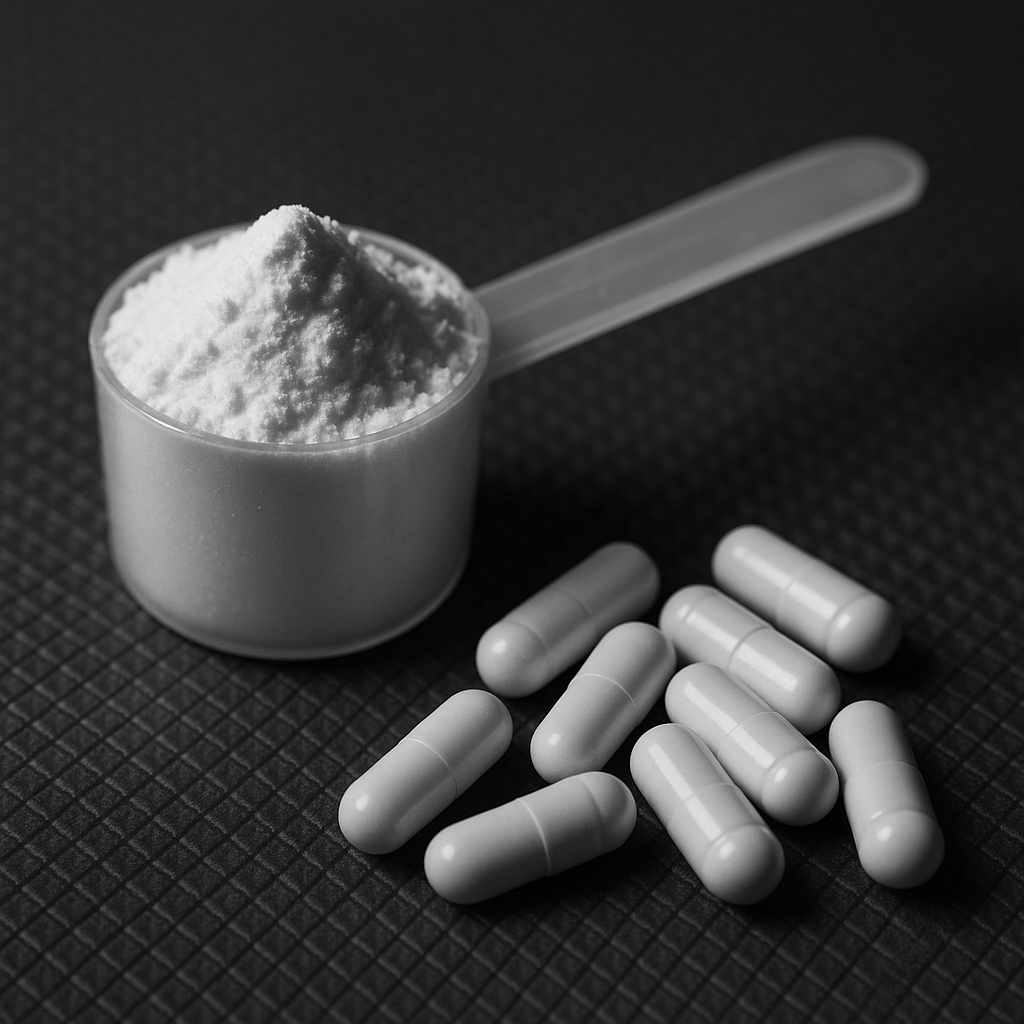
Creatine vs HMB: Which Is Better for Muscle and Strength?
Creatine and HMB both support muscle—just in different ways. We compare mechanisms, real-world results, dosing, and who benefits most (hint: creatine still wins for strength). Learn when it makes sense to stack them.
Key Takeaways
- For strength and power, creatine monohydrate outperforms HMB in most trained adults.
- HMB may help untrained and older adults by reducing muscle breakdown and soreness.
- Creatine maintenance is 3–5 g/day; loading 20 g/day for 5–7 days is optional.
- Typical HMB dose is 3 g/day (calcium salt or free-acid form).
- Stacking can make sense during layoffs, high-volume blocks, or calorie deficits.
- Choose plain creatine monohydrate with an NPN in Canada and third‑party testing.
- Both creatine and HMB are permitted by WADA; focus on training and protein first.
Quick verdict: similar goals, different strengths
If you lift in Canada and want the biggest return on a small daily habit, creatine monohydrate is the clear winner for strength, power, and lean mass. Its effects are consistent across ages and training levels when paired with a structured program. HMB (beta‑hydroxy beta‑methylbutyrate) can help certain people—especially untrained lifters, older adults, or anyone returning from a layoff—by reducing muscle protein breakdown and soreness. But head‑to‑head, it rarely beats creatine on the barbell.
Think of it this way: Creatine builds your engine (more phosphocreatine to regenerate ATP for explosive efforts), while HMB protects the chassis (less muscle breakdown during novel or stressful training). For most, creatine is your everyday foundation; HMB is situational.
New to creatine? Start with our best creatine picks and see how to dose in our timing guide. Curious about whether to front-load? Read the loading explainer. If you’re considering both supplements, we outline a smart, safe stack below—including who’s most likely to feel the difference and when.
How creatine works—and what results to expect
Creatine increases your muscles’ phosphocreatine stores, which your body uses to rapidly regenerate ATP—the immediate fuel for short, intense efforts like heavy sets and sprints. With higher PCr, you can often squeeze out an extra rep or sustain higher training quality across sets. Over weeks, that added training volume translates into more strength and lean mass.
The gold standard is creatine monohydrate, supported by the International Society of Sports Nutrition (ISSN). A simple plan is 3–5 g/day with food. Loading (about 20 g/day split over 5–7 days) saturates muscles faster; if you skip it, expect full saturation in roughly 3–4 weeks. Timing is flexible—consistency is what matters. See our when to take creatine guide and creatine calculator to personalize dosing.
Safety-wise, creatine is among the most researched sports supplements and is permitted by WADA. Minor water weight is usually intracellular (in muscle), not bloat. For buying tips and brand picks, visit our creatine review hub.
What HMB does—and who it suits
HMB is a metabolite of the amino acid leucine. It appears to work primarily by reducing muscle protein breakdown (via proteolysis pathways), with a smaller contribution to stimulating protein synthesis. Practically, that can mean less damage, soreness, and performance drop when training is new, very high in volume, or you’re detrained.
The typical research dose is 3 g/day in either calcium HMB (HMB‑Ca) or free‑acid HMB (HMB‑FA). Evidence suggests HMB is most helpful for untrained individuals adapting to resistance exercise and for older adults, particularly during periods of inactivity, rehabilitation, or when muscle loss risk is high. In well‑trained lifters on balanced programs and adequate protein, results are mixed and often modest.
HMB isn’t a substitute for dietary protein or creatine. Think of it as a supportive option during specific phases—like the first month back after time off, a calorie deficit, or heavy training blocks. If you try it, keep protein at ~1.6–2.2 g/kg/day, lift progressively, and monitor your own response over 4–8 weeks.
Head‑to‑head: muscle, strength, and power
Comparative evidence consistently favours creatine for increases in maximal strength, high‑intensity performance, and lean mass when combined with resistance training. These findings are supported by the ISSN’s position stand on creatine, which considers it safe and effective for a broad range of athletes. By contrast, HMB’s effects are context‑dependent: more reliable in untrained or older populations and less consistent in well‑trained lifters.
Some early studies using free‑acid HMB reported large gains in strength and mass, but subsequent independent trials haven’t consistently reproduced those magnitudes—especially in experienced athletes following well‑controlled programs and adequate protein diets. The ISSN’s HMB position stand reflects this nuance: HMB can blunt muscle damage and support retention of lean mass, with the most practical benefit in scenarios of high muscle breakdown or detraining.
What about stacking? Mechanistically, the two don’t compete: creatine boosts phosphagen energy, HMB modulates muscle protein turnover. Direct synergy data are limited, but many athletes stack them safely. If your goal is maximum strength, start with creatine; consider adding HMB during returns from layoffs, aggressive volume phases, or cuts where you’re chasing recovery as much as progress.
Dosing, timing, and how to stack responsibly
Creatine
- Maintenance: 3–5 g/day creatine monohydrate. Take it any time; pairing with a meal is convenient.
- Optional loading: 20 g/day split into 4 doses for 5–7 days, then 3–5 g/day. See our loading guide.
- Timing: Consistency beats timing. If you care to optimize, many take it post‑workout or with carbohydrate/protein. More on timing: when to take creatine.
HMB
- Dose: 3 g/day total. HMB‑Ca is often split into 1 g, 3x/day; HMB‑FA is commonly taken in 1–3 doses.
- Timing: Taking 30–60 minutes pre‑workout is common, but daily consistency is more important—especially for older adults or during rehab phases.
Stack example (8–12 weeks):
- Creatine monohydrate: 3–5 g/day, daily.
- HMB: 3 g/day during the first 4–8 weeks back from a layoff, in a cut, or during very high training volume.
- Protein: ~1.6–2.2 g/kg/day from food plus supplements as needed.
Use our creatine calculator to dial in your dose. If you respond well and want brand options, see our review hub and best creatine roundup.
Safety, regulation in Canada, and smart buying
Both creatine and HMB have strong safety profiles in healthy adults when used as directed, and both are permitted by WADA. In Canada, look for products with a Natural Product Number (NPN) and check listings in Health Canada’s Licensed Natural Health Products Database (LNHPD). This helps confirm the product is authorized for sale with appropriate quality controls.
Buying tips for Canadians
- Go simple: Choose plain creatine monohydrate. Micronized powder mixes easily and is cost‑effective.
- Third‑party testing: Look for NSF Certified for Sport or Informed Choice logos—useful for tested athletes.
- Label clarity: Avoid proprietary blends. Creatine should list grams per serving; HMB should list “beta‑hydroxy beta‑methylbutyrate” and form (HMB‑Ca or HMB‑FA) with total mg/g per serving.
- Value: Bulk powder often offers the best cost per 5 g serving.
Not sure where to start? Explore our practical how‑to guides, compare brands in our reviews, and see top creatine picks. When in doubt—especially if you have a medical condition, take medications, or are pregnant/breastfeeding—speak with a healthcare provider.
Creatine vs HMB at a glance
- 3–5 g/day Creatine monohydrate maintenance
- 3 g/day Typical HMB daily dose
- 20 g/day × 5–7 Optional creatine loading phase
- ~3–4 weeks Time to creatine saturation without loading
- WADA: Permitted Status for both creatine and HMB
Frequently Asked Questions
Is creatine better than HMB for building strength?
Yes for most trained lifters. Creatine consistently improves maximal strength, power, and training volume when paired with resistance training. HMB may help more in untrained or older adults, or during periods of high muscle breakdown, but it rarely outperforms creatine on strength.
Can I take creatine and HMB together?
Yes. They work through different mechanisms—creatine supports ATP regeneration, HMB reduces muscle protein breakdown—so they do not compete. Direct synergy data are limited, but stacking is common and generally well‑tolerated when doses are kept within guidelines.
What’s the best creatine dose and form?
Use creatine monohydrate at 3–5 g/day. You can optionally load 20 g/day (split into 4 doses) for 5–7 days to saturate faster. Other forms are not consistently superior to monohydrate for performance or cost.
Does HMB help if I already eat a high‑protein diet?
If you are well‑trained and consuming adequate protein (about 1.6–2.2 g/kg/day), HMB’s added benefit on muscle and strength is likely small. It may still help reduce soreness or muscle loss during detraining, rehab, or aggressive calorie deficits.
Will creatine or HMB cause bloating or water retention?
Creatine can increase intracellular water in muscle, which is usually perceived as fuller muscles rather than bloating. HMB is not typically associated with water retention. Staying hydrated and spreading doses can minimize GI discomfort.