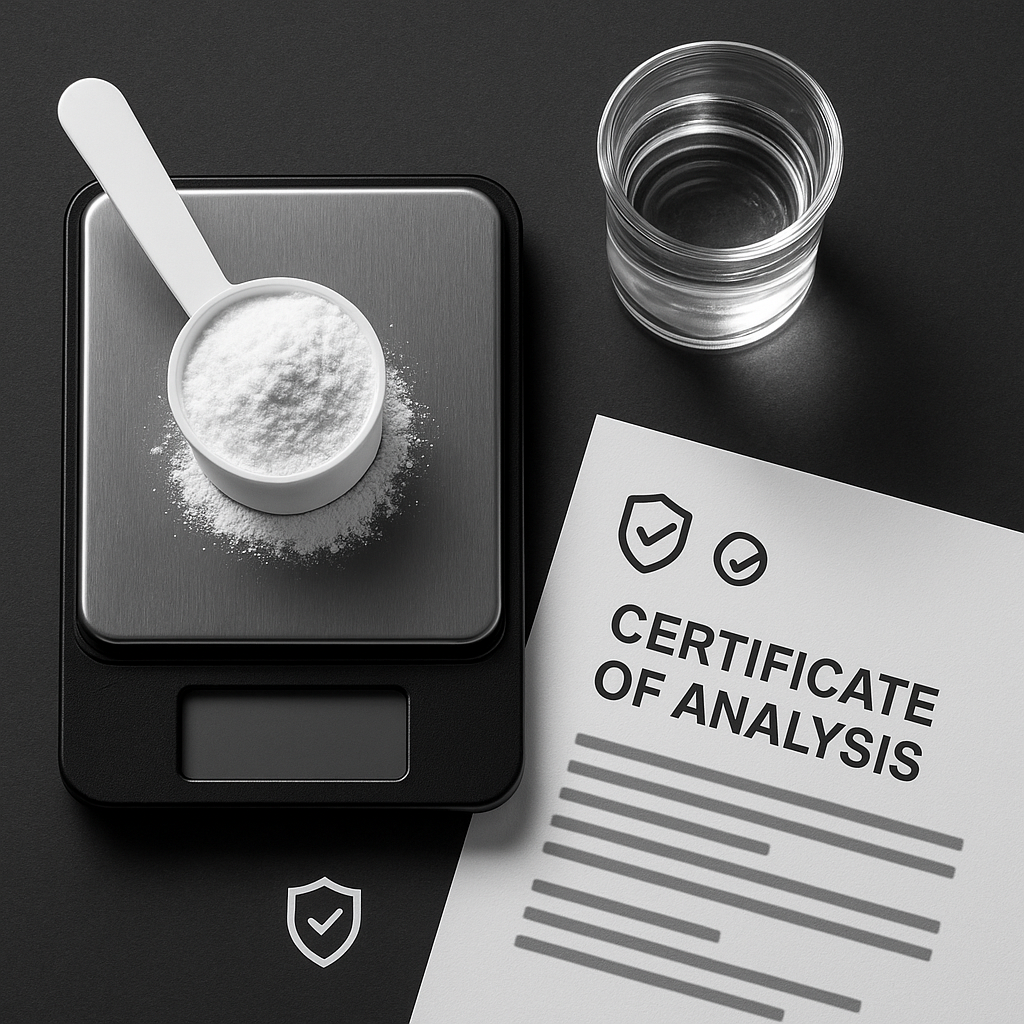
How to Judge Creatine Quality: What Labels Don't Tell You
Not all creatine is made to the same spec. In Canada, labels rarely tell you about heavy metal limits, banned‑substance screening, or what “Creapure” truly guarantees. Here’s how to read beyond the front panel—and ask brands for the proof.
Key Takeaways
- Prefer creatine monohydrate—3–5 g/day—as the gold standard supported by the ISSN.
- Creapure indicates high‑purity German creatine, but still look for a brand’s own COA and, for athletes, NSF Certified for Sport or Informed Sport.
- Ask for a recent, batch‑specific COA showing assay (≥99%+), heavy metals, microbes, and typical creatine impurities (creatinine, DCD, DHT).
- For Canadians, check the tub for an NPN and a Canadian distributor—then verify testing on the brand’s site.
- Heavy metals should be reported numerically or as “ND” (not detected) with the test method noted.
- “Micronized” improves mixability and mouthfeel; it does not equal higher purity or effectiveness.
- Choose transparent brands that publish testing and certifications; avoid blends or proprietary mixes for creatine.
Why creatine quality matters in Canada
Creatine monohydrate is one of the most studied sports supplements, with strong support for 3–5 g per day for maintenance and a loading option for faster saturation. While the form is straightforward, the quality behind the label can vary: raw material source, impurity profile, and whether the finished product was screened for contaminants or banned substances. In Canada, many creatine products are licensed as Natural Health Products—look for an NPN (Natural Product Number)—but an NPN alone doesn’t guarantee the level of testing you may want as an athlete.
High-quality creatine should be pure, safe, and exactly what it claims to be—no unnecessary fillers and no harmful contaminants. Labels don’t always show batch data, so smart buyers ask for it. If you’re new to creatine, we cover dosing and timing here: When to Take Creatine, and you can personalize your plan with our Creatine Calculator. For product picks we’ve vetted for transparency and testing, see Best Creatine in Canada and our in-depth Creatine Supplements Review.
- Bottom line: Choose creatine monohydrate and verify quality with real documents—don’t rely on front-of-tub claims.
Creapure: what it certifies—and what it doesn’t
Creapure is a trademarked creatine monohydrate made in Germany by Alzchem. It’s widely regarded for tight manufacturing controls, traceability, and a very clean impurity profile. Brands that use Creapure can display the logo, and many publish certificates confirming lot codes that originate from the German facility.
What Creapure does signal: a reputable raw material source with stringent testing for typical creatine-related impurities (e.g., creatinine, dicyandiamide, dihydrotriazine) and heavy metals. What Creapure does not automatically guarantee: that the final, packaged product you’re buying was independently screened for banned substances or that the brand ran additional lot-specific microbiological testing after blending and packaging. Those steps depend on the brand’s quality program.
- If you can get both: a Creapure-based product and a recent, batch-specific COA from the brand—great.
- Non-Creapure creatine can also be excellent when manufacturers show robust third-party testing. See our vetted options in Best Creatine.
Takeaway: Creapure is a positive signal, not the only path to high-quality creatine. Always ask for proof on the actual lot you’ll use.
Third-party testing and banned-substance certifications
“Third-party tested” can mean many things. For competitive athletes subject to anti-doping rules, look specifically for NSF Certified for Sport or Informed Sport on the finished product. These programs batch-test for a broad list of substances prohibited by sport organizations and verify label claims. Both also allow you to verify lot numbers on their websites before you buy or consume.
- NSF Certified for Sport: Screens for ~290+ banned substances and audits manufacturing. Look up your lot at the NSF portal.
- Informed Sport: Tests every batch prior to release and lists certified lots online for consumer verification.
- Other claims: “Lab tested,” “GMP,” or generic “third-party tested” are helpful but do not equal sport certification. Ask what was tested, by whom, and for which analytes.
Even if you’re not subject to testing, these certifications reduce contamination risk. If a product lacks sport certification, request a recent, batch-specific COA showing purity, heavy metals, and microbiology. We highlight certification status in our Creatine Supplements Review and brand-by-brand notes across our Guides.
Heavy metals and contaminants: what a good creatine shows
Health Canada expects Natural Health Products to control contaminants like lead, arsenic, cadmium, and mercury. On a creatine COA, you should see numerical results for these metals, often reported in ppm (mg/kg) or as ND (not detected), along with the analytical method (e.g., ICP-MS) and the lab’s accreditation status (ISO/IEC 17025 is a good sign).
- Impurities specific to creatine: Look for tests on creatinine (a breakdown product), dicyandiamide (DCD), and dihydrotriazine (DHT). High-quality lots keep these very low or undetected.
- Microbiology: Total aerobic count, yeast/mould, E. coli, Salmonella, and Staphylococcus aureus should meet strict limits. Methods are typically USP, EP, or AOAC based.
- Residual solvents: If listed, they should comply with pharmacopeial limits. Creatine manufacturing should not leave meaningful solvent residues.
When a brand only says “below limits” without numbers, ask for the actual results and acceptance criteria. Remember, limits can depend on serving size and method sensitivity. Reputable brands are transparent and will share batch data. If you need a starting shortlist, our Best Creatine roundup flags products with published contaminant testing.
How to read a COA (Certificate of Analysis)
A good COA is batch-specific, dated, and issued by an independent, accredited lab. Here’s how to scan one efficiently:
- Identity: “Creatine monohydrate” should be confirmed by an identity test (e.g., FTIR). Lot/batch number must match your tub.
- Assay (purity): Reported as % creatine monohydrate by HPLC or titration. Top products often show ≥99% with tight specs. Creatinine, DCD, and DHT should be very low or ND.
- Heavy metals: Lead, arsenic, cadmium, mercury each listed with results and method (ICP-MS). Numbers or “ND” are better than vague pass/fail.
- Microbiology: Total plate count and pathogens with limits and results. Look for methods (USP/EP/AOAC) and a clear “Complies/Pass.”
- Physical tests: Appearance (white powder), loss on drying/moisture, and sometimes particle size. Minor moisture variation is normal; large deviations can affect flow but not necessarily purity.
- Signatures & accreditation: Issued by an ISO/IEC 17025-accredited lab, signed by a qualified reviewer.
If a brand hesitates to provide a recent COA, consider another option. We link to brands that publish testing transparently in our review hub.
Micronized vs purity: what particle size really means
“Micronized” creatine refers to smaller particle size, not a different chemical form. The goal is improved mixability and less grit in the glass. Micronization can help the powder disperse faster in water and reduce sediment, which some users find gentler on the stomach.
What it does not mean: higher chemical purity by itself. Purity comes from synthesis and purification steps, not from grinding the crystals smaller. A non-micronized, high-purity creatine can be every bit as effective as a micronized one. Conversely, a micronized creatine with poor raw material quality won’t be rescued by particle size.
- Choose based on preference: If you dislike gritty texture, micronized is worth it.
- Effectiveness: Regardless of particle size, creatine monohydrate remains the gold standard. Aim for 3–5 g/day for maintenance, as supported by the ISSN. See timing tips in When to Take Creatine and loading pros/cons in Creatine Loading Phase.
A Canadian buyer’s checklist
Use this quick checklist before you click buy or head to the checkout:
- Form: Single-ingredient creatine monohydrate. Avoid blends and unnecessary additives.
- NPN & distributor: Check the label for a Canadian NPN and a domestic distributor/importer.
- Third-party proof: Ideally NSF Certified for Sport or Informed Sport on the finished product. Otherwise, request a batch-specific COA with assay, heavy metals, microbiology, and creatine-specific impurities.
- Transparency: Brand publishes test results or will share them on request. Lot numbers are traceable.
- Price sanity check: Compare cost per 100 g against trusted picks in Best Creatine. Extremely low prices with no documentation are red flags.
- Usability: Choose micronized if you prefer smoother mixing; store sealed in a cool, dry place.
- Dose & plan: Target 3–5 g/day long-term. Personalize with our Calculator and see all how‑to resources in our Guides.
With these steps, you’ll get the benefits creatine is known for—strength, performance, and convenience—backed by the quality documentation that matters.
Creatine Quality Quick Check
- 3–5 g/day Evidence-based maintenance dose (ISSN-supported)
- ≥99% Typical purity reported on high-quality creatine COAs
- 2 seals NSF Certified for Sport or Informed Sport for athletes
- 1 ingredient Creatine monohydrate—no blends needed
Frequently Asked Questions
Is Creapure better than other creatine monohydrate?
Creapure is a high-quality, German-made creatine monohydrate with strong process controls and excellent impurity specs. However, non-Creapure creatine can be equally pure and effective if the brand provides robust, batch-specific third‑party testing. Look for an assay near or above 99%, low/ND impurities, and clear heavy metal and microbiology data.
Do I need NSF Certified for Sport or Informed Sport if I’m not tested?
You don’t strictly need sport certification if you’re not competing under anti-doping rules. That said, these programs reduce contamination risk for everyone. If a product lacks those seals, ask for a recent, independent COA showing purity, heavy metals, and microbiology so you can make an informed choice.
Are heavy metals a real concern in creatine?
Reputable creatine manufacturers control for heavy metals and typically show very low or not‑detected levels on COAs. Health Canada expects Natural Health Products to have suitable contaminant specifications and testing. Always review numerical results (or ND) and the test method—vague 'below limits' statements aren’t enough.
What does “micronized” actually do?
Micronized creatine has smaller particles that disperse more easily in liquid, improving mixability and mouthfeel. It does not inherently change chemical purity or effectiveness. Choose based on texture preference; both micronized and non‑micronized creatine monohydrate support the same benefits when dosed correctly.
How do I get a COA for the creatine I’m buying?
Check the brand’s website for a quality or testing page, often searchable by lot number. If it’s not posted, email customer support and request a recent, batch‑specific COA for the lot you plan to buy. If they can’t provide it, consider a more transparent brand.