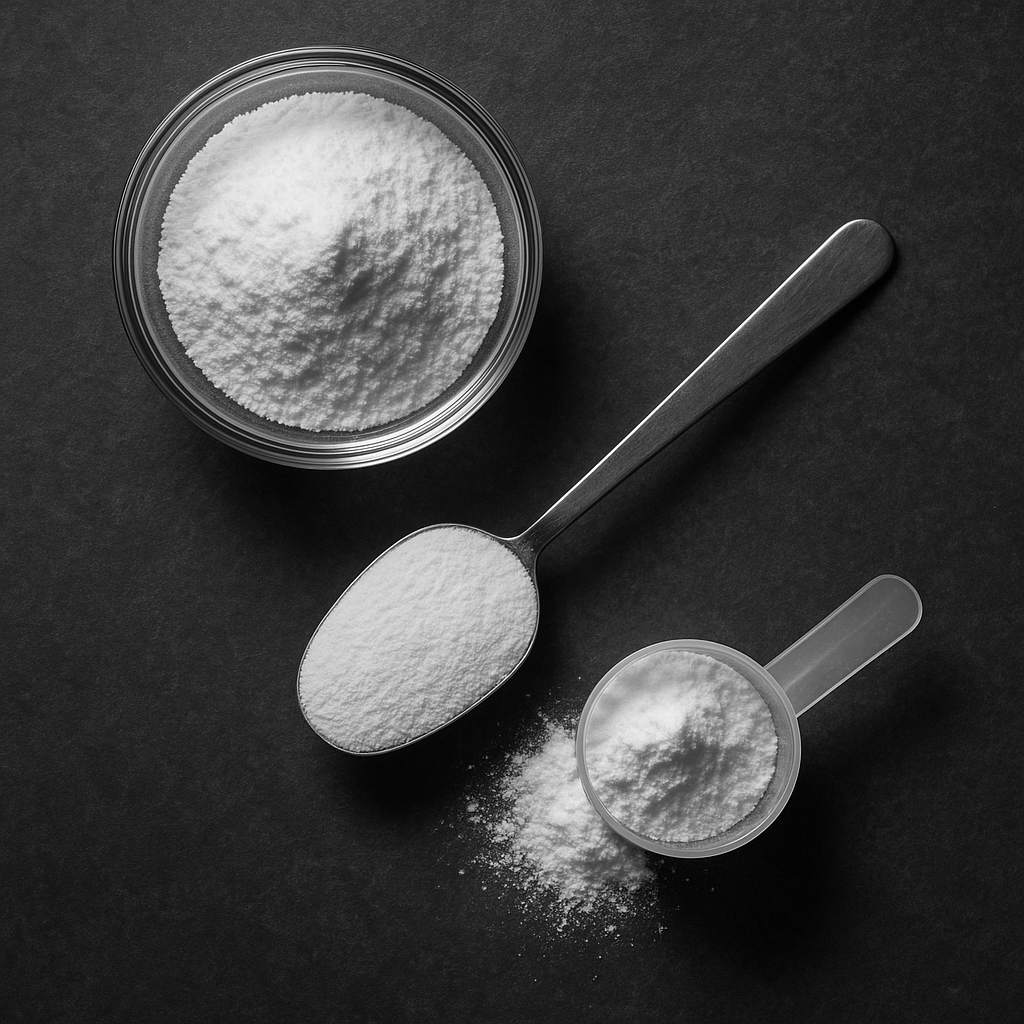
Creatine Serving Size: How to Measure 5g Without a Scale
No scale? No problem. Learn how many teaspoons get you close to 5 g of creatine, why the scoop in your tub can be misleading, and simple ways to avoid underdosing. Canadian, evidence-based, and practical.
Key Takeaways
- For daily maintenance, aim for 3–5 g of creatine monohydrate; 5 g is a simple target.
- A level 5 mL teaspoon of creatine monohydrate typically weighs ~3–5 g; density varies by brand.
- The scoop in your tub measures volume (mL), not weight (g)—it may not deliver 5 g.
- Use a level measuring teaspoon plus a small top‑up (e.g., 1/4 tsp) to approximate 5 g.
- Check your label’s serving size by weight and ignore scoop assumptions.
- Monohydrate is the gold standard; flavored blends and other forms change the weight per spoon.
- If you can, weigh once to calibrate your spoon; after that, repeat the same technique.
Why serving size matters
For most people, the goal with creatine is simple: reach and maintain muscle creatine saturation. The evidence base supports two practical options: a loading phase (e.g., ~20 g/day split into 4 servings for 5–7 days) followed by maintenance, or a straight maintenance approach of 3–5 g/day without loading. Either way, hitting a consistent daily amount is what drives results over weeks, not a single perfectly measured scoop.
Where many Canadians slip up is with underdosing. A scoop from one brand might be close to 5 g, while another (especially flavored blends or different creatine forms) may deliver less. Labels also list servings by weight (g) but include a scoop that measures volume (mL). Because powders pack differently, a 5 mL scoop rarely guarantees 5 g by weight.
To keep things easy and evidence-based, we recommend aiming for 5 g/day of creatine monohydrate as your default maintenance dose. It fits squarely within the ISSN-supported 3–5 g/day range, gives you a buffer against small measurement errors, and works well for most lifters, endurance athletes, and recreational trainees. If you’d like to customize by body mass or switch between loading and maintenance, try our simple Creatine Calculator.
How to measure 5 g without a scale
Kitchen measuring spoons are your best friend. In Canada, a standard teaspoon is 5 mL by volume. Creatine monohydrate’s density varies by grind (micronized vs. regular) and brand, so a level teaspoon of powder can land anywhere around ~3–5 g. That’s close, but not always bang on.
- Start with a level teaspoon: Fill a measuring teaspoon, tap the handle gently to settle, and level it with a flat edge (e.g., the back of a knife). This will usually put you near 4 g.
- Add a small top‑up: If you don’t have a scale, a slight additional sprinkle (or a level 1/4 teaspoon) typically brings most monohydrate powders closer to ~5 g. Because densities differ, think of this as a repeatable routine, not perfection.
- Split if you prefer: Two level 1/2 teaspoons (about 2.5 mL each) taken at different times of day can improve comfort if you’re prone to stomach upset.
Best practice? If you can borrow a scale once, calibrate your spoon: weigh a level teaspoon of your brand one time, note how much you need to top up, and then use that same technique daily. Want dosing options for loading vs. maintenance? See our Loading Phase guide and When to Take Creatine.
The scoop in your tub isn’t always 5 g
It’s easy to assume the included scoop equals one serving by weight. In reality, most supplement scoops indicate mL (volume), while your label’s serving size is listed in grams (weight). Because creatine monohydrate can pack loosely or tightly depending on grind and humidity, a 5 mL scoop might deliver closer to ~3.5–4.8 g of powder—not a guaranteed 5 g.
- Check the label first: Look for the exact serving size in grams (e.g., “Serving size: 5 g”). If the scoop is described in mL, treat it as a starting point, not a promise.
- Beware flavored mixes: Flavored creatines or multi-ingredient blends often use bigger scoops because they include sweeteners and flavors. The scoop size in these products does not reflect creatine weight alone.
- Micronized vs. regular: Micronized powders can settle differently than non-micronized, slightly changing what a scoop holds by weight.
If accuracy matters to you, weigh your scoop once to see how it lines up with the label—then stick to that technique. If you’re choosing a new product, our Canadian picks in Best Creatine and the in-depth Creatine Supplements Review call out serving clarity and scoop consistency.
Loading vs. maintenance: how much to take
Two evidence-supported paths can get you to the same destination (full muscle creatine stores):
- Maintenance only: Take 3–5 g/day of creatine monohydrate. Expect roughly 3–4 weeks to reach saturation. This is simple, gentle on the stomach, and works for most people.
- Loading + maintenance: Take ~20 g/day for 5–7 days, split into 4 servings of ~5 g, then switch to 3–5 g/day. Loading saturates faster but isn’t required.
Timing: Creatine timing is flexible. Consistency matters more than taking it at a specific hour. Many Canadians prefer it with a meal or post-workout to reduce the chance of minor GI discomfort. For more on timing, see When to Take Creatine.
Safety: In healthy individuals, long-term use of creatine monohydrate at recommended doses is well-supported by research. If you have kidney concerns, are pregnant, or take medications, consult a healthcare professional. For deeper context on protocols, explore our practical Guides.
Canadian measuring hacks to stay consistent
Day-to-day consistency beats perfect precision. Use these Canada-friendly tips to keep your creatine close to target without obsessing over decimals:
- Use metric measuring spoons: Choose a set with clear mL markings. A level 5 mL teaspoon is your baseline; add a small top‑up to approximate 5 g.
- Level the same way every time: Fill, gently tap to settle, and level with a flat edge. Avoid compressing the powder aggressively—packing changes weight.
- Mind humidity: Creatine can clump. Store in a dry cupboard, keep the desiccant in the tub, and break up clumps before measuring.
- Travel smart: Pre-portion in mini containers using two level 1/2 teaspoons per packet. It’s simple and repeatable.
- Use your shaker lines (indirectly): If you’re calibrating a scoop, remember that 5 mL of water = 5 g of water. That helps you understand volume—but you’ll still need to account for powder density.
Finally, consider brand transparency. Canadian products with clear labels, an NPN (Natural Product Number), and straightforward serving instructions make life easier. See our curated picks in Best Creatine and detailed comparisons in the Review.
Powder type and density: not all spoons are equal
Creatine monohydrate remains the gold standard—well-studied, widely available in Canada, and cost-effective. Our teaspoon guidance here is aimed at unflavoured creatine monohydrate powder. Other forms and blends can change how many grams fit in a spoon:
- Micronized monohydrate: Finer particles may settle differently, modestly affecting grams per teaspoon. Calibrate once and repeat.
- Flavoured mixes & blends: Added flavours and sweeteners increase volume. A larger scoop doesn’t equal more creatine—check the grams of creatine on the label.
- Creatine HCl and other forms: Some brands suggest smaller serving sizes because these forms are more soluble. However, most performance research—and standard dosing guidance—centres on monohydrate. If you choose a different form, follow the product’s weight-based serving and evaluate results over time.
If you’re selecting your first tub, stick with a reputable creatine monohydrate. It aligns with the International Society of Sports Nutrition’s recommendations. Compare top Canadian options in Best Creatine and our buying Guides.
How Much Is 5 g of Creatine?
- ~3–5 g What a level 5 mL teaspoon of creatine monohydrate often weighs
- 3–5 g/day Evidence-based maintenance intake for most people
- 20 g/day (5–7 d) Typical loading split into 4 × ~5 g servings
- ~1.7–2.5 g What a level 1/2 teaspoon may deliver (density-dependent)
Frequently Asked Questions
Is one teaspoon of creatine exactly 5 grams?
Not always. A level 5 mL teaspoon of creatine monohydrate typically lands around 3–5 g depending on particle size and packing. If you can, weigh it once to calibrate your spoon; otherwise, use a level teaspoon plus a small top‑up as a repeatable routine.
Why does the scoop in my tub not match the serving size on the label?
Scoop size is volume (mL), while serving size is weight (g). Because powder density varies, a 5 mL scoop may not equal 5 g. Flavoured products and blends are even trickier because the scoop includes non-creatine ingredients. Trust the grams on the label, not the scoop alone.
Do I need a loading phase or can I just take 3–5 g daily?
Both work. Loading (~20 g/day for 5–7 days, then 3–5 g/day) saturates stores faster. Taking 3–5 g/day without loading will also saturate over several weeks. Choose the approach that fits your routine and stomach tolerance.
Does creatine timing matter for results?
Timing is flexible. Total daily intake and consistency matter most. Many people take creatine with a meal or after training to reduce the chance of mild GI upset. See our When to Take Creatine guide for simple timing options.
Is creatine monohydrate still the best choice?
Yes. Creatine monohydrate is the most researched, cost-effective form with strong support for safety and efficacy in healthy individuals at recommended doses. If you try another form, follow the label and assess how you respond.