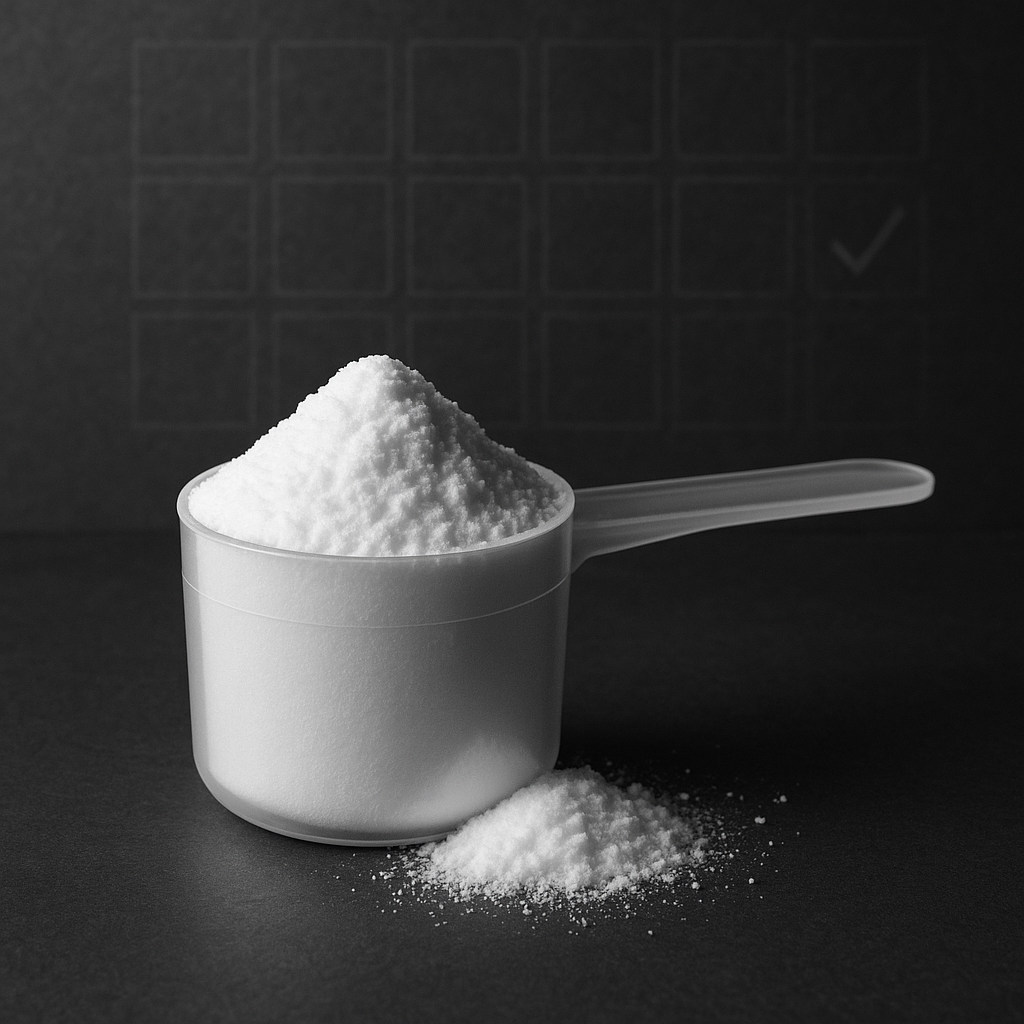
Is It Safe to Take Creatine Every Day for Years? Long-Term Safety Review
Worried about taking creatine every day for years? We review what 5-year trials, 10-year follow-ups, and decades of real-world use actually show—plus which lab markers to watch and what myths have never been confirmed.
Key Takeaways
- For healthy adults, 3–5 g/day of creatine monohydrate is the evidence-based long-term maintenance dose.
- Controlled trials up to ~5 years show no harmful changes in kidney or liver function markers at standard doses.
- Serum creatinine may rise slightly (a benign lab artifact); eGFR and cystatin C better reflect kidney function.
- No convincing evidence links creatine to dehydration, cramping, or hair loss in healthy users.
- Loading (20 g/day for 5–7 days) is optional; daily 3–5 g reaches full stores within ~3–4 weeks.
- Choose Canadian NPN-licensed products and third-party testing to ensure purity and label accuracy.
- People with kidney disease, on nephrotoxic meds, pregnant or breastfeeding should consult a clinician before use.
What long-term safety really means
When people ask if it’s “safe to take creatine every day for years,” they’re really asking two things: what do the longest controlled studies show, and what do real-world biomarkers look like in seasoned users? The short answer: for healthy adults using creatine monohydrate at the standard 3–5 g/day, the best available evidence and expert consensus consider it safe for long-term use. The International Society of Sports Nutrition (ISSN) explicitly supports creatine monohydrate as the gold standard for both efficacy and safety.
Why the confidence? Decades of research across athletes, older adults, and clinical populations show consistent patterns: improved high-intensity performance, small initial increases in body mass from intracellular water, and no harmful changes in routine health markers when used as directed. In Canada, creatine products are regulated as Natural Health Products (NHPs); choosing an item with a valid NPN and third-party testing further reduces quality risk.
This review breaks down the state of the science by time horizon—5 years, 10 years, and “lifetime” exposure—then walks through which biomarkers matter, what has never been found in healthy users, and a practical, Canadian-specific plan for safe, long-term supplementation. If you’re new to dosing, see our guides to loading, timing, and picking the best creatine.
Five years, ten years, and beyond: what the evidence shows
Up to ~5 years: Longest controlled trials and athlete cohort studies using standard dosing report no adverse effects on kidney or liver function, cardiovascular markers, or hydration status in healthy adults. ISSN’s position stand summarizes these findings and classifies creatine monohydrate as safe and effective when used as recommended.
Five to ten years: We don’t have decade-long randomized trials—practically, very few nutrition interventions are studied that long under RCT conditions. However, longitudinal follow-ups, registries, and decades of widespread athletic use have not revealed credible safety signals at maintenance intakes. When clinicians do see abnormal kidney labs in users, it’s most often a laboratory interpretation issue (mildly higher serum creatinine reflecting more creatine/creatinine turnover), not actual renal injury.
Lifetime use: No trial can promise “lifetime safety.” What we can say with honest confidence: in healthy adults, 3–5 g/day of creatine monohydrate shows a strong safety profile through the study windows we have, with a biologically plausible rationale for ongoing safety. For those with kidney disease, on nephrotoxic medications, pregnant, or breastfeeding, discuss with a healthcare professional before use—conservative practice is appropriate when evidence is limited.
Prefer to maintain without loading? That’s fine—build stores with 3–5 g/day and revisit our dosing tools: creatine calculator and how-to guides.
Biomarkers in long-term users: what changes and what doesn’t
Here’s how routine labs behave in long-term creatine users at standard doses:
- Kidney function: Serum creatinine may rise slightly because creatine converts to creatinine—this can mimic lower eGFR on paper. In healthy users, more specific measures (e.g., cystatin C) and clinical context typically show no renal impairment. If you track labs, ask your clinician to interpret results with supplementation in mind.
- Liver enzymes (ALT/AST), bilirubin, alkaline phosphatase: Controlled trials report no clinically meaningful changes with 3–5 g/day over months to years.
- Hydration and cramping: Early concerns about dehydration or cramping have not been supported in well-controlled settings; intracellular water in muscle increases slightly, which is one reason body mass can rise.
- Blood pressure and lipids: No consistent adverse effects at recommended intakes in healthy adults.
Two practical tips for Canadians:
- Use an NPN-licensed product and consider brands with independent testing. Our roundups of best creatine and creatine reviews highlight options available nationwide.
- For anyone with a kidney history—or taking medications processed by the kidneys—baseline labs plus periodic follow-up (eGFR and, if available, cystatin C) offer reassurance and personalized oversight.
Dosing for the long haul: what actually works
Maintenance: The evidence-based long-term dose is 3–5 g/day of creatine monohydrate. This maintains full intramuscular stores after an initial loading phase—or builds to full saturation in ~3–4 weeks without loading.
- Loading (optional): 20 g/day split into 4 doses for 5–7 days, then 3–5 g/day. See our loading guide.
- Timing: Take it when it fits your routine; consistency matters more than clock time. See when to take creatine.
- Form: Plain monohydrate remains the gold standard. Micronized powder can improve mixability. Flavoured blends add cost without improving efficacy.
- Hydration and GI: Drink water with your dose and split if you experience stomach upset.
Cycling? Not required. There is no evidence that routine “off” cycles improve safety in healthy users at 3–5 g/day. If you take a break during travel, simply resume your daily dose—no need to re-load unless you want faster re-saturation.
Want help choosing? Start with our Canadian-focused picks in best creatine and deep-dives in supplement reviews.
What has never been shown in healthy adults at standard doses
Across controlled trials and expert reviews, several fears have not been supported when creatine monohydrate is used as directed:
- Kidney damage: No credible evidence of renal harm in healthy adults at 3–5 g/day. Apparent “kidney changes” often trace back to expected shifts in serum creatinine, not true dysfunction.
- Liver toxicity: Routine liver panels remain within normal ranges in long-term studies.
- Injury, dehydration, or cramping: Not increased in well-controlled settings; some data even suggest no difference or lower cramp rates in athletes following structured programs.
- Hair loss: A small trial reported higher DHT during short-term loading, but there is no direct clinical evidence that standard creatine use causes hair loss.
What can happen? A modest early increase in body mass (often ~1–2 kg) from water in muscle, and occasional GI discomfort if large single doses are taken. These are expected, manageable effects—not safety red flags.
As always, those with pre-existing kidney disease, on nephrotoxic medications (e.g., some NSAIDs, certain antibiotics), or who are pregnant/breastfeeding should seek medical advice before starting.
A Canadian safe-use checklist for years of daily creatine
For healthy adults planning multi-year use, this simple checklist keeps you aligned with the evidence and Canadian regulations:
- Pick the right product: Choose creatine monohydrate with a valid Canadian NPN. Look for third-party testing (e.g., NSF, Informed Choice) for added assurance. Browse our best creatine and brand reviews.
- Use an evidence-based dose: 3–5 g/day, with optional loading if you want faster saturation. See how to load and when to take it.
- Stay consistent and hydrated: Take with water or a meal. Split doses if your stomach is sensitive.
- Know your labs: If you track health markers, note that serum creatinine may rise modestly; consider eGFR using cystatin C where available and interpret results in context.
- Check with a clinician if needed: Especially for kidney conditions, pregnancy/breastfeeding, or if you use nephrotoxic medications.
- Keep it simple long-term: No cycling required; no fancy forms needed. If you pause, resume with 3–5 g/day. For planning and personalization, try our creatine calculator and practical how-to guides.
Bottom line: for healthy Canadians, daily creatine monohydrate at 3–5 g has one of the strongest safety profiles in sports nutrition—now backed by decades of consistent research and real-world use.
Long-term creatine at a glance
- 3–5 g/day Evidence-based maintenance dose
- Up to ~5 years Controlled trials show no harm at standard doses in healthy adults
- ~1–2 kg Typical early body mass increase from water in muscle
- 0 cycles needed No requirement to cycle for safety
Frequently Asked Questions
Do I need to cycle creatine if I plan to take it for years?
No. There’s no evidence that cycling improves safety or effectiveness for healthy adults using 3–5 g/day of creatine monohydrate. If you stop for a while (e.g., travel), simply resume your daily maintenance dose when you return; re-loading is optional if you want faster re-saturation.
Is daily creatine safe for kidneys over the long term?
In healthy adults at standard doses, long-term studies and expert reviews show no harmful effects on kidney function. Serum creatinine may rise slightly due to creatine metabolism, which can make eGFR look lower on paper. If you have kidney disease, take nephrotoxic medications, or have concerns, consult your clinician and consider cystatin C-based estimates.
What form of creatine is best for multi-year use?
Creatine monohydrate is the gold standard for safety, efficacy, and value. Micronized monohydrate mixes more easily but isn’t inherently safer or more effective. Novel forms haven’t consistently outperformed monohydrate in peer-reviewed research.
Does creatine cause hair loss with long-term use?
There’s no convincing clinical evidence that creatine causes hair loss. One small study found higher DHT during short-term loading, but no studies have shown increased hair loss in creatine users. Genetics, hormones, and other factors play a larger role in male pattern baldness.
Which labs should I monitor if I’m a long-term user?
For healthy users, routine labs aren’t required. If you want added reassurance or have risk factors, ask about eGFR interpretation in the context of creatine use, consider cystatin C if available, and include basic liver enzymes (ALT/AST). Track trends over time rather than reacting to a single value.
Do I need a loading phase to be safe?
Safety doesn’t depend on loading. Loading (20 g/day for 5–7 days) just saturates muscle faster. You can reach the same saturation by taking 3–5 g/day consistently for ~3–4 weeks.