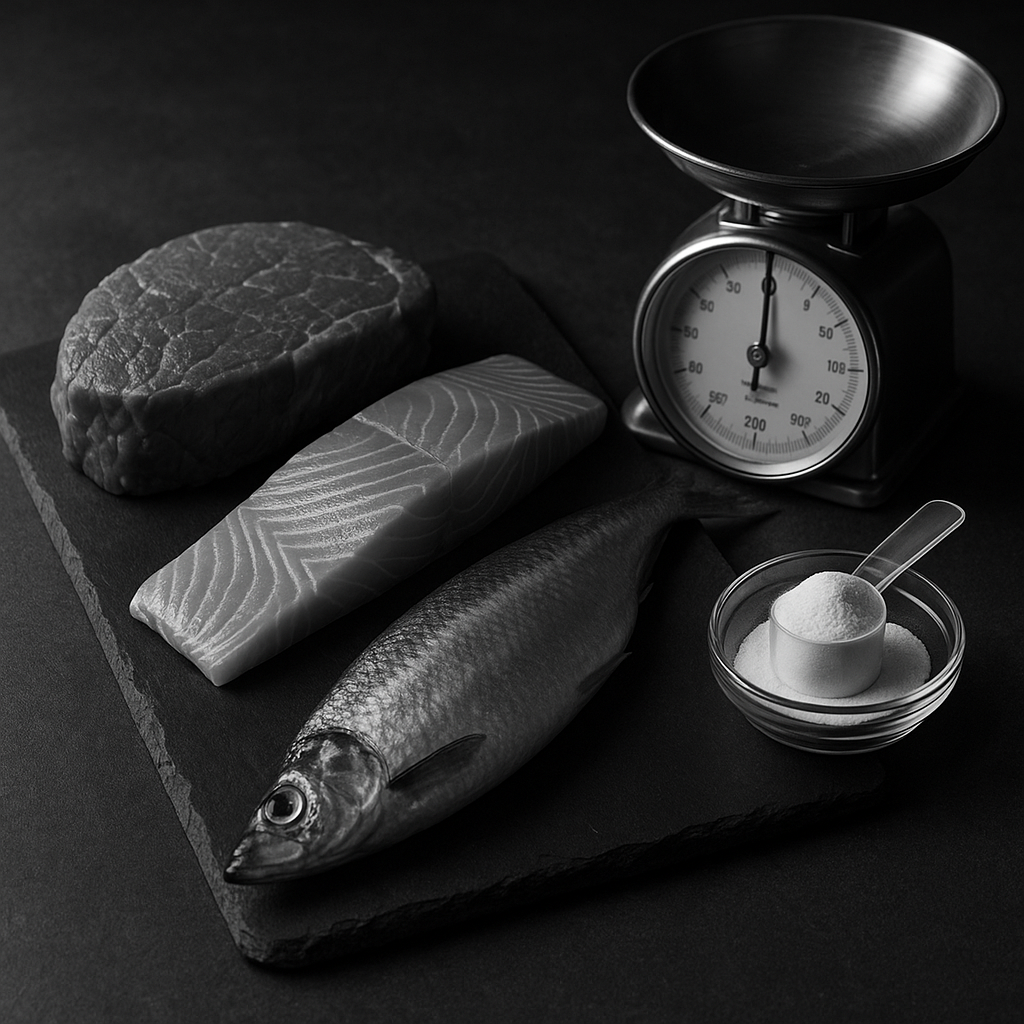
Creatine in Food: Natural Sources and Why Supplements Win
How much creatine is in beef, salmon, and herring—really? We break down realistic food intakes (yes, ~2 kg of steak for a 5 g scoop), what cooking does to creatine, and why monohydrate supplements are the practical choice, especially for plant‑based Canadians.
Key Takeaways
- Typical omnivore diets provide about 1–2 g of creatine per day—below the 3–5 g/day used in research.
- Beef has roughly 3–5 g creatine per kg raw; salmon ~2–4 g/kg; herring ~6–10 g/kg.
- You’d need around 2 kg of raw beef to match one 5 g supplement scoop.
- Cooking and dripping losses can reduce creatine content by ~10–30%.
- Creatine monohydrate is the gold standard; 3–5 g/day is a proven maintenance dose.
- Vegetarians and vegans typically have lower muscle creatine and respond robustly to supplementation.
- Choose third‑party tested creatine with a Canadian NPN when possible.
Why creatine in food matters (and how much you really get)
Creatine is a naturally occurring compound stored mostly in skeletal muscle, where it helps rapidly regenerate ATP during short, intense efforts. Your body makes some creatine, and omnivores get a bit more from meat and fish. But here’s the practical gap: typical diets provide only about 1–2 g/day, while the maintenance intake used in most sports nutrition research is 3–5 g/day of creatine monohydrate.
That difference matters for athletes chasing power output, lifters working through plateaus, and plant-based Canadians whose diets contain almost no creatine. Food can help—but amount and consistency are the sticking points. Creatine content varies by species, cut, freshness, and handling; cooking can lower it further. Hitting a research-backed daily target through food alone quickly becomes unrealistic for most people.
The good news: creatine monohydrate remains the gold standard—budget-friendly, stable, and extensively studied. In this guide, we’ll detail how much creatine is in beef, salmon, and herring, what cooking does, why vegetarians and vegans face a larger gap, and how to supplement smartly. For more background and practical tips, browse our Guides and our timing primer, When to Take Creatine.
How much creatine is in beef, salmon, and herring?
Raw meat and fish are the main dietary sources of creatine. Typical raw content ranges often cited in the literature and sport nutrition texts are:
- Beef: roughly 3–5 g per kg (1,000 g) of raw meat
- Salmon: roughly 2–4 g per kg of raw fish
- Herring: roughly 6–10 g per kg of raw fish
Those ranges reflect natural variability (species, diet, cut), storage, and pre-cooking handling. To visualize what this means for a typical 5 g daily target:
- At 3–5 g/kg, you’d need about 1–2 kg of raw beef—often close to 2 kg—to equal a 5 g scoop.
- At 2–4 g/kg, salmon would demand roughly 1.3–2.5 kg.
- At 6–10 g/kg, herring would still require around 0.5–0.8 kg.
That’s before any losses from cooking. For most Canadians, eating that much meat or fish daily is impractical and expensive—not to mention inconsistent across meals. If you want to sanity-check the math for your usual portions, try our quick Creatine Calculator. And if you decide to bridge the gap with a powder, our roundups can help: Best Creatine in Canada and our data-driven Creatine Supplements Review.
Cooking losses: what happens to creatine in the pan
Creatine in raw meat and fish isn’t fully preserved during cooking. Heat and moisture can convert a portion of creatine to creatinine and carry it into drippings or cooking liquid. Reported reductions vary with time, temperature, and method, but a ~10–30% drop is a practical ballpark for many household preparations.
What you can do in the kitchen:
- Avoid overcooking. Higher heat and longer times tend to increase losses.
- Keep the juices. Drippings and broths hold some creatine/creatinine; use them in sauces or stews rather than discarding.
- Moist, shorter methods. Gentle poaching, steaming, or quick searing may retain more than prolonged boiling, braising, or repeated reheating.
Even with careful techniques, you’re still unlikely to hit a consistent 3–5 g/day solely from cooked food, especially if your menu rotates. That’s one reason many athletes pair a normal, protein-forward diet with a small daily creatine dose. For timing and practical mixing ideas, see When to Take Creatine.
The vegan and vegetarian creatine gap in Canada
Plant foods contain virtually no creatine. Vegetarians and vegans typically have lower baseline muscle creatine than omnivores, which is one reason research often shows a larger performance and cognitive response to supplementation in plant-based individuals. If you don’t eat meat or fish, relying on food to deliver meaningful creatine simply isn’t an option.
The practical solution is straightforward: use creatine monohydrate—which is chemically synthesized, not animal-derived, and typically compatible with vegan diets (check the label for capsule ingredients if using caps). A steady 3–5 g/day fills the gap reliably and predictably, independent of your menu.
New to creatine? Start with our buyer’s guide, Best Creatine in Canada, and our in-depth Creatine Supplements Review. For a broader look at plant-based sport nutrition and daily routines, browse our Guides.
Why supplements win for most people
From a Canadian athlete’s perspective, creatine monohydrate checks three boxes that food can’t consistently match:
- Precision and consistency. A level scoop provides the dose you intend—3–5 g/day—without relying on large servings of meat or fish every day.
- Evidence and safety. Creatine monohydrate is the most studied form and remains the gold standard supported by the International Society of Sports Nutrition (ISSN). It’s well-tolerated in healthy adults when used as directed.
- Value. In Canada, plain creatine monohydrate powder often costs well under $0.25 per 5 g serving, making it far more economical than sourcing equivalent amounts from food.
Shopping tips for Canadians:
- Look for plain monohydrate (no fillers), ideally micronized for easier mixing.
- Check for an NPN (Natural Product Number) and consider third‑party testing for purity.
- Skip exotic forms promising more for more money—monohydrate consistently delivers. See our picks in Best Creatine and detailed brand notes in Creatine Supplements Review.
Dosing done right: loading, timing, and a simple plan
You have two evidence-based paths to saturate muscle creatine stores:
- Without loading: Take 3–5 g/day. Most people reach saturation in ~3–4 weeks—simple and gentle on the stomach.
- With loading (optional): Take ~20 g/day split into 4 doses for 5–7 days, then maintain at 3–5 g/day. This front-loads stores faster. Learn more in our Creatine Loading Phase guide.
Timing? The daily total matters more than the clock. Mix with water or a meal you reliably eat. If you like routines, pair creatine with training or a consistent snack—see When to Take Creatine. Stay hydrated and, if you have kidney disease or are taking medications, speak with your healthcare provider first.
Want help personalizing your intake? Use our Creatine Calculator to map a loading window and maintenance plan that fits your schedule and training volume.
Food vs scoop: creatine at a glance
- 1–2 g/day Typical creatine from an omnivorous diet
- ~2 kg beef Raw beef needed to match a 5 g scoop
- 10–30% Estimated creatine reduction from common cooking
- 3–5 g/day Research-supported maintenance dose (monohydrate)
Frequently Asked Questions
Which foods are highest in creatine?
Among common options, herring tends to top the list, followed by beef and salmon. Typical raw content ranges are roughly 6–10 g/kg for herring, 3–5 g/kg for beef, and 2–4 g/kg for salmon. Exact values vary with species, cut, freshness, and handling.
Can I meet my creatine needs without supplements?
It’s possible in theory but impractical for most people. To match a single 5 g scoop, you’d need around 2 kg of raw beef (more if cooked), or upwards of 0.5–0.8 kg of herring. Cost, cooking losses, and daily consistency make supplementation the simpler route.
Does cooking destroy creatine in meat and fish?
Heat and moisture can convert creatine to creatinine and carry it into cooking liquids. Losses depend on method and time, but a 10–30% reduction is a reasonable estimate. Keeping drippings for sauces and avoiding overcooking can help, but won’t reliably reach 3–5 g/day.
Is creatine monohydrate safe and do I need to load?
In healthy adults, creatine monohydrate is well-supported for safety and efficacy. Loading (about 20 g/day for 5–7 days) is optional; you can also take 3–5 g/day with no loading and reach saturation over several weeks. Stay hydrated and consult a clinician if you have medical conditions.
Is creatine vegan?
Yes—creatine monohydrate used in supplements is synthesized and typically vegan-friendly. Powders are usually just creatine and sometimes silica; check capsules for gelatin. Plant foods contain virtually no creatine, so supplementation is the practical option for vegan athletes.