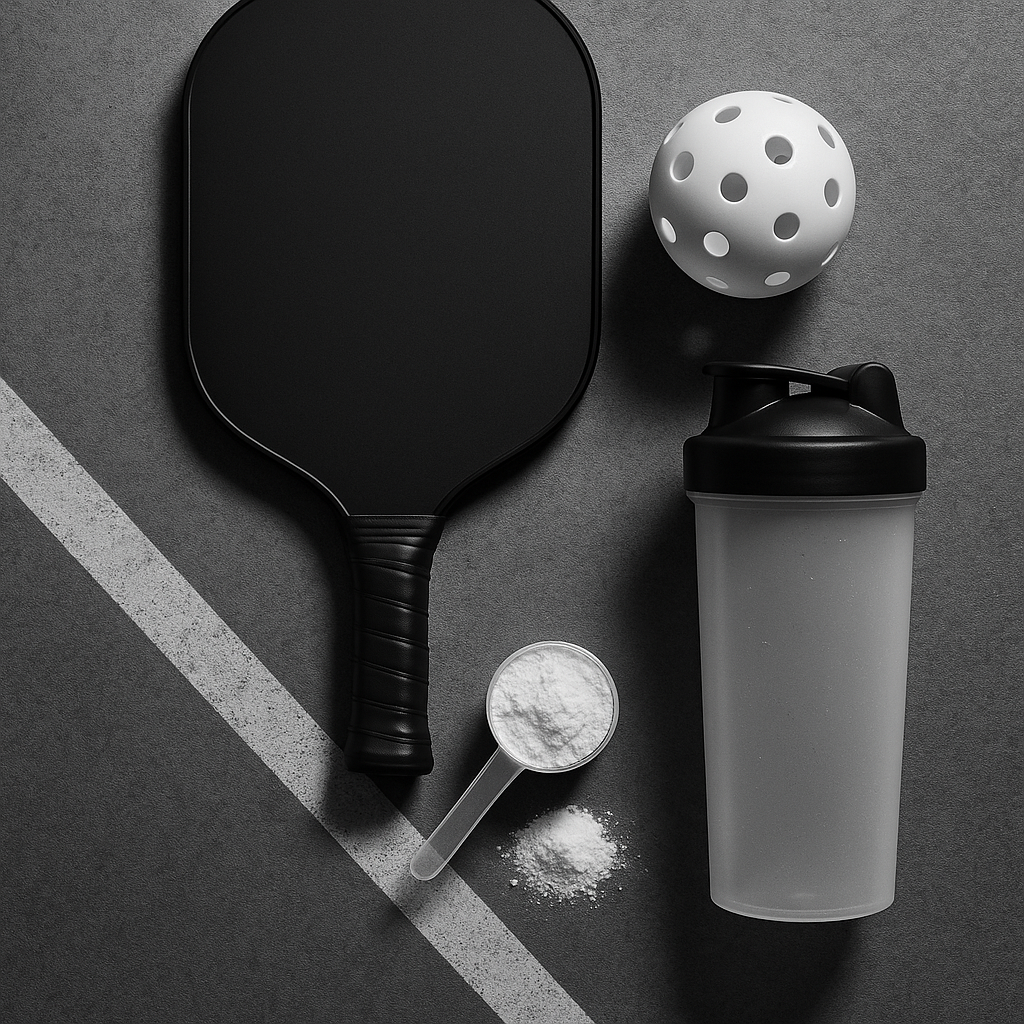
Creatine for Pickleball: Explosive Play and Quick Recovery
Pickleball is all quick bursts, sharp cuts, and repeat rallies—exactly where creatine shines. Here’s how to use it to add pop to your serves, stay sharp late in games, and recover faster between matches.
Key Takeaways
- Creatine monohydrate is the gold standard; take 3–5 g daily for maintenance.
- Optional loading: 20 g/day split into 4 doses for 5–7 days to saturate faster.
- Timing is flexible; consistency matters most—pair with a meal or post-match.
- Expect small water-weight increases; hydrate well, especially for hot court days.
- Choose third-party tested creatine with an NPN for Canadian compliance.
- Not on WADA’s Prohibited List; suitable for competitive play in Canada.
- Use our calculator to dial in your dose and skip unnecessary blends.
Why creatine fits pickleball
Pickleball rewards short, explosive efforts: quick first steps to the kitchen line, lateral shuffles, sudden drives, and tight resets during long rallies. Those actions draw heavily on your phosphocreatine system—the body’s rapid energy reserve for efforts lasting a few seconds. Creatine monohydrate boosts your intramuscular phosphocreatine stores, helping you regenerate ATP faster so you can repeat high-intensity efforts with less drop-off.
In practice, that can mean a crisper split-step, more pop on serves and overheads, and better consistency during stacked points or back-to-back matches. While direct research in pickleball is limited, creatine’s benefits are well documented across sports with similar demands—repeated sprints, jumps, and changes of direction. The mechanism is the same, and the dosing is simple.
- Simple protocol: 3–5 g/day for maintenance; loading is optional (more below).
- Fast payoff: Loading can increase muscle creatine in about a week; daily maintenance reaches saturation more gradually.
- Flexible timing: Take it when it fits—consistency matters more than the clock.
If you want help personalizing the dose, try our Creatine Dose Calculator. For a deeper dive on timing and protocols, see When to Take Creatine and our Creatine Loading Guide.
What benefits to expect on court
Creatine won’t replace footwork drills or paddle control—but it can raise your ceiling on the qualities that drive pickleball performance. The most consistent improvements seen across relevant sports are in short-duration power and repeat-effort capacity. That translates to better acceleration off the mark, stronger directional changes, and the ability to maintain shot quality deeper into a match.
- Explosive strokes: A small boost in peak power can add pace to serves, drives, and overheads without changing your swing.
- Repeatability: Faster ATP regeneration helps you recover between points and during scrambles at the kitchen line, reducing late-rally drop-offs.
- Training quality: Expect a couple more quality reps in agility, plyometric, or resistance sessions—small weekly wins that compound.
- Potential cognitive support: Some research suggests creatine may aid tasks requiring short-term memory and decision-making under fatigue. While not guaranteed, many players report feeling steadier late in sessions.
Note: Individual responses vary. If you’re dialing in your routine, pair supplementation with targeted court movement drills and strength work. Our product roundups at Best Creatine in Canada and detailed Creatine Reviews can help you pick a reliable option to test over 4–8 weeks.
How to take creatine for pickleball
Form: Choose creatine monohydrate—it’s the gold standard for safety, efficacy, and value. Fancy blends rarely outperform it. Micronized powders mix more easily, which can make daily use simpler.
Dose: For most adults, take 3–5 g/day. If you want faster saturation (e.g., a tournament is coming up), you can optionally load with 20 g/day split into 4 × 5 g servings for 5–7 days, then drop to 3–5 g/day. Loading isn’t required; steady daily dosing will still saturate muscles over time.
- Timing: Take it at a time you won’t forget. With a meal or post-practice can be convenient. Consistency matters more than pre vs. post.
- Mixing: Stir into water, a smoothie, or a carb-protein shake. Warm liquids can help dissolve it.
- Duration: You don’t need to “cycle off.” Many athletes use creatine year-round.
If you’re unsure which path fits your schedule, start with maintenance and evaluate after 3–4 weeks. For more detail, see When to Take Creatine and our Loading Phase explainer. Want a hand with numbers? Try the Creatine Dose Calculator to keep it simple.
Hydration, electrolytes, and weight changes
Creatine draws a small amount of water into muscle as stores increase. Many players notice a modest scale bump—often less than a kilogram—during the first couple of weeks. That’s intracellular water (not bloating under the skin), and it often comes with a “fuller” feeling in working muscles. It typically doesn’t hinder quickness; in fact, better repeat power can outweigh the small mass change for most players.
- Hydration basics: Add an extra 250–500 mL of fluids across the day when you start creatine. For hot outdoor play or long indoor sessions, include electrolytes (sodium, potassium).
- Cramp myth check: Large position stands report no increase in cramping or dehydration with creatine when athletes hydrate normally. Still, build smart habits—sip before warm-up and between games.
- GI comfort: If you’re sensitive, take smaller split doses (e.g., 2–3 g twice daily) and mix thoroughly.
Preparing for a tournament or league night? Keep your routine unchanged in the 48 hours prior—don’t suddenly increase dose. For broader planning around training and recovery, browse our step-by-step Guides.
Safety and compliance in Canada
For healthy adults, creatine monohydrate is one of the most researched and supported supplements in sport. Major organizations consider it safe at recommended doses. In Canada, many creatine products are sold as Natural Health Products (NHPs); look for a Natural Product Number (NPN) on the label as a sign the product is licensed for sale.
- Sport legality: Creatine is not on the WADA Prohibited List and is permitted in Canadian competition.
- Who should get medical advice first: Anyone with kidney or liver disease, those taking nephrotoxic medications, people who are pregnant or breastfeeding, and youth athletes should consult a qualified healthcare professional before use.
- Quality control: Prefer third-party tested products (e.g., Informed Choice/NSF) to reduce contamination risk.
As always, supplements work best alongside sound nutrition, sleep, and progressive training. If in doubt, speak with a registered dietitian or sport physician familiar with your health history and competitive level.
How to choose a creatine in Canada
The Canadian market has plenty of solid options—no need to overpay. Focus on three things: the right form (monohydrate), clean labels, and trustworthy testing.
- Monohydrate only: Skip blends and “next-gen” forms that cost more without consistent benefits. Micronized monohydrate mixes easiest.
- NPN and testing: Look for an NPN on the package and third-party testing logos (e.g., Informed Choice, NSF) to support purity and label accuracy.
- Simple ingredients: A single-ingredient powder is ideal. Unflavoured keeps cost low and versatility high.
- Creapure option: Some products use Creapure-brand monohydrate from Germany, valued for tight quality control.
- Value check: Compare price per 5 g serving rather than jar size. Most Canadians can find excellent options at a reasonable cost.
To save time, see our curated picks at Best Creatine in Canada and deep-dive brand analysis in the Creatine Supplements Review. If you’re assembling a full performance plan, explore our training and nutrition Guides.
Quick-start creatine facts for pickleball
- 3–5 g/day Evidence-based maintenance dose
- 20 g/day × 5–7 days Optional loading to saturate faster
- 3–4 weeks Time to saturate without loading
- Not on WADA list Creatine is permitted in sport
- 0.5–1.0 kg Typical early water-weight increase
Frequently Asked Questions
Will creatine make me too heavy or slow for pickleball?
Most players see a small initial increase in body mass from water stored inside muscle, often under a kilogram. This usually doesn’t harm quickness—many notice better repeat power and less late-match fade, which can be a net positive for court speed.
Do I need to load if I have matches this weekend?
Loading can raise muscle creatine faster, but it’s optional. If you start a few days before play, use small, split doses (e.g., 4 × 5 g with meals) and hydrate well. Otherwise, begin with 3–5 g/day and let saturation build over several weeks.
Is creatine safe for older pickleball players?
For healthy older adults, creatine monohydrate at recommended doses is generally considered safe and may support training quality. As with any supplement, speak with your healthcare provider if you have medical conditions or take prescription medications.
Is creatine allowed in Canadian tournaments and leagues?
Yes. Creatine is not listed on the World Anti-Doping Agency (WADA) Prohibited List and is permitted in competition. Always use reputable, third-party tested products to minimize contamination risk.
Does creatine cause cramps or dehydration?
Large position stands have not found higher cramp or dehydration rates with creatine when athletes maintain normal hydration. Still, it’s smart to drink regularly and add electrolytes for hot outdoor or long indoor sessions.