Creatine for Office Workers: The Brain Benefits Beyond the Gym
Afternoon brain fog isn’t just about willpower—your neurons are running an energy economy. Creatine helps recycle cellular energy in the brain, not just in muscles. Here’s how a simple 3–5 g/day routine can support focus, memory, and sustained output for Canadian desk workers.
Key Takeaways
- Creatine supports brain energy (ATP) recycling, which can aid working memory and mental stamina—especially under stress or sleep loss.
- Monohydrate is the gold-standard form; take 3–5 g/day with or without food (timing is flexible).
- Loading is optional; skip it for simplicity or use a 5–7 day load if you want faster saturation.
- Well-tolerated in healthy adults; start with 2–3 g/day if you’re prone to stomach upset and stay hydrated.
- Choose a Health Canada–licensed product (NPN), ideally third‑party tested; avoid proprietary blends.
- Vegetarians and vegans may see greater cognitive benefits due to lower baseline creatine.
- Pair creatine with good sleep, breaks, protein, and fluids for best workday focus.
Why your brain at work runs on creatine
The afternoon slump hits when your brain’s energy demands outpace supply. Every email, spreadsheet, and Zoom call leans on adenosine triphosphate (ATP)—your cells’ energy currency. Creatine helps recycle ATP quickly through the phosphocreatine system. While we often talk about that system in the context of lifting, the brain also relies on it during intense cognitive tasks, problem solving, and when you’re tired.
Your body makes creatine and you get some from food (mainly meat and fish), but brain and muscle stores aren’t always topped up—especially if you’re vegetarian or vegan. Supplementing with creatine monohydrate can increase tissue stores, potentially supporting working memory, attention, and mental stamina when the workload spikes or sleep is short.
For office workers, the appeal is simple: a low-cost, well-studied supplement with a strong safety profile in healthy adults that may help you stay on task longer. It’s not a stimulant, so don’t expect a jolt—think of it as supporting the brain’s energy buffer. If you’re new to the ingredient, start with our practical guides on when to take creatine and our step-by-step creatine guides for everyday routines.
The research in plain English
Creatine has one of the most robust evidence bases in sports nutrition, and reputable organizations endorse it for performance and safety in healthy adults. For cognition specifically, findings are promising but task-dependent. A widely cited randomized trial in vegetarians reported improved memory and reasoning with creatine versus placebo, aligning with the idea that people with lower baseline creatine may benefit more. Meta-analyses and narrative reviews generally suggest small improvements in working memory and attention—especially when the brain is under strain, like during sleep deprivation or high cognitive load.
In well-rested omnivores doing easy tasks, results can be neutral; that’s consistent with the mechanism—an energy buffer matters most when demand is high. Importantly, the form and dose used in positive studies are typically creatine monohydrate at 3–5 g/day, or short loading phases followed by maintenance.
Bottom line: If your workday includes heavy context switching, deadlines, or uneven sleep, creatine is a reasonable, evidence-aligned experiment. Expect subtle benefits that compound with consistent use, not an instant stimulant-like effect. For athletes who also spend most days at a desk, consider it a two-for-one: support gym performance and mental stamina. See our best creatine picks to get started.
How to take creatine for mental performance
The established maintenance dose is 3–5 g/day of creatine monohydrate. Timing is flexible—creatine works by saturating stores, not by acute timing. Many people take it with breakfast or lunch to create a failsafe habit and reduce the chance of forgetting.
- Maintenance only: Take 3–5 g once daily. Expect steady saturation in about 4–6 weeks.
- Optional loading: If you want faster saturation, use ~20 g/day split into 4 doses for 5–7 days, then 3–5 g/day. Details here: creatine loading phase.
- With food or without: Either is fine. Taking creatine with a meal or a warm drink can improve comfort if you have a sensitive stomach.
- Hydration: Keep fluids consistent through the day. Creatine draws water into cells; a refillable bottle at your desk helps.
If you like precision, our creatine calculator can personalize your loading and maintenance plan. For timing preferences (morning vs. evening) and how to pair creatine with coffee or workouts, see when to take creatine.
Choosing a creatine in Canada
Look for simple, well-tested products. Creatine monohydrate is the gold standard for effectiveness, safety, and value. Micronized monohydrate can mix a little easier. Branded raw materials like Creapure can offer added quality assurance, but many generic monohydrates are excellent—focus on transparency and testing.
- Health Canada licensing: Check the label for an NPN (Natural Product Number). This means the product is authorized for sale in Canada.
- Third-party testing: NSF Certified for Sport or Informed Choice adds confidence for purity and label accuracy.
- Clean label: You want one active ingredient: creatine monohydrate. Skip proprietary blends and unnecessary additives.
- Cost check: Compare the price per 5 g serving; monohydrate should be budget-friendly.
We keep a running list of reliable options in our Canadian-focused guides: see best creatine and our in-depth creatine supplements review.
Side effects, safety, and who should avoid it
Creatine monohydrate is well-studied and generally safe for healthy adults at 3–5 g/day. The most common side effect is mild stomach upset—often solved by splitting the dose or taking it with food. Some people notice a small, early increase on the scale from water held inside muscle cells; this doesn’t mean dehydration, but staying hydrated is still smart.
- Kidneys: In healthy individuals, long-term research has not shown harm. Creatinine (a lab marker) may rise due to supplementation and can be misread as kidney dysfunction; inform your clinician if you supplement.
- Hair loss: Evidence for creatine causing hair loss is insufficient. One small study reported a DHT increase during loading, but no hair outcomes and limited replication.
- Who should avoid or seek advice: People with kidney disease, those on nephrotoxic or diuretic medications, and those who are pregnant or breastfeeding should speak with a healthcare professional first.
Choose licensed Canadian products (look for an NPN) and follow label directions. When in doubt, consult your clinician and share your supplement list for safe, coordinated care.
Your simple office routine
Here’s a practical way to weave creatine into your workday without overthinking it.
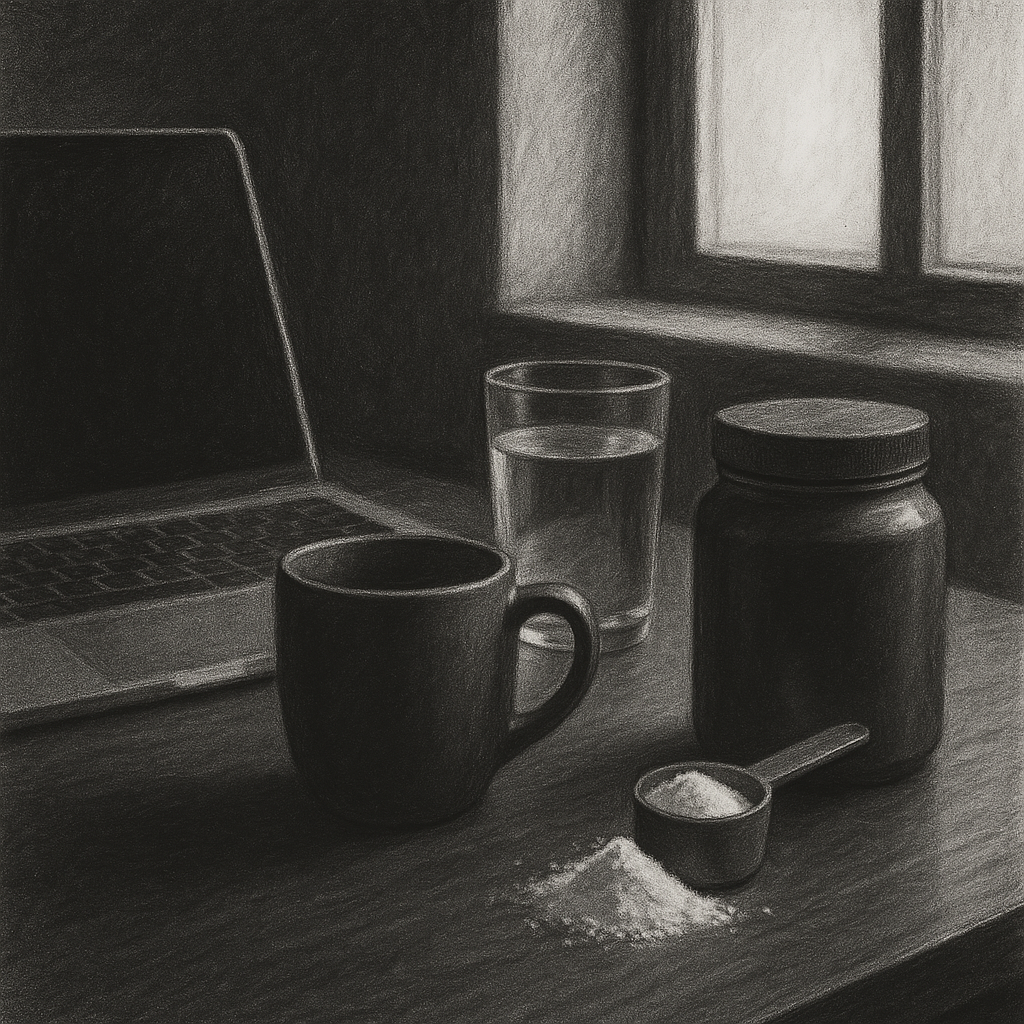
- Daily anchor: Take 3–5 g with breakfast or lunch. Leave the tub and scoop beside your kettle or mug to create a visible cue.
- Hydration loop: Mix creatine into a glass of water or your mid-morning tea. Refill your bottle whenever you stand up for a break.
- Afternoon support: If 2–4 p.m. is your low point, pair creatine with a protein-rich snack and a 5–10 minute walk to reset attention.
- Sleep matters: Creatine can buffer energy when sleep is short, but it won’t replace rest. Aim for a regular schedule and light exposure in the morning.
- Review and refine: Give it 4–6 weeks. Track perceived focus or task completion time. If you need faster saturation, consider a short load (details: loading phase).
For more timing tips and stacking with workouts or coffee, visit when to take creatine and our practical guides.
Creatine for the Workday, At a Glance
- 3–5 g/day Evidence-based daily maintenance dose
- 4–6 weeks Typical time to saturate without loading
- Monohydrate Gold-standard form supported by ISSN
- NPN on label Health Canada–licensed product
- Vegetarian/vegan Often see larger cognitive response
Frequently Asked Questions
Will creatine actually help with afternoon brain fog?
It can help some people, particularly under high cognitive load or after short sleep. Creatine supports ATP recycling in brain cells, which may aid working memory and sustained attention. It’s not a stimulant—think steady support rather than a quick buzz.
Do I need to load creatine for mental benefits?
No. A simple 3–5 g/day routine will saturate stores in 4–6 weeks. A short loading phase (about 20 g/day split for 5–7 days) can speed that up, then continue with 3–5 g/day. Choose the approach you’ll stick with consistently.
When should I take creatine for focus—morning or afternoon?
Timing is flexible. Consistency matters more than the clock. Many desk workers anchor their dose to breakfast or lunch to build the habit. If you’re curious about timing preferences, see our guide on when to take creatine.
Will creatine make me jittery or dehydrated?
Creatine is not a stimulant, so it won’t cause jitters. It draws water into cells, which is compatible with normal hydration—just keep fluids steady through the day. A refillable bottle at your desk helps.
Is creatine safe to use long-term for non-athletes?
In healthy adults, creatine monohydrate has a strong safety profile at 3–5 g/day, supported by position stands and long-term data. If you have kidney disease, take diuretics or nephrotoxic meds, or are pregnant/breastfeeding, consult your healthcare provider first.
Will creatine make me gain weight or look puffy?
Some people see a small early increase on the scale from water drawn into muscle cells, not body fat. It’s usually modest and often stabilizes. Staying hydrated and using a steady 3–5 g/day dose can keep things comfortable.