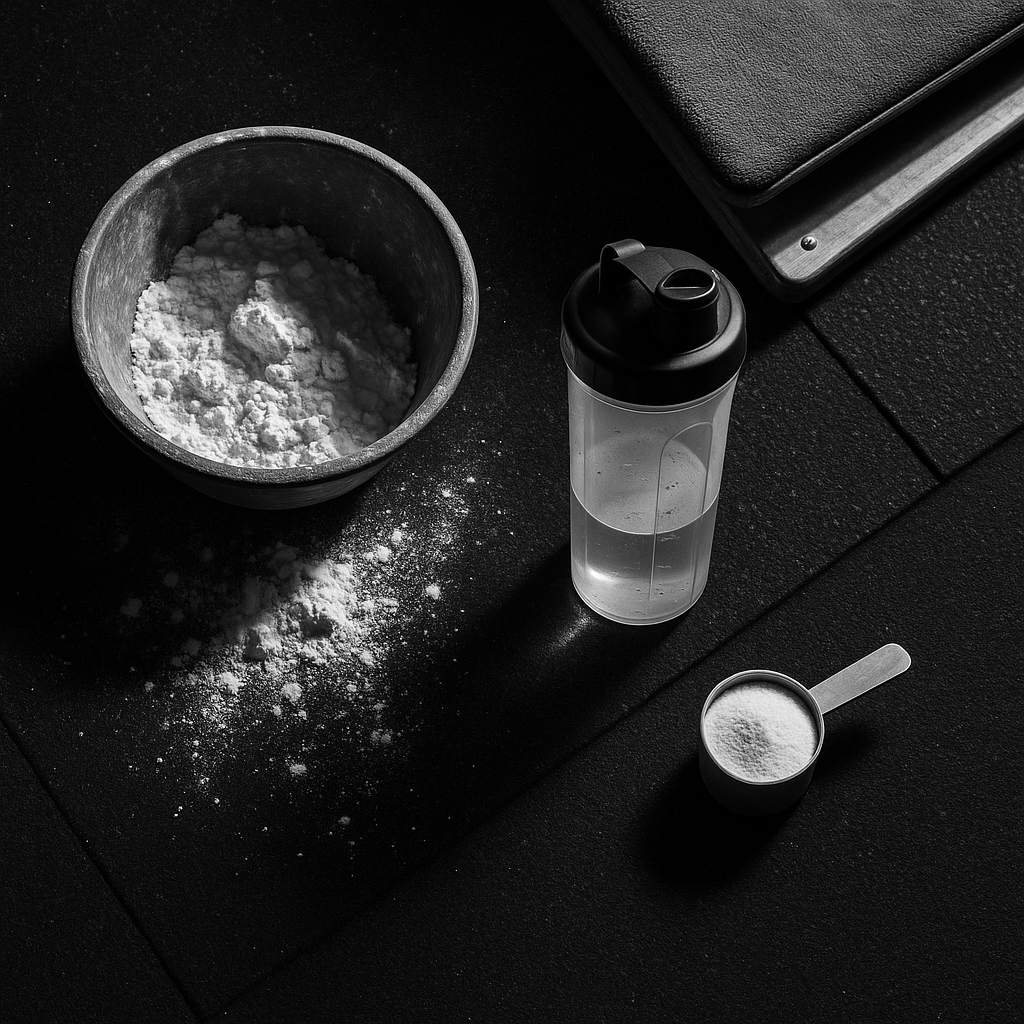
Creatine for Gymnastics: Power-to-Weight and Explosive Skills
Gymnastics rewards athletes who can express high power without carrying extra weight. Here’s how creatine supports vaults, tumbling, and repeated explosive sets—while managing mass and hydration.
Key Takeaways
- Gymnastics relies on the phosphocreatine system for 5–15 second explosive efforts; creatine supports this energy pathway.
- Monohydrate is the gold standard; 3–5 g per day is sufficient for most gymnasts without a loading phase.
- To protect power-to-weight, start at 3 g/day, split doses with meals, and track body mass and jump metrics weekly.
- Timing is flexible—consistency matters most; pairing with a meal or post-training is practical.
- Expect a small early rise in body water (often ~0.5–1.5 kg), which is intracellular and performance-supportive, not fat.
- Choose third-party tested products (Informed Sport/Choice) and stick with plain monohydrate; see our Canadian picks.
- On meet week, avoid sudden changes; maintain your established dose and hydration plan.
Why creatine fits gymnastics
From a full-speed vault approach to a tumbling pass or a set of release moves, gymnastics is built on short, explosive bouts. These rely heavily on the phosphocreatine (PCr) system—the body’s fastest energy source for high-power efforts lasting roughly 5–15 seconds. During a training session, gymnasts repeat these bursts with partial recovery, asking muscles to restore PCr quickly between attempts.
Creatine monohydrate increases intramuscular creatine and PCr stores. That can help maintain bar speed, jump height, and sprint power across repeated sets—key qualities on floor, vault, and fast-twitch elements on other apparatus. While total routine times are longer, the make-or-break moments are these brief, high-force efforts.
For a deeper primer on how energy systems work across sports and how to align supplements with training blocks, see our guides. If you want to align creatine intake with practice time, our overview on when to take creatine covers timing nuances. The bottom line: in a sport where every centimetre of height and tenth of a second on run-up speed matters, supporting the PCr system is squarely on target.
What creatine can do for explosive skills
Creatine helps regenerate ATP via the PCr shuttle, buffering energy for maximal and near-maximal efforts. In practice, that can mean sustaining repeated explosive outputs: vault run-ups, round-off back handspring sets into twists, or powerful swings into release moves. Evidence from the International Society of Sports Nutrition (ISSN) and multiple peer-reviewed studies supports creatine’s ability to increase high-intensity work capacity, power, and strength—qualities that underpin skill height, rotation speed, and bar velocity.
For gymnastics, two benefits matter most: 1) maintaining power across sets (less drop-off on later reps or passes), and 2) faster recovery of PCr between attempts when rest is limited. While the exact size of benefit varies with training status and protocol, the direction is consistently positive when paired with sound programming.
Creatine is also remarkably well-studied for safety in healthy individuals at recommended intakes. The gold standard is creatine monohydrate, not designer variants. For an evidence-based overview of timing considerations, see when to take creatine, and for a full loading vs. non-loading discussion, see creatine loading. If you want product guidance, our Canadian-focused picks are at best creatine.
Power-to-weight ratio: managing mass and water
Gymnastics rewards maximal output with minimal extra mass. A fair question is whether creatine adds unwanted weight. The typical early change is a modest increase in intracellular water within muscle—often about 0.5–1.5 kg over the first 1–3 weeks. This is not fat gain; it reflects better cellular hydration and may even support force production and training quality.
Still, athletes sensitive to body mass can manage this well:
- Skip loading and begin with 3 g/day to raise stores gradually.
- Split the dose (e.g., 1 g three times daily with meals) to improve tolerance and minimize any transient GI upset.
- Track weekly body mass (morning, after washroom) and simple metrics like vertical jump or 10 m sprint to ensure power-to-weight stays on target. Our creatine calculator can help plan dosing.
- Keep sodium and hydration consistent in meet week; avoid last-minute changes that can shift water.
If appearance or apparatus feel is critical for a specific competition, start supplementation in the off-season or base phase to understand your personal response well before you compete.
Dosing and timing for gymnasts
The mainstream, evidence-based approach is simple: 3–5 g/day of creatine monohydrate as a maintenance dose. A loading phase (e.g., 20 g/day split into 4 doses for 5–7 days) saturates muscles faster, but many gymnasts prefer to skip loading to limit rapid water shifts. You will still reach full stores—just over a few weeks instead of one.
Timing is flexible. Creatine is not an acute stimulant; consistency matters more than exact timing. Practical options include: with breakfast, post-practice mixed into a smoothie, or with your largest meal to piggyback on insulin-mediated uptake. For details, see when to take creatine and our breakdown of the loading phase.
Use plain monohydrate powder—it’s cost-effective and best supported by research. Capsules are fine if you value convenience. For Canadian-tested picks and value comparisons, see best creatine and our supplements review. Most athletes do well cycling only when training cycles change; there’s no requirement to stop unless you’re troubleshooting weight, GI comfort, or travel logistics.
From practice to meet day: applying creatine
Practice blocks: During heavy skill acquisition or strength phases, creatine can help sustain bar speed, sprint power, and tumbling height across sets. Pair it with structured rest (2–3 minutes between high-output attempts) to allow phosphocreatine to recover, and progressive overload in your strength work.
Peaking and meet week: Avoid last‑minute changes. Maintain your established daily dose and keep hydration and electrolytes steady. If you’re highly mass-sensitive, consider a 3 g/day protocol started well in advance, and continue it through competition rather than stopping—abrupt changes are more disruptive than steady habits.
Fueling tips: Taking creatine with a meal or carbohydrate-protein snack is convenient and supports adherence. On double-session days, one daily dose is still enough. Remember, creatine’s benefits are chronic—it supports the underlying energy system for vaults, sprints, and explosive skills but does not acutely “amp you up.” For more implementation detail, browse our practical guides.
Buying in Canada: quality and compliance
Stick to the basics: creatine monohydrate from a reputable brand, ideally third‑party tested by Informed Sport or Informed Choice. This reduces the risk of contamination—important for athletes in Canadian programs subject to drug testing. The Canadian Centre for Ethics in Sport (CCES) reminds athletes that supplements carry inherent risk; third‑party certification helps manage it.
Practical shopping tips for Canadians:
- Check for certification logos on the label and batch numbers you can verify online.
- Choose plain powder to minimize cost per 5 g and avoid unnecessary additives or sugars.
- Ignore marketing for exotic forms (salts, esters, “pH-buffered”): monohydrate remains the research-backed standard.
- Plan your budget—a 1 kg tub typically covers ~6 months at 5 g/day.
Ready to compare options? Start with our Canadian picks at best creatine and deeper brand analysis in our creatine supplements review. If you’re fine‑tuning dose to training load or body mass, our handy calculator can help.
Creatine and Gymnastics at a Glance
- 5–15 s Typical window where phosphocreatine powers explosive skills
- 3–5 g/day Evidence-based maintenance dose of creatine monohydrate
- ~1 kg Common early increase in intracellular water mass (not fat)
- 2–3 min Time to restore most PCr between high-power attempts
Frequently Asked Questions
Will creatine make me too heavy for gymnastics?
Most athletes see a small, early rise in body mass (often ~0.5–1.5 kg) from increased intracellular water—not fat. For mass‑sensitive gymnasts, start with 3 g/day, split doses with meals, and monitor body mass and simple performance markers (e.g., jump height, sprint time). Skipping the loading phase further tempers rapid shifts.
Is creatine allowed under Canadian anti-doping rules?
Creatine is not on the WADA Prohibited List and is widely used in sport. However, supplements can be contaminated. Choose third‑party certified products (Informed Sport/Choice) and review CCES guidance on supplement risk. Athletes are responsible for what they ingest, so buy carefully and keep records.
Should under-18 gymnasts use creatine?
Evidence supports the safety of creatine monohydrate at recommended doses in healthy individuals, but minors should involve parents/guardians and a qualified sport dietitian or physician. Focus first on fundamentals—energy intake, protein, sleep, and coaching. If creatine is used, stick to 3–5 g/day monohydrate and monitor closely.
Do I need a loading phase for gymnastics?
No. Loading saturates muscles faster but isn’t required. Many gymnasts prefer 3–5 g/day without loading to minimize rapid water shifts. You’ll reach similar muscle creatine levels over several weeks, which aligns well with training cycles.
When should I take creatine around practice or meets?
Timing is flexible; consistency matters most. Many athletes pair creatine with a meal or take it post‑practice for convenience. Avoid making changes during meet week—maintain your established routine and hydration plan.