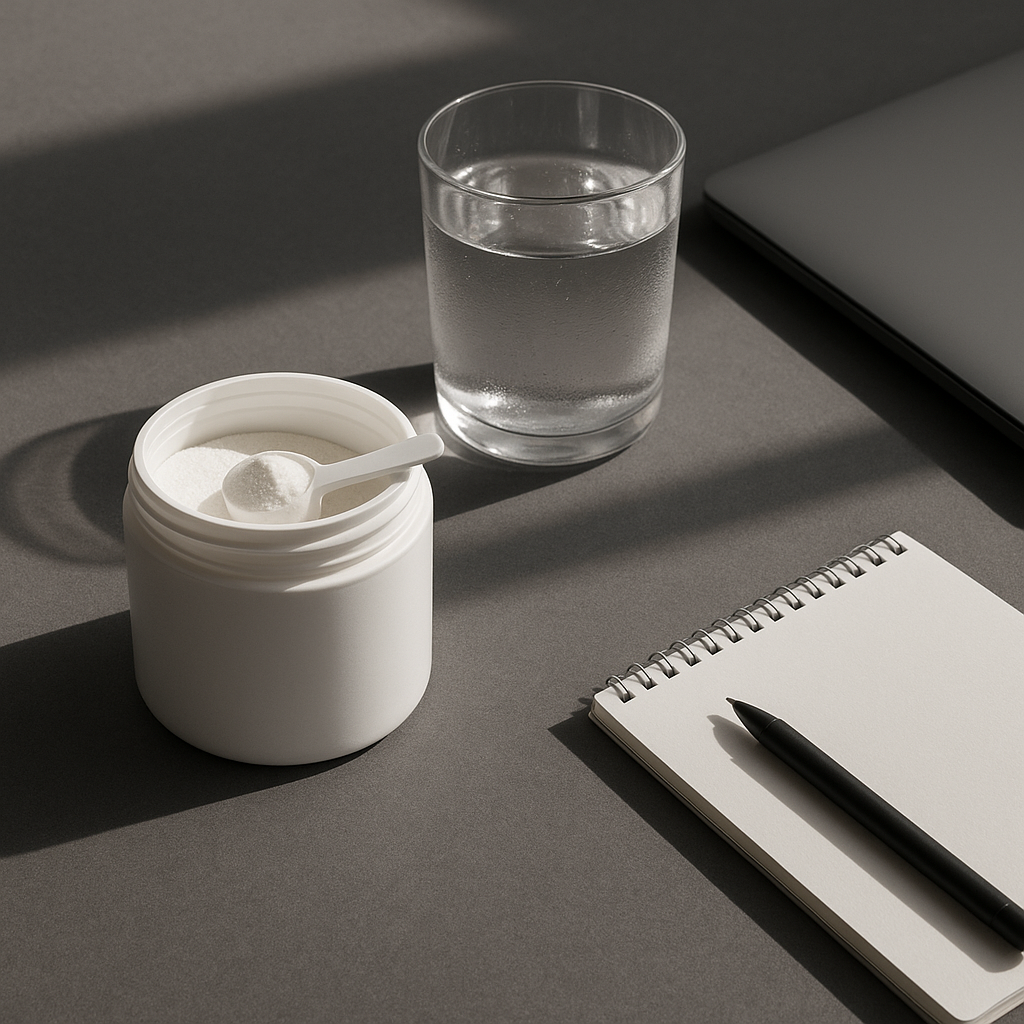
Creatine for Desk Workers: Brain Power for a Sedentary Day
If your focus fades around hour 4 and again after lunch, you’re not alone. Creatine isn’t just for the gym — it helps the brain recycle energy for steadier attention and working memory through a long desk day. Here’s what the science says, how to dose, and how to use it alongside smart work habits.
Key Takeaways
- Creatine monohydrate (3–5 g/day) is the gold-standard, ISSN-supported dose for daily maintenance.
- Benefits for attention and working memory tend to be modest but more noticeable under fatigue or low sleep.
- No strict timing needed; take your daily dose with a meal you never miss to improve adherence.
- A 5–7 day loading phase (20 g/day split) works faster, but it’s optional for desk workers.
- Vegetarians/vegans may see greater cognitive benefit due to lower baseline creatine stores.
- Choose Canadian products with an NPN and third-party testing; monohydrate powder offers best value.
- Hydrate well and monitor GI tolerance by starting at 3 g/day, then moving to 5 g/day if desired.
Why focus fades at hour 4 and 7
Even a well-planned workday can feel like two sprints: the morning push that hits a wall around hour 4, then the post-lunch stretch where attention thins again near hour 7. Part of this is behavioural (fewer breaks, decision fatigue), but there’s also a bioenergetic story. Your brain runs hot on ATP — its moment-to-moment energy currency. When tasks are demanding and continuous, local ATP turnover rises and mental fatigue accumulates, which can show up as slower working memory, weaker sustained attention, and more task switching.
Creatine is best known for muscle performance, yet the brain also stores and uses creatine-phosphocreatine as a rapid energy buffer. The logic is simple: if you can slightly improve the brain’s ability to recycle ATP during demanding cognitive work, you may smooth out dips in attention and working memory — especially when you’re tired or under time pressure.
That doesn’t mean creatine is a stimulant or a shortcut. Think of it as part of a foundation: good sleep, hydration, movement, and smart breaks first; then consider creatine for an incremental lift. Below, we outline what the research shows for non-athletes, and how to dose it for a desk-bound routine.
How creatine helps a sedentary brain
Creatine’s role in the brain mirrors its role in muscle: it supports rapid regeneration of ATP via the phosphocreatine system. The effect size isn’t dramatic like caffeine; instead, it’s a gentle nudge that can matter when neural demand is high or when you’re starting at a disadvantage (e.g., low sleep, vegetarian diet with lower baseline creatine stores).
- Sustained attention: Some randomized trials report improved vigilance and reaction consistency during mentally taxing tasks, particularly under fatigue.
- Working memory: Research in non-athletes, including vegetarians, has shown improvements on memory spans and complex reasoning tasks after several weeks of creatine monohydrate.
- Resilience under stressors: Studies in sleep deprivation and hypoxia models suggest creatine may blunt the typical drop in executive function — relevant to late-night deadlines or travel days.
Importantly, not everyone feels a clear “on switch.” The average effect is modest and builds with regular use, much like topping up a nutrient. As always, individual response varies. If you test creatine for desk work, give it 3–4 weeks and pair it with smart scheduling and breaks for a fair trial.
What the research says for non-athletes
The International Society of Sports Nutrition recognizes creatine monohydrate as the gold standard with strong safety data and broad performance benefits. For cognition in non-athletes, evidence is smaller but encouraging. A classic randomized, placebo-controlled, cross-over trial in healthy adults found that oral creatine improved working memory and reasoning tasks, with larger effects observed in individuals with lower baseline stores (e.g., vegetarians).
Systematic reviews have since noted that benefits are most detectable when the brain is under load — sleep restriction, oxygen stress, or prolonged mental effort — and are less pronounced at full rest with short, easy tests. That pattern aligns with creatine’s role as an energy buffer: the bigger the drain, the more opportunity to help.
Bottom line: for everyday desk work, expect small, practical gains in attention consistency and working memory that are easier to notice on long or demanding days. If you work across time zones, manage high-volume information, or sustain deep focus blocks, you may be more likely to feel a benefit.
How to dose and time it
Stick with the basics supported by mainstream sports nutrition research and the ISSN: creatine monohydrate, 3–5 g per day. You can take it as a single daily scoop or split into 2–3 smaller servings if your gut prefers that.
- Loading (optional): If you want faster saturation, use ~20 g/day for 5–7 days (split into 4 doses), then maintain at 3–5 g/day. For most desk workers, skipping the load and letting stores rise over 3–4 weeks is perfectly fine.
- Timing: There’s no magic hour. Take it with a meal you never miss (breakfast or lunch) to anchor the habit. See our guide on when to take creatine.
- Hydration and tolerance: Start at 3 g/day for a week to assess GI comfort, then move to 5 g/day if desired. Add an extra glass of water.
- Vegetarian/vegan? You may respond more noticeably; 3–5 g/day is still appropriate.
Want help personalizing your plan? Try our creatine calculator and browse step-by-step guides.
A practical workday protocol
Consider this simple framework for an 8–9 hour desk day. It combines evidence-based creatine use with fatigue management so you don’t rely on willpower alone.
- Morning anchor (Dose): Take 3–5 g creatine monohydrate with breakfast and a full glass of water. If you use caffeine, keep it consistent and not too late in the day.
- Deep focus blocks: Schedule your most demanding working-memory tasks before the typical hour-4 dip. Use 50–90 minute blocks with 5–10 minute movement breaks.
- Hour-4 guardrail: Stand, hydrate, light snack (carb + protein), and a quick walk or mobility flow. Creatine isn’t a stimulant — movement still matters.
- Post-lunch setup: Front-load admin during the early afternoon when alertness is lower, then a second 60–75 minute deep block before the hour-7 wall.
- Evening boundary: Wrap with a low-cognitive-load review and plan tomorrow. Protect sleep — it multiplies the value of any supplement.
If you’re selecting a product, see our best creatine picks in Canada and detailed supplement reviews.
Safety, side effects, and who should avoid
Creatine monohydrate has one of the strongest safety profiles in sports nutrition when used at recommended doses. The ISSN considers long-term use of 3–5 g/day safe in healthy individuals. Common, usually mild effects can include transient water weight gain (often 0.5–1.0 kg) and occasional GI discomfort if you take large doses on an empty stomach.
- Who should speak to a clinician first: Anyone with kidney disease, a history of kidney issues, or those taking nephrotoxic medications should consult their healthcare provider. The same applies during pregnancy or breastfeeding due to limited data.
- Hydration and electrolytes: Add a modest hydration bump and include potassium/sodium through regular meals, particularly if you’re also increasing daily steps or workouts.
- Form matters: Choose creatine monohydrate. Other forms are more expensive without better evidence for cognition or overall efficacy.
In Canada, look for products with an NPN (Natural Product Number)Licensed Natural Health Products Database.
How to buy creatine smart in Canada
Shopping here is straightforward: pick a reputable Canadian brand offering plain creatine monohydrate with an NPN, third-party testing (e.g., Informed Choice), and a clean ingredient list (ideally just “creatine monohydrate”). Powders offer the best per-serving value; capsules are convenient but costlier.
- Cost-per-gram check: Compare price per 5 g serving, not the tub price. Monohydrate should be affordable.
- Avoid hype: Forms like creatine HCl, buffered, or esterified haven’t shown consistent advantages for cognition or overall outcomes versus monohydrate.
- Mixing tips: Stir into water, juice, or a smoothie. Micronized powders dissolve more easily.
- Quality signals: Transparent batch numbers, published testing, and clear contact info are green flags.
Ready to choose? Start with our curated picks at Best Creatine in Canada, compare labels in our supplement reviews, and explore more how-to content in our guides library.
Creatine for Focus at Your Desk
- 3–5 g/day Evidence-based maintenance dose (monohydrate)
- 7–28 days Typical time to benefit without a loading phase
- 20 g/day × 5–7 d Optional loading to saturate faster
- Monohydrate Gold-standard form backed by ISSN
- Vegetarians ↑ response Lower baseline stores can mean bigger gains
Frequently Asked Questions
Will creatine make me feel puffy or gain weight at my desk?
Some people notice 0.5–1.0 kg of water weight as muscles store more creatine and water. It’s typically not visible as bloat in clothing and doesn’t impair mental performance. If you’re sensitive, start at 3 g/day and take it with a meal.
Do I need a loading phase if I only want cognitive benefits?
No. Loading (20 g/day for 5–7 days) reaches saturation faster, but a steady 3–5 g/day will get you there in 3–4 weeks. For most desk workers, consistency matters more than speed.
Is creatine safe long term for non-athletes?
In healthy individuals, long-term use of creatine monohydrate at 3–5 g/day is well supported by safety data and the ISSN position stand. If you have kidney disease, are pregnant or breastfeeding, or take medications affecting kidney function, consult your clinician first.
When should I take creatine for the best focus?
Creatine isn’t timing-sensitive like caffeine. Take it with a routine meal you never miss (breakfast or lunch) to improve adherence. Pairing with carbs and protein may support uptake; hydration helps GI comfort.
Is caffeine better than creatine for alertness?
They work differently. Caffeine is a stimulant that can quickly boost alertness but may cause jitters or a crash. Creatine is an energy buffer that supports attention and working memory more subtly over weeks. Many people use both, timed sensibly.
Can I take creatine if I don’t work out at all?
Yes. Creatine is not just for athletes. Evidence in non-athletes suggests modest cognitive benefits, especially under fatigue. Still, combining creatine with movement breaks and sleep hygiene will deliver the best real-world productivity gains.