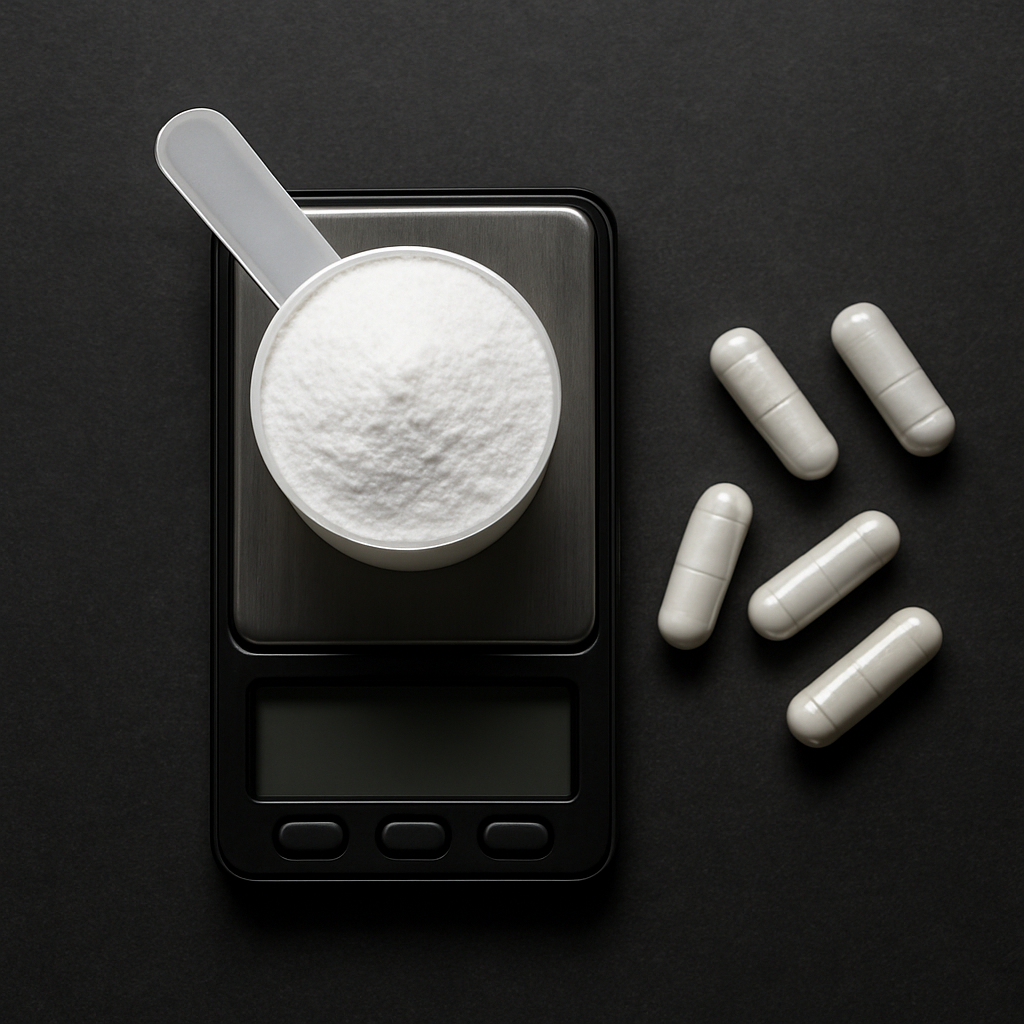
Creatine Capsules vs Powder in Canada: Which Is Better Value?
Creatine works the same whether you swallow capsules or mix powder—the difference is price, convenience, and how precisely you can dose. We break down real cost-per-gram math in Canada, highlight trusted brands, and help you decide which form actually fits your routine and budget.
Key Takeaways
- Creatine monohydrate is the gold standard; aim for 3–5 g per day.
- Powder is usually the lowest cost per gram in Canada; capsules trade higher cost for convenience.
- Hitting 3–5 g typically requires 4–7 capsules (often 500–750 mg each).
- Look for NPN licensing and clean labels (100% creatine monohydrate, ideally Creapure).
- Choose capsules if you’re on-the-go or hate mixing; choose powder for budget and dose flexibility.
- Use our calculator to compare cost per gram before you buy.
- Timing is flexible; consistency matters more than when you take it.
Capsules vs powder: the real difference
Creatine works because of the ingredient, not the container. Both capsules and powders can deliver creatine monohydrate, the form most supported by research for strength, power, and lean mass. The International Society of Sports Nutrition (ISSN) supports a maintenance intake of 3–5 g/day for most adults after an optional loading phase. In other words: capsules and powders are equally effective when they provide the same dose of monohydrate.
Where they truly differ is in cost per gram, convenience, and dose flexibility. Capsules are pre-measured and travel-friendly but usually cost more per gram. Powder is easy to titrate (e.g., 3 g, 5 g, or higher for larger athletes) and is usually the cheapest way to hit your daily target.
In Canada, look for products licensed as Natural Health Products with an NPN on the label and a simple ingredient list: ideally just “creatine monohydrate.” If a product touts a special form (e.g., hydrochloride), keep in mind that monohydrate remains the gold standard for efficacy and value. If you’re unsure how much you personally need, our creatine calculator and practical guides (when to take creatine and the loading phase) can help.
Cost per gram in Canada: how to do the math
Price tags can be misleading. The fairest way to compare capsules to powder is cost per gram of creatine. Here’s how to calculate it in seconds:
- Powder: Price ÷ total grams in the tub. Example: A 1,000 g tub at $60 works out to $0.06 per gram. A 5 g serving costs about $0.30.
- Capsules: Multiply capsules per bottle × milligrams per cap to get total grams, then Price ÷ total grams. Example: 300 caps × 750 mg = 225 g. At $40, that’s about $0.18 per gram. A 5 g serving (≈7 caps) costs about $0.90.
Typical Canadian retail as of today: powders often land around $0.05–$0.10 per gram, while capsules commonly fall around $0.15–$0.30 per gram. Sales can narrow the gap, but powder usually wins on value.
Use our quick cost-per-gram calculator to plug in your local prices and serving sizes. If you train daily, even a small per-gram difference adds up over months. When comparing, also factor in shipping (for online orders), loyalty discounts, and whether the product is Creapure (a premium monohydrate known for strict quality control) or a reputable generic—both can be excellent when properly tested and licensed.
Convenience and dose flexibility
Capsules shine for portability and routine adherence. No scoop, no shaker, no taste—just count your caps and go. The trade-off is caps per dose: many products use 500–750 mg capsules, so reaching 3–5 g may take 4–7 capsules. That’s fine for some, annoying for others, and impractical if you prefer larger maintenance doses (e.g., bigger athletes using ~0.03 g/kg/day).
Powder offers precise dose control. If you’re sensitive to GI upset, you can start with 2–3 g and move up gradually, or split doses AM/PM. Powders also make an optional loading phase (e.g., 0.3 g/kg/day for 5–7 days, then 3–5 g/day) easier to execute without swallowing a handful of capsules. If texture bothers you, mix powder into a smoothie, yogurt, or warm tea—it’s virtually tasteless when properly dissolved.
Timing is flexible. Research suggests consistency beats timing—take creatine when you’re most likely to remember it. For practical timing strategies, see our timing guide. If you’re considering a loading phase, weigh the GI side effects and read our walkthrough first.
Canadian brand landscape: powders and capsules
Good news: Canadians have strong access to high-quality creatine monohydrate powders from homegrown companies and trusted imports. For powders, look for simple, single-ingredient tubs with an NPN, third-party testing, and—if you prefer—Creapure branding (a German-made monohydrate known for tight specs). Examples widely available in Canada include:
- PVL (Pure Vita Labs) Micronized Creatine Monohydrate, including Creapure options.
- ALLMAX Nutrition Micronized Creatine Monohydrate (often Creapure-labeled SKUs).
- Kaizen Creatine Monohydrate (frequently seen at major Canadian retailers).
- Canadian Protein Creatine Monohydrate (bulk formats for value-driven buyers).
Capsules are less common among Canadian-born brands, but Canadians can still find solid options domestically and via Canadian retailers that stock reputable international capsule products. When shopping capsules, prioritize:
- Per-capsule content (e.g., 750 mg vs 500 mg) so you can plan total caps per 3–5 g.
- License and testing: look for an NPN and clear quality statements; verify via Health Canada’s database.
- Clean labels: ideally just creatine monohydrate and capsule shell.
You can verify product licensing in the Health Canada Licensed Natural Health Products Database. For curated picks across forms and budgets, see our best creatine and in-depth supplement reviews.
Who should choose capsules vs powder?
The best form is the one you’ll take every day. A few scenarios to help you decide:
- Choose capsules if you travel often, dislike mixing powders, or want ultra-quick, mess-free dosing at work or school. Capsules are also handy if you stack multiple supplements and prefer to keep your shaker for protein only.
- Choose powder if you want lowest cost per gram, flexible dosing (e.g., 3 g on off days, 5 g on heavy days), or you plan to do a short loading phase. Powder also suits athletes who mix creatine into a daily smoothie or intra-workout drink.
- If you have a sensitive stomach, start with 2–3 g of powder in plenty of water or food and build up. If capsules feel easier on you, split them with meals. Consistency matters more than the form.
- If you’re plant-based, confirm capsule shells are veggie caps (hydroxypropyl methylcellulose) rather than gelatin. Powders are typically vegan by default.
Still unsure? Browse our practical creatine buying guides and run your numbers through the cost-per-gram calculator. If the plan doesn’t fit your lifestyle and budget, it won’t be sustainable—start with the form you can take every day.
Buying smart in Canada: labels, sizes, and storage
Once you’ve picked a form, make your purchase count:
- Check the NPN: An NPN indicates the product is licensed as a Natural Health Product in Canada. Search the NPN or brand in Health Canada’s database for peace of mind.
- Prefer simplicity: 100% creatine monohydrate, no fillers. Creapure can be a quality signal, but well-tested generic monohydrate also performs.
- Size up for value: Larger powder tubs usually drive cost per gram down. Capsules vary less with size but watch per-cap content (500 vs 750 mg).
- Do the math: Use our calculator or divide price by total grams. Compare your shortlist—including shipping and loyalty discounts.
- Store right: Keep creatine cool and dry; clumping can occur with humidity but doesn’t affect potency. Use the scoop or a scale for consistent dosing.
- Timing and consistency: Take it when you’ll remember. See our timing guide for simple routines that stick.
For vetted picks across budgets, forms, and retailers, explore our Best Creatine in Canada and detailed supplement reviews before you buy.
Capsules vs Powder at a Glance
- 3–5 g/day ISSN-supported maintenance dose of creatine monohydrate
- 4–7 caps Typical capsules needed to reach 3–5 g (500–750 mg each)
- ~$0.05–$0.10/g Common powder cost per gram in Canada
- ~$0.15–$0.30/g Common capsule cost per gram in Canada
- 0.03 g/kg/day Alternative body-mass-based maintenance approach
Frequently Asked Questions
Do creatine capsules work as well as powder?
Yes—if the dose and form are the same. Capsules and powders both deliver creatine monohydrate, which is the research-backed gold standard. Hitting 3–5 g per day consistently is what matters most for results.
Is Creapure worth paying extra for?
Creapure is a high-purity, German-made creatine monohydrate with rigorous quality control. Many generic monohydrates are also excellent. If a small price premium buys you extra confidence in testing and traceability, Creapure can be worth it; otherwise choose a licensed NPN product from a reputable brand.
Do I need a loading phase with capsules?
No. Loading (about 20 g/day divided for 5–7 days) saturates muscle faster but isn’t required. You can take 3–5 g/day from day one and reach similar saturation over several weeks—often easier with capsules since you avoid swallowing many caps at once.
Are creatine capsules vegetarian or vegan?
The creatine itself is typically vegan, but capsule shells can be gelatin (animal-derived) or plant-based (HPMC). If you’re plant-based, choose products that specify veggie caps or opt for powder, which is generally vegan by default.
When is the best time to take creatine?
Timing is flexible; consistency is key. Take it at the time you’re most likely to remember—morning coffee, with lunch, or post-workout. For practical timing ideas that fit your routine, see our guide on when to take creatine.