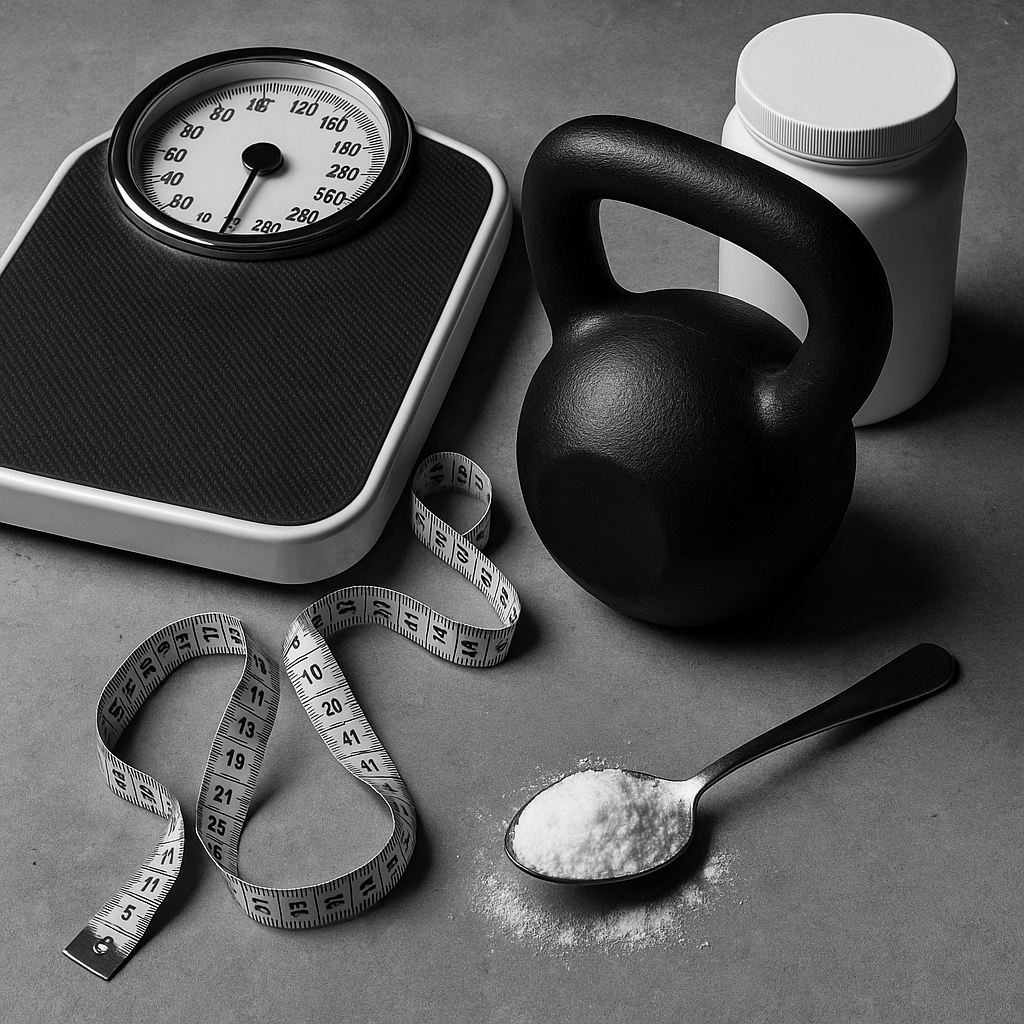
Creatine While Losing Weight: Does It Help or Hurt?
Seeing the scale jump while you’re cutting can be frustrating—especially if you just started creatine. Here’s why that early bump is water, not fat, and how creatine can help preserve lean mass and performance so your fat-loss phase stays on track.
Key Takeaways
- Creatine can add 0.5–1.5 kg of intracellular water early on—expect it and don’t confuse it with fat gain.
- During a calorie deficit, creatine helps you maintain training quality, which supports lean mass and long-term metabolic rate.
- Monohydrate is the gold standard; take 3–5 g/day (ISSN-supported). Loading (20 g/day for 5–7 days) is optional.
- Consistency matters more than timing; pair with a meal and stay well hydrated.
- Track waist, photos, strength, and body comp—not just scale weight—to gauge real fat loss.
- Choose third-party tested creatine with an NPN for the Canadian market.
- Consider keeping creatine in until after your cut; drop it only for short-notice, scale-sensitive weigh-ins.
The scale paradox: why it jumps when you start creatine
If you add creatine right as you enter a fat-loss phase, the scale can nudge up—often 0.5–1.5 kg in the first 1–2 weeks. That’s not fat. Creatine pulls water into the muscle cell as your muscles store more phosphocreatine. It’s intracellular, performance-supporting water, not under-the-skin “bloat.”
This early change can be psychologically tough during a cut, but it’s actually helpful: more water inside muscle can improve training quality and recovery. Over weeks, the scale signal becomes clearer as fat loss accumulates. If you prefer to avoid the early bump, skip loading and let levels rise gradually with 3–5 g/day; saturation typically takes 3–4 weeks with this approach.
During a deficit, your tracking strategy matters. Relying on a single morning weigh-in can be misleading. Instead, use multiple indicators: weekly average weight, waist/hip measurements, progress photos, and gym performance. If those are moving in the right direction, a small short-term scale uptick from creatine is a feature, not a bug.
Want help deciding on loading and daily dosing? Try our creatine calculator, and read our guides on when to take creatine and the loading phase.
What creatine actually does in a calorie deficit
Creatine supports the phosphocreatine energy system, rapidly recycling ATP for short, intense efforts—think your last reps, sprints, and heavy sets. In a calorie deficit, those reps are the first to suffer. By improving high-intensity performance, creatine helps you maintain training volume and power output, the very stimuli that tell your body to keep muscle.
Creatine is not a fat burner. Its value during a cut is indirect: it helps you train better and recover more effectively, which supports lean mass retention. Keeping muscle isn’t just about aesthetics—lean mass is metabolically active tissue. Preserve it, and you better protect resting energy expenditure as body weight drops.
Pair creatine with the fundamentals of an effective cut: a moderate calorie deficit, adequate protein (about 1.6–2.2 g/kg body mass per day), progressive resistance training 2–4+ times per week, and enough sleep. Many Canadians see their best results with simple, consistent routines and a straightforward monohydrate powder. For product picks and comparison testing, see our Best Creatine in Canada and our in-depth creatine supplements review.
Lean mass, metabolic rate, and the case for creatine while cutting
Most people lose a mix of fat and lean tissue in a deficit. The more lean mass you preserve, the better you maintain strength, performance, and resting metabolic rate. Evidence reviewed by major sports nutrition bodies supports creatine (especially combined with resistance training) for increasing or maintaining fat-free mass across ages and training levels.
Practically, this means creatine can help you keep doing hard things when calories are lower: hitting your target reps, sustaining bar speed, and recovering between sets. Over weeks, that can be the difference between holding onto muscle versus watching it fade. Even if the scale doesn’t plummet in week one due to water in the muscle, your body composition is moving in the right direction if waistlines shrink and lifts hold steady or improve.
Special note: people starting with lower muscle creatine stores—such as some vegetarians—and older adults often respond especially well. If you’re an athlete managing weight classes, periodize intelligently: keep creatine during the training block, and only manipulate it if a last-minute weigh-in requires a transient scale drop (see our FAQ below for strategy).
Weight loss expectations: water versus fat (and how to measure progress)
Creatine’s early mass increase is from water held inside the muscle cell. That’s different from subcutaneous water you might associate with “puffiness.” Intramuscular water supports performance and doesn’t hide muscle definition once overall body fat is trending down.
Two practical approaches can reduce scale anxiety:
- Skip loading: Take 3–5 g/day and let muscles saturate over 3–4 weeks. Scale changes tend to be smaller and slower than with loading (20 g/day for 5–7 days).
- Use multiple metrics: Track 7-day average weight, tape measurements (waist, hips, thigh), biweekly photos, and gym performance. If three of four improve, your cut is working.
If you use body comp tools, be aware they have quirks. Home BIA scales are sensitive to hydration and sodium; DEXA is more stable but still influenced by glycogen and water. Try to test under similar conditions (same time, similar carb/sodium intake). Above all, align expectations: fat loss is slower and less linear than social media suggests, and creatine’s water effect is a short chapter at the start—not the whole book.
How to take creatine during a cut: dosing, timing, and hydration
Dose: The ISSN-supported maintenance dose is 3–5 g/day of creatine monohydrate. Loading is optional: 20 g/day split into 4 doses for 5–7 days saturates faster, then continue with 3–5 g/day. If you’re scale-sensitive, skip loading.
Timing: Consistency beats timing. Take it at a convenient time you’ll remember—often with a meal. Some prefer post-workout with carbs and protein, but day-to-day total intake matters most. See our guide on when to take creatine.
Hydration: Creatine shifts water into muscle. Stay well hydrated, especially if you’re active or dieting. Salt and potassium from normal whole foods (e.g., dairy, potatoes, beans, fruits/veg) support fluid balance.
Stacking and safety: Plain monohydrate is sufficient. Avoid pricey blends, “bloat blockers,” or proprietary mixes. For athletes tested in Canada, look for third-party certifications (Informed Sport/NSF). As always, if you have kidney disease or other medical conditions, consult a healthcare professional. For a personalized dose path, try our calculator and read about the loading phase.
Buying creatine in Canada: what to look for
Form: Creatine monohydrate remains the gold standard for effectiveness, safety, and value. Micronized powders mix easily; capsules are convenient when travelling. Other forms haven’t consistently outperformed monohydrate in peer-reviewed research.
Quality: In Canada, look for an NPN (Natural Product Number) on the label to indicate Health Canada authorization. Athletes should choose products that are third-party tested (e.g., Informed Sport or NSF Certified for Sport) to reduce contamination risk.
Labels and cost: A clean ingredient panel (just creatine monohydrate) is ideal. Most Canadians will spend less than a dollar per day at 3–5 g. Avoid unnecessary extras like fillers, flavours, or stimulant add-ons when your goal is a steady, daily routine.
For vetted picks and testing insights, see our Best Creatine guide and full supplement reviews. If you want broader context on dosing, timing, and troubleshooting, explore our practical guides.
Creatine on a Cut: Quick Facts
- 3–5 g/day Standard maintenance dose (monohydrate)
- 20 g/day × 5–7 d Optional loading to saturate faster
- +0.5–1.5 kg Typical early water weight (not fat)
- 3–4 weeks Time to saturate without loading
Frequently Asked Questions
Will creatine make me gain fat while I’m dieting?
No. Creatine may raise scale weight early due to water stored inside muscle, not because of increased fat mass. Over time, if your calorie deficit and protein intake are on point, you’ll lose fat while creatine helps maintain training performance and lean mass.
Should I stop creatine to see the scale drop before a weigh-in?
If a short-notice, scale-only check matters (e.g., a weight-class sport), pausing creatine for 7–14 days can reduce intramuscular water slightly. You’ll likely see a modest, temporary scale decrease, but training quality may dip. For most people, it’s better to keep creatine in during the cut and judge progress by body composition, not a single weigh-in.
What’s the best time to take creatine during a cut?
Consistency matters more than timing. Take 3–5 g daily at a time you’ll remember, often with a meal. Some prefer post-workout alongside carbs and protein, which is convenient but not essential. The key is not missing days, especially during a deficit when training is more demanding.
Is creatine safe for my kidneys while I’m cutting?
In healthy individuals, creatine monohydrate at recommended doses is well supported by safety data. If you have kidney disease, are taking nephrotoxic medications, or have other health conditions, speak with your healthcare provider before starting. Stay hydrated—particularly important during energy restriction and higher training loads.
Do women cutting weight benefit from creatine?
Yes. Women respond to creatine with similar improvements in high‑intensity performance and lean mass support. The same dosing (3–5 g/day) applies. Expect the same early, modest water-weight effect inside muscle; it doesn’t equate to increased body fat or permanent “bloat.”