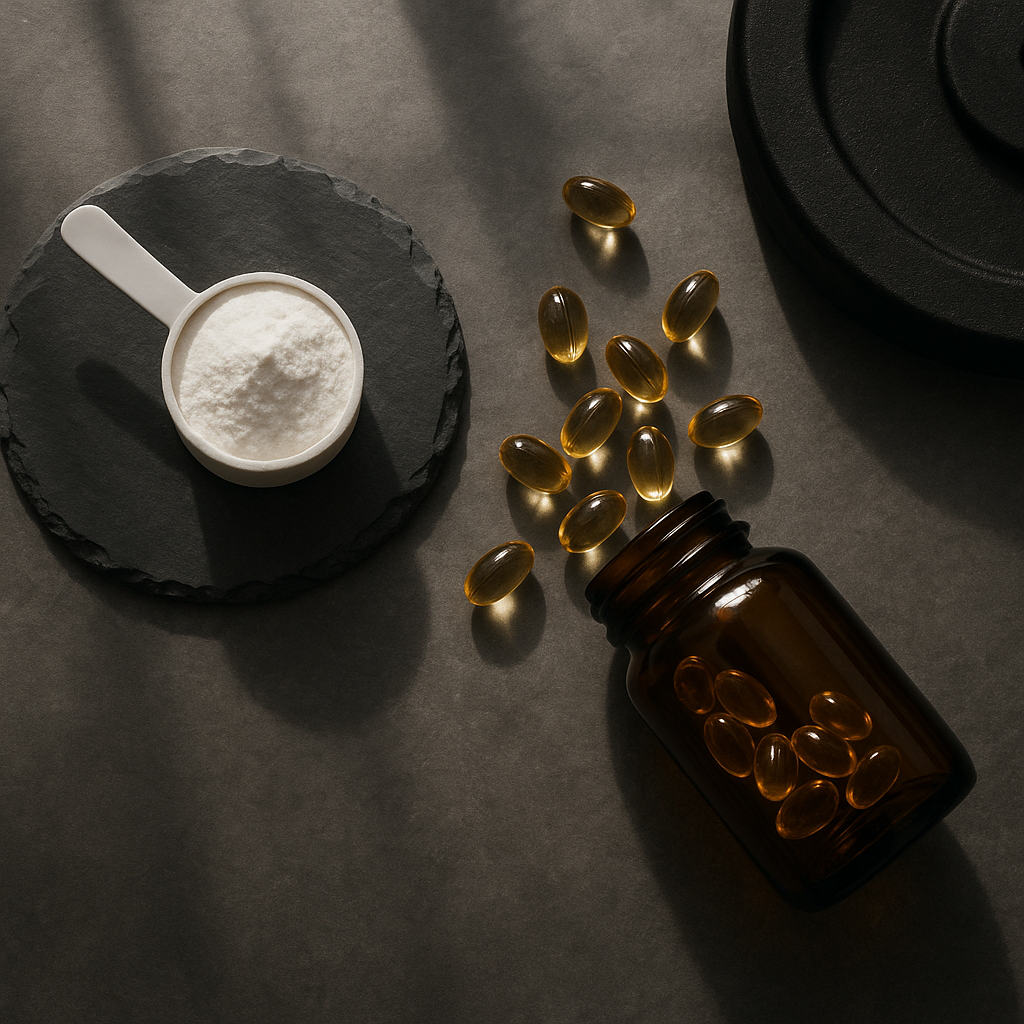
Creatine and Vitamin D: A Canadian Athlete's Power Stack
From dark winters to lower red‑meat and fish intake, Canadian athletes commonly under-consume creatine and run low on vitamin D. Here’s how stacking them can support muscle function, bone integrity, and year‑round performance—plus exactly how to dose both safely.
Key Takeaways
- Creatine monohydrate (3–5 g/day) and vitamin D support complementary aspects of muscle function and bone health.
- Canadians face long winters and limited UVB, making vitamin D insufficiency common—ask your doctor about a 25(OH)D test.
- Vegetarian and vegan athletes may benefit most from creatine because dietary creatine comes mainly from meat and fish.
- Take vitamin D with a meal containing fat; creatine timing is flexible—daily consistency matters most.
- Loading creatine (20 g/day for 5–7 days) is optional; you can also saturate with 3–5 g/day over 3–4 weeks.
- Choose Canadian products with an NPN, and look for third‑party testing (NSF/Informed Choice) to reduce contamination risk.
Why Canadians often fall short on creatine and vitamin D
Canada’s latitude, long winters, and modern eating patterns create a perfect storm for two common shortfalls: vitamin D and dietary creatine. UVB light—the kind your skin needs to make vitamin D—is weak for much of the year in most provinces. Even outdoor athletes can struggle to maintain healthy blood levels from October through early spring. Meanwhile, creatine isn’t a vitamin you synthesize in meaningful performance‑supporting amounts; it’s found primarily in red meat and fish. Athletes who limit animal products, eat smaller portions, or are cutting calories often get very little from food.
Why does this matter? Vitamin D supports calcium balance, muscle function, and bone mineralization. Creatine fuels high‑intensity efforts by replenishing ATP via the phosphocreatine system—critical for sprints, repeated shifts, heavy lifts, and late‑game power. If one is low, your training quality, recovery, or robustness may suffer; if both are low, the ceiling for progress can drop further.
The good news: both are simple to measure or manage. Ask your family doctor about a 25(OH)D blood test if you suspect low vitamin D. For creatine, you don’t need a lab test—consistent supplementation with creatine monohydrate reliably raises intramuscular stores. If you’re brand new to creatine, our quick creatine dose calculator and primer on when to take creatine can help you start smart.
How creatine and vitamin D complement muscle and bone
Creatine supports short‑burst, high‑power output by increasing intramuscular phosphocreatine, which donates phosphate to regenerate ATP. More phosphocreatine can mean better rep quality, a few extra seconds of sprint speed, or stronger final sets—small advantages that compound into greater training volume and adaptation over weeks.
Vitamin D acts through vitamin D receptors in muscle and supports calcium handling involved in contraction and relaxation. It also underpins bone remodeling by aiding calcium and phosphate balance, which is vital for athletes absorbing high impact (jumps, cuts, checks) and heavy axial loading.
Why consider them together? They target different but complementary bottlenecks. Creatine helps you do more quality work; vitamin D helps your neuromuscular system and skeleton respond to that work. Over time, improved training density from creatine can increase mechanical loading on bone, while adequate vitamin D status supports the bone’s ability to remodel and stay resilient. The result isn’t a magic synergy, but a practical one: when both boxes are ticked, the path to stronger muscle and sturdier bone is clearer.
For a grounded look at forms and timing, see our guides to creatine supplements and when to take creatine. For deeper reading across topics, browse our how‑to guides.
Dosing guide: taking creatine and vitamin D together
Creatine monohydrate remains the gold standard—safe, affordable, and well‑studied. Two dosing options work:
- Daily steady state: 3–5 g once per day. Stores saturate in ~3–4 weeks without a loading phase.
- Optional loading: ~20 g/day split into 4 doses for 5–7 days, then 3–5 g/day to maintain. Learn more in our loading guide.
Timing is flexible for creatine. Take it whenever you reliably remember—morning, post‑workout, or with a main meal. Hydrate normally throughout the day. If you want a nudge, our creatine calculator can personalize a plan by body mass.
Vitamin D works best with food containing fat. For most healthy adults 19–70 years, Health Canada’s recommended dietary allowance is 600 IU (15 mcg) per day, with an upper limit of 4,000 IU (100 mcg) unless advised by a healthcare professional. Many Canadian athletes use 1,000–2,000 IU daily during low‑sun months, then adjust with their clinician based on bloodwork.
Can you take them together? Yes. Combine your daily creatine (3–5 g) with vitamin D at a meal—no known negative interaction. Consistency matters more than clock time.
Tip: If you experience mild stomach upset during creatine loading, split doses further (e.g., 5 x 4 g) and pair with meals.
What the evidence says on performance, recovery, and bone
Creatine: The International Society of Sports Nutrition (ISSN) concludes that creatine monohydrate is effective for increasing high‑intensity exercise capacity, lean mass, and training quality when combined with resistance training. Benefits apply to power, sprint, and team sports, and may extend to injury resilience by enabling better strength development. Long‑term safety in healthy individuals is well‑supported when using recommended doses.
Vitamin D: Adequate status supports muscle function and helps maintain bone mineral density through calcium and phosphate balance. Evidence for direct performance enhancement is strongest in individuals who are deficient; normalizing low levels may improve muscle function and reduce risks associated with low bone integrity. In northern climates, winter insufficiency is common, which is why Canadian agencies emphasize dietary and supplemental sources during low‑sun seasons.
Together: There’s no requirement to co‑supplement for an additive effect, but the duo is complementary. Creatine helps you do more high‑quality work; vitamin D helps your muscles and bones adapt to that work. For bone health specifically, resistance training is the primary driver, with vitamin D supporting mineralization and creatine improving the training you can tolerate. The takeaway: cover both basics to protect performance potential and skeletal robustness year‑round.
For product picks that meet evidence‑based criteria, see our best creatine roundup.
Safety, testing, and buying in Canada
Creatine monohydrate at 3–5 g/day is well‑tolerated in healthy adults. If you have kidney disease, are taking nephrotoxic medications, or have a complex medical history, speak with your clinician first. Minor weight gain (often 1–2 kg) can occur from increased intramuscular water and lean mass—generally a performance positive. Stay normally hydrated.
Vitamin D is safe within Health Canada’s limits (600 IU/day for most adults; upper limit 4,000 IU/day unless medically indicated). Because individual needs vary with sun exposure, skin tone, and body composition, the most reliable approach is a periodic 25(OH)D blood test ordered by your doctor. Vitamin D can interact with certain medications (e.g., thiazide diuretics, some heart medications), so check with your pharmacist or physician.
Shopping in Canada:
- Look for a Natural Product Number (NPN) and verify in Health Canada’s Licensed Natural Health Products Database.
- Prefer third‑party certification for sport (e.g., NSF Certified for Sport, Informed Choice) to reduce contamination risk.
- Choose creatine monohydrate in plain powder—no fillers or proprietary blends.
- For vitamin D, D3 (cholecalciferol) is commonly used; softgels or drops taken with meals aid absorption.
Creatine is permitted by major anti‑doping bodies, but supplements can be contaminated—another reason to seek third‑party tested products.
A practical plan for the Canadian training year
Daily baseline (year‑round):
- Creatine monohydrate: 3–5 g once daily. Timing flexible; anchor to a meal you never miss.
- Vitamin D: 1,000–2,000 IU with your largest meal during low‑sun months; align final dose with your doctor based on bloodwork and Health Canada guidance.
Winterization (late fall to spring): Reduce reliance on sun. Keep vitamin D consistent, and consider a creatine loading phase if you’re starting a new strength block (see loading guide).
In‑season travel: Pack a small scoop and baggie for creatine; vitamin D softgels or drops are carry‑on friendly. Consistency beats perfection—missing a day won’t erase progress.
Vegetarian/plant‑forward athletes: Creatine is particularly helpful given low dietary intake. Plain monohydrate powder is vegan‑friendly. For product vetting and value picks, explore our supplement reviews.
Strength + bone focus: Pair creatine with progressive resistance training and impact work you can recover from (jumps, loaded carries). Adequate vitamin D, dietary protein, and calcium form the recovery foundation. For more seasonal playbooks, browse our performance guides and curated best creatine options.
Your Creatine + Vitamin D Quick Stack
- 3–5 g/day Creatine monohydrate maintenance
- 600 IU (15 mcg) Health Canada RDA for adults 19–70
- 4,000 IU/day Do not exceed without medical guidance (UL)
- With a meal Take vitamin D alongside dietary fat
Frequently Asked Questions
Can I take creatine and vitamin D at the same time?
Yes. There’s no known negative interaction. Take your 3–5 g creatine whenever you’ll remember, and take vitamin D with a meal that contains fat to support absorption. Consistency matters more than exact timing.
Do I need to load creatine to see results?
No. Loading (about 20 g/day for 5–7 days) saturates muscles faster, but a steady 3–5 g/day also reaches saturation in ~3–4 weeks. Choose the approach that best fits your schedule and stomach.
How do I know if I’m low in vitamin D?
Ask your family doctor for a 25‑hydroxyvitamin D [25(OH)D] blood test. In Canada, levels commonly dip in winter due to low UVB exposure. Your clinician can interpret results and recommend an appropriate dose.
I’m vegetarian—will creatine help me more?
Likely, yes. Because creatine is found mainly in meat and fish, vegetarians and vegans tend to have lower muscle creatine stores. Supplementing with creatine monohydrate (3–5 g/day) can close that gap and support training.
Will creatine cause dehydration or kidney damage?
In healthy individuals using recommended doses, creatine is not shown to cause dehydration or kidney damage. Maintain normal hydration. If you have kidney disease or take nephrotoxic medications, consult your clinician before use.