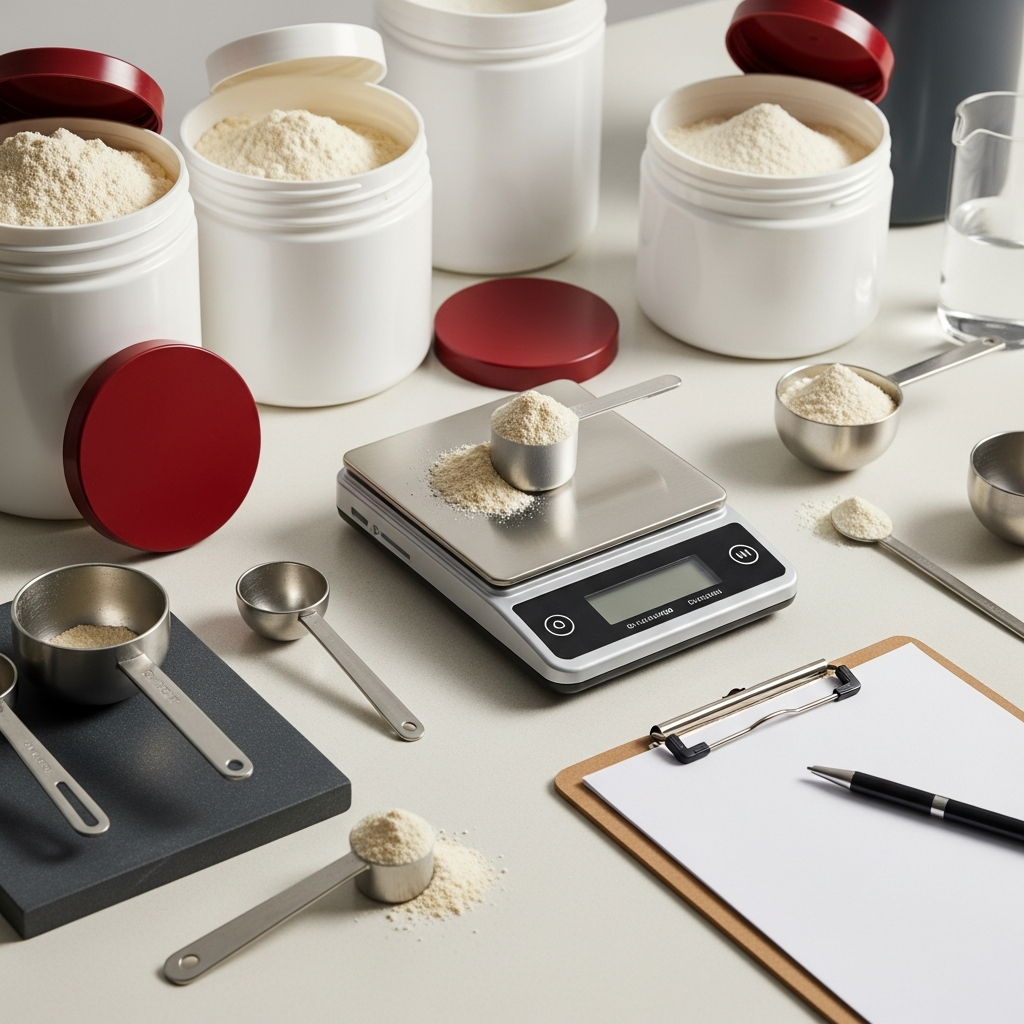
How We Test and Rank Creatine at Creatine Canada
Every supplement site says its rankings are 'unbiased'. Few show their work. This is exactly how we evaluate creatine products — the criteria we score, the red flags that sink a product, and the things we deliberately ignore.
Key Takeaways
- We score five things: ingredient quality and form, third-party testing, cost per effective serving, label honesty, and real-world usability.
- Third-party certification (NSF Certified for Sport, Informed Choice/Sport) is the strongest single quality signal a creatine product can carry.
- Cost per 5 g serving — not tub price — is how we compare value across sizes and formats.
- Proprietary blends that hide the creatine dose are an automatic disqualification from our top rankings.
- We don't rank on flavour marketing, brand fame, or affiliate payout — and we update rankings when products change.
Why we show our work
Creatine is a strange category to review: the active ingredient is nearly identical across hundreds of products. That's exactly why methodology matters. When the molecule is the same, the differences that remain — purity verification, honest labelling, sensible dosing formats, fair pricing — are subtle, and it's easy for a ranking to quietly become a list of whoever pays the most.
So this post is our methodology, in public. It's the same framework behind our flagship creatine review and every buying guide on this site. If we ever rank a product highly, you should be able to trace it back to the criteria below.
The five things we score
Every product we evaluate gets assessed on the same five dimensions:
- 1. Ingredient quality and form. Is it creatine monohydrate (the form with the overwhelming evidence base), and is the source disclosed? Purity-branded material like Creapure earns credit; unproven exotic forms don't get a premium just for being novel.
- 2. Third-party testing. Independent certification — NSF Certified for Sport, Informed Choice, Informed Sport — is the strongest quality signal in the industry, because it verifies both content and contaminant screening on an ongoing basis. Products with no verification at all cap out at a lower score.
- 3. Cost per effective serving. We normalize every product to the price of a 5 g dose of actual creatine. This is where gummies and some capsule products reveal their true cost — sometimes 5-10× the price of powder for the same dose.
- 4. Label honesty. Full dose disclosure, a real NPN, accurate serving counts, and no proprietary blends. A label that hides how much creatine you're getting is an automatic disqualification from top rankings.
- 5. Real-world usability. Mixability, taste (for flavoured products), scoop accuracy, dose-per-unit practicality for capsules and gummies, and packaging that keeps powder dry.
Red flags that sink a product
Some issues aren't just point deductions — they take a product out of consideration entirely:
- Proprietary blends that conceal the creatine dose behind a blend total.
- Meaningless fairy-dusting — 'creatine matrices' with six forms in undisclosed micro-doses.
- Missing or invalid NPN for products sold in Canada.
- Implied health claims that go far beyond the evidence (creatine is excellent; it is not a fat-burner or a testosterone booster).
- A pattern of failed or missing identity testing reported by independent labs.
If you want to run these checks yourself in a store aisle, our label-reading field guide walks through them line by line.
What we deliberately ignore
Just as important as what we score is what we don't:
- Brand fame and marketing spend. A famous logo doesn't change what's in the tub.
- Influencer endorsements. Paid enthusiasm is not evidence.
- Affiliate payout. Some products we rank highly pay us nothing; some products that would pay well rank poorly or not at all. Rankings and revenue are kept separate — that separation is described in our editorial standards.
- Exotic-form hype. Until a form beats monohydrate in head-to-head trials, 'newer' doesn't mean 'better' — it usually just means 'more expensive'.
How rankings stay current
Products change: formulas get reworked, prices move, certifications lapse, tubs shrink. We re-check pricing and availability on a rolling basis, and we re-score a product whenever its formulation or certification status changes. When a ranking changes materially, the affected pages are updated rather than left to age quietly.
We also read our own inbox. If a reader flags a clumping problem, a label change, or a failed test report we missed, that goes into the next review cycle. Corrections and updates follow the process in our editorial standards — publicly, not silently.
Our scoring at a glance
- 5 Criteria every product is scored on
- 5 g The standardized dose we price every product against
- 0 Products ranked because of affiliate payout
Frequently Asked Questions
Do you physically test creatine products in a lab?
We don't run our own chemistry lab. We rely on independent third-party certification programs (NSF, Informed Choice/Sport) and published lab analyses for purity verification, combined with hands-on evaluation of mixability, labelling, dosing accuracy, and value.
Does affiliate revenue affect your rankings?
No. Rankings are scored on the five criteria described here before any consideration of links or revenue. Some top-ranked products earn us nothing, and high-payout products that score poorly are ranked poorly. Our editorial standards page describes this separation.
Why do you favour creatine monohydrate in rankings?
Because the evidence does. Monohydrate has hundreds of trials behind it and no alternative form has consistently outperformed it. Alternative forms are evaluated fairly, but they don't earn a premium for novelty alone.
How often are your rankings updated?
Prices and availability are re-checked on a rolling basis, and products are re-scored whenever their formulation, size, or certification status changes. Material ranking changes are published as updates on the affected pages.